Best AEO Tools in 2026: 7 AI Visibility Trackers Compared on Price, Prompts and Engines
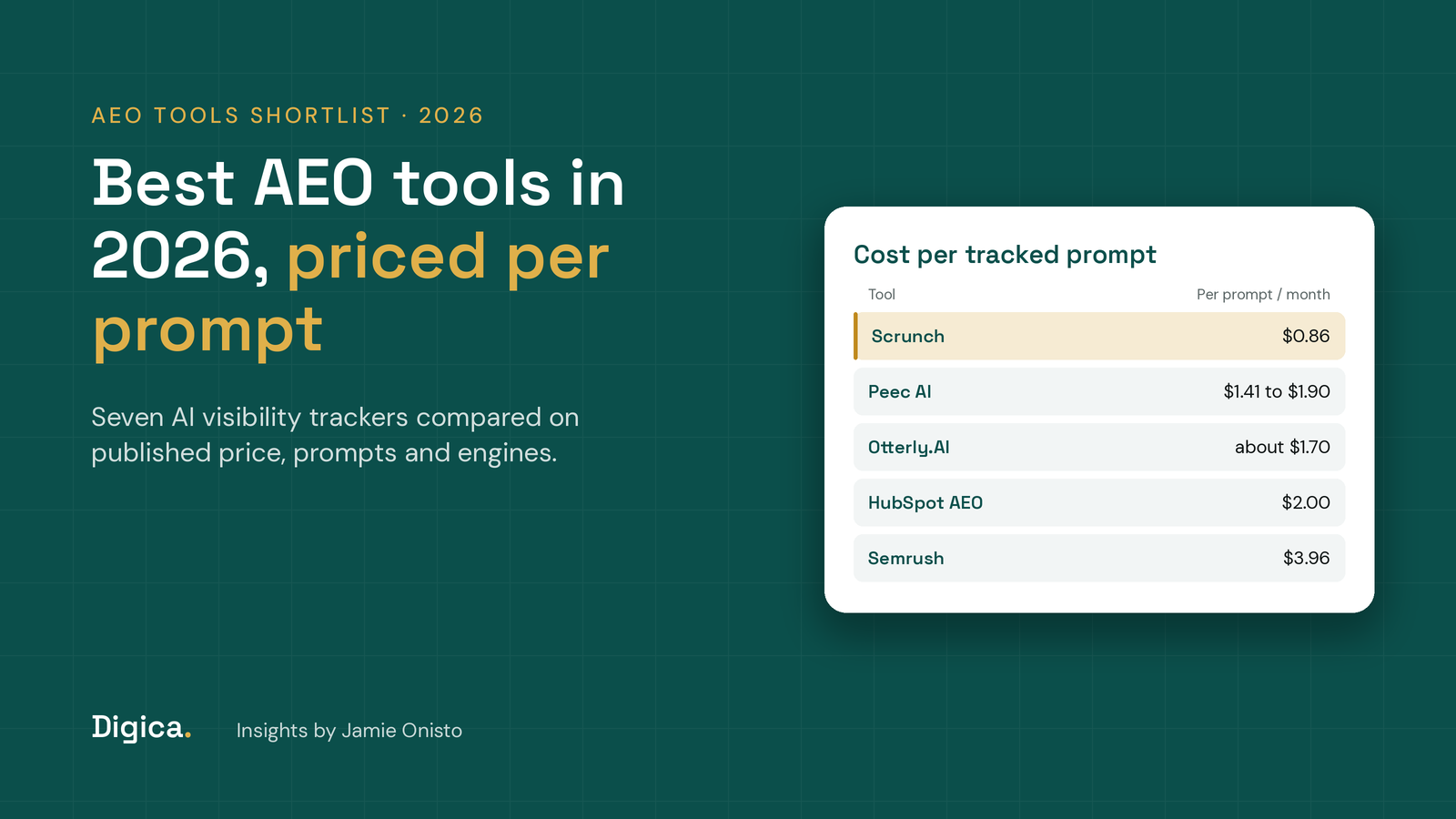
Most marketplace teams buy an AEO tool, type in their brand name and 20 obvious questions, and get a dashboard that says they are visible in 70% of AI answers. It feels like progress. It is usually a measurement of the wrong prompts. Published prices for answer engine optimization (AEO) tools now run from $50 a month to custom enterprise contracts, and the cheapest way to waste that money is to track questions nobody in your category asks.
The tools themselves are good and getting better. The difference between them, for a B2B marketplace, comes down to three numbers: how many prompts you can track for the price, which AI engines they cover, and whether the data helps you decide what to fix. Brand features and dashboards matter far less than the sales pages suggest.
We compared seven AEO tools on their own pricing pages in November 2026 and ranked them for one use case: a B2B marketplace tracking category questions on both the buyer and supplier side. This piece pairs with our guide to getting category and listing pages cited by AI engines, because a tracker only tells you where you stand.
Quick Navigation
- What an AEO tool does and does not do
- How we picked
- The best AEO tools at a glance
- The 7 best AEO tools, reviewed
- How many prompts a B2B marketplace needs to track
- A worked example: pricing 320 prompts across three tools
- Three failure scenarios
- Where to start: a decision framework
- What tracking is worth on the same traffic
- FAQ
- Related Articles
What an AEO tool does and does not do
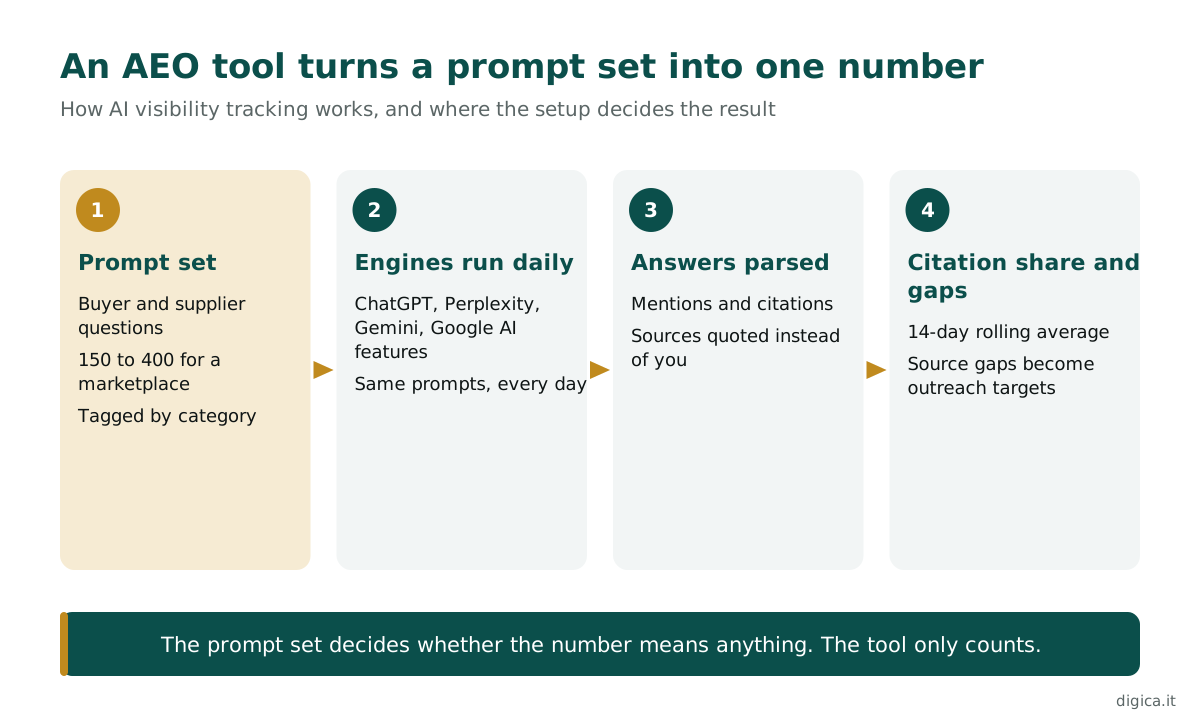
An AEO tool runs a fixed set of prompts through AI engines such as ChatGPT, Perplexity, Gemini and Google AI Overviews on a schedule, then reports how often your brand is mentioned or cited and which sources the engines quote instead. That is the whole job: measurement.
What it does not do is change the answers. Google is explicit that appearing as a supporting link in its AI features requires only that a page be indexed and eligible to show with a snippet, with no additional technical requirements or special markup. In other words, the levers are the same crawlable, fact-rich pages that drive search. The tool shows you where those levers are failing.
For a B2B marketplace, the useful outputs are:
- Citation share by category. Out of the prompts for "industrial pump suppliers", how many answers cite you, a competitor, or a third-party list?
- Source gaps. Which domains engines quote for your category that do not mention you. These are your outreach targets.
- Engine differences. A marketplace can be strong in Perplexity and absent in Google AI Overviews. That points to different fixes.
- Trend over time. Answers vary from run to run, so a single day means little. A 14-day rolling average is the number to watch.
Treat vendor features such as "AI content writers" and "optimization agents" as extras. They can help a small team, but they do not replace someone who owns the category pages and the outreach.
How we picked
We ranked the seven tools for a B2B marketplace tracking 100 to 400 category prompts on both sides of the market. Every price comes from the vendor's own pricing page or product page, checked in November 2026. Where a price is not published, we say so rather than estimate it.
Four criteria, in order of weight:
- Prompts per dollar. Marketplaces have many categories and two audiences, so prompt volume is the binding constraint.
- Engine coverage. ChatGPT, Perplexity and Google's AI features at a minimum, because that is where most B2B research questions land today.
- Published, predictable pricing. You should be able to budget the tool without a sales call.
- Fit with an existing stack. If you already pay for an SEO suite, an add-on can be the cheapest start.
We did not score dashboard design, AI writing features or integrations we could not test against a published spec. Vendors change plans often: Profound removed its self-serve brand plans in 2026, and several tools changed prompt limits during the year. Check the vendor page before you buy.
The best AEO tools at a glance
Seven AEO tools compared by published entry price, prompts, cost per prompt, main risk and best fit (vendor pages, November 2026).
| Rank | Tool | Model | Published entry cost | Prompts at entry | Cost per prompt | Main risk | Best for |
|---|---|---|---|---|---|---|---|
| 1 | Scrunch | Standalone tracker | $300 a month ($250 billed annually) | 350 | $0.86 | Starter is a big first commitment | Marketplaces with many categories |
| 2 | Peec AI | Standalone tracker | $95 a month | 50 | $1.90 | Three active engines per plan | Growing prompt sets, unlimited seats |
| 3 | Ahrefs Brand Radar | SEO suite add-on | Custom Prompts from $50 a month | Priced on checks | Not comparable | Pricing tied to the Ahrefs stack | Teams already on Ahrefs |
| 4 | Semrush AI Visibility Toolkit | SEO suite add-on | $99 a month per domain | 25 | $3.96 | Most expensive per prompt | Teams already on Semrush |
| 5 | Otterly.AI | Standalone tracker | €29 a month | 16 | €1.81 | Low prompt cap on entry plan | Testing AEO before committing |
| 6 | HubSpot AEO | Standalone or in Marketing Hub | $50 a month ($45 billed annually) | 25 | $2.00 | Three engines, small prompt set | HubSpot users, first 25 prompts |
| 7 | Profound | Enterprise platform | Not published for brands | Custom | Not published | No self-serve brand plan | Enterprise teams, nine engines |
The ranking is for marketplaces. A single-product SaaS tracking 30 prompts would rank these tools very differently, with HubSpot AEO and Otterly.AI near the top.
The 7 best AEO tools, reviewed
1. Scrunch
Scrunch publishes two self-serve plans: Starter at $300 a month month-to-month ($250 billed annually) with 350 custom prompts, and Growth at $500 a month ($417 annually) with 700. Both cover ChatGPT, Claude, Gemini, Perplexity, Google AI Mode and AI Overviews, and Meta. At about $0.86 per prompt on Starter, it is the cheapest published route to a marketplace-sized prompt set.
Best for: marketplaces with 30 or more categories that need buyer and supplier prompts tracked together.
Watch: $300 a month is a large first step if you have not yet proven you will act on the data.
2. Peec AI
Peec AI lists Starter at $95 a month (50 prompts), Pro at $245 (150) and Advanced at $495 (350), all with unlimited seats and three active engines chosen from eight, including ChatGPT, Perplexity, AI Overviews, AI Mode and Gemini. Enterprise adds more models on annual billing. The per-prompt cost falls from $1.90 to $1.41 as you move up.
Best for: teams that want to start small and scale prompts without changing tools.
Watch: the three-engine limit per plan; pick the engines your buyers actually use.
3. Ahrefs Brand Radar
Brand Radar sits inside Ahrefs. Custom Prompts start at $50 a month and the AI Visibility Index starts at $199 a month, according to Ahrefs' Brand Radar page, covering AI Overviews, AI Mode, ChatGPT, Perplexity, Gemini and Copilot. Ahrefs prices Custom Prompts on checks rather than prompts, so a straight per-prompt comparison does not hold.
Best for: teams already using Ahrefs for SEO who want AI visibility next to keyword and backlink data.
Watch: confirm what your existing Ahrefs plan includes before adding the index.
4. Semrush AI Visibility Toolkit
Semrush sells its AI Visibility Toolkit at $99 a month per domain with 25 tracked prompts, and extra prompts in blocks of 50. Its Semrush One bundles combine SEO and AI visibility from $199 a month. At $3.96 per prompt on the base plan, it is the most expensive option in this list per tracked question.
Best for: Semrush customers who want one login and one invoice.
Watch: a second domain costs another $99, and 25 prompts covers only a handful of categories.
Not sure which prompts to track?
Our growth audit maps the buyer and supplier questions in your categories before you pay for a tracker.
5. Otterly.AI
Otterly.AI publishes Lite at €29 a month (16 prompts), Standard at €189 (120 prompts) and Premium at €489 (403 prompts), with daily tracking and a credit system across engines. Its own page shows slightly different figures in its metadata, so confirm the plan limits at checkout.
Best for: a low-cost trial of AEO tracking before committing a budget.
Watch: 16 prompts will not cover a marketplace; plan on Standard or above.
6. HubSpot AEO
HubSpot sells its AEO tool standalone at $50 a month ($45 billed annually) with no HubSpot subscription required, tracking 25 prompts across ChatGPT, Perplexity and Gemini, with a free 28-day trial. It is also included in Marketing Hub Professional and Enterprise.
Best for: HubSpot teams who want AI visibility next to their CRM data, or anyone testing their first 25 prompts.
Watch: no Google AI Overviews in the standalone engine list, and a small prompt set.
7. Profound
Profound is the enterprise end of the market. Since September 2026 its pricing page shows a free trial and a quoted Enterprise plan for brands, with up to nine engines. Agencies can add client workspaces at $399 a month each. Brand pricing is not published.
Best for: large marketplaces with a dedicated AI search team and security review requirements.
Watch: budget for a sales cycle, and compare the quote with Scrunch Growth on prompts per dollar.
How many prompts a B2B marketplace needs to track
A B2B marketplace usually needs 150 to 400 prompts to get a reliable picture: enough to cover each priority category on both the buyer and supplier side, across the three or four question types buyers actually ask. Fewer than 100 prompts usually means tracking a sample too small to act on.
Build the prompt set from your own taxonomy, not from the tool's suggestions:
- Categories. Start with the 20 to 50 categories that drive most of your requests.
- Two sides. For each category, add buyer questions ("best X suppliers in Y") and supplier questions ("where to find buyers for X").
- Question types. Cover "best", "cost", "how to choose" and "alternatives" phrasings. Buyers ask all four, and engines cite different sources for each.
- Geography. If you operate in more than one country, prompts change by market, and so do the cited sources.
Answers vary by run, by engine and by user, so the tool's daily number will move even when nothing changed. Research on generative engines treats visibility as something measured across many responses; the GEO paper from Princeton and other institutions defined its visibility metrics over sets of queries and reported improvements of up to 40% from content changes. The practical lesson: judge trends over two to four weeks across the whole prompt set, never single answers.
Want help building your prompt set?
We will draft your first 100 buyer and supplier prompts with you in a 30-minute call.
Segment the prompts the way you run the business. If your growth plan is organized by category, tag prompts by category so the tool reports citation share where you can act on it. Ask about tagging and exports during the trial; it is the feature that decides whether the data reaches a planning meeting. A tool that cannot split buyer prompts from supplier prompts will blend two very different stories into one average, and the supplier side is usually the one that hides a problem.
A worked example: pricing 320 prompts across three tools
Take a B2B services marketplace with 40 priority categories. For each category it tracks two buyer questions and two supplier questions: 40 × 4 = 160 prompts. It operates in the US and the UK, so the set doubles: 320 prompts.
Published monthly cost to track 320 prompts (November 2026 list prices):
- Scrunch Starter: 350 prompts for $300. Cost: $300 a month, or $3,600 a year.
- Peec AI Advanced: 350 prompts for $495. Cost: $495 a month, or $5,940 a year.
- Semrush AI Visibility Toolkit: 25 prompts for $99, plus 50-prompt blocks. To reach 320 prompts you need 6 extra blocks (25 + 300 = 325). At the $60 per block reported by Semrush's add-on terms, that is $99 + (6 × $60) = $459 a month, or $5,508 a year.
The spread is $3,600 to $5,940 a year for the same prompt set. That is not a reason to pick the cheapest tool by default. If the team already lives in Semrush and will act on the data there, $459 a month can be the better buy. If nobody owns the prompt set, every option is expensive.
Engine coverage changes the comparison too. Scrunch Starter covers ChatGPT, Claude, Gemini, Perplexity, Google AI Mode and AI Overviews, and Meta on every plan. Peec AI lets you run three engines at a time from a list of eight, so a marketplace that needs four engines either picks its three most important or moves to Enterprise. Semrush's toolkit reports on ChatGPT, Google's AI features, Gemini and Perplexity. If your buyers research mostly in ChatGPT and Google, all three cover the core. If your category skews toward Perplexity or Claude, check the engine list before the price.
One more cost sits outside the invoice: the hours to review the data. Budget two to four hours a week for someone to read the trend, pick the next template change and log the result. At a loaded cost of $75 an hour, that is $600 to $1,200 a month, more than any tool on this list. Software is the cheap part of AI visibility tracking.
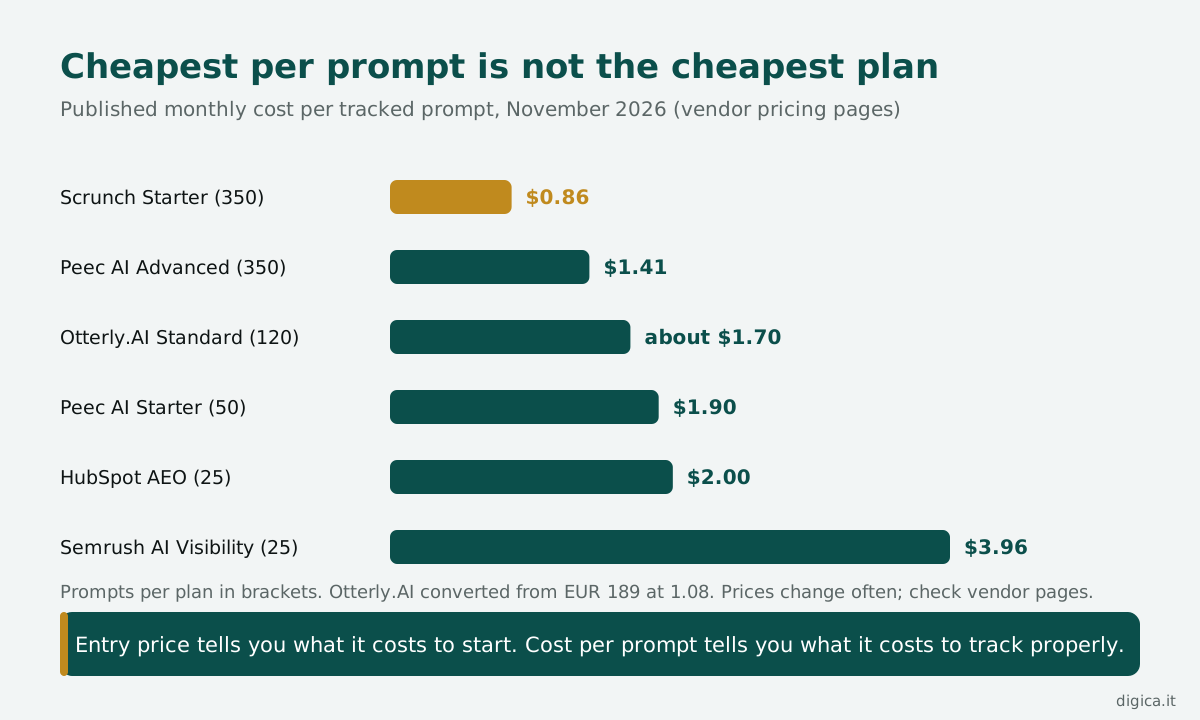
The chart above is the comparison most buying guides skip. Entry price tells you what it costs to start. Cost per prompt tells you what it costs to track a marketplace properly, and on that measure the order of the market almost reverses.
Three failure scenarios
These are patterns we see when marketplaces set up AEO tracking on their own. The figures are representative, not a specific account.
Scenario 1: the brand-name dashboard. A marketplace tracks 25 prompts, most containing its own name. Visibility reads 72%. The board deck celebrates it. Meanwhile, on the 200 category questions buyers actually ask, the marketplace appears in under 10% of answers, and nobody knows, because those prompts were never tracked.
The right call: keep brand prompts under 10% of the set and report category citation share as the headline number.
Scenario 2: decisions on noise. A team tracks 40 prompts on one engine and changes its category pages every time the daily number drops. Six weeks and $1,200 of tool spend later, it has rewritten pages four times and learned nothing, because daily variation on 40 prompts is larger than any real change.
The right call: track at least 150 prompts, judge 14-day averages, and change one template at a time.
Scenario 3: tracking a site engines cannot read. A marketplace pays $495 a month to track Perplexity visibility while its bot protection blocks Perplexity's crawler. Visibility stays near zero for a quarter. Perplexity's documentation recommends allowing PerplexityBot so your site appears in its search results, and a five-minute robots.txt check would have caught it.
The right call: confirm crawler access for every engine you track before the first invoice.
Every one of these failures is cheap to avoid and expensive to discover late. The tool was never the problem; the setup was.
Where to start: a decision framework
Pick the tool by the size of the prompt set you can act on, then by the stack you already pay for. These thresholds are starting points from our own setups, not vendor guidance.
- If you will track fewer than 50 prompts, start with HubSpot AEO ($50 a month, 25 prompts) or Peec AI Starter ($95, 50 prompts). Treat it as a 60-day test of whether the team acts on the data.
- If you will track 50 to 150 prompts, use Peec AI Pro ($245, 150 prompts) or Otterly.AI Standard (€189, 120 prompts).
- If you will track 150 to 400 prompts, compare Scrunch Starter ($300, 350 prompts) with Peec AI Advanced ($495, 350 prompts). For most marketplaces, this is the right band.
- If you need more than 400 prompts or more than five engines, price Scrunch Growth ($500, 700 prompts) against a Profound Enterprise quote.
- If you already pay for Ahrefs or Semrush, test their AI visibility add-on for 30 days first. One less login is worth a higher per-prompt cost if it means the data gets used.
- If nobody owns acting on the data, do not buy a tool yet. Fix ownership first.
Rule six is the one most teams skip. A tracker with no owner is a subscription, not a strategy.
See where your marketplace is cited today
We benchmark citation share on your top categories before you commit to a tool or a retainer.
The decision also changes with stage. Early marketplaces are better served by a small, sharp prompt set they review weekly, because the goal is to learn which category pages engines will quote at all. Larger ones need a tool that supports tagging and exports, so citation share can sit next to traffic and requests in the same report and the growth team can see which categories deserve the next template change. Whatever the stage, revisit the prompt set every quarter: categories grow, buyer language shifts, and a set that was right in January will be stale by summer.
What tracking is worth on the same traffic
Tracking is worth what it helps you win. At $300 to $500 a month, a 320-prompt setup costs $3,600 to $6,000 a year. On a marketplace where an AI-referred session is worth about $7.20 (4% request rate, 50% match rate, $360 net revenue per transaction), winning enough prompts to add 200 AI-referred sessions a month is worth $1,440 a month, or $17,280 a year.
On those numbers the tool pays back in roughly three to four months ($3,600 to $6,000 a year against $1,440 a month of added net revenue), provided someone acts on what it shows. The cost of doing nothing is quieter: competitors keep the citations for your category questions, and buyers build their shortlist before they reach you.
The number to take into your next planning meeting: tracking a marketplace-sized prompt set costs about $1 to $2 per prompt a month, and one won category prompt that adds a few hundred sessions a month pays for the whole tool.
FAQ
What are the best AEO tools in 2026? For a B2B marketplace tracking hundreds of category prompts, Scrunch and Peec AI offer the best published prompts per dollar. Ahrefs Brand Radar and the Semrush AI Visibility Toolkit suit teams already on those suites. HubSpot AEO and Otterly.AI are low-cost starting points, and Profound fits enterprise teams willing to go through a sales process.
How much do AI visibility tools cost? Published entry prices range from $50 a month (HubSpot AEO) to $300 a month (Scrunch Starter), with enterprise plans quoted. Per tracked prompt, published plans run from about $0.86 to $3.96 a month. Prices were checked on vendor pages in November 2026 and change often.
What is the difference between an AEO tool and an SEO tool? An SEO tool tracks rankings and clicks in classic search results. An AEO tool tracks whether your brand is mentioned or cited inside AI-generated answers from engines such as ChatGPT, Perplexity, Gemini and Google AI Overviews. Several SEO suites now sell AEO tracking as an add-on.
How many prompts should I track for AI visibility? A B2B marketplace usually needs 150 to 400 prompts: priority categories, both buyer and supplier questions, and the main question types such as best, cost and alternatives. Under 100 prompts, daily variation tends to swamp real change.
Can an AEO tool improve my AI visibility on its own? No. The tool measures citations; it does not earn them. Visibility improves when category pages carry clear, quotable facts, AI crawlers can reach them, and trusted third-party sites mention you.
Is there a free AEO tool? Several vendors offer free trials, including HubSpot AEO (28 days) and Profound (seven days, 50 prompts). A free trial is enough to test whether your team will act on the data before you commit a budget.
Related Articles
- GEO for marketplaces: turn category and listing pages into AI citations
- How to choose a GEO agency for a B2B marketplace
- Being the source AI answer engines cite: a GEO playbook
- Category page SEO for marketplaces: the money page guide
Where this connects
This article is part of our B2B marketplace growth series.