The best API marketplaces and directories in 2026, by catalog and developer reach
An API is now a product line, and an API marketplace is where many of them are sold. Postman's 2025 State of the API report, a survey of over 5,700 developers, architects and executives, found that 65% of organizations generate revenue from their API programs. Where that API is listed decides how many developers ever see it, and how much of each payment the provider keeps.
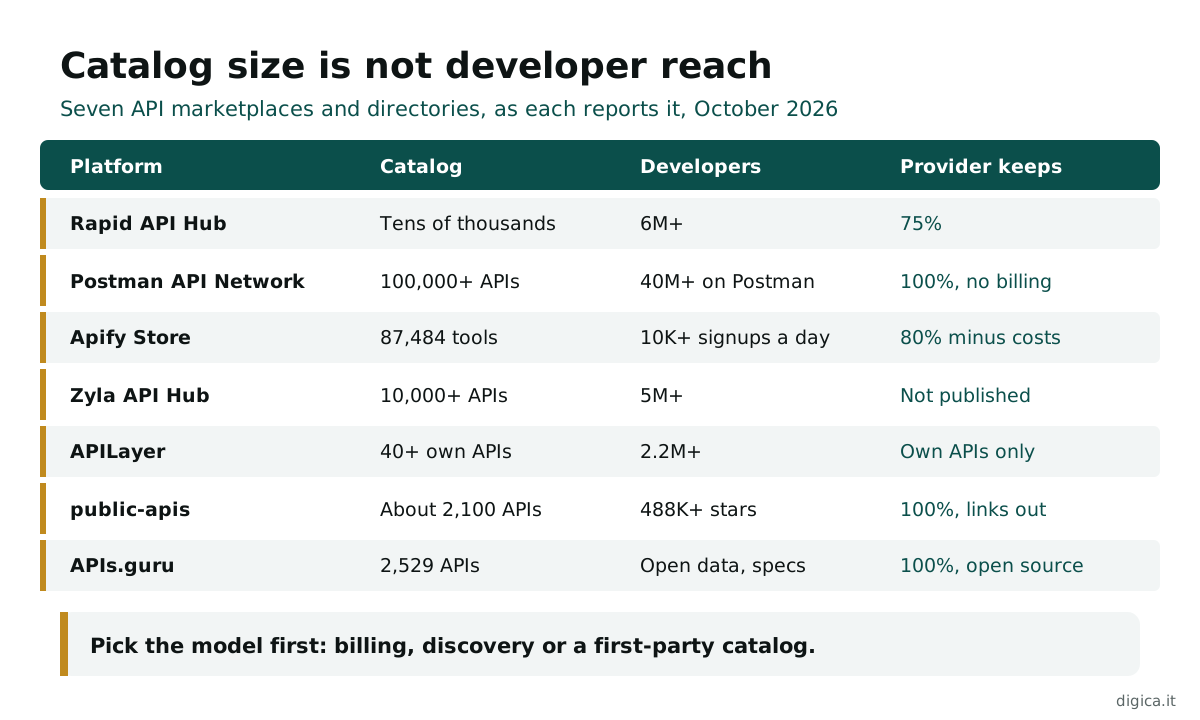
The tempting comparison is catalog size: which API marketplace lists the most APIs. That number mixes very different things. One platform counts 100,000+ APIs because any team can publish a public collection for free. Another lists about 40 because it builds every API itself. A third counts tens of thousands of APIs that developers can subscribe to and pay for on one bill. A big catalog with no billing and a small catalog with millions of paying developers solve different problems.
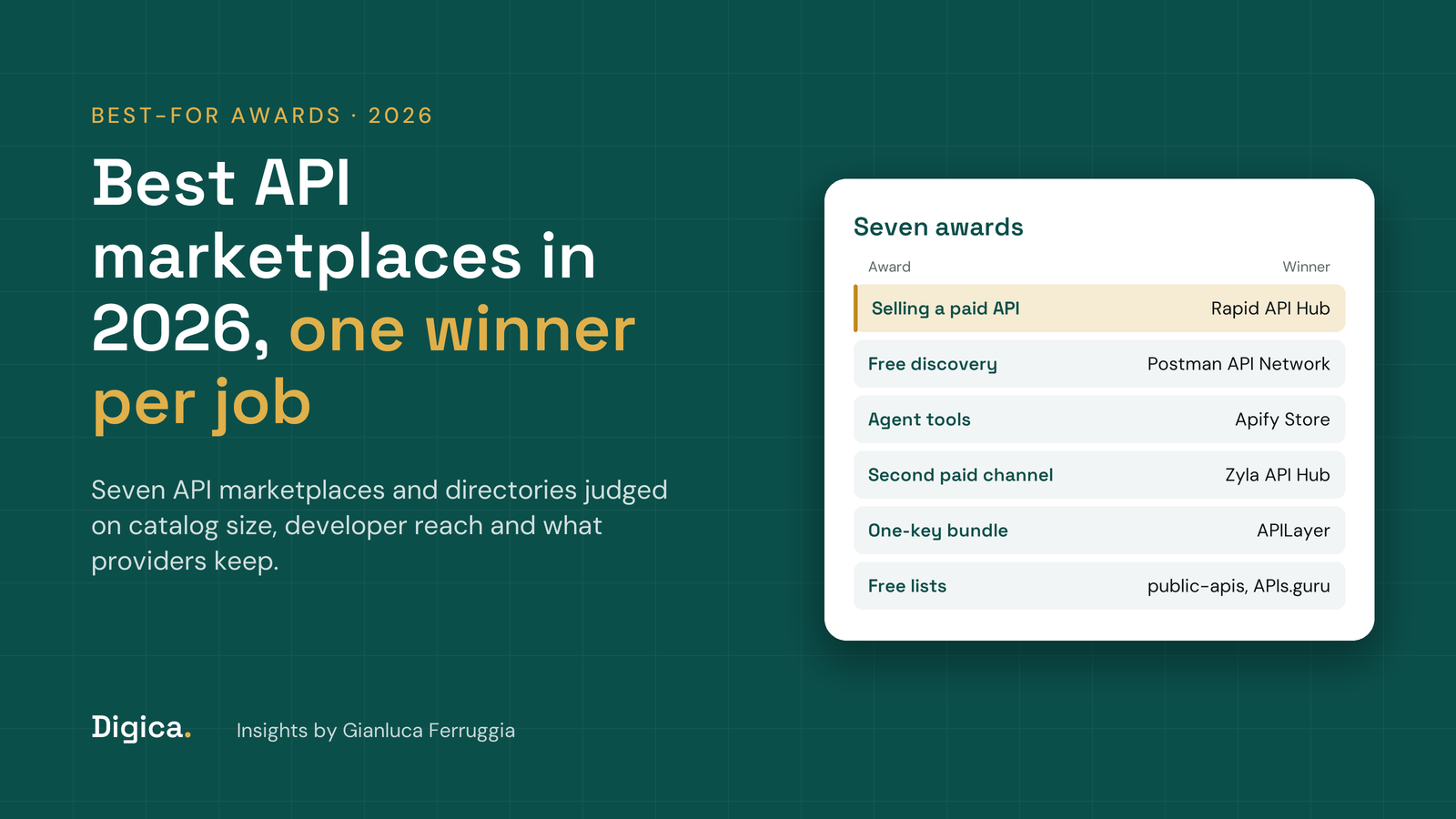
So instead of one ranking, this guide gives a best-for award to each of seven API marketplaces and API directories, judged on catalog size and developer reach: how many APIs each lists, how many developers it reaches, and how a provider gets paid. Figures come from each platform's own pages, documentation and announcements, checked on October 14, 2026. It is the supply and demand lens we use when we help SaaS and software marketplaces grow.
Quick Navigation
- The seven awards at a glance
- Best for selling a paid API: Rapid API Hub
- Best for free discovery at scale: Postman API Network
- Best for scrapers and agent tools: Apify Store
- Best second channel for paid APIs: Zyla API Hub
- Best one-key bundle: APILayer
- Best free lists: public-apis and APIs.guru
- Marketplace, directory or catalog: three models
- Three ways an API listing stalls
- Where to list your API first
- The number for your next pricing review
- FAQ
- Related Articles
The seven awards at a glance
The short answer: Rapid API Hub is the largest API marketplace that bills developers for you, Postman API Network is the largest free API directory, and Apify Store is the largest store built for scrapers and agent tools. The table shows why each won its award.
Seven API marketplaces and directories compared on catalog, reach, provider economics and fit
| Award | Platform | Catalog | Developer reach | Provider keeps | Main risk for a provider | Best for |
|---|---|---|---|---|---|---|
| Best for selling a paid API | Rapid API Hub | Tens of thousands of APIs | Over 6 million developers | 75% of each payment, paid via PayPal | A 25% fee on every payment | Public APIs priced per call or per plan |
| Best for free discovery | Postman API Network | 100,000+ APIs from 18,000+ publishers | Postman: 40 million+ developers, 500,000 organizations | 100%; no billing, buyers pay you directly | You run billing and sales yourself | Developer-first APIs with their own billing |
| Best for scrapers and agent tools | Apify Store | 87,484 tools and automations | 10,000+ developer signups a day | 80% of revenue minus platform costs | Usage costs reduce your share | Scrapers, automations and agent tools |
| Best second channel | Zyla API Hub | 10,000+ APIs | 5 million+ developers | Not published | Fee terms not public | A second paid channel next to Rapid |
| Best one-key bundle | APILayer | 40+ first-party APIs | 2.2 million+ developers | Not a channel for third-party APIs | Not a place to list your own API | Buyers who want many utilities on one key |
| Best community list | public-apis on GitHub | About 2,100 free APIs | 488,000+ GitHub stars | 100%; links out to you | Only free APIs fit | Free APIs seeking early adoption |
| Best machine-readable catalog | APIs.guru | 2,529 APIs, 108,837 endpoints | Used as an open data source | 100%; open source | No buyers, only specs | Getting your OpenAPI spec into tools |
Read the "provider keeps" column first. It splits the seven into three models: platforms that bill and take a cut, directories that send developers to you for free, and first-party catalogs where the platform owns every API. Catalog size only matters once you know which of the three you need.
Best for selling a paid API: Rapid API Hub
Rapid API Hub, long known as RapidAPI, is the API marketplace with the largest paying audience. Its site says it serves over 6 million developers worldwide and offers tens of thousands of APIs through a single account. Nokia acquired Rapid's technology and research and development unit at the end of 2024, and the platform is now part of Nokia's network API work.
The economics are simple and public. Rapid takes a flat 25% marketplace fee on all payments made through the API Hub, a rate it set on November 15, 2025, to cover processing costs it had been absorbing. Its own example: an API plan priced at $100 pays the provider $75. Developers subscribe to plans and pay overages on one Rapid bill, and Rapid pays providers through PayPal.
For the developer, the attraction is one account and one invoice for many APIs, with a test console on every listing. That convenience is what makes the audience valuable to a provider: a developer who already has a payment method on file can move from trying an API to paying for it without a procurement step. It also means the listing page does the selling, so pricing tiers, examples and response times on that page carry more weight than on a provider's own site.
Listing an API and seeing too few subscribers?
In 30 minutes we look at where your developers search, and which API marketplace or directory should come first.
What the 25% buys is billing, a consolidated invoice for the developer, and a catalog developers already browse. For a small API team that would otherwise build subscriptions, metering and payouts, that is often worth it. For an API with large customers who would sign a direct contract, it is expensive.
The verdict: the best API marketplace for a provider who wants paying developers without building billing. Move large accounts to direct contracts once they appear, and keep the listing for discovery.
Best for free discovery at scale: Postman API Network
Postman API Network is the largest API directory by catalog, and it charges providers nothing. In June 2025 Postman said the network held over 100,000 APIs from more than 18,000 publishers, inside a platform used by more than 40 million developers and 500,000 organizations. Its about page says 98% of the Fortune 500 use Postman.
The network does not sell anything. A provider publishes a public workspace with collections and documentation, a developer forks it and starts calling the API, and any payment happens on the provider's own site. That makes it the best channel for reach and the worst for monetization: the developer meets your API inside a tool they already use every day, but you still need your own sign-up, pricing and billing.
Postman's own survey adds a reason to take the network seriously as AI agents start calling APIs: 89% of developers use AI, but only 24% design APIs for AI agents. A well-documented public collection is one of the simplest ways to make an API readable by both.
That trade-off suits most commercial APIs well. A provider keeps 100% of revenue and the customer relationship, and uses Postman to cut the time from first look to first successful call.
The verdict: the best free API directory for any provider that already bills its own customers. List here before paying any marketplace fee.
Best for scrapers and agent tools: Apify Store
Apify Store is the strongest API marketplace for one fast-growing category: web scrapers, automations and tools that AI agents call. Apify, founded in 2015, says its store lists 87,484 tools and automations, called Actors, and that more than 10,000 developers sign up every day.
Providers keep 80% of revenue minus the platform costs of running their Actor, according to Apify's pricing documentation, and Apify says it paid out $1.6 million to creators in the last month. Buyers pay per event or per usage through their own Apify plan, so a developer can try many tools without a new contract for each.
The limit is fit. Apify is built for code that runs on its own infrastructure, so it suits scraping, data extraction and automation tasks better than a general REST API that already runs elsewhere. Platform costs also come out of the provider's share, so a heavy Actor keeps less than the 80% headline.
The verdict: the best API marketplace for scrapers, data extraction and agent tools. For a general-purpose API hosted on your own servers, Rapid or Zyla fits better.
Best second channel for paid APIs: Zyla API Hub
Zyla API Hub says it lists 10,000+ APIs and reaches 5 million+ developers, which makes it the closest like-for-like alternative to Rapid. Developers subscribe per API, and Zyla offers two months free on yearly subscriptions.
Do developers find your API but never subscribe?
A growth audit maps your listings, documentation and sign-up flow on each API marketplace, and where developers drop off.
Zyla does not publish its provider commission on its marketplace pages, so a provider has to ask before listing. That is a real gap for a platform competing with Rapid's fully public terms, and the main reason it ranks as a second channel rather than a first one. The audience claim is large, and a provider already running on Rapid can reuse most of its listing copy, pricing tiers and documentation, so the cost of testing a second channel is mostly time.
The verdict: a sensible second paid channel for an API that already sells on Rapid, once you have its commission terms in writing.
Best one-key bundle: APILayer
APILayer is not a channel for your API; it is a catalog of its own. It says it offers 40+ production-ready APIs, from currency and IP data to email validation, and that 2.2 million+ developers trust it. A developer gets many utility APIs under one account and one key.
It earns an award because it shapes the category. A buyer who needs five simple utilities often prefers one vendor and one invoice to five marketplace subscriptions. APILayer also co-curates the public-apis list on GitHub, so its team sits close to one of the biggest free discovery channels in this guide.
The verdict: the best choice for buyers who want many utility APIs on one key. For providers, it is a benchmark for what a bundled competitor looks like, not a place to list.
Best free lists: public-apis and APIs.guru
Two free, open projects win the last two awards, and both matter more to discovery than their size suggests.
public-apis on GitHub lists about 2,100 free APIs across roughly 50 categories. On October 14, 2026, it had 488,529 GitHub stars and 54,174 forks, and it was last updated the day before. Community members and people working at APILayer curate it. A free API added here sits in a list with more than 488,000 stars, at no cost.
APIs.guru is a different kind of directory. It collects machine-readable OpenAPI definitions rather than human-readable listings, and its live metrics show 2,529 APIs, 3,992 specifications and 108,837 endpoints from 677 providers. It is built for tools and code generators to read, so a spec published there can reach developers through their tooling.
The verdict: list free APIs on public-apis for adoption, and publish your OpenAPI definition to APIs.guru so tools can find it. Neither pays you, and neither charges you.
Marketplace, directory or catalog: three models
Every name in this guide fits one of three models, and choosing the model matters more than choosing the platform.
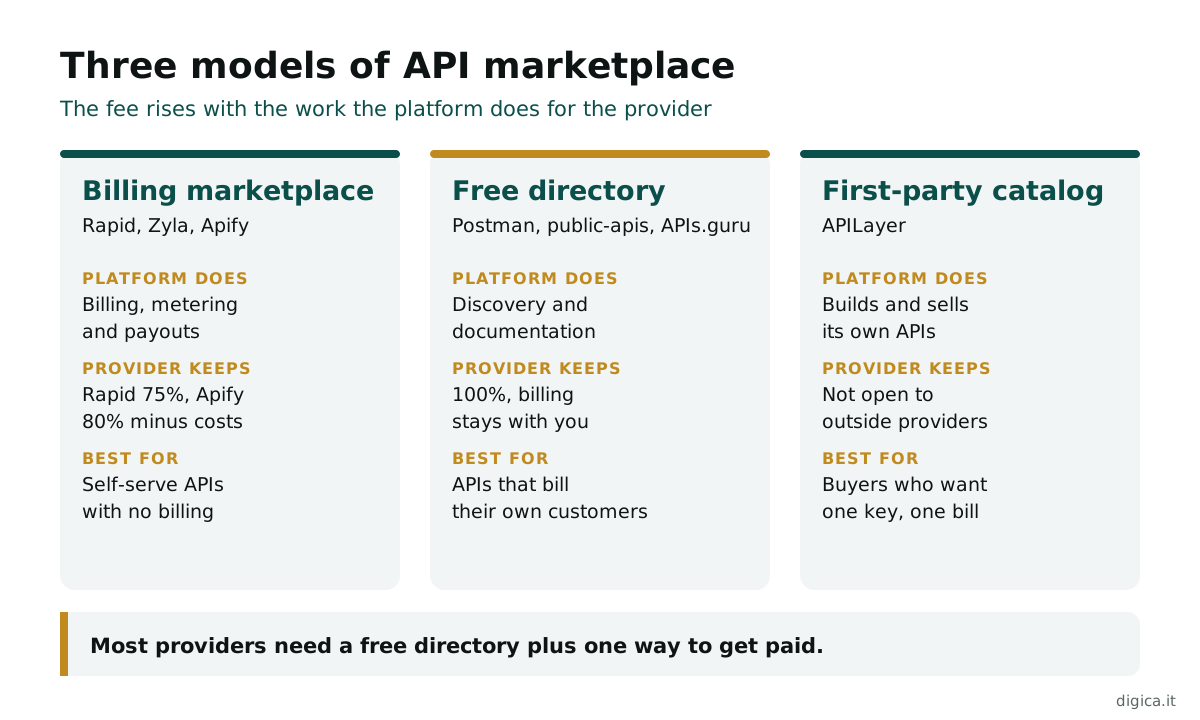
A billing marketplace (Rapid, Zyla, Apify) handles subscriptions, metering and payouts, and takes a share of every payment. A free directory (Postman API Network, public-apis, APIs.guru) sends developers to you and leaves billing to you. A first-party catalog (APILayer) sells only its own APIs. The fee you pay rises with the work the platform does for you.
The models also attract different developers. A billing marketplace attracts developers who want to buy now and are comparing plans. A free directory attracts developers who are exploring and will often build a prototype before anyone talks about price. A first-party catalog attracts buyers who want fewer vendors. Most API providers need the first two at once: the directory to be found, and either a marketplace or their own billing to be paid.
Security is now part of that work. Akamai's 2026 State of the Internet report on apps, APIs and DDoS found the average number of daily API attacks rose 113% year over year, and 87% of surveyed organizations reported an API-related security incident in 2025. A marketplace that issues keys and meters calls carries some of that risk; a directory that links to your endpoint leaves all of it with you. Price that in when you compare a 25% fee with a free listing.
Three ways an API listing stalls
Most API listings that go nowhere fail for reasons unrelated to the API itself. These patterns recur.
- Listing a contract product on a self-serve shelf. A provider whose buyers sign annual contracts lists on a billing marketplace, gives away 25% of the small deals and none of the large ones arrive. The large buyers wanted a sales call, not a plan page.
- Thin documentation. Developers judge an API in the first few minutes: a working example, an auth guide and a sandbox. A listing with a one-line description and no runnable request loses to a weaker API with better docs, on every platform here.
- One channel only. A provider lists on one marketplace and nowhere else, so developers searching a directory, GitHub or their own tools never meet the API. The free directories cost nothing and widen the funnel into the paid one.
The fix in each case is to match the channel to the buyer: self-serve developers to a billing marketplace, teams with their own billing to a free directory, and every public spec to the machine-readable catalogs.
Where to list your API first
Choose by how your buyers pay and who they are, using these thresholds.
- If your API is self-serve and you have no billing system, list on Rapid API Hub first and accept the 25% fee as the cost of billing.
- If you already bill customers directly, publish to Postman API Network and keep 100% of revenue.
- If your product is a scraper, automation or agent tool, publish on Apify Store and price per event.
- If you already sell on Rapid and want a second paid channel, get Zyla's commission in writing, then list.
- If your API is free, submit it to public-apis and publish its OpenAPI definition to APIs.guru.
- If more than half your revenue comes from a few large accounts, keep marketplace listings for discovery and sell the large accounts direct.
Running an API marketplace or developer platform?
We grow supply and demand for SaaS and software marketplaces, from the first providers to repeat buyers.
Whatever you choose, list in a free directory as well as any paid marketplace. Discovery compounds across channels, and the free ones cost only the time to publish good documentation. Cloudflare's 2025 Year in Review shows how fast API clients are changing: 20% of automated API requests came from Go-based clients in 2025, up from 12% in 2024, and Python's share rose from 9.6% to 17%. Your docs and examples need to meet developers in the languages they now use.
The number for your next pricing review
On a $100 plan, Rapid pays the provider $75. At $10,000 a month of API subscriptions, that 25% fee is $2,500 a month, or $30,000 a year, in exchange for billing and reach. If the marketplace brings developers you would not otherwise reach, that is a good trade. The biggest cost of doing nothing is paying $30,000 a year to bill customers who already know where to find you.
FAQ
What is an API marketplace? An API marketplace is a platform where developers find, subscribe to and pay for APIs from many providers on one account. Rapid API Hub, Zyla API Hub and Apify Store bill developers and pay providers, taking a share of each payment.
What is the difference between an API marketplace and an API directory? An API marketplace handles billing and takes a fee. An API directory, such as Postman API Network, public-apis or APIs.guru, lists APIs for discovery and leaves billing to the provider, so the provider keeps 100% of revenue.
What is the largest API marketplace? By paying audience, Rapid API Hub, which says it serves over 6 million developers and offers tens of thousands of APIs. By catalog, Postman API Network, with over 100,000 APIs from more than 18,000 publishers.
How much does RapidAPI charge API providers? Rapid takes a flat 25% marketplace fee on all payments made through the API Hub, effective November 15, 2025. On a $100 plan, the provider receives $75. Payouts are made through PayPal.
Is RapidAPI still available after the Nokia acquisition? Yes. Nokia acquired Rapid's technology and research and development unit at the end of 2024, and the API Hub still operates, serving over 6 million developers with tens of thousands of APIs.
Where can I find free public APIs? The public-apis repository on GitHub lists about 2,100 free APIs in roughly 50 categories, and APIs.guru publishes machine-readable OpenAPI definitions for 2,529 APIs. Postman API Network also lists many free public APIs.
Should I list my API on more than one API marketplace? Yes, if the channels differ. Pair one billing marketplace with free directories such as Postman API Network and public-apis. Listing on two billing marketplaces makes sense only once you know each one's fee terms.
Related Articles
- SaaS and software marketplace growth
- Best AI agent marketplaces in 2026: reach and vetting
- Best data marketplaces in 2026
- Marketplace business models
- How to attract vendors to a B2B marketplace
This article is part of our B2B marketplace growth series. Browse more on the Digica blog.