Marketplace Business Models: How B2B Platforms Make Money
Most B2B marketplaces pick their business model in a week and live with it for 5 years. The founders copy a take rate from a consumer platform, or a subscription price from a competitor, and only find out at the first renewal cycle whether vendors think it was worth paying. By then the model has already decided what the growth team builds, which metrics the board watches and which vendors stay.
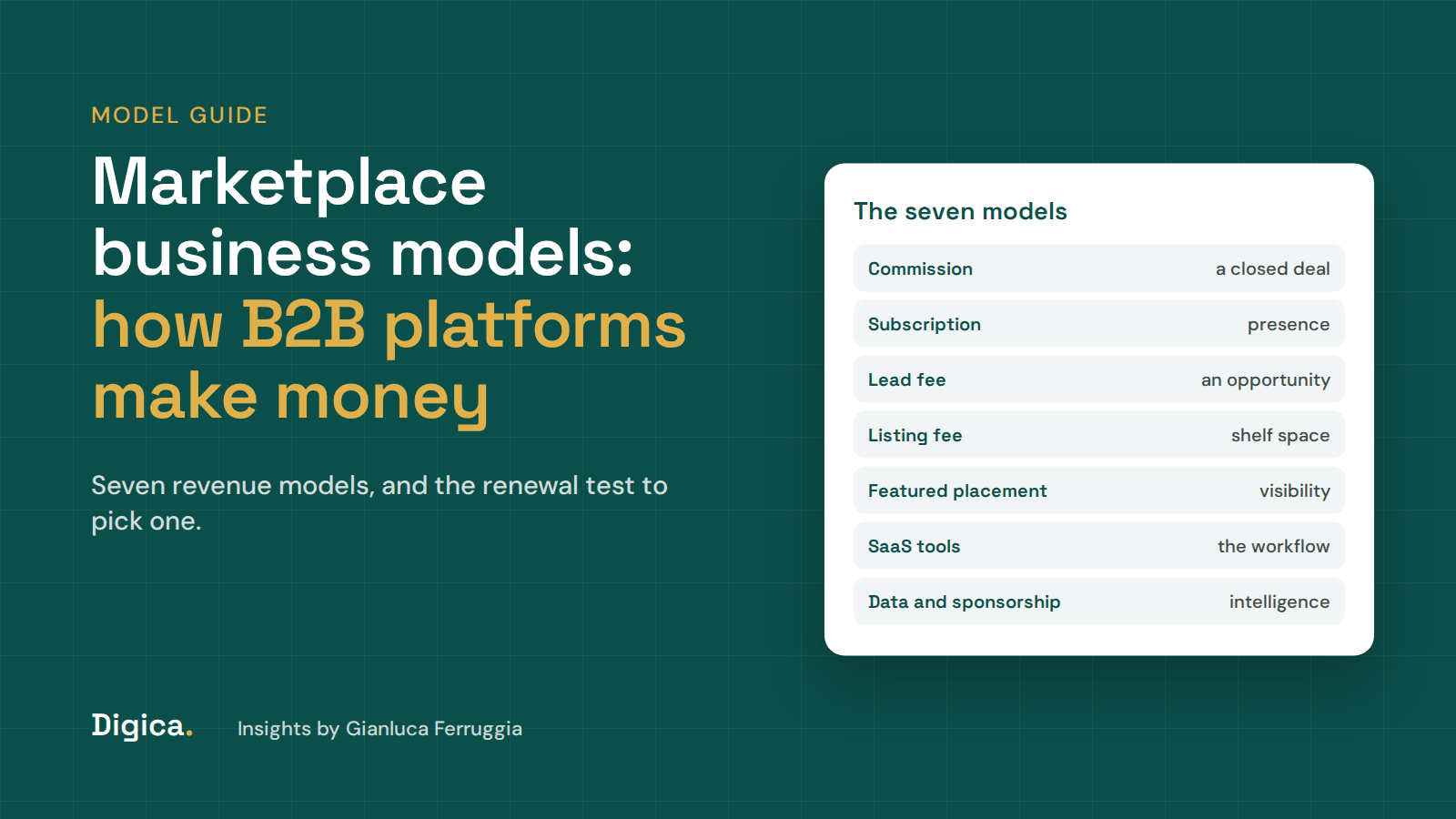
There are seven ways a B2B marketplace can make money: commissions, subscriptions, lead fees, listing fees, featured placement, SaaS tools, and data or sponsorship. Each one is a promise to the vendor about what they are paying for. The model that works is the one where the promise is kept often enough that vendors renew without being chased.
This guide covers each marketplace business model, which one fits which B2B category, and how the model you choose shapes your growth engine. It draws on what we learned scaling a B2B agency marketplace to 40,000+ listed agencies, and it is the same framework we use in our B2B marketplace consulting work.
Quick Navigation
- What a marketplace business model really is
- The seven B2B marketplace revenue models
- Commission: the default that often breaks in B2B
- Subscription vs commission marketplace pricing
- The lead fee model
- Listing fees, featured placement and sponsorship
- SaaS tools and data: monetizing the workflow
- Which model fits which B2B category
- The renewal test
- How the model shapes the growth engine
- Three failure scenarios and how to choose
What a marketplace business model really is
A marketplace business model is the rule that decides who pays, for what, and when. It is not a pricing page. It is the contract between the platform and its supply.
In consumer marketplaces the answer is usually simple: the platform takes a cut of each transaction. B2B is messier. Deals are large, slow and relationship driven. A buyer may meet a vendor once on your platform and then work with them for six years. A procurement team may never put a card into your checkout at all. So the question is not only "how much do we charge" but "what event do we charge on".
That choice of event matters more than the price. Charge on the transaction and you need the transaction to happen on your rails. Charge on access and you need vendors to believe the access produces business. Charge on the lead and you need the lead to be real. Every marketplace monetization decision is really a decision about which of those three things you can prove.
The seven B2B marketplace revenue models
Here are the options, grouped by what the vendor is paying for.
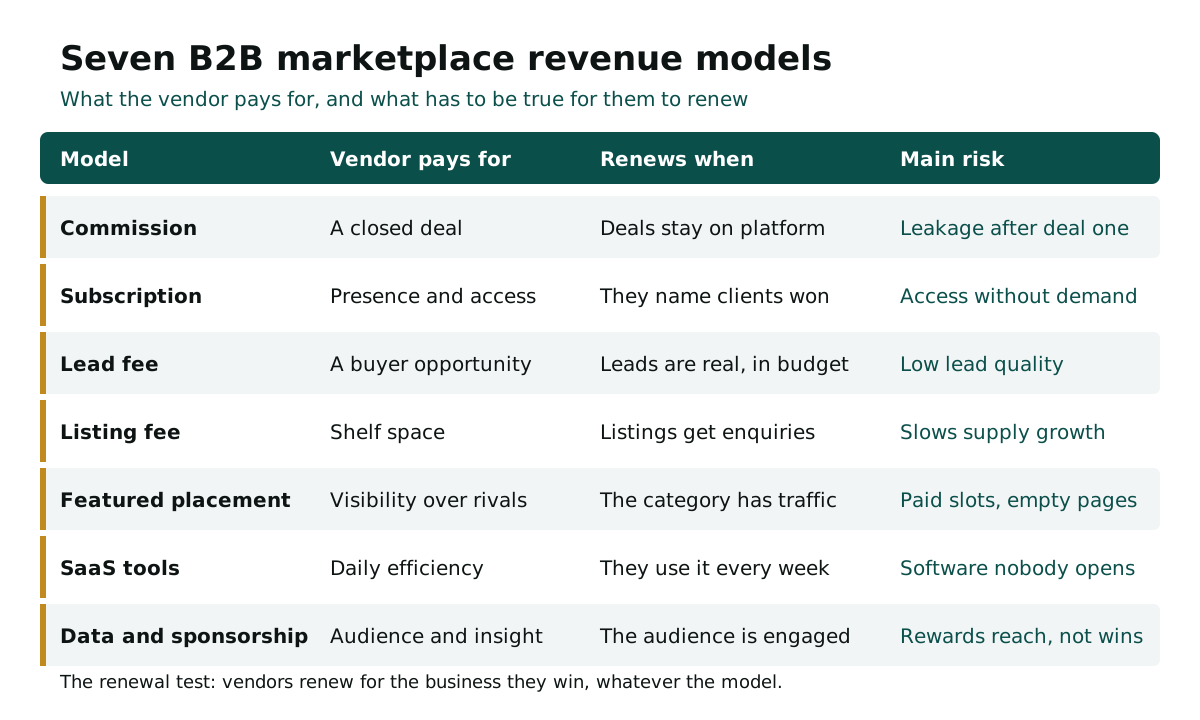
- Commission (take rate): a percentage of each transaction. The vendor pays for a closed deal.
- Subscription: a recurring fee for a profile, access to buyers or a tier of features. The vendor pays for presence.
- Lead fee: a fixed price per buyer enquiry, request for quote or introduction. The vendor pays for an opportunity.
- Listing fee: a one-off or periodic charge to publish a product or service. The vendor pays for shelf space.
- Featured placement: paid ranking, badges or top-of-category slots. The vendor pays for visibility over rivals.
- SaaS tools: software for quoting, scheduling, invoicing or CRM, sold to vendors whether or not they win deals on the platform. The vendor pays for efficiency.
- Data and sponsorship: benchmark reports, market intelligence or sponsored content sold to vendors, investors or brands. The buyer of this is often not a vendor at all.
Most mature B2B platforms run two or three of these at once. The mistake is stacking them before the first one works.
Commission: the default that often breaks in B2B
Commission is the cleanest model on paper. Revenue scales with value created, vendors pay only when they win, and investors understand it. It works best when the platform touches the whole transaction: matching, contracting, payment and delivery.
The ceiling is real. Bill Gurley's essay A Rake Too Far makes the case that high rakes become friction, because the fee ends up in the price the buyer pays, and it pushes suppliers to find a way around the platform. For reference, he puts Amazon marketplace fees at roughly 6 to 15%. His conclusion: high volume combined with a modest rake is the formula for a durable marketplace.
In B2B the pressure is stronger, because the second deal between the same buyer and vendor rarely needs you. Commission works in B2B when at least one of these holds:
- The platform handles payment, escrow, compliance or financing, so moving off platform costs the buyer something.
- Transactions are frequent and small, so each one is not worth the effort of going direct.
- The vendor would not have found that buyer otherwise, every time, because buyers churn through many suppliers.
If none of those hold, a commission model will look healthy in year one and leak in year two.
Subscription vs commission marketplace pricing
A subscription marketplace sells access. Vendors pay monthly or yearly for a profile, a place in category pages, and the chance to be found. This is the model most B2B directories and service marketplaces end up on, because it does not depend on seeing the transaction.
The trade is simple. Commission aligns your revenue with vendor outcomes but needs transaction control. Subscription gives you predictable revenue without transaction control, but every renewal is a referendum on whether the access paid off.
Not sure your model fits your category?
We review your pricing, vendor cohorts and renewal data and tell you which model your growth engine can actually support.
A worked example shows the difference. Assume 300 vendors on a $300 a month plan. That is $90,000 in monthly recurring revenue, or $1,080,000 a year, and it arrives whether or not a single deal closes on the platform. Now assume the same 300 vendors close $1,500,000 in deals a month through the platform and you charge 8% commission. That is $120,000 a month, but only if every deal is recorded. If a quarter of repeat business moves off platform, the commission line falls toward the subscription line, with more collection work attached.
In our experience the hybrid that holds up best in B2B services is a modest subscription for presence plus a paid upgrade for visibility, with transaction fees reserved for categories where the platform genuinely runs the deal. That keeps revenue predictable and keeps the commission where it can be defended.
The lead fee model
The lead fee model charges vendors per enquiry, request for quote or introduction. It sits between subscription and commission: the vendor pays for an opportunity, not a result.
It suits categories where deals are large, buyers make one considered purchase, and the transaction happens offline: industrial equipment, professional services, construction, software implementation. The vendor's maths is easy to check. Assume a vendor pays $60 per lead, closes one in ten, and the average job is worth $8,000. Their cost of acquisition is $600 per won deal, or 7.5% of the job value. Most vendors will renew that happily.
The weak point is lead quality. A lead fee platform lives or dies on whether the enquiry is real, in budget and in scope. Three rules keep it honest:
- Qualify the buyer before the vendor pays: budget, timeline and scope captured on the form.
- Cap how many vendors receive each lead. Five vendors fighting over one buyer makes every lead feel worthless.
- Offer credits for leads that are clearly invalid, before vendors have to ask.
Listing fees, featured placement and sponsorship
These three models sell visibility rather than outcomes. They are easy to launch and easy to overuse.
Listing fees work when supply is scarce and each listing has high value, such as equipment for sale or a specialist service catalogue. They fail when you need many vendors to create liquidity, because a fee at the door slows the supply side exactly when you need it to grow.
Featured placement is the most common upsell in B2B directories. It works when there is real demand on the category page to redirect. If a category gets 40 buyer visits a month, the top slot is worth very little, and vendors who pay for it will not renew. Sell placement only in categories where you can show the traffic.
Sponsorship means a brand pays to be associated with a category, a report or an event on your platform. It can be meaningful revenue for marketplaces with an engaged professional audience, but it rewards audience size, not vendor success. Treat it as a secondary line that funds content, not as the core model.
All three share one risk: they let you earn money from vendors without delivering them business. That feels fine until the renewal date.
SaaS tools and data: monetizing the workflow
The stronger B2B platforms increasingly earn from the vendor's workflow, not just the match. Quoting tools, scheduling, invoicing, a light CRM: software the vendor uses every day, on and off the platform.
Tidemark's chapter on marketplace take rates frames the trade clearly. Marketplaces typically monetize at 10 to 30% take rates, while vertical software vendors usually monetize at under 1%. The more of the transaction process a platform takes on, the higher its take rate can be. Their example is ACV Auctions, which started at about 2% of GMV and added services that grew to 55% of revenue, lifting its total take rate above 4%.
Find the fee your vendors will defend
We map what your platform does in each deal and show which payments, tools or data your vendors would pay for next.
The lesson for a B2B marketplace: if you cannot raise the commission, deepen what you do in the deal. Payments, financing, compliance checks, logistics and software each add a fee the vendor can see value in, and each one makes moving off platform more expensive.
Data is the other workflow asset. A marketplace sees prices, demand and response times across a whole category. Packaged as benchmarks or market reports, that data can be sold to vendors, investors or suppliers upstream. It also earns press and citations, which feeds the demand side. Start by publishing it free to build authority, and charge for depth later.
Which model fits which B2B category
There is no best marketplace revenue model in the abstract. There is the model that fits how deals happen in your category. This is the table we use as a starting point.
| Model | Vendor cost profile | Main risk | Best for |
|---|---|---|---|
| Commission (take rate) | Variable, paid only on won deals | Leakage off platform after the first deal | Frequent, smaller transactions the platform pays out on, such as parts, freelance work, logistics |
| Subscription | Fixed monthly or yearly fee | Churn at renewal if access does not produce business | Service directories, agency and software marketplaces, professional networks |
| Lead fee | Fixed price per qualified enquiry | Low lead quality kills renewal | Large, one-off purchases closed offline, such as industrial, construction, B2B services |
| Listing fee | One-off or periodic per listing | Slows supply growth and liquidity | Scarce, high-value supply such as used equipment or specialist catalogues |
| Featured placement | Premium on top of base plan | Paid slots in categories with little traffic | Categories with proven buyer demand to redirect |
| SaaS tools | Recurring software fee | Building software nobody uses daily | Fragmented vendor bases with weak tooling |
| Data and sponsorship | Contract or campaign based | Rewards audience size, not vendor success | Platforms with deep category data and an engaged audience |
Two questions settle most choices. First, can the platform see and control the transaction? If yes, commission is on the table. If no, look at subscription or lead fees. Second, how often does the same buyer buy from the same vendor? The more often, the more a per-transaction fee will leak, and the more access or software pricing makes sense.
The renewal test
Every model eventually faces the same test: vendors renew for the business they win. Not for traffic, not for impressions, not for a badge. For revenue they can trace back to you.
We saw this first-hand growing a B2B agency marketplace from five people to a 150-person team and 3,200% growth. The vendors who renewed were the ones who could name the clients they had won through the platform. The ones who churned had often been sold visibility and could not connect it to a contract.
Run the renewal test on your own base before you change pricing:
- Win rate per vendor: how many vendors closed at least one deal they attribute to the platform in the last 12 months?
- Fee to business ratio: for the median vendor, what is the annual fee as a share of the revenue the platform brought them? Under 10% is comfortable. Over 25% is a churn signal.
- Renewal by cohort: do vendors who received ten or more buyer enquiries renew at a higher rate than those who received fewer than three? If yes, your model is fine and your problem is demand distribution.
If vendors who win renew and vendors who do not win churn, the model is working and the job is to spread demand more evenly. If vendors who win still churn, the price or the model is wrong.
How the model shapes the growth engine
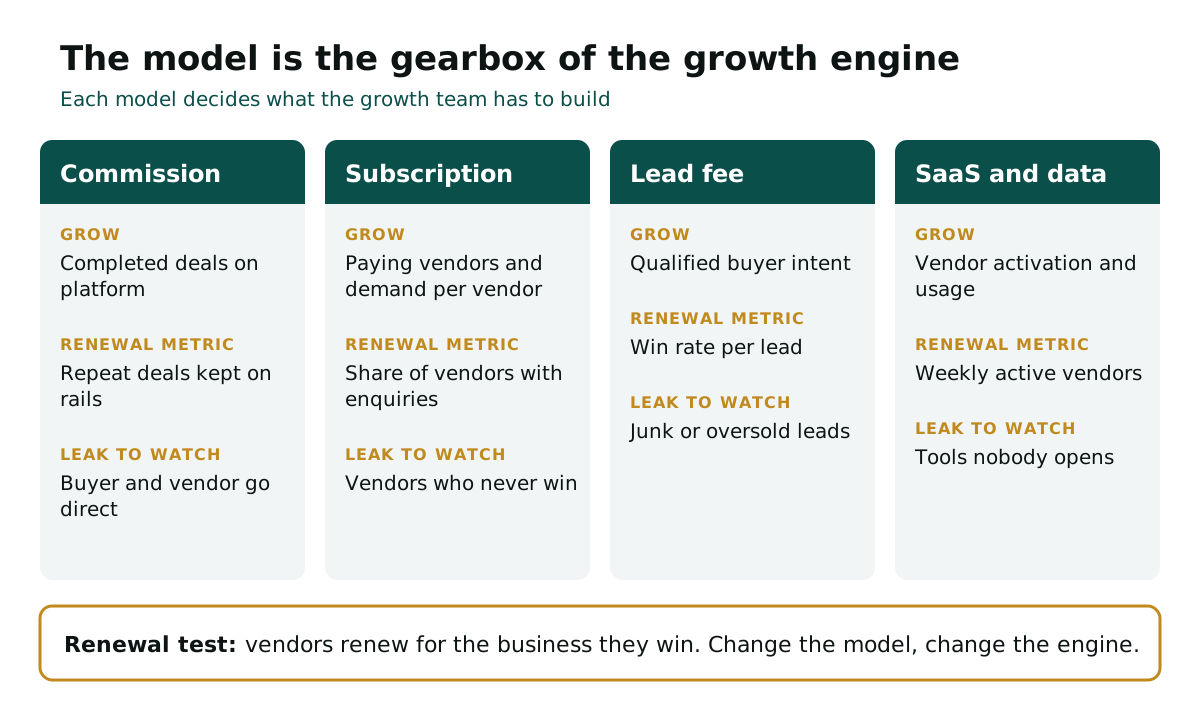
The model you pick decides what your growth team has to build. Think of the business model as the gearbox: it decides which part of the engine turns into revenue.
Commission marketplaces grow by increasing completed transactions on platform. The growth work is buyer acquisition, conversion through checkout, and features that keep repeat deals on your rails, such as payments, saved vendors and reordering.
Subscription marketplaces grow by adding vendors and keeping them. Vendor acquisition is the visible half. The hidden half is sending each paying vendor enough qualified demand to renew. This is where marketplace liquidity becomes the metric that compounds: share of paying vendors receiving real enquiries each month.
Lead fee marketplaces grow by generating qualified buyer intent. That means category page SEO, buyer content and comparison pages that capture people with a real project. In our experience organic search is the cheapest source of in-market B2B buyers: on one water and wastewater B2B marketplace, organic impressions grew more than 10x within 6 months once category pages answered real buyer questions.
SaaS and data led platforms grow through vendor activation and usage. The engine is onboarding, product adoption and, often, partner and referral motions. In a SaaS partner programme we ran, 94% of referred accounts were still active after onboarding.
This is why a model change is never just a pricing change. Moving from commission to subscription means your growth team stops optimising checkout and starts optimising demand per vendor. If nobody owns that shift, revenue stalls in the gap. It is often the first thing a fractional CMO for marketplaces has to fix.
Three failure scenarios and how to choose
These are the three model failures we see most often, with what each one costs.
1. Commission on relationship deals. A professional services marketplace charges 10% on every project. The first project closes on platform. The next three between the same buyer and vendor happen by email. Research on an online freelance marketplace by Gu and Zhu in Management Science found that higher trust raises hiring of good freelancers, but once trust is high enough it also increases disintermediation, offsetting the revenue gain. Assume $400,000 in repeat business a month leaves the platform. At 10% that is $40,000 a month in commission that never arrives. The right call: a subscription or a lower fee on repeat business, plus payment and compliance features that make staying worth it.
2. Selling visibility without demand. A directory sells featured placement in 200 categories, most with fewer than 50 buyer visits a month. Vendors pay once and do not renew. The right call: sell placement only in categories with proven demand, and put the rest of the effort into category page SEO until the traffic is there.
3. Lead fees on unqualified enquiries. A platform charges $50 per lead and sends each enquiry to eight vendors. Win rates collapse, vendors dispute every invoice, and the sales team spends its time issuing refunds. The right call: cap distribution at three to four vendors, qualify budget and timeline on the form, and raise the price per lead once quality is proven.
To choose, work through three thresholds:
- Platform controls payment and transactions repeat often: start with commission, keep the rake modest, invest in payments.
- Transactions close offline and buyers buy rarely: start with lead fees, and make lead quality the first metric.
- Vendors need ongoing presence and buyers browse before contacting: start with subscription, and measure demand per paying vendor monthly.
Add featured placement, SaaS and data only after the core model passes the renewal test.
Choose a model your growth engine can carry
We pressure test your model against the renewal test and build the growth plan that fits it.
Here is the figure for your next board meeting. Assume 300 vendors paying $300 a month, and 35% of them fail to renew because they cannot trace any business to the platform. That is $378,000 of annual revenue walking out every year, before the cost of replacing those vendors. Assume a model and demand rework costs $45,000 in team time and tooling and cuts that churn to 20%. You recover $162,000 a year, and the work pays back in roughly three to four months. The cost of doing nothing is paying to acquire vendors your model is quietly designed to lose.
FAQ
What is a marketplace business model? It is the rule that decides who pays the platform, for what and when. The main options are commission, subscription, lead fees, listing fees, featured placement, SaaS tools, and data or sponsorship.
Which marketplace business model is best for B2B? It depends on the category. Commission fits frequent transactions the platform pays out on. Lead fees fit large purchases closed offline. Subscription fits service directories where vendors need ongoing presence.
What is a typical marketplace take rate? Tidemark puts typical marketplace take rates at 10 to 30%, compared with under 1% for vertical software. B2B platforms often sit lower, because large repeat deals make high commissions easy to avoid.
Should a B2B marketplace charge buyers or vendors? Usually vendors. Buyers in B2B are scarce and expensive to acquire, so most platforms keep the buyer side free and charge the side that gains new revenue.
How do I reduce disintermediation on a commission marketplace? Make staying on platform worth it: payments, escrow, compliance checks, financing and saved workflows. Lower fees on repeat business between the same parties also help.
When should a marketplace change its business model? When vendors who win business still churn, or when most revenue leaks off platform after the first deal. Run the renewal test on your cohorts before changing anything.