The best places to sell data in 2026: what a data owner gets from each broker and platform
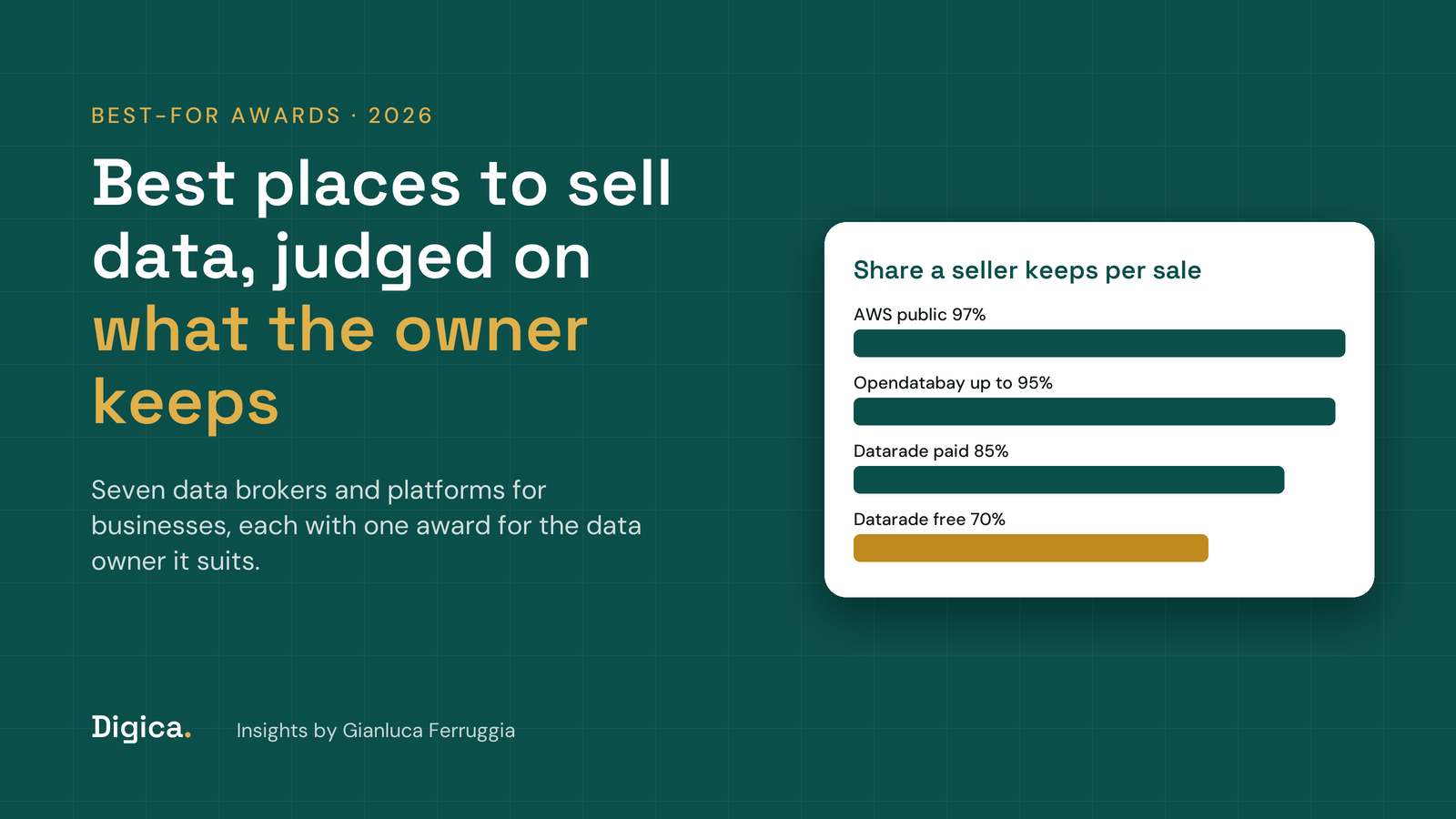
If you are working out where to sell data your company already holds, the choice of route decides how much of each sale you keep. On AWS Data Exchange, a seller keeps 97% of a public offer. On Datarade's free plan, a seller keeps 70%. On some managed brokers, the owner pays nothing at all and the buyer covers the fee. The same dataset can earn very different amounts depending on where you take it.
Fees are only half of it. The routes also differ on who the buyers are, what it takes to be accepted, how long the first deal takes, and what rights you hand over. A cloud marketplace gives you distribution to analysts who already use that cloud. A managed broker finds an AI lab for an archive you never thought of as a product. They suit different owners.
This guide is for businesses with data to sell or license: company records, proprietary datasets, media archives and operating data. It is not about individuals selling personal data. It gives seven places to sell data one award each, and compares what the owner gets: who pays, the share kept, eligibility, time to first deal and how rights are handled. Figures are each company's own, checked on October 24, 2026. For the buyer's view of the same market, see our ranking of data marketplaces.
Quick Navigation
- Where to sell data: who pays and what they buy
- Seven data monetization platforms, side by side
- Best for published fees and cloud reach: AWS Data Exchange
- Best for buyers already in the warehouse: Snowflake Marketplace
- Best for broad B2B discovery: Datarade
- Best self-serve route for AI datasets: Opendatabay
- Best of the data licensing companies for media and health data: Protege
- Best for archives and workflow data with no fees: Troveo
- Best for US firms that want the sale handled: Pewter
- Three failure scenarios
- Which route fits your data
- FAQ
- Related Articles
Where to sell data: who pays and what they buy
The short answer: businesses sell data either to analytics buyers, through data marketplace platforms where buyers search and subscribe, or to AI companies, usually through brokers and licensing companies that find the buyer and negotiate the deal.
Analytics buyers want data that helps them decide: company records, location and foot traffic, prices, transactions and market signals. They buy through the data marketplace platforms built into their cloud or warehouse, or through discovery sites where they compare providers. They usually subscribe, so the money arrives monthly or yearly.
AI buyers want data that helps them train and test models, and the supply they used to take for free is shrinking. The Data Provenance Initiative found that in a single year, 2023 to 2024, restrictions made about 5% of all tokens in a widely used training corpus, and more than 28% of its most critical sources, fully off limits to AI crawlers (Data Provenance Initiative, arXiv). That is why labs now pay for archives, video and real business records, often in one large licensing deal rather than a subscription.
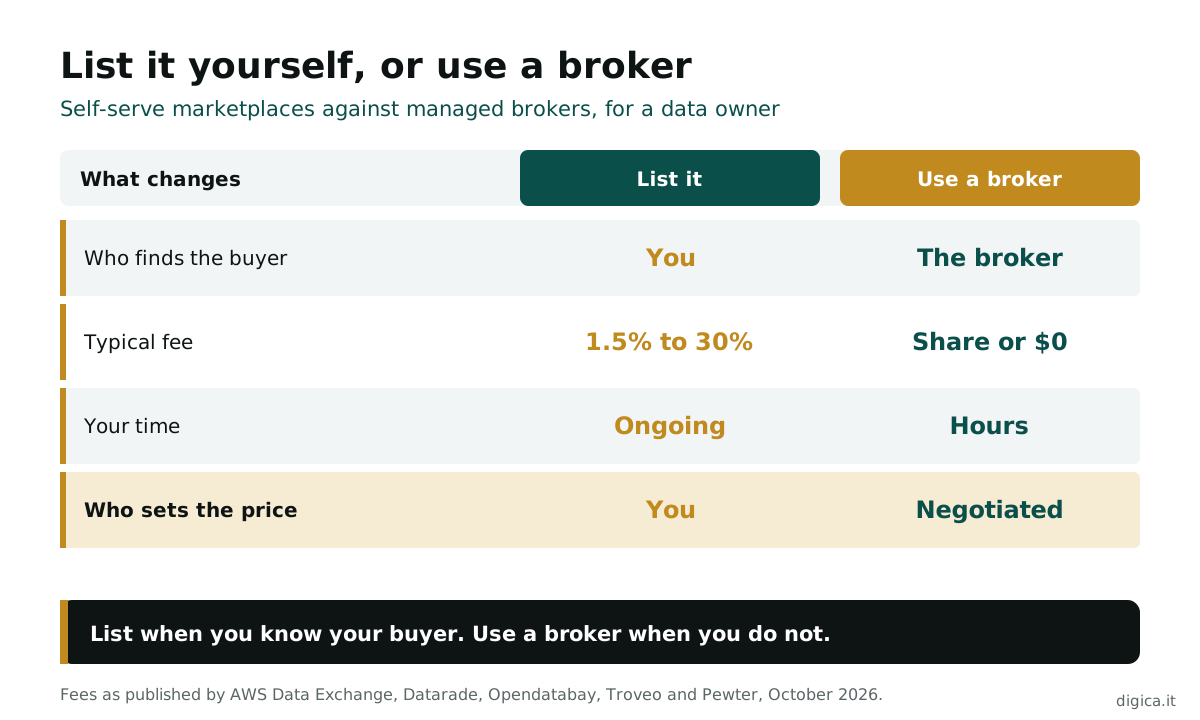
The two kinds of buyer lead to two kinds of route. Self-serve marketplaces let you list, set a price and pay a commission. Managed brokers do the selling for you and take a share or charge the buyer. Our view: most data owners should decide which buyer they want before they look at any route, because a listing on the wrong platform earns nothing however low the fee.
Seven data monetization platforms, side by side
The short answer: AWS Data Exchange and Opendatabay let sellers keep the most per sale on published terms, Datarade has the broadest B2B reach, and Protege, Troveo and Pewter handle the whole sale for owners who would rather not sell themselves.
Seven places to sell data compared on who pays, the share the seller keeps, eligibility, time to start, rights, main risk and best fit
| Route | Who buys | Seller keeps | Eligibility | Time to start | Rights handled | Main risk | Best for |
|---|---|---|---|---|---|---|---|
| AWS Data Exchange | AWS customers | 97% public, up to 98.5% private | Eligible country, US bank account | No timeline published | You set the license terms | Buyers must use AWS | Published fees and cloud reach |
| Snowflake Marketplace | Snowflake customers | Fee not published | Full account, approved profile | No timeline published | Listing terms you set | Unknown fee rate | Warehouse-native buyers |
| Datarade | B2B data buyers | 70% to 85% by plan | Application, no raw personal data | Review in 1 to 2 business days | You license direct | Annual fee on paid plans | Broad B2B discovery |
| Opendatabay | AI and analytics buyers | 70% to 95% by sale size | Rights checked before listing | Free to list | Rights verified per dataset | Small sales pay 30% | Self-serve AI datasets |
| Protege | AI labs | Revenue share, rate not published | Media, health and similar data | Often under a month | You keep ownership | Percentage not public | Rights-sensitive data |
| Troveo | 40+ AI buyers | No fees charged to owners | Archives and business data | 1 to 2 weeks processing | Ownership never transfers | Time-limited exclusivity | Archives and workflow data |
| Pewter | AI labs via licensing partners | Owner pays nothing | US firms, 20+ staff, 3+ years of records | Call within 1 business day | De-identified copy licensed | US firms only | US firms wanting a managed sale |
Read the "seller keeps" column with the "who buys" column. A higher share of a smaller buyer pool can still earn less than a lower share of the right one.
Best for published fees and cloud reach: AWS Data Exchange
The short answer: AWS Data Exchange publishes its fees in full and puts your data in front of AWS customers, with a lower fee the larger the contract.
AWS charges 3% on public offers. On private offers, the fee is 3% for contracts under $1 million, 2% from $1 million to under $10 million, and 1.5% at $10 million or more, with 1.5% on all renewals. Offers sold through channel partners carry an extra 0.5%. AWS also lets providers move existing subscribers onto AWS at no extra cost, which helps if you already sell direct. The catalog lists more than 3,500 third-party data sets.
Running a data B2B marketplace that needs more sellers?
In 30 minutes we look at how data owners find platforms like yours, on Google and in AI answers, and why the right ones list elsewhere.
Eligibility is the hurdle. Providers must be based in an eligible country, which includes the US, UK, EU members, Japan, Australia and several others, file US tax forms and have a US bank account, though a virtual account through Hyperwallet is accepted. AWS reviews each provider through a support case and does not publish how long that takes.
The fit is analytics data for buyers already on AWS. Buyers subscribe and receive the data in their own AWS account, so it suits files and feeds that update on a schedule. It is less useful for a one-off archive sale to an AI lab.
The award. Best for published fees and cloud reach: the lowest fee in this ranking, written down.
Best for buyers already in the warehouse: Snowflake Marketplace
The short answer: Snowflake Marketplace reaches buyers who want data delivered straight into their Snowflake account, with no files to move.
Snowflake says its marketplace has more than 820 providers and 3,400 listings. Buyers get access to live data inside their own account, which removes the delivery work that slows most data deals. For a seller whose buyers already run on Snowflake, that is the strongest argument for listing there.
To sell, you need a full Snowflake account rather than a trial, must accept the provider terms and have a provider profile approved. Payments run through Stripe, or through Snowflake itself when the buyer pays from a capacity commitment. Snowflake deducts its fees from the gross amount before paying out, but does not publish the rate, so ask for it in writing before you list paid data.
The trade-off is the buyer pool. Snowflake customers are a large and valuable group, but they are one group. Data that sells to many kinds of buyer may need a second route.
The award. Best for buyers already in the warehouse: the shortest path from listing to live data in a buyer's account.
Best for broad B2B discovery: Datarade
The short answer: Datarade is the broadest discovery site for B2B data buyers, with a free plan that costs more per sale and paid plans that cost less.
Datarade's free plan charges 30% commission and allows three listings. Its paid plans cost $6,000 a year with 20% commission, or $12,000 a year with 15%, and a custom Gold plan sits above them. The application takes about three minutes, and most are reviewed within one to two business days. It does not accept raw personal data that has not been anonymized.
The plan choice is simple arithmetic. On $40,000 of annual sales, the free plan costs $12,000 in commission. The $6,000 plan costs $6,000 plus $8,000, or $14,000. The $12,000 plan costs $12,000 plus $6,000, or $18,000. Paid plans only pay off at higher volumes, so most new sellers should start free and move up once sales justify it.
Datarade's value is reach across buyer types: marketing, finance, research and AI teams all search it. It is where a new data provider can learn which buyers respond before committing to a single cloud marketplace.
The award. Best for broad B2B discovery: the widest spread of buyer types for a seller still finding its market.
Best self-serve route for AI datasets: Opendatabay
The short answer: Opendatabay is free to list on, takes a smaller commission the larger the sale, and checks a seller's rights before a dataset goes live.
Opendatabay charges no listing fee. Its commission falls with sale size, from 30% on sales up to $100 to 5% on sales above $250,001, so a seller keeps 95% of a large deal. It also brokers deals, paying the agreed provider price, and commission applies to deals it introduced even if they close off the platform. Payouts arrive within 30 days of the end of each month, with a $50 minimum. It lists 103 providers and 611 products.
Do data owners find your platform before they find a broker?
A growth audit maps how data owners search for places to sell data, on Google and in AI answers, and which of your seller pages they never reach.
The rights check is the point of difference. Opendatabay verifies that a seller has the right to sell each dataset before it lists, which matters to AI buyers who now ask for provenance before they pay. The US Copyright Office's 2025 report on generative AI training found that licensing agreements for AI training are "fast emerging" in some sectors, though their availability is still inconsistent (US Copyright Office). Sellers that can show clean rights are the ones those agreements reach.
The limit is scale. With about a hundred providers, it is a smaller marketplace than the cloud platforms, so a seller trades reach for terms built around AI data.
The award. Best self-serve route for AI datasets: the most seller-friendly commission on large sales, with rights checked up front.
Best of the data licensing companies for media and health data: Protege
The short answer: Protege licenses data that is too sensitive to list on an open marketplace, such as clinical records, medical imaging and film and TV archives, and pays partners a revenue share each time their data is used.
Protege says its partners always keep ownership of their data, licensing limited rights for AI training only. It does not publish the revenue share percentage. It says it often fulfills active buyer opportunities in under a month, and its own case study describes a European broadcaster earning more than $1 million in six months. Its partner network covers hundreds of organizations, and it raised $30 million from a16z in January 2026.
The value is the governance layer. Health and media owners cannot sell to an AI lab without privacy and IP review, and most marketplaces do not offer one. Protege does that work, which is why it can reach labs with data that would otherwise never be sold.
The trade-off is transparency. Without a published rate, an owner has to negotiate the share deal by deal, and should compare it against at least one other route.
The award. Best for media and health data: the route built for data that needs governance before it can be licensed.
Best for archives and workflow data with no fees: Troveo
The short answer: Troveo charges owners no fees, has paid licensors more than $20 million, and sells archives and business data to more than 40 active AI buyers.
Troveo says there are no fees, setup costs or deductions for owners, who share in revenue on every sale, and that full-company data deals start at six figures. Ownership never transfers, and any exclusivity is time-limited with exit terms. Getting started takes a scoping call and a few hours of exports, and content processing takes one to two weeks. It reports more than 8 million hours of licensed video and more than 7,000 providers in its network.
Troveo started with video and now buys business data as well, which widens who can sell. A company with years of recorded calls, support tickets or internal footage may have an asset it has never priced. The question to ask is how exclusivity works and for how long, because a time-limited exclusive can block a second sale.
The award. Best for archives and workflow data with no fees: the most paid out to licensors in this ranking, with no fees to owners.
Best for US firms that want the sale handled: Pewter
The short answer: Pewter helps established US companies license a de-identified copy of their operating records to AI labs, takes about an hour of the owner's time, and is paid by its licensing partner rather than by the owner.
Pewter works with US firms that have at least 20 staff, three or more years of records and work mainly in English. The owner pays nothing. Its licensing partner pays Pewter when a deal closes. It says the process takes about an hour of the owner's time and that it calls back within one business day. The business keeps its original files, and only a de-identified copy is licensed.
Its site cites examples from its licensing partner, such as $350,000 for a 60-person accounting firm and $650,000 for a 100-person freight broker. Treat those as examples rather than benchmarks, since every dataset is priced on its own.
The fit is narrow but clear: an established US business with years of email, chat, tickets or industry system records that would never build a data product itself. For those owners, a managed route is the only one that makes sense.
The award. Best for US firms that want the sale handled: the least work for the owner of any route here.
Three failure scenarios
These are the patterns that recur when businesses sell data on fee alone.
- The cheapest listing with no buyers. A logistics company lists its shipment data on a low-commission cloud marketplace, then waits. Its buyers, freight analysts, do not use that cloud. After a year it has sold nothing. A discovery site with buyers across industries would have shown within a quarter whether the data had a market.
- The exclusive that blocked the next deal. A media company signs an exclusive with an AI buyer for its archive, then gets a better offer from a second lab and cannot accept it. The exclusivity terms were never read for length or exit rights. A time-limited, non-exclusive license would have kept the second sale open.
- The dataset that failed diligence. A company tries to license customer support transcripts to an AI lab, but cannot show consent or de-identification. The deal stalls in legal review. A route that checks rights and de-identifies data before listing would have fixed the problem before a buyer saw it.
Each company had data worth selling. None picked the route that matched its buyer and its rights.
Which route fits your data
The short answer: decide who your buyer is, then how much selling you want to do, then which terms protect a second sale.
- If your buyers already run on AWS and your data updates on a schedule, list on AWS Data Exchange. Its fee falls to 1.5% on contracts of $10 million or more.
- If your buyers run on Snowflake and want live data, list on Snowflake Marketplace, and get the fee rate in writing first.
- If you do not yet know which buyers want your data, start on Datarade's free plan, and move to a paid plan only once annual sales pass about $60,000.
- If you have AI datasets with clean rights and expect sales above $10,000, use Opendatabay, where commission falls as sales grow.
- If your data is clinical, medical or premium media, go to Protege for its governance layer.
- If you hold large archives or recorded business data and want no fees, approach Troveo and read the exclusivity terms.
- If you are an established US firm with 20+ staff and years of records, start with Pewter.
Running a data or AI training data B2B marketplace?
We help data B2B marketplaces recruit the data owners that make a catalog worth buying from, and reach the buyers searching for them.
Rules are also tightening in Europe. The EU Data Act has applied since September 12, 2025, setting rules on who can access and use data generated by connected products and related services (European Commission). For owners, documenting where data came from and who holds rights to it is becoming part of the sale.
The number to take into your next board meeting is the gap between routes. On a $1 million private offer, AWS Data Exchange keeps $20,000 and you keep $980,000. On Datarade's free plan, the same sale would cost $300,000 in commission. If you match the route to the buyer and the deal size, you keep most of the value of your data. The biggest cost of doing nothing is an asset that earns nothing while AI buyers pay others for data like yours.
FAQ
Where can a business sell its data? A business can sell data on cloud marketplaces such as AWS Data Exchange and Snowflake Marketplace, on discovery sites such as Datarade and Opendatabay, or through managed brokers such as Protege, Troveo and Pewter that find buyers, often AI labs, and handle the deal.
How much do data marketplace platforms charge sellers? It varies widely. AWS Data Exchange charges 3% on public offers and as little as 1.5% on large private offers. Datarade charges 15% to 30% depending on plan, and Opendatabay 5% to 30% depending on sale size.
Can I sell my data to AI companies? Yes, if you own the rights. AI labs now license archives, video and business records, usually through brokers and data licensing companies such as Protege, Troveo and Pewter, which check rights and handle de-identification.
What are data licensing companies? Data licensing companies negotiate licenses for a data owner's content with buyers such as AI labs. The owner keeps ownership and grants limited rights, for example to train a model, in return for a fee or revenue share.
Do I lose ownership when I sell data? Usually not. Most routes license data rather than selling it outright. Protege says partners always keep ownership, Troveo says ownership never transfers, and Pewter licenses a de-identified copy while the business keeps its originals.
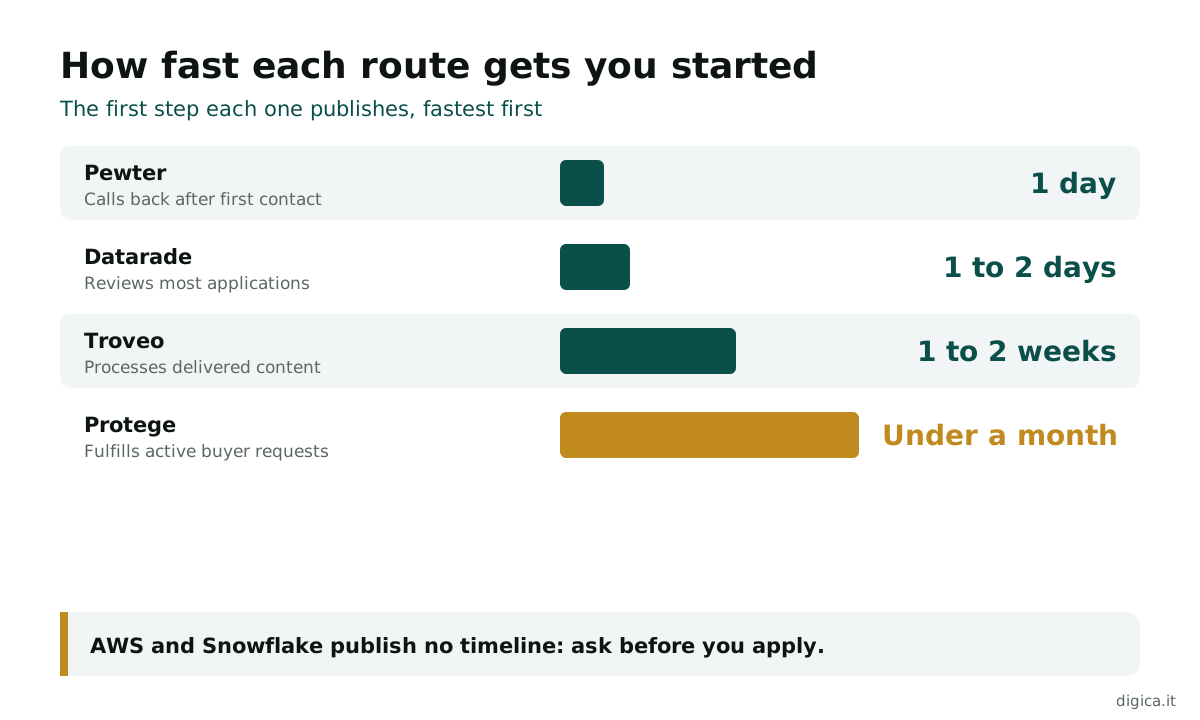
How long does it take to sell data? It depends on the route. Datarade reviews most applications within one to two business days, Troveo processes content in one to two weeks, and Protege says it often fulfills active buyer opportunities in under a month.
Related Articles
- Data marketplace growth
- Best data marketplaces in 2026: 10 platforms compared
- AI training data market: who buys, who sells, who wins
- Best places to buy datasets for AI training
- Best B2B data providers in 2026: data brokers compared
Where this connects
This article is part of our B2B marketplace growth series. Browse more on the Digica blog.