The best places to buy datasets for AI training in 2026, compared on training rights and provenance
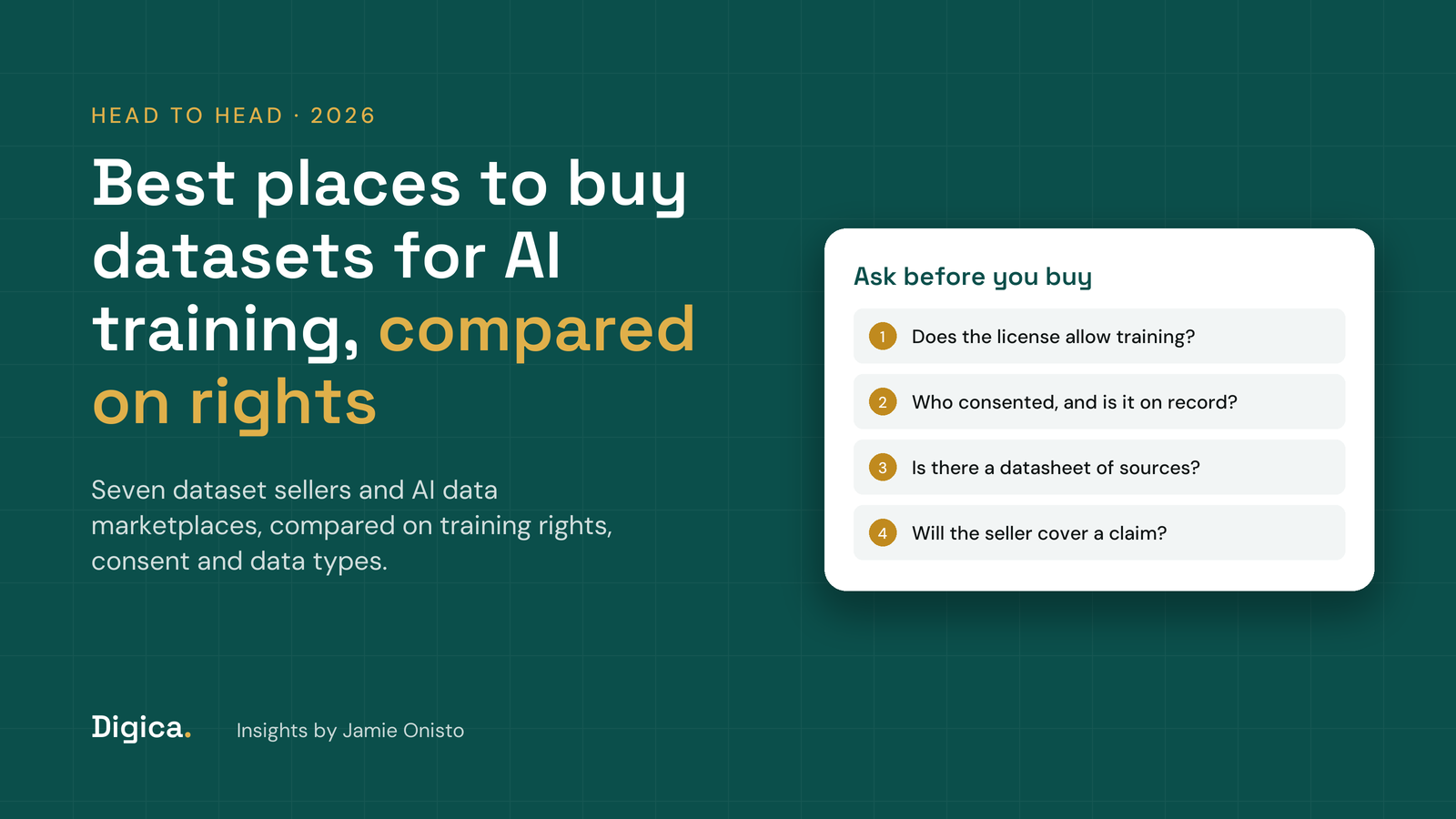
If you buy datasets for AI training, the price is rarely the biggest risk. The rights are. The Data Provenance Initiative audited about 4,000 widely used datasets and found that while fewer than a third carry restrictive licenses themselves, over 80% of the source content in widely used text, speech and video datasets comes with non-commercial restrictions (Data Provenance Initiative, arXiv). The license on the download page and the rights in the content can be two different things.
That gap is why a growing set of companies now sells datasets with the rights cleared at the source: stock media libraries licensing their archives, specialist brokers paying creators for unpublished footage, and AI data marketplaces where owners license data under one standard contract. They differ sharply in what they will actually promise you in writing.
This guide compares seven of the best places to buy datasets for AI training on the questions a legal or procurement team will ask: does the license grant the right to train, how was the data consented and documented, and which data types it covers, from text and speech to images and video. Figures are each company's own, checked on October 23, 2026. If you are looking at the wider market, including data for analytics, start with our ranking of data marketplaces.
Quick Navigation
- What buying a dataset actually gets you
- Seven places to buy datasets, side by side
- Shutterstock against Getty Images: licensed media at scale
- Defined.ai against Protege: AI data marketplaces with contracts
- Troveo against Wirestock: video training data from creators
- Created by Humans: book text with author consent
- LLM datasets and video datasets: what changes by data type
- What to check in a dataset license
- Three failure scenarios
- Which source fits your model
- FAQ
- Related Articles
What buying a dataset actually gets you
The short answer: when you buy datasets for AI training, you are buying a license to use data for a stated purpose, and the value is in what that license permits, what the seller warrants and how well the data is documented.
Most commercial dataset licenses are narrower than buyers assume. They typically allow use inside your own business, ban reselling the data, and set limits on what a model trained on it may produce. Some allow commercial use of the trained model outright. Others restrict it to research. A few promise to cover you if a rights holder complains, most do not.
Provenance is the second half. A well-documented dataset tells you where each item came from, who created it, whether people shown in it signed releases, and when it was collected. That matters for two reasons. It is the evidence you need if anyone challenges your model, and regulators now ask for it, as we cover below.
The third question is fit. Datasets for AI training come in very different shapes: text for large language models, speech with speaker metadata, images with captions, video with motion and camera data, and structured records. No single seller is strong in all of them, which is why most AI teams end up buying from two or three.
Our view: the cheapest dataset is the one you never have to retrain away from. Paying more for clean rights is usually cheaper than paying later to prove what you trained on.
Seven places to buy datasets, side by side
The short answer: Shutterstock and Getty Images lead for licensed images and video at scale, Defined.ai publishes the clearest training license, Protege leads for governed sensitive data, Troveo and Wirestock for creator video and media, and Created by Humans for book text.
Seven places to buy datasets for AI training compared on data types, training rights, provenance, cost model, main risk and best fit
| Source | Data types | Training rights stated | Provenance and consent | Cost model | Main risk | Best for |
|---|---|---|---|---|---|---|
| Shutterstock | Images, video, audio, 3D, metadata | Rights-cleared data for model training | Contributor libraries, contributor fund since 2022 | Custom license | Dataset contract terms not published | Image and video models at scale |
| Getty Images | Images, video, metadata, 3D | "Safe for commercial use" datasets | 600,000+ contributors, curated sets | Custom license | Release terms not published | Commercially safe image and video sets |
| Defined.ai | Speech, text, image, video, multimodal | Published license allows commercial use of trained models | Informed consent claimed, 1.6M+ contributors | Per dataset | Outputs must not reproduce contributors | Speech and multilingual data with clear terms |
| Protege | Clinical records, imaging, film and TV, audio | Governed exchange with privacy and IP checks | Partners paid per use, no public datasheets | Revenue share to partners | Little public license detail | Healthcare and premium media data |
| Troveo | Video, audio, text, robotics | Licensed from content owners | Non-public data, no digital replicas of creators | Per minute, reported $1 to $4 | Consent terms not published | Video and audio at volume |
| Wirestock | Images, video, 3D, music | "Ethically sourced" training data | 700,000+ creators, no public consent terms | Custom license | Thin public documentation | Creator media and custom shoots |
| Created by Humans | Book text | Training and reference rights, non-exclusive | Authors verify identity and opt in by title | License per catalog | Few published buyer deals | Long-form text with author consent |
The table rewards documentation. A seller that publishes its license and consent process ranks above one with a bigger library and vaguer terms, because your legal team will ask for both.
Shutterstock against Getty Images: licensed media at scale
The short answer: Shutterstock has the broader set of AI data services and the larger disclosed data business, while Getty Images leans harder on commercially safe curation and exclusive custom datasets.
Shutterstock licenses training data drawn from its own libraries, Bigstock and Pond5, covering images, video, audio, 3D and the metadata attached to them. In October 2025 it added services for model builders: custom content production, preference data, curation and annotation, and evaluation pipelines. Its 2025 annual report shows its data, distribution and services line at $203.3 million, about 21% of total revenue of $989.9 million, with growth attributed to demand for AI training data and metadata.
Selling datasets to AI teams?
In 30 minutes we look at how AI buyers find dataset sellers and data marketplaces like yours, and where your catalog is too thin to win their deals.
Getty Images sells what it calls curated, rights-cleared datasets, describing its image and video training dataset as safe for commercial use, with rich metadata exclusive to Getty. For custom work, it builds datasets for a customer's exclusive use with a network of more than 340,000 creators. Its 2025 annual report counts over 645 million images and videos and more than 600,000 contributors. Getty datasets are also sold through Defined.ai.
Both have been tested by events. Getty's UK case against Stability AI ended in November 2025 with its training claim dropped and its secondary copyright claims dismissed, which shows how hard it is to enforce rights after the fact. The planned Getty and Shutterstock merger was terminated in July 2026 after the UK competition regulator required a sale of part of Shutterstock's business.
The head-to-head. Choose Shutterstock for breadth across media types and added services such as preference data. Choose Getty when commercial safety and an exclusive custom set matter more than range.
Defined.ai against Protege: AI data marketplaces with contracts
The short answer: Defined.ai is the most transparent seller here about training rights, while Protege is built for data too sensitive to sell without a governance layer.
Defined.ai runs both a marketplace and its own catalog of speech, text, image, video and multimodal datasets. Its published data license agreement limits use to the buyer's internal business, bans reselling the data and explicitly allows commercial use of models trained, tested or benchmarked on it, provided the outputs do not reproduce recognizable contributor content such as voices or faces. It says its data comes with informed consent and fair pay from more than 1.6 million contributors in 500+ languages and locales, and it holds ISO 27001, 27701 and 42001 certifications. In January 2026 it reported 65% revenue growth for 2025.
Protege calls itself a governed data exchange. It specializes in data that most sellers cannot touch: de-identified clinical records and medical imaging, plus film, TV, audio and motion capture, including the archive it gained by buying Calliope Networks. A compliance layer reviews privacy and intellectual property, and data partners are paid a revenue share each time their data is used. It raised a $25 million Series A in August 2025 and a further $30 million from a16z in January 2026.
The difference is what you can read before you talk to sales. Defined.ai publishes its contract. Protege does not publish dataset-level terms, so the governance has to be checked in diligence.
The head-to-head. Choose Defined.ai when you want to read the training rights before you sign. Choose Protege for healthcare or premium media data that needs a governed process to sell at all.
Troveo against Wirestock: video training data from creators
The short answer: Troveo is the larger specialist in licensed video training data, while Wirestock builds custom media from a large creator network.
Troveo says it holds more than 8 million hours of licensed video and 4 million hours of audio, and that every dataset in its library is sourced and licensed from content owners, is not publicly available and has not been used in a prior training run. It reported paying content owners more than $20 million by May 2026. Bloomberg reported in 2025 that AI companies were paying creators $1 to $4 a minute for unused footage through brokers such as Troveo, and the deals reported at the time barred AI firms from making digital replicas of the creators.
Wirestock supplies images, video, 3D, design assets and music for AI training. In May 2026 it raised a $23 million Series A, reporting more than 700,000 creators and an annual revenue run rate above $40 million. It describes its data as ethically sourced but does not publish its consent terms.
Do AI teams find your datasets when they search?
A growth audit maps how AI buyers search for training data, on Google and in AI answers, and which of your dataset and category pages they never reach.
For a video model, the question is not only volume. It is whether the footage includes people, and whether each person signed a release. Neither company publishes its release process, so ask for a sample of releases with any order.
The head-to-head. Choose Troveo for volume of existing video and audio. Choose Wirestock when you need new, commissioned media in a specific style.
Created by Humans: book text with author consent
The short answer: Created by Humans is the clearest consent model for long-form text, built with authors rather than around them.
It launched in January 2025 as the official AI licensing partner of the Authors Guild. Authors verify their identity, claim their works by ISBN and choose which books, if any, to license. It offers training rights and separate reference rights for retrieval-augmented generation (RAG), where a model looks up the text at answer time, under non-exclusive contracts.
The case for it is provenance. Text is where the most expensive training disputes have been. Anthropic's $1.5 billion settlement with authors, approved in 2026, came from books taken from pirate libraries. A license that each author opted into is the opposite of that. It gives a buyer a named rights holder behind every title.
The limit is scale and track record. Early coverage questioned how far its protections went in practice, and it has not published named buyer deals. For a large language model, it is a source of high-quality licensed text, not a replacement for a full training corpus.
Why it is here. The most direct route to long-form text with documented author consent.
LLM datasets and video datasets: what changes by data type
The short answer: LLM datasets are judged on rights and quality per token, video datasets on releases and metadata per minute, and speech datasets on speaker consent and coverage.
For text and LLM datasets, the hardest material to license is long-form, professionally written and recent: books, journalism, technical writing and expert reasoning. Created by Humans and the publisher deals cover the first two. Human data vendors cover expert reasoning, which is why many teams buy post-training data from them rather than from dataset sellers. Our ranking of data annotation and AI training data companies covers that side.
For video datasets and video training data, the questions multiply. Who appears on camera and did they sign a release? Is there motion, depth or camera metadata? Is the footage unpublished, so no other lab has trained on it? Troveo, Shutterstock, Getty and Protege all sell video, but they document it differently.
For speech, buyers look for speaker counts, accents, recording conditions and consent per speaker. Defined.ai leads on published terms here.
The US Copyright Office's May 2025 report on generative AI training found that voluntary licensing markets were developing and recommended letting them continue without new legislation (US Copyright Office). For buyers, that means the contract, not a statute, is where the rights are set. Our guide to the AI training data market maps who sells each type and the deal structures in use.
What to check in a dataset license
The short answer: check six things before you sign: the permitted use, model output limits, resale and sharing, warranties, documentation and term.
- Permitted use. Does the license say training, fine-tuning and evaluation explicitly, and for commercial models?
- Output limits. Does it restrict what the trained model may produce, such as recognizable voices, faces or styles?
- Resale and sharing. Can your contractors and cloud providers access the data, and can you share the model?
- Warranties and indemnity. Does the seller confirm it had the right to license the data, and will it cover you if it did not?
- Documentation. Is there a datasheet with sources, collection dates, consent and releases?
- Term. What happens to the data, and to models trained on it, when the license ends?
A seller that answers all six in writing has done the work. A seller that answers two is asking you to take the rest on trust. Our view: sellers that publish these answers make the buyer's legal review shorter, and a shorter review is usually what decides who gets the order.
Three failure scenarios
These are the patterns that recur when an AI team buys datasets on price and volume alone.
- The research license in a product. A startup fine-tunes its commercial model on a cheap speech dataset, then finds during due diligence for its next round that the license covers research only. Retraining on licensed data delays the round by a quarter. Reading the permitted-use clause before purchase would have taken an hour.
- The video with no releases. A team buys a large video dataset that includes recognizable people, and the seller cannot produce model releases when a customer's lawyers ask. The customer pauses the contract. A seller that documents releases per clip would have closed the question in a day.
- The archive everyone already trained on. A lab pays for a large public-domain text set expecting an edge, then discovers most competitors trained on the same material. The money bought nothing distinctive. Paying for unpublished or exclusive data would have bought the difference.
Each team bought data. None of them bought the rights or the evidence they actually needed.
Which source fits your model
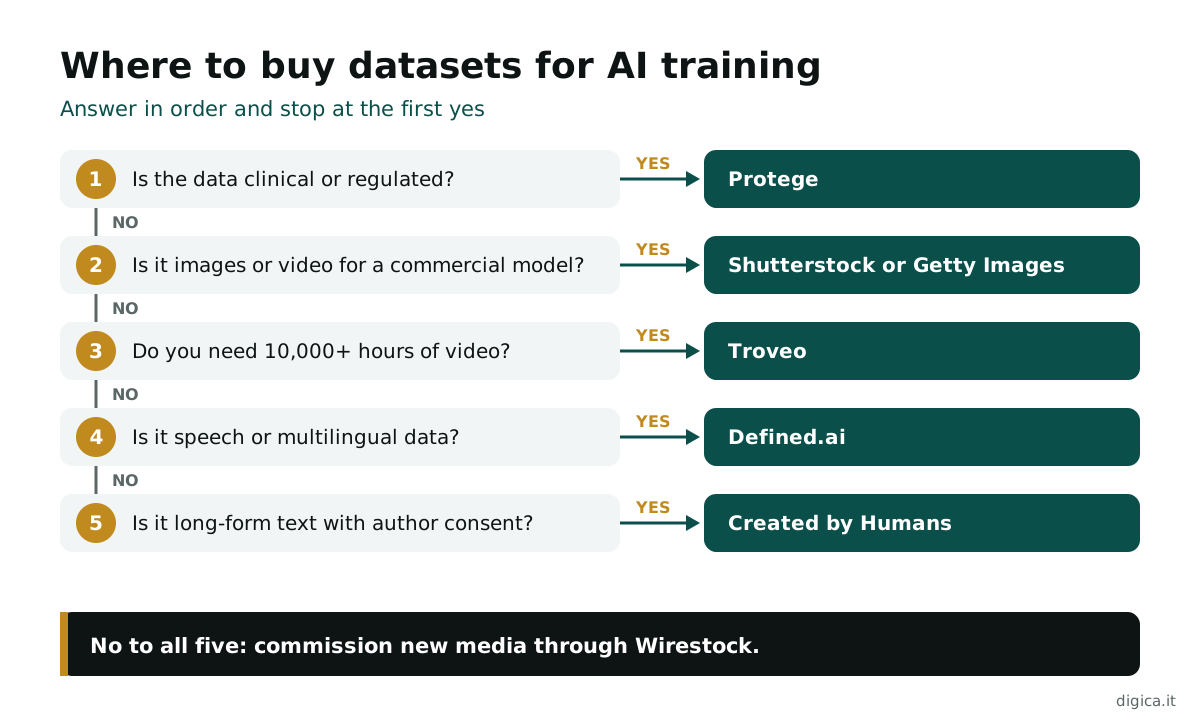
The short answer: start with the data type, then the rights you need, then how much documentation your buyers or regulators will ask for.
- If more than half your training budget is images or video and you sell commercially, shortlist Shutterstock and Getty Images and compare their indemnity terms.
- If you need speech or multilingual data and want to read the license first, start with Defined.ai.
- If your model needs clinical or other regulated data, use a governed exchange such as Protege and budget extra time for diligence.
- If you need more than 10,000 hours of video or audio, approach Troveo and ask for per-minute pricing and sample releases.
- If you need new media in a specific style, commission it through Wirestock.
- If you are training a language model and want author-consented text, add Created by Humans to your sources.
Running a data or AI training data B2B marketplace?
We help data B2B marketplaces recruit the data owners that make a catalog worth buying from, and reach the AI teams searching for datasets.
The number to take into your next budget meeting is what clean rights are worth. Shutterstock's data business alone brought in $203.3 million in 2025, and Anthropic agreed to pay $1.5 billion, about $3,000 per book, over books it had not licensed. If you buy datasets with documented rights up front, you save the cost of retraining and the delay in diligence. From August 2, 2025, the EU's template for general-purpose AI models requires providers to publish a summary of their training content, including sources (European Commission). The biggest cost of doing nothing is a model you cannot document, sold into a market that now asks for it.
FAQ
Where can I buy datasets for AI training? You can buy datasets for AI training from stock media companies such as Shutterstock and Getty Images, AI data marketplaces such as Defined.ai and Protege, and specialist brokers such as Troveo for video. Each publishes different terms on training rights.
Does buying a dataset give you the right to train a commercial model? Not always. Some licenses allow commercial use of trained models, such as Defined.ai's published license, while others limit use to research. Read the permitted-use clause and ask for a warranty that the seller had the right to license the data.
How much does AI training data cost? Prices vary by type and are mostly quoted per deal. Bloomberg reported in 2025 that AI companies paid creators $1 to $4 a minute for unused video footage, with higher prices for 4K and drone footage.
Where can I buy video datasets for AI training? Troveo, Shutterstock, Getty Images and Protege all sell video training data. Troveo says it holds more than 8 million hours of licensed video, and Protege added a film and TV archive by buying Calliope Networks.
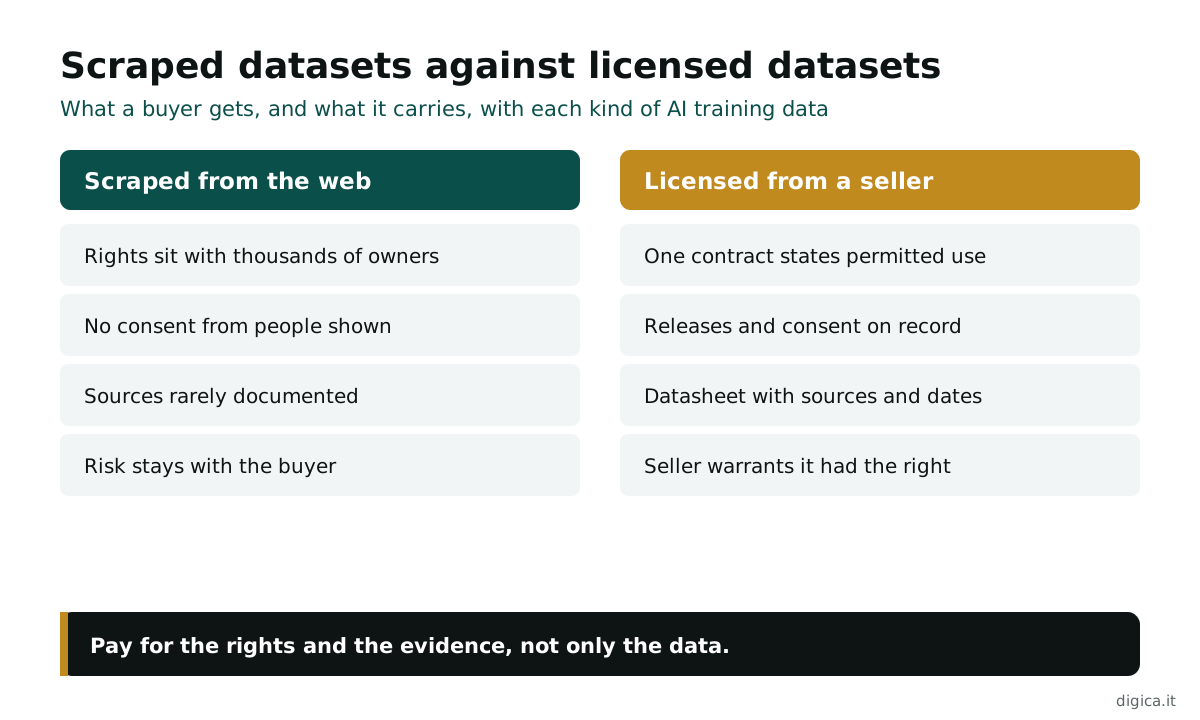
What is the difference between a licensed dataset and a scraped one? A licensed dataset comes with a contract stating what you may do with it and, ideally, documentation of where each item came from and who consented. A scraped dataset is collected from the web, often without the rights holders' permission, which leaves the risk with the buyer.
Are LLM datasets different from other AI training data? Yes. LLM datasets are text, and the scarce kinds are long-form, professionally written or expert reasoning data. Buyers judge them on rights, quality and whether competitors have already trained on the same material.
Related Articles
- Data marketplace growth
- Best data marketplaces in 2026: 10 platforms compared
- AI training data market: who buys, who sells, who wins
- Best data annotation and AI training data companies
- Best API marketplaces and directories
Where this connects
This article is part of our B2B marketplace growth series. Browse more on the Digica blog.