Marketplace Vendor Onboarding: Why Listed Is Not Live
Most B2B marketplaces count a vendor as onboarded the moment the signup form is submitted. That number looks great in a board deck. It says nothing about whether the vendor will ever answer a buyer. In the marketplaces we audit, it is common to find that fewer than half of the vendors who joined in the last 90 days have a complete profile, and fewer still have replied to a single request.
Listed is not live. A vendor who is listed but silent costs you twice: you paid to acquire them, and every buyer who contacts them and hears nothing learns that your marketplace does not work. Fix vendor onboarding and you fix the supply side of the engine, which is why it is one of the first things we look at in any B2B marketplace growth consulting engagement.
This guide sets out an activation-first vendor onboarding process built on three gates: profile completion, first response and first lead. It covers the metrics to track, starting targets, what to automate and what to hand-hold, and the failure scenarios that quietly drain supply.
Quick Navigation
- Marketplace onboarding is not procurement onboarding
- Listed is not live: the activation gap
- The activation-first onboarding process
- Gate 1: A profile buyers can use
- Gate 2: First response inside the hour
- Gate 3: First lead in 14 days
- Activation metrics and starting targets
- What to automate and what to hand-hold
- Four failure scenarios
- Where to start: a decision framework
Marketplace onboarding is not procurement onboarding
Search for "vendor onboarding" and most results describe procurement: how a large company vets a new supplier for risk, tax forms, insurance and compliance before paying its first invoice. That is a real discipline, but it is not this one.
On a marketplace, the direction is reversed. The vendor is your customer and your product at the same time. Marketplace vendor onboarding, also called seller onboarding or marketplace supplier onboarding, is the process that turns a signup into a supplier buyers can find, trust and hire. Verification still matters, especially if you handle payments, but it is one step inside a bigger job. The goal is not a clean file. The goal is a vendor who responds, wins work and stays.
That difference changes what you measure. Procurement teams measure time to approve. Marketplace teams should measure time to first lead.
Listed is not live: the activation gap
The supply count on your homepage is a vanity number until you know how much of it is active. Investors have said this for years. In its guide to 13 metrics for marketplace companies, Andreessen Horowitz frames the core job of any marketplace as matching supply with demand, and lists match rate, market depth and supply concentration among the numbers that matter. None of those is "vendors signed up."
The activation gap is the distance between listed vendors and live vendors. We define a live vendor with three conditions:
- Complete: the profile has the fields buyers filter and decide on.
- Responsive: the vendor has replied to at least one buyer request within your response window.
- Proven: the vendor has received at least one qualified lead and engaged with it.
A marketplace with 2,000 listed vendors and 600 live ones does not have 2,000 vendors. It has 600, plus 1,400 profiles that can hurt buyer experience when they appear in search results and go silent. When we grew a B2B agency marketplace to more than 40,000 listed agencies, the work that mattered was never the listing count. It was how many of those agencies could take a brief that week.
This is also why onboarding drives liquidity. If buyers keep landing on vendors who never answer, match rate falls, and no amount of demand-side spend fixes it. We cover that link in detail in our piece on the liquidity metric that compounds.
The activation-first onboarding process
An activation-first vendor onboarding process is built backwards from the first lead. Every step exists to get a vendor to their first real buyer conversation as fast as possible. Anything that does not serve that goal moves later.
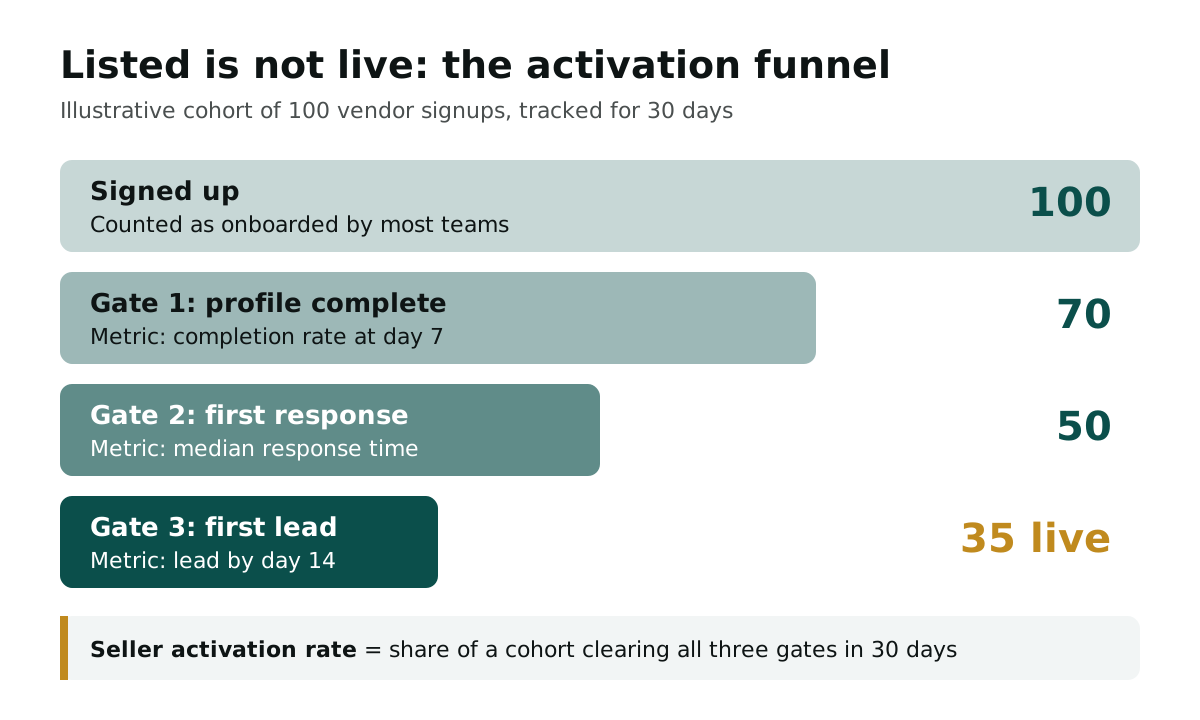
The process has three gates, each with one owner and one metric:
- Gate 1, profile complete. The vendor has filled the fields that make them findable and comparable. Metric: profile completion rate at day 7.
- Gate 2, first response. The vendor has answered a buyer request, or a structured test request, inside the hour. Metric: median first response time.
- Gate 3, first lead. The vendor has received and engaged with a qualified lead. Metric: share of new vendors with a first lead by day 14.
Seller activation rate is then simple: the share of a monthly signup cohort that clears all three gates within 30 days. Track it by cohort, not as a blended total, or a big month of signups will hide a broken flow.
Find your activation gap
We map your vendor onboarding gates and show where new supply stalls before it ever reaches a buyer.
In our experience, most marketplaces already have the data for this. Signup dates, profile fields, message timestamps and lead records sit in the product database. Nobody has joined them into a cohort view. That join is usually a few days of analyst time, and it changes the conversation from "we need more vendors" to "we need the vendors we have to go live."
Gate 1: A profile buyers can use
A complete profile is not every field filled. It is the fields buyers use to shortlist. Ask your sales or support team which five questions buyers ask most, and make those the required fields.
For most B2B marketplaces the list looks like this:
- Services or product categories, mapped to your taxonomy, not free text.
- Location and the regions served.
- A price signal: hourly rate, minimum project size or a price range.
- Two or three proof points: case studies, client names where allowed, certifications.
- A named contact who will receive leads.
Then cut everything else from the first session. Company history, team photos and long descriptions can come after the first lead, when the vendor has a reason to invest time.
Three tactics move completion fastest. First, prefill from what you already know: the vendor's website, public company data or the signup form. Second, show a completion meter tied to a benefit, such as "complete profiles appear in category search." Third, hide incomplete profiles from search by default. That last one feels harsh, but it protects buyers and gives vendors a clear reason to finish.
Gate 2: First response inside the hour
Response speed is where most vendor onboarding quietly fails. A vendor finishes the profile, a buyer sends a request three weeks later, and the email lands in an inbox nobody checks.
The research on lead response is blunt. In a study published in Harvard Business Review, The Short Life of Online Sales Leads, researchers audited 2,241 US companies and found that firms that tried to contact a lead within an hour were nearly seven times as likely to qualify it as those that waited longer. Only 37% responded within an hour, and 23% never responded at all. Your vendors behave the same way, and on a marketplace their silence is charged to your brand, not theirs.
So make the first response part of onboarding, not something you hope for later:
- Run a test request. In week one, send each new vendor a realistic sample brief and ask them to reply through the platform. It teaches the workflow and tells you who is reachable.
- Confirm the channel. Ask where they want leads: email, SMS, Slack or app notification. Verify it with a real message.
- Set the expectation in writing. "Vendors who reply within one hour get ranked higher" is a rule vendors understand.
- Escalate fast. If a real request sits unanswered for four hours, notify the vendor again and alert your supply team.
Response time then becomes a ranking signal. Fast responders get more visibility, slow responders get fewer leads, and vendors learn that speed pays.
Gate 3: First lead in 14 days
The first lead is the moment a vendor decides whether your marketplace is worth their time. If it does not arrive, the vendor stops logging in, and by the time a buyer finally shows up, the vendor is gone.
You cannot wait for organic demand to reach every new vendor. You have to route it. Three ways to do that:
- New vendor boost. Give newly complete profiles a temporary ranking lift in their category for 14 days, capped so buyers still see proven vendors first.
- Matched introductions. For high-value categories, have a supply manager hand-pick a suitable open request and introduce the new vendor.
- Category-first recruiting. Recruit vendors into categories where demand already exceeds supply, so the first lead is likely. Recruiting into crowded categories guarantees a slow start.
The last point connects onboarding to acquisition. If you are deciding where to recruit next, our guide to attracting vendors to a B2B marketplace covers how to pick categories by demand gap.
A useful rule from our own work on partner and referral programmes: the onboarding that sticks is the one that ends in a real outcome. In one SaaS partner motion, 94% of referred accounts were still active after onboarding, because every account was walked to a first result rather than left at signup.
Activation metrics and starting targets
Public benchmarks for marketplace vendor activation are thin, and most published numbers mix very different business models. Treat the figures below as starting targets to calibrate against your own cohorts, not as industry facts. After three cohorts you will have your own baseline, which beats any borrowed number.
Track five numbers every month, by signup cohort:
- Profile completion rate at day 7. Starting target: 70% or more. Below 50% means the form is too long or the value is unclear.
- Median first response time. Starting target: under one hour during business hours, in line with the HBR research above.
- Response rate. The share of buyer requests that get any reply within 24 hours. Starting target: 90% or more.
- First lead by day 14. Starting target: 60% or more of complete vendors. If it is lower, routing or category fit is the problem.
- Seller activation rate at day 30. All three gates cleared. A marketplace moving from 35% to 60% has changed its supply economics.
Now attach money to it with a worked example. Assume you sign up 100 new vendors a month and it costs $400 in sales, marketing and review time to acquire each one, so $40,000 a month. Assume each live vendor pays a $300 monthly subscription. At a 35% activation rate, 65 vendors a month never go live. That is $26,000 of acquisition spend a month buying profiles that will not earn anything.
Lift activation to 60% and you add 25 live vendors per cohort, worth $7,500 in new monthly recurring revenue each month. Assume the fix costs $30,000: a rebuilt onboarding flow plus one supply manager for a quarter. Cumulative added revenue reaches $7,500 in month one, $22,500 in month two and $45,000 in month three, ignoring churn. Payback lands inside the third month.
Model your activation economics
We build the cohort view and the payback model from your own data, so you know what a better onboarding flow is worth.
The point of the model is not precision. It is to make the activation gap visible as a cost line, so that fixing onboarding competes fairly with buying more traffic. Swap in your own acquisition cost, subscription or take rate and cohort size. If the payback lands inside two quarters, onboarding belongs at the top of the roadmap, ahead of new demand campaigns.
What to automate and what to hand-hold
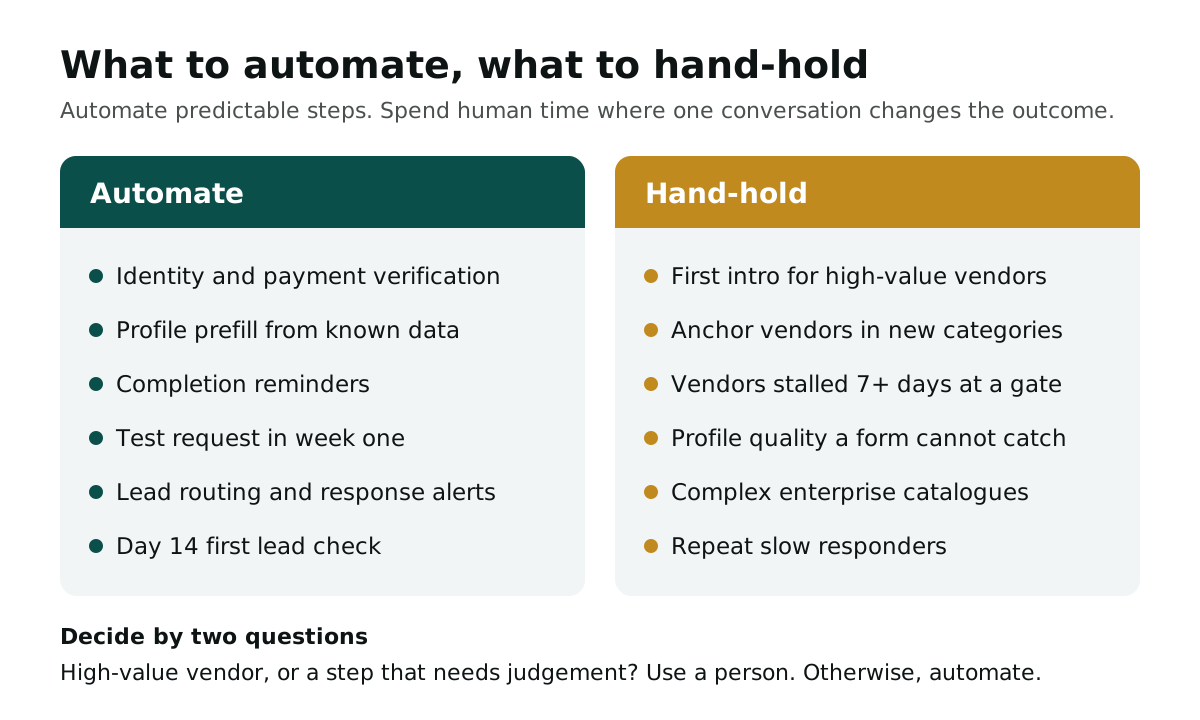
Not every vendor deserves a call, and not every step should be a call. The split depends on vendor value and on how much judgement the step needs. Automate the predictable steps and spend human time where one conversation changes the outcome.
| Approach | Cost per vendor | Main risk | Best for |
|---|---|---|---|
| Fully self-serve flow | Lowest: product build, then near zero | Silent drop-off nobody notices | Long tail vendors, low-value categories |
| Automated nudges plus test request | Low: email and in-app sequences | Vendors learn to ignore reminders | Most new vendors in their first 14 days |
| Supply manager hand-holding | High: one manager per few hundred vendors | Does not scale, depends on one person | High-value categories and anchor vendors |
| Group onboarding sessions | Medium: one weekly session | Low attendance, generic advice | Cohorts of similar vendors in one vertical |
| Paid concierge setup | Covered by a setup fee | Vendors expect ongoing service | Enterprise suppliers with complex catalogues |
Automate these: identity and payment verification, profile prefill, completion reminders, lead routing, response time alerts and the day 14 check. Hand-hold these: the first introduction for high-value vendors, any vendor stalled at a gate for more than seven days in a priority category, and vendors whose profile has quality problems a form cannot catch.
If you take payments, use your payment provider's onboarding rather than building your own. The trade-offs between collecting everything up front and collecting it later are covered further down, because getting that choice wrong is one of the most common failure scenarios we see.
Four failure scenarios
These are the vendor onboarding failures we see most often, and what each one costs.
1. The verification wall. A marketplace asks for bank details, tax IDs and identity documents before the vendor can see a single buyer request. Half of new vendors stop at that screen. Stripe's documentation on hosted onboarding for connected accounts describes the alternative: incremental onboarding, where you collect the minimum at signup and more as the account earns, so vendors can onboard quickly. The right call: collect verification when money is about to move, not before the first lead.
2. The silent inbox. Leads go to the email address used at signup, which belongs to a founder who never checks it. Buyers wait, then leave. As a worked example, assume 20 buyer requests a month go unanswered, each worth a $1,500 first project, and a 10% take rate, that is $3,000 a month in lost commission before you count the buyers who never return. The right call: verify the lead channel in week one with a test request.
3. The crowded category. Sales recruits vendors wherever they will sign, so new vendors pile into categories that already have too much supply. None of them gets a first lead. They churn, and sales recruits more. The right call: set recruiting targets by demand gap per category, reviewed monthly.
4. The cohort that hides. Activation is reported as one blended rate. A great month of signups lifts the number while the onboarding flow for one region is broken. The right call: report activation by monthly cohort and by category, and alert on any cohort that falls 10 points below the trailing average.
Where to start: a decision framework
Start with the gate where the most vendors stall, because that is where a fix pays back fastest. Pull your last three monthly cohorts and use these thresholds:
- Profile completion at day 7 below 50%: shorten the form to the five buyer questions, add prefill and hide incomplete profiles from search.
- Median first response above four hours: add the test request and lead channel check to week one, and make response time a ranking signal.
- First lead by day 14 below 40% of complete vendors: add the new vendor boost and redirect recruiting to categories with a demand gap.
- No cohort view at all: build it first. You cannot manage what you cannot see, and the build usually takes days, not weeks.
If you are not sure which gate is the bottleneck, a growth audit maps it from your own data in a few weeks.
Turn listed vendors into live ones
We work as your embedded growth team to rebuild vendor onboarding around the first lead and measure every cohort.
Here is the number for your next leadership meeting. In the worked example, 100 vendor signups a month at a 35% activation rate means 65 vendors who never go live, or $26,000 a month in acquisition spend that earns nothing. Over a year that is $312,000. A $30,000 onboarding fix that lifts activation to 60% pays back inside one quarter and keeps compounding with every new cohort. The cost of doing nothing is paying every month for supply that buyers can see but never hire.
FAQ
What is vendor onboarding in a marketplace? It is the process that takes a new vendor from signup to their first qualified buyer conversation: a complete profile, a verified lead channel, a first response and a first lead.
How is it different from procurement vendor onboarding? Procurement onboarding vets a supplier before a company buys from it, focused on risk and compliance. Marketplace vendor onboarding treats the vendor as a customer and focuses on activation.
What is a good seller activation rate? There is no reliable public benchmark across marketplace models. Use 60% of a monthly cohort clearing all three gates within 30 days as a starting target, then calibrate against your own history.
Should we verify vendors before they go live? Verify what buyers need to trust the vendor before they appear in search. Collect payment and tax details when money is about to move, unless regulation in your category requires otherwise.
Who should own vendor onboarding? One person or team on the supply side, measured on activation rate by cohort. Splitting it between sales, product and support means nobody owns the drop-off.
How long does it take to improve activation? Form and routing changes show up in the next monthly cohort. A full rebuild with a cohort view and hand-holding for priority categories usually shows a clear lift within one quarter.