The best commercial real estate marketplaces in 2026, compared head to head on listings and reach

A commercial real estate marketplace is where brokers and owners put a property in front of tenants and investors, and every one of them leads with a big number. LoopNet says its network draws 13 million visitors a month. Crexi says more than 2 million monthly active users. Brevitas says 350,000 listings have been created on it. Those numbers measure three different things, and choosing a platform on the biggest one is how listings end up in front of the wrong buyers.
The money behind the choice is growing. CBRE said in August 2026 that it still expects US commercial real estate investment volume to rise 16% this year (CBRE). More deals mean more listings competing for the same tenants and investors, and more pressure on brokers to pick the commercial real estate marketplace whose audience actually transacts.
This guide compares six commercial real estate marketplaces head to head on listings and reach: what each one carries, how many people see it and what its headline number really counts. It is written for brokers and owners deciding where to list, and for teams building or growing a commercial real estate B2B marketplace. Figures are each company's own, checked on October 28, 2026. For the professional networks behind the same deals, see our guide to real estate directories and communities.
Quick Navigation
- What counts as a commercial real estate marketplace
- Six commercial real estate marketplaces, scored side by side
- LoopNet against Crexi: the two biggest listing marketplaces
- Ten-X against RCM: auctions and investment sales
- CommercialCafe against Brevitas: leasing reach and wide coverage
- What each headline number really counts
- Three failure scenarios
- Where to list: a decision framework
- FAQ
- Related Articles
What counts as a commercial real estate marketplace
The short answer: a commercial real estate marketplace is a platform where many brokers and owners list office, industrial, retail, land and investment property for lease or sale, and tenants and investors search it in one place. A single brokerage's website does not count, and neither does a residential portal.
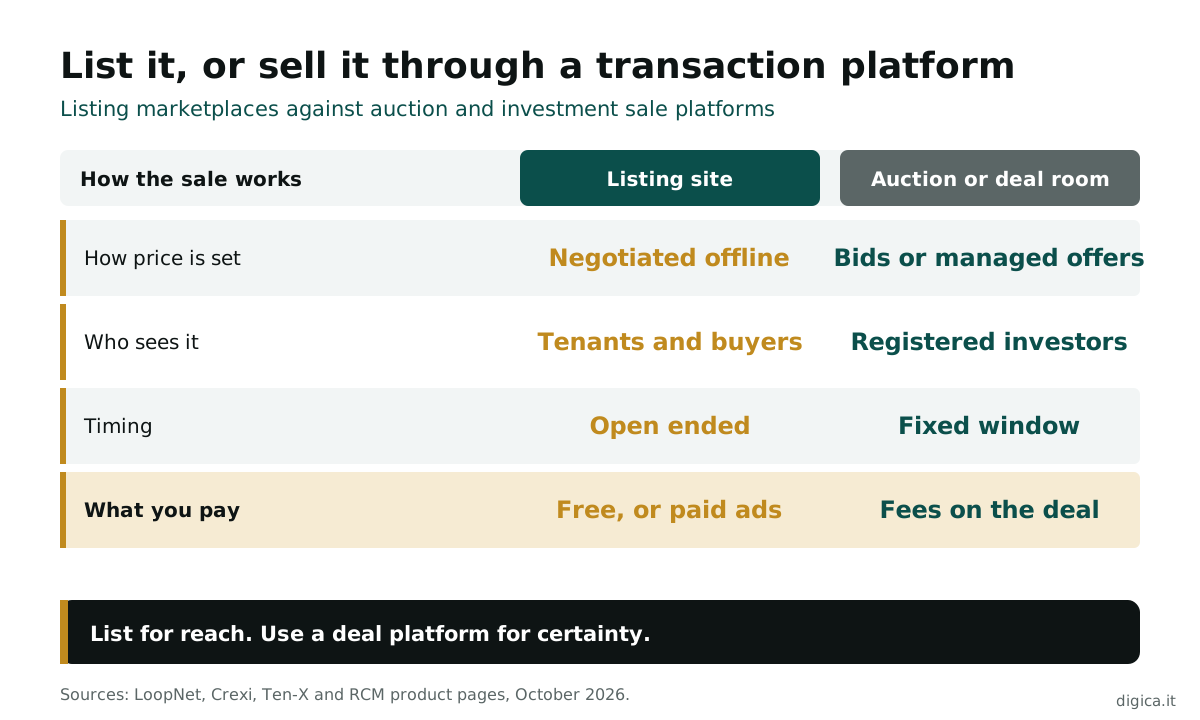
The category splits into two models. Listing marketplaces, such as LoopNet, Crexi, CommercialCafe and Brevitas, show a property and its price, and the broker negotiates offline. Transaction platforms, such as Ten-X and Real Capital Markets (RCM), run the sale itself, through an online auction or a managed offer process with a virtual deal room.
Both are B2B marketplaces in the full sense. Brokers and owners are the supply side, tenants and investors are the demand side, and the platform makes money when the two sides keep coming back. The same tests we apply to every B2B marketplace apply here: how much supply it carries, whether buyers really use it and how well it matches the two.
A commercial real estate directory is related but different. It lists firms and professionals rather than properties. Some marketplaces add a broker directory on top of their listings, which helps tenants find a specialist when no listing fits.
Our view: judge a commercial real estate marketplace on who searches it, then on how much it lists. A large inventory with the wrong audience makes your listing harder to find, not easier.
Six commercial real estate marketplaces, scored side by side
The short answer: LoopNet has the biggest audience claim, Crexi the strongest free listing offer, Ten-X the clearest auction record, RCM the deepest investor network for investment sales, CommercialCafe the tightest link to landlord software and Brevitas the widest international coverage.
Six commercial real estate marketplaces compared on headline number, what it counts, how listing works, main risk and best fit
| Marketplace | Headline number | What the number counts | Cost to list | Main risk | Best for |
|---|---|---|---|---|---|
| LoopNet | 13M+ monthly visitors | Visitors across LoopNet, CityFeet and Showcase | Free basic listing, paid Silver, Gold, Platinum and Diamond ads | Paid tiers decide how visible you are | Maximum exposure for lease and sale |
| Crexi | 2M+ monthly active users | Active users, plus $1T+ in transactions facilitated | Free listings, paid tools on top | Smaller audience than LoopNet's claim | Brokers who want reach without listing fees |
| Ten-X | 11,500 properties sold | Completed auction sales, $34B in total | Through Ten-X broker partners | Auction terms suit some sellers only | Sellers who want a firm timeline |
| Real Capital Markets (RCM) | 14k+ active listings | Live investment sale listings, 84K+ principal investors | Broker-run deal rooms and offers | Built for brokers, not owners | Institutional investment sales |
| CommercialCafe | Yardi listing network | Listings from brokers and Yardi landlord software | Free listings, syndication through Yardi | Leasing-led, fewer sale listings | Office, retail and coworking leasing |
| Brevitas | 350,000+ listings created | Listings created since launch, not live listings | Free to add, paid Premium | Cumulative number overstates live inventory | International and mixed portfolios |
Every figure is the company's own claim, and none of the six publishes an independent audit. Use the headline number to compare a platform with itself over time, not with its rivals.
LoopNet against Crexi: the two biggest listing marketplaces
The short answer: LoopNet wins on audience size and Crexi wins on cost to list. Most brokers with lease or sale inventory list on both, and pay for visibility only where the deal justifies it.
LoopNet
LoopNet is the flagship of CoStar Group's commercial listing network, which also includes CityFeet and Showcase. Its content page invites brokers to share expertise with 13 million monthly visitors, and its footnote says that figure covers the whole network, not LoopNet alone. CoStar's annual report shows LoopNet revenue of $312 million in 2025, up from $282 million in 2024, driven by more paid listings and a higher average price per listing.
Running a commercial real estate marketplace or directory?
In 30 minutes we look at how brokers, tenants and investors find platforms like yours, on Google and in AI answers, and where they drop off before they list or inquire.
That revenue line is the useful signal. Brokers pay more each year to stand out on LoopNet, which says the audience produces enough inquiries to justify it. It also says visibility is increasingly paid. A basic listing appears, but Silver, Gold, Platinum and Diamond ads get the placement and retargeting. CoStar told investors it planned to add 80 LoopNet sales staff in 2026, which points the same way.
Crexi
Crexi is the largest independent rival. In a July 2025 announcement with MRED, the Chicago-area listing service, Crexi said it had facilitated more than $1 trillion in transactions and 8.6 billion square feet leased, and had more than 2 million monthly active users. The MRED partnership put more broker listings from one large regional market onto Crexi, which is how a listing marketplace grows supply without asking each broker to re-enter data.
Crexi's pitch to brokers is free listings plus paid tools for marketing, data and auctions. That makes it the obvious second platform for every listing, and for some property types, such as small retail and net lease, the first. Its 2 million monthly active users is a stricter measure than total visitors, so the gap with LoopNet is smaller than the headline numbers suggest.
The verdict. List on both. Pay for LoopNet visibility on the listings where tenant volume matters most, and use Crexi to cover the rest at no listing cost.
Ten-X against RCM: auctions and investment sales
The short answer: Ten-X runs online auctions for sellers who want speed and certainty, and RCM runs broker-led investment sales for institutional buyers. Both measure success in completed deals, not visitors.
Ten-X
Ten-X is CoStar Group's online auction platform for commercial real estate, bought in 2020, and CoStar's annual report describes it as giving brokers, sellers and buyers access to auctions backed by its data (CoStar 10-K). Ten-X says it has sold 11,500 properties worth $34 billion in total and works with 7,500 broker partners. Sellers list through a broker, set a reserve and run a fixed bidding window, with due diligence documents posted in advance.
That model suits a specific seller: one who values a firm close date over the last few percent of price, such as a lender selling a bank-owned asset or an owner clearing a portfolio. Ten-X properties also appear on LoopNet, which gives an auction the reach of the larger listing network. The trade-off is that auctions signal a seller who wants to move, and some buyers bid accordingly.
Real Capital Markets (RCM)
RCM, now part of LightBox, is a deal platform for investment sales. It shows more than 14,000 active listings and says it reaches more than 84,000 principal investors and 300,000 industry professionals. Brokers use it to run the whole marketing process: confidentiality agreements, a virtual deal room, email campaigns and offer management.
RCM's number is the most useful of the six for an investment sale, because it counts principal investors, the people who sign. It is a broker's tool, not an owner's: owners reach RCM's network through the broker they hire. For a multifamily or industrial investment sale above a few million dollars, it is often where the serious buyers are already registered.
The verdict. Use Ten-X when the seller needs a date. Use RCM when the seller needs the widest field of qualified investors.
CommercialCafe against Brevitas: leasing reach and wide coverage
The short answer: CommercialCafe is built around leasing and landlord software, and Brevitas around breadth across property types and countries. Both are free to start, and both suit a broker who wants extra coverage beyond the two largest platforms.
CommercialCafe
CommercialCafe is Yardi's commercial listing marketplace. Its listings come from brokerages and from landlords who already use Yardi's property management software, and they are syndicated across Yardi's listing network. Yardi has folded other brands into it: CommercialEdge.com now redirects to CommercialCafe, and 42Floors has redirected there since May 2024.
That consolidation is the reason to list. Tenants searching for office, retail or coworking space find one site where they used to find three. For landlords already on Yardi, listings can flow in without being typed twice, which keeps vacancies current. The catch is that CommercialCafe is leasing-led, so a sale listing gets less from it than a lease listing does.
Brevitas
Brevitas covers the widest range of property types in this list, from business and land to hotels, multifamily and special purpose, and it carries international listings across the Caribbean, Latin America and Monaco. It says 350,000 property listings have been created on it and that it has more than 200,000 members worldwide. Anyone can add a property for free, with a paid Premium tier, and NAR members get a discount on its plans through NAR's partner program.
The listings number is cumulative. It counts every listing created since launch, not the inventory live today, so it is not comparable with an active listing count. What Brevitas does well is coverage: an owner or broker with a mixed portfolio, or a property outside the United States, can list everything in one place.
The verdict. Add CommercialCafe to every lease listing. Add Brevitas when the property is unusual, international or part of a mixed portfolio.
What each headline number really counts
The short answer: there are four kinds of headline number in commercial real estate marketplaces: visitors, active users, listings and completed deals. Each one answers a different question, and only the last one proves that buyers act.
Visitors, as in LoopNet's 13 million, count everyone who arrives, including people who leave after one page, and here they cover a network of three sites. Active users, as in Crexi's 2 million, count people who log in or engage, which is a stricter test. Listings, as in RCM's 14,000 active and Brevitas's 350,000 created, measure supply, and the difference between active and created matters. Completed deals, as in Ten-X's 11,500 properties sold, measure outcomes. A platform that reports completed deals is telling you what happened after the inquiry, which is the part a broker is actually paid for.
Do brokers and tenants find your property marketplace before a rival's?
A growth audit maps how brokers, tenants and investors search for commercial real estate marketplaces like yours, on Google and in AI answers, and which of your property and location pages they never reach.
Market conditions decide which number matters most for a given listing. The National Association of REALTORS® reported that hotel sales volume rebounded to $27.9 billion in the 12 months to August 2026, up from $20.9 billion in 2025, while retail vacancy held at 4.3% (NAR). In a tight retail market, tenant reach matters most, so visitors and active users count. In a rebounding sale market, the number of qualified investors counts.
The useful question to ask any commercial real estate marketplace is not how big it is. Ask how many inquiries a listing like yours received there in the last 90 days, in your market. A platform that can answer that question knows its own buyers.
Three failure scenarios
These are the patterns that recur when brokers choose where to list on headline numbers alone.
- The biggest number with the wrong buyers. A broker selling a $15 million industrial portfolio relies on a basic listing on the largest listing site because it has the most visitors. Inquiries come from small owner-users, not institutional investors. Running the sale through an investment sale platform with registered principal investors would have put it in front of the buyers who could close.
- The free listing nobody saw. A landlord lists office suites only as free basic listings, and they sit below paid placements in every search. Vacancy runs a quarter longer than the market. Paying for visibility on the two largest suites, and listing the rest for free, would have cost less than one month of lost rent.
- The auction used for the wrong seller. An owner with no deadline sends a well-located retail center to auction because it promises speed. Bidders read the auction as pressure to sell and price it that way. A standard marketed sale, with an auction kept as a fallback, would have tested the price first.
Each broker used a real commercial real estate marketplace. None of them matched the platform's audience to the deal. With commercial mortgage debt near $5 trillion and investment volume rising, the cost of listing in the wrong place grows with every deal in the market.
Where to list: a decision framework
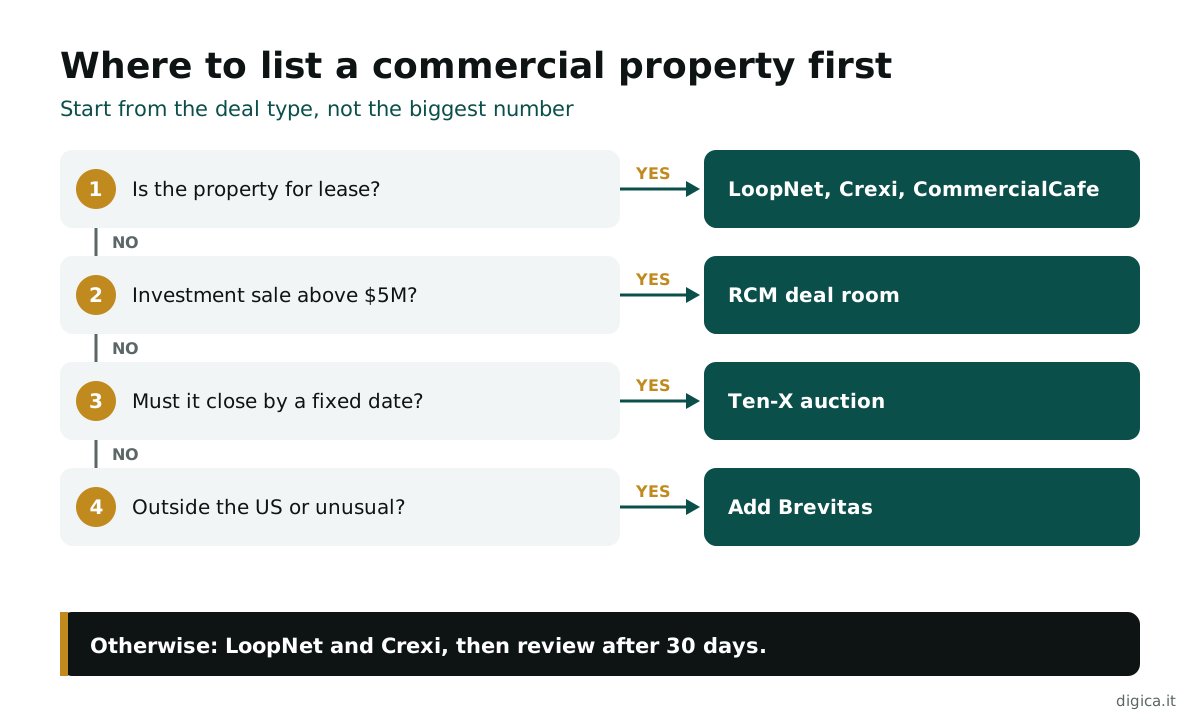
The short answer: list every property on the two largest listing marketplaces, then add the platform that matches the deal type.
- If the property is for lease, list on LoopNet and Crexi, add CommercialCafe, and pay for visibility only on spaces above your average size.
- If it is a standard sale under about $5 million, list on LoopNet and Crexi, and check inquiries after 30 days before paying for upgrades.
- If it is an investment sale above about $5 million, run the process through RCM or a similar deal room, and keep the public listings brief.
- If the seller needs a close by a fixed date, consider Ten-X, and set the reserve at a price the seller will accept.
- If the property is outside the United States or an unusual type, add Brevitas.
- If a platform cannot tell you how many inquiries similar listings received in your market, treat its headline number as marketing, not reach.
Growing a commercial real estate B2B marketplace?
We help commercial real estate marketplaces and directories recruit the brokers that make listings worth searching, and reach the tenants and investors comparing them.
The number to take into your next pricing conversation is inquiries per listing per month, not visitors. For example, a paid listing at $500 a month that produces 10 qualified inquiries costs $50 per inquiry. A free listing that produces one costs nothing and returns almost nothing. Measure both for 90 days on comparable properties and pay only where the cost per inquiry falls. The biggest cost of doing nothing is a vacancy that runs another quarter while the listing sits on page three.
FAQ
What is the biggest commercial real estate marketplace? By audience, LoopNet is the biggest, with 13 million monthly visitors across its network of LoopNet, CityFeet and Showcase. Crexi is the largest independent rival, with more than 2 million monthly active users.
Is Crexi free to list on? Crexi lets brokers and owners list properties without a listing fee, and sells paid tools for marketing, data and auctions on top. That makes it a common second platform alongside LoopNet.
What is a commercial real estate directory? A commercial real estate directory lists firms and professionals, such as brokers, appraisers and property managers, rather than properties. Some commercial real estate marketplaces add a broker directory to their listings so tenants can find a specialist.
How do commercial real estate auctions work online? On a platform such as Ten-X, a seller lists through a broker, sets a reserve price and runs a fixed bidding window, with due diligence documents posted in advance. The highest bid above the reserve wins, and the close follows on a set timeline.
Where should I list commercial property for lease? List lease space on LoopNet and Crexi for reach, add CommercialCafe for leasing-focused tenants, and pay for upgraded visibility only on the spaces where faster leasing is worth the cost.
Who owns LoopNet? LoopNet is owned by CoStar Group, which also owns CityFeet, Showcase and the Ten-X auction platform.
Related Articles
- Commercial real estate marketplace and directory growth
- Best real estate directories and communities
- Best surplus equipment marketplaces
- Best B2B marketplaces in 2026: 7 examples by industry
- Liquidity is the only marketplace metric that compounds
Where this connects
This article is part of our B2B marketplace growth series. Browse more on the Digica blog.