The best real estate directories and communities for professionals, grouped by type and judged on member reach
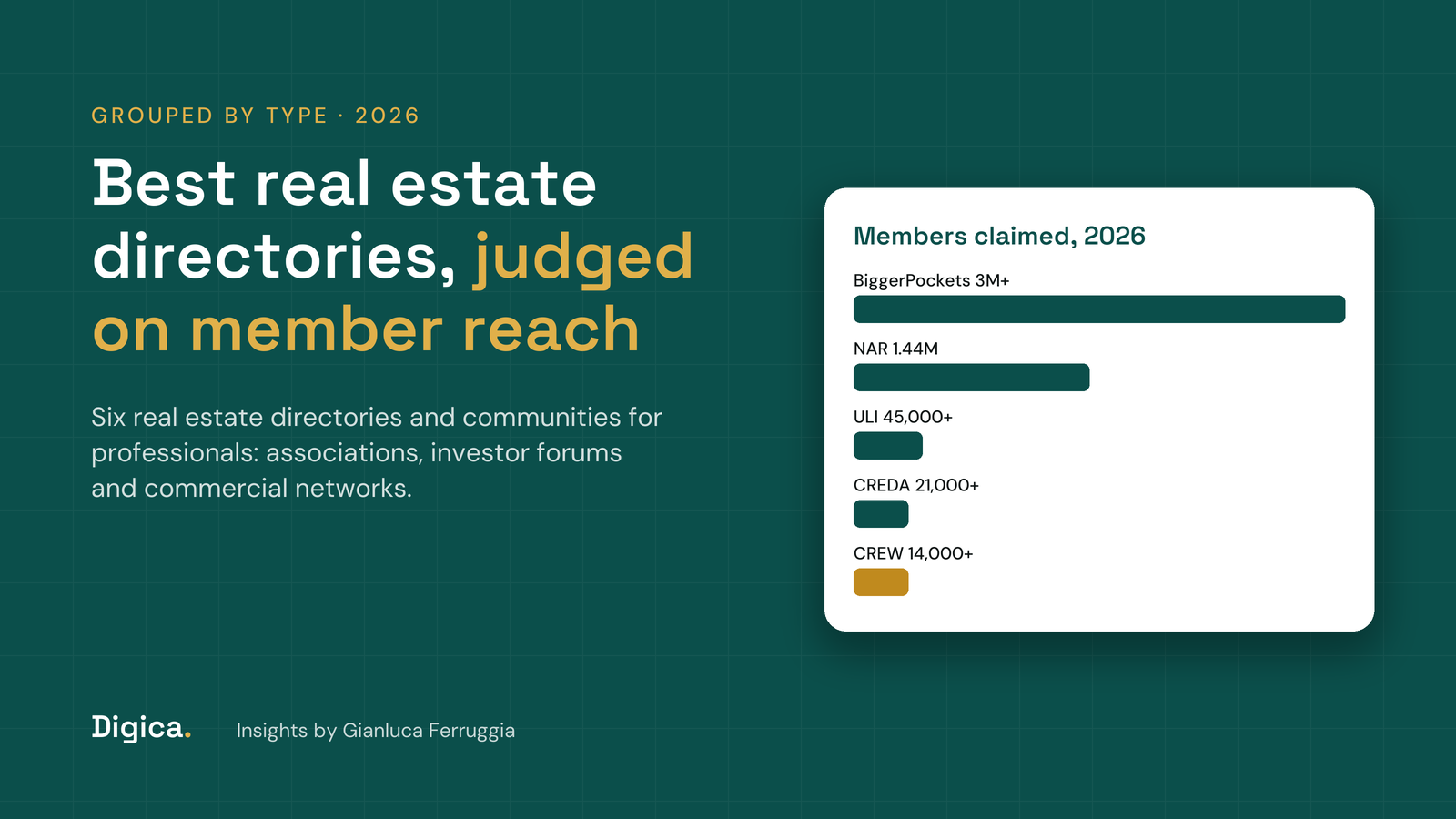
A real estate directory is only as useful as the people in it. The National Association of REALTORS® counted 1,439,163 members in June 2026, down only slightly from 1,463,352 a year earlier (NAR). BiggerPockets says its investor community has more than 3 million members. A commercial network such as CREW Network has about 14,000. Each of those numbers buys a professional a very different kind of reach.
The mistake most professionals make is to treat member count as the whole answer. A directory of 1.4 million agents is the right place to be found by a homebuyer's relocation team. It is the wrong place to meet the developer who will lease your next industrial building. Reach only matters when the members are the people you need to meet, and when the directory lets them find you.
This guide groups six real estate directories and communities for professionals by type: association directories, investor communities and commercial real estate networks. It judges each on member reach: how many members it claims, who they are and how members actually find each other. It is written for agents, brokers, investors and commercial real estate professionals choosing where to list themselves and where to spend networking time. Figures are each organization's own, checked on October 28, 2026. For the listing side of the same market, see our ranking of commercial real estate marketplaces.
Quick Navigation
- What counts as a real estate directory or community
- Six real estate directories and communities, side by side
- Association directories
- Investor communities
- Commercial real estate networks
- How members find each other in each directory
- Reach against relevance
- Three failure scenarios
- Choosing a real estate community: a decision framework
- FAQ
- Related Articles
What counts as a real estate directory or community
The short answer: a real estate directory lists professionals so others can find them, and a real estate community connects them so they can work together. The best organizations do both, and this guide only includes ones that do.
That rules out three things the phrase is often used for. Consumer agent-finder sites, which rank agents for homebuyers, are lead tools rather than professional directories. Property listing sites, such as the commercial real estate B2B marketplaces we cover separately, list buildings rather than people. And social media groups, which can be large, rarely publish a member count anyone can verify.
What is left are organizations with a member base, a way to search it and a reason to belong: trade associations with member directories, investor communities with forums and service-provider directories, and commercial networks built around development, land use or a professional group. Each one is itself a B2B community, with professionals on one side and the people who want to reach them on the other. That is why the tests we use on any B2B community apply here: how many members it has, whether they are active and how easily the right two members can find each other.
Our view: in real estate, a directory listing is a credential before it is a lead source. People check whether you are a member before they call you.
Six real estate directories and communities, side by side
The short answer: NAR has the widest reach among agents and brokers, BiggerPockets among investors, and ULI, CREDA, CCIM and CREW Network among commercial real estate professionals, where smaller numbers mean more senior members.
Six real estate directories and communities compared on members claimed, who they are, the directory offered, cost to join, main risk and best fit
| Organization | Members claimed | Who the members are | Directory offered | Cost to join | Main risk | Best for |
|---|---|---|---|---|---|---|
| National Association of REALTORS® | 1,439,163 (June 2026) | Agents, brokers, appraisers | Find a Member, Find an Office, specialty directories | Paid membership through a local association | So many members that a listing rarely stands out | Being verifiable as a REALTOR® |
| CCIM Institute | 9,000+ designees, 4,000 in pursuit | Commercial investment brokers and advisors | Find a CCIM, CCIMConnect | Paid membership plus designation courses | Designation takes time to earn | Commercial investment credibility |
| BiggerPockets | 3,000,000+ | Individual and professional investors | Agent, lender, tax, property manager and lawyer finders | Free account, paid Pro tiers | Mostly smaller investors | Reaching active investors |
| Urban Land Institute (ULI) | 45,000+ | Developers, investors, designers, public officials | Member directory, members only | Paid membership | Directory is closed to non-members | Senior land use and development contacts |
| CREDA (formerly NAIOP) | 21,000+ across 55 chapters | Developers and owners of office, industrial and retail | Membership directory, members only | Paid membership | Chapter strength varies | Industrial and office development |
| CREW Network | 14,000+ across 86 chapters | Women and allies across commercial real estate | Member directory, CREW app | Paid membership through a chapter | Smaller pool overall | Referrals across disciplines |
Every count is the organization's own claim. None publishes how many members are active in a typical month, so treat totals as reach on paper, not attention.
Association directories
The short answer: association directories trade breadth for verification. NAR proves you are a REALTOR® to anyone who checks, and CCIM proves you have passed a commercial investment curriculum.
National Association of REALTORS®: the widest professional reach
NAR is the largest real estate association in the United States, with 1,439,163 members as of June 18, 2026. Its directories hub includes Find a Member, Find an Office, Find an Association and a group and team directory, plus specialty lists for global, senior market, short sales and land professionals.
Reach here is about verification, not discovery. A relocation manager, a lender or a commercial broker in another state uses NAR's directory to confirm that a referral partner is who they claim to be. NAR's 2026 member profile reported that the typical REALTOR® has 13 years of experience, up from 12, and did nine transaction sides in 2025. That is a large, experienced base, and it means a plain listing will not stand out on its own. Specialty directories, where the pool is smaller and the search is narrower, do more for visibility than the main member search.
CCIM Institute: the credential for commercial investment
CCIM Institute says more than 9,000 people hold its designation and another 4,000 are working toward it, across 59 chapters worldwide. Its Find a CCIM directory lists designees, and CCIMConnect gives members a network to share deals and questions.
Running a real estate directory or professional community?
In 30 minutes we look at how real estate professionals find platforms like yours, on Google and in AI answers, and where they drop off before they join or list.
CCIM's member count is small next to NAR's, and that is the point. The designation requires coursework in commercial investment analysis, so a listing signals a specific skill set. A private investor searching for a broker who can underwrite a retail center is more likely to trust a CCIM listing than a general agent search. In November 2025 CCIM described a membership spanning 60 chapters worldwide, with new partnerships in Kazakhstan and Mexico, which widens reach for brokers working cross-border deals.
Why it wins. The most recognized credential directory for commercial investment professionals.
Investor communities
The short answer: investor communities are the largest real estate communities by member count, and the most active. They suit professionals who serve investors more than those who need peers.
BiggerPockets: the largest real estate investor community
BiggerPockets describes itself as a community of more than 3,000,000 members. Its press page adds 150 million podcast downloads since 2013 and more than 1.2 million YouTube subscribers. Members use forums, calculators, courses and meetups, and its BPCON2026 conference ran in Orlando from October 2 to 4, 2026.
For professionals, the directory is the useful part. BiggerPockets runs finders for agents, lenders, tax professionals, finance professionals, property managers and lawyers who work with investors. An agent who lists there is not competing with every agent in town. They are competing with the agents who say they understand investors, which is a smaller and more relevant group. Accounts are free, with paid Pro and business tiers on top.
The limit is the member mix. Most members are individual investors buying their first to tenth property. That is a good audience for an agent, lender or property manager, and a poor one for a commercial developer looking for institutional capital. In June 2025 BiggerPockets announced a banking partnership aimed at its more than 3 million investor members, which says a lot about who the audience is.
Why it wins. The largest active community of real estate investors, with a directory built for the professionals who serve them.
Commercial real estate networks
The short answer: commercial real estate networks have the smallest member counts and the most senior members. They are where developers, investors and advisors meet the people they will do deals with.
Employment numbers show why these networks stay small. The US Bureau of Labor Statistics counted 530,600 real estate broker and sales agent jobs in 2025 and projects growth of 2% from 2025 to 2035 (BLS). Commercial specialists are a fraction of that, and developers and institutional investors a smaller fraction again. A network of 20,000 can cover a large share of the people who matter in one commercial niche.
Urban Land Institute: the senior development network
ULI says it has a global network of more than 45,000 real estate professionals, from developers and investors to designers and public officials. Its member directory is open to members only, and much of the networking happens through district councils, product councils and its Fall and Spring Meetings. The 2026 Fall Meeting ran from October 26 to 28 at the Miami Beach Convention Center.
The closed directory is a feature. A senior developer will answer a message from a fellow ULI council member long before a cold email. The cost is that you only reach ULI members by joining and showing up. For someone who wants to be found by people outside the network, ULI does little.
CREDA: industrial and office development
On July 1, 2026, NAIOP became the Commercial Real Estate Development Association, CREDA. It says it represents more than 21,000 members across 55 chapters in North America, mostly developers, owners and investors in office, industrial, retail and mixed-use property, plus the professionals who serve them.
CREDA's strength is the chapter. A broker who wants to meet the industrial developers in one metro will find more of them at a local chapter event than anywhere online. The members-only directory supports that, but reach depends heavily on how active the local chapter is. Check the chapter's event calendar before you pay for membership.
CREW Network: referrals across commercial disciplines
CREW Network says it has more than 14,000 members across 86 chapters, after adding an East Tennessee chapter in June 2026. Members are women and allies across commercial real estate, from brokerage and finance to law, construction and design. Its member directory and app are built for referrals across disciplines, and its 2026 convention in Miami Beach brought together more than 1,300 commercial real estate leaders.
CREW's reach is wide across roles rather than deep in one. A tenant representative broker can find a lender, an attorney and a construction manager in the same directory, which is why members use it for referrals more than for deal sourcing.
Why they win. The most direct access to senior commercial real estate professionals, in exchange for membership and time.
How members find each other in each directory
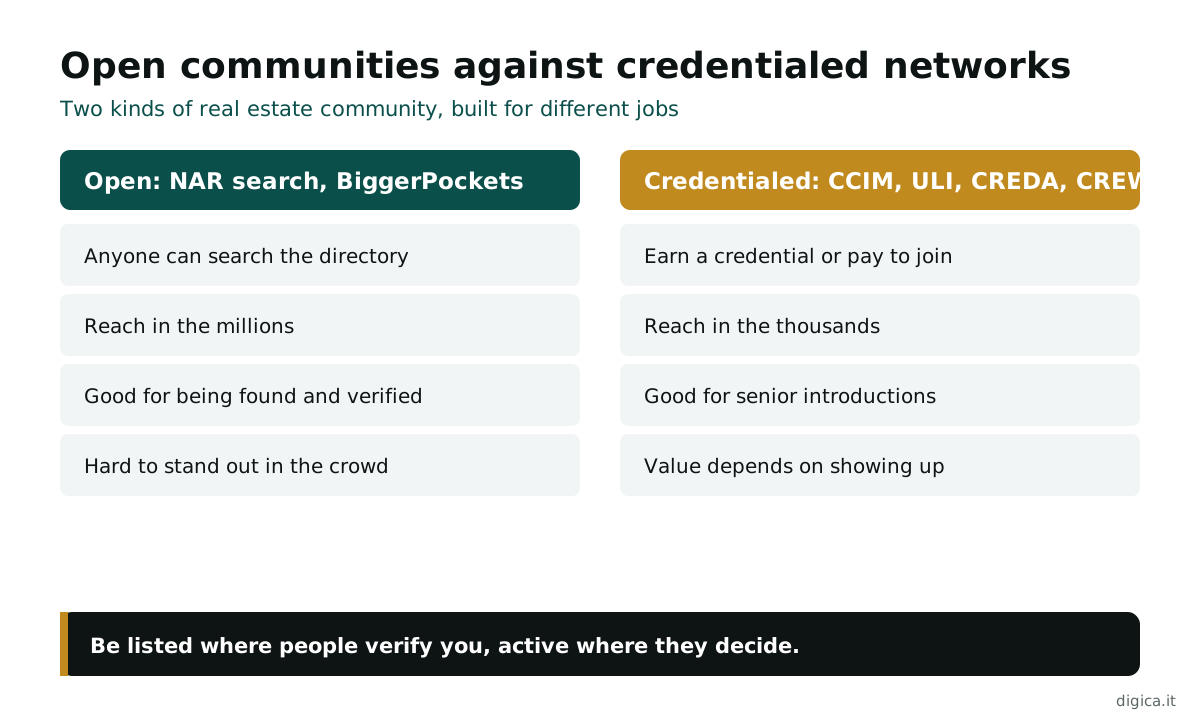
The short answer: there are three ways members find each other: an open search anyone can use, a members-only directory, and in-person chapters. The more closed the directory, the more senior the members, and the less it does for being found by strangers.
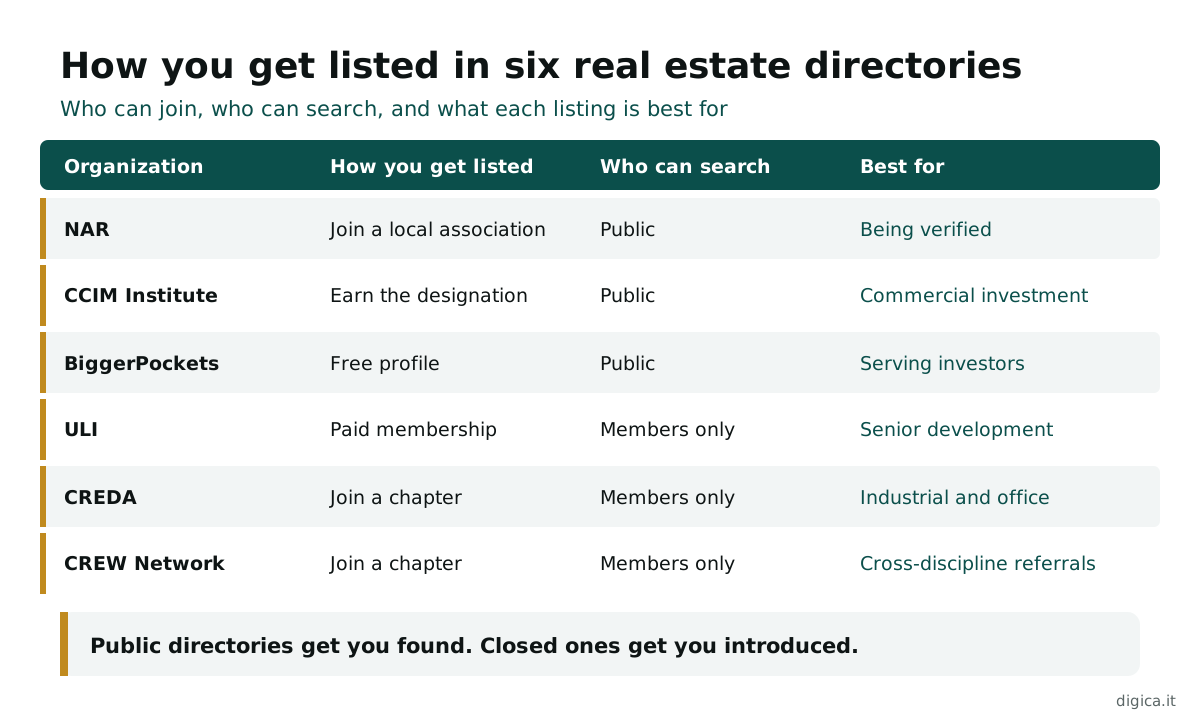
NAR and BiggerPockets run directories that the public can search. That makes them useful for being found by people outside the network, such as a relocation team or a new investor. CCIM sits in between: the Find a CCIM search is open, but its value depends on the designation. ULI, CREDA and CREW Network keep their directories for members, and the real search happens at events and inside chapters.
The practical test is simple. Before you join, ask how a stranger would find you through it. If the answer is a public profile in a search, measure the directory on how often you appear for the searches your clients make. If the answer is a chapter event, measure it on how many useful conversations you have in the first six months. The two are different products and should not be judged on the same number.
Most real estate professionals need one of each: a public directory that confirms who they are, and one closed network where the people they want to work with spend their time.
Reach against relevance
The short answer: member count tells you how many people a directory can reach, not whether they are your people. The best choice is usually the smallest community that still holds most of your buyers or partners.
Run the numbers on a typical case. An industrial broker in one metro joins NAR and lists in its directory of 1.4 million members. Very few of them lease industrial buildings in that metro. The same broker joins a local CREDA chapter, part of a network of 21,000. A meaningful share of the local developers, owners and their advisors are in the room at every event. The smaller network reaches more of the right people, and every conversation at those events is with someone who could become a client or a referral partner.
Investors are the exception. BiggerPockets is both the largest and the most relevant community for an agent or lender who works with small investors, because those investors are the members. That overlap is rare, and it explains why its service-provider directories are so competitive.
Do real estate professionals find your directory before a rival's?
A growth audit maps how agents, brokers and investors search for directories and communities like yours, on Google and in AI answers, and which of your member and location pages they never reach.
Our view: be listed where people verify you, and active where people decide. A public listing nobody visits does no harm, but networking time spent in the wrong community is the most expensive mistake on this list, because it is paid in hours, not dues. Dues can be cancelled at renewal. The evenings spent at the wrong events cannot be recovered, and they are the same evenings that could have gone to the network where your next client is.
Three failure scenarios
These are the patterns that recur when real estate professionals choose a directory or community on member count alone.
- The biggest directory with the wrong members. A commercial broker relies on a general agent directory for referrals because it has the most members. Residential agents send the occasional lead, but none of the developers or investors the broker needs are searching there. A CCIM listing and one CREDA chapter would have put the broker in front of the right people.
- The closed network joined and never used. An investor pays for ULI membership to meet developers, then never joins a council or attends a meeting. The directory is members only, so nobody finds them. Picking one council and attending its meetings for a year would have produced the introductions.
- The investor audience treated as an afterthought. A property manager who mostly serves small landlords never sets up a profile in BiggerPockets' property manager finder. Competitors who do get the inquiries from new investors in the same city. A complete profile, with services and areas served, would have cost an hour.
Each professional joined a real organization. None of them matched the members to the business first. With NAR's 2026 member profile showing 75% of members very certain they will stay active in real estate for at least two more years (NAR), the competition inside every directory is not going away.
Choosing a real estate community: a decision framework
The short answer: start with the people you need to meet, then pick the directory where they are members and the community where they spend time.
- If you are a residential agent or broker, keep your NAR listing complete and add one specialty directory that matches your niche, such as land or global.
- If more than half of your clients are investors, build a full profile in BiggerPockets' agent, lender or property manager finder.
- If you broker commercial investment property, earn or complete the CCIM designation, and list in Find a CCIM.
- If you work with industrial, office or retail developers, join the CREDA chapter in your metro and attend at least six events a year before judging it.
- If you want senior development and land use contacts, join ULI and pick one council, rather than relying on the directory.
- If you need referrals across finance, law and construction, join CREW Network through your local chapter.
- If a directory cannot tell you how many members are in your market, ask before you pay.
Growing a real estate directory or B2B marketplace?
We help real estate directories and commercial property B2B marketplaces recruit the members and brokers that make them worth searching, and reach the professionals comparing them.
The number to take into your next planning meeting is introductions per hour, not members per dollar. For example, a membership that costs 40 hours a year and produces 10 useful introductions costs four hours per introduction. A free directory that produces one inquiry a year costs nothing in time but returns almost nothing. Track both for 12 months and keep the ones that produce business. The biggest cost of doing nothing is spending another year in a community full of people who will never hire you.
FAQ
What is a real estate directory? A real estate directory is a searchable list of real estate professionals, such as agents, brokers, appraisers or commercial specialists, usually run by an association or community. It lets clients, referral partners and other professionals find and verify someone before contacting them.
What is the largest real estate community? By member count, BiggerPockets is the largest real estate investor community, with more than 3 million members. The National Association of REALTORS® is the largest professional association, with 1,439,163 members in June 2026.
What is the best real estate community for commercial professionals? It depends on the role. CCIM Institute suits commercial investment brokers, CREDA suits developers and owners of industrial, office and retail property, ULI suits senior development and land use professionals, and CREW Network suits referrals across disciplines.
Is NAIOP now CREDA? Yes. On July 1, 2026, NAIOP became the Commercial Real Estate Development Association, CREDA. It says it represents more than 21,000 members across 55 chapters in North America.
Are real estate directories worth paying for? A directory is worth paying for when its members include the people you need to meet in your market. Ask how many members are in your city and specialty before you join, and track introductions for a year.
How do I get listed in a real estate directory? In most association directories you are listed automatically once you join, through a local association for NAR or a chapter for CREW Network. BiggerPockets lets you create a free account and a profile in its service-provider finders.
Related Articles
- Commercial real estate marketplace and directory growth
- Best commercial real estate marketplaces in 2026
- Best business communities for professionals
- Best expert networks in 2026
- Best B2B directories to list your business in 2026
Where this connects
This article is part of our B2B marketplace growth series. Browse more on the Digica blog.