The best consulting marketplaces in 2026, ranked on how they vet their consultants
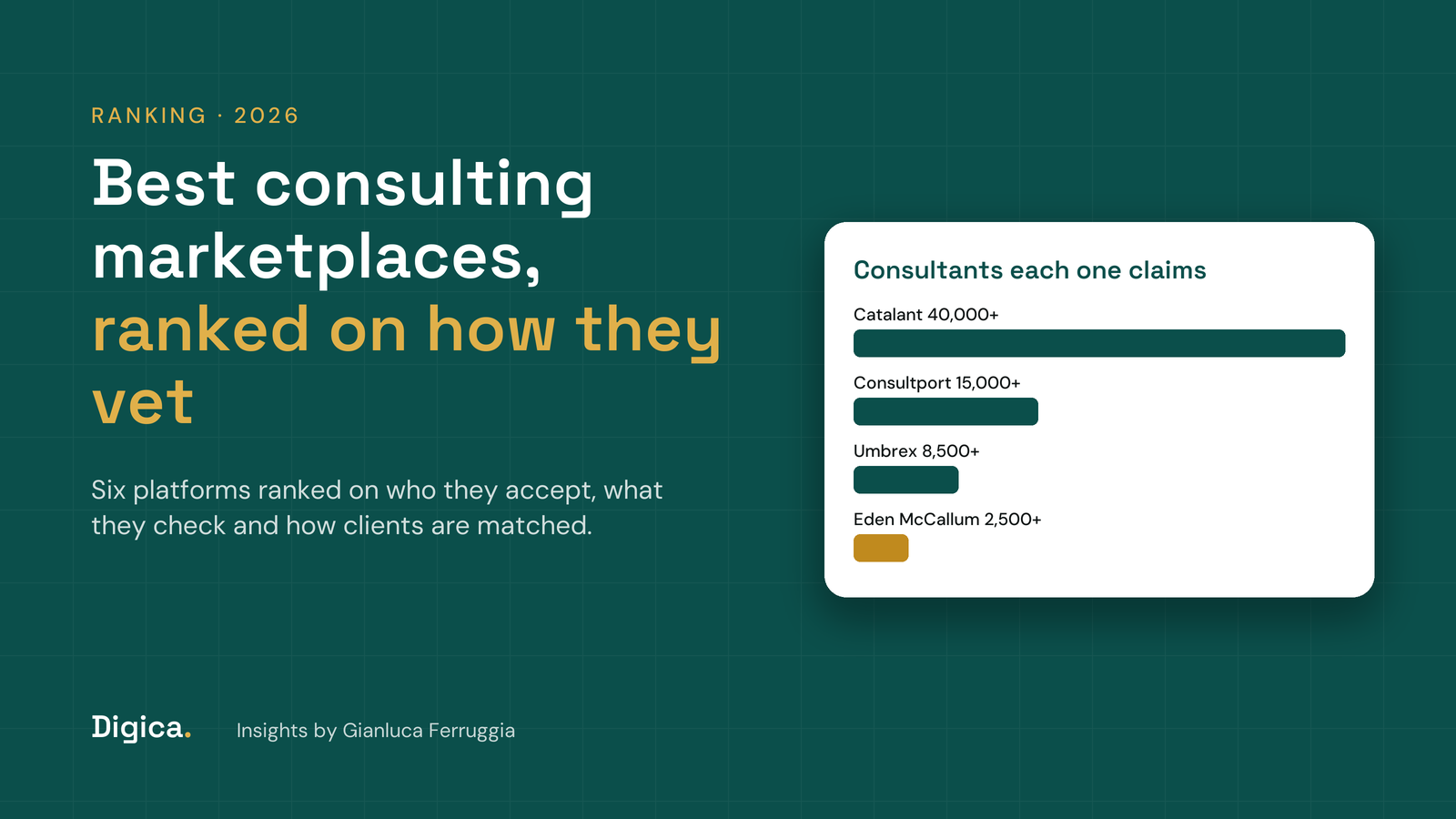
A consulting marketplace sells one thing above all: confidence that the consultant it puts in front of you is as good as the profile says. Pool size is easy to claim and hard to use. Catalant says it has 40,000+ consultants. Toptal says only about 3% of applicants make it through its screening. Eden McCallum says it accepts one in ten. Those numbers describe very different promises, and a client who picks on the biggest pool can still end up interviewing the wrong people for three weeks.
The supply of independent consultants keeps growing, which makes vetting matter more, not less. The US Bureau of Labor Statistics counts about 1.1 million management analyst jobs in 2025, with employment projected to grow 10% over the decade to 2035, and 14% of the occupation self-employed (US Bureau of Labor Statistics). More consultants on the market means more profiles to sift, and the consulting marketplace that sifts well wins the client.
This guide ranks six consulting marketplaces on consultant vetting: who they accept, what they check, how many consultants they claim and how a client is matched to one. It is written for strategy, operations and transformation leads hiring independent consultants, and for founders growing a consulting B2B marketplace. Figures are each company's own, checked on November 2, 2026. For on-demand expert calls rather than projects, see our guide to the best expert networks.
Quick Navigation
- How consulting marketplaces vet consultants
- Six consulting marketplaces compared
- 1. Toptal: the most transparent screening
- 2. Eden McCallum: one in ten, with industry experience
- 3. Umbrex: a community of former MBB consultants
- 4. Business Talent Group: curated slates for the Fortune 100
- 5. Catalant: the largest pool of senior consultants
- 6. Consultport: a fast shortlist in Europe
- Three failure scenarios
- Choosing a consulting marketplace: a decision framework
- What good vetting is worth
- FAQ
- Related Articles
How consulting marketplaces vet consultants
The short answer: consulting marketplaces vet in three ways. Some publish a screening process with pass rates. Some filter on pedigree, usually years at a top consulting firm. Some vet project by project, building a short slate for each brief. The best ones combine at least two.
Each model has a cost. A published screening process tells you how hard it is to get in, but not whether the consultant suits your project. A pedigree filter is easy to check and correlates with structured problem solving, but it can exclude operators who learned the work inside a company. Project-by-project curation fits the brief best, but you are trusting the marketplace's judgment rather than a rule you can inspect.
That is why we ranked on vetting rather than on pool size. A consulting marketplace with 40,000 consultants and a weak shortlist costs the client more time than one with 2,500 and a strong one. The tests we use for every talent marketplace apply here: how much supply, how reliable it is and how well clients are matched to it.
Our view: ask every consulting marketplace two questions before the first call. What share of applicants do you accept, and who decides which consultants I see? A platform that answers both clearly has usually done the work.
Six consulting marketplaces compared
The short answer: Toptal publishes the strictest and most detailed screening, Eden McCallum and Umbrex filter hardest on consulting pedigree, Business Talent Group curates for the largest companies, Catalant has the largest senior pool and Consultport is the fastest route to a shortlist in Europe.
Six consulting marketplaces compared on pool size, how they vet, time to a shortlist, cost to the client, main risk and best fit
| Marketplace | Consultants claimed | How it vets | Time to shortlist | Cost model | Main risk | Best for |
|---|---|---|---|---|---|---|
| Toptal | Top 3% of applicants | Five published screening steps | Under 24 hours on average | Pay if satisfied after a trial of up to two weeks | Generalist platform, not consulting only | Fast, tested hires |
| Eden McCallum | 2,500+ | Accepts one in ten applicants | Not published | Project fee, teams with in-house partners | Smaller pool | Board-level strategy work |
| Umbrex | 8,500+ | Over 90% ex-McKinsey, Bain or BCG | Bios in 48 hours on average | Consultant's own rate | Pedigree, not project fit | Former MBB talent |
| Business Talent Group | Not published | Curated slate per project | Not published | Project based | No acceptance rate published | Fortune 100 and interim leaders |
| Catalant | 40,000+ | Senior alumni and operators | Not published | Enterprise programs | No vetting steps published | Large enterprise programs |
| Consultport | 15,000+ | Track record at a leading consultancy | 48 hours | Consultant's rate plus a service fee | Selection criteria are broad | European corporates and PE |
Every figure is the company's own claim. The column to read first is "How it vets", because it tells you what the marketplace has actually checked before you see a profile.
1. Toptal: the most transparent screening
The short answer: Toptal ranks first because it publishes every step of its screening and the share of applicants who pass each one. Only about 3% make it through, and the average time to match a client with a management consultant is under 24 hours.
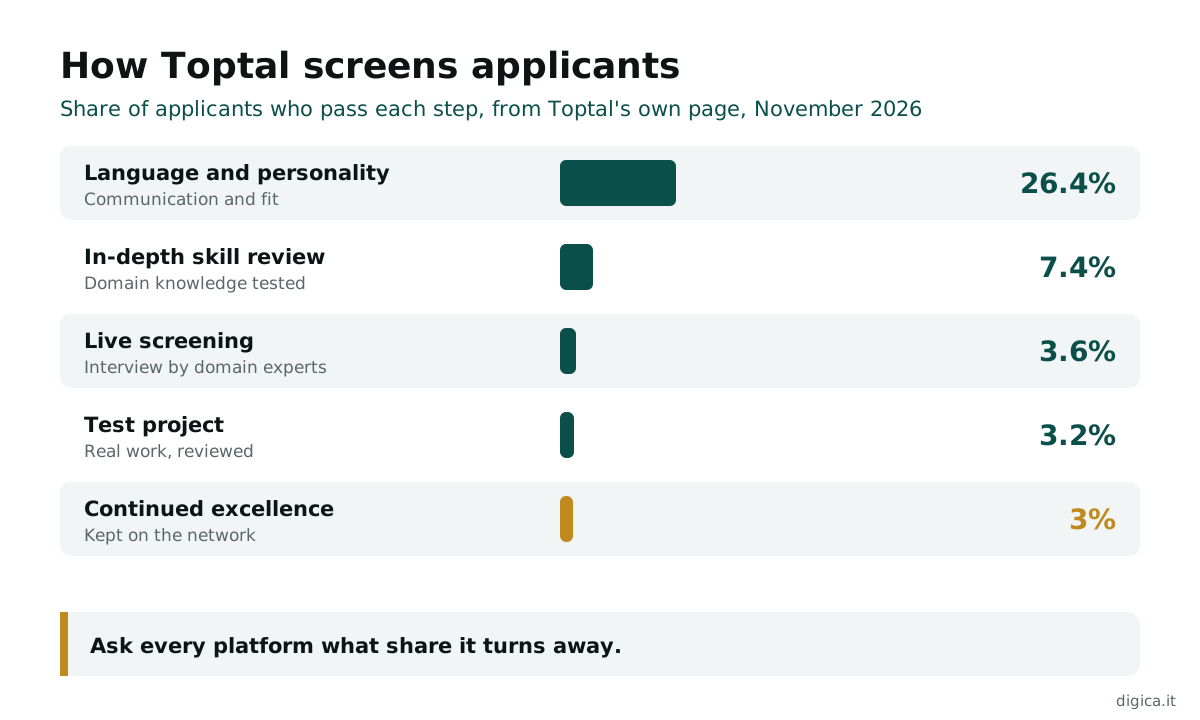
Toptal's five steps are specific. 26.4% of applicants pass a language and personality review, 7.4% pass an in-depth skill review, 3.6% pass a live screening by domain experts and 3.2% complete a test project. The last step, continued excellence, keeps about 3% on the network over time. Clients start with a call with a Toptal advisor, are introduced to a matched consultant and can trial the work for up to two weeks, paying only if satisfied.
Running a consulting or expert B2B marketplace?
In 30 minutes we look at how clients find platforms like yours, on Google and in AI answers, and where they drop off before they submit a brief.
The caveat is breadth. Toptal covers software developers, designers, finance experts and project managers as well as management consultants, so the same screening applies to very different work. The published funnel is also a useful benchmark for any other platform. If a consulting marketplace cannot say what share of applicants it turns away, compare its answer with Toptal's before trusting the profiles it sends. Best for: companies that want a tested consultant quickly and value a trial over a long selection process.
2. Eden McCallum: one in ten, with industry experience
The short answer: Eden McCallum, based in London, says it accepts one in ten consultants who apply, has a network of 2,500+ independent consultants and has completed more than 3,500 projects for 500+ clients.
Its filter is narrower than most. Consultants need top-tier management consulting experience, and Eden McCallum says more than nine in ten have also worked in industry. That combination is the point: a consultant who has built a strategy and then had to deliver one inside a company tends to write recommendations that survive contact with operations.
It also works differently from an open marketplace. Eden McCallum combines independent consultants with its own in-house partners and analysts to form project teams, chosen for skills, experience and fit. Best for: leadership teams that want strategy work with consulting-firm structure, from senior people who have also run businesses.
3. Umbrex: a community of former MBB consultants
The short answer: Umbrex says more than 90% of its 8,500+ consultants are alumni of McKinsey, Bain or BCG, and it sends clients consultant bios within 48 hours on average.
Umbrex was founded in 2015 by Will Bachman, a former McKinsey consultant, with Jing Liang and Margarita Soto. Its membership is aimed primarily at former consultants from those three firms. Applicants submit an application and a resume, usually get a decision within 48 hours, and pay no membership or application fees. Clients describe the project, receive bios, interview and select.
The model is a pedigree filter with a light touch, and it is clear about it. The consultant's background is checked before they join. Their fit for your project is something you test in the interview. Best for: clients who want MBB-trained problem solvers and are comfortable running their own selection from a short set of bios.
4. Business Talent Group: curated slates for the Fortune 100
The short answer: Business Talent Group, a Heidrick & Struggles company, says it serves 53% of the Fortune 100 and fills 99% of talent requests, with consultants trained at the Big 3 and boutique firms alongside subject matter experts and executives.
Do clients find your consulting marketplace before a rival's?
A growth audit maps how companies search for consultants and consulting platforms, on Google and in AI answers, and which of your expertise, industry and consultant pages they never reach.
BTG vets for the project rather than publishing an acceptance rate. A client shares the need, including scope, budget and timeline, and chooses from a curated slate of talent selected with in-house consultants and proprietary technology. BTG says 91% of clients explore a new project within 12 months, which is a reasonable signal that the slates work.
Its data also shows where demand is moving. The 2026 High-End Independent Talent Report, built on BTG data, says interim chief financial officers are 51% of interim leadership requests. Senior independents are a growing share of that demand. MBO Partners says a record 5.6 million independent professionals in the United States earned more than $100,000 in 2025, up 19% on 2024 (MBO Partners). A marketplace that can shortlist from that group for a specific brief is doing work a client would otherwise do itself. Best for: large companies that need interim executives or senior specialists, and want the marketplace to do the shortlisting.
5. Catalant: the largest pool of senior consultants
The short answer: Catalant, based in Boston, says it has more than 40,000 consultants with 15+ years of average experience, drawn from elite consulting firm alumni and former Fortune 500 operators, working with more than 3,900 businesses.
Catalant sells mainly to enterprises, private equity firms and consulting firms, and in February 2026 it added four senior leaders, including a chief product officer and managing directors for health care, consumer and financial services. Its scale is the strongest in this ranking, and its average experience figure is high.
It ranks fifth on vetting because it publishes no acceptance rate or screening steps, so a client has to take the quality of the pool on trust and test it through the platform's matching. Best for: enterprises running many consulting projects at once that want one platform and a deep bench of senior operators.
6. Consultport: a fast shortlist in Europe
The short answer: Consultport, based in Berlin, offers access to 15,000+ consultants across 200+ areas of expertise, and sends a shortlist of qualified consultants within 48 hours.
Consultport says it is very selective about who joins. Applicants need clear evidence of a strong track record at a leading management consultancy, or proven management and digital experience in established or digital-first companies. Requests and proposals are free, and clients pay the consultant's rate plus a service fee. Corporates, consultancies, private equity firms and scale-ups use it.
The trade-off is that the selection criteria are broad enough to include both consulting alumni and operators, so the shortlist does more of the vetting than the entry gate. Best for: European corporates and private equity teams that want several qualified profiles within two days.
Three failure scenarios
These are the patterns that recur when clients choose a consulting marketplace on pool size rather than vetting.
- The pool that was too big to use. A mid-size manufacturer posts a pricing project to the largest consulting marketplace it can find and receives 30 profiles. Its team spends three weeks interviewing, and the project starts a month late. A marketplace that sends a short, curated slate would have produced a hire in days.
- The pedigree that did not fit the work. A private equity portfolio company hires a former strategy consultant with a perfect resume for a hands-on operations turnaround. The diagnosis is excellent and the implementation stalls. Asking for operating experience, not only consulting pedigree, would have matched the brief.
- The trial nobody used. A software company hires through a platform with a risk-free trial but does not set clear goals for the first two weeks. By the time it realizes the fit is wrong, the trial has passed and the contract renews. Writing down what success looks like in week two would have made the trial worth having.
Each client used a real consulting marketplace. None matched the platform's vetting model to the work it needed done.
Choosing a consulting marketplace: a decision framework
The short answer: start from how fast you need someone, what kind of experience the work needs and how much selection you want to do yourself, then pick the consulting marketplace whose vetting matches.
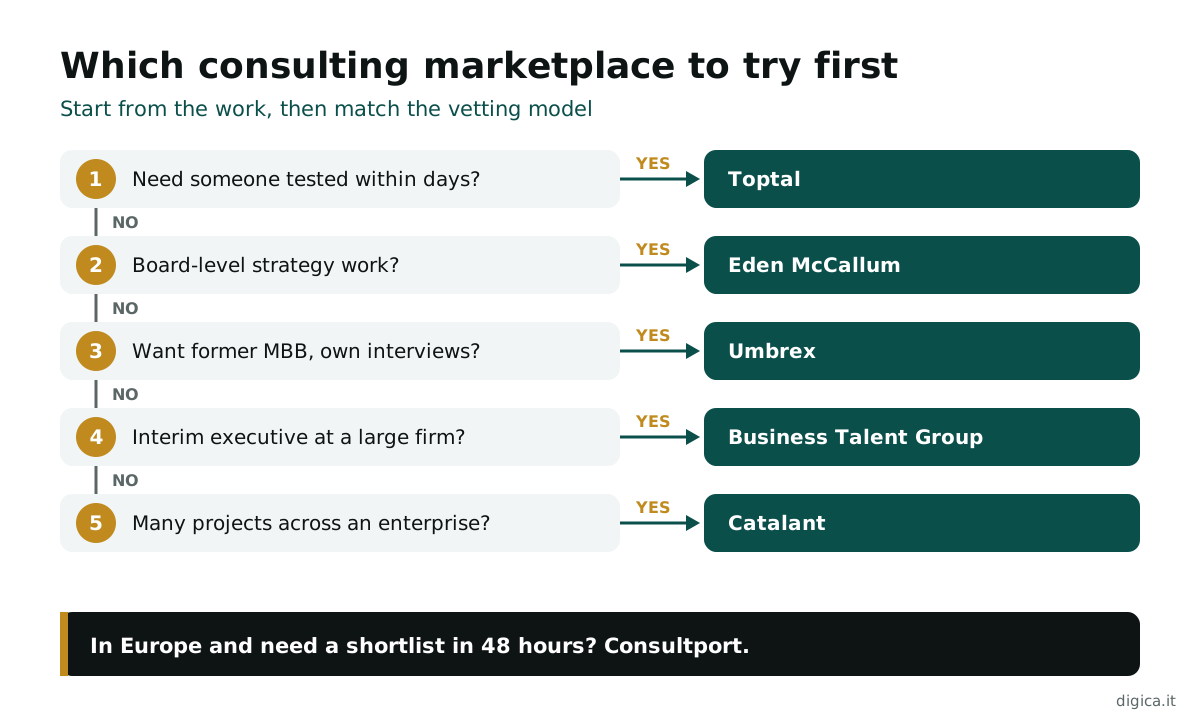
- If you need a tested consultant within days and want a trial, start with Toptal.
- If the work is board-level strategy and you want consultants who have also run businesses, use Eden McCallum.
- If you want former McKinsey, Bain or BCG consultants and will run your own interviews, use Umbrex.
- If you need an interim executive, such as an interim CFO, at a large company, use Business Talent Group.
- If you run many projects at once across an enterprise or portfolio, use Catalant.
- If you are in Europe and want a shortlist within 48 hours, use Consultport.
- If the project is hands-on implementation, ask every platform for operating experience, not only consulting pedigree.
Independent consulting is also becoming a larger and better-paid market, which raises the stakes on every one of these choices. The more senior people choose to work independently, the more a consulting marketplace's vetting decides who a client actually sees, and the less a raw pool size tells you.
Growing a consulting B2B marketplace?
We help consulting and expert marketplaces recruit the consultants clients ask for, and reach the companies searching for them on Google and in AI answers.
Most companies end up with two platforms: one for fast, tested specialists and one for senior or interim leaders. Review the choice after every project. The marketplace whose shortlist produced your best hire is a better guide than any pool size on its homepage. Our guide to freelance marketplaces covers the platforms for smaller, task-based work. For consulting marketplace operators, the same lesson runs the other way: the clearer you are about who gets in and how a slate is chosen, the faster a client trusts the first profile you send.
What good vetting is worth
The short answer: good vetting is worth the weeks of selection it saves and the cost of a wrong hire it avoids. Both are larger than most clients expect.
The market is large enough that the choice matters. The Upwork Research Institute's Future Workforce Index found that 28% of US skilled knowledge workers work independently, and that they earned $1.5 trillion in 2024 (Lewis Silkin). That is a deep pool to choose from, and a shallow vetting process makes it harder to use, not easier.
Run the numbers on a typical case. Suppose a senior consultant costs $2,000 a day on a 60-day project, $120,000 in total. If a weak match is replaced after three weeks, the client loses 15 days of fees, $30,000, plus three weeks of the project timeline and the internal time spent onboarding twice. A marketplace with strong vetting that gets the first match right avoids most of that, and pays back any service fee on the first project. The figures are illustrative, but the logic holds: the cost of a wrong consultant is far larger than the fee for finding a right one.
The number to take into your next hiring discussion is days from brief to a consultant actually working, alongside the share of first matches you kept. The biggest cost of doing nothing is paying senior day rates for the wrong person while the problem you hired them for waits.
FAQ
What is a consulting marketplace? A consulting marketplace is an online platform that connects companies with independent consultants for projects, interim roles or advisory work. Examples include Toptal, Eden McCallum, Umbrex, Business Talent Group, Catalant and Consultport.
How do consulting marketplaces vet consultants? Most use one or more of three methods: a published screening process with tests and interviews, a pedigree filter such as years at a top consulting firm, and a curated shortlist chosen for each project. Toptal publishes pass rates for each step, and Eden McCallum says it accepts one in ten applicants.
Which consulting marketplace has the strictest vetting? Toptal publishes the strictest figures in this ranking, with about 3% of applicants passing all five screening steps. Eden McCallum accepts one in ten, and Umbrex says more than 90% of its consultants are former McKinsey, Bain or BCG consultants.
How much do consulting marketplaces cost? Costs vary by model. Consultport charges the consultant's rate plus a service fee, Umbrex consultants set their own rates, and Toptal lets clients pay only if satisfied after a trial of up to two weeks. Enterprise platforms such as Catalant and Business Talent Group price by project or program.
Is a consulting marketplace better than a consulting firm? A consulting marketplace usually gives faster access to senior independents at lower cost, while a consulting firm provides a full team, methods and accountability for the result. Some platforms, such as Eden McCallum, combine independent consultants with in-house partners to offer both.
How do I become a consultant on a consulting marketplace? Apply through the platform's consultant page with your resume and track record. Most require several years at a leading consulting firm or senior industry experience, and some, such as Toptal, add skill reviews, live screening and a test project.
Related Articles
- Consulting marketplace growth
- Best expert networks in 2026, by pool and compliance
- Best talent marketplaces in 2026: who vets hardest
- Best freelance marketplaces for businesses in 2026
- Best staffing marketplaces in 2026, by fill speed
Where this connects
This article is part of our B2B marketplace growth series. Browse more on the Digica blog.