The best staffing marketplaces in 2026, grouped by type and compared on how fast they fill
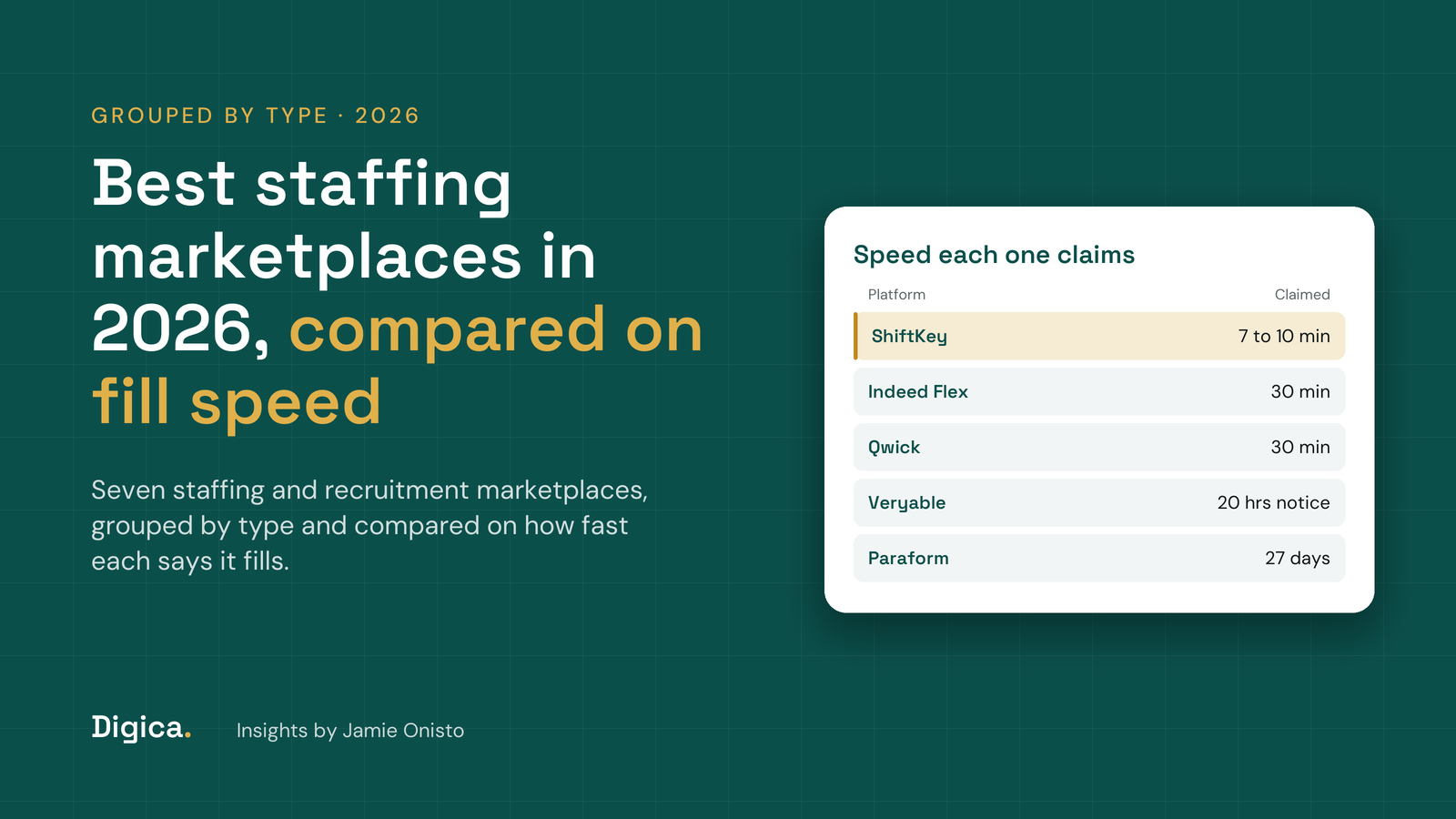
A staffing marketplace is a B2B marketplace where businesses post shifts or roles and a pool of pre-vetted workers, or competing recruiters, fills them without a traditional agency in the middle. Demand for that kind of flexible labor is large and steady. The US Bureau of Labor Statistics counted 2,486,800 jobs in temporary help services in September 2026, up from 2,471,600 a year earlier.
For an operations manager with an empty shift on Saturday, the number that matters is not the size of the pool. It is how fast the shift gets filled, and whether the person turns up. Every staffing marketplace on this list publishes a speed claim. The trouble is that each one measures something different: minutes to claim a shift, hours of notice, a fill rate within a day, or days to a signed hire.
This guide groups seven of the leading staffing and recruitment marketplaces by type and compares them on fill speed, using the figures each one publishes, checked on October 21, 2026. Almost every speed figure here is the company's own claim, and we say so each time. It is the same liquidity test we apply when we help staffing and recruitment B2B marketplaces grow both their worker pool and their business demand.
Quick Navigation
- What fill speed means on a staffing marketplace
- Seven staffing marketplaces compared
- Shift marketplaces for hospitality, events and warehouses
- Light industrial and manufacturing: Veryable
- Healthcare per diem: ShiftKey
- Recruitment marketplaces for permanent hires: Paraform
- Why claimed fill times do not compare
- Three failure scenarios
- Which staffing marketplace fits which gap
- FAQ
- Related Articles
What fill speed means on a staffing marketplace
The short answer: fill speed is the time between a business posting work and a qualified person accepting it, and on a staffing marketplace it depends on how many active workers sit near that job.
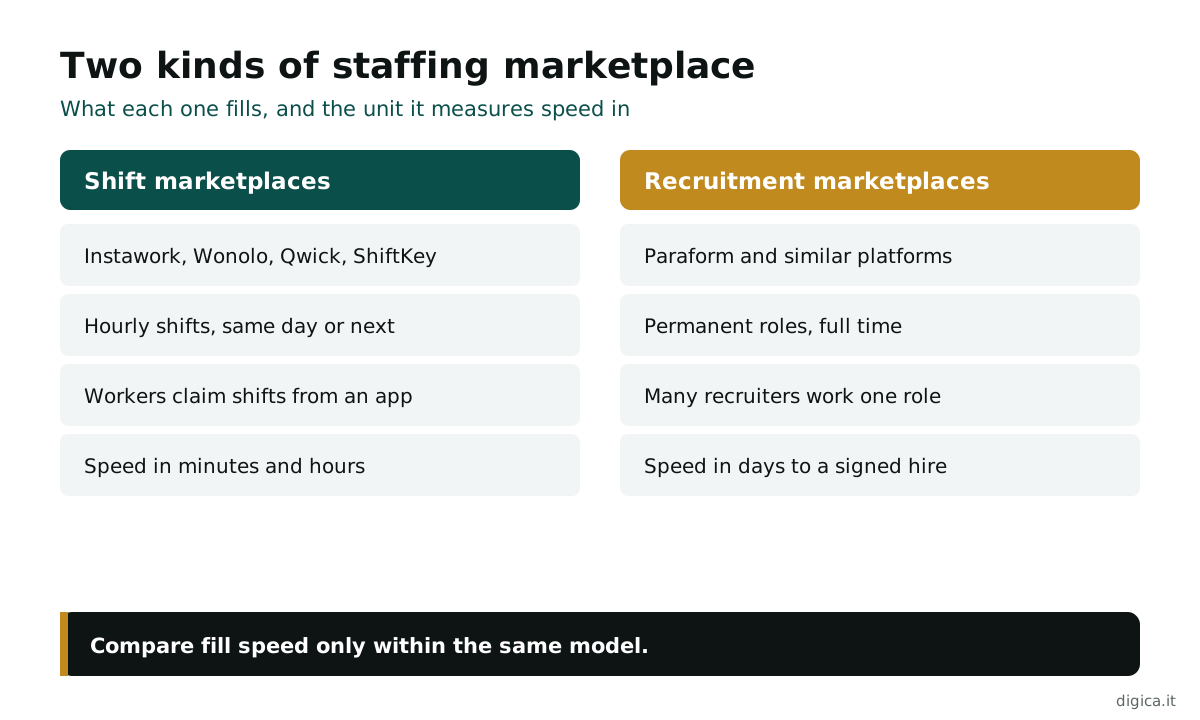
There are two broad models. Shift marketplaces fill hourly work, often for the same day or the next. A restaurant, warehouse, event venue or care home posts a shift, and workers who have already been screened claim it from an app. Recruitment marketplaces fill permanent roles. An employer posts a job, and dozens of independent recruiters or agencies compete to send candidates, paid only when someone is hired.
The two models measure speed in different units. A shift marketplace talks in minutes and hours. A recruitment marketplace talks in days. Comparing a 30 minute fill time with a 27 day time to hire tells you nothing, because they are different jobs.
What drives speed is the same in both. A shift fills fast when there are enough available, qualified workers within travel distance at the moment it is posted. A role fills fast when enough recruiters already know candidates who fit. That is liquidity, and it is the reason a staffing marketplace that fills in minutes in one city can take days in the next. In our experience, the most useful question to put to any platform is not "how fast do you fill?" but "how fast do you fill this role, in this city, at this notice?"
Seven staffing marketplaces compared
The short answer: Indeed Flex and Qwick claim the fastest average fill for general shifts, ShiftKey the fastest claim for healthcare, Instawork and Wonolo the largest worker pools, Veryable the clearest view of lead time for manufacturing, and Paraform the shortest published time to hire among recruitment marketplaces.
Seven staffing marketplaces compared by type, the speed claim each publishes, worker pool, main risk and best fit
| Marketplace | Type | Speed claim (company's own) | Worker pool claimed | Main risk | Best for |
|---|---|---|---|---|---|
| Instawork | Shift staffing | 90% of jobs filled within 24 hours | 7M+ hourly workers | Claim covers shifts posted 2 to 7 days ahead | Hospitality and warehouses across North America |
| Wonolo | Shift staffing | 92% worker show rate | 3M+ workers, 500+ US markets | No published time-to-fill figure | High-volume warehouse and event work |
| Indeed Flex | Shift staffing | 30 minutes average time to fill; 95% fulfilment | 240,000+ verified active workers (UK) | Figures published for the UK, not the US | Employers already hiring through Indeed |
| Qwick | Hospitality shifts | 30 minutes average fill; 95% fill rate | 350,000+ verified pros | Hospitality only | Restaurants, caterers and venues |
| Veryable | Light industrial | Median lead time about 20 hours | 750,000+ vetted workers | Bid model needs clear job specs | Manufacturers smoothing weekly volume |
| ShiftKey | Healthcare per diem | Shifts claimed in 7 to 10 minutes when sent directly | 140,000+ licensed professionals | Speed claim is for direct sends only | Care facilities covering nurse call-offs |
| Paraform | Recruitment marketplace | 27 day average time to hire | 10,000+ recruiters | Permanent hires, not shifts | Startups hiring technical roles |
Read the speed column as a set of different measurements, not a ranking. The section below on why claimed fill times do not compare shows how far apart they are.
Shift marketplaces for hospitality, events and warehouses
The short answer: Instawork and Wonolo bring the largest pools, Indeed Flex and Qwick the fastest stated average fill. Choose between them on where your shifts are and how much notice you give.
Instawork, founded in 2015 and backed by Benchmark, Greylock, Spark Capital and TCV, says it has more than 7 million hourly workers in its network across the US and Canada. Its homepage claims that 90% of jobs are filled within 24 hours, against 7 to 10 days for a traditional agency, and a 98% show rate. The small print matters: the 24 hour figure is based on US shifts posted two to seven days in advance. For a business that plans its rota a week out, that is a strong promise. For a same-day gap, it is not the number to rely on.
Wonolo, co-founded by chief executive Yong Kim and backed by Bain Capital Ventures, which led its 2018 Series C, leads with reliability rather than minutes. It reports a 92% worker show rate, more than 3 million workers, more than 6.2 million jobs posted and more than 500 US markets. It does not publish a current average time to fill. A show rate is arguably the more honest metric: a shift that is filled in four minutes by someone who does not arrive has not been filled.
Running a staffing or recruitment B2B marketplace?
In 30 minutes we look at where your fill rate breaks down, city by city, and how businesses and workers find platforms like yours before they find you.
Indeed Flex began in London in 2015 as Syft, was bought by Indeed in 2019 and took the Indeed Flex name in 2021. Its UK marketplace page claims a 95% average fulfilment rate, a 30 minute average time to fill and more than 240,000 verified, active workers. In December 2025 it opened eight new US markets, including Charlotte, Las Vegas, Orlando, Phoenix and Reno. The speed figures are published for the UK, so a US employer should ask for local data before planning around them.
Qwick, founded in Phoenix in 2017 and focused on hospitality, makes the same 30 minute claim: a 30 minute average fill time, a 95% fill rate and a best-fit professional matched in under 30 minutes. It reports more than 350,000 verified professionals and more than 2.5 million shifts filled. Being hospitality only is a strength here. A caterer needs servers and bartenders who have done the job before, and a specialist pool finds them faster than a general one.
The verdict. For planned hospitality and warehouse work across many cities, Instawork and Wonolo have the depth. For short-notice hospitality shifts, Qwick's specialist pool and Indeed Flex's stated 30 minute fill are the claims to test first.
Light industrial and manufacturing: Veryable
The short answer: Veryable is built for manufacturers and warehouses that need to flex labor week to week, and it is unusually open about lead time.
Veryable, founded in 2016 in Dallas, Texas, runs a bid model. A business posts work, and vetted workers, which Veryable calls Operators, bid for it. Its about page reports more than 750,000 vetted workers nationwide, an average of 6.1 bids per work opportunity and more than 17,000 same-day shifts filled. Its on-demand labor page gives a median lead time of about 20 hours before the shift starts, and says most businesses can find workers for the next day.
That 20 hour figure is more useful than a headline "minutes to fill", because it tells a plant manager how much notice to give. Six bids per job also says something about depth: the business chooses among several workers rather than taking whoever claims first.
The trade-off is set-up. A bid model works when the job is clearly specified: the station, the skills, the shift length. Vague postings get fewer good bids. For a manufacturer whose order book swings by 20% from week to week, that effort usually pays back in fewer overtime hours and fewer idle temps.
The verdict. For light industrial work where next-day cover is enough, Veryable is the specialist to shortlist. Give it 24 hours of notice and a precise job description, and judge it on the bids you receive.
Healthcare per diem: ShiftKey
ShiftKey makes the fastest speed claim on this list, and it comes with an important condition. Founded in 2016 and based in Irving, Texas, it was valued at more than $2 billion when it raised $300 million in January 2023. It says it works with more than 10,000 facilities and more than 140,000 experienced, licensed independent professionals.
In a September 2025 guide to filling last-minute shifts, ShiftKey says shifts are usually claimed within seven to 10 minutes when they are sent directly to professionals. The condition is "sent directly": the facility already knows which nurses it wants and pushes the shift to them. A shift posted to the open pool will not always move that fast. ShiftKey also says that facilities using its Admin Assist service reduced call-offs by 25%.
Healthcare is where speed carries the highest stakes. A care facility below safe staffing levels faces regulatory risk, not just a slow evening. The wider staffing market is also cyclical: the American Staffing Association reports that temporary and contract staffing employment fell 7.5%, or 154,000 jobs, from the fourth quarter of 2025 to the first quarter of 2026, a seasonal slowdown. Healthcare per diem demand does not follow that cycle in the same way, which is why specialist healthcare marketplaces invest in pre-credentialed pools.
Do businesses find your staffing marketplace first?
A growth audit maps how employers and workers search for staffing platforms, on Google and in AI answers, and which of your city and role pages they never reach.
The verdict. For care facilities that keep a roster of trusted per diem nurses, ShiftKey's direct-send model is the fastest option here. Ask how long open-pool shifts take in your area before you rely on it for emergencies. A facility with no roster of its own is starting from the open pool, so the headline minutes may not apply. Build that roster during quiet weeks, and the fast claims become the ones you actually get when a nurse calls in sick.
Recruitment marketplaces for permanent hires: Paraform
The short answer: a recruitment marketplace speeds up permanent hiring by putting many specialist recruiters on one role at once, and Paraform is the most prominent recent example.
Paraform, based in San Francisco, raised a $20 million Series A led by Felicis in June 2025. It says more than 10,000 expert recruiters and more than 1,000 companies use the platform, and that recruiters on it have earned $26 million. It claims a 27 day average time to hire, three times faster hiring and a 70% interview rate.
The model is different from an agency. An employer posts a role once, and independent recruiters who specialize in that kind of hire compete to fill it, paid only on placement. Speed comes from parallel search: ten recruiters with existing networks find a fit sooner than one recruiter starting cold.
The 27 day figure is worth setting against the wider market. Employer benchmarking data puts the median time to fill a position at about a month and a half, so a platform that reliably hires in under four weeks is saving two to three weeks on every open role. For a startup paying engineers to cover an empty seat, those weeks are real cost.
The verdict. For startups and growth companies hiring technical or specialist permanent staff, Paraform is the recruitment marketplace to test. It does not fill shifts, so pair it with a shift marketplace if you need both.
Why claimed fill times do not compare
The seven speed claims in this guide measure five different things. The diagram below lines them up, so you can see why "30 minutes" and "90% in 24 hours" are not a faster and a slower version of the same promise.
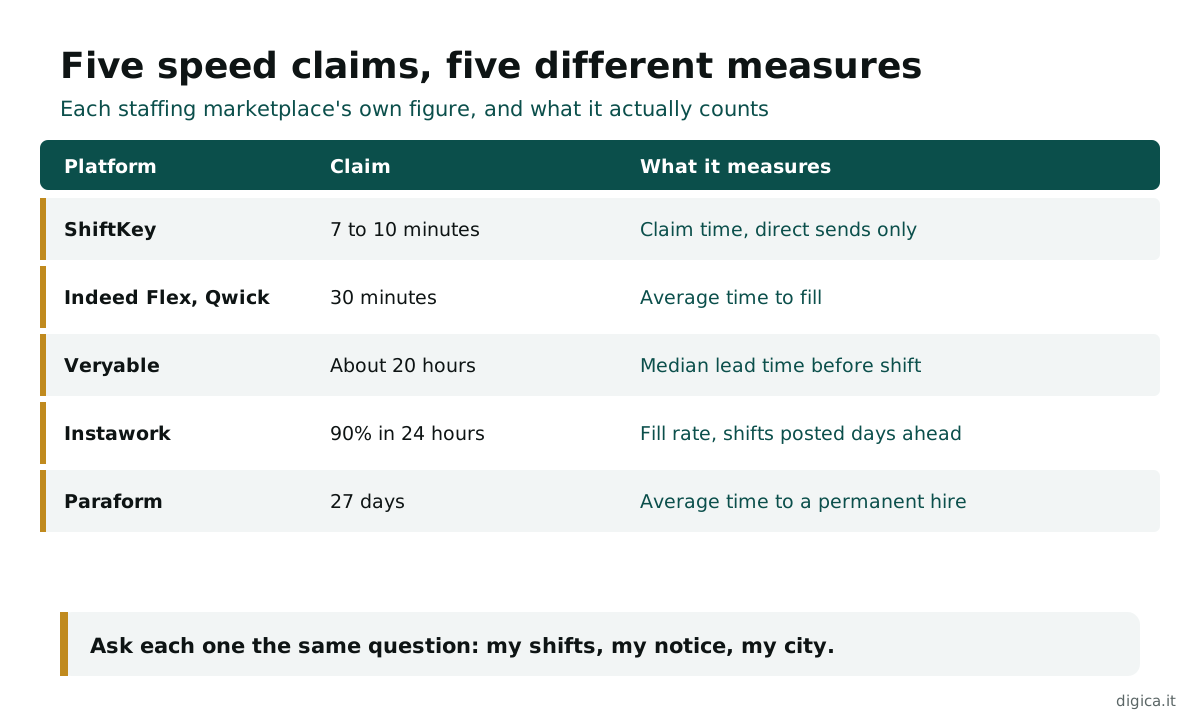
ShiftKey measures minutes to claim a shift sent to a known professional. Indeed Flex and Qwick measure average time to fill across their pools. Instawork measures the share of shifts filled within a day, for shifts posted days ahead. Veryable measures lead time before the shift. Paraform measures days to a signed permanent hire.
None of these is dishonest. Each is the number that flatters the model. A direct-send healthcare marketplace looks best on minutes. A planned-shift marketplace looks best on fill rate. A recruitment marketplace looks best on days against an agency.
The fix is to turn every claim into the same question. How many of my shifts, at my notice, in my city, were filled by someone who turned up? A platform that can answer that from your own trial data is worth more than one with a faster headline. Run the same two-week test on two platforms, with the same shifts and the same notice, and the comparison becomes real.
Three failure scenarios
These are the patterns that recur when a business chooses a staffing marketplace on the headline speed claim.
- The same-day gap on a planned-shift platform. A distribution center signs up because a platform fills 90% of jobs within a day, then posts a shift four hours before it starts. The claim was for shifts posted days ahead, and the shift goes unfilled. Posting recurring shifts a week out, and keeping a short-notice option for gaps, would have covered both.
- The fill without the show. An event venue picks the platform with the fastest claimed fill time. Shifts fill in minutes, but a share of workers cancel or do not arrive, and the venue runs short-staffed on its busiest night. Asking for the show rate in its city, not just the fill time, would have pointed it to a more reliable pool.
- The permanent role treated as a shift. A software company uses temporary contractors from a shift-style platform to cover an open engineering role for three months while its own search drags on. A recruitment marketplace working the role in parallel would likely have closed the hire in weeks, and the contractor cost would have stopped sooner.
Each team read a real number. Each read it as an answer to a question it was not asking.
Which staffing marketplace fits which gap
The short answer: start with the type of gap, then the notice you can give. These decision points make it specific.
- If you fill hospitality shifts with less than 24 hours of notice, test Qwick and Indeed Flex, and track how many filled shifts were actually worked.
- If you post warehouse or event shifts a week ahead across several cities, shortlist Instawork and Wonolo and compare show rates in your markets.
- If you run a plant or warehouse whose volume swings more than 15% week to week, try Veryable and give it at least 24 hours of notice.
- If you staff a care facility and keep a roster of trusted per diem nurses, use ShiftKey's direct send, and ask for open-pool fill times as a backup.
- If a permanent role has been open for more than 30 days, add a recruitment marketplace such as Paraform alongside your own search.
- If a platform cannot show you fill and show rates for your city and notice period, run a two-week trial on a small set of shifts before you commit volume.
Growing a staffing or recruitment B2B marketplace?
We help staffing and recruitment B2B marketplaces build the worker supply and business demand that make fast fills possible in every city they serve.
The number to take into your next operations review is the gap between a month and a half and a few hours. SHRM's 2025 recruiting benchmarking data puts the median time to fill a position at about a month and a half. The fastest shift marketplaces here claim to fill hourly work in 30 minutes or less, and the fastest recruitment marketplace claims 27 days for a permanent hire. The biggest cost of doing nothing is running every gap through one slow channel, and paying overtime, lost orders or empty beds for the weeks in between.
FAQ
What is a staffing marketplace? A staffing marketplace is a B2B marketplace where businesses post shifts or roles and pre-vetted workers, or competing recruiters, fill them through an app or platform instead of a traditional agency. Examples include Instawork and Wonolo for shifts and Paraform for permanent hires.
What is the difference between a staffing marketplace and a recruitment marketplace? A staffing marketplace usually fills hourly or temporary shifts, measured in minutes or hours. A recruitment marketplace fills permanent roles by letting many recruiters compete on one job, measured in days to hire.
Which staffing app fills shifts the fastest? Of the platforms in this guide, ShiftKey makes the fastest claim, saying healthcare shifts sent directly to professionals are usually claimed within seven to 10 minutes. Indeed Flex and Qwick both claim a 30 minute average fill time. All are the companies' own figures.
How many people work in temporary staffing in the US? The US Bureau of Labor Statistics counted 2,486,800 jobs in temporary help services in September 2026, on a seasonally adjusted, preliminary basis.
What is a good fill rate for a staffing marketplace? The platforms in this guide claim fill rates around 90% to 95%, and show rates of 92% to 98%. Compare both, in your city and at your notice period, because a filled shift that nobody works is not filled.
How long does it take to fill a permanent role? SHRM's 2025 benchmarking data puts the median time to fill at about a month and a half. Paraform, a recruitment marketplace, claims a 27 day average time to hire.
Related Articles
- Staffing and recruitment B2B marketplace growth
- Best talent marketplaces in 2026: who vets hardest
- Best freelance marketplaces for businesses in 2026
- Best Upwork alternatives in 2026, compared on fees
- Liquidity is the only marketplace metric that compounds
This article is part of our B2B marketplace growth series. Browse more on the Digica blog.