The best creator and designer communities to join in 2026, ranked by engagement and opportunities
A creator community is only worth joining if something happens there: a client finds you, a mentor reviews your portfolio, a meetup puts you in a room with people who hire. Most online communities fail that test within a month. Members join, post once and drift away, because the community offered conversation but no opportunities.
The money behind creative work is moving fast, which raises the cost of joining the wrong one. The IAB forecast US creator economy ad spend at $37 billion in 2025, up 26% in a year and growing about four times faster than the media industry as a whole (IAB). Brands are paying creators more. The communities where that work is found and won are becoming business infrastructure, not hobbies.
This ranking covers seven creator and designer communities, judged on engagement and opportunities: how active each one is, and what members actually get from it. It is written for designers and creators deciding where to spend their time, and for the people who run creator platforms and want to know what the leaders offer. Figures are each organization's own, checked on October 29, 2026. For the brand side of the same economy, see our ranking of influencer marketplaces for B2B brands.
Quick Navigation
- What makes a creator community worth joining
- 1. Behance: the largest creator community for client work
- 2. Figma Community and Friends of Figma: resources and local chapters
- 3. ADPList: the designer community for mentorship
- 4. CreativeMornings: free monthly events in 200+ cities
- 5. Dribbble: project briefs and a designer job board
- 6. AIGA: the professional association for designers
- 7. Patreon: for creators who run their own community
- Seven creator and designer communities, side by side
- Three failure scenarios
- Which designer community to join first
- FAQ
- Related Articles
What makes a creator community worth joining
The short answer: a creator community is worth joining when it produces opportunities you can count, such as briefs, mentorship sessions, events or paying members, and when other members are active enough that your work gets seen. Member totals alone say little.
We ranked on two tests. Engagement asks whether the community is alive: sessions held, events run, resources published, chapters meeting. Opportunity asks what a member walks away with: a client, a job, a mentor's feedback, a local network or recurring income. A community with 50 million profiles and no way to be found is a directory. A community of 500 people who meet every month and hire each other is a business asset.
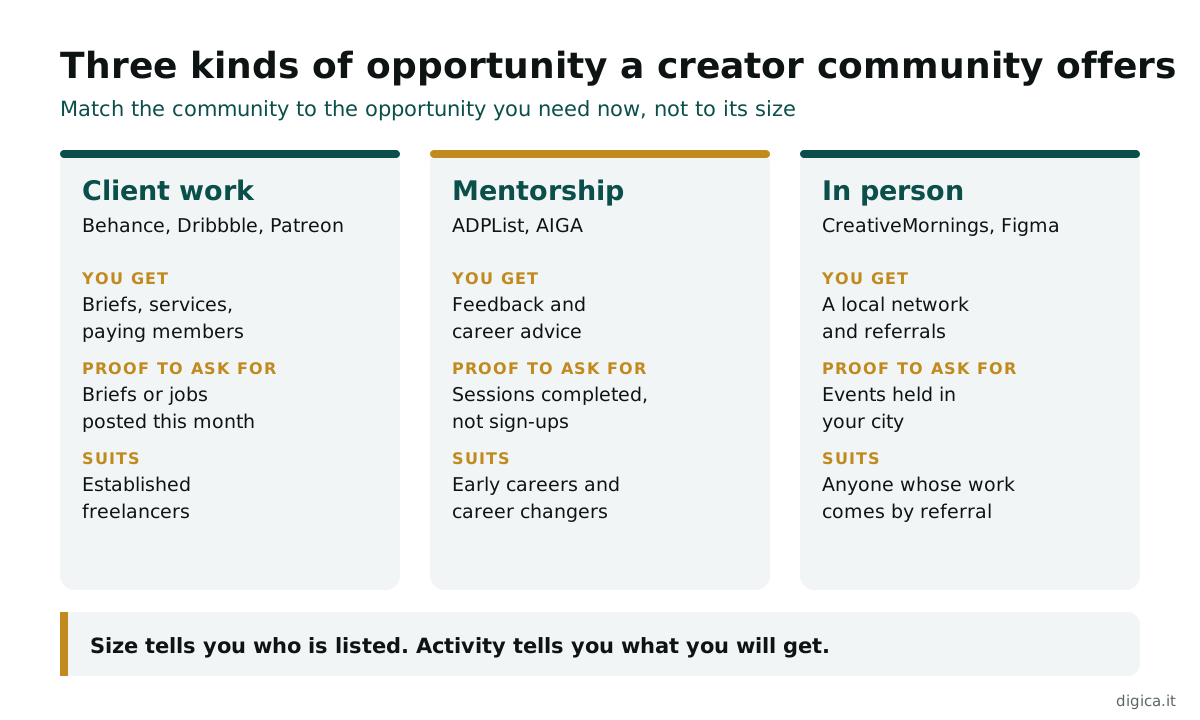
We also separated three kinds of opportunity, because they suit different stages of a career. Client work suits established freelancers. Mentorship and feedback suit people early in their careers or changing discipline. In-person connection suits anyone whose next job will come from a referral. The best designer community for you is the one that matches the opportunity you need now, not the biggest one.
We left out communities whose activity we could not verify from a current source, and general platforms where design is a small share of the traffic. Several Slack, Discord and Reddit groups are popular, but none publish figures we could check.
1. Behance: the largest creator community for client work
The short answer: Behance, owned by Adobe, says it has more than 50 million members, and it turns that audience into client work through freelance services, job proposals and asset sales. It ranks first because it combines the largest audience with the most direct route to being paid.
Behance has run since 2006, and says creative work on it gets seen billions of times every year. A member publishes projects to a public profile, and clients find them through search and the platform's Hire page. Members can list freelance services at prices they set, sell digital assets, send proposals on freelance jobs and take payment through PayPal or Stripe. Client reviews build up on the profile over time.
Joining is free. Behance Pro adds 0% platform fees, profile analytics, an Adobe Portfolio website and a Pro badge, with a seven-day free trial. For a working freelancer who bills clients through Behance, the fee waiver is the main reason to pay.
The engagement risk is scale itself. With tens of millions of profiles, a new member's work can sink without trace. Behance rewards members who publish complete case studies regularly and who are active in a niche where clients search, such as packaging or motion design, rather than in broad categories where competition is heaviest.
Best for: visual creatives who want inbound freelance clients and a portfolio clients already know how to search.
2. Figma Community and Friends of Figma: resources and local chapters
The short answer: Figma runs two communities in one. Figma Community is a library of more than 250,000 shared resources, including more than 10,000 plugins and widgets, and Friends of Figma is a network of more than 250 local chapters in 82 countries.
The resources figure comes from Figma's own registration statement filed with the US Securities and Exchange Commission, as of March 31, 2025. For a designer, publishing a well-made template or plugin to Figma Community is a way to be found by the people who use Figma every day, many of whom hire. It is exposure rather than income for most newcomers: Figma's help center says it is not approving new creators to sell paid files on Community at this time.
Friends of Figma is the engagement half. Figma said in May 2026 that its chapters ran more than 900 events in the previous year, from portfolio nights to talks and workshops. Joining a chapter is free, and many chapters meet both in person and online.
Running a creator or designer community?
In 30 minutes we look at how creators and the clients who hire them find platforms like yours, on Google and in AI answers, and where they drop off before they join.
The two halves reward different members. Product and interface designers who build tools for other designers get the most from the resource library. Designers who want a local network get the most from the chapters, which are among the few free, regular in-person design events in many cities.
Best for: product, interface and user experience designers who want local meetups and a way to be found through the tools they already use.
3. ADPList: the designer community for mentorship
The short answer: ADPList is a free mentorship platform with more than 39,000 approved mentors and 589,000 members, and it publishes its activity: members in more than 160 countries completed a session in the year to August 21, 2026.
ADPList began in design and now covers product, engineering and other fields. A member books a one-to-one session with a mentor, usually for career advice, portfolio feedback or interview practice. Its public stats page, updated October 28, 2026, puts the median session at 30 minutes. In December 2025 it said members had logged 300 million minutes of mentorship sessions in total.
That makes ADPList the most measurable designer community in this ranking. Where other communities report sign-ups, ADPList reports sessions completed, which is a much harder number to inflate. It is free to start, and free sessions are available.
The limit is the type of opportunity. ADPList offers advice and feedback, not paid work. A session with a senior designer can sharpen a portfolio or open an introduction, but the platform is not built to match clients with freelancers. Members early in their careers get the most from it. Mentors get visibility and a reputation for generosity, which often matters more to a senior designer's next role than another portfolio project.
Best for: early-career designers and career changers who want regular feedback from people further ahead.
4. CreativeMornings: free monthly events in 200+ cities
The short answer: CreativeMornings runs free monthly breakfast lectures, hosted by volunteers in more than 200 cities, and it is the strongest in-person creative community in this ranking.
Founded in 2008 by Tina Roth Eisenberg, CreativeMornings was built on one rule that still holds: every event is free of charge and open to anyone. Each chapter hosts a talk on a shared global theme each month, and the events mix designers, writers, photographers and people who commission creative work. The organization also runs a creative jobs board.
The engagement test is simple: are people in the room? For a creative who works alone, a monthly event in their own city is one of the most reliable ways to meet the people who will refer the next job. Those connections rarely happen in an online forum.
The limit is that CreativeMornings depends on where you live. A strong chapter in a large city can be a career-changing network, while members far from a chapter get only the online content and the jobs board. Check how often your local chapter meets, and how many people attend, before relying on it.
Best for: creatives of any discipline who want a local network and new work through referrals.
5. Dribbble: project briefs and a designer job board
The short answer: Dribbble is a designer showcase that sells access to client work: project briefs designers can bid on, services they can list and a full-time job board, on paid plans from $4 a month billed yearly.
Dribbble was founded in 2009 and operates as a fully remote company. Its Pro plans set out what each tier unlocks. Standard, at $8 a month billed yearly, adds proposals, up to three listed services and a portfolio website. Higher tiers add monthly credits for responding to project briefs, and the Plus plan, at $99 a month, waives client fees and includes 300 brief credits a month. Service listings on the site show prices such as "From $3,000/project".
The opportunity is direct, and the credit model makes it measurable: a designer knows exactly how many briefs they responded to each month and how many turned into work. That suits a freelancer who treats new business as a pipeline.
Do creators find your community before a rival's?
A growth audit maps how creators, designers and the clients who hire them search for communities like yours, on Google and in AI answers, and which of your pages they never reach.
The risk is that opportunity is rationed by plan. Free members can showcase work, but the client-facing features sit behind subscriptions, and Dribbble publishes no current member count, so it is hard to judge how many clients and designers are active. Test one paid month and count the briefs that match your work before committing to a year.
Best for: freelance designers who want a steady flow of briefs and are ready to pay for access.
6. AIGA: the professional association for designers
The short answer: AIGA describes itself as the largest professional association of designers in the world, and offers local chapters, national programs and a professional credential, for annual dues from $50 for students to $500 for its leader tier.
AIGA works differently from every other entry here. It is a membership association, not a platform. Dues vary by chapter and career stage; AIGA Minnesota, for example, lists $150 a year for emerging designers with one to four years of experience, $250 for professionals with five or more and $500 for its leader tier. Members get chapter events, national programs and a voice in advocacy for the profession.
The case for joining is long-term. The US Bureau of Labor Statistics put median pay for graphic designers at $62,960 in May 2025, and projects their employment to decline 2% from 2025 to 2035 while about 16,000 openings will still arise each year (BLS). In a field where total jobs are flat or shrinking, the people who are known in their local professional community tend to hear about those openings first.
The limit is reach outside the United States, where AIGA's chapters are concentrated. It also asks for the most money upfront of any community in this ranking, so its value depends on attending the events your dues pay for.
Best for: established US designers who want a professional network, local events and a credential.
7. Patreon: for creators who run their own community
The short answer: Patreon is where creators build paid communities of their own, rather than join someone else's. It says more than 300,000 creators have more than 10 million paying members a month, and that creators have earned more than $10 billion on it.
Patreon is the creator-side answer to the "creator community" search. A writer, illustrator, podcaster or designer offers members access to work, posts, community spaces and perks, and members pay a monthly fee. The opportunity is the most direct in this ranking: recurring income from the people who value your work most.
The engagement burden falls on the creator. A Patreon community stays alive only as long as its creator keeps publishing and answering members. Patreon supplies the payments and the tools, not the audience; most creators bring their members from an existing following elsewhere.
That makes Patreon a later-stage choice. The communities above help a creator build reputation and a following. Patreon is how a creator with a following turns it into a business.
Best for: creators with an existing audience who want recurring revenue from their own community.
Seven creator and designer communities, side by side
The short answer: Behance and Dribbble lead on paid client work, ADPList on measurable mentorship, Friends of Figma and CreativeMornings on in-person networks, AIGA on professional standing and Patreon on income from your own members.
Seven creator and designer communities compared on size, opportunity, activity, cost, main risk and best fit
| Community | Size claimed | Main opportunity | Activity signal | Cost to join | Main risk | Best for |
|---|---|---|---|---|---|---|
| Behance | 50M+ members | Freelance clients, services, asset sales | Work seen billions of times a year | Free; Pro adds 0% fees | Hard to be found at scale | Inbound client work |
| Figma Community and Friends of Figma | 250,000+ resources; 250+ chapters | Exposure through resources; local meetups | 900+ events in a year | Free | New paid sellers not approved | Product and interface designers |
| ADPList | 589K+ members, 39K+ mentors | One-to-one mentorship | Sessions in 160+ countries in a year | Free to start | Advice, not paid work | Early-career designers |
| CreativeMornings | Hosts in 200+ cities | Local network, jobs board | Monthly events | Free | Depends on your city | Referral-led creatives |
| Dribbble | Not published | Project briefs, services, jobs | Brief credits each month | From $4 a month, billed yearly | Opportunity sits behind plans | Freelancers with a pipeline |
| AIGA | Largest design association, by its own account | Chapters, programs, credential | Chapter events | $50 to $500 a year | Mostly US | Established US designers |
| Patreon | 300,000+ creators, 10M+ paying members | Recurring income | Monthly paying members | Free to start | Creator carries the engagement | Creators with an audience |
Every figure is the organization's own claim. None publishes an independent audit, so treat sizes as a ceiling and activity signals as the better guide.
Three failure scenarios
These are the patterns that recur when creators and designers join communities without a plan.
- The giant profile nobody sees. A packaging designer uploads ten projects to the largest creator community, adds broad tags and waits. Months pass without a client message, because thousands of new projects arrive every day in the same categories. Publishing fewer, deeper case studies in a narrow specialty, and responding to briefs rather than waiting, would have put the work in front of clients who search for it.
- The mentorship that never turned into work. A junior designer books a dozen mentorship sessions, gets excellent portfolio advice and never applies it to a live project. Feedback improves work only when the work keeps changing. Alternating sessions with client or volunteer projects, and returning to the same mentor with the result, would have turned advice into a portfolio piece and often an introduction.
- The paid plan bought for the badge. A freelancer pays for a year of a top-tier plan, spends the brief credits in the first month on poor-fit projects and lets the rest lapse. Adobe's 2025 survey of more than 16,000 creators found 41% discover new tools through recommendations from other creators (Adobe), and the same word of mouth decides which communities pay off. Asking two members in the same niche how many briefs became work, before buying a year, would have saved most of the fee.
Each person joined a real community. None of them matched it to the opportunity they needed.
Which designer community to join first
The short answer: start from the opportunity you need in the next six months, then join the community that produces it, and measure it after 90 days.
- If you need clients in the next three months, build a focused profile on Behance and respond to at least ten briefs on Dribbble before judging either.
- If you have less than three years of experience, book two ADPList sessions a month with the same one or two mentors, and bring new work to each session.
- If your past jobs came from referrals, attend your local CreativeMornings and Friends of Figma events for three months in a row; one visit tells you nothing.
- If you design interfaces or tools, publish one useful template or plugin to Figma Community, because it puts your name in front of designers who hire.
- If you are a US designer with five or more years of experience, join AIGA at the professional tier and take on a chapter role, which is where its network pays off.
- If more than 1,000 people already follow your work, open a Patreon community and offer one benefit you can deliver every month.
- If a community cannot show you activity from the last 30 days, do not invest time in it.
Building a creator or influencer platform?
We help creator and influencer platforms recruit the creators that make them worth visiting, and reach the brands and clients comparing them.
For the people who run creator communities, the lesson is the same from the other side. Members stay where opportunities are visible and counted. For a design marketplace, we run a live program with 275+ editorial collaborations. In our experience, the platforms that keep members are the ones that show what members get, not just how many there are.
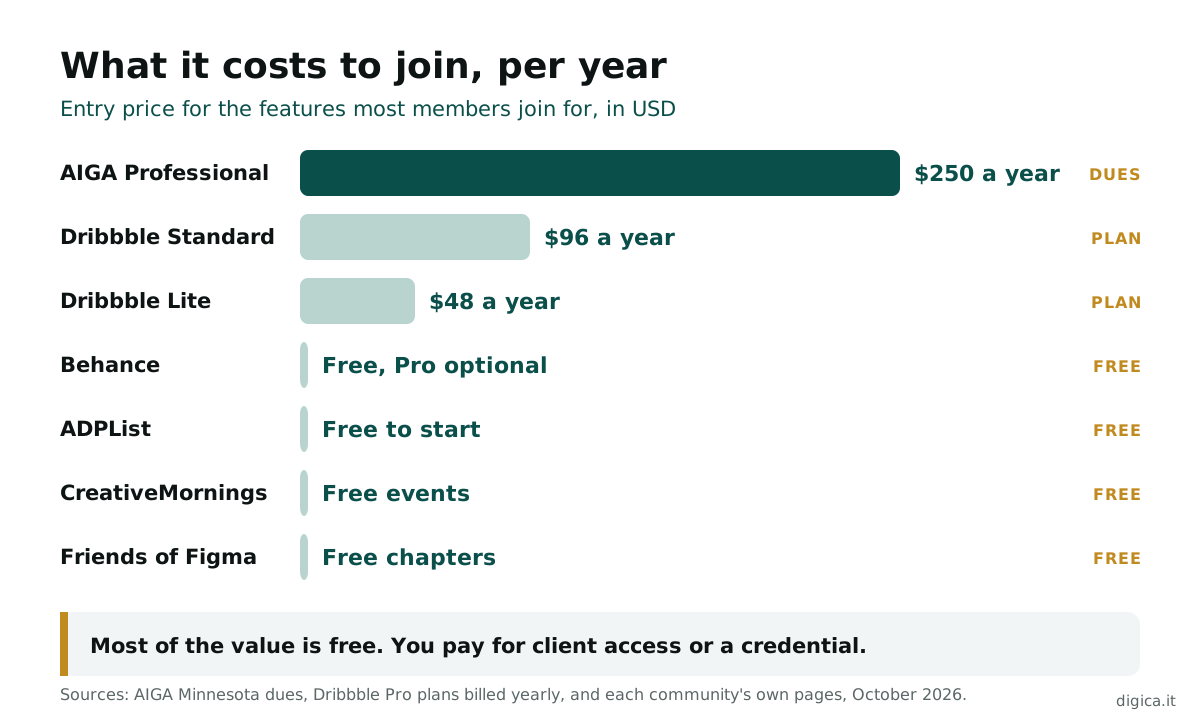
The number to track is opportunities per hour invested, not followers gained. A Dribbble Standard plan costs $96 a year; if it brings one project at the $3,000 seen in its service listings, it pays back on the first job, and if it brings none in 90 days, cancel it. If two hours a month at a local event brings one referral a quarter, and ten hours a month on a showcase brings none, the event is the better investment by any measure. The biggest cost of doing nothing is a year spent in communities that never sent you a single client, mentor or member.
FAQ
What is a creator community? A creator community is a group of creators, designers or artists who share work, feedback and opportunities, online or in person. Some are platforms where clients hire members, such as Behance; others are networks for mentorship or events, or paid communities a creator runs for their own audience.
What is the best designer community to join? It depends on what you need. Behance and Dribbble lead for client work, ADPList for mentorship, CreativeMornings and Friends of Figma for local events, and AIGA for professional standing in the United States.
Are designer communities free? Most are free to join. Behance, Figma Community, Friends of Figma, ADPList and CreativeMornings cost nothing to start. Dribbble charges for client-facing features from $4 a month billed yearly, and AIGA chapter dues run from $50 to $500 a year.
How do I find clients through a creator community? Choose a community where clients actively search or post briefs, such as Behance or Dribbble, publish detailed case studies in a narrow specialty and respond to briefs rather than waiting. Local events add referrals that online profiles rarely produce.
What is the best community for UX designers? For user experience designers, ADPList offers free mentorship from working practitioners, and Friends of Figma runs more than 250 local chapters with regular events. Figma Community also lets designers publish templates and plugins that other designers use.
Can creators earn money from their own community? Yes. Patreon says more than 300,000 creators have more than 10 million paying members a month, and that creators have earned more than $10 billion on it. Income depends on bringing an existing audience and delivering regular benefits.
Related Articles
- Creator and influencer marketplace growth
- Best influencer marketplaces for B2B brands in 2026
- Best community platforms for B2B communities in 2026
- Best B2B and business communities to join in 2026
- Best developer communities in 2026, ranked by activity
- Best freelance marketplaces for businesses in 2026
Where this connects
This article is part of our B2B marketplace growth series. Browse more on the Digica blog.