The best data annotation companies in 2026, ranked on how they source and check the human data AI labs buy
Data annotation companies supply the human judgment that AI models are trained and tested on: people who label images, transcribe speech, write model answers and rank which of two answers is better. It has become one of the largest B2B services markets in AI. Surge AI reportedly passed $1 billion in revenue in 2024, and Meta paid $14.3 billion for 49% of Scale AI in June 2025.
What the biggest buyers want has changed faster than most rankings of data labeling companies. Frontier labs no longer need thousands of generalists drawing boxes on photos. They need doctors, lawyers, engineers and mathematicians who can write a hard problem, solve it and explain where a model went wrong, and they need proof that the work was checked. A vendor's sourcing model and its quality controls now matter more than its headcount.
This guide ranks seven of the leading data annotation and AI training data providers on exactly that: where each finds its people, how it checks their work, and who it serves, using what each company publishes, checked on October 23, 2026. It is the same supply-quality test we apply when we help data B2B marketplaces grow, because the best of these companies are talent B2B marketplaces with AI labs as the buyers.
Quick Navigation
- What data annotation companies do in 2026
- Seven data annotation companies ranked
- 1. Surge AI: credential-checked experts for frontier labs
- 2. Scale AI: the largest contributor platform, rebuilt after Meta
- 3. Mercor: an expert hiring engine for AI labs
- 4. Labelbox: labeling software with its own expert network
- 5. Appen: the veteran crowd, now growing on LLM work
- 6. TELUS Digital: a million-strong community with layered review
- 7. iMerit: managed domain experts for regulated data
- How the quality controls compare
- Three failure scenarios
- Which data annotation company fits your project
- FAQ
- Related Articles
What data annotation companies do in 2026
The short answer: data annotation companies, also called data labeling companies or human data companies, recruit people to create and check the examples AI models learn from, then deliver that data with evidence that it meets the buyer's quality bar.
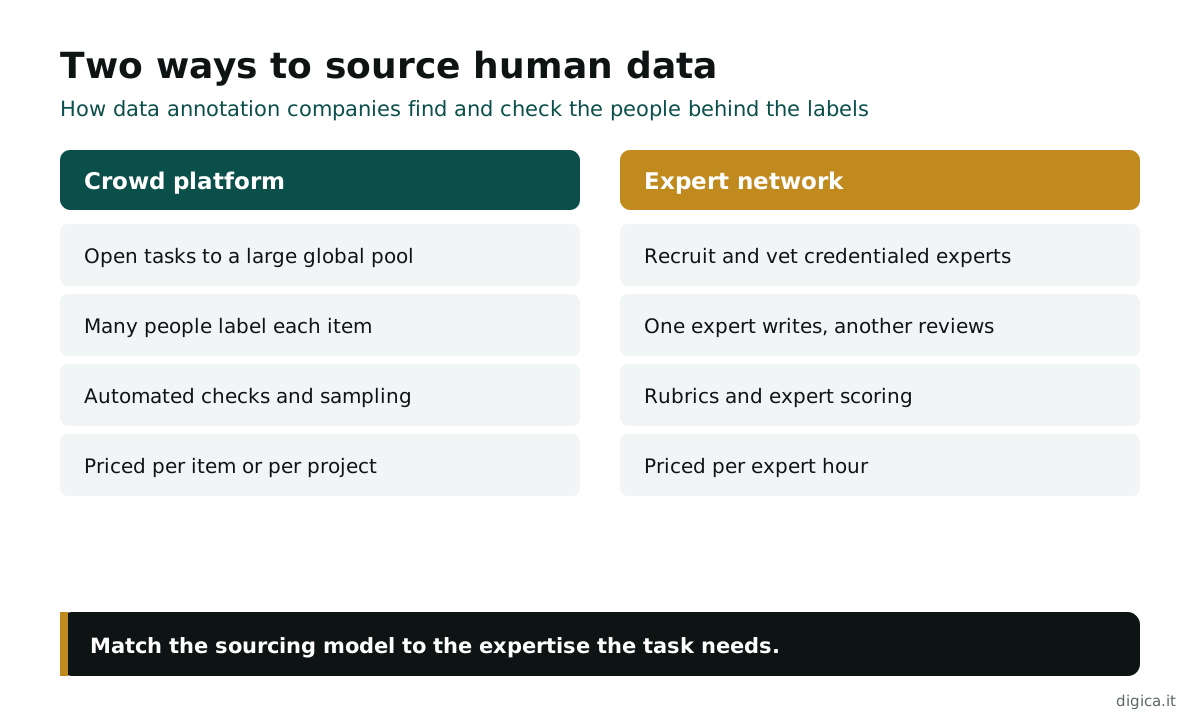
There are three ways to do it. A crowd platform opens tasks to a large pool of contributors worldwide and relies on volume, redundancy and automated checks. An expert network recruits and vets specialists, often with degrees or professional licenses, and pays them by the hour for harder work. Labeling software gives a buyer's own team, or a vendor's, the tools to label, review and measure the work. Most large providers now combine two or three of these.
The shift toward experts comes from how modern models are trained. Reinforcement learning from human feedback (RLHF) depends on people writing demonstration answers and ranking model outputs, the method OpenAI described in its InstructGPT research (Ouyang et al., arXiv). The better the model, the harder the questions and the more expert the human needed to judge the answer.
We ranked the seven companies below on four things: the sourcing model, the size and type of the workforce each claims, the quality controls and certifications it publishes, and the buyers it serves. We weighted published quality controls heavily, because a buyer cannot audit what a vendor will not describe. Our view: a vendor that will not tell you how it checks its people is asking you to trust the one thing you are paying it to prove.
Seven data annotation companies ranked
The short answer: Surge AI ranks first for expert depth with the largest labs, Scale AI second for platform scale and certifications, Mercor third for hiring speed, Labelbox fourth for buyers who want their own tooling, Appen fifth for language coverage, TELUS Digital sixth for layered review at volume, and iMerit seventh for regulated data.
Seven data annotation companies compared on sourcing model, workforce claimed, quality controls published, cost model, main risk and best fit
| Rank | Company | Sourcing model | Workforce claimed | Quality controls published | Cost model | Main risk | Best for |
|---|---|---|---|---|---|---|---|
| 1 | Surge AI | Managed expert workforce | 200,000+ across 500+ disciplines | Role-level credential bars | Managed projects | Few published QA details | Frontier labs needing hard expert data |
| 2 | Scale AI | Crowd platform plus software | $1B paid to contributors | SOC 2 Type II, ISO 27001, FedRAMP High | Managed projects | Buyer concerns after Meta's 49% stake | Government and enterprise programs |
| 3 | Mercor | Expert network | 30,000+ experts (October 2025) | AI interviews plus expert rubric scoring | Hourly expert rates | Fast growth, young processes | Labs hiring specialists quickly |
| 4 | Labelbox | Software plus Alignerr network | 100,000+ experts on Alignerr | SOC 2 Type II, NIST 800-171, structured review | Platform plus services | Two products to evaluate | Teams that want their own labeling stack |
| 5 | Appen | Crowd platform | 1M+ contributors in 170+ countries | SOC 2, ISO 27001, bias audits | Managed projects | Shrinking business outside China | Multilingual and speech data |
| 6 | TELUS Digital | Crowd plus managed teams | 1M+ contributors, 500+ languages | Automated checks, AI vetting, expert review | Managed projects | Change after the 2025 take-private | High-volume enterprise programs |
| 7 | iMerit | Managed domain experts plus software | 25,000+ Scholars in 60+ countries | SOC 2, ISO 27001, HIPAA, TISAX | Managed projects | Smaller expert pool | Medical, automotive and regulated data |
Read the table across, not down. A crowd of a million is not better than 30,000 vetted experts if your task needs a licensed physician, and a strong certification list does not tell you how answers are checked.
1. Surge AI: credential-checked experts for frontier labs
Surge AI ranks first because it has built the deepest expert workforce aimed squarely at the hardest work frontier labs buy. TechCrunch reported in September 2025 that Surge works with OpenAI, Google, Anthropic and Meta, and Bloomberg reported that the company, bootstrapped and profitable, was in talks to raise money for the first time at a valuation of at least $25 billion.
On sourcing, Surge says its workforce numbers more than 200,000 people across 80+ languages and 500+ disciplines. Its role listings set the bar by credential rather than by test score alone, with legal roles asking for people such as current or former Supreme Court clerks. That is the managed expert model at its sharpest: recruit fewer, more qualified people and pay them for judgment.
Running a human data or annotation business?
In 30 minutes we look at how AI teams and expert contributors find platforms like yours, and which side of your market is holding growth back.
The gap is transparency. Surge publishes far less about its quality assurance process than the platform companies below, and its chief executive has told TechCrunch the company built an internal team to create training environments for AI agents, a sign that the product is moving beyond labeling. For a frontier lab, the track record answers the question. For a smaller buyer, ask for the review process in writing.
Why it ranks first. The strongest expert sourcing in the market and the largest buyers, held back only by how little it publishes about checks.
2. Scale AI: the largest contributor platform, rebuilt after Meta
Scale AI ranks second: it still runs the largest contributor platform and the strongest certification set here, but Meta's investment changed who buys from it. In June 2025, Meta paid $14.3 billion for a 49% non-voting stake, valuing Scale at over $29 billion, and founder Alexandr Wang joined Meta. TechCrunch reported that Google planned to cut ties, and OpenAI said it was winding down work before its finance chief said Scale would remain one of many vendors.
On sourcing, Scale says it has paid $1 billion to contributors globally and recorded 15 billion human decisions. Contributors work through its Outlier platform, where many act as reviewers who rate model responses, alongside Scale's Data Engine software.
On checks, Scale publishes the strongest security credentials on this list: SOC 2 Type II, ISO/IEC 27001:2022, FedRAMP High and Department of Defense Impact Level 4. It says much less about how individual tasks are reviewed. In July 2025, Scale cut about 14% of its staff, around 200 full-time roles, as it refocused on enterprise and government customers.
Why it ranks second. Unmatched scale and certifications, with a customer base reshaped by Meta's stake. For a public sector or enterprise buyer, it may rank first.
3. Mercor: an expert hiring engine for AI labs
Mercor ranks third because it has turned expert recruiting into a near-automated B2B marketplace. In October 2025 it raised a $350 million Series C at a $10 billion valuation, led by Felicis, and TechCrunch reported at the time that it had more than 30,000 experts earning over $85 an hour on average, with more than $1.5 million paid out each day. TechCrunch also reported that it works with OpenAI, Meta and Anthropic.
The sourcing model is what makes it distinctive. Candidates sit a structured AI-led interview of about 20 minutes, and human expert interviewers score candidates against rubrics. Mercor also publishes APEX, a benchmark built from real professional work, which doubles as a public signal of how it thinks about quality.
The risk is speed. A company that grew this fast has young processes, and its own site now shows figures far above the October 2025 numbers that are hard to verify. Ask how reviewers are chosen and how disagreements between experts are resolved.
Why it ranks third. The fastest route to vetted specialists, with checks that are clearer than most but still maturing.
4. Labelbox: labeling software with its own expert network
Labelbox ranks fourth because it is the best option here for buyers who want to own their labeling process rather than outsource it. It sells a labeling and evaluation platform and runs Alignerr, an expert network that says it has more than 100,000 experts and hires more than 1,000 a week. Labelbox claims that over 90% of leading US AI labs post-train and evaluate on its platform.
Do AI teams find your annotation company when they search?
A growth audit maps how AI buyers search for data labeling and human data providers, on Google and in AI answers, and which of your pages they never reach.
Its controls are well documented. Labelbox lists SOC 2 Type II, GDPR, CCPA and NIST 800-171 compliance, and its published work for Meta describes a sequence of prompt creation, structured scoring criteria, review, expert feedback and quality assurance. In October 2026, it closed a Series E of more than $100 million, led by Infinitum Partners with a16z among the investors, and reported more than 400 customers.
The trade-off is that a buyer is evaluating two products: software it will run and a workforce it will hire. Teams with a strong internal data operations function get the most from it.
Why it ranks fourth. The clearest documented quality process here, best for teams that want control over their own labeling stack.
5. Appen: the veteran crowd, now growing on LLM work
Appen ranks fifth: it has the widest language coverage of any crowd platform, but its business outside China is shrinking. The Australian-listed company says it has more than 1 million contributors in 170+ countries, working in 235+ languages, and that it holds SOC 2 and ISO 27001 certification, with bias and compliance audits among its services.
Its results show where demand has moved. In its full-year 2025 results, Appen reported revenue of $230.8 million, up 4.5%, with Appen China up 75% to $102.9 million on large language model projects and Appen Global down 21% to $127.9 million (Appen FY25 results, ASX). It guided to $270 million to $300 million for 2026.
For speech, multilingual text and locale-specific evaluation, a crowd this broad is hard to replace. For expert reasoning data, it competes against companies built for that work from the start.
Why it ranks fifth. The broadest language reach on this list, with growth concentrated in one region.
6. TELUS Digital: a million-strong community with layered review
TELUS Digital ranks sixth, a large crowd and managed team operation that publishes a clearer quality process than most. It says its AI data community has more than 1 million contributors working in 500+ languages and dialects across 20+ verified expert domains, producing more than two billion labels a year.
On checks, TELUS Digital describes multilayer quality assurance that combines automated tooling, AI-powered contributor vetting and expert human review, and it was named a Leader in Everest Group's PEAK Matrix assessment. Its customer logos include Google, Meta, Microsoft and Amazon.
The change to watch is ownership. TELUS, the Canadian telecoms group, completed its take-private of TELUS Digital on October 31, 2025. That brings stability and backing, and also the usual questions a buyer should ask after any change of control: same teams, same terms, same roadmap.
Why it ranks sixth. Volume and layered review for large enterprise programs, with ownership recently changed.
7. iMerit: managed domain experts for regulated data
iMerit ranks seventh: smaller than the crowds above, but built for data where errors carry legal or safety risk. Its Scholars program counts more than 25,000 domain experts in 60+ countries, which it positions directly against crowd-sourced annotation, and it runs its own Ango Hub platform with quality assurance modes and expert performance monitoring.
Its certification list is the most regulation-focused here: SOC 2, ISO 27001, GDPR, HIPAA and TISAX, the last of which matters to automotive buyers. Customer logos include Microsoft, Google Cloud, GE Healthcare and Johnson and Johnson.
Why it ranks seventh. The right fit for medical imaging, automotive and other regulated work, with a smaller expert pool than the leaders.
How the quality controls compare
The short answer: platform companies publish certifications, expert networks publish vetting, and almost nobody publishes how individual answers are checked, which is the question a buyer most needs answered.
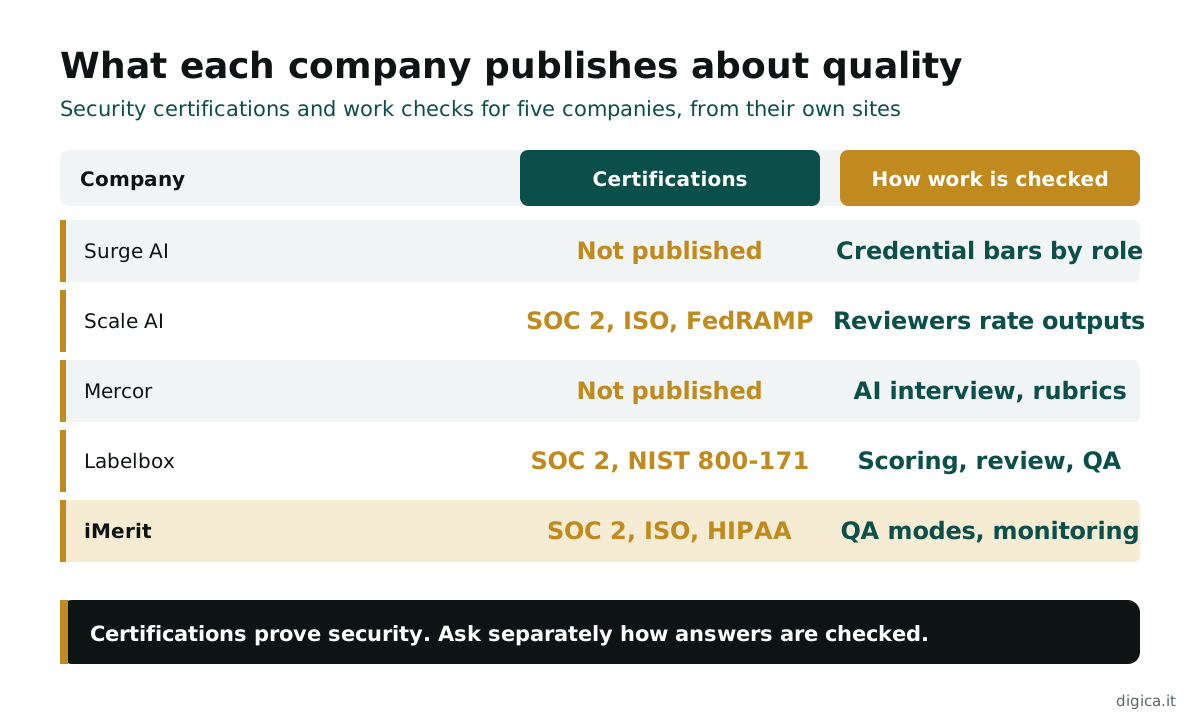
Certifications and quality controls answer different questions. SOC 2, ISO 27001 and HIPAA tell you the data is handled securely. They do not tell you whether the answer a contractor wrote is correct. For that you need the vendor's review process: how many people see each item, how disagreements are resolved, how reviewers are chosen and how often good work is sampled against known answers.
The pattern across the seven is clear. Scale, Appen and iMerit lead on certifications. Labelbox and TELUS Digital describe the clearest review processes. Surge and Mercor lead on vetting the people before work starts. Each has a gap, and the gap is where a buyer should push hardest in the pilot.
A practical test works better than reading websites. Give two vendors the same 200 items, including 20 where you already know the right answer, and compare both accuracy and how each explains its mistakes.
Three failure scenarios
These are the patterns that recur when an AI team chooses a data annotation company on size or price alone.
- The crowd hired for expert work. A team building a legal assistant sends contract analysis to a large crowd platform because the per-item rate is low. The labels come back fast and inconsistent, because few contributors have legal training, and the model learns the inconsistency. An expert network at a higher hourly rate would have produced fewer, usable examples.
- The certification taken as quality. A health company picks a vendor because it holds HIPAA and ISO 27001, then discovers in testing that nobody reviewed radiology labels a second time. Security was never the problem. Asking for the review process and seeding known answers in the pilot would have caught it.
- The single vendor with a new owner. An AI team runs all of its human data through one provider, which then takes a large investment from a competitor of the team's biggest customer. Overnight, the team has to move sensitive projects mid-flight. Splitting work across two vendors from the start would have made the move routine.
Each team made a reasonable choice on one dimension. Each paid for ignoring the sourcing model or the checks.
Which data annotation company fits your project
The short answer: start from the expertise the task needs, then the volume, then the regulation the data falls under.
- If the task needs a professional credential, such as a law degree or medical license, for more than 30% of items, shortlist Surge AI and Mercor and ask each for its vetting criteria.
- If you need more than 1 million labels a year across many languages, compare Appen and TELUS Digital on language coverage and review layers.
- If your own team wants to run labeling and keep the process in house, trial Labelbox's platform first and add its expert network only for overflow.
- If the data is medical, automotive or otherwise regulated, require HIPAA or TISAX as relevant and look at iMerit first.
- If you sell to government or need FedRAMP, Scale AI is the only provider here that publishes FedRAMP High.
- If more than half your human data spend sits with one vendor, add a second before your next large project.
Growing a human data or AI training data B2B marketplace?
We help data B2B marketplaces recruit the experts and data owners that make them worth buying from, and reach the AI teams searching for them.
The figure to take into your next budget meeting is the size of the market you are buying in. The Stanford AI Index 2026 puts US private AI investment at $285.9 billion in 2025, and Surge AI alone reportedly passed $1 billion in revenue in 2024 selling human data into those budgets. If you pilot two vendors on the same seeded test set before you sign, you save the cost of retraining on bad labels. The biggest cost of doing nothing is a model trained on data nobody checked, which you only find out about when it fails in front of your customers.
FAQ
What do data annotation companies do? Data annotation companies recruit people to label, write and check the examples AI models learn from, such as tagged images, transcribed speech, written answers and rankings of model outputs, and deliver that data with quality checks for the buyer.
What are the biggest data labeling companies? By reported revenue and scale, the biggest data labeling and human data companies are Surge AI, reported at more than $1 billion in revenue in 2024, Scale AI, Mercor, Appen, TELUS Digital and Labelbox.
Which companies provide RLHF data? Surge AI, Scale AI, Mercor, Labelbox through its Alignerr network, Appen and TELUS Digital all provide data for reinforcement learning from human feedback, including demonstration answers and rankings of model outputs.
How do data annotation companies check quality? The common methods are vetting contributors before work starts, having more than one person label each item, expert review of a sample, and seeding tasks with known correct answers. Ask any vendor which of these it uses and how often.
Is Scale AI still the largest data annotation company? Scale AI still runs one of the largest contributor platforms, having paid $1 billion to contributors, but Surge AI reportedly passed it on revenue in 2024, and some large labs reduced their work with Scale after Meta bought 49% of it in June 2025.
What is the difference between crowd and expert data annotation? Crowd annotation spreads simpler tasks across a large pool of contributors and checks quality through volume and redundancy. Expert annotation pays vetted specialists by the hour for tasks that need professional knowledge, such as law, medicine or advanced coding.
Related Articles
- Data marketplace growth
- AI training data market: who buys, who sells, who wins
- Best places to buy datasets for AI training in 2026
- Best data marketplaces in 2026: 10 platforms compared
- Best talent marketplaces in 2026
Where this connects
This article is part of our B2B marketplace growth series. Browse more on the Digica blog.