The AI training data market in 2026: who buys, who sells, and who wins
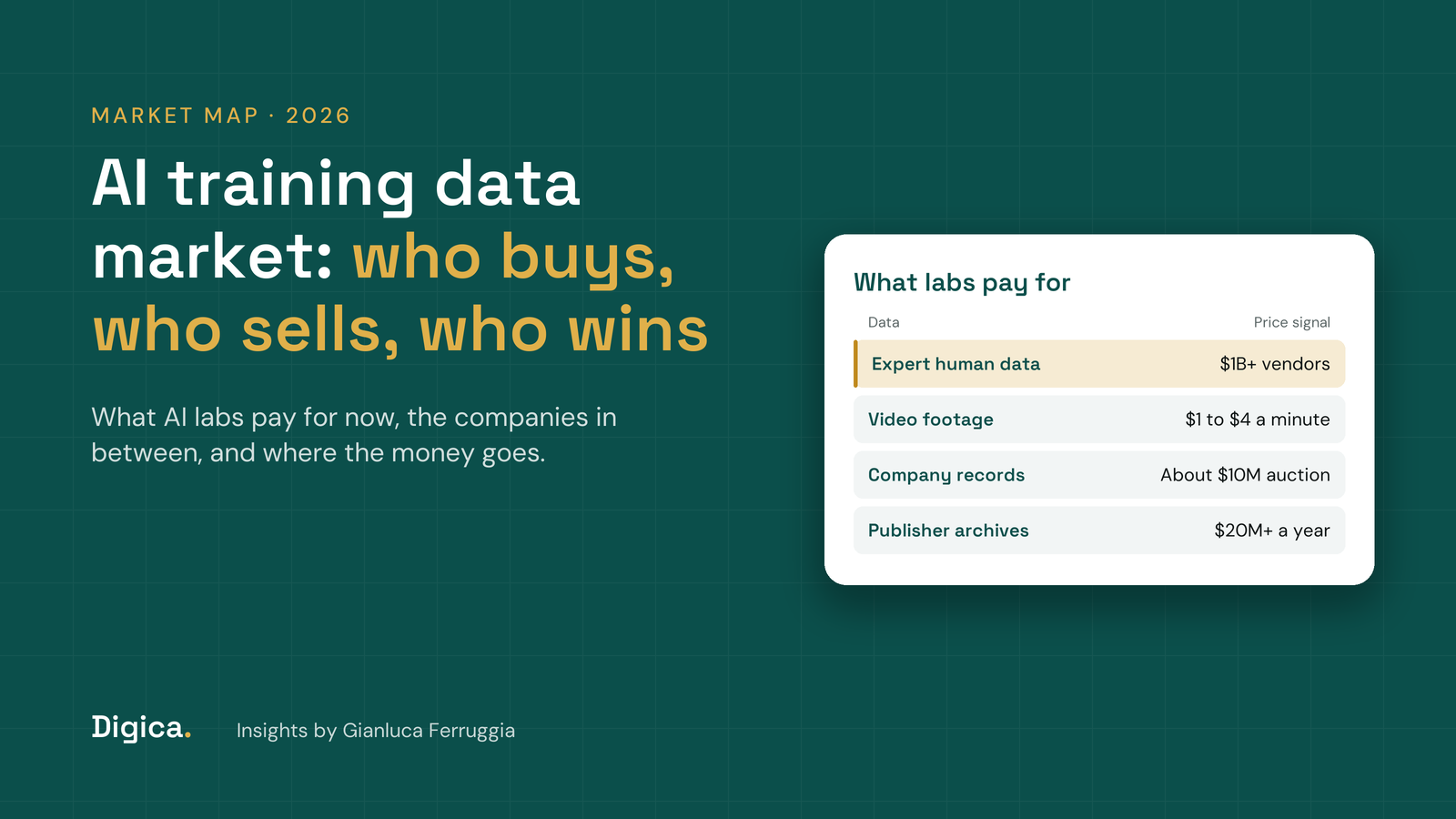
AI training data used to be whatever a crawler could reach. In 2026 it is something AI labs pay for, and they pay a lot. Surge AI, which sells expert human feedback to AI labs, reportedly made more than $1 billion in revenue in 2024, and Shutterstock's 2025 annual report shows $203.3 million from its data, distribution and services line, citing demand for model training.
The free supply is running down at the same time. Public web text is finite, more of it is blocked to crawlers every year, and courts have made clear that how a lab acquires data matters as much as what it does with it. That is turning training data from a scraping problem into a buying problem, with buyers, sellers, brokers, prices and contracts. In other words, a B2B market.
This guide maps that market: what frontier labs buy now, who sells it, the deal structures in use, and where the money actually flows. It is written for data owners deciding whether to sell, and for the brokers and AI data marketplaces in between. It is the same supply and demand lens we use when we help data B2B marketplaces grow both sides.
Quick Navigation
- What AI training data means in 2026
- Who buys: what frontier labs pay for now
- Human data is the biggest line item
- Video and company records: the newest supply
- Who sells: AI training data companies in the middle
- The AI data marketplace layer
- Deal structures side by side
- Where the money flows
- Three failure scenarios
- Where to start: a decision framework
- What provenance is worth
- FAQ
- Related Articles
What AI training data means in 2026
The short answer: AI training data is any text, image, audio, video, code or record set used to train, fine-tune or evaluate a model, and in 2026 the valuable kind is licensed, documented and hard to get anywhere else.
Three years ago, most training data was public web text. That pool is now the constraint. Epoch AI estimates the stock of quality-adjusted public human text at around 300 trillion tokens and projects that it will be fully used at some point between 2026 and 2032 (Epoch AI). The Data Provenance Initiative's Consent in Crisis study, presented at NeurIPS in 2024, found that in a single year about a quarter of tokens from the most critical web domains became restricted through robots.txt.
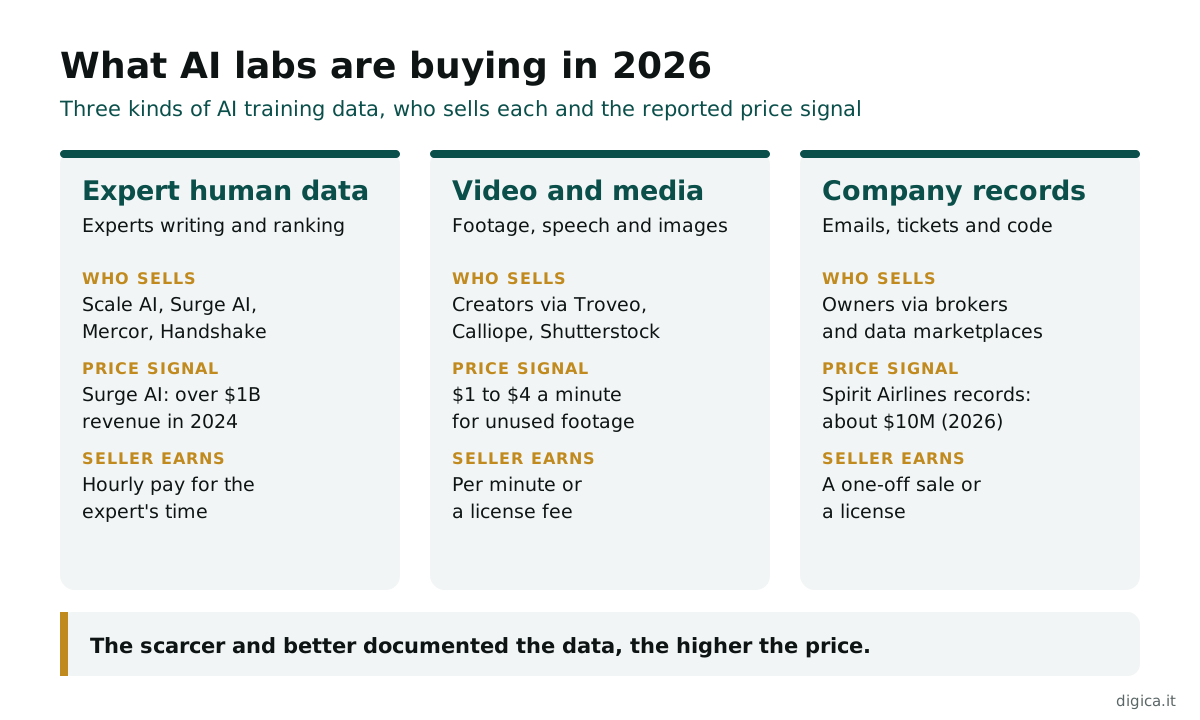
So labs now buy three things the open web cannot supply. Expert judgment: people who can write, check and rank answers in law, medicine, finance or code. Rich media: video, speech and images with clear rights. And real work: the emails, tickets, spreadsheets and code that show how a business actually operates, which labs use to train and test agents.
The phrase "training data" also covers evaluation data now. A lab building an agent needs tasks with known good answers to measure it against. That makes the market bigger than the word "training" suggests, and it is why many buyers care as much about structure and documentation as about volume.
Our view: the open web was the cheap phase of this market. The paid phase rewards whoever can prove where their data came from.
Who buys: what frontier labs pay for now
The short answer: the frontier labs (OpenAI, Google, Meta, Anthropic and a handful of others) are the main buyers, and they buy expert human data first, then video and multimodal data, then proprietary company records.
The scale of the buying is visible in the deals. In June 2025, Meta invested $14.3 billion for a 49% non-voting stake in Scale AI, and Scale's founder moved to Meta. OpenAI said it was winding down its Scale work, before its finance chief said it would keep working with the company, and Reuters reported that Google planned to cut ties. A single investment changed who would buy from whom, which tells you how concentrated the demand side is.
Running a data or AI training data B2B marketplace?
In 30 minutes we look at how AI teams and data owners find platforms like yours, and which side of your market is too thin to close deals.
Publishers and platforms sit on the other side of the earliest deals. Reddit's 2025 annual report shows "other revenue", which includes its data licensing, at $140.0 million, up from $15.2 million in 2023. Amazon's licensing deal with The New York Times, announced in May 2025, was reported at $20 million to $25 million a year.
Below the frontier labs sit a long tail of buyers: model builders in specific domains, enterprise AI teams fine-tuning for their own use, and the data vendors themselves, who buy raw material and resell it improved. For a data owner, that long tail matters. It is where most first deals happen, because the frontier labs mostly buy at a scale and with a diligence process few owners can meet on day one.
Human data is the biggest line item
The short answer: human data, meaning people writing, ranking and checking model outputs, is where most AI training data spend goes, and the vendors that supply it have grown faster than almost any other B2B services business.
The numbers are large even allowing for reporting gaps. Scale AI made $870 million in revenue in 2024, according to Bloomberg, with about $2 billion projected for 2025. Reuters reported that Surge AI, bootstrapped and profitable, passed $1 billion in 2024. TechCrunch reported in September 2025 that Mercor was approaching $450 million in annualized run-rate revenue.
New entrants scale from existing networks of experts. Handshake, a careers network for students and graduates, turned its PhD and student base into an AI data business that Dealroom put at about $1 billion in gross annualized revenue by April 2026, much of which is paid out to the contractors doing the work.
What labs pay for has moved up the skill curve. Early reinforcement learning from human feedback (RLHF) used generalist raters comparing two answers. Today's buyers want lawyers, doctors, engineers and mathematicians who can write a hard problem, solve it and explain where a model went wrong. That is a recruiting and quality control business more than a technology one, which is why the leading vendors look like talent B2B marketplaces with an AI customer base. Our ranking of data annotation and AI training data companies compares how each one sources and checks that work.
The opinion we hold: the human data vendors are B2B marketplaces in all but name. They win on supply quality, matching speed and trust, the same three things that decide every two-sided business we work on.
Video and company records: the newest supply
The short answer: video is bought by the minute from creators and studios, and company records, the emails, chats and code of real businesses, are the fastest growing new source, sold through brokers and even bankruptcy auctions.
On video, Bloomberg reported in January 2025 that OpenAI, Google and Moonvalley were paying creators $1 to $4 a minute for unused footage, with 4K, drone and 3D footage at the top of the range. Brokers such as Troveo and Calliope Networks sit between the creators and the labs, and Troveo said it had paid creators more than $5 million.
Company records are newer and stranger. Fast Company and Gizmodo, following Forbes, reported in April 2026 that shuttered startups were selling old Slack chats, email archives and Jira tickets to AI companies, with the wind-down firm SimpleClosure helping arrange nearly 100 such sales at $10,000 to $100,000 per company. In August 2026, Google won the Spirit Airlines bankruptcy data auction at about $10 million, for a package of roughly 100 million emails, 500 million Teams records and 30 million lines of code, with passenger data excluded.
The data AI company micro1 then made the demand explicit. On October 9, 2026, it committed to spend $1 billion over 12 months acquiring and licensing enterprise operational data, de-identified, to build training environments for AI agents.
This is the part of the market most relevant to ordinary B2B companies. A 70-person firm will never sell a video library or hire 1,000 PhDs, but it does have years of real work in its systems. The open question is whether it can sell that without exposing customers, staff or trade secrets.
Who sells: AI training data companies in the middle
The short answer: AI training data companies fall into four groups: expert workforce vendors, data brokers, licensing marketplaces and infrastructure that lets publishers charge for access.
- Expert workforce vendors. Scale AI, Surge AI, Mercor, Handshake and micro1 recruit specialists, run the projects and deliver the finished data. They capture the largest share of spend because they sell labor plus quality control.
- Data brokers. Troveo and Calliope Networks for video, and wind-down firms such as SimpleClosure for company archives, find supply, clean it and negotiate with buyers. They earn a cut or a spread.
- Licensing marketplaces. Protege, which raised $30 million from a16z in January 2026, runs a governed marketplace for proprietary data such as clinical records, medical images, video and audio. Human Native, a London rights marketplace, joined Cloudflare in January 2026.
- Access infrastructure. Cloudflare's pay per crawl, Microsoft's Publisher Content Marketplace and the Really Simple Licensing (RSL) standard let websites set terms for AI crawlers rather than block them.
Smaller, newer players show where the gaps are. Opendatabay runs a licensed data marketplace for AI training and fine-tuning, with providers listing text, image, audio, video, code and human feedback data. Pewter works for owners of US companies with 20 or more employees, handling the valuation, de-identification and sale of their company records to AI buyers, with no fee to the owner. If you are deciding where to buy rather than sell, our guide to the best places to buy datasets for AI training compares the licensing terms.
The AI data marketplace layer
The short answer: an AI data marketplace connects data owners with AI buyers and standardizes the license, the documentation and the payment, and it wins or loses on the same supply and demand problems as any other B2B marketplace.
The supply side is hard because most owners do not know their data is worth anything, do not know what format buyers want, and worry about privacy and contracts. The demand side is hard because buyers want large, consistent volumes with clean rights, and most single owners cannot supply that alone. An AI training data marketplace earns its fee by solving both: aggregating many owners into packages a lab will buy, and giving owners a process they trust.
Do AI teams find your data marketplace when they search?
A growth audit maps how AI buyers and data owners search for platforms like yours, on Google and in AI answers, and which of your pages they never reach.
Policy is pushing the same way. The US Copyright Office's May 2025 report on generative AI training favored voluntary licensing markets over new legislation (US Copyright Office). The $1.5 billion settlement Anthropic agreed with book authors, finally approved in July 2026 at about $3,000 per book, turned on how the books were acquired. Both point buyers toward sources that can document where data came from.
That makes provenance the product. In our own ranking of data marketplaces, four of the ten platforms are run by cloud providers, which win on distribution to buyers already inside their platforms. The independent AI data marketplaces cannot match that reach. They have to win on supply nobody else has and on paperwork buyers can rely on.
We have seen this pattern from the inside. Building a B2B agency marketplace to 40,000+ listed agencies and 1M+ monthly users meant solving supply first: making it obvious to providers why listing was worth their time, then giving buyers enough proof to trust what they found. Data marketplaces face the same order of work, with higher stakes on trust.
Deal structures side by side
The short answer: most AI training data deals are flat annual licenses, per-unit prices or one-off sales, with usage-based payments growing in the access layer.
The table compares the structures that have been publicly reported, with examples and the risk each carries for the seller.
Six AI training data deal structures compared on example, cost to the buyer, main risk for the seller and best fit
| Structure | Reported example | Cost to the buyer | Main risk for the seller | Best for |
|---|---|---|---|---|
| Flat annual license | Reddit and Google, reported at about $60 million a year (2024) | Fixed, known in advance | Underpricing data whose value rises | Large platforms with fresh, continuous content |
| Archive fee plus recurring fee | Axel Springer and OpenAI, reported at tens of millions of euros a year | One-off plus ongoing | Archive priced once, never again | Publishers with deep archives and daily output |
| Per-unit price | Video at $1 to $4 a minute (Bloomberg, 2025) | Scales with volume | Commodity pricing for ordinary footage | Creators and studios with large libraries |
| One-off sale of records | Spirit Airlines data to Google, about $10 million (2026) | Single payment | Perpetual or exclusive terms that cap future income | Companies closing down or selling old archives |
| Usage or revenue share | Perplexity's publisher pool sharing 80% of Comet Plus revenue (2025) | Variable, tied to use | Low early payouts, hard to audit | Publishers whose content is used in live answers |
| Pay per crawl | Cloudflare pay per crawl, priced per request (2025) | Per access | Buyers simply not paying and going elsewhere | Websites that want terms instead of a block |
Two terms matter more than the price. Exclusivity: a perpetual, exclusive license can pay well once and then stop you selling the same data again. And warranties: buyers increasingly ask the seller to confirm it had the right to sell, and to cover them if it did not. Those clauses are where most of the risk in a first deal sits. Settle both in writing before you compare offers on price.
Where the money flows
The short answer: most of the money goes to the expert workforce vendors, then to large platforms and publishers through licenses, and a small but fast-growing share to owners of company records through brokers and AI data marketplaces.
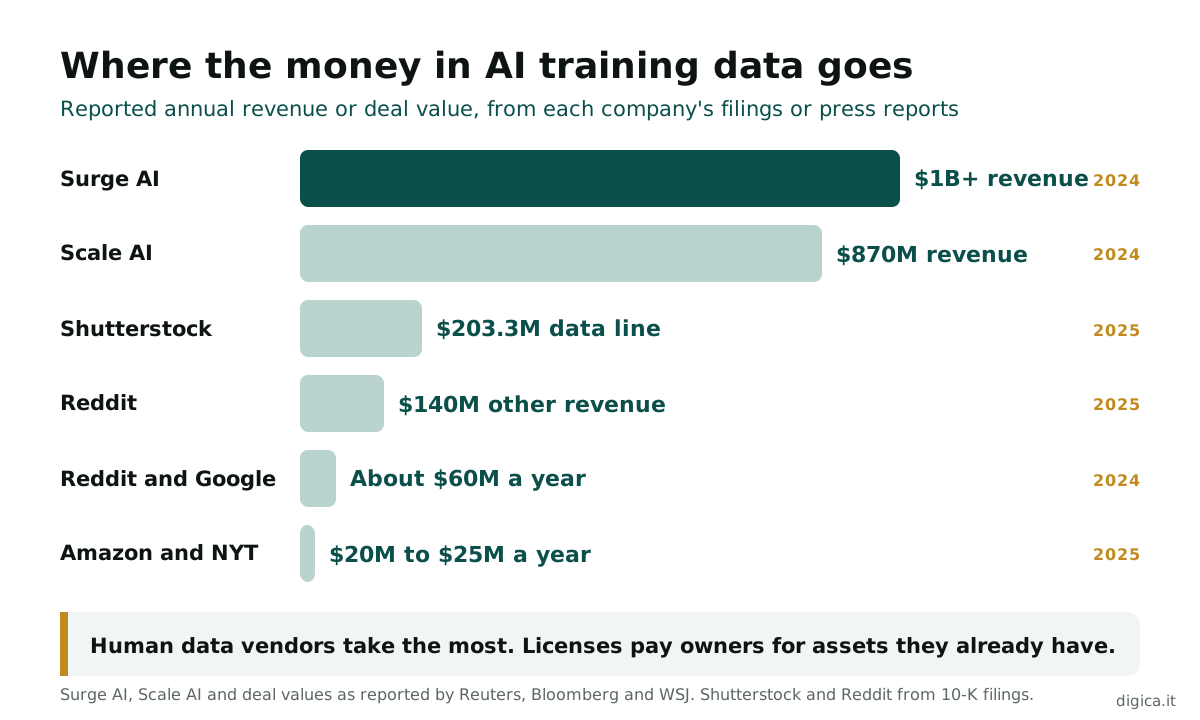
Analyst estimates undercount it. Research firms put the AI training dataset market at about $3 billion to $4 billion in 2025. A single vendor, Surge AI, reportedly passed $1 billion in revenue in 2024, and Scale AI made $870 million. The likely difference is that dataset market reports measure datasets sold as products, not the human data services where the bulk of spend goes.
A large share of what the human data vendors bill goes straight to their contractors. That is why the vendors' gross revenue overstates what they keep, and why the economics look like a talent B2B marketplace: a take on every hour of expert work.
For a data owner, the practical reading is this. Labor-heavy data earns the most in total, but the owner of that data is the expert, who is paid by the hour. Owned assets, such as archives, footage and company records, are where an organization can be paid for something it already has. That is the slice now growing fastest, and the one where brokers and AI data marketplaces compete.
Three failure scenarios
These are the patterns that recur when a data owner or an AI data marketplace enters the market without a plan.
- The exclusive deal that capped the upside. A mid-size publisher signs a perpetual, exclusive license for its archive with one buyer, because the first offer looks large. A year later, three other buyers ask for the same archive and the publisher cannot sell it. A non-exclusive license with a renewal date would have kept the archive earning.
- The archive nobody could sell. A software company decides to license its support tickets and code history, then discovers the data is full of customer names, credentials and contract details. The de-identification work costs more than the first offer. Asking a broker to scope the clean-up before talking to buyers would have shown the real net value.
- The marketplace with buyers and no supply. An AI data marketplace raises money, signs letters of interest from AI teams and launches with a few dozen thin datasets. Buyers browse once and do not return. Recruiting a small number of high-value data owners first, with the paperwork done, would have given buyers a reason to come back.
Each one priced or planned for one side of the market and ignored the other.
Where to start: a decision framework
The short answer: decide whether you are selling labor, selling an asset or running the market, then let the data type and its rights decide the route.
Growing a data or AI training data B2B marketplace?
We help data B2B marketplaces recruit the data owners that make a catalog worth buying from, and reach the AI teams searching for it.
- If you have more than 10,000 hours of footage or audio with clear ownership, approach video and speech brokers first, and ask for a per-minute price with non-exclusive terms.
- If your company has more than 20 employees and several years of email, tickets or code, get a valuation and a de-identification plan from a broker before any buyer conversation, and never sign an exclusive license on the first offer.
- If you are a publisher or platform with daily new content, prefer a flat annual license or a usage-based model over a one-off archive sale, and add machine-readable terms through RSL or your content delivery network.
- If you employ or can recruit domain experts, the human data vendors pay for their time. Your organization earns a referral or partnership fee at most, so price accordingly.
- If you run or plan an AI data marketplace, recruit supply before demand, standardize the license and the data documentation, and publish how each dataset was collected and consented.
- If you cannot show where your data came from, fix that before anything else. No serious buyer will pay for data it cannot defend.
Most data owners we speak to start in the wrong place: they ask what their data is worth before asking whether they can prove they own it. Turn that order around and the first deal becomes much simpler to close.
What provenance is worth
Provenance is the number to take into your next board conversation. Under the European Union's AI Act, providers of general-purpose AI models must publish a summary of their training content using the European Commission's template, which has applied since August 2, 2025 (European Commission). Buyers now need sellers who can fill in that summary for them.
If you document where every record came from and who consented, you can save a buyer from the kind of exposure that cost Anthropic $1.5 billion, about $3,000 per book, and you can charge for that. The biggest cost of doing nothing is selling into a market that has moved to licensed, documented data with records you cannot explain, and getting a broker's lowest price or no offer at all.
FAQ
What is AI training data? AI training data is the text, images, audio, video, code and records used to train, fine-tune or evaluate an AI model. In 2026 the most valuable AI training data is licensed, documented and scarce, such as expert human feedback, rights-cleared video and de-identified company records.
Who buys AI training data? Frontier AI labs such as OpenAI, Google, Meta and Anthropic are the largest buyers, followed by companies building models for specific domains, enterprise AI teams and the data vendors themselves.
What are the biggest AI training data companies? By reported revenue, the largest are the human data vendors: Scale AI, which made $870 million in 2024, Surge AI, reported at more than $1 billion in 2024, and Mercor. Shutterstock is one of the largest licensors of media for training.
What is human data in AI? Human data is training data created or checked by people: written answers, rankings of model outputs, corrections and expert explanations. It is used for reinforcement learning from human feedback and for evaluating models, and it is the largest line item in AI training data spend.
How much can a company earn by selling its data to AI companies? Reported deals range widely. Shuttered startups have sold Slack and email archives for $10,000 to $100,000 each, and Spirit Airlines' records sold for about $10 million at auction. The price depends on volume, uniqueness, data quality and how clean the rights are.
What is an AI training data marketplace? An AI training data marketplace is a B2B marketplace that connects data owners with AI buyers and standardizes the license, documentation and payment. Protege, Opendatabay and Human Native, now part of Cloudflare, are examples.
Related Articles
- Data marketplace growth
- Best data marketplaces in 2026: 10 platforms compared
- Best data annotation and AI training data companies
- Best places to buy datasets for AI training in 2026
- B2B marketplace growth strategy: what works in 2026
- Being the source AI answer engines cite
- How to attract vendors to a B2B marketplace
Where this connects
This article is part of our B2B marketplace growth series. Browse more on the Digica blog.