The best equipment rental marketplaces for contractors, by fleet availability
A machine that is not on site by seven in the morning costs a contractor a crew's day. That is why the first question to ask an equipment rental marketplace is not the day rate but how much fleet sits behind its search box. BigRentz says its network of 6,000 rental companies and 14,000+ locations puts 90% of US job sites within a 30-minute drive of a partner yard. A small peer-to-peer site may list a few thousand items across a whole country. Both call themselves an equipment rental marketplace.
The difference matters more as budgets tighten. Contractors rent to avoid owning idle iron, and the rental market keeps growing while construction spending slows. The platform you book through decides how often the machine you need is actually free, close and delivered on time, which is a construction marketplace problem as much as a fleet one.
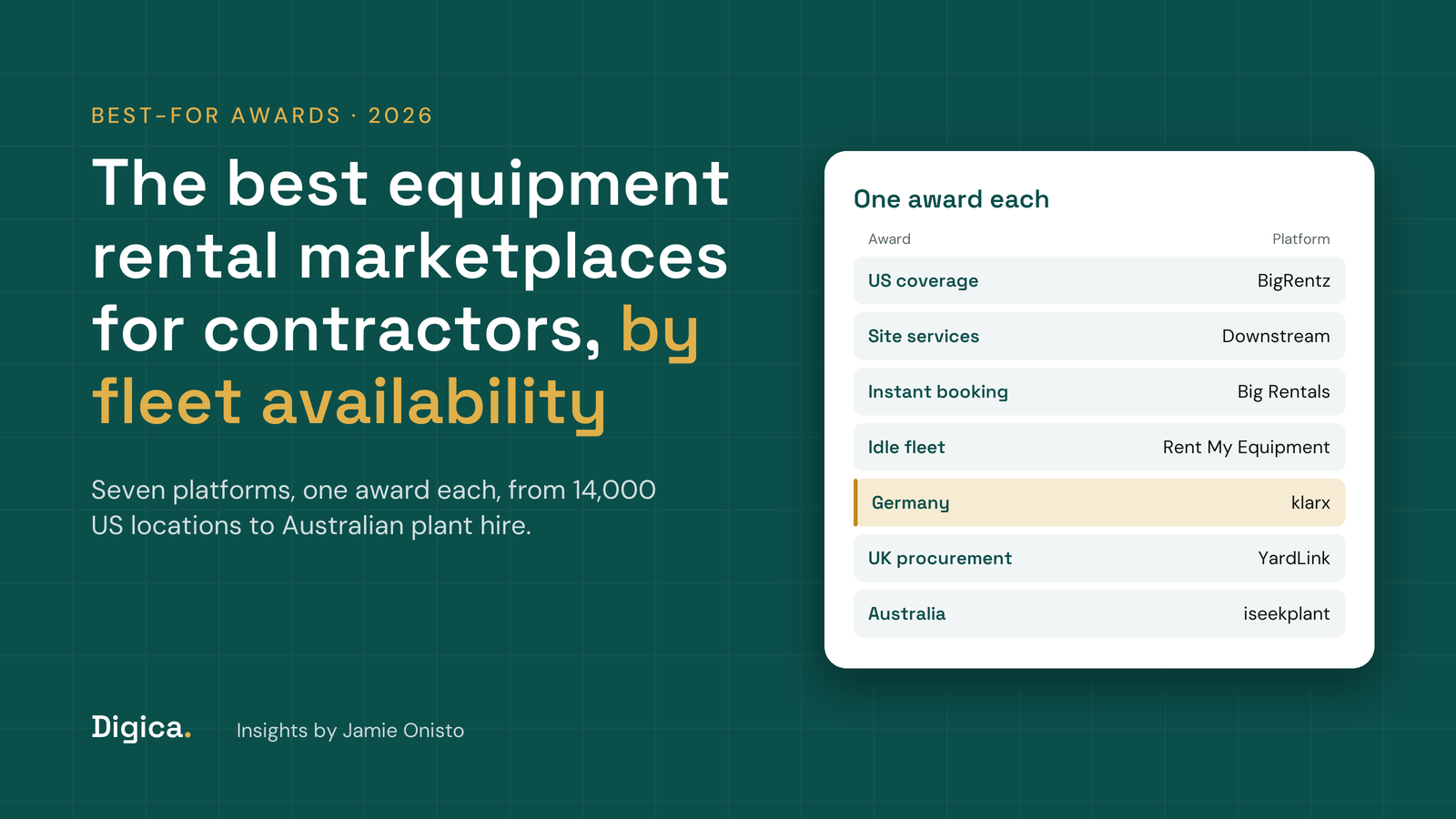
This guide gives seven equipment rental marketplaces one award each for fleet availability: how many rental yards, depots, machines or listings each one can put in front of a contractor, where, and how fast. It is written for contractors, project and procurement leads choosing where to rent, and for founders growing a rental B2B marketplace. Figures come from each platform's own pages or interviews, checked on November 13, 2026.
Quick Navigation
- How we judged fleet availability
- The seven awards at a glance
- US awards: coverage, site services, instant booking and idle fleet
- Outside the US: Germany, the UK and Australia
- What a fleet number does not tell you
- Three failure scenarios
- Choosing an equipment rental marketplace by job
- What availability is worth
- FAQ
- Related Articles
How we judged fleet availability
We asked each platform one question: when a contractor searches, how much equipment can it actually reach? Every marketplace answers in its own unit. Some count rental companies, some count depots or branches, some count machines, and the peer-to-peer platforms count listed items. We kept each figure in its own unit rather than forcing them into one ranking, because a depot and a listing are not the same thing.
We then looked at where that fleet sits, how a booking works (instant, quoted or brokered), and what happens on delivery. Each platform won the one award its numbers support best. We left out single-company rental fleets such as the national rental chains, which are suppliers on several of these platforms rather than marketplaces, and the used-equipment sites covered in our guide to surplus equipment marketplaces, which sell machines rather than rent them.
The market these platforms serve is large and still growing. The American Rental Association forecasts that US construction, industrial and general tool rental revenue will rise 3.4% in 2026 to $83.5 billion, with growth of 4.4% in 2027 and 5.1% in 2028 (American Rental Association forecast via Rental Equipment Register). Canada is forecast to grow 5.2% to $6.3 billion.
Our view: in rental, availability is the product. A lower day rate on a machine that is two hours away, or booked, saves nothing. The best equipment rental marketplace for a contractor is the one most likely to say yes, nearby, on the day.
The seven awards at a glance
The table pairs each award with the fleet number behind it. Use it to shortlist before reading the detail.
| Award | Platform | Fleet availability, in its own unit | Where | How you book | Cost to the contractor | Main risk | Best for |
|---|---|---|---|---|---|---|---|
| Nationwide US coverage | BigRentz | 6,000 rental companies, 14,000+ locations | USA | Brokered order, BigRentz sources the yard | Rental price, delivery quoted per job | You rarely choose the yard yourself | Contractors working in many states |
| Equipment plus site services | Downstream | 100,000+ listings in 23+ categories | USA | Three or more supplier quotes, then book | Pay in full or Net 30 | Quotes, not instant prices, for many items | Multi-site rollouts |
| Instant booking from independents | Big Rentals | 1,000+ verified suppliers | USA | Instant book on most equipment | Listed price, compare locally | Younger network, founded 2023 | Fast bookings from local owners |
| Peer-to-peer idle fleet | Rent My Equipment | 10,000+ items, 3,600 operators | USA and Canada | Request, owner confirms | Owner's price, damage cover included | Owner can decline | Renting from, or to, other contractors |
| Machine count in Germany | klarx | 530,000+ machines, 5,907 partner stations | Germany | Online, email or phone | Published day and hourly rates | Germany only | German contractors of any size |
| UK procurement teams | YardLink | 1,000+ suppliers, 2,400+ depots, 10m+ assets | UK | One account across suppliers | Supplier rates through one platform | UK only | Procurement teams with many suppliers |
| Australian plant hire | iseekplant | 18,718 suppliers, 375,245 machines and services | Australia | Quick quotes from local suppliers | Supplier quotes | Directory model, quotes vary | Civil contractors across Australia |
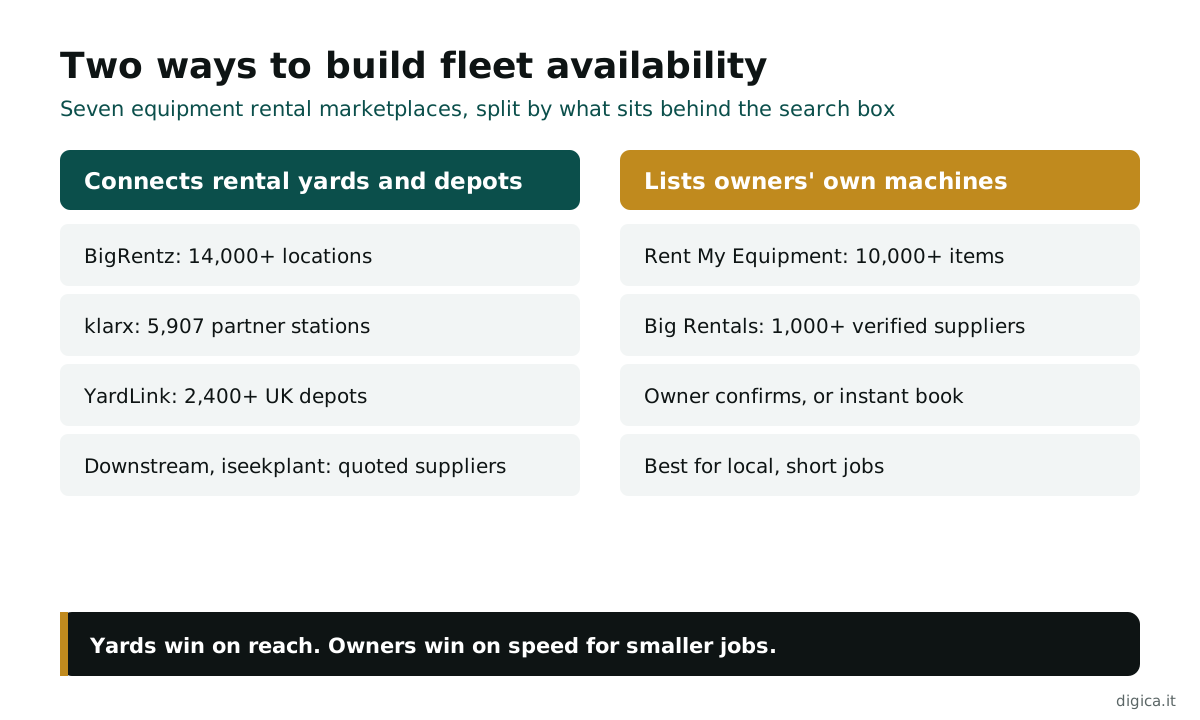
Two patterns stand out. The aggregators count yards and depots, and win on reach. The owner platforms count items, and win on speed and price for smaller jobs.
US awards: coverage, site services, instant booking and idle fleet
Four platforms take the US awards. They share a market and very different models: a broker, a quote marketplace, an instant-book platform and a peer-to-peer exchange.
Best for nationwide US coverage: BigRentz
BigRentz is a broker. A contractor places one order and BigRentz sources the machine from its network of independent and national rental yards. Founded in 2012, it says it now works with 6,000 rental companies across more than 14,000 locations. Its chief executive, Scott Cannon, said in May 2025 that the network puts 90% of US job sites within a 30-minute drive of a partner yard.
The model suits contractors who work across many states and want one account, one invoice and one phone number. Cannon also said its pricing model is trained on about 500,000 rental contracts and prices 99% of rented items in a millisecond. The trade-off is control: you choose the machine, BigRentz chooses the yard.
Best for equipment plus site services: Downstream
Downstream is an aggregator built for contractors who need more than a machine. Its platform covers equipment, dumpsters, portable toilets, fencing, storage and more, with 100,000+ listings across 23+ categories nationwide. It gathers three or more quotes from vetted suppliers in each market and lets contractors pay in full or on Net 30 terms through a credit line.
Running an equipment rental B2B marketplace?
In 30 minutes we look at how contractors find rental platforms like yours, on Google and in AI answers, and how to turn your fleet numbers into more bookings.
Downstream raised an $8 million Series A in late 2025, co-led by Brick & Mortar Ventures and Moneta Ventures. It can read a multi-location rollout spreadsheet and quote every site at once, which is why it wins this award: a retail or telecom rollout across dozens of sites needs the same lifts, bins and fencing everywhere, from different local suppliers.
Best for instant booking from independent owners: Big Rentals
Big Rentals, founded in 2023 with offices in Los Angeles and Nashville, connects contractors with independent equipment owners and small to mid-size fleets. It says it has 1,000+ verified suppliers nationwide and 35,000+ customers and contractors, and offers guaranteed instant booking on most equipment. Owners can list for free and run their fleet on its software.
In November 2025 it raised a $2.8 million seed round led by SNAK Venture Partners. The network is younger and smaller than BigRentz, and the name is easy to confuse with it. The award goes for speed: an instant yes from a local owner is often worth more than a bigger network that answers tomorrow.
Best for peer-to-peer idle fleet: Rent My Equipment
Rent My Equipment, owned by 2Quip since its acquisition in May 2025, is a peer-to-peer marketplace. Contractors, dealers and individuals list their own idle equipment and rent it to others. The site lists 10,000+ items from 3,600 operators across all 50 states and Canada, with 23,000 renters and owners.
Protection is built in: up to $50,000 per incident for damage and theft, with ID checks, GPS tracking and a guided delivery and return. The owner confirms each request, so availability depends on another contractor's schedule. The award goes for the two-way use: a contractor can rent a machine for one job and earn on its own idle fleet the next week.
Outside the US: Germany, the UK and Australia
Three platforms outside the US publish the strongest fleet numbers in this guide. Each wins its own country.
Best for machine count in Germany: klarx
Munich-based klarx counts more than 530,000 construction machines across 5,907 partner stations in Germany, including over 27,759 excavators, 12,122 loaders and 11,222 cranes. It also keeps its own machines in partner depots across the country, so a nearby unit is often free even in busy weeks, and runs its own freight network for delivery.
More than 6,060 customers use it, from small firms to large contractors, booking online, by email or by phone. The award is for depth: no other platform here publishes a machine count of that size for a single country.
Best for UK procurement teams: YardLink
London-based YardLink gives UK procurement teams one platform to hire from any supplier: 1,000+ suppliers, 2,400+ depots and 10 million+ assets, plus building materials delivered in as little as 24 hours. It will also source scarce or specialist kit on request.
The award is for procurement rather than speed. A main contractor with dozens of hire suppliers gets one account, one set of terms and one view of spend, without asking site managers to give up the depots they already trust.
Best for Australian plant hire: iseekplant
Brisbane-based iseekplant, launched in 2012 by two civil engineers, lists 18,718 construction suppliers and 375,245 machines and services across Australia. It says suppliers see more than 115,000 project opportunities a month and $1.4 billion in job leads a year.
Contractors describe the job and location and get quotes from local suppliers, which suits plant hire with an operator, the norm in much of Australian civil work. The award is for depth in one country with long distances, where a local supplier matters most.
What a fleet number does not tell you
A big fleet number is a start, not a guarantee. It says how much equipment could be reached, not how much is free next Tuesday within an hour of your site.
Each unit hides something different. A count of rental companies says nothing about whether the yard near you stocks the machine. A count of machines across a country does not show how many are free this week. A count of listed items on a peer-to-peer platform includes owners who may say no. The number to ask for is local: how many units of this class, within this distance, on these dates.
Delivery is the hidden half. BigRentz's chief executive put transportation at about 40% of the cost of a typical rental under $2,000. Distance to the nearest yard with a free machine therefore decides price as much as the day rate does, and a marketplace that cannot show distance is hiding part of the bill.
Is your fleet visible to contractors?
A growth audit shows how contractors search for rental platforms in your category, what AI answers say about your coverage, and which pages would win more bookings.
Market conditions raise the stakes. US construction spending ran at a seasonally adjusted annual rate of $2,186.1 billion in September 2026, 2.7% below a year earlier (US Census Bureau). With margins under pressure, a late or distant machine costs more than it did in a boom year, and renting rather than buying keeps fleet risk off the balance sheet. That makes the platform a contractor books through part of its cost control, not just a convenience.
Three failure scenarios
These are illustrative patterns, not accounts of named companies. The costs are typical, not audited.
- The cheapest rate, the farthest yard. A contractor books an excavator on the lowest day rate it can find. The yard is two hours away, delivery doubles the bill, and the machine arrives after lunch, so the crew loses half a day. A platform that showed distance alongside price would have pointed to a nearer yard at a higher rate and a lower total.
- The peer-to-peer gap. A small firm plans a week of work around a machine listed by another contractor. The owner needs it back for their own job and declines two days before the start. With no backup, the job slips a week. On peer-to-peer platforms, line up a second option or use an aggregator for anything on the critical path.
- The rollout with ten suppliers. A retail rollout across 30 sites is booked one site at a time with local yards. Terms, insurance certificates and invoices differ at every site, and finance spends weeks reconciling them. One marketplace that quotes every site and bills on one account would have cut that work to days.
The pattern behind all three is the same. The contractor judged the booking on one number, the rate, and ignored the two that decide whether the work happens on time: distance and certainty. Write all three down before choosing a platform, and ask every marketplace you use to show them on the quote, not after the booking.
Choosing an equipment rental marketplace by job
Start with the job, then match the platform. The right equipment rental marketplace for a one-day dig is rarely the right one for a 30-site rollout, so decide what the job needs before you compare networks. These thresholds are a starting point, not rules.
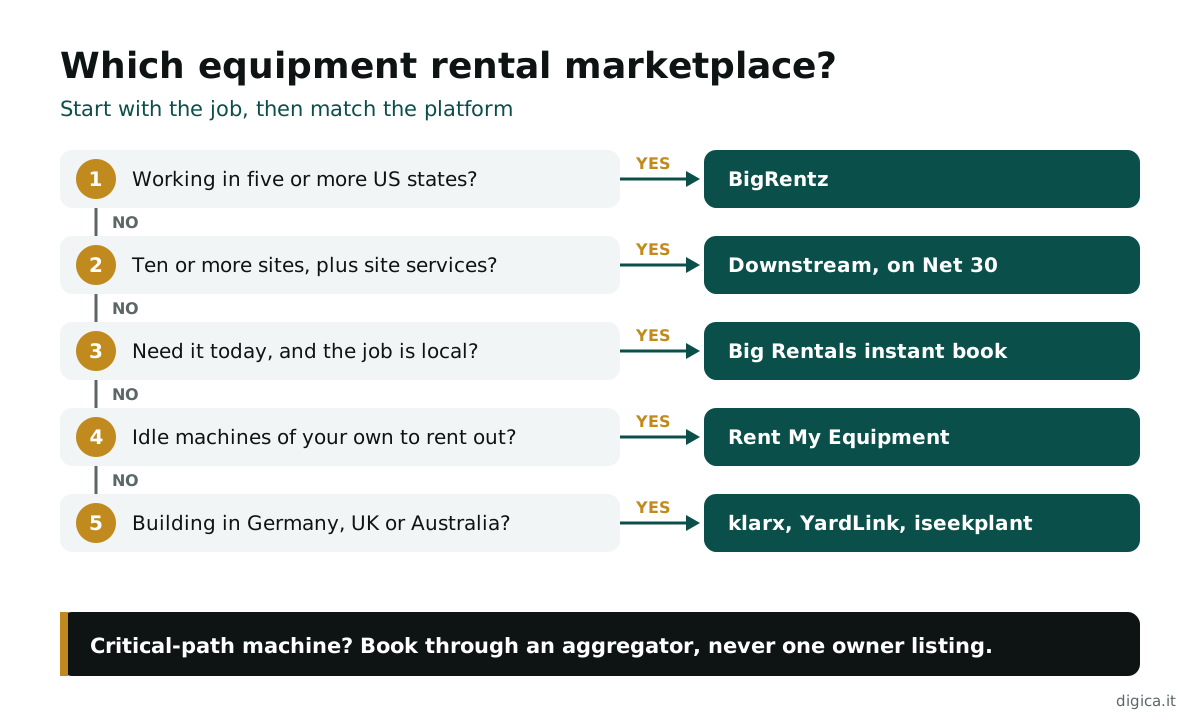
- If you work in five or more US states, use a broker with national reach such as BigRentz, so one account covers every job.
- If the job spans ten or more sites and needs bins, toilets or fencing as well as machines, use Downstream and ask for Net 30.
- If you need a machine today or tomorrow and the job is local, try Big Rentals' instant booking first.
- If you have idle equipment for more than a few weeks a year, list it on Rent My Equipment and rent from the same network when you are short.
- If you build in Germany, start with klarx; in the UK, put procurement on YardLink; in Australia, request quotes on iseekplant.
- If the machine is on the critical path, never rely on a single peer-to-peer listing. Book through an aggregator or hold a backup.
- If delivery is more than a third of the quote, ask for a nearer yard before you accept.
European markets are moving more slowly than the US. Forecasts presented at the European Rental Association's 2025 convention put rental growth in Germany at 1% in 2025 and 2.4% in 2026, and in the UK at 1.5% and 3% (European Rental Association via International Rental News). In slower markets, rental companies compete harder for bookings, and the marketplace with the widest supplier base gives a contractor the most room to negotiate.
What availability is worth
Run an illustrative case. A contractor spends $200,000 a year on rentals made up of jobs under $2,000 each. If transportation is about 40% of a typical rental of that size, around $80,000 of that spend is getting machines to site. Booking through a platform that finds a nearer yard with a free unit, and cuts delivery cost by a quarter, saves about $20,000 a year before counting the crew hours saved by on-time arrival.
For founders, the lesson runs the other way. An equipment rental B2B marketplace wins contractors by showing availability, not by claiming size. Fleet counts by machine class and region, distance on every quote and clear delivery times belong on the page, in the category pages that rank for "excavator rental near me" and in the answers AI assistants give.
Growing a construction or rental B2B marketplace?
We help construction and equipment marketplaces win contractors and rental suppliers through search, AI answers and the proof that makes a booking feel safe.
The number to take into your next rental review is 40%: the share of a typical small rental that goes on getting the machine to site. If your platform cannot show you the nearest yard with a free unit, the biggest cost of doing nothing is paying that 40% to haul equipment past closer yards, every week, on every job. Switching where you book costs nothing up front, so the payback on a better platform starts with the first rental it routes to a nearer yard.
FAQ
What is an equipment rental marketplace? An equipment rental marketplace is a platform where contractors rent machines from many rental companies or owners through one search. Some broker the order, some collect quotes, and some let owners list their own idle equipment.
Which equipment rental marketplace has the most rental partners in the US? Among the platforms in this guide, BigRentz reports the largest network, with 6,000 rental companies and more than 14,000 locations, which its chief executive says puts 90% of US job sites within a 30-minute drive of a partner yard.
Is it cheaper to rent heavy equipment through a marketplace? Often, when the marketplace compares several yards and shows delivery cost. Transport can be about 40% of a small rental, so the nearest yard with a free machine usually beats the lowest day rate.
Can contractors rent out their idle equipment? Yes. Peer-to-peer platforms such as Rent My Equipment let contractors list idle machines for other contractors to rent, with damage and theft cover of up to $50,000 per incident.
Who pays for damage when renting through a peer-to-peer platform? It depends on the platform's protection plan. Rent My Equipment includes cover for damage and theft by default, backed by ID checks and GPS tracking. Read the plan's limits before you book.
Are there equipment rental marketplaces in the UK, Germany or Australia? Yes. YardLink covers 2,400+ depots in the UK, klarx counts 530,000+ machines in Germany, and iseekplant lists 18,718 suppliers in Australia.
Related Articles
- Construction marketplace growth
- The best construction marketplaces by who buys and sells
- The best construction directories for contractors and suppliers
- The best surplus equipment marketplaces
- Marketplace liquidity: the metric that compounds
Where this connects
This article is part of our B2B marketplace growth series. Browse more on the Digica blog.