The best construction directories and communities, head to head on contractor coverage
A construction directory can tell you that a subcontractor exists. It rarely tells you the subcontractor is licensed, insured and free next month. The largest platforms in this guide claim coverage from 215,000 business pages to 6.5 million contractor profiles, yet those figures count different things, and most of them say little about what was checked. On a job where a failed sub can stop the program, that gap is the whole decision.
The pressure on the shortlist is real. US construction spending ran at a seasonally adjusted annual rate of $2,186.1 billion in September 2026 (US Census Bureau). There is a lot of work to place, and fewer firms with the capacity to take it, so a directory search is often the first step in finding someone new.
This guide compares seven construction directories and communities head to head, on one lens: contractor coverage, and how that data is checked. It covers open networks, project data platforms, license records, a building materials directory and a peer forum. It is written for general contractors, owners, procurement leads and product makers, and for founders growing a construction B2B marketplace. Figures are each company's own, checked on November 5, 2026.
Quick Navigation
- How we judged contractor coverage
- The scorecard: seven platforms side by side
- Open networks head to head: Procore vs BuildingConnected
- Project data head to head: The Blue Book vs ConstructConnect
- Public records: Gryd against all of them
- The building materials directory: Sweets
- The construction community: ContractorTalk and trade groups
- What verified means in a construction directory
- Three failure scenarios
- Choosing a construction directory: a decision framework
- What a checked shortlist is worth
- FAQ
- Related Articles
How we judged contractor coverage
We asked three questions of each platform. How many contractors or firms does it say it covers, and in what unit? Where and in which trades? And what does it say it checks?
Search results for "construction directory" are mostly listicles for home-service trades, many written by directories or by vendors that sell marketing to contractors. They help a roofer get listed. They do not help a project team choose between platforms, so we kept this guide to commercial and B2B use.
We picked seven of the most important platforms across five jobs: finding subs, running bids, tracking projects, checking license history and specifying products, plus one community for peer advice. Every coverage figure is the vendor's own and none is audited. Where a platform does not explain a claim, we say so. Our guide to B2B directories covers the wider category if you buy outside construction.
Our view: coverage is the easy part of a directory. Almost every firm you could want is listed somewhere. What differs is how fresh the record is, who checked it, and whether a bad record has any consequence for the platform.
The scorecard: seven platforms side by side
Gryd has the largest record count, BuildingConnected is strongest for running invited bids, ConstructConnect publishes prices and project coverage by metro, and Procore is the only one of the seven that publishes its listing review. Read the "Stated checks" column before you read the coverage column.
Seven construction directories and communities compared on coverage claimed, stated checks, who pays, main limit and best fit
| Platform | Type | Coverage claimed | Stated checks | Who pays | Main limit | Best for |
|---|---|---|---|---|---|---|
| Procore Construction Network | Open directory | 215k+ business pages, US and Canada | 24 to 48 hour page review | Free to list and browse | Confirms the business, not its cover | Free first search |
| BuildingConnected | Bid network | 1.5M+ professionals, 2M+ projects | TradeTapp, a paid product | Subs free, general contractors pay | Counts people, not firms | Invited bids with prequalification |
| The Blue Book Network | Directory | 1M+ businesses, 677,000+ firms | "Verified" label, no stated method | Not published | Standard undisclosed | US commercial sub search |
| ConstructConnect | Project data | 575,000+ companies, 825,000+ projects, 382 metros | Research team refresh | From $129 a month per market | Priced by market | Preconstruction and product makers |
| Gryd (BuildZoom Data) | License and permit data | 6.5M+ contractor profiles, 400M+ permits | Public record sources | Data buyers, by request | Shows no capacity or insurance | License and permit history at scale |
| Sweets | Building products | Thousands of products | Manufacturer-supplied files | Not published | Makers, not contractors | Specifying products |
| ContractorTalk | Forum | About 172,000 members | None, self-registered | Free | Anonymous, not for sourcing | Peer advice for small firms |
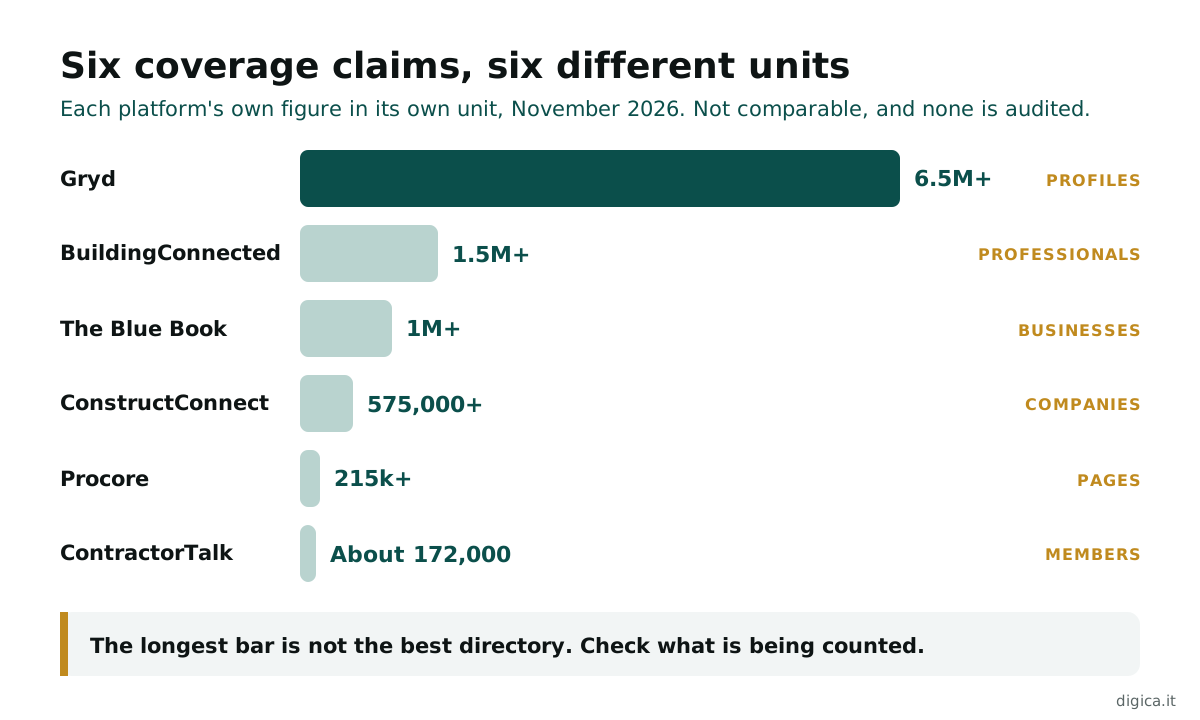
The units differ on every line, so this is not a ranking by size. A profile, a business, a firm, a professional and a forum member are five different things.
Open networks head to head: Procore vs BuildingConnected
Procore is the better free directory and BuildingConnected is the better bidding tool. Which one you use depends on whether you are looking for a firm or inviting firms to a job.
Procore Construction Network
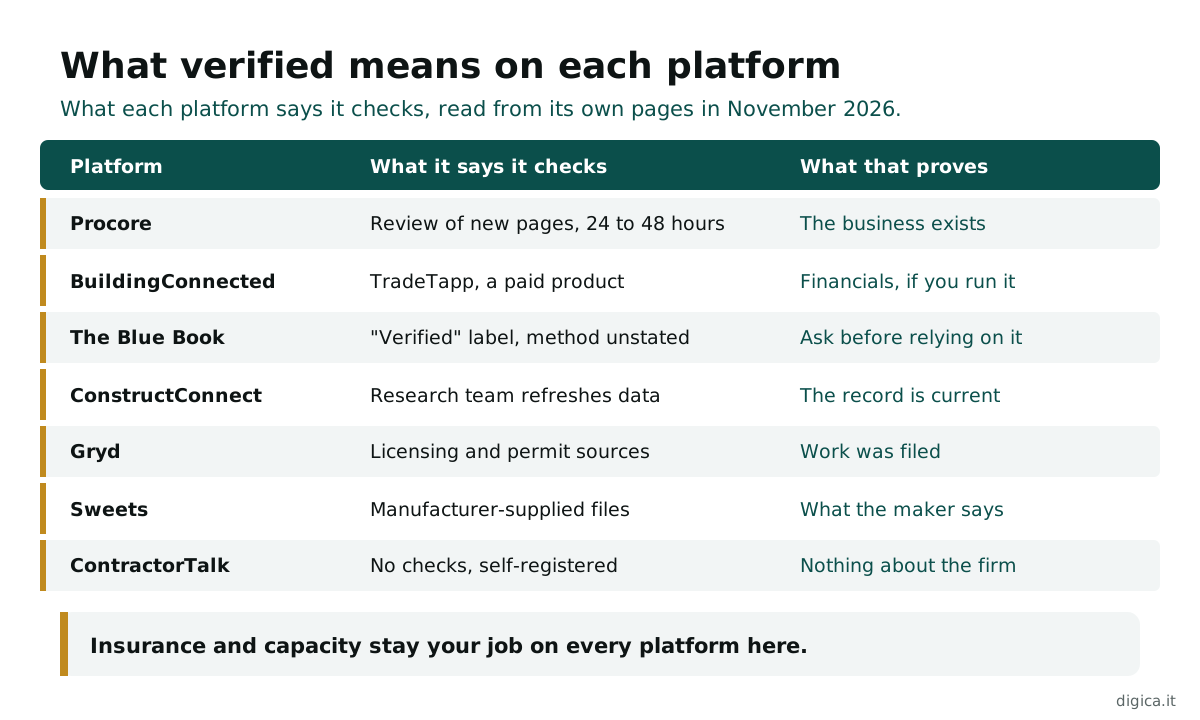
Procore's network is a free public directory of more than 215,000 unique business pages across the US and Canada, searchable by trade, company type and region. It is the only platform here that publishes its review steps. New pages pass through a 24 to 48 hour approval, in which Procore checks that the business is real and in a supported region, that it is not a duplicate and that the details are accurate.
That is a useful standard, but be clear what it covers. It shows that a business exists. Nothing on the pages we read says that licenses, insurance or financials are checked. Some profiles are also created from outside data and may be unclaimed, so a listing is not always the firm speaking for itself.
BuildingConnected
BuildingConnected, owned by Autodesk, is a bid network first and a directory as a side effect. It says it covers more than 1.5 million construction professionals and has been used on more than 2 million projects. The same page also says "over 1,000,000" professionals, so treat the number as a range. Either way, it counts people rather than firms, and firm counts and regional depth are not published.
Its model is simple. Subcontractors get a free bid board, and general contractors and owners pay for the bidding product. Vetting sits in TradeTapp, a separate paid tool with custom questionnaires, limit calculations and financial ratios. That is deeper than any listing review, but it applies only when a contractor runs it on a specific sub.
Running a construction B2B marketplace or directory?
In 30 minutes we look at how contractors and owners find platforms like yours, on Google and in AI answers, and where they drop off before they contact a firm.
Head to head, start with Procore if you need a name in a new market and you have no budget. Use BuildingConnected if you already run invited bids and want financial prequalification in the same workflow. The two work well together: find the firm on one, then invite and qualify it on the other, so a free listing never becomes the only check.
Project data head to head: The Blue Book vs ConstructConnect
These two incumbents sell the same promise, who is building what and who can help. The Blue Book is stronger on firm search, and ConstructConnect is stronger on project coverage and on pricing you can see.
The Blue Book Network
The Blue Book has been a commercial construction directory since 1913 and now sits inside Dodge Construction Network, which also owns Sweets. It says more than 1 million businesses are in the network, and describes 1.5 million projects and more than 677,000 firms as updated daily. It sends more than 2 million bid invitations and project notifications a week.
The word to examine is "verified". Dodge labels firms as verified and describes qualifications, certifications and project history, but the pages we read do not explain the method. Ask what a verified badge means before you lean on it. Pricing is not published, and the process starts with a demo.
ConstructConnect
ConstructConnect, based in Cincinnati and including the iSqFt bidding product, reports more than 825,000 active projects, 382 metro areas and more than 575,000 companies with contacts and activity. Its data is refreshed daily by a research team. It also lists a prequalification feature but gives no numbers for it.
It is the only one of the seven with a public price list for buyers: the starter plan is $129 a month per market on a month-to-month basis, the professional plan starts at $199 a month per market on an annual contract, and the premium plan starts at $10,000 a year. Priced by market, it suits regional teams well. A national buyer needs to multiply it out.
Head to head, The Blue Book is the better place to search for a firm by trade and region. ConstructConnect is the better place to track projects and spot who is bidding, especially for a building product maker that wants early sight of specifications. Its 575,000 figure counts firms seen in project activity, not firms that have been vetted.
Public records: Gryd against all of them
Gryd, the renamed BuildZoom Data, is the only platform here built on public records, and it has the largest count: more than 6.5 million contractor profiles and more than 400 million building permits across more than 2,500 jurisdictions. It says its licensing data covers over 95% of US contracting businesses, and it draws on building departments and licensing authorities.
That gives it the strongest evidence base of the seven, because a permit shows that work was actually filed. A directory profile is a claim, while a permit record is a trail. Note the corporate change, too: Block Renovation announced in November 2025 that it had bought the BuildZoom Marketplace, so the consumer marketplace and this data product should not be treated as the same thing.
The limit is what the record does not show. A license and a permit history tell you nothing about a firm's current insurance, its capacity next quarter or its financial health. It is US only and it is sold to data buyers by request, so this is a tool for owners, insurers and marketplace founders rather than for a project engineer who needs one sub by Friday.
Against the others, Gryd answers "has this firm actually done this work?" better than any of them. Pair it with a bid network, which answers "will this firm bid on mine?"
The building materials directory: Sweets
Sweets is the established building materials directory for specifiers, and because it belongs to Dodge, it sits alongside The Blue Book. It lets architects and specifiers browse thousands of products by category and MasterFormat section, and download CAD files, BIM objects and specifications. Dodge says 96% of the top 300 architecture firms use it.
Its files are manufacturer-supplied, which is the right way to think about it. Sweets is a very good place to find the current specification from the maker, and a poor place to find independent proof that the product performs. It lists makers rather than contractors, so it complements this guide's contractor platforms and does not compete with them.
A directory listing also tells you nothing about availability. Lead times on some long-lead equipment can run to many months, so treat "in the directory" and "on site by the required date" as separate questions. For a wider view of supplier search, see our guides to supplier databases and manufacturing directories.
The construction community: ContractorTalk and trade groups
A construction community answers a different question from a directory: not who to hire, but how others handled this. ContractorTalk is a long-running example, and trade associations remain the more useful networks for finding people.
ContractorTalk, a forum for professional contractors since 2003 and owned by VerticalScope, reports about 172,000 members and about 3.6 million posts. It is free, and it is the right place for an owner of a small trade firm to ask a practical question. Lifetime members are not active members, though, and usernames are anonymous, so it cannot be used for sourcing.
Trade associations do the job forums cannot. National contractor associations run local chapters, events and member rolls, where you can meet a firm face to face and ask who has worked with it. A chapter member list is short on data, but it is strong on reputation, and that matters more in construction than in most B2B categories. Our guide to business communities covers how networks like these work more broadly.
What verified means in a construction directory
"Verified" can mean almost anything in a construction directory, from "this business exists" to a full review of its financials. Always ask who checked, what they checked and when.
The stakes are rising because capacity is short. In the 2025 workforce survey from the Associated General Contractors and NCCER, 88 percent of firms that directly employ craft workers reported having craft openings, and 45 percent reported project delays caused by worker shortages, either their own or their subcontractors' (AGC and NCCER). When good firms are busy, you end up calling firms you do not know, and the quality of the record starts to matter.
In practice, we see four levels across these platforms. At the first, the listing is self-declared or drawn from outside data. At the second, the platform confirms the business exists. At the third, the record rests on public documents, such as licenses and permits. At the fourth, a named buyer collects financials and references for a specific job. No directory does the fourth level for you. It needs your own process, with the platform as a tool.
Before you trust a badge, open one profile and ask three questions. When was this record last updated? Who confirmed it? And if it is wrong, who finds out first? A platform that cannot answer all three is still useful, but your team is doing the checking.
Three failure scenarios
These are patterns that recur when teams treat a listing as a qualification. The dollar figures are illustrative.
- The license that was not there. An owner hires a sub found on a free directory because it has a tidy profile and good photos. Halfway through, the state license turns out to belong to a different entity, and the work has to be stopped and reinspected. A licensing board check on the first day would have taken 10 minutes and saved perhaps $80,000 in delay and rework.
- The insurance certificate that had lapsed. A general contractor collects a certificate at onboarding and never checks it again. A worker is hurt after the policy expires, and the claim lands on the contractor's own policy. A prequalification process with renewal tracking would have flagged the lapse before anyone was on site.
- The sub that ran out of cash. A contractor awards a large package to the lowest bidder without any financial review. Slow payment is common in this tier: Siteline reports that the average subcontractor waited 96 days to be paid in 2025. The sub stops paying its suppliers, and the replacement costs more than the original saving. Financial prequalification on any package above a set size would have raised the question early.
Do contractors and owners find your platform first?
A growth audit maps how construction buyers search for firms and platforms like yours, on Google and in AI answers, and which trade, region and project pages they never reach.
Every team found a real firm on a real platform. None of them treated the listing as the start of the checks rather than the end of them. The fix in each case took minutes or hours at the beginning of the job, and each failure took months and real money to put right at the end of it, usually with the client watching.
Choosing a construction directory: a decision framework
Match the platform to the question you are asking, then add checks in proportion to the size of the package. Most teams will use two or three of these.
- If you need names in a new market and have no budget, start with Procore Construction Network, then confirm licenses with the state board.
- If you run more than 10 invited bids a year, use BuildingConnected, and add TradeTapp for any package above a size you set, for example $250,000.
- If you need to search commercial firms by trade and region, use The Blue Book, and ask what the verified label covers.
- If you sell products or services into live projects in 3 or fewer metros, ConstructConnect's per-market pricing works in your favor. For national coverage, ask for a custom price before you commit.
- If you need license and permit history at scale, go to Gryd, especially if you are an owner, insurer or marketplace founder.
- If you are specifying products, use Sweets for the maker's files, and check lead times separately.
- If you want advice from peers, use a forum for quick questions and a local trade association chapter for references.
Write your thresholds down, because a checklist that depends on memory fails on the busiest week of the year. Keep one owner for prequalification, and review expired certificates each quarter. Our guide to procurement marketplaces covers the purchasing controls around these choices, and our guide to surplus equipment marketplaces helps if you also buy used plant.
What a checked shortlist is worth
A checked shortlist is worth the delays, rework and replacement costs it prevents. One failed sub usually costs far more than years of subscriptions to any platform here.
Run a typical case. Suppose a contractor awards 40 packages a year, and two go wrong because of a license, insurance or cash problem. If each failure costs $80,000 in delay, rework and replacement, that is $160,000 a year. Against that, a ConstructConnect plan for two markets at the starter price costs $3,096 a year, which is $129 times two markets times 12 months. If better checks prevent one failure, the saving is $80,000. The failure costs are illustrative, but the arithmetic holds at most sizes of firm.
The labor market makes this harder to ignore. The US Bureau of Labor Statistics counted 8,364,000 construction employees in September 2026, a preliminary figure (BLS), and with openings as common as the survey above shows, new subs are hard to avoid.
Growing a construction B2B marketplace or directory?
We help construction B2B marketplaces and directories win the suppliers and contractors that make them credible, and reach the buyers searching for them.
The number to take into your next operations review is how many subs you hired last year without checking a license, a current certificate of insurance and a financial reference. If you cannot answer, start logging it this quarter, and make one person responsible for it. The biggest cost of doing nothing is a sub who looked real on a listing and failed in the middle of your job.
FAQ
What is a construction directory? A construction directory is an online list of contractors, subcontractors, suppliers or building products, searchable by trade and region. Some are free, such as Procore Construction Network. Others, such as The Blue Book and ConstructConnect, are tied to project data and bidding.
What is the best free construction directory? Procore Construction Network is free to list on and browse, with more than 215,000 business pages across the US and Canada. It also publishes its review process, which confirms that a business is real. It does not say it checks licenses or insurance.
What is a building materials directory? A building materials directory lists products and makers so architects and specifiers can compare them and download files. Sweets, from Dodge, lets users browse thousands of products by MasterFormat section and download manufacturer-supplied CAD, BIM and specification files.
What is a construction community? A construction community is a network where contractors share advice and contacts. It can be a forum such as ContractorTalk, which reports about 172,000 members, or a trade association with local chapters. Use forums for advice and associations for references.
How do I verify a contractor found in a directory? Check the license with the state board, ask for a current certificate of insurance from the insurer, review permit history and call references from recent jobs. For large packages, add a financial review. A directory badge does not replace any of these.
How much do construction directories cost? It varies widely. Procore's network and BuildingConnected's bid board for subcontractors are free. ConstructConnect lists a starter plan at $129 a month per market, and its premium plan starts at $10,000 a year. The Blue Book does not publish prices.
Related Articles
- Construction marketplace growth
- Best B2B directories
- Best supplier databases and directories for B2B in 2026
- Best manufacturing directories
- Best procurement marketplaces for B2B buyers in 2026
Where this connects
This article is part of our B2B marketplace growth series. Browse more on the Digica blog.