The best construction marketplaces for materials and subcontractors, grouped by who buys and who sells
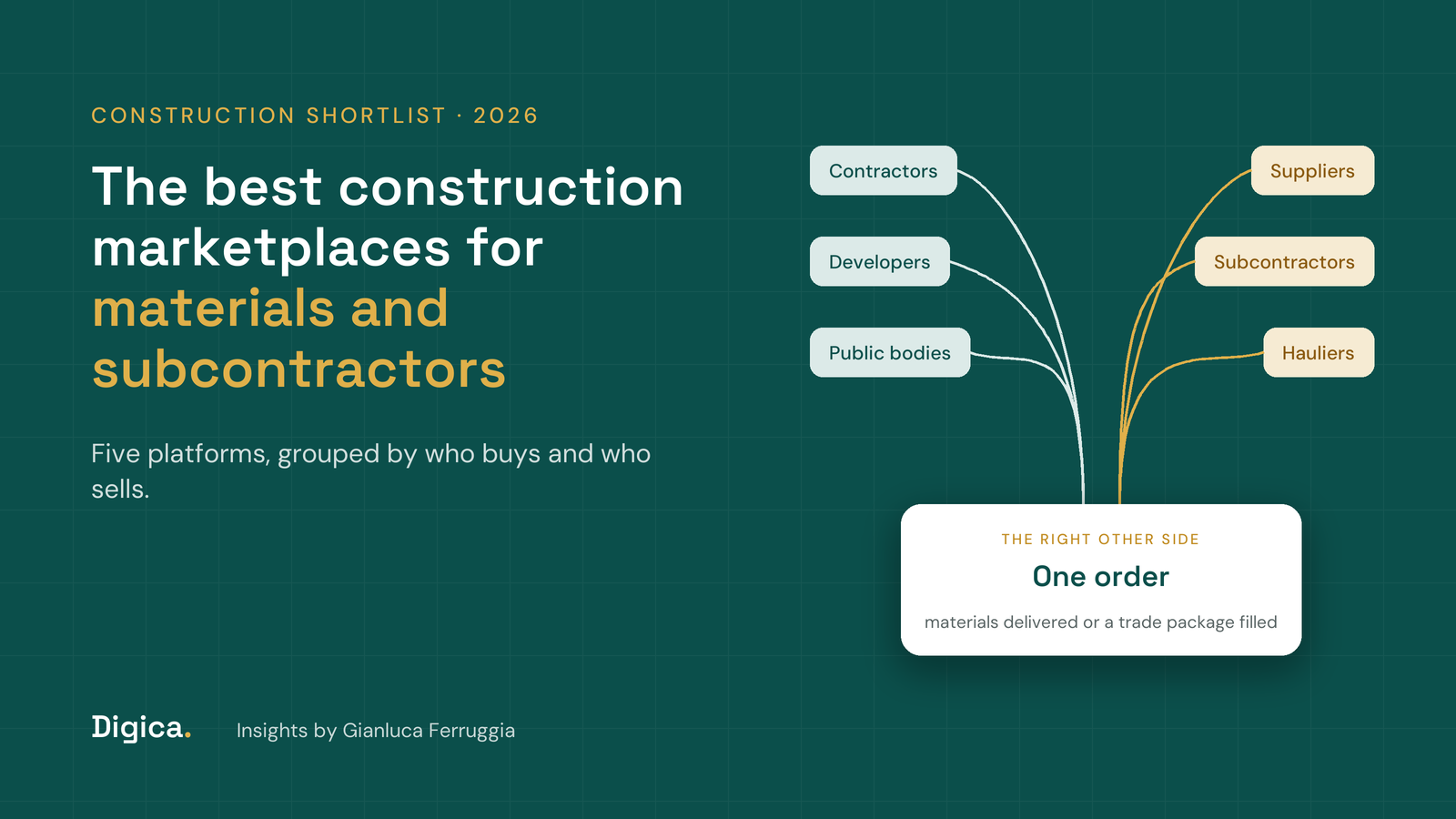
A general contractor in Germany can now send a trade package to a network of 280,000+ subcontractors, and a contractor in the same country can order gravel and a truck to deliver it from a platform with 6,500+ haulage partners. Neither existed at that scale ten years ago. Yet most search results for "construction marketplace" still mix software integration hubs, how-to-build guides and lists of retailers, so it is hard to see who actually buys and who sells on each platform.
That question matters more than price. A construction marketplace is only useful if the right people are on the other side: suppliers who deliver to your sites, or subcontractors qualified for your kind of work. A platform with a huge network in the wrong country, or for the wrong trades, is a slow way to get nothing.
This guide groups five construction marketplaces by type, building materials or subcontractors, and describes each by who buys, who sells and how big each side is in the platform's own unit. It is written for procurement, estimating and operations leads at contractors and developers, and for founders growing a construction B2B marketplace. Figures are each company's own, checked on November 11, 2026.
Quick Navigation
- How we grouped construction marketplaces
- The five construction marketplaces at a glance
- Materials: Schüttflix, for bulk materials and haulage
- Materials: Infra.Market, for manufactured materials in India
- Subcontractors: Cosuno, for tenders in German-speaking markets
- Subcontractors: Constructionline, for prequalified UK suppliers
- Subcontractors: Tough Leaf, for certified US subcontractors
- Network size, counted five ways
- Three failure scenarios
- Choosing a construction marketplace by job
- What the right construction marketplace is worth
- FAQ
- Related Articles
How we grouped construction marketplaces
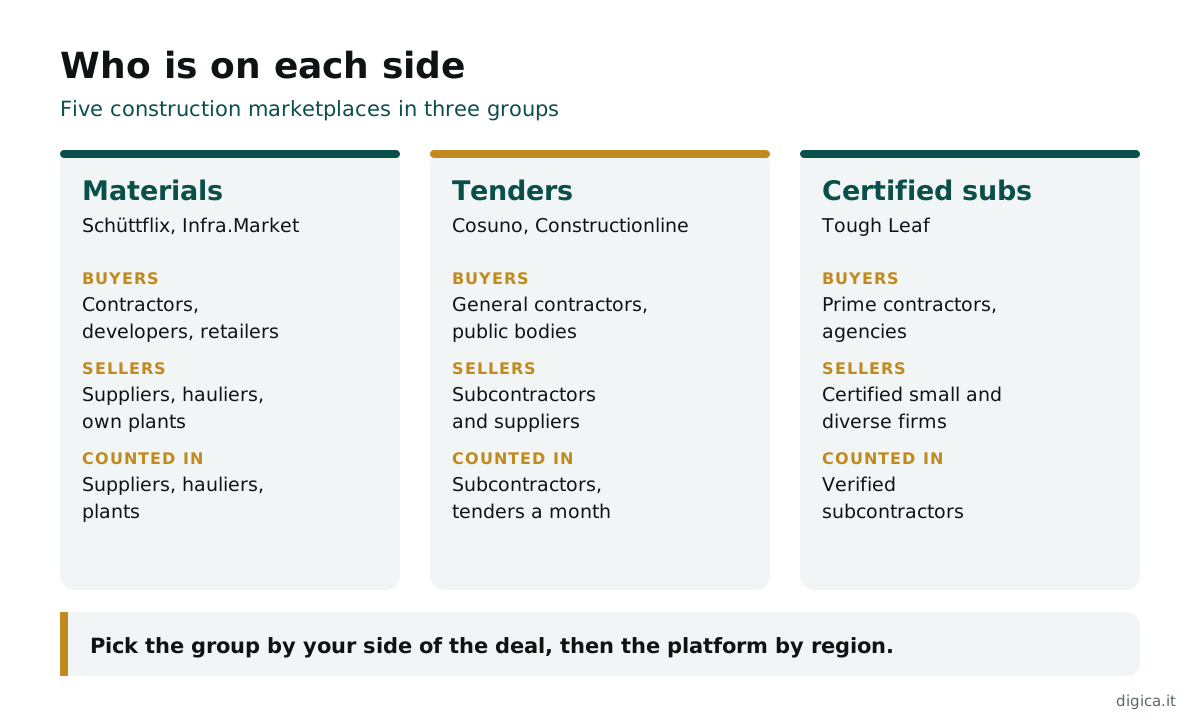
We split the field into two groups. A building materials marketplace sells physical goods, from aggregates to cement and tiles, and usually arranges delivery. A subcontractor marketplace connects contractors with trades, through tenders, prequalification or certified sourcing. Each group answers a different question, so ranking them in one list would compare a supplier of sand with a bid network.
For each platform we asked three things. Who buys? Who sells? And how big is each side, in the unit the platform itself uses? We did not judge on price, because most of these platforms quote per order or charge the seller side, and a price comparison would hide the bigger question of whether the right people are there at all.
The stakes are large and not growing. US construction spending ran at a seasonally adjusted annual rate of $2,203.1 billion in August 2026, 1.7% below August 2025, with private nonresidential work at $773.0 billion (US Census Bureau). In a flat market, contractors win margin by buying and subcontracting better, not by waiting for volume.
We left out the bid and contractor directories covered in our ranking of construction directories and communities, and equipment rental, which deserves its own comparison. Our view: a construction marketplace earns its place on a job when it saves an estimator a day of phone calls, not when it wins a price war on one order.
The five construction marketplaces at a glance
The table puts the five side by side. Read the "network" column carefully, because no two platforms count the same thing.
| Platform | Type | Who buys | Who sells | Network, in its own unit | Best for | Main risk |
|---|---|---|---|---|---|---|
| Schüttflix | Building materials | Construction companies | Material suppliers, disposers, hauliers | 4,000+ suppliers and disposers, 6,500+ haulage partners | Bulk materials with delivery in central Europe | Coverage limited to four countries |
| Infra.Market | Building materials | Contractors, developers, retailers | Its own and exclusive partner plants | 283+ plants, 17,256 retail touchpoints | Manufactured materials in India | Closer to a manufacturer than an open marketplace |
| Cosuno | Subcontractors | General contractors, developers, architects | Subcontractors and trades | 280,000+ qualified subcontractors | Private tenders in German-speaking markets | Qualification process not described publicly |
| Constructionline | Subcontractors | Main contractors, public bodies | Prequalified suppliers and subcontractors | 14,000+ invitations to tender a month | UK public and prequalified work | Membership fees for suppliers |
| Tough Leaf | Subcontractors | Prime contractors, agencies | Certified small and diverse subcontractors | 400,000+ verified subcontractors | US certified subcontracting goals | Narrower focus on certified firms |
The two groups rarely compete. A contractor might use one materials platform and one subcontractor network on the same job, and the decision for each turns on geography first.
Materials: Schüttflix, for bulk materials and haulage
Schüttflix is the clearest example of a two-sided building materials marketplace in Europe. Construction companies order sand, gravel and other bulk materials, book the haulage and arrange disposal of mineral waste in one place. Its homepage counts 4,000+ building material suppliers and disposers, 6,500+ partner haulage companies and 30,000+ vehicles.
The balance of those numbers tells you what it is for. With more hauliers than suppliers, Schüttflix is built around getting heavy material to a site, which is where bulk orders usually go wrong. It has operated in Germany, Austria, Poland and the Czech Republic since July 2022, and in January 2025 it formed the Schüttflix Group, which it describes as Europe's largest platform for the circular economy in construction.
Who it suits: contractors and earthworks firms buying bulk materials in those four countries, especially where disposal and delivery are part of the same job. Who it does not suit: anyone outside its countries, or buyers of finished products such as windows or tiles. The trade-off is depth over breadth, and in bulk materials that is the right trade.
Materials: Infra.Market, for manufactured materials in India
Infra.Market sells concrete, cement, steel, tiles, plywood and paints to contractors, developers and retail outlets across India. It is the largest platform in this guide by revenue, but it is also the furthest from a classic marketplace. It sells through 163 plants it owns and 120 exclusive third-party plants, so the seller side is largely Infra.Market itself.
The scale is real. Infra.Market reported gross revenue of about $2.1 billion for the year to March 2025, up 27%, while profit fell 42%, according to filings reported by Entrackr. Its site lists 283+ manufacturing plants, 17,256 retail touchpoints across 22 states and 11 brands.
For a contractor in India, that model means predictable supply and one counterparty for many materials. For a founder, it shows a path that many building materials marketplaces take: start as a matching platform, then buy or contract the supply to control quality and margin. The cost is that buyers no longer compare independent sellers, which is the reason many go to a B2B marketplace in the first place.
Subcontractors: Cosuno, for tenders in German-speaking markets
Cosuno is a tendering platform and subcontractor network for Germany, Austria and Switzerland. General contractors, developers and architects send trade packages out for bids, and subcontractors bid for free. Its site counts 280,000+ qualified subcontractors, 600+ clients and 4,000+ tenders a month.
That makes Cosuno the strongest pick here for a contractor who wants more bids per package without calling more people. The demand side is concentrated, a few hundred large clients, while the supply side is broad, which is the shape a subcontractor marketplace needs. Cosuno says its clients save 5.7% on construction costs on average, a claim it does not break down publicly.
The shortage of trades makes that reach worth more each year. In the US, 82% of construction firms told the Associated General Contractors of America and Sage they had a hard time filling hourly craft positions, and 24% said their subcontractors had lost workers to immigration enforcement (AGC). When each trade has fewer crews, the contractor who reaches more of them gets the bids.
Running a construction B2B marketplace?
In 30 minutes we look at both sides of your network, where contractors and suppliers find platforms like yours, and which side to grow first.
The gap in Cosuno's public story is vetting. It calls its subcontractors qualified but does not explain the check on its site, so a contractor should still run its own prequalification for anything safety-critical. That is a small step next to the time saved on sourcing, and a reasonable split of work: the platform finds the trades, and the contractor decides which of them it trusts on a live site. Ask for the qualification criteria in writing before the first award.
Subcontractors: Constructionline, for prequalified UK suppliers
Constructionline is the UK's prequalification network for construction suppliers, and its Marketplace adds the tenders. Main contractors, councils, NHS trusts and central government buy; verified subcontractors and suppliers sell. Members are validated against the PAS 91 prequalification standard and beyond, which saves a supplier from answering the same questionnaire for every buyer.
The demand side is what sets it apart. Constructionline's 2026 supplier guide reports 500,000+ leads on the platform, an average of 14,000+ invitations to tender a month and coverage of over 90% of UK public sector opportunities. Its parent's Construction Marketplace Health Index tracked more than 10,000 projects and contract opportunities a year, and found only 28% of subcontractors use tech platforms to find work.
That last figure is the opportunity in one line. Most UK subcontractors still find work through relationships, so a supplier who is prequalified and visible reaches buyers that competitors never meet. For buyers, the value is the audit trail: a public body can show that every supplier was checked against the same standard.
The trade-off is cost on the supplier side. Membership is paid, and small subcontractors who only work for one or two local builders may not recover it. For anyone bidding into public or tier 1 work, it is close to a requirement.
Subcontractors: Tough Leaf, for certified US subcontractors
Tough Leaf helps US prime contractors and government agencies find and verify certified subcontractors: minority, women, disadvantaged, small, veteran and service-disabled veteran owned businesses. Its site counts 400,000+ verified subcontractors and support for 100+ certification types.
Its focus is compliance, and that is the point. Public projects and many private owners set participation goals for certified firms, and missing them can cost a contractor the bid or the next one. In November 2025 Tough Leaf launched ClearSource, which checks certifications, insurance, union status and past performance automatically. Its 2026 report links structured sourcing workflows to 3.5 times more competitive bids, a figure from its own survey.
Who it suits: general contractors with diversity or small business goals on public work, and the certified subcontractors who want to be found by them. Who it does not suit: a contractor looking for any trade at the lowest price, because the network is filtered by certification first.
Network size, counted five ways
Every network number in this guide counts something different. Schüttflix counts suppliers and haulage partners, Infra.Market counts plants and retail touchpoints, Cosuno and Tough Leaf count subcontractors, and Constructionline counts tenders. None of them can be lined up as one league table.
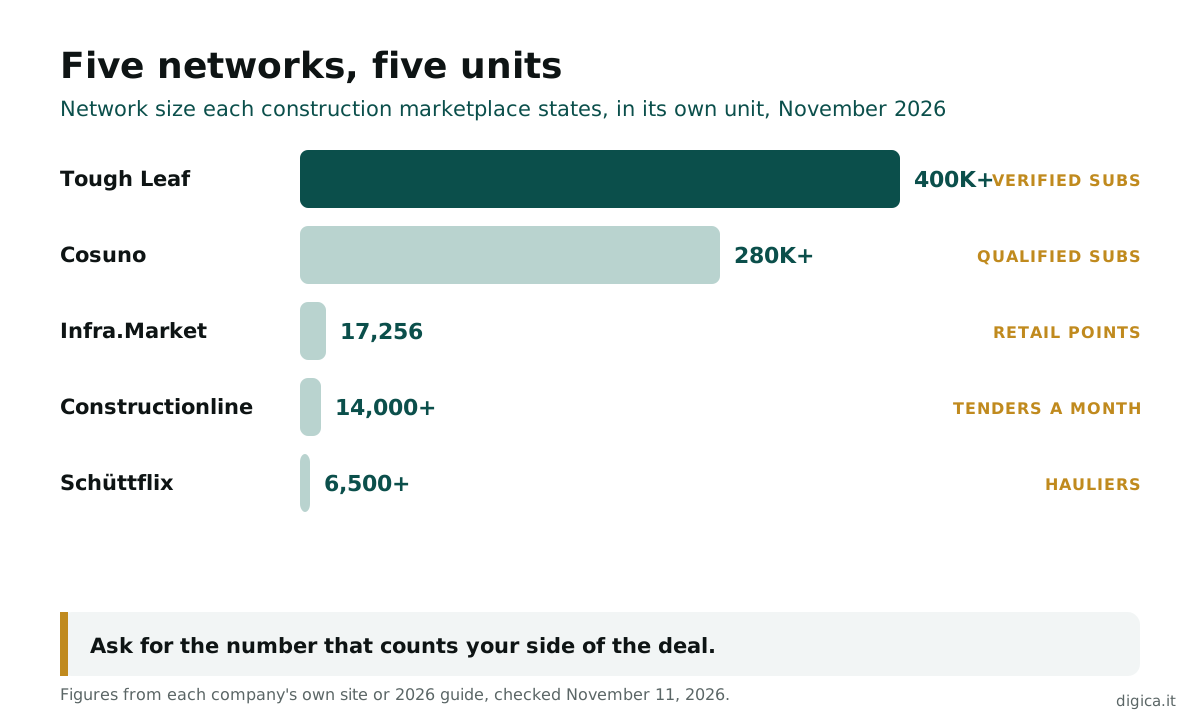
The unit tells you who the platform serves best. A subcontractor count serves the contractor, because it measures choice. A tender count serves the subcontractor, because it measures work. A haulier count serves the site, because it measures whether material arrives. When you compare platforms, ask for the number that matches your side of the deal, and ask how many of them are active in your region.
This is also the most common mistake we see on the platforms themselves. A construction B2B marketplace that only publishes its supply count tells contractors there is choice, but tells every new subcontractor that the space is crowded. Publishing both sides, in units each side cares about, is one of the cheapest ways to attract vendors to a B2B marketplace.
Three failure scenarios
These are illustrative patterns, not accounts of named firms. The costs are typical ranges, not audited figures. Each one comes from treating a construction marketplace as a list of names rather than a network with a shape: a region, a trade mix and a check.
- The wrong country. A contractor expanding into a new region signs up to a large subcontractor network that is strong at home but thin there. Packages go out to a handful of firms, bids come back high, and the estimator falls back on phone calls two weeks later. The right call was to ask for active subcontractors by trade in the target region before committing.
- The unchecked sub. A builder awards a package to a subcontractor found on an open network without checking insurance or accreditation. A site incident exposes the gap, and the cost of the delay and the claim runs to many times the saving on the bid. A prequalified network, or a quick check against a standard such as PAS 91, would have caught it.
- The missed goal. A prime contractor bids a public job with a participation goal for certified firms, but cannot show enough certified subcontractors in its bid. The bid is scored down and lost. A certified sourcing network used at the estimating stage would have produced the list in hours.
Are contractors finding your platform?
A growth audit shows how contractors and subcontractors search for platforms in your category, on Google and in AI answers, and where your B2B marketplace is missing.
Each failure starts with the same assumption: that a big network is the right network. The fix in every case was to ask who is on the other side, where, and checked how, before the first order or tender. Those three questions take an afternoon to answer with a platform's sales team, and the answers are usually more useful than any headline network number on its homepage.
Choosing a construction marketplace by job
Start from the job, not the platform. These thresholds are a starting point.
- If you buy bulk materials and need delivery in Germany, Austria, Poland or the Czech Republic, start with Schüttflix.
- If you buy cement, steel, tiles or plywood for projects in India, compare Infra.Market with your local distributors on the same order.
- If you send more than 10 trade packages a month in German-speaking markets, a tender network such as Cosuno will usually return more bids than a phone list.
- If you bid UK public or tier 1 work, prequalification through Constructionline is close to essential, whether you buy or sell.
- If a US project carries a participation goal for certified firms, source through a certified network such as Tough Leaf at the estimating stage, not after award.
- If none of these fits your region or trade, look at the specialist construction directories and procurement networks before you build your own list.
Backlogs make speed worth paying for. US contractors reported an average of 8.7 months of work in the pipeline in September 2026, according to the Associated Builders and Contractors backlog indicator (BD+C). With that much work booked, the constraint is rarely demand. It is how fast an estimator can buy and subcontract each package.
What the right construction marketplace is worth
The value sits in the estimator's time and in the bids it produces. Take an illustrative mid-size contractor that sends 40 trade packages a month. If a tender network adds two competitive bids per package and that lowers the winning price by 2% on an average $250,000 package, the saving is about $5,000 a package, or roughly $2.4 million a year. Halve every input and it is still worth a subscription.
The same logic works for founders. A construction B2B marketplace that shows each side who is on the other one grows faster, because every new supplier makes the platform more useful to buyers and every new tender gives suppliers a reason to stay. That is the liquidity that compounds, and it is why we judge these platforms on who is there rather than on price.
Growing a construction B2B marketplace?
We help construction and materials marketplaces win supply, demand and visibility in search and AI answers, so both sides find you first.
The number to take into your next procurement review is the 28%: the share of UK subcontractors who use tech platforms to find work. Whichever side you are on, most of your counterparts are not yet on a construction marketplace, and the biggest cost of doing nothing is that the ones who are get the first call. For a contractor, the payback on a tender network subscription is usually measured in the first few packages it fills; for a subcontractor, it is the first tender won that a phone list would never have reached.
FAQ
What is a construction marketplace? A construction marketplace is an online platform where contractors and developers buy materials, hire subcontractors or rent equipment from many sellers in one place. Some sell materials with delivery; others run tenders between contractors and subcontractors.
What is the best building materials marketplace? It depends on the country. Schüttflix leads for bulk materials and haulage in Germany, Austria, Poland and the Czech Republic, with 4,000+ suppliers and disposers. In India, Infra.Market sells through 283+ plants.
How do general contractors find subcontractors online? Through tender networks such as Cosuno, prequalification networks such as Constructionline in the UK, or certified sourcing networks such as Tough Leaf in the US. Bid directories are covered in our separate guide.
What is a subcontractor marketplace? A subcontractor marketplace connects contractors who need trade work with subcontractors who bid for it. The best ones show how they check subcontractors and how many are active in each region and trade.
Are subcontractor marketplaces free for subcontractors? Some are. Cosuno says bidding is free for subcontractors. Prequalification networks such as Constructionline charge suppliers a membership fee, which buys access to tenders and a recognized check.
How are subcontractors vetted on construction marketplaces? It varies. Constructionline validates members against the PAS 91 standard, Tough Leaf checks certifications, insurance and past performance, and some networks describe subcontractors as qualified without publishing the check.
Related Articles
- Construction B2B marketplace growth
- The best construction directories and communities, head to head on contractor coverage
- The best procurement marketplaces for B2B buyers
- The best industrial marketplaces for MRO buying
- Vertical marketplaces: why niche B2B platforms win
Where this connects
This article is part of our B2B marketplace growth series. Browse more on the Digica blog.