The best fintech directories and communities in 2026, each with one award for what it does best
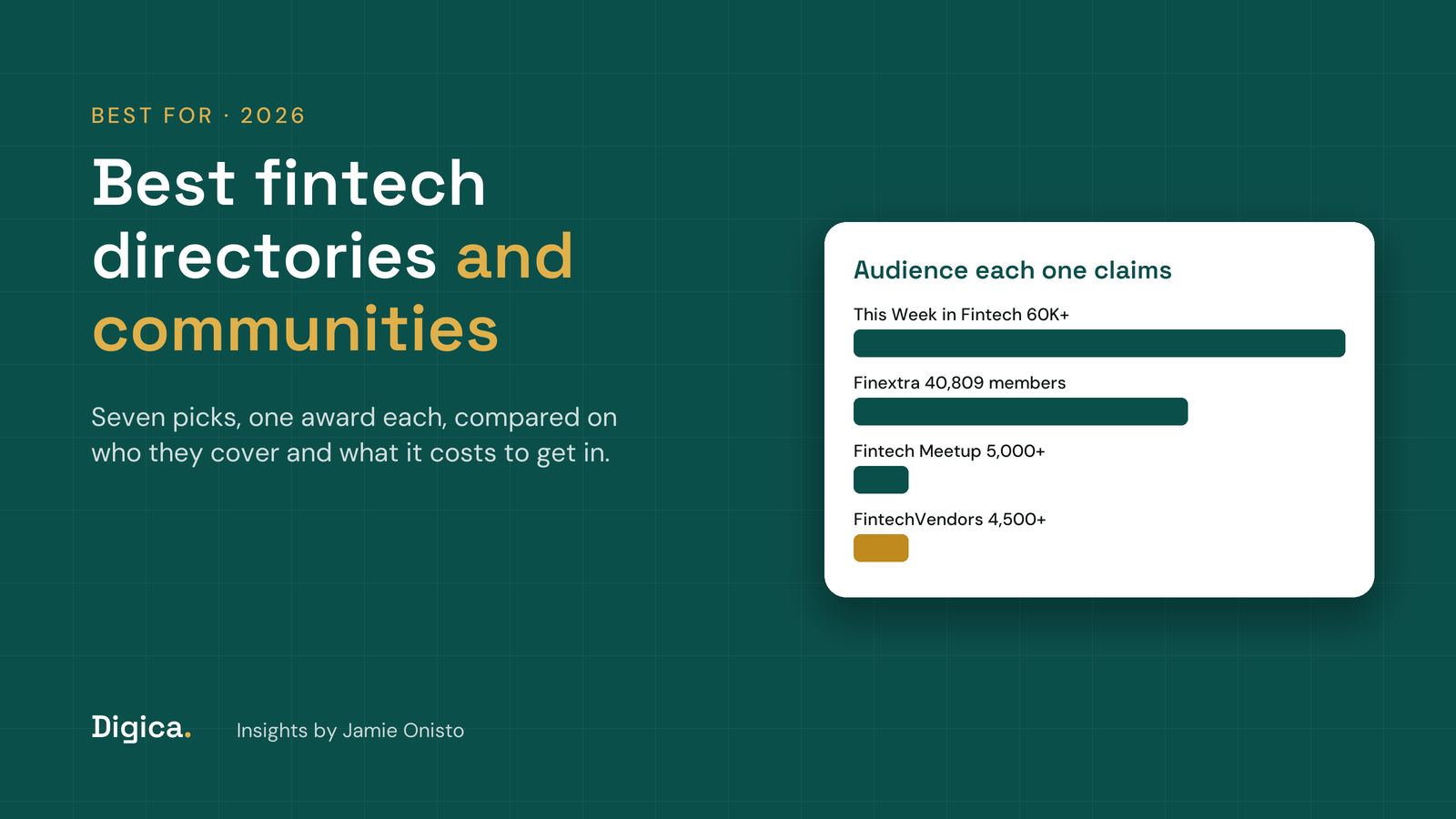
A fintech directory promises one thing: the right people find you, or you find them. Which people depends entirely on the directory. FintechVendors.com lists 4,500+ technology providers for banks and credit unions. Finextra counts 40,809 community members. CB Insights tracks more than 13 million company profiles. Each number is real, and each one describes a different audience you would be paying, in time or money, to reach.
The stakes are rising again. Global fintech investment rose from $72.2 billion in the second half of 2025 to $103.1 billion in the first half of 2026, while the number of deals fell from 2,501 to 2,100, according to KPMG (KPMG Pulse of Fintech). More money chasing fewer companies means buyers, partners and investors are choosier, and being findable in the right fintech directory or fintech community matters more than being everywhere.
This guide gives seven fintech directories and communities one award each, judged on coverage and members: what each counts, who is in it, what access costs and how a company gets in. It is written for fintech founders and marketing leads deciding where to list or join, and for bank and credit union teams looking for partners. Figures are each organization's own, checked on October 31, 2026. For broader B2B lists, see our guide to B2B directories to list your business.
Quick Navigation
- What a fintech directory or community is for
- Seven fintech directories and communities at a glance
- Best free fintech community for professionals: Finextra
- Best fintech directory for banks and credit unions: FintechVendors.com
- Best paid fintech database for market intelligence: CB Insights
- Best online fintech community for founders: This Week in Fintech
- Best UK fintech member body: Innovate Finance
- Best for Australian fintechs: FinTech Australia
- Best for meetings with banks: Fintech Meetup
- Three failure scenarios
- Choosing a fintech directory or community: a decision framework
- FAQ
- Related Articles
What a fintech directory or community is for
The short answer: a fintech directory helps someone find a company, and a fintech community helps people find each other. Both are worth joining only if the people on the other side are the ones you need.
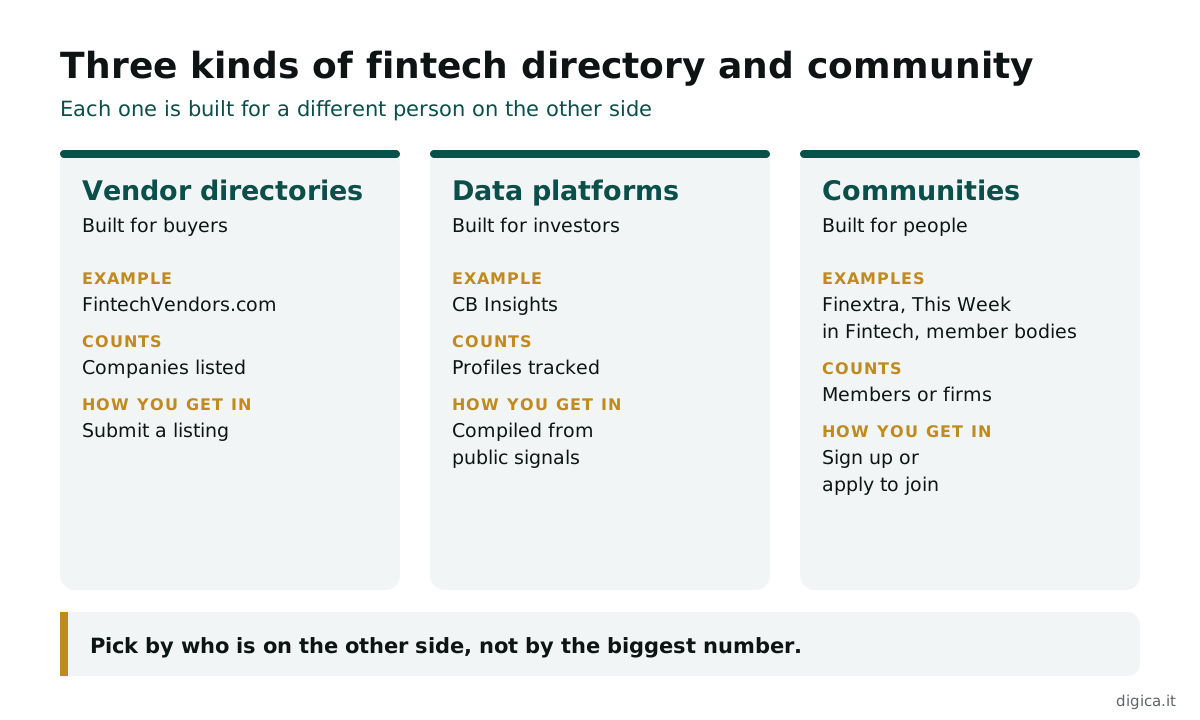
The category splits three ways. Vendor directories, such as FintechVendors.com, are built for buyers: a bank looking for a lending platform or a payments provider searches by category and compares. Data platforms, such as CB Insights, are built for investors, analysts and corporate strategy teams, and they compile profiles whether a company asks or not. Communities and member bodies, such as Finextra, This Week in Fintech, Innovate Finance and FinTech Australia, are built for people: founders, operators, bankers and investors who want news, introductions, events and a voice with regulators.
Each type counts something different. A directory counts companies listed. A data platform counts profiles tracked. A community counts members or subscribers. A member body counts member firms. A fintech founder comparing "40,000 members" with "4,500 vendors" is comparing readers with competitors.
Our view: start from who you need to reach, not from the biggest number. A payments startup selling to US credit unions gets more from 700 financial institutions at one event than from 40,000 readers worldwide. The same thinking applies to any financial services B2B marketplace: supply and demand only meet where both sides actually turn up.
Seven fintech directories and communities at a glance
The short answer: Finextra has the largest free professional community, FintechVendors.com the deepest free vendor directory for US banks, CB Insights the widest paid data, This Week in Fintech the busiest founder chat, Innovate Finance the UK policy voice, FinTech Australia the APAC network and Fintech Meetup the most bank meetings in one place.
Seven fintech directories and communities compared on type, coverage claimed, who is in it, cost to access, main risk and best fit
| Pick | Type | Coverage claimed | Who is in it | Cost to access | Main risk | Best for |
|---|---|---|---|---|---|---|
| Finextra | Community and news | 40,809 members | Bank and fintech professionals | Free to register | No company database | Visibility with banking professionals |
| FintechVendors.com | Vendor directory | 4,500+ providers | Vendors serving banks and credit unions | Free, paid upgrades | No reviews, no insurtech yet | Getting found by US financial institutions |
| CB Insights | Data platform | 13M+ company profiles | Investors, analysts, strategy teams | Paid, price on request | Cost for early-stage teams | Market maps and funding data |
| This Week in Fintech | Online community | 10,000+ in Slack, 60,000+ audience | Founders, operators, investors | Free basic tier, paid premium | Chat, not a database | Founder and operator networking |
| Innovate Finance | Member body | More than 250 members | UK fintechs to global banks | Membership packages | UK and policy focus | UK fintechs that want a policy voice |
| FinTech Australia | Member body | 400+ fintechs | Australian fintechs and startups | From 550 Australian dollars a year | Australia only | Fintechs building in Australia |
| Fintech Meetup | Meetings event | 5,000+ attendees, 700+ institutions | Fintechs, banks, credit unions | Free for hosted banks, paid for vendors | Once a year | Booking meetings with banks |
Every figure is the organization's own claim, and none publishes an independent audit. Read the "Who is in it" column first. It decides whether the coverage number means anything to you.
Best free fintech community for professionals: Finextra
The short answer: Finextra is the largest free fintech community for people who work in banking, payments and fintech, and the best place to be read by them.
Finextra is a London fintech news site and community, incorporated in 2000. Its community page shows 40,809 members and 27,242 expert opinions, and says membership is free to registered members. Members post their own expert opinions, join groups and comment on the news, which Finextra has published at scale for more than two decades. Finextra calls itself the world's largest fintech community, a claim it makes for itself.
Running a fintech directory, community or B2B marketplace?
In 30 minutes we look at how fintechs, banks and investors find platforms like yours, on Google and in AI answers, and where they drop off before they join or list.
The coverage is people, not companies. There is no structured company directory to search and no classification of vendors by category. What Finextra offers instead is attention: a fintech whose founder writes useful expert opinions is read by the bankers and payment leads who later run vendor selections. That is slower than a listing and harder to fake.
The award. Best free fintech community for being seen by banking and fintech professionals. Treat it as a publishing channel, not a directory.
Best fintech directory for banks and credit unions: FintechVendors.com
The short answer: FintechVendors.com is the deepest free fintech directory built for US banks and credit unions choosing technology providers, and listing on it costs nothing.
FintechVendors.com says it lists 4,500+ fintech providers, including professional services firms such as auditors and consultants. Vendors are grouped by category, such as digital banking, core, lending, payments and cards, and CRM and marketing, and buyers can filter by headquarters region and ownership and compare vendors side by side. Its founder is Peter Jeye.
The model is clear from its FAQ: the site is free, with no user subscription or vendor listing fees, and it earns from upgraded listings and advertising. To get listed, a company fills in a listing request and must have its own website. Two limits are stated plainly. FintechVendors.com is not a ratings site, so there are no reviews, and insurtech is not covered yet.
For a fintech selling to US financial institutions, this is the closest thing to a buyer's shortlist that costs nothing to join. For a consumer fintech or one selling to merchants, the audience is the wrong one.
The award. Best fintech directory for getting found by banks and credit unions. List here first if they are your buyers.
Best paid fintech database for market intelligence: CB Insights
The short answer: CB Insights is the widest paid database for fintech funding, market maps and company research, and the one investors and strategy teams use most to build shortlists.
CB Insights says it tracks more than 13 million company profiles across every sector. Its 2026 fintech predictions drew on signals from more than 23,000 fintechs, tagged into markets such as payments, digital lending, wealth tech and retail banking, with its own Mosaic Score and market maps. Profiles are compiled by CB Insights itself, so a fintech does not apply to be listed.
That changes what "being in" CB Insights means. You cannot buy your way onto a market map, and you cannot opt out of being analyzed. What a fintech can control is the public signal CB Insights reads: funding announcements, hiring, partnerships and press. The platform is sold to enterprises through sales conversations, and the price is not published.
The award. Best paid fintech database for market intelligence. Worth the subscription for investors and corporate development teams. For an early-stage founder, the free alternatives cover most of the need.
Best online fintech community for founders: This Week in Fintech
The short answer: This Week in Fintech runs the busiest online fintech community for founders, operators and investors, with a free Slack tier and a paid premium tier.
This Week in Fintech, based in New York and led by founder and CEO Nik Milanović, says its basic Slack community has 10,000+ members and its WhatsApp and Telegram groups 8,000+. Across its newsletter and community it describes an audience of more than 60,000 founders, executives and investors, and calls itself the largest fintech community in the world, its own claim.
Concentration matters more than raw size. Fintech is one of the few sectors where a single dense founder community can reach a meaningful share of the people building in it, and the Cambridge Centre for Alternative Finance found that 84% of the 240 fintechs it surveyed partner with incumbent financial institutions (Cambridge Judge Business School). Those partnerships often start with an introduction, and founder communities are where introductions happen.
The basic tier gives open channels and peer networking. The premium tier adds curated discussions, members-only events, the full member directory, job matching and data, at prices not published on the site. The limit is format: it is a chat community, not a searchable fintech directory, and it rewards members who show up regularly.
The award. Best online fintech community for founders and operators. Join the free tier, and pay for premium once you need the member directory.
Best UK fintech member body: Innovate Finance
The short answer: Innovate Finance is the UK industry body and membership association for fintech, and the place for UK fintechs that want a seat in policy conversations as well as a network.
Innovate Finance, based in the City of London, says it has more than 250 members, ranging from seed-stage startups to global financial institutions and professional services firms. Membership comes in packages for fintechs, partners and vendors, investors and regional hubs. Prices are not published on its site.
Do fintechs and banks find your platform before a rival's?
A growth audit maps how buyers, founders and partners search for fintech directories, communities and B2B marketplaces like yours, on Google and in AI answers, and which of your pages they never reach.
What sets a member body apart from a fintech community is representation. Innovate Finance speaks for the sector with government and regulators, and its members get access to that work as well as events and introductions. The trade-off is scope. It is a UK and policy-led body, not an open directory, and its value grows with how actively a member takes part. For a UK fintech facing a regulatory question that will shape its market, that seat at the table is worth more than any listing.
The award. Best UK fintech member body. Join if the UK is your market and regulation shapes your roadmap.
Best for Australian fintechs: FinTech Australia
The short answer: FinTech Australia is the national body for Australian fintechs, with a published price that starts low enough for founding teams.
Based in Sydney, FinTech Australia represents more than 400 fintech companies and startups, according to coverage of its Intersekt 2026 program. Its own site carries an ecosystem map and a services directory, so it works as a fintech directory as well as a member body. It publishes its pricing: membership tiers depend on team size and headquarters location, starting from 550 Australian dollars a year for founding teams, with a 150 Australian dollar Friend of Fintech subscription for companies that are not fintechs.
The limit is geography. For a fintech building in Australia, or selling into it from abroad, the ecosystem map and the national events put it in front of the market in one step. Elsewhere, the regional fintech associations in Singapore, Hong Kong, Ireland and the UK play the same role for their own markets.
The award. Best for fintechs building or selling in Australia, and the most transparent pricing of any member body here.
Best for meetings with banks: Fintech Meetup
The short answer: Fintech Meetup is an annual event built around pre-booked, one-to-one meetings between fintechs and financial institutions, and it delivers more bank meetings in one place than any directory.
Fintech Meetup, run from New York and held at the Venetian in Las Vegas, says it brings together more than 5,000 attendees, 1,000+ CEOs and founders and 700+ financial institutions, and that it has facilitated more than 50,000 double opt-in meetings. Meetings are curated and both sides must accept, which is the opposite of cold outreach.
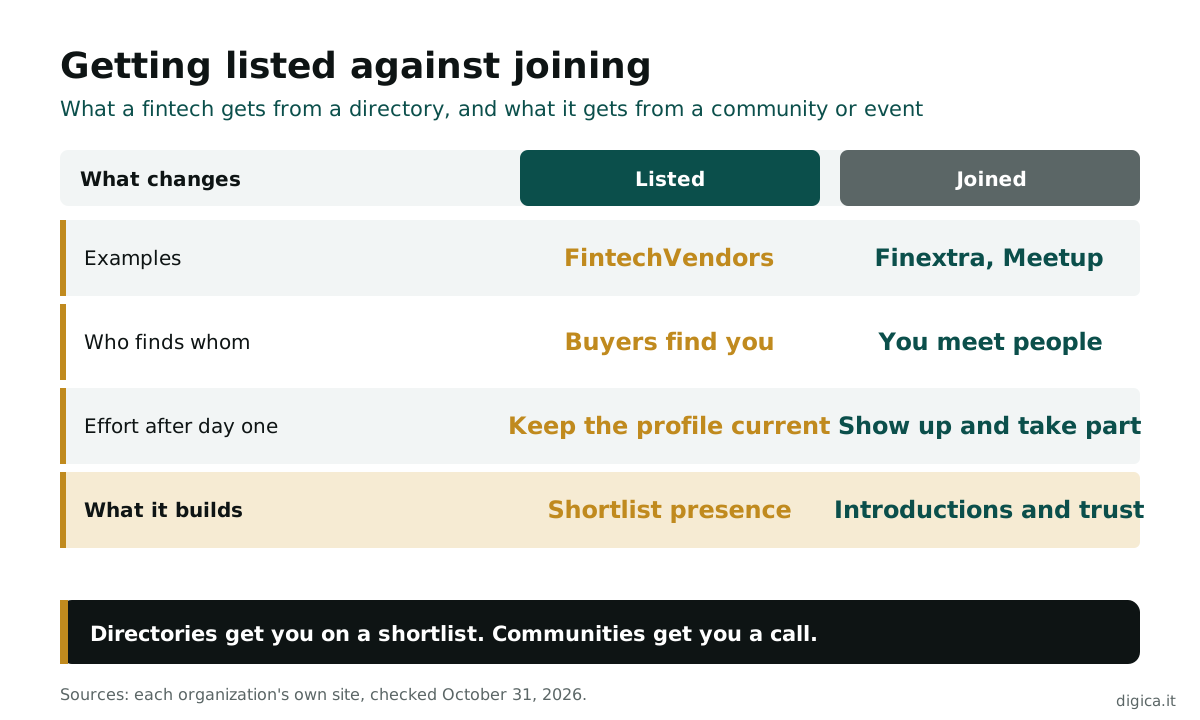
The pricing shows who it is built for. Hosted bank and credit union tickets are free, with up to $750 of travel and hotel reimbursement for FDIC-insured banks and NCUA credit unions. Fintech and vendor tickets are paid, and prices were not shown on the pages we checked. A fintech pays for access to buyers who were paid to attend.
The limit is time. It happens once a year, and the meetings are only as useful as the follow-up. For a fintech whose buyers are US banks and credit unions, it compresses months of outreach into three days.
The award. Best for booking meetings with banks and credit unions. Pair it with a FintechVendors.com listing so the buyers you meet can find you again.
Three failure scenarios
These are the patterns that recur when fintechs pick directories and communities on headline numbers.
- The community used as a sales list. A lending software startup joins a large founder community and posts its product in every channel. Members are founders, not buyers, and the posts are ignored or removed. Listing on a vendor directory banks use, and taking part in the community as a peer, would have reached buyers and built a reputation at the same time.
- The profile nobody claimed. A payments fintech raises a round but never updates the public signals data platforms read. Its profile shows an old product and no partnerships, and an investor's market map leaves it out. A short quarterly routine of announcements and an up-to-date website would have kept it on the map at no cost.
- The membership with no market. A European wealth tech pays for membership of a national fintech body in a market it is not yet licensed to serve. The events are useful, but no member can buy from it for two years. Joining the body in its home market first, and the second one once the license was in sight, would have paid back in year one.
Each team picked a real fintech directory or community. None of them matched it to the audience they needed next.
Choosing a fintech directory or community: a decision framework
The short answer: decide who you need to reach in the next 12 months, then pick the one place where that audience already gathers.
- If your buyers are US banks or credit unions, list on FintechVendors.com first, and budget for Fintech Meetup once you can staff the meetings.
- If you need investors or corporate partners to find you, keep the public signals CB Insights reads current, and only buy a subscription if you are building market maps yourself.
- If you are a founder looking for peers, hires and introductions, join This Week in Fintech's free tier and stay active for 90 days before judging it.
- If you want to be read by banking and payments professionals, publish expert opinions on Finextra once a month.
- If you are in the UK or Australia and regulation shapes your market, join Innovate Finance or FinTech Australia, and take part in at least one working group a year.
- If none of these fit, look at your region's fintech association, such as those in Singapore, Hong Kong, Ireland or Scotland, before any global list.
Access to finance is still growing, which keeps the market for fintech partners wide. The World Bank's Global Findex 2025 reports that 79% of adults globally now have an account (World Bank). Every account sits with an institution that buys technology, and the fintechs that reach those institutions through the right directories and communities are the ones on the shortlist.
Growing a fintech, lending or financial services B2B marketplace?
We help fintech and lending B2B marketplaces recruit the supply that makes them worth joining, and reach the institutions and founders comparing them.
The number to take into your next planning meeting is cost per qualified conversation, not members reached. If a fintech spends $15,000 a year across listings, memberships and one event and gets 30 qualified conversations with banks, each costs $500. One bank partnership worth $100,000 a year pays that back in under two months. The biggest cost of doing nothing is a shortlist that gets written without you.
FAQ
What is a fintech directory? A fintech directory is a searchable list of fintech companies, usually organized by category such as payments, lending or core banking. Some, like FintechVendors.com, are built for buyers at banks and credit unions. Others, like CB Insights, are data platforms built for investors and analysts.
How do I get my fintech listed in a directory? On a vendor directory such as FintechVendors.com you submit a listing request, and you need your own company website. On data platforms such as CB Insights you cannot apply: profiles are compiled from public signals, so keep your funding, partnership and product news current.
What is the largest fintech community? Two organizations make the claim. Finextra shows 40,809 registered community members, and This Week in Fintech describes an audience of more than 60,000 founders, executives and investors across its newsletter and community. They count different things, so compare who is in each.
Are fintech communities free to join? Many are. Finextra is free to registered members and This Week in Fintech has a free Slack tier. Member bodies such as Innovate Finance and FinTech Australia charge membership fees, and FinTech Australia's start from 550 Australian dollars a year for founding teams.
Where do banks and credit unions find fintech partners? Through vendor directories such as FintechVendors.com, events such as Fintech Meetup, which offers free hosted tickets to banks and credit unions, and their own professional networks and news sources, such as Finextra.
Which fintech association should a startup join? The one in the market where you sell. In the UK that is Innovate Finance, in Australia FinTech Australia, and in other markets the national or regional fintech association. Join the home market first and add others once you can serve them.
Related Articles
- Fintech and lending marketplace growth
- Best B2B directories to list your business in 2026
- Best startup communities in 2026, ranked by members
- Best B2B and business communities to join in 2026
- Best startup directories and Product Hunt alternatives
Where this connects
This article is part of our B2B marketplace growth series. Browse more on the Digica blog.