The best legal directories and marketplaces for businesses in 2026, judged on how they check who they list
A legal directory is a guide that lists law firms, lawyers or legal products so that clients can find and compare them. For a business, the question is not whether a lawyer is listed. It is how the directory decided to list them. Chambers and Partners says it runs about 350,000 interviews and surveys a year to build its rankings. Some consumer directories let any lawyer with a bar number create a profile. Both are called legal directories.
That gap matters more in 2026 than it did five years ago. The Thomson Reuters Institute's 2026 State of the US Legal Market describes an environment in which "legal buyers are increasingly selective". General counsel and founders are splitting work between firms, flexible lawyers and software, and each of those choices starts in a different kind of directory.
This guide gives seven legal directories and marketplaces a "best for" award each, judged on two things: how each one verifies the firms, lawyers or products it lists, and what it covers. It covers business use only: finding outside counsel, adding legal capacity or choosing legal software. It does not cover finding a lawyer for a personal matter. Facts come from each company's own pages, checked on October 19, 2026. It is the same verification lens we use when we help professional services marketplaces build trust with buyers.
Quick Navigation
- How legal directories check who they list
- Seven legal directories compared
- Best for research-led rankings: Chambers and Partners
- Best for client feedback: The Legal 500
- Best for peer review: Best Lawyers
- Best for flexible in-house talent: Axiom
- Best for managing outside counsel: Priori
- Best for startups and small businesses: UpCounsel
- Best legal tech directory: Legaltech Hub
- Three failure scenarios and a decision framework
- FAQ
- Related Articles
How legal directories check who they list
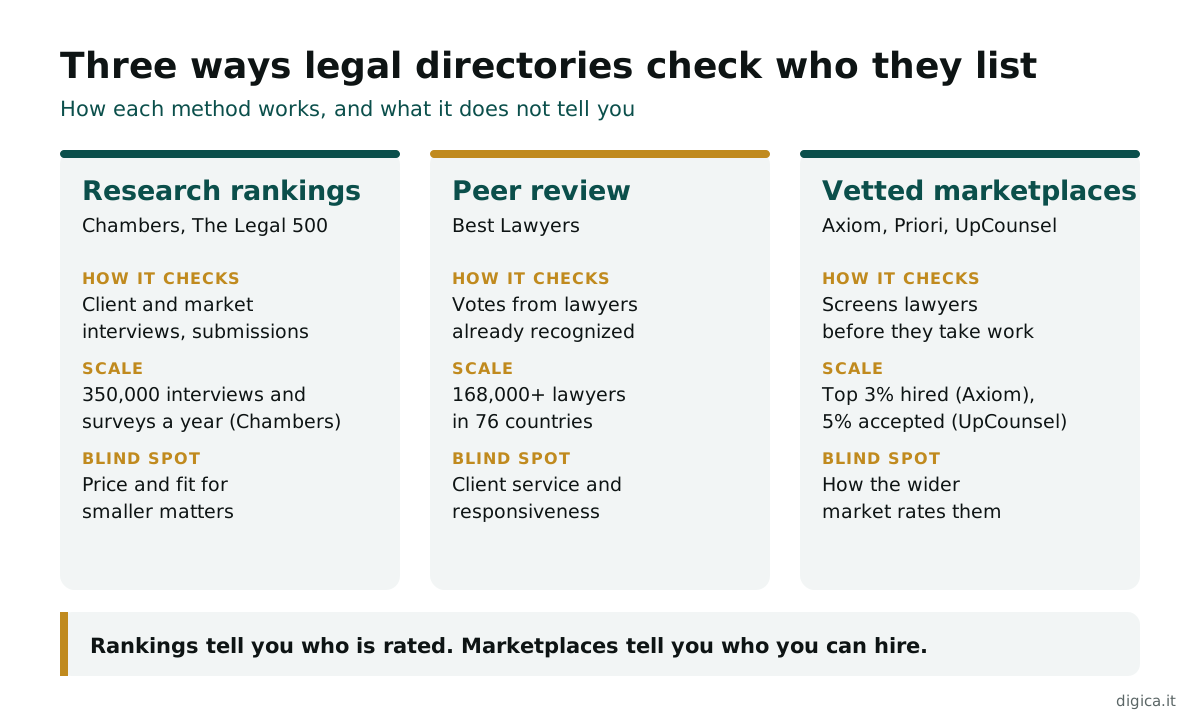
The short answer: in three ways. Research-led guides interview clients and lawyers. Peer-review guides ask lawyers to vote on other lawyers. Marketplaces screen lawyers before they let them take work. Each method answers a different question, and none answers all of them.
Research-led rankings, such as Chambers and Partners and The Legal 500, tell you which firms and partners the market rates in a practice area. They are built from client feedback, firm submissions and interviews. They are strong on reputation and weak on price, availability and fit for a smaller matter.
Peer-review guides, such as Best Lawyers, tell you which individual lawyers other lawyers respect. That is a useful signal for specialist work, but it measures standing in the profession, not how a lawyer serves a client.
Marketplaces, such as Axiom, Priori and UpCounsel, tell you which lawyers you can actually engage this month, and at what level of experience. Their checks focus on admission, experience and quality of past work. Their weakness is the opposite of the rankings: you learn a lot about the individual and little about how the wider market rates them.
There is a fourth check that no directory does for you: confirming that a lawyer is admitted where the work is governed. Every serious marketplace says it verifies admission, and every serious buyer should still ask. It takes five minutes and it is the cheapest form of due diligence in legal procurement.
The practical consequence is simple. Use a ranking to shortlist firms, a marketplace to add capacity, and a legal tech directory to shortlist software. A business that uses one tool for all three jobs gets the wrong answer to at least two of them.
Seven legal directories compared
The short answer: Chambers has the widest research coverage, The Legal 500 leans hardest on client feedback, Best Lawyers on peer votes, Axiom has the most selective intake, Priori suits in-house teams managing many firms, UpCounsel suits smaller businesses and Legaltech Hub covers software rather than lawyers.
Seven legal directories and marketplaces compared on how they verify, what they cover, main risk and fit
| Directory | Type | How it verifies | Coverage it reports | Main risk | Best for |
|---|---|---|---|---|---|
| Chambers and Partners | Research-led ranking | 350,000 interviews and surveys a year | 200 jurisdictions | Ranks the top of the market only | Choosing a firm for major work |
| The Legal 500 | Research-led ranking | Contacts 300,000 clients for feedback | Firms ranked by practice and region | Built for large firms, not small matters | Comparing firms on client feedback |
| Best Lawyers | Peer review | Votes from lawyers already recognized; no pay to be listed | 168,000+ lawyers in 76 countries | Peer standing, not client service | Finding respected specialists |
| Axiom | Flexible talent marketplace | Hires the top 3% of applicants | 14,000+ lawyers on 4 continents | Price not published | Senior lawyers seconded in-house |
| Priori | Outside counsel marketplace | Vetted network, half with AmLaw experience | 8,000+ professionals, 70+ countries | Built for legal departments | In-house teams sourcing firms |
| UpCounsel | Business lawyer marketplace | Accepts 5% of applications | 14 years' average experience | Lawyer quality varies by matter | Startups and small businesses |
| Legaltech Hub | Legal tech directory | No public vetting process | 2,800+ solutions | Listings are not endorsements | Shortlisting legal software |
Read the "how it verifies" column first. Coverage tells you whether a directory can help. Verification tells you whether you can rely on the answer.
Best for research-led rankings: Chambers and Partners
Chambers and Partners, founded in London in 1990 by Michael Chambers, runs the largest research operation of any legal directory. Its methodology page describes research in 200 jurisdictions and 24 languages, around 350,000 interviews and surveys a year, a 330-strong research team and about 9,000 firms covered each year.
Rankings are built from four inputs: referee feedback, client satisfaction indices, market reputation and the researchers' own knowledge of the market. Chambers does not publish how much weight each one carries.
Running a legal or professional services marketplace?
In 30 minutes we look at how business buyers search for lawyers and legal services in your niche, and why they do not find you first.
Ownership changed in 2023, when Abry Partners bought the business from Inflexion, which kept a minority stake. For a buyer, the point is continuity: the research model has not changed with the owner.
Read a Chambers entry for its commentary as much as its band. The written notes from clients often say more about responsiveness, team depth and how a firm handles pressure than the ranking itself, and they are the part buyers most often skip.
The award: best for research-led rankings. Use Chambers when you need a firm for major work and want to know who the market rates, in many countries at once. Do not use it to find a lawyer for a small, routine matter; the rankings start at the top of the market.
Best for client feedback: The Legal 500
The Legal 500, published by Legalease in London, leans hardest on what clients say. Its research page says it contacts 300,000 clients a year for feedback on the lawyers they instruct. That is combined with firm submissions and interviews run by its journalists and researchers, and benchmarked against a sample of leading clients.
One detail is worth knowing if you are on the other side of a ranking. The Legal 500 says the absence of an interview does not count against a firm. The research runs on a fixed calendar: work on its 2027 Europe, Middle East and Africa guides began in September 2026, for publication in March 2027.
The award: best for client feedback. Use The Legal 500 when you care most about how a firm treats its clients, and read the written commentary, not only the tier.
Best for peer review: Best Lawyers
Best Lawyers, founded in 1981 and based in Augusta, Georgia, ranks individual lawyers by peer review. Only lawyers it already recognizes can vote, and lawyers are "neither required nor permitted to pay for inclusion". It describes more than 168,000 recognized legal professionals across 150 practice areas in 76 countries.
Since 2021, Best Lawyers has been owned by Abry Partners, the same investor that bought Chambers in 2023. The two guides still use different methods: Chambers asks clients and the market, Best Lawyers asks lawyers.
Peer review is a good signal for specialist work, such as a tax structuring question or a complex dispute, where other lawyers know who is genuinely expert. It is a weaker signal for responsiveness, cost control or how a lawyer works with a small in-house team.
The award: best for peer review. Use Best Lawyers to find respected specialists, then check client feedback elsewhere.
Best for flexible in-house talent: Axiom
Axiom, founded in 2000 and led by chief executive David McVeigh, has the most selective intake of any marketplace here. It says only the top 3% of applicants are hired to its bench. It reports more than 14,000 legal professionals across more than 60 legal areas on four continents, an average of 18 or more years of post-qualification experience, and work for 75% of the Fortune 100.
In April 2025, Axiom launched Axiom Self-Service, which it describes as a fully digital legal talent marketplace for US in-house teams. In July 2025, it said more than 850 lawyers on its bench had AI skills.
Axiom suits a company that needs a senior lawyer inside the business for months, for example to cover a leave, run a product launch or clear a contract backlog. It does not publish rates, so budget conversations start with a quote.
The award: best for flexible in-house talent. Use Axiom when you need experienced lawyers seconded into your team quickly, and when vetting depth matters more than price.
Best for managing outside counsel: Priori
Priori, based in New York, started in 2013 as a marketplace for small businesses and moved to corporate legal departments in 2016. Its talent marketplace page describes more than 8,000 vetted professionals across all 50 US states and more than 70 countries, with 50% holding AmLaw experience and 85% with eight or more years of experience.
Do business buyers find your legal marketplace, or your competitors?
A growth audit maps how general counsel and founders search for legal services, on Google and in AI answers, and which pages they never reach.
Priori has added tools for running outside counsel, not just finding it: request-for-proposal software in 2024, and now a rate review service that benchmarks what firms charge. That changes what it is. It is less a directory you search and more a system a legal department uses to source, compare and price its firms. That matters because legal departments are being asked to do more with less. The 2026 Law Department Management Benchmarking Report from ACC and Major, Lindsey & Africa, based on 576 legal departments in 45 countries, found total legal spend fell to 0.43% of company revenue, from a previous high of 0.63%. A tighter budget makes a benchmark of what each firm charges far more useful than another list of names.
The award: best for managing outside counsel. Use Priori when you run a legal department that hires many firms and wants a repeatable way to source and benchmark them.
Best for startups and small businesses: UpCounsel
UpCounsel, founded in 2012, is a marketplace where businesses post a legal need and receive proposals from lawyers. It says it accepts 5% of the applications to join its network, that its lawyers average 14 years of experience, and that it regularly verifies the lawyers in its network.
It has a turbulent history. UpCounsel announced in 2020 that it would shut down, and was bought at the last minute by Enduring Ventures, which kept it running. It is still operating in 2026.
The model suits startups and small businesses with defined matters: incorporation, a trademark filing, a contract review or an employment question. The trade-off is that quality sits with the individual lawyer you choose. Read reviews and ask for a fixed fee before you start.
The award: best for startups and small businesses that need a business lawyer for a defined task and have no general counsel.
Best legal tech directory: Legaltech Hub
Legaltech Hub, founded in October 2020 by Nicola Shaver and Chris Ford, is a directory of legal software rather than lawyers. Its premium page describes more than 2,800 solutions across categories. Its September 2026 generative AI map counts 1,416 solutions that use generative AI, from 1,117 providers across 19 categories, up from 855 in December 2025.
That growth is the reason a directory helps. When the number of products in one slice of the market rises by two thirds in under a year, nobody on an in-house team can track it alone, and a structured shortlist becomes more valuable.
Legaltech Hub does not describe a public process for checking listings, so treat a listing as a sign that a product exists, not that it works. Use it to build a longlist, then check references and run a pilot.
The award: best legal tech directory for in-house teams and firms building a software shortlist.
Three failure scenarios and a decision framework
Most legal directory mistakes come from one confusion: treating a ranking and a marketplace as the same kind of tool. A ranking answers "who does the market rate?" A marketplace answers "who can I hire this month, and how well were they checked?" The diagram below sets the two side by side.
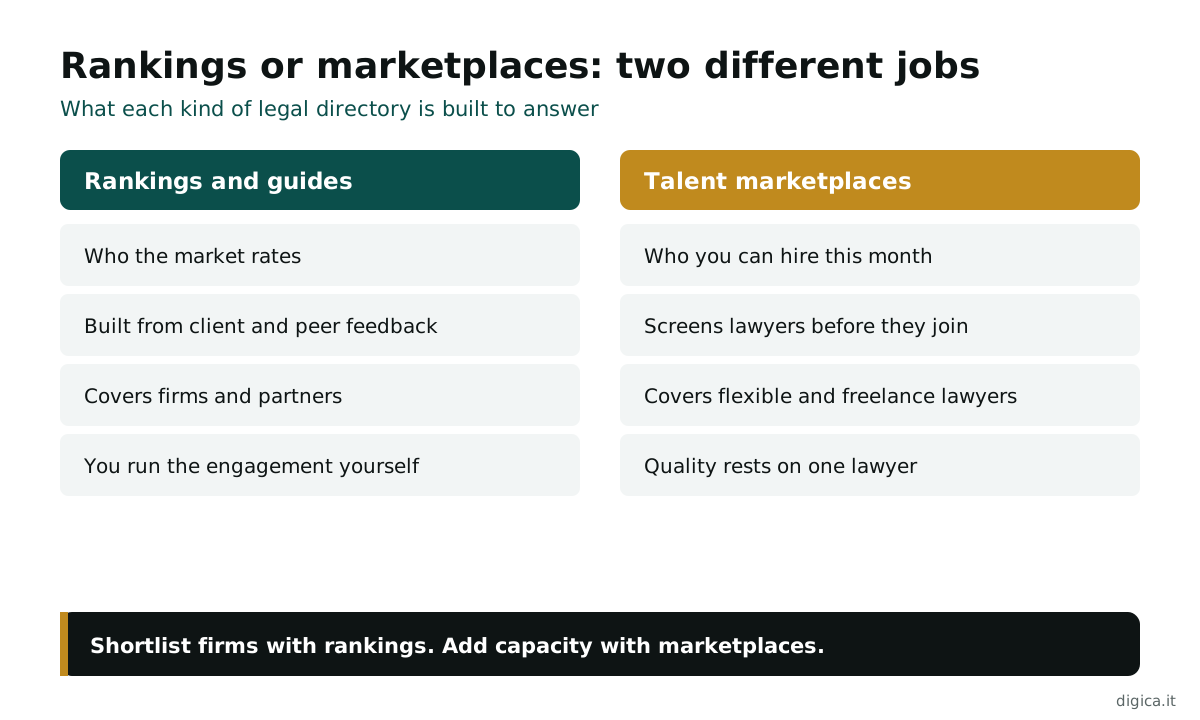
Keep that split in mind when you read the scenarios below. Each one starts with a reasonable choice of directory, made for the wrong job. None of them involves a bad lawyer or a dishonest listing. They involve a business that asked a ranking to behave like a marketplace, or a marketplace to behave like a ranking, and paid for the difference in fees, time or a second engagement.
These are the patterns that recur when businesses pick the wrong kind of legal directory.
- The top-tier firm for a routine job. A 60-person software company picks a band-one firm from a research-led ranking for its standard customer contracts. The work is excellent, the bills are sized for a much larger client, and the contracts still take three weeks each. A vetted marketplace lawyer on a fixed fee would have done the same work faster.
- The marketplace lawyer for a bet-the-company matter. A founder hires the cheapest marketplace proposal for a contested acquisition. The lawyer is qualified but has never run a deal of that size, and the company pays a second firm to fix the documents.
- The software directory read as a recommendation. A legal team picks a contract tool because it was listed in a well-known directory, and skips the pilot. Six months later, adoption is low and the team is choosing again.
Use these decision points to choose where to start.
- If the matter could change the value of the company, start with Chambers or The Legal 500 and shortlist three ranked firms.
- If you need a named specialist in a narrow field, check Best Lawyers, then confirm client feedback in a research-led guide.
- If you need a senior lawyer inside the business for three months or more, ask Axiom for profiles.
- If your legal department uses more than 10 outside firms, look at Priori to source and benchmark them.
- If you have no general counsel and a defined task, post it on UpCounsel and ask for a fixed fee.
- If you are buying legal software, build a longlist on Legaltech Hub, then pilot at least two tools.
Growing a professional services or legal marketplace?
We help professional services marketplaces win the searches and AI answers that business buyers use before they choose a provider.
Legal budgets are under pressure, which makes each choice count. Total legal spend has fallen to 0.43% of company revenue, as the benchmark cited in the Priori section shows, while software takes a growing share: Gartner predicts legal tech budgets will double by 2028, driven by specialized legal AI platforms. For a company with $500 million in revenue, 0.43% is about $2.15 million a year. If the right directory moves even a tenth of that work to the right kind of provider, the saving runs into six figures. The biggest cost of doing nothing is paying top-of-market rates for routine work because the only directory anyone checked was a ranking.
FAQ
What is a legal directory? A legal directory is a guide that lists law firms, lawyers or legal products so clients can find and compare them. Business directories include research-led rankings such as Chambers and Partners, peer-review guides such as Best Lawyers, and legal tech directories such as Legaltech Hub.
What is the difference between Chambers and The Legal 500? Both rank firms and lawyers from research. Chambers runs about 350,000 interviews and surveys a year across 200 jurisdictions. The Legal 500 contacts 300,000 clients a year and leans heavily on client feedback.
Do lawyers pay to be listed in Best Lawyers? No. Best Lawyers says lawyers are neither required nor permitted to pay for inclusion, and only lawyers it already recognizes can vote.
What is a legal marketplace? A legal marketplace is a platform where businesses find and hire lawyers directly. Examples include Axiom for seconded in-house lawyers, Priori for outside counsel and UpCounsel for startups and small businesses.
How do legal marketplaces vet lawyers? Each sets its own bar. Axiom says it hires the top 3% of applicants, UpCounsel accepts 5% of applications, and Priori describes a vetted network in which half of its professionals have AmLaw experience.
Is UpCounsel still operating? Yes. UpCounsel announced a shutdown in 2020 but was bought by Enduring Ventures, and it is still operating in 2026.
Where can I compare legal tech products? Legaltech Hub lists more than 2,800 legal tech solutions. Treat a listing as a starting point, not an endorsement, and run a pilot before you buy.
Related Articles
- Professional services marketplace growth
- Best expert networks in 2026, by pool and compliance
- Best talent marketplaces in 2026: who vets hardest
- Best agency directories in 2026, ranked
- Best SaaS directories to list your product in 2026
This article is part of our B2B marketplace growth series. Browse more on the Digica blog.