The best SaaS communities for founders and operators, grouped by who they serve
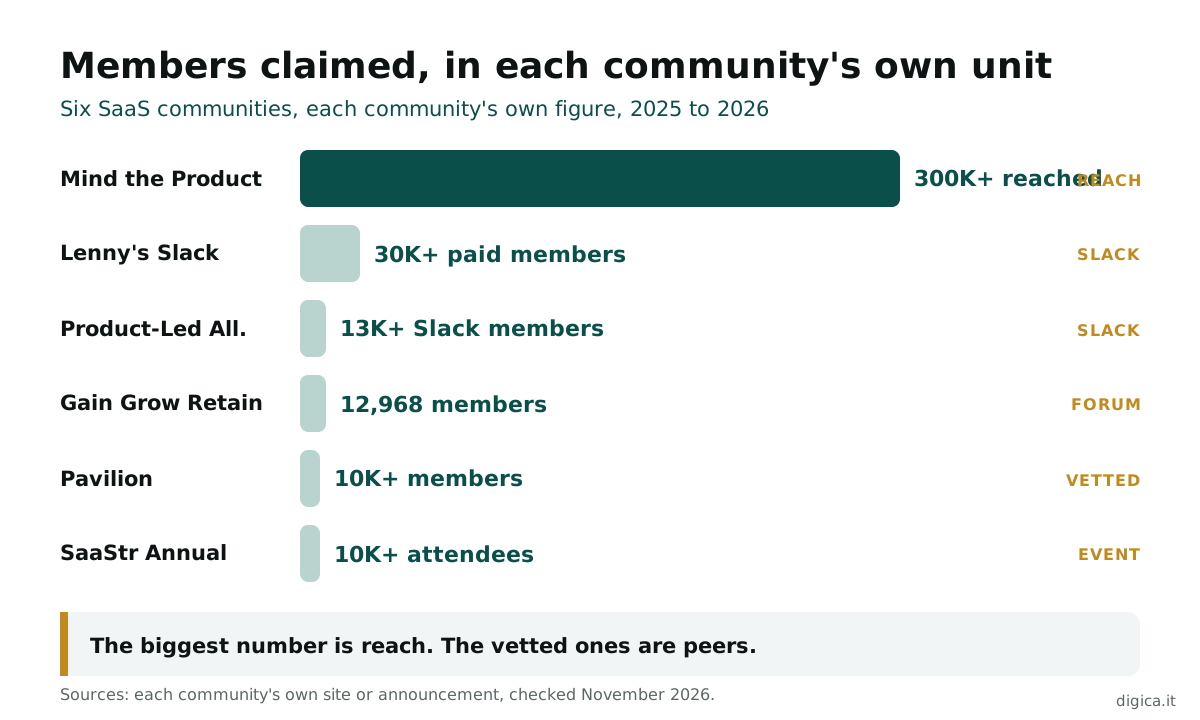
A SaaS community is worth joining when its members are the people you need to learn from, and worth building around when they are the people you sell to. The numbers vary wildly. Mind the Product says it reaches more than 300,000 product people. Lenny's Newsletter runs a Slack of more than 30,000 paying subscribers. Pavilion has more than 10,000 members and accepts only senior revenue leaders. All three are SaaS communities. Each one is useful to a very different person.
The choice matters more than it used to, because buyers now learn from each other before they talk to anyone selling. In a March 2026 survey of 1,202 US business decision makers by SurveyMonkey and Reddit, 83% said they complete their research through peer communities and self-directed search, and 73% said they trust peer insights, against 55% for vendor websites (SurveyMonkey). The community your peers sit in is where your next hire, partner or customer forms an opinion.
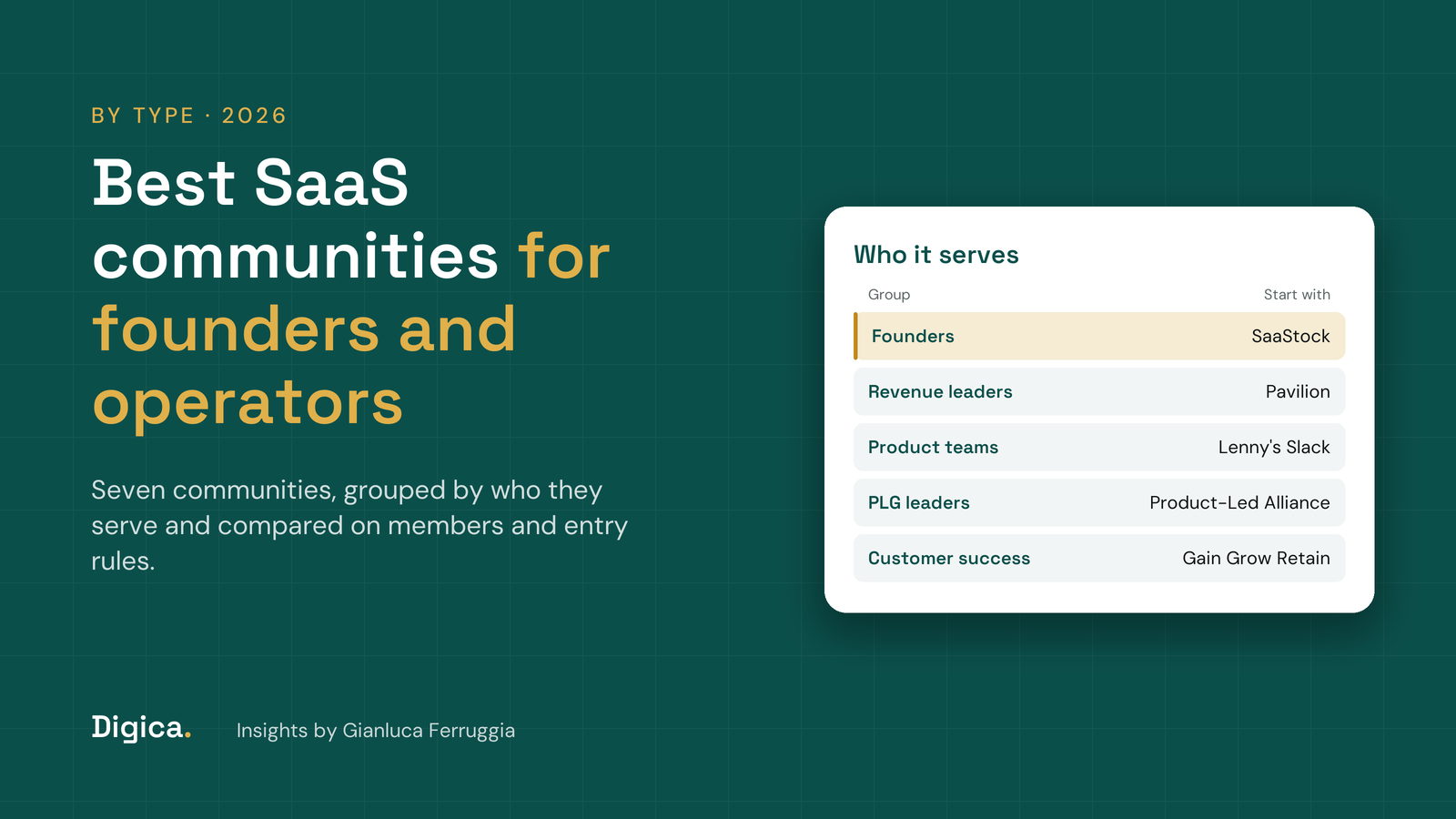
This guide picks seven of the biggest SaaS communities for founders and operators and groups them by who they serve: founders, revenue and go-to-market leaders, product teams and customer success. For each, it sets out the members claimed, the focus and how you get in. Figures are each community's own, checked on November 3, 2026. For founder groups outside SaaS, see our guide to the best startup communities.
Quick Navigation
- How we picked the best SaaS communities
- Seven SaaS communities at a glance
- Founder communities: SaaStr and SaaStock
- Revenue and go-to-market communities: Pavilion
- Product communities: Lenny's, Mind the Product and Product-Led Alliance
- Customer success communities: Gain Grow Retain
- What a member count really measures
- Three failure scenarios
- Choosing a SaaS community: a decision framework
- What the right SaaS community is worth
- FAQ
- Related Articles
How we picked the best SaaS communities
The short answer: we looked for the largest and most active communities built for people who start, sell, build or support SaaS products, then grouped them by the job their members do, because that decides who you meet.
A SaaS community can be a Slack, a forum, a chain of local meetups, a paid membership with peer groups or an events brand with a large audience. We included all of these, as long as members can meet or talk to each other, not just read. We left out communities that have stopped running, communities that have become agencies, and broad founder networks we cover elsewhere.
Every community here publishes how many members or attendees it has, who it is for and how to join. We judged each on three questions: how many people are in it, how focused it is on one role or stage, and how hard it is to get in. Entry rules matter as much as size, because they decide whether the person next to you is a peer or a vendor.
Our view: pick a SaaS community by the role of the people in it before its size. A 10,000 member group of your peers beats a 300,000 member audience you will never speak to.
Seven SaaS communities at a glance
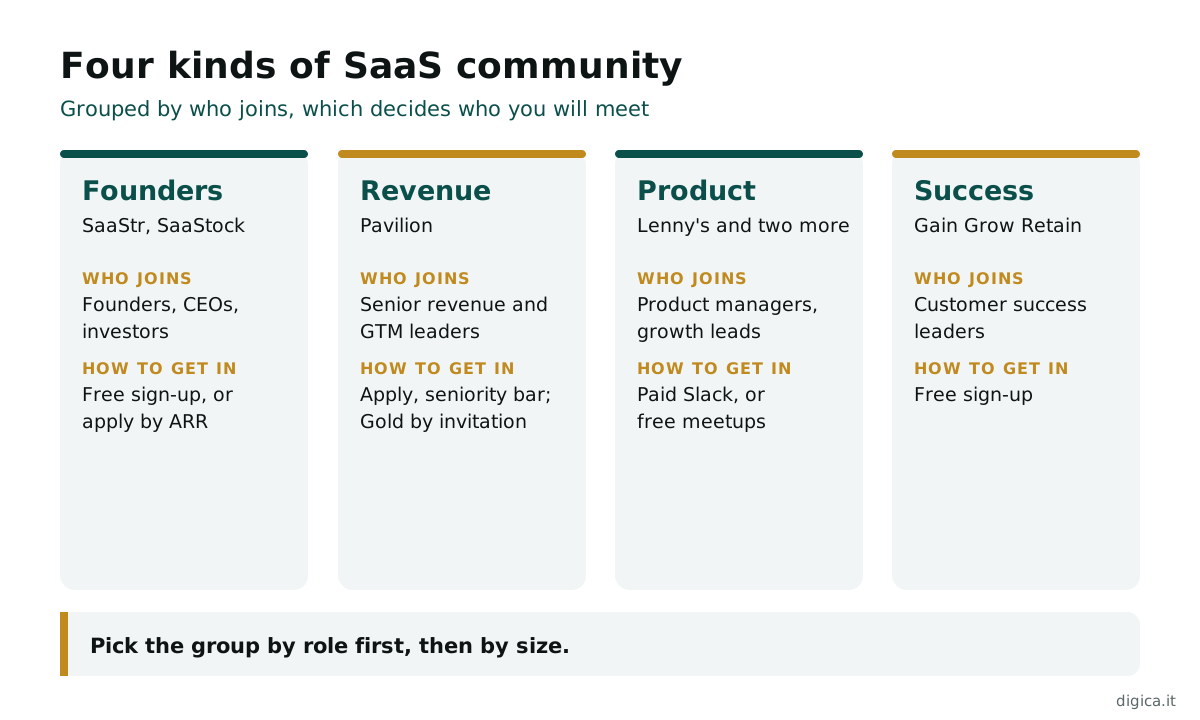
The short answer: SaaStr and SaaStock serve founders, Pavilion serves senior revenue leaders, Lenny's Newsletter, Mind the Product and Product-Led Alliance serve product people, and Gain Grow Retain serves customer success.
Seven SaaS communities compared on members claimed, who they are for, how to join, cost, main risk and best fit
| Community | Members claimed | Who it is for | How to join | Cost to join | Main risk | Best for |
|---|---|---|---|---|---|---|
| SaaStr | 10,000+ expected at its 2026 Annual | B2B founders, CEOs, revenue and marketing leaders | Free sign-up, paid event tickets | Free to tickets | Audience more than peer group | Largest SaaS event and content |
| SaaStock | Tens of thousands of founders reached since 2015 | Founders at $500K to $100M ARR | Apply, matched by ARR | Paid membership | Ownership in change | ARR-matched founder circles |
| Pavilion | 10,000+ members | Senior revenue and GTM leaders | Apply; Gold is invitation-only | Paid membership | Strict seniority bar | Vetted executive peers |
| Lenny's Newsletter Slack | 30,000+ Slack members | Product, growth and founders | Paid subscription | $20 a month or $200 a year | Busy, broad Slack | High-signal product peers |
| Mind the Product | 300,000+ product people reached | Product managers worldwide | Free to join | Free, paid tiers | Large reach, loose ties | Local product meetups |
| Product-Led Alliance | 13,000+ Slack members | Product and growth leaders running PLG | Free Insider tier | Free, paid tiers | Certification focus | Product-led growth peers |
| Gain Grow Retain | 12,968 members | Customer success leaders | Free sign-up | Free | Narrow to one function | Customer success peers |
Each figure is the community's own, and the units differ: members, Slack members, attendees and people reached are not the same thing. Read the "Who it is for" and "How to join" columns first. They tell you who you will actually meet.
Founder communities: SaaStr and SaaStock
The short answer: SaaStr is the largest SaaS community by reach, built around content and one very large event. SaaStock is smaller and more selective, with paid peer circles matched by annual recurring revenue.
SaaStr
SaaStr, founded by Jason Lemkin in 2012, describes itself as the world's largest community for B2B and AI software. It is open: anyone can sign up for free, and most of the community lives in its blog, podcast and events. Its flagship, SaaStr AI Annual, ran on May 12 to 14, 2026 at the San Mateo County Event Center in California and expected more than 10,000 attendees, with founders, CEOs, revenue, marketing and customer leaders and investors all in the audience. SaaStr reported registrations for the 2026 event at 143% of the same point a year earlier.
Building a SaaS community or directory of your own?
In 30 minutes we look at how founders and operators find communities like yours, on Google and in AI answers, and what we would do first to grow members who stay.
SaaStr does not publish a member count, so the event figure is the honest measure of its size. Its strength is breadth: one place to hear how other B2B software companies grow, hire and raise. Its limit is the same breadth. At 10,000 people, you meet who you plan to meet, so it suits founders who book meetings in advance more than those hoping for chance encounters. Its free content is the part most founders use all year, and it costs nothing to try.
SaaStock
SaaStock, based in Dublin since its first European event in 2016, runs SaaS conferences and a paid Founder Membership. Entry is by application, and members need annual recurring revenue between $500K and $100M. Founders are placed in circles by ARR, at $500K to $1M, $1M to $10M and $10M and above, so a founder at $2M talks to founders at $2M, not to a public company CEO.
SaaStock says it has reached tens of thousands of founders since 2015 and runs more than 30 events a year, with monthly mastermind groups, a community chat, a retreat and quarterly dinners. Its own numbers also show change. SaaStock Europe 2025 in Dublin drew 1,680 attendees, down from 3,119 in 2024, and the site now says Founderpath has acquired SaaStock's US and European events. The ARR-matched circles are the reason to join. Check how they will run under new ownership before you pay.
Revenue and go-to-market communities: Pavilion
The short answer: Pavilion is the largest private community for revenue and go-to-market leaders, with more than 10,000 members, and it is selective about who gets in.
Pavilion, formerly Revenue Collective, says it has more than 10,000 members worldwide. Its membership page is built for executives at companies with $100M or more in ARR, and its Gold tier, launched in September 2025, is invitation-only for C-level leaders at businesses with $100M to $3B in ARR. Members join chapters, dinners and retreats, and take courses through Pavilion School. In September 2025 it also launched Pathfinder, a go-to-market assistant for members, and appointed Rich Gardner as President alongside founder and CEO Sam Jacobs.
That seniority bar is the point. Revenue leaders join Pavilion to compare compensation, quotas, team structures and pricing with people facing the same board. For a vendor, the bar works the other way: Pavilion is a room you earn your way into through members, not one you can buy a seat in. We covered its wider peer group in our guide to the best business communities.
The trade-off is reach. A head of sales at a 40-person startup will not meet the bar, and should look at founder communities or product communities first. Pavilion repays the fee only when you are senior enough to use its peers, and when the questions you bring are ones only other revenue executives can answer.
Product communities: Lenny's, Mind the Product and Product-Led Alliance
The short answer: product people have the richest choice of SaaS communities. Lenny's Newsletter runs the most focused paid Slack, Mind the Product the widest network of local meetups, and Product-Led Alliance the community most focused on product-led growth.
Lenny's Newsletter community
Lenny Rachitsky's newsletter says it has more than 1,000,000 subscribers, and its private Slack, open only to paid subscribers, has more than 30,000 members. A paid subscription costs $20 a month or $200 a year on the web. The Slack covers product, growth, hiring and careers, and a weekly digest pulls the best threads together for members who cannot keep up.
The paywall is what keeps it focused. Members are mostly product managers, growth leads and founders who pay to be there, which makes the questions specific and the answers practical. In 2026 the paid tier also bundles free access to more than 20 software tools, which changes the maths for a team buying it. For a founder, it is the fastest way to hear how product teams at other SaaS companies solve the same problem.
Mind the Product
Mind the Product, now part of Pendo, says it reaches more than 300,000 product people worldwide. Its ProductTank meetups began in a London pub in 2010 and now run in cities around the world, alongside its conferences, including INDUSTRY 2025, held in Cleveland, Ohio from September 8 to 10, 2025. Joining is free, with paid tiers for more content.
Its reach is the widest in this guide, and its ties are the loosest. Mind the Product is where a product manager finds a local meetup and a conference, rather than a small group that knows their company. That is the right fit for building a network across a city, and the wrong fit for confidential advice.
Product-Led Alliance
Product-Led Alliance, founded in December 2019 and based in London, says it has more than 16,000 members and more than 13,000 Slack members. It focuses on product-led growth: free trials, onboarding, activation and the product as the main sales channel. Its free Insider tier includes certifications, with paid tiers for more.
It suits product and growth leaders whose company sells through the product rather than through a sales team. The certification focus is useful for building skills, and less useful if what you need is senior peers. We cover the wider set of B2B community platforms these groups run on in a separate guide.
Customer success communities: Gain Grow Retain
The short answer: Gain Grow Retain is the largest free community built for customer success leaders at SaaS companies, with 12,968 members on its own site.
Gain Grow Retain, founded by Jay Nathan and Jeff Breunsbach and acquired by Higher Logic in 2020, shows 12,968 members, 2,119 discussions and 378 events on its site. It is free to join. Members use its forum and groups, attend its events, including GGR Live in Austin, and can take a Customer Success Foundations certificate.
Customer success is where SaaS revenue is kept or lost, and it is often the function with the least peer support inside a company. A community of people doing the same job is where renewal playbooks, health scores and team structures get compared honestly. Gain Grow Retain's discussion count is the useful number here: posts show a community that is used, not just joined.
The limit is that it is one function. A founder will not find investors or revenue leaders there. A head of customer success will find more practical help than in any general SaaS community, and the free entry makes it the easiest first step in this guide for anyone in that role.
What a member count really measures
The short answer: a member count measures how many people signed up, not how many take part. Discussions, events and entry rules tell you more about whether a SaaS community is alive.
Look at the units in this guide. SaaStr counts expected attendees. Mind the Product counts people reached. Lenny's counts Slack members who pay. Gain Grow Retain counts members and posts. A large figure can describe an audience that reads and never talks, and a small one can describe a group that meets every month and knows each other's numbers.
Entry rules are the other half of the picture. An open community grows fast and fills with vendors, recruiters and people who joined once and never came back. A community that checks role, seniority or revenue grows slowly, and the people in it are more likely to be peers. Neither model is better in general, and both can be right for the same person at different times. The question is whether the filter matches what you need: reach to be seen, or peers to learn from.
Buying is also becoming a group activity, which raises the value of the right community. Forrester's 2025 Buyers' Journey Survey found that 73% of B2B purchases involve three or more departments, and that the average purchase involves 13 internal and 9 external people (Forrester). Those external people include peers in communities. A founder who is known and trusted in the right group reaches several of them at once.
Is your SaaS product discussed where your buyers ask each other?
A growth audit maps where your buyers ask peers for advice, which communities and AI answers name your rivals, and which pages would put you in the conversation.
So read every member count with three checks. First, what unit is it: members, subscribers, attendees or reach? Second, how many discussions or events happened in the last year? Third, who is allowed in? A community that passes all three is worth your time even if its headline number is the smallest on the list. One that fails all three is a mailing list with a logo.
Three failure scenarios
These are the patterns that recur when founders and operators join or sponsor a SaaS community for the wrong reason.
- The big room with no peers. A seed-stage founder buys a ticket to the largest SaaS event of the year expecting to meet investors and customers, but books no meetings in advance. They spend three days in sessions and leave with business cards from other founders at their stage. Booking ten meetings a month ahead, or joining a smaller ARR-matched circle, would have turned the same budget into relationships.
- The membership that was too senior. A first-time head of revenue at a $5M ARR company joins an executive community built for leaders at far larger companies. The discussions are about board politics and team structures they will not need for years. A community matched to their stage, or a free functional community, would have answered this quarter's questions.
- The vendor who sponsored instead of contributing. A SaaS company sponsors a community event to reach its buyers, and nobody remembers the booth. A competitor's product lead answered questions in the same community's Slack every week for a year and is now the name members recommend. Showing up as a practitioner would have earned the trust the sponsorship could not buy.
Each one chose a real SaaS community. None of them checked who the members were, and what those members come for.
Choosing a SaaS community: a decision framework
The short answer: start with your role and stage, then pick the community whose entry rules put you among peers.
- If you are a founder below $500K ARR, start with free founder communities and SaaStr's content, and save paid memberships until you can use peer advice every month.
- If you are a founder between $500K and $100M ARR, apply to an ARR-matched program such as SaaStock's Founder Membership.
- If you lead revenue at a company with $100M or more in ARR, apply to Pavilion, where its seniority bar works in your favor.
- If you are in product or growth, join Lenny's Newsletter Slack for focused peer questions, and add Mind the Product for local meetups.
- If your company sells through the product with free trials, add Product-Led Alliance.
- If you run customer success, join Gain Grow Retain first. It is free and focused on your function.
- If you want to reach buyers rather than peers, contribute as a practitioner for at least six months before you sponsor anything.
Running a B2B community or expert network?
We help B2B communities grow members who stay, from search and AI answers to the partner programs that bring in the right people.
Most founders and operators end up in two communities: one for their role and one for their stage. That is enough. Review the pair once a year, and leave any community where you have not asked or answered a question in six months, because a membership you do not use is a cost, not a network. Our guide to community SEO covers the other side, for teams building a community of their own.
What the right SaaS community is worth
The short answer: the right SaaS community is worth the decisions it improves and the people it introduces, and both can be counted.
Community teams themselves are under pressure to show value. The CMX 2026 Community Industry Report found that 93% of community professionals now use AI tools, up from 81% a year earlier, a sign of how much work small community teams are asked to carry (CMX). The communities in this guide that survive are the ones whose members can point to a result.
Run an illustrative case. A $3M ARR SaaS founder pays $200 a year for a product Slack and joins a free customer success community. One answered question on pricing packaging lifts conversion on one plan, worth $30,000 in new ARR, and one introduction leads to a senior hire found without a $40,000 recruiter fee. That is $70,000 of value against $200 of cost. The figures are illustrative, but the pattern holds for most founders: one good answer or introduction a year pays for the right community many times over.
The number to take to your next planning meeting is how many decisions or hires came from peers last year. If it is zero, you are in the wrong communities, or in the right ones without taking part. The biggest cost of doing nothing is learning slowly what your peers already know.
FAQ
What is a SaaS community? A SaaS community is a group where people who start, sell, build or support software as a service products meet and share advice. It can be a Slack, a forum, local meetups, a paid membership with peer groups or an events brand.
What is the best SaaS community for founders? For reach, SaaStr is the largest, with more than 10,000 expected attendees at its 2026 Annual. For peer advice, SaaStock's Founder Membership places founders with $500K to $100M in ARR in groups matched by revenue.
Which SaaS communities are free? SaaStr's content and community sign-up, Mind the Product, Product-Led Alliance's Insider tier and Gain Grow Retain are free to join. Pavilion, SaaStock's Founder Membership and Lenny's Newsletter Slack are paid.
What is the best SaaS community for product managers? Lenny's Newsletter Slack, with more than 30,000 paying members, is the most focused. Mind the Product, which says it reaches more than 300,000 product people, is best for local meetups.
Is Pavilion worth it? Pavilion is worth it for senior revenue and go-to-market leaders who can use a vetted peer group of more than 10,000 members. Its membership is built for leaders at companies with $100M or more in ARR, so earlier-stage leaders often get more from a community matched to their stage.
How do I choose a SaaS community? Match your role and stage first, then check the community's entry rules and activity. A smaller community of peers who post and meet regularly is usually worth more than a larger audience.
Related Articles
- B2B communities and expert networks
- Best startup communities in 2026, ranked by members
- Best B2B and business communities to join in 2026
- Best community platforms for B2B communities in 2026
- Best SaaS directories to list your product in 2026
Where this connects
This article is part of our B2B marketplace growth series. Browse more on the Digica blog.