What is a cloud marketplace? AWS, Azure and Google Cloud compared on reach to enterprise buyers
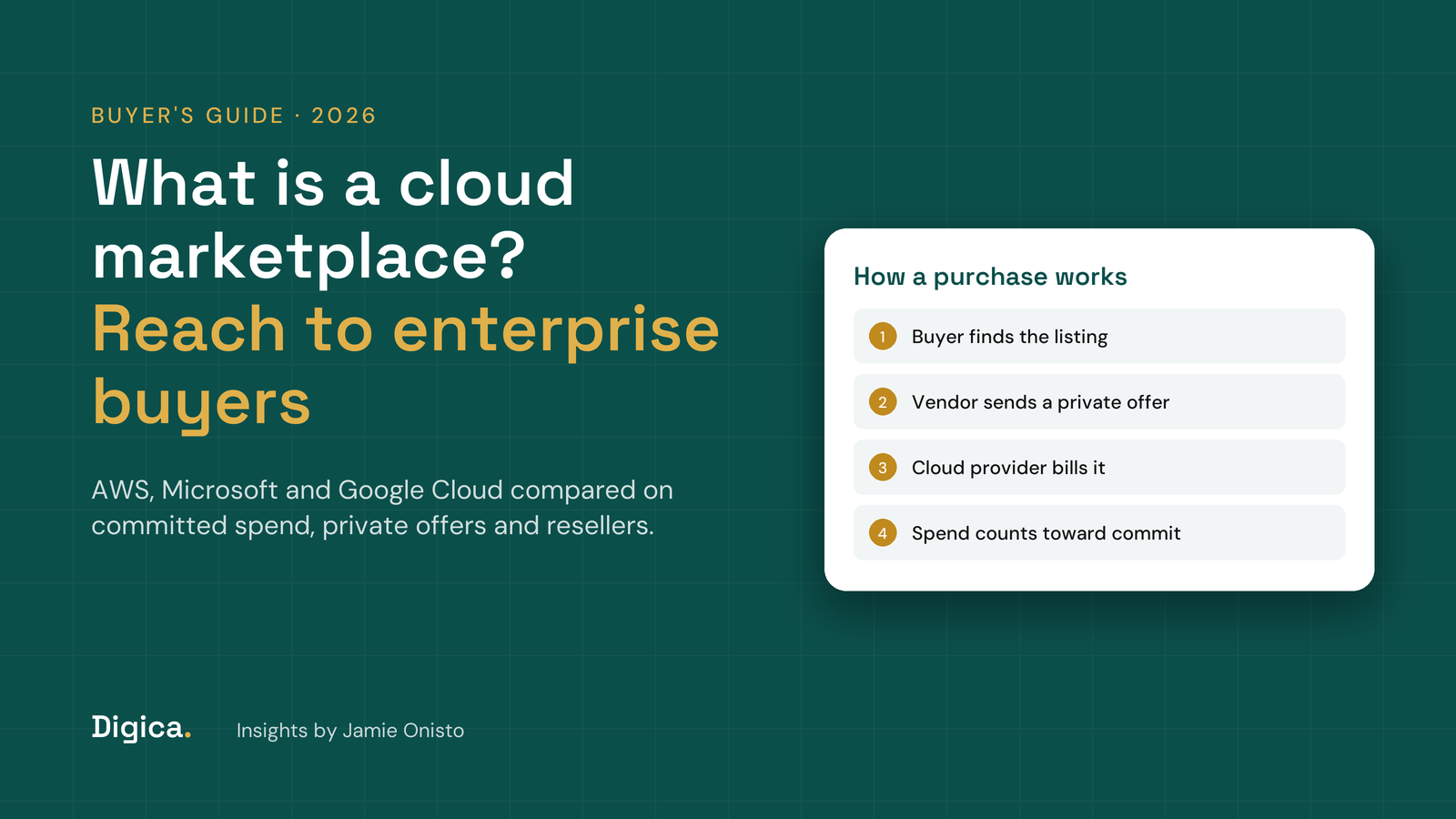
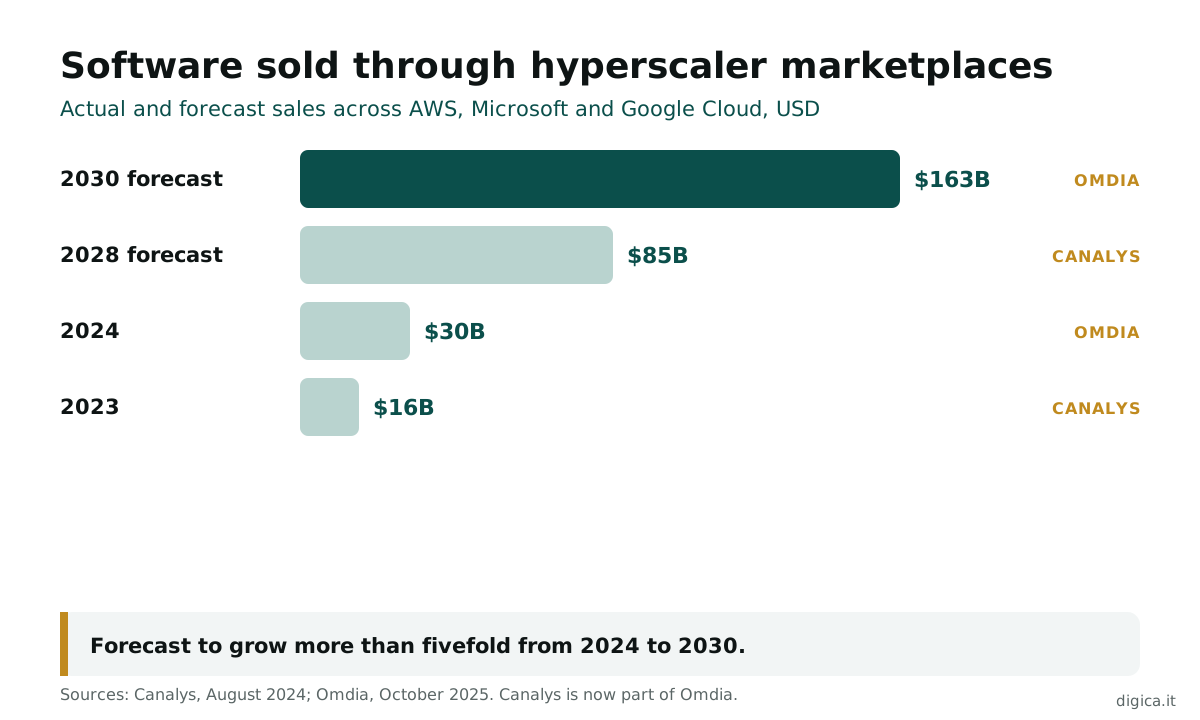
A cloud marketplace is the software catalog a cloud provider runs for its own customers. An enterprise that already pays AWS, Microsoft or Google for infrastructure can find a third-party product there, agree terms, and pay for it on the same cloud invoice, often out of money it has already committed to spend. That last part is why the channel has grown so fast. Omdia forecasts that enterprise software sales through hyperscaler cloud marketplaces will rise from $30 billion in 2024 to $163 billion by 2030.
The common mistake is to treat a cloud marketplace as a store window. Listing a product does not put it in front of buyers. What moves a deal is procurement: whether the purchase counts against the buyer's cloud commitment, whether a private offer can carry negotiated terms, and whether the buyer's reseller can sell it. Those rules differ by provider, and they decide which enterprise buyers each cloud marketplace can actually reach.
This guide explains what a cloud marketplace is, then compares AWS Marketplace, Microsoft Marketplace and Google Cloud Marketplace head to head on reach to enterprise buyers, with a short look at Oracle, Alibaba Cloud and Huawei Cloud. Facts come from each provider's own documentation and announcements, checked on October 18, 2026. It is written for software vendors deciding where to list first, the same question we work on in SaaS and software marketplace growth.
Quick Navigation
- What is a cloud marketplace?
- AWS, Azure and Google Cloud, side by side
- AWS Marketplace: the widest enterprise footprint
- Microsoft Marketplace: one store for Azure and Microsoft 365 buyers
- Google Cloud Marketplace: the only published cap
- Other cloud marketplaces: Oracle, Alibaba Cloud and Huawei Cloud
- Why committed spend decides who buys
- Private offers and the reseller channel
- Three failure scenarios
- Where to list first: a decision framework
- The number to take to your CFO
- FAQ
- Related Articles
What is a cloud marketplace?
A cloud marketplace is a digital catalog, run by a cloud provider, where business buyers find, buy and deploy third-party software and pay for it on their cloud bill. The provider handles billing and the contract paper, and eligible purchases can count toward the buyer's committed cloud spend.
That definition hides three separate jobs. The first is discovery: a searchable catalog of software as a service (SaaS), machine images, containers, data and professional services. The second is procurement: standard or negotiated contract terms, so the buyer does not have to onboard a new supplier. The third is billing: one invoice, from a vendor the buyer's finance team already pays.
For a software vendor, the third job matters most. An enterprise with a multi-year cloud commitment has budget that is already approved. If your product can be bought against that commitment, you are no longer asking for new money. You are asking the buyer to spend money they would otherwise risk leaving unused.
That is also why a cloud marketplace behaves differently from a B2B marketplace that matches buyers with sellers. Most cloud marketplace revenue does not come from strangers browsing the catalog. It comes from buyers who already know the product, and who choose the cloud marketplace as the way to pay for it. Treat the listing as a procurement route first and a discovery channel second.
AWS, Azure and Google Cloud, side by side
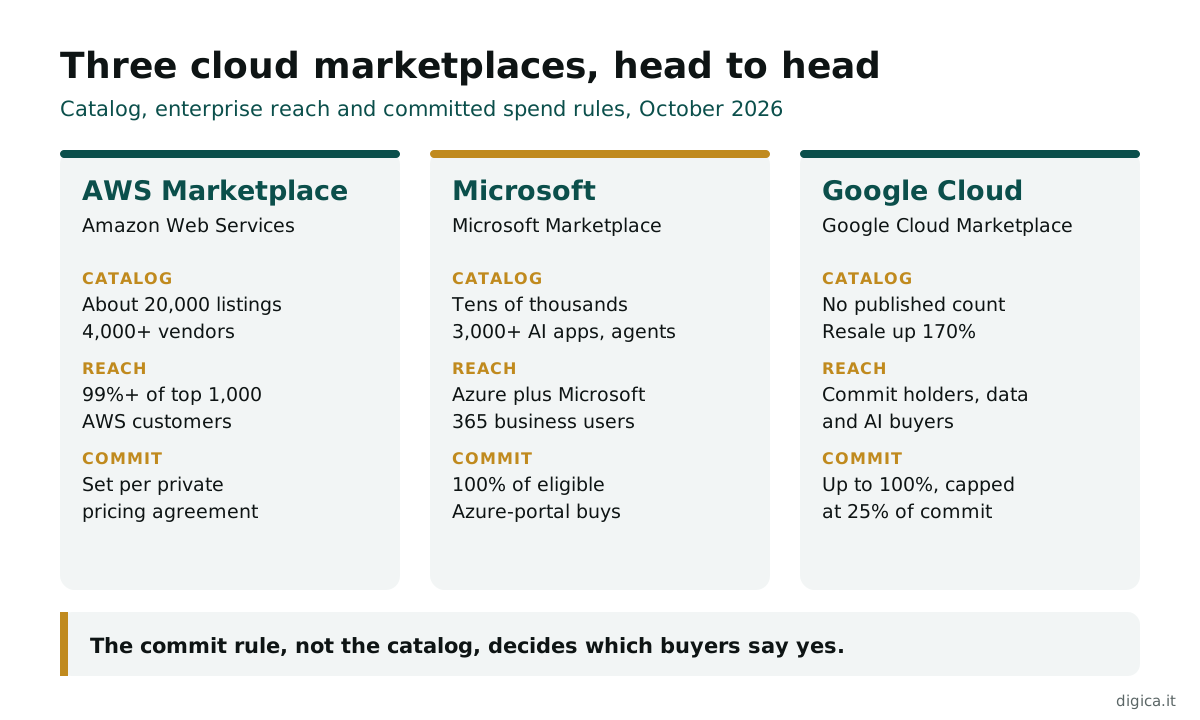
The short answer: AWS Marketplace has the largest published catalog and the deepest enterprise footprint, Microsoft Marketplace offers the most generous published drawdown on eligible purchases, and Google Cloud Marketplace is the only one of the three that publishes a hard cap on how much of a commitment marketplace spend can retire.
AWS, Microsoft and Google Cloud marketplaces compared on catalog, enterprise reach, committed spend, channel resale, main risk and fit
| Factor | AWS Marketplace | Microsoft Marketplace | Google Cloud Marketplace |
|---|---|---|---|
| Catalog | About 20,000 listings from 4,000+ vendors (December 2024) | "Tens of thousands" of solutions, 3,000+ AI apps and agents (September 2025) | No published count |
| Enterprise reach | Used by over 99% of AWS's top 1,000 customers | Azure buyers plus Microsoft 365, Dynamics and Copilot users | Google Cloud commit holders, strong in data and AI |
| Committed spend | Counts toward commitment terms set in each customer's private pricing agreement | 100% of eligible purchases count toward the Azure consumption commitment | Up to 100% of eligible spend, capped at 25% of the commitment |
| Channel resale | Channel Partner Private Offers | Multiparty private offers, now in Europe, Australia, Japan and South Africa | Reseller private offers count toward commit since June 2025 |
| Main risk | Drawdown rules are contract-specific, not public | Only Azure-portal purchases used in Azure qualify | Spend above the 25% cap is lost |
| Best for | Vendors selling security, data and DevOps to large AWS estates | Vendors selling to Microsoft-centric enterprises | Data and AI vendors with Google Cloud buyers |
Read the committed spend row first. It is the line that turns a listing into a budget line, and it is where the three providers differ most.
AWS Marketplace: the widest enterprise footprint
AWS Marketplace, run by Amazon Web Services from Seattle, has the longest track record of the three. At re:Invent in December 2024, its vice president Matt Yanchyshyn put the catalog at about 20,000 public listings from more than 4,000 vendors, and said over 99% of AWS's top 1,000 customers use it. AWS has not published a newer customer count; its last figure, from June 2023, was more than 330,000 active customers.
For a vendor, the reach number that matters is the second one. If nearly every large AWS customer already buys through the marketplace, their procurement and legal teams have accepted its contract terms at least once. That removes weeks of supplier onboarding from your sales cycle.
Listed on a cloud marketplace and still waiting for the first enterprise deal?
In 30 minutes we look at how enterprise buyers find products like yours, and what stands between your listing and a private offer.
AWS has also widened what it sells. Since May 2025 it lists SaaS products that run on other clouds or on premises, and marks products that run fully on AWS with a "Deployed on AWS" badge. AWS says badged products will continue to count toward "additional customer benefits", which vendors read as the commitment terms in a customer's private pricing agreement. In July 2025 it added an AI Agents and Tools category, and in December 2025 it launched Express Private Offers, which give buyers a personalized offer in minutes, plus multi-product solutions sold by one partner.
The verdict: the first listing for most vendors that sell to large AWS estates. Check whether your product qualifies for the badge, because that decides whether the purchase helps the buyer's commitment.
Microsoft Marketplace: one store for Azure and Microsoft 365 buyers
Microsoft Marketplace, run from Redmond, is the newest of the three in its current form. On September 25, 2025 Microsoft merged Azure Marketplace and Microsoft AppSource into one store, launched first in the US, with "tens of thousands" of cloud and industry solutions and more than 3,000 AI apps and agents.
The merge changes who a listing reaches. Azure Marketplace spoke mainly to IT and infrastructure teams. AppSource spoke to business users of Microsoft 365, Dynamics 365 and Power Platform. One store means one listing can reach both, which no other provider here matches.
Microsoft also publishes the clearest drawdown rule. According to its documentation, 100% of the pretax purchase amount of an "Azure benefit eligible" offer counts toward the buyer's Microsoft Azure Consumption Commitment (MACC). The conditions are strict, though. The purchase must go through the Azure portal on a subscription tied to the agreement, credit card purchases made directly on the store do not count, and the software must run only in Azure.
On the channel side, multiparty private offers let a partner sell a vendor's product on agreed terms. They expanded to 30 European countries in May 2026, then to Australia, Japan and South Africa in July 2026.
The verdict: the strongest published drawdown and the widest audience inside an enterprise. Make sure your offer carries the Azure benefit eligible badge before you promise a buyer that it counts.
Google Cloud Marketplace: the only published cap
Google Cloud Marketplace, run by Google from Mountain View, does not publish a listing or customer count. It does publish growth: Google said in May 2025 that third-party sales resold through channel partners grew 170% from 2023 to 2024.
Its drawdown rules are the most transparent of the three. Google's documentation says up to 100% of spend on eligible marketplace services may count toward a customer's minimum commitment. Its commit policy for marketplace purchases then adds the limit: all eligible marketplace spend combined can retire at most 25% of the minimum commitment, and any amount above that does not count. Since June 8, 2025, purchases through authorized resellers count too.
That cap matters for large deals. A buyer with a $10 million commitment can retire at most $2.5 million of it through marketplace purchases, across every vendor they buy from. If other vendors have already used that headroom, your product gets no drawdown benefit at all.
Google has also put agents at the center. In April 2025 it announced an AI agent section of the marketplace, and in October 2025 Gemini Enterprise added an agent finder for partner-built agents.
The verdict: a strong fit for data and AI vendors whose buyers live in BigQuery and Vertex AI. Ask how much of the buyer's 25% marketplace headroom is left before you price the deal around it.
Other cloud marketplaces: Oracle, Alibaba Cloud and Huawei Cloud
Beyond the three hyperscalers, three more cloud marketplaces matter for specific enterprise buyers.
Oracle Cloud Marketplace. Oracle, based in Austin, Texas, bills paid listings against Universal Credits. Its documentation caps spending on third-party solutions at 25% of the customer's active Universal Commit Credit amount. Private offers are generally available to partners at Level 1 and above; multiparty private offers are in limited availability for US customers only. It suits vendors that sell to Oracle Database and Oracle Cloud Infrastructure customers.
Alibaba Cloud Marketplace. Alibaba Cloud, based in Hangzhou, China, describes "thousands" of partner products in its vendor guide updated in June 2026. It is the main route to enterprises running workloads in mainland China, where the China and international sites are separate for data-residency reasons.
Huawei Cloud KooGallery. Huawei Cloud, based in Shenzhen, China, runs KooGallery for customers across Asia Pacific, Latin America and the Middle East. Press reports from Huawei's 2025 Asia Pacific partner conference put it at about 45,000 partners and 12,000 offerings. Export controls limit its use in the US and parts of Europe.
One closure is worth knowing: Red Hat Marketplace shut on April 1, 2025, so older guides that list it are out of date.
Why committed spend decides who buys
Committed spend is the reason enterprise buyers use cloud marketplaces at all. Large companies sign multi-year commitments with their cloud provider in exchange for discounts. If they spend less than they committed, they pay the difference anyway.
Omdia estimates close to $470 billion of cloud commitments sit across AWS, Azure and Google Cloud. Even a small share of that, redirected to third-party software, is larger than most software categories.
This changes who in the buying company cares about your product. The engineering lead wants the tool. The procurement lead wants to avoid onboarding a new supplier. The finance lead wants to retire commitment before the term ends. A cloud marketplace listing that qualifies for drawdown gives all three a reason to say yes, and the finance reason is often the one that moves the date.
The rules are where vendors trip. Microsoft counts 100% of eligible purchases but only through the Azure portal and only for software that runs in Azure. Google counts up to 100% but caps all marketplace drawdown at 25% of the commitment. AWS ties the benefit to each customer's private pricing agreement and, since May 2025, to the "Deployed on AWS" badge. Oracle caps third-party spend at 25% of the commit credit.
In each case, the buyer's contract decides the answer, not your listing. Ask the buyer's cloud account team, not the marketing page.
Timing matters as much as eligibility. Commitments run on fixed terms, so a buyer with unused commitment and two quarters left has a strong reason to move a purchase forward, while a buyer who is already over their commitment has none. Ask where the buyer stands in their term early in the deal, because it tells you whether the marketplace speeds the purchase up or simply changes how the invoice arrives.
Private offers and the reseller channel
Public list prices rarely close enterprise deals. Most large purchases on a cloud marketplace use a private offer: a listing visible only to one buyer, with negotiated price, terms and payment schedule.
Each provider now extends private offers to partners. AWS has Channel Partner Private Offers, where the vendor authorizes a reseller and the reseller builds the buyer's offer. Microsoft has multiparty private offers. Google has reseller private offers, which count toward the buyer's commitment since June 2025.
This matters because many enterprises buy software through a reseller they already trust. Canalys, now part of Omdia, expected more than half of hyperscaler marketplace sales to flow through channel partners by 2027, and Omdia now says partners will handle nearly 60% of marketplace transactions by 2030. A vendor that sells only direct on the marketplace reaches the buyers who buy direct, which is a shrinking share.
Do enterprise buyers find your product before they open the cloud marketplace?
A growth audit maps how buyers search for software in your category, on Google and in AI answers, and where your listing and proof pages fall short.
The practical point for a software vendor: a listing without private offer and reseller support covers only part of the enterprise market. Set up both before you announce the listing. Then tell your reseller partners the listing exists, which sounds obvious and is often skipped. A reseller can only build a private offer for a product it has been authorized to sell, and that authorization is a step the vendor has to start.
Three failure scenarios
These are the patterns that recur when cloud marketplace listings stall.
- The listing that did not count. A SaaS vendor lists on AWS Marketplace and wins a $400,000 deal on the promise that it retires the buyer's commitment. The product runs partly outside AWS and does not carry the badge, the buyer's finance team finds out at renewal, and the second year is renegotiated at a discount.
- The headroom someone else used. A data vendor prices a $1.5 million Google Cloud deal around drawdown. The buyer has already used most of its 25% marketplace allowance on two other vendors, so the purchase brings no commitment benefit, and the deal slips a quarter while finance looks for new budget.
- The store nobody was sent to. A vendor publishes on all three marketplaces in one quarter, announces it, and waits. Six months later there are two inbound inquiries, because buyers rarely browse; they arrive with a product already in mind. The listing worked as a payment route but was never connected to demand.
The fix is the same in each case: confirm the buyer's drawdown rules before pricing, build private offers and reseller support early, and treat the listing as the last step of a buying journey that starts on search and in AI answers.
Where to list first: a decision framework
Use these decision points to choose your first cloud marketplace.
- If more than half of your target accounts run mainly on AWS, list on AWS Marketplace first, and confirm your product qualifies for the "Deployed on AWS" badge.
- If your buyers are Microsoft 365 or Dynamics users as well as Azure teams, list on Microsoft Marketplace first, because one listing reaches both.
- If your product runs on BigQuery, Vertex AI or Gemini Enterprise, start with Google Cloud Marketplace, and ask each buyer about their 25% headroom.
- If your average deal is above $100,000, set up private offers and reseller private offers before launch; public pricing will not close those deals.
- If you sell into China, add Alibaba Cloud Marketplace; for Oracle Database customers, add Oracle Cloud Marketplace.
- If you cannot support two listings properly, run one well rather than three badly.
Selling software through cloud marketplaces?
We grow SaaS and software vendors on the platforms enterprise buyers already use, from listing pages to the demand that sends buyers to them.
Whichever you choose, track three numbers each quarter: deals closed through the marketplace, the share of those that retired buyer commitment, and days from first call to signed private offer. After two quarters, those numbers tell you whether a second listing is worth the work. They also show where the listing stops helping, which is usually when buyers reach the cloud marketplace without having seen your product anywhere else first.
The number to take to your CFO
A Forrester study commissioned by AWS found that a composite enterprise using AWS Marketplace cut procurement time by 60% and saw a 377% return, with payback inside six months. Treat a vendor-commissioned study with care, but the direction is consistent with what buyers say. If your product qualifies for drawdown, you are selling against budget that is already approved, not asking for new money. The biggest cost of doing nothing is a deal priced around drawdown that the buyer's contract will not honor, so confirm the rules in writing before the quote goes out.
FAQ
What is a cloud marketplace? A cloud marketplace is a catalog run by a cloud provider, such as AWS Marketplace, Microsoft Marketplace or Google Cloud Marketplace, where businesses buy third-party software and pay for it on their cloud bill. Eligible purchases can count toward the buyer's committed cloud spend.
What is the difference between Azure Marketplace and Microsoft Marketplace? Microsoft merged Azure Marketplace and Microsoft AppSource into one store, Microsoft Marketplace, on September 25, 2025. It now covers cloud infrastructure products and business apps for Microsoft 365, Dynamics 365 and Copilot.
Do cloud marketplace purchases count toward committed spend? Often, with conditions. Microsoft counts 100% of eligible purchases made through the Azure portal toward the Azure consumption commitment. Google counts up to 100% of eligible spend, capped at 25% of the commitment. AWS sets the terms in each customer's private pricing agreement.
Which cloud marketplace is the biggest? AWS Marketplace publishes the largest catalog, about 20,000 listings from more than 4,000 vendors as of December 2024, and says over 99% of AWS's top 1,000 customers use it. Microsoft reports "tens of thousands" of solutions; Google does not publish a count.
What is a private offer on a cloud marketplace? A private offer is a listing only one buyer can see, with negotiated price, terms and payment schedule. AWS, Microsoft and Google all let resellers create private offers on a vendor's behalf.
How big is the cloud marketplace channel? Omdia forecasts that software sales through hyperscaler cloud marketplaces will grow from $30 billion in 2024 to $163 billion by 2030.
Related Articles
- SaaS and software marketplace growth
- Best software marketplaces for SaaS vendors in 2026
- Best AI agent marketplaces in 2026: reach and vetting
- Best API marketplaces and directories in 2026
- Best B2B ecommerce marketplace platforms in 2026
This article is part of our B2B marketplace growth series. Browse more on the Digica blog.