The best software review sites in 2026: G2, Capterra and the alternatives, compared on review volume and buyer trust
A software review site is a B2B marketplace where business buyers read verified reviews of software from other users before they shortlist a vendor. Every serious one now has to prove its reviews are real, because regulators require it. The US Federal Trade Commission's final rule on fake reviews bans paying for reviews that express a particular sentiment, and lets the FTC seek civil penalties against knowing violators.
The usual advice is to pick a G2 alternative or a Capterra alternative. In 2026 that advice needs an update. G2 agreed to buy Capterra, GetApp and Software Advice from Gartner in January 2026, and the sale closed on February 5, 2026. Moving from G2 to Capterra no longer moves you to a different company. The real alternatives are the sites G2 does not own, and the way to compare them is how many reviews they hold and how hard they check each one.
This guide puts G2 and Capterra side by side as the benchmarks, then compares four alternatives against them, head to head, on review volume and buyer trust: Gartner Peer Insights, TrustRadius, PeerSpot and SourceForge. Facts come from each site's own guidelines and pages, checked on October 21, 2026. It is the trust lens we use when we help SaaS and software marketplaces decide where their reviews will do the most work.
Quick Navigation
- Who owns the software review sites now
- The scorecard: six software review sites compared
- G2 and Capterra: the benchmarks, now one company
- Gartner Peer Insights against G2
- TrustRadius against G2
- PeerSpot against Capterra
- SourceForge against Capterra
- How each software review site checks a reviewer
- Three failure scenarios
- Where to collect reviews first
- FAQ
- Related Articles
Who owns the software review sites now
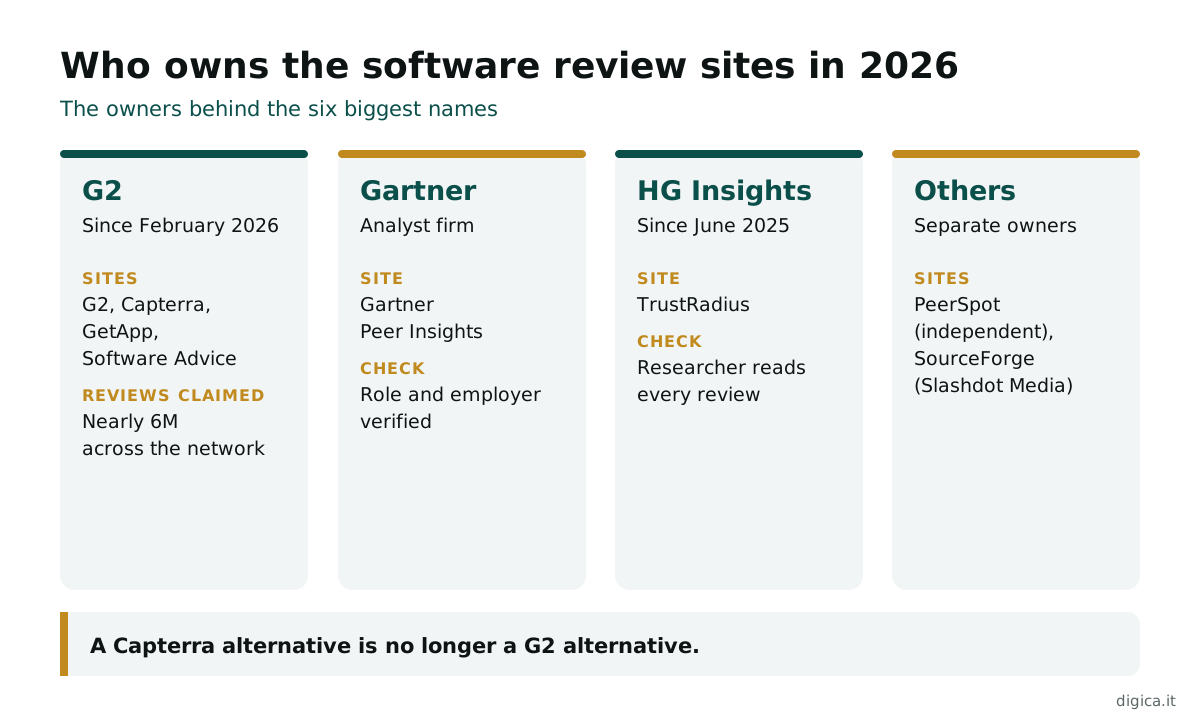
The short answer: four owners control five of the six biggest software review sites. G2 owns G2, Capterra, GetApp and Software Advice. Gartner owns Peer Insights. HG Insights owns TrustRadius. Slashdot Media owns SourceForge. PeerSpot is independent.
Ownership matters for two reasons. First, it decides whether a "Capterra alternative" is really an alternative. A vendor that spreads its review program across G2 and Capterra is now working with one company, under one set of commercial terms, even if the two sites keep different guidelines and audiences. G2 says the combined network holds nearly 6 million verified customer reviews and reaches more than 200 million software buyers a year.
Second, ownership shapes how the reviews get used. Gartner Peer Insights sits beside Gartner's analyst research. TrustRadius now belongs to HG Insights, a company that sells technology data to sales and marketing teams, which points to reviews being used as buying signals as well as social proof.
None of this makes any site less trustworthy. It does change the shortlist. If your goal is independent proof in more than one place, a second G2-owned site adds less than it did a year ago.
The scorecard: six software review sites compared
The short answer: G2 and Capterra lead on review volume, TrustRadius publishes the most about rejection, Gartner Peer Insights has the tightest incentive cap, PeerSpot is the enterprise specialist and SourceForge has the broadest catalog with the least published about review checks.
Six software review sites compared on owner, review volume, reviewer checks, incentive rules, main risk and best fit
| Review site | Owner | Volume it publishes | How reviewers are checked | Incentive rule | Main risk | Best for |
|---|---|---|---|---|---|---|
| G2 | G2 | 3M+ verified reviews; 180,000+ products | LinkedIn, business or personal email; two-stage moderation | Capped at $100 per reviewer across campaigns, labeled | Crowded categories reward review volume | Mid-market SaaS with active review programs |
| Capterra | G2 (since Feb 2026) | 2.5M+ verified reviews | Human moderators, identity check, plagiarism and generative AI detection | Nominal, offered equally, labeled | Same owner as G2 | SMB software sold self-serve |
| Gartner Peer Insights | Gartner | Not confirmed for this guide | Profile with email, role and employer, confirmed on Gartner or LinkedIn | Gifts of $25 or less; asked since 2016 | Smaller volume per product | Enterprise vendors in Gartner-covered markets |
| TrustRadius | HG Insights (since June 2025) | 12M+ annual B2B tech evaluators | LinkedIn or work email; a researcher reads every review | Incentives tied to responses rejected | Less self-serve traffic | Higher-priced B2B software |
| PeerSpot | Independent | Not published | LinkedIn or company email; interviews verified by LinkedIn | Under 10% of reviews via interviews, disclosed | Enterprise IT only | Enterprise IT and security vendors |
| SourceForge | Slashdot Media | 126,600+ software titles; 20M+ visitors a month | No public guidelines found | No public policy found | Hardest to judge on trust | Broad discovery and open source |
A procurement lead can read the trade-off straight from the table. Volume sits with the G2 group. The most published detail on how reviews are checked sits with TrustRadius and Gartner. The rest of this guide takes each alternative head to head against the benchmark it most often replaces.
G2 and Capterra: the benchmarks, now one company
G2 and Capterra are still the two largest software review sites, and since February 2026 they share an owner. Comparing them is now about audience and guidelines, not about choosing a rival company.
G2, founded in 2012 and based in Chicago, says it has more than 3 million verified user reviews and lists more than 180,000 products and services. It says more than 100 million people use it each year. Reviewers sign in with a LinkedIn account, a business email address or a personal email address, answer use-case questions and can verify with a screenshot that G2 never makes public. Reviews must describe use within the past two years. G2 says every review passes an automatic filter and a manual check by its moderation team before it is published, and reviewers with a business tie to the vendor are labeled. Incentives are capped at $100 per reviewer across all campaigns, and incentivized reviews carry a label.
Selling SaaS through review sites and directories?
In 30 minutes we look at where your buyers read reviews before they shortlist you, and which of those pages send them to a competitor.
Capterra, founded in 1999 and based in Arlington, Virginia, spent a decade inside Gartner before the sale to G2. Its community guidelines, updated in May 2026, say it has carefully verified more than 2.5 million reviews. Human moderators check that reviewers are real people and that reviews are authentic, using software to analyze text quality and to detect plagiarism and generative AI. Reviewers must be individuals whose identity Capterra can verify. Incentives must be nominal and offered equally regardless of rating, and a Reviewer Source icon shows when one was given.
The verdict. Both sites are rigorous about identity and incentive disclosure. Capterra's audience leans toward small businesses buying self-serve; G2's toward mid-market teams comparing in crowded categories. For a vendor, the choice between them is now an audience choice inside one company.
Gartner Peer Insights against G2
The short answer: Peer Insights trades volume for a tighter check on who the reviewer is, and it carries the Gartner name into enterprise buying committees.
Gartner launched Peer Insights in 2015. Its FAQ describes a multi-step verification process: reviewers complete a profile with their email, job role, title and organization, and must have a confirmed profile on Gartner or on a credible external site such as LinkedIn that verifies their identity, employer and role. People who work for a company with a direct stake in the category are excluded.
The incentive rules are the strictest published by any site on this list. Gartner defines nominal gifts as $25 or less, has asked every reviewer since December 2016 whether they were offered an incentive, caps an individual at ten gift cards in a calendar year, and pays only for reviews that are published. G2's cap is $100 per reviewer.
Against G2, Peer Insights usually has fewer reviews per product. For a vendor whose buyers already read Gartner research, that matters less than it seems. An enterprise buyer weighing three vendors reads ten detailed, role-verified reviews more carefully than 400 short ones.
The verdict. For enterprise software in a market Gartner covers, Peer Insights is the alternative to add first. It will not replace G2's volume, and it is not meant to.
TrustRadius against G2
The short answer: TrustRadius publishes more about how it rejects reviews than any other site here, and it now sits inside a B2B data company.
TrustRadius was founded in Austin, Texas, in 2012 and was bought by HG Insights in June 2025. HG Insights described an audience of more than 12 million annual B2B technology evaluators at the time of the deal. Every reviewer authenticates through LinkedIn or a work email address, and a researcher reads each review and checks that the reviewer has recent experience with the product before it is published.
The figure that sets it apart is its rejection rate. TrustRadius says it rejects about 3% of reviews, either because it believes they are fraudulent or because they miss its quality standards. None of the other sites in this guide publishes a comparable number. It also refuses to publish reviews driven by vendors offering incentives tied to particular responses, and weights its trScore to correct for vendor-sourced reviews.
That level of disclosure matches a wider regulatory push. In the UK, the Competition and Markets Authority's fake reviews guidance, published in April 2025, sets out what businesses and review platforms must do under the new consumer protection law. A site that already documents its checks is better placed than one that does not.
Are buyers finding your reviews, or a competitor's?
A growth audit maps how software buyers search for your category, on Google and in AI answers, and which review and comparison pages they land on first.
The verdict. For B2B software with longer sales cycles and higher contract values, TrustRadius is the strongest alternative on published trust. Ask how HG Insights uses review data in its buyer-intent products before you plan around it. A smaller set of researcher-checked reviews tends to carry more weight with a buying committee than a large set of quick ratings, so judge TrustRadius on the deals it influences, not on review count.
PeerSpot against Capterra
The short answer: PeerSpot is a specialist for enterprise technology, the opposite end of the market from Capterra's small-business audience.
PeerSpot, based in New York and formerly known as IT Central Station, focuses on enterprise IT, security and infrastructure. New users must register with a LinkedIn profile or a company email address. For reviews collected by interview, PeerSpot validates the reviewer's identity using LinkedIn and other web sources.
Its disclosure on vendor-sponsored reviews is specific. PeerSpot interviews customers on behalf of vendors and writes the interviews up as reviews. It says fewer than 10% of its reviews are collected this way, each carries a disclosure, and those reviewers may have been offered a gift card. That is more transparent than a blanket "incentives may apply".
Against Capterra, PeerSpot has far less breadth and does not publish a total review count. It wins on depth for the buyers it serves: a network security team evaluating three vendors wants long reviews from peers with similar environments, not star ratings from small businesses.
The verdict. For enterprise IT and security vendors, PeerSpot is the alternative to Capterra worth the effort. For anything sold to small businesses, Capterra remains the better place to collect reviews.
SourceForge against Capterra
The short answer: SourceForge has one of the largest catalogs and audiences of any software directory, and the least published about how it checks reviews.
SourceForge, founded in 1999 and based in San Diego, is owned by Slashdot Media. Its business software directory lists more than 126,600 software titles, and it says it has more than 20 million visitors a month. Many of those visitors come for open-source downloads, which gives business listings a large, technical audience.
We could not find public review guidelines, a verification method or an incentive policy for SourceForge's business software reviews. That does not mean the reviews are unreliable. It means a buyer or a vendor cannot check, and on a trust lens that is the weak point.
The verdict. For reach and discovery, especially for developer tools and open-source products, SourceForge is worth a listing. For reviews that a cautious buyer will rely on, pair it with a site that publishes its checks.
How each software review site checks a reviewer
Trust on a software review site comes down to two questions: who is this reviewer, and were they paid? The diagram below sets five of the sites against both. PeerSpot matches TrustRadius on identity, and discloses its interview-based reviews.
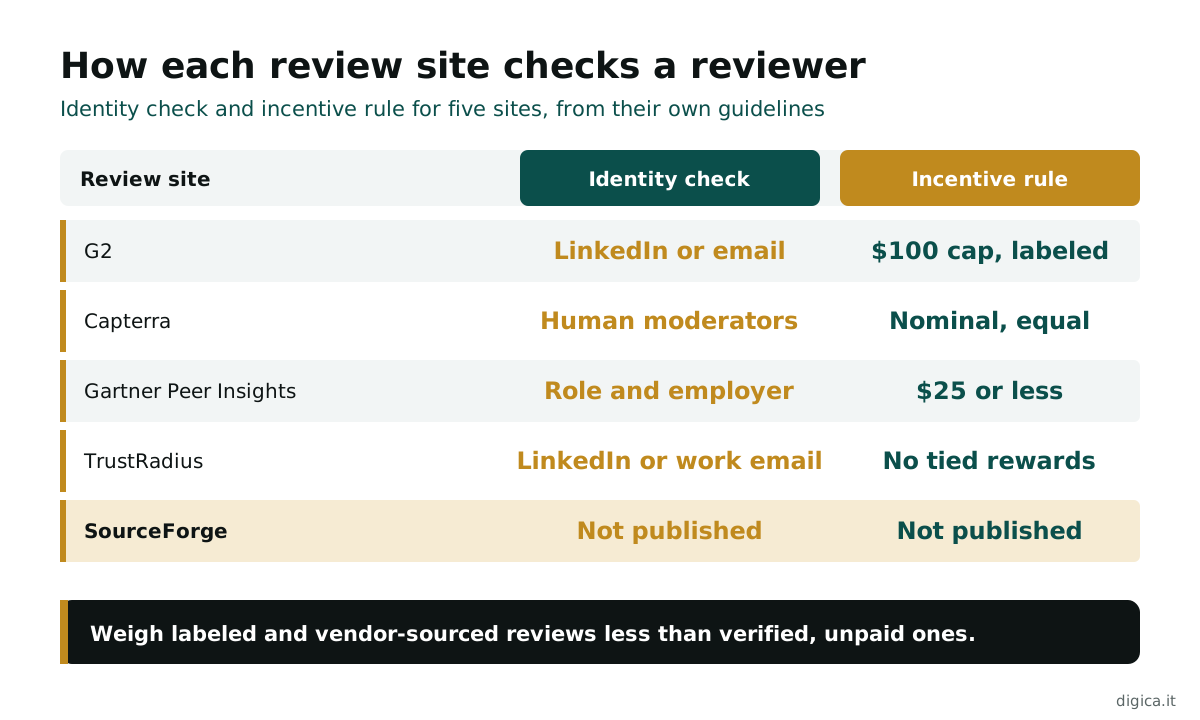
The pattern is clear. Every site except SourceForge publishes an identity check, and most accept LinkedIn or a work email. The differences are in what happens after sign-in: G2 runs two moderation stages, TrustRadius has a researcher read every review, Capterra uses human moderators plus detection software, and Gartner checks the reviewer's role against the category.
Incentive rules vary more. Gartner caps gifts at $25 and G2 at $100 per reviewer, Capterra requires them to be nominal and equal, and TrustRadius and PeerSpot focus on disclosure and on rejecting reviews tied to a particular answer. Every one of these approaches is a response to the same regulatory pressure.
For a buyer, the practical rule is to read the label. A review marked as incentivized or vendor-sourced is not worthless, but it should weigh less than one from a verified current user who was not asked by the vendor.
Three failure scenarios
These are the patterns that recur when vendors choose software review sites on volume alone.
- The second site that was the same company. A SaaS company runs review campaigns on G2 and Capterra to show independent proof in two places. A buyer's procurement team notes that both now belong to G2. The company would have added more credibility by spending part of that budget on Gartner Peer Insights or TrustRadius.
- The incentive that broke the rules. A vendor offers a bigger gift card for five-star reviews through an outside agency. The site removes the reviews and the vendor loses a year of social proof in its category. Offering the same nominal incentive to every customer, whatever they score, would have kept the reviews live.
- The enterprise product on a small-business site. A security platform with six-figure contracts collects hundreds of short reviews on a site whose audience is mainly small businesses. Its enterprise buyers never see them. Fewer, longer reviews on PeerSpot or Peer Insights would have reached the committee that signs.
Each choice looked reasonable on volume. Each failed on trust or audience.
Where to collect reviews first
The short answer: match the site to your buyer and contract size, then add one site with a different owner. These decision points make it specific.
- If you sell self-serve software to small businesses, start with Capterra, then add G2 for the mid-market buyers who compare there.
- If you sell to mid-market teams in a crowded category, prioritize G2, and aim for at least 25 recent reviews before you pay for placement.
- If your average contract is above $25,000 a year, add TrustRadius, where a researcher reads every review.
- If you sell into a market Gartner covers, build a base of role-verified reviews on Peer Insights.
- If you sell enterprise IT, networking or security, add PeerSpot for long-form peer reviews.
- If your product is a developer tool or open source, keep a SourceForge listing for discovery, and send reviewers to a site that publishes its checks.
Growing a SaaS or software B2B marketplace?
We help SaaS and software marketplaces earn the reviews, rankings and citations that bring buyers to the right listing first.
The number to take into your next pipeline review is how often a buyer changes their mind after reading. In G2's April 2026 survey of 1,076 B2B software buyers, 69% chose a different vendor than they first planned, and buyers named citations from a software review site as their top trust signal in AI answers. A vendor with no verified reviews on the sites its buyers trust is out of that decision before a sales call. The biggest cost of doing nothing is losing deals you never knew were in play.
FAQ
What is the best software review site? G2 and Capterra have the most reviews, with more than 3 million and more than 2.5 million verified reviews respectively. For enterprise software, Gartner Peer Insights, TrustRadius and PeerSpot publish stricter checks on who the reviewer is.
Is Capterra owned by G2? Yes. G2 agreed to buy Capterra, GetApp and Software Advice from Gartner in January 2026, and the sale closed on February 5, 2026. Gartner still owns Gartner Peer Insights.
What is a good G2 alternative? Gartner Peer Insights for enterprise buyers in Gartner-covered markets, TrustRadius for higher-priced B2B software and PeerSpot for enterprise IT and security. Capterra, GetApp and Software Advice are now owned by G2.
How do software review sites verify reviews? Most require reviewers to sign in with LinkedIn or a work email, then moderate each review before it is published. TrustRadius says a researcher reads every review and rejects about 3% of submissions.
Can software vendors pay for reviews? Vendors can offer small incentives on most sites if they are offered regardless of the rating and are disclosed. The FTC's rule bans incentives conditioned on a positive or negative review.
Who owns TrustRadius? HG Insights bought TrustRadius in June 2025. TrustRadius was founded in Austin, Texas, in 2012.
Related Articles
- SaaS and software marketplace growth
- Best SaaS directories to list your product in 2026
- Best software marketplaces for SaaS vendors in 2026
- Best startup directories and Product Hunt alternatives
- Being the source AI answer engines cite: a GEO playbook
This article is part of our B2B marketplace growth series. Browse more on the Digica blog.