The best telecom marketplaces for businesses, grouped by what their coverage really counts
A telecom marketplace promises a simple thing: many providers, one place to buy. The numbers on these platforms look huge, from 1,200 carriers to 2.7 billion locations. Yet none of them answers the question that decides a contract, which is how many providers can actually serve your address today. Pick on the headline number and you can sign for a network that reaches your cloud but not your warehouse, or two "diverse" circuits that fail together.
The market underneath keeps getting bigger and harder to read. TeleGeography puts total international internet bandwidth at 2,259 terabits per second (TeleGeography). More capacity means more sellers, more resellers and more platforms offering to sort them for you, each counting coverage in its own unit.
This guide groups seven of the most important telecom marketplaces by type, on one lens: provider coverage, and what each number really counts. It covers interconnection exchanges, carrier quoting platforms, wholesale voice exchanges and network API aggregators. It is written for IT, network and procurement leads buying connectivity, and for founders growing a telecom B2B marketplace. Figures are each company's own claims, checked on November 5, 2026.
Quick Navigation
- What counts as a telecom marketplace
- Seven telecom marketplaces side by side
- Interconnection exchanges: Megaport and Console Connect
- Quoting and procurement: Connectbase, Lightyear and UPSTACK
- Wholesale voice and messaging: TelecomsXChange
- Network APIs: Aduna
- Why provider coverage numbers do not compare
- Three failure scenarios
- Choosing a telecom marketplace: a decision framework
- What better coverage is worth
- FAQ
- Related Articles
What counts as a telecom marketplace
A telecom marketplace is a B2B platform where buyers find, compare or order connectivity from more than one provider. Four quite different businesses use the label, and they serve different buyers.
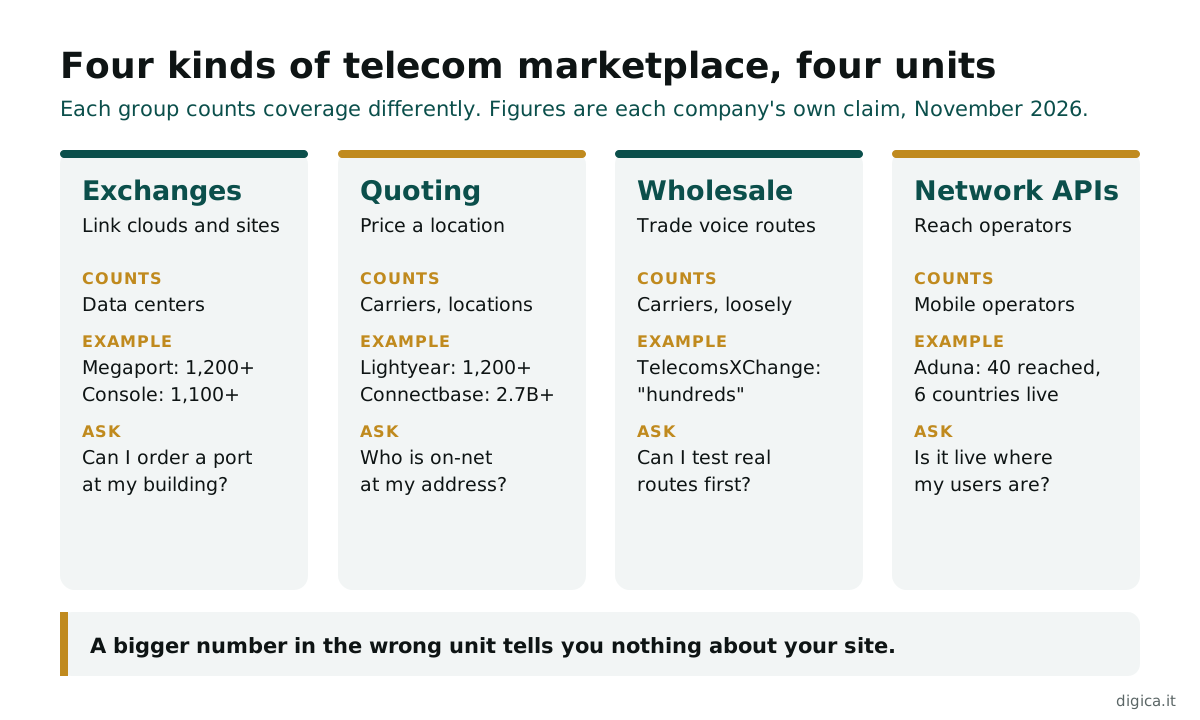
Interconnection exchanges sell on-demand links between data centers and clouds. Quoting and procurement platforms collect prices from many carriers for a given location. Wholesale exchanges let carriers and voice providers trade routes and numbers. Network API aggregators give developers one route to the network functions of several mobile operators.
We chose seven platforms that are live, that report their scale in 2025 or 2026 or on current pages, and that lead one of those four jobs. We left out channel distributors that serve sales advisers rather than end buyers, and hardware dealers. We also left out consumer comparison sites, because this guide is about business connectivity.
Our view: the label matters less than the unit. Before you compare two platforms, find out what each is counting. A carrier that can serve your building and a carrier that merely has an account on a platform both count as one, and only the first is useful to you.
Seven telecom marketplaces side by side
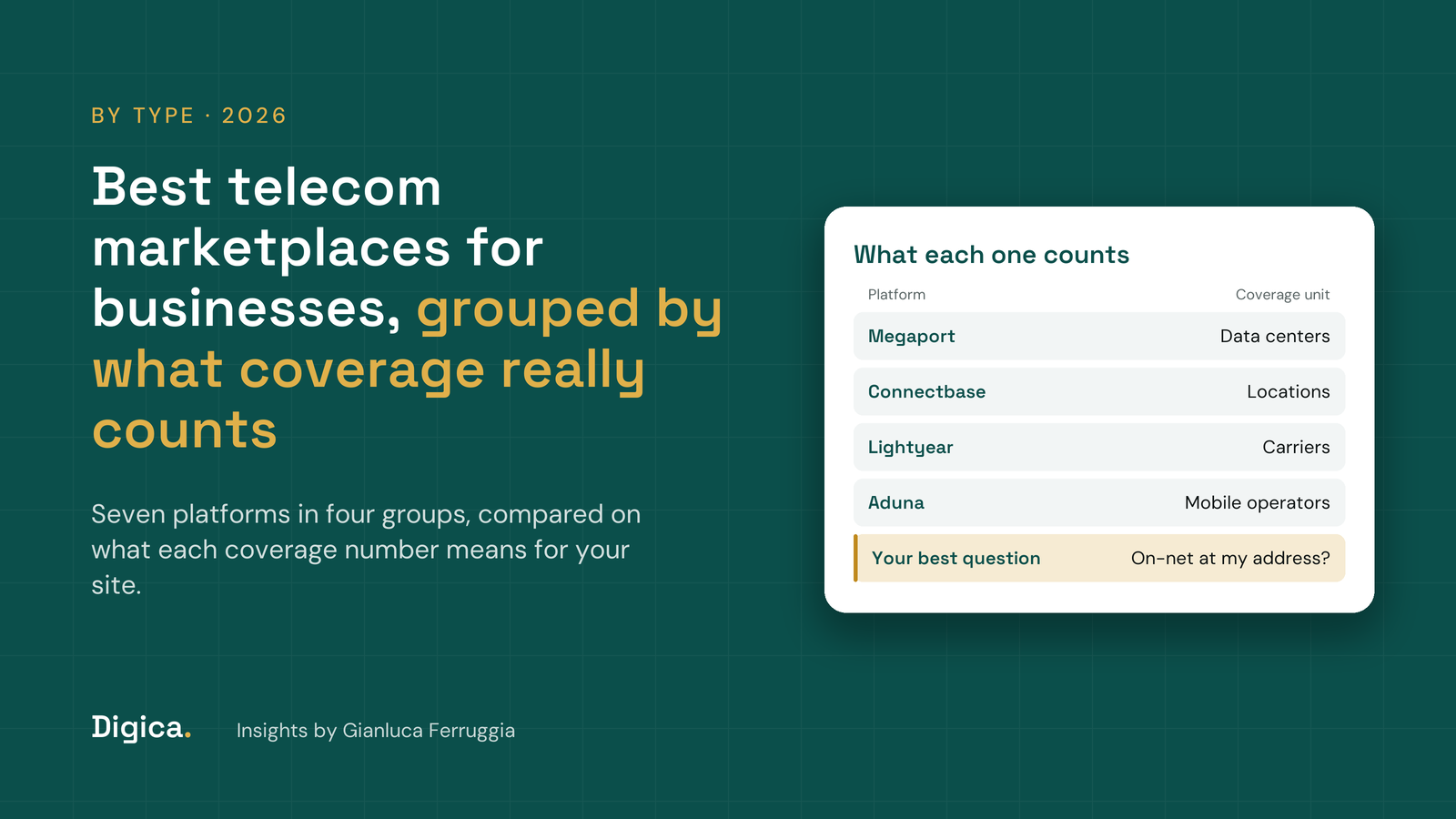
Megaport and Console Connect count data centers, Connectbase counts locations, Lightyear counts carriers, UPSTACK does not publish a count, TelecomsXChange says "hundreds", and Aduna counts mobile operators. Read the "What the number counts" column before the number itself.
Seven telecom marketplaces compared on coverage claimed, what that number counts, how you pay, main risk and best fit
| Platform | Group | Coverage claimed | What the number counts | How you pay | Main risk | Best for |
|---|---|---|---|---|---|---|
| Megaport | Interconnection | 1,200+ data centers, 410+ providers | Enabled facilities | Buyer pays for services | Offices outside enabled sites | Linking clouds and data centers |
| Console Connect | Interconnection | 1,100+ data centers | Locations, ports in 10 markets | Buyer pays for services | Port markets far fewer than sites | Asia-heavy cloud footprints |
| Connectbase | Quoting | 400+ buyers and sellers, 2.7B+ locations | Locations profiled | Pricing not published | Built for carrier teams | Carrier and wholesale teams |
| Lightyear | Quoting | 1,200+ carriers | Carriers in its data | Vendor commission on purchases | Commission built into price | Multi-site RFPs |
| UPSTACK | Advisory | "Hundreds of vendors" | No exact count | Vendor pays the adviser | Vendor list not published | Sourcing run by people |
| TelecomsXChange | Wholesale | "Hundreds" of carriers | Carriers for voice routes | $599.99 a year plus seller rates | Not for typical enterprise IT | Voice providers buying routes |
| Aduna | Network APIs | 40 mobile operators | Operators, live in 6 countries | Through partner platforms | Reach and live countries differ | Fraud and identity teams |
Every figure is the company's own claim. The units differ, so the table is not a ranking by size. A smaller number in the right unit can be worth far more than a larger number in the wrong one.
Interconnection exchanges: Megaport and Console Connect
Interconnection exchanges are the right starting point when your problem is linking clouds and data centers, not connecting offices. Both of these platforms let you order virtual connections between enabled sites instead of buying a fixed circuit for each link.
Megaport
Megaport, founded in Brisbane in 2013, is the larger of the two by the numbers it publishes: more than 1,200 enabled data centers, more than 410 service providers and more than 4,000 customers in more than 31 countries. Its network reaches the major clouds, including Azure, AWS, Google Cloud, Oracle, IBM and Alibaba. Recent deals widened the product. It bought Latitude.sh for dedicated compute and entered India by acquiring Extreme IX.
The limit is in the unit. Megaport counts data centers, so an office or branch outside an enabled facility still needs a separate last-mile link. For a business whose traffic runs mainly between clouds, that hardly matters. For a retailer with 300 stores, it is most of the project.
Console Connect
Console Connect is the on-demand platform of PCCW Global, based in Hong Kong. It lists more than 1,100 data center locations and thousands of interconnected businesses. Its distinguishing feature is its list of clouds, which adds Huawei Cloud and Tencent Cloud to the US names, plus Alibaba Cloud. That makes it a natural fit for a business with a large footprint in Asia.
Read one number carefully: Console Connect says enterprise access ports, the kind that reach your own buildings, are available in 10 markets worldwide. That is a long way from 1,100 data centers. Ask exactly where you can order a port before you plan around the bigger figure.
Running a telecom or connectivity B2B marketplace?
In 30 minutes we look at how network and procurement teams find platforms like yours, on Google and in AI answers, and where they drop off before they ask for a quote.
Head to head, Megaport wins on published provider count and breadth of facilities, and Console Connect wins on Asian cloud options. Both are for teams that know exactly which sites they need to link and can order against them. Neither replaces a local access purchase, so budget for last-mile circuits separately and check that a real provider can deliver them at each building.
Quoting and procurement: Connectbase, Lightyear and UPSTACK
These three help buyers and sellers find a price for a specific location, and they differ most in who they are built for and who pays them. Connectbase serves the carrier side, Lightyear serves enterprise buyers with software, and UPSTACK serves buyers with advisers.
Connectbase
Connectbase runs The Connected World, a platform where network buyers and sellers check whether a location can be served and at what price. It says more than 400 buyers and sellers use it as their system of record, that more than 2.7 billion locations are profiled, and that more than $10 billion of connectivity spend takes place on it. It passed 400 million quotes in late 2025 and acquired Cloud Age the same year.
This is the most serious location-level data of the seven, but it is built for carriers and wholesale teams. A mid-size IT department is not the natural user. Founders should study it anyway, because it shows what a telecom B2B marketplace looks like when the core asset is data rather than a catalog.
Lightyear
Lightyear, based in New York, is the procurement platform most clearly built for enterprise buyers. It says its data comes from more than 2 million quotes across more than 1,200 carriers, covering internet, wide area networks, voice and colocation. In August 2026 it launched Dispatch, with software agents for carrier quoting and installation tracking.
Its FAQ is honest about the model: in most cases the vendor pays Lightyear a commission on what you buy, and that commission is built into the price. Many channels in telecom work this way, and a carrier's own sales rep earns commission too. The practical step is to ask what each carrier on your shortlist pays. A carrier count also says nothing about how many of those carriers are on-net at your site.
UPSTACK
UPSTACK, based in New York, is closer to an advisory firm than an open marketplace, and we include it because many buyers use it instead of one. It says it has deep knowledge across thousands of solutions and hundreds of vendors, and that it manages more than $1 billion of annual technology spend for more than 1,000 customers. It publishes no vendor list or exact count.
Its FAQ states that it is paid directly by the vendor, not by you. As with Lightyear, that keeps the service free at the point of use and adds a question you should ask. The difference is that you get people running the sourcing rather than software, which suits a firm without a network team.
Wholesale voice and messaging: TelecomsXChange
TelecomsXChange is the option here for telecom businesses buying from telecom businesses. Based in Burlington, Ontario, it runs a wholesale exchange for voice, messaging, numbers and eSIM, and also licenses its platform to operators that want to run their own exchange.
Coverage is stated loosely: hundreds of interconnected carriers for voice termination, and an eSIM exchange covering more than 200 countries. There is no exact carrier total or country breakdown for voice, so you cannot test the claim from outside. What it does publish is its pricing model. Membership is listed at $599.99 a year as a limited-time price, normally $999. On top of that you pay each seller's published rate, and the exchange says it adds no markup or commission.
Do network buyers find your platform first?
A growth audit maps how IT and procurement teams search for connectivity and platforms like yours, on Google and in AI answers, and which location and provider pages they never reach.
That is unusually clear for this sector, and it is the opposite of the vendor-paid model above. It also tells you who this is for: voice providers, mobile virtual network operators and carriers with the skills to manage routes and test quality themselves. A typical enterprise IT team buying phone lines should look elsewhere, because nobody on an exchange like this will manage the service for it.
Network APIs: Aduna
Aduna gives developers one route to network functions across many mobile operators, such as checking a phone number or spotting a recent SIM swap. It is a joint venture between Ericsson and 12 operators, including AT&T, T-Mobile, Verizon, Deutsche Telekom, Orange, Vodafone and Telstra, and the deal closed in July 2025.
In March 2026 it reported total coverage of 40 mobile operators and 15 partners in digital identity, fraud prevention and communications. Services were live in six countries at that date: the US, Germany, Spain, Canada, France and the Netherlands, with seven more named as coming. Reach and live service are different numbers, and a buyer should plan around the second.
Buyers usually reach Aduna through developer platforms such as Google Cloud, Infobip, Sinch and Vonage rather than directly. This makes it a different purchase from the rest of this guide. There are no circuits or carriers to compare, and the question is whether the signal you need is live in the countries where your customers are. Pricing is not stated on its site, so expect to find it through the partner you buy from.
Why provider coverage numbers do not compare
Coverage figures on telecom marketplaces do not compare because each one counts something different, and the unit decides what the number can tell you. A data center count, a location count and a carrier count can all be true and still say nothing about your address.
Three gaps are worth knowing, all visible in the companies' own figures. The first is sites against ordering points, as with Console Connect's 1,100 data centers and access ports in 10 markets. The second is reach against live service, as with Aduna's 40 operators and six live countries. The third is carriers against on-net carriers, because a quoting platform's list includes every carrier in its data, and most will not have a network in your building.
Diversity is a further trap. TeleGeography, which collected nearly 84,000 local access quotes across 350 cities for the second half of 2025, warns that loops from different providers can share the same underlying incumbent fiber duct, so one physical cut can take out both (TeleGeography). Two names on a quote do not make two paths. The same research says many teams still buy from fragmented price data, long email threads and static spreadsheets, which is the opening these platforms are trying to fill.
Have you asked a platform how many providers can serve one specific address, on-net, today? It is the one coverage question that a telecom marketplace cannot answer with a headline. Try it with your hardest site, not your easiest one.
Three failure scenarios
These are patterns, not reports about any named platform. We found no recent public case of a buyer harmed by a telecom marketplace itself. The figures are illustrative.
- The cloud fabric that stopped at the data center. A retailer chooses an interconnection exchange because its site count looks strong, then finds that its 200 stores all need separate local access. The project grows from a few weeks of virtual connections into months of circuit orders. Mapping offices against enabled sites first would have shown this on day one.
- The two carriers in one duct. A logistics firm buys primary and backup circuits from two providers on a quoting platform. A single road dig cuts the shared duct and takes down both, stopping its busiest warehouse for a shift. Asking for route maps before signing would have cost nothing. A diverse route might have cost 20% more on that site.
- The cheapest quote from the wrong incentive. A finance team accepts the shortlist from a vendor-paid adviser without asking how commissions differ, and signs a 36-month term with the carrier that pays most. Renewal pricing later shows it overpaid. A written commission disclosure at the start would have shaped the comparison.
Each buyer used a real platform for a real reason. None of them asked what the coverage number meant at their own site.
Choosing a telecom marketplace: a decision framework
Match the platform to the job first and to the size of the number second. Most businesses need only one group, and many of the seven are not built for them at all.
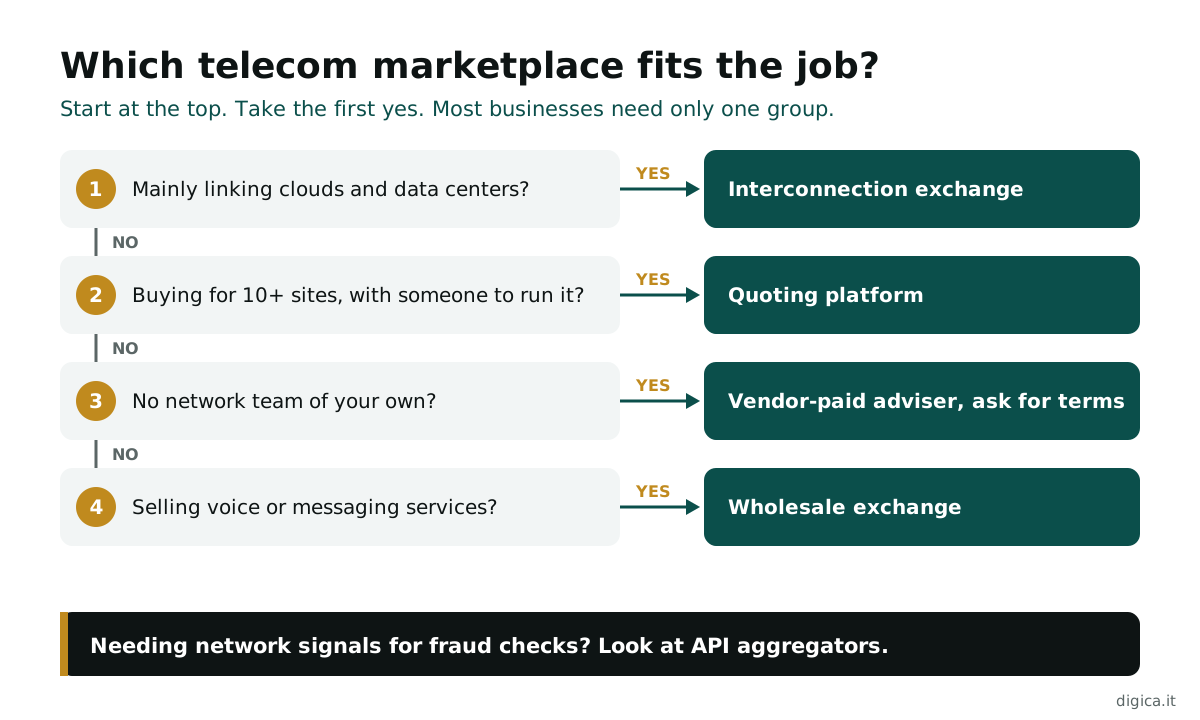
- If most of your traffic runs between clouds and data centers, shortlist Megaport first, and add Console Connect if more than a quarter of that footprint is in Asia.
- If you buy for more than 10 sites and have someone to run an RFP, use a quoting platform such as Lightyear, and ask for the commission by vendor in writing.
- If you have no network team, use an adviser such as UPSTACK, and ask for the list of vendors it considered for your project.
- If you sell or wholesale connectivity, look at Connectbase for location-level quoting and price data.
- If you run a voice or messaging business, use TelecomsXChange, and test real routes before you commit volume.
- If fraud or identity is the problem, check that Aduna's signals are live in your countries, then buy through your existing developer platform.
- For any site you cannot afford to lose, require route maps from both providers before you treat them as diverse.
Our guide to procurement marketplaces for B2B buyers covers the purchasing controls around these choices. If you buy cloud and software as well, our guides to the best software marketplaces and what a cloud marketplace is explain how committed spend works on those platforms. Keep a one-page record of which platform covers which sites and who gets paid when you buy.
What better coverage is worth
Better coverage is worth the outages, delays and overpayment it prevents, and most of that is decided at the site level. A platform that can show on-net options for your hardest address saves more than one with the longest list.
Flexibility has a measurable price. TeleGeography's survey of wide area network managers found that 17% had bought and used network as a service in 2025, and another 25% were actively researching it. It also found that some providers charge a premium of 10% to 35% for short-term use compared with a 12-month contract, while others charge none (TeleGeography). So the same flexibility can be free on one platform and cost a third more on another.
Run a typical case. Suppose a business spends $100,000 a year on on-demand network services. A 10% to 35% premium for short-term use is $10,000 to $35,000 a year, which is what you save by choosing the right provider or committing where your traffic is stable. A shared-duct outage at a busy site could cost more than that in a single shift. The figures are illustrative, but the logic holds for most multi-site buyers.
Growing a telecom B2B marketplace?
We help telecom and connectivity B2B marketplaces win the providers that make them credible, and reach the network and procurement teams searching for coverage.
The number to take into your next network review is how many providers are on-net at your five most important sites, with route maps to prove it. If you cannot answer that today, start there, because every other coverage figure depends on it. The biggest cost of doing nothing is a backup circuit that fails at the same moment as the primary.
FAQ
What is a telecom marketplace? A telecom marketplace is a B2B platform where businesses or carriers find, compare or order connectivity from more than one provider. The label covers interconnection exchanges, carrier quoting platforms, wholesale voice exchanges and network API aggregators, and each serves a different buyer.
What is the best telecom marketplace for an enterprise? It depends on the job. Lightyear suits multi-site buyers running competitive quotes across more than 1,200 carriers. Megaport suits teams linking clouds and data centers. UPSTACK suits firms that want advisers to run the sourcing.
How do telecom marketplaces make money? It varies. Lightyear and UPSTACK say vendors usually pay them, so the fee sits inside the price you pay. TelecomsXChange charges buyers a membership and says it adds no markup. Interconnection exchanges charge the buyer for the services used.
How do I check real provider coverage at my address? Ask which providers are on-net at that exact address today, not how many carriers the platform lists. Test your hardest site, ask for install lead times in writing and request route maps for any circuits you plan to treat as diverse.
What is network as a service? Network as a service, or NaaS, lets a business order virtual connections on demand instead of buying fixed circuits. TeleGeography found that 17% of wide area network managers surveyed had bought and used it in 2025, and 25% were researching it.
What is a network API marketplace? It gives developers one route to mobile network functions, such as number verification or SIM swap checks, across several operators. Aduna, backed by Ericsson and 12 operators, reports coverage of 40 operators and is sold through platforms such as Google Cloud, Infobip, Sinch and Vonage.
Related Articles
- Telecom marketplace growth
- Best procurement marketplaces for B2B buyers in 2026
- Best API marketplaces and directories
- Best software marketplaces
- What is a cloud marketplace?
Where this connects
This article is part of our B2B marketplace growth series. Browse more on the Digica blog.