What Catalant, MarketerHire and Business Talent Group Teach Anyone Building an Expert Marketplace
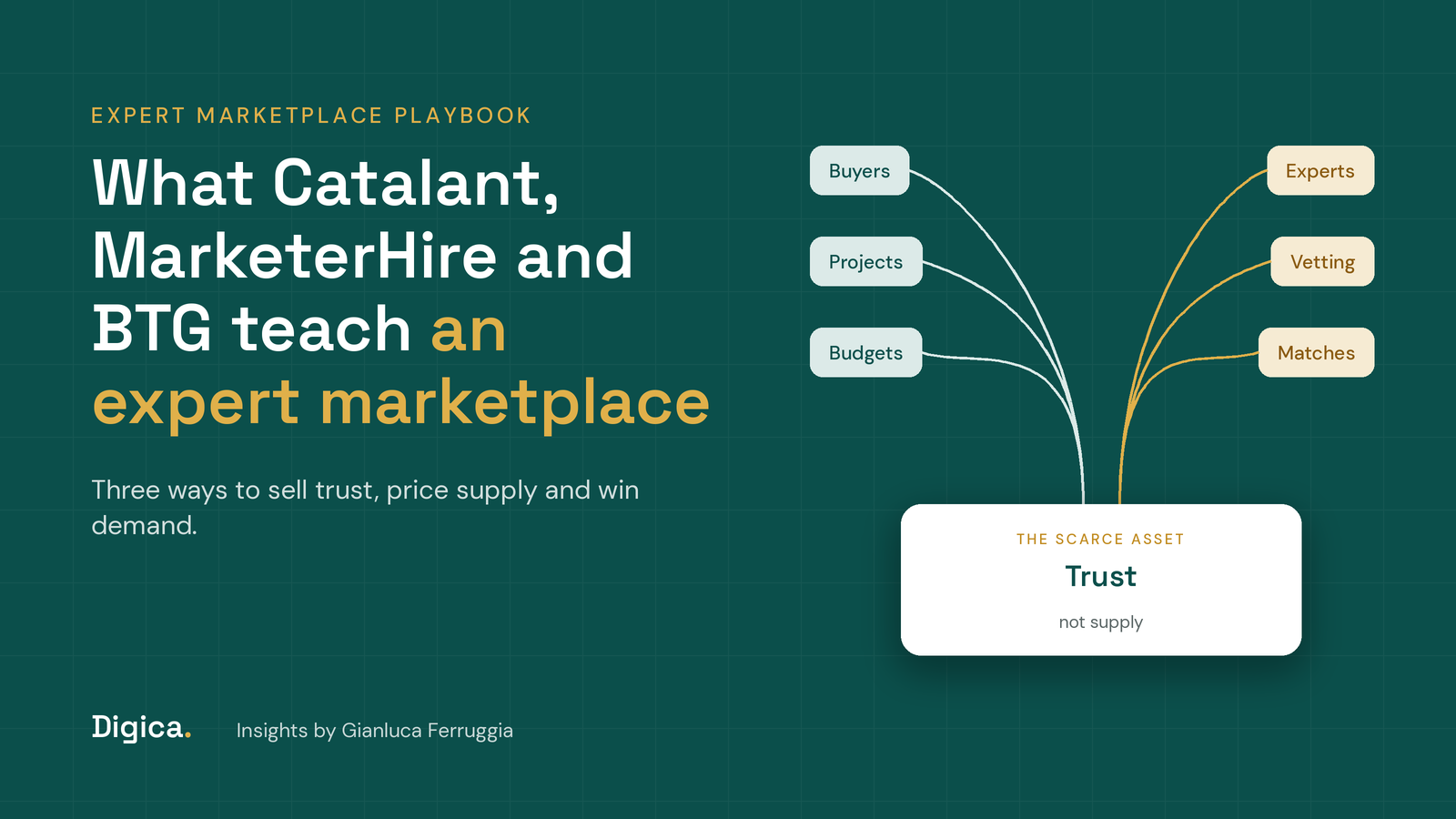
Most founders building an expert marketplace think their hardest problem is finding enough experts. It rarely is. Thousands of consultants, marketers and interim executives will list themselves for free. The hard problem is getting a buyer with a $30,000 project to trust a stranger chosen by software, and every successful expert marketplace is, underneath, a machine for producing that trust.
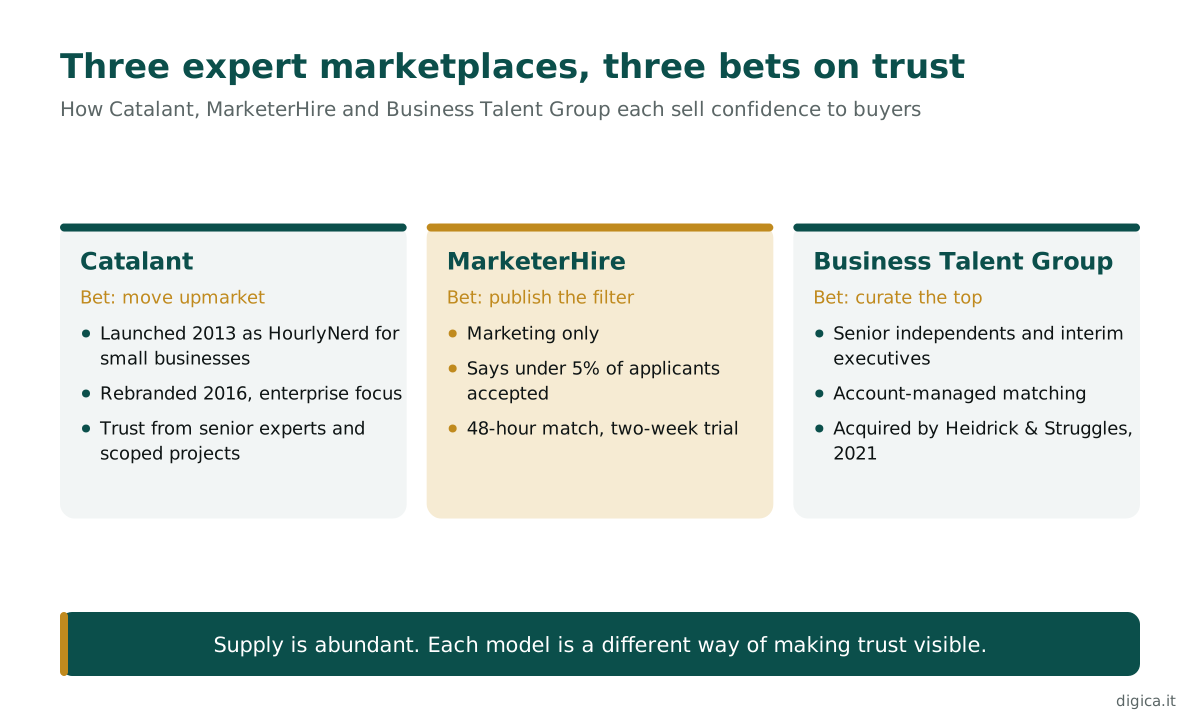
Three companies show three different ways to build that machine. Catalant began in 2013 as HourlyNerd and moved upmarket to enterprise clients. MarketerHire narrowed to one function, marketing, and publishes how few applicants it accepts. Business Talent Group (BTG) built a high-touch model for senior independent talent and was acquired by Heidrick & Struggles in 2021. None of them won by having the most supply.
This piece is not a review of the three platforms. It is a set of operator lessons for anyone building or growing an expert or professional services marketplace: how each one sells trust, prices supply and wins demand, what to copy, and where the models break. If you are choosing a platform to hire from, our ranking of the best consulting marketplaces on vetting is the better read.
Quick Navigation
- Why expert marketplaces sell trust, not supply
- Catalant: the buyer you start with may not be the buyer who pays
- MarketerHire: publish the filter
- Business Talent Group: curation as an exit strategy
- The three models compared
- Demand is a brand problem: who owns your name in search
- Three failure scenarios
- Where to start: a decision framework
- What a better hire rate is worth on the same requests
- FAQ
- Related Articles
Why expert marketplaces sell trust, not supply
An expert marketplace sells trust because the buyer cannot judge the expert's quality before the work starts, and the cost of a bad hire is far higher than the fee. Supply is abundant; confidence is scarce. Every design choice that works in this category is a way of transferring confidence from the platform to the expert.
This is not new. A decade ago, Clayton Christensen and co-authors argued that consulting was approaching disruption because the opacity that protected firms was eroding, with "alternative staffing models" and better-informed clients among the forces. Expert marketplaces are one of those alternative models. What they inherited from consulting firms is the core problem: a buyer paying for judgment they cannot inspect in advance.
That changes what growth means. In a goods marketplace, more listings usually mean more selection and more conversion. In an expert marketplace, more unvetted profiles often mean lower conversion, because each new profile adds noise to the buyer's decision. The marketplaces we audit in this space typically see request-to-hire rates between 15% and 35%. The gap between the two ends is almost never supply volume. It is how quickly and credibly the platform narrows the choice.
So the useful question for a founder is not "how do we get more experts?" It is "how does a buyer know, within two days, that the three people we show them are right?" The three companies below answer it differently.
Catalant: the buyer you start with may not be the buyer who pays
Catalant's lesson is that the market you launch into can be the wrong one, and the signal is where repeat, high-value demand actually comes from. The company launched in 2013 as HourlyNerd, connecting small and midsize businesses with MBA students and recent graduates for consulting projects. In 2016 it rebranded as Catalant and shifted its focus to enterprise clients.
The pivot changed almost everything: the buyer, the expert profile, the project size and the sales motion. Small businesses wanted cheap, quick help. Enterprises wanted senior, specialized consultants and a way to bring outside expertise in without a full consulting firm engagement. The supply that suited one did not suit the other.
What to copy:
- Read demand by value, not volume. If 20% of buyers produce 70% of engagement value, that 20% is your market, whatever the launch deck said.
- Let supply follow the buyer. Moving upmarket means recruiting different experts, not just raising prices on the same ones.
- Change the name if the old one fights the new buyer. A playful brand built for students and small businesses can work against an enterprise procurement team.
Where it breaks: moving upmarket lengthens sales cycles and adds procurement, security and legal reviews. A marketplace that pivots to enterprise without a sales team usually stalls between the two markets.
Is your best demand coming from the buyer you planned for?
We map where your highest-value requests really come from in a 30-minute call.
The broader point for any expert marketplace: audit your last 100 engagements by size and repeat rate every quarter. The pattern usually tells you where the business is going long before the founders admit it. Sort them by engagement value and look at the top fifth: which industries, which buyer titles, which expert profiles. If that slice looks nothing like your marketing, your marketing is pointed at the wrong buyer, and every month it stays that way costs you the requests the right buyers would have sent.
MarketerHire: publish the filter
MarketerHire's lesson is that vetting only builds trust if buyers can see it. The company matches businesses with freelance and fractional marketers, and it puts its filter on the front of the offer: it says fewer than 5% of applicant marketers are accepted, that matches arrive within 48 hours, and that engagements start with a two-week trial. It also publishes typical pricing, around $7,000 to $10,000 a month for senior fractional marketers, on its own blog.
Each of those claims answers a buyer's fear before the buyer raises it:
- "Will this person be good?" An acceptance rate under 5%.
- "How long will this take?" A match in 48 hours.
- "What if it does not work?" A two-week trial.
- "What will it cost?" A published monthly range.
The narrow scope matters too. By limiting itself to marketing, MarketerHire can vet against one discipline's standards and speak to one buyer, usually a founder or head of marketing. A generalist platform has to explain its vetting for every function at once, which makes the claim weaker.
What to copy: publish your acceptance rate, your time to match and your trial or guarantee terms, and make them the first thing a buyer reads. If the numbers are not good enough to publish, that is the roadmap.
Where it breaks: published claims have to stay true. Third-party reviewers have noted that some of MarketerHire's own pages quote different acceptance rates, under 1% in one place and under 5% in another. Inconsistent trust claims cost more than vague ones, so keep a single source of truth for every number you publish.
Business Talent Group: curation as an exit strategy
Business Talent Group's lesson is that a high-touch expert marketplace can be worth most to an incumbent that wants its supply. BTG built a marketplace for high-end independent talent: consultants, subject-matter experts, project managers and interim executives. In April 2021, Heidrick & Struggles, the executive search and leadership advisory firm, acquired it, with BTG's co-founders Jody Greenstone Miller and Amelia Tyagi continuing to lead it.
The logic is visible from the buyer's side. An executive search firm already serves companies that need senior people. Adding a marketplace of vetted independent talent lets it sell project-based and interim help to the same clients, without building that network from scratch. The marketplace's curated supply was the asset.
What to copy:
- Curate hard at the top of the market. At senior levels, a smaller, better-known network beats a large anonymous one.
- Treat account management as part of the product. High-value buyers expect a person, not a search box.
- Know who would buy you. Search firms, consulting firms and staffing groups all have reasons to want vetted independent supply.
Where it breaks: high-touch models scale with headcount. Each account manager handles a limited number of clients, so revenue per employee rises slowly. That is acceptable if the engagement values are high enough, which is why the model fits the top of the market and rarely the middle.
The three models compared
The three models differ mainly in who they sell to, how visible their vetting is, and how much of the matching a person does. Each choice trades scale against trust.
Three expert marketplace models compared by buyer, vetting signal, published cost, main risk and best fit.
| Aspect | Catalant | MarketerHire | Business Talent Group |
|---|---|---|---|
| Primary buyer | Enterprise teams, after a 2016 pivot from small businesses | Founders and marketing leads | Large companies needing senior or interim talent |
| Supply | Independent consultants and expert teams | Freelance and fractional marketers | High-end independents and interim executives |
| Trust signal | Enterprise positioning and project scoping | Published acceptance rate under 5%, 48-hour match, two-week trial | Senior curation and account management |
| Published cost | Not published | Typically $7,000 to $10,000 a month (company blog) | Not published |
| Main risk | Long enterprise sales cycles | Keeping published claims consistent | Scales with headcount |
| Best for | Copying an upmarket pivot | Copying transparent vetting | Copying curation at the top of the market |
The table is also a pricing lesson. Strategies for two-sided platforms often price one side to grow the other; the HBR article on strategies for two-sided markets remains the standard framing for that pricing choice. In expert marketplaces, the pattern is consistent: experts list for free or near free, and buyers pay a rate that includes the platform's margin. The open choice is whether to show the buyer that rate up front. MarketerHire does; Catalant and BTG quote.
Published pricing shortens the sales cycle and filters out buyers who cannot afford the service. Quoted pricing protects margin on complex projects. Pick based on your average engagement value, not on what a competitor does.
Demand is a brand problem: who owns your name in search
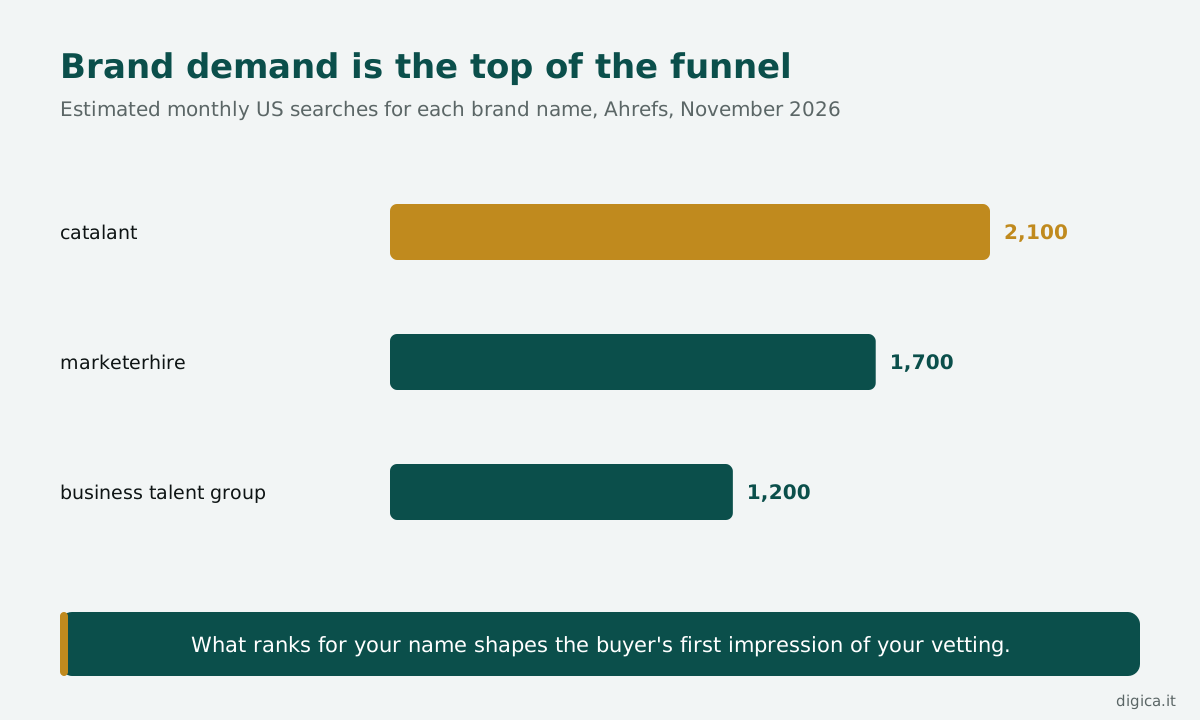
For established expert marketplaces, the largest single source of buyer intent is often their own name. In US search alone, Ahrefs estimates about 2,100 monthly searches for "catalant", 1,700 for "marketerhire" and 1,200 for "business talent group" (November 2026). Those searchers already know the brand. What they read next decides whether they request a match.
Here is the uncomfortable part. Branded searches for expert marketplaces increasingly land on third-party review and "alternatives" pages written by agencies and affiliates, not on the marketplace's own site. The buyer's first impression of your vetting, pricing and fit comes from someone else's summary, often written to send that buyer to a competitor. AI answer engines repeat the same sources when asked "is [brand] any good?" The marketplace did the hard work of building awareness, and a page it does not control collects the trust. For a business whose whole product is trust, that is the worst possible place to lose a buyer, because the doubt is planted before the platform has a chance to answer it.
What to do about it:
- Own the review intent. Publish a clear "how we vet", "what it costs" and "who it is for" page, and make it the best answer to "[brand] reviews" and "[brand] pricing".
- Own the comparison intent. If buyers search "[brand] vs [competitor]", write the honest comparison yourself.
- Check what AI engines say. Ask ChatGPT and Perplexity about your marketplace by name and note which sources they cite. Those are the pages to correct or outrank.
- Earn mentions where the engines look. If an industry publication or association page is cited for your category, a factual mention there does more for branded answers than another page on your own site.
- Answer the objection directly. If the top complaint in reviews is price or response time, address it on your own pages with numbers. Silence lets the third-party page frame it for you.
This is top-of-funnel work, and it compounds. Every branded search that lands on your own trust page instead of a competitor's affiliate article is a buyer who reaches the request form already believing the filter is real.
None of this needs a large budget. A marketplace with 1,000 or more branded searches a month can usually fix its brand results with three or four well-built pages and a handful of earned mentions on the domains engines already trust. The return shows up first in the request rate from branded traffic, then in sales calls that start further along.
Who controls the first answer about your marketplace?
We grow professional services marketplaces through search, AI citations and earned coverage.
Measure it separately. Tag branded sessions in your analytics and track their request rate month by month, apart from non-branded traffic. In expert marketplaces we audit, branded visitors who land on a clear trust page often convert at two to three times the rate of those who arrive through a third-party review first. That gap is the business case for the work, and it is visible within a quarter.
Three failure scenarios
These are patterns we see in expert and professional services marketplaces. Figures are representative, not a specific account.
Scenario 1: open supply, no visible filter. A consulting marketplace lets any expert list and sends each buyer request to everyone who matches a keyword. Buyers receive 30 to 40 proposals per request. Request-to-hire falls from 28% to 14% in two quarters, because buyers cannot tell the proposals apart and stop choosing.
The right call: cap responses at three to five pre-screened experts per request and publish how they were chosen.
Scenario 2: enterprise experts, small-business buyers. A marketplace recruits senior former consulting-firm partners and markets to small businesses. Average proposals come in at $25,000; average buyer budget is $6,000. Experts churn because nothing closes, buyers churn because nothing fits.
The right call: pick the buyer first, then recruit the supply whose rates fit that buyer's budget.
Scenario 3: the brand results belong to someone else. A growing expert marketplace reaches 1,500 branded searches a month. The top results for "[brand] reviews" are two affiliate articles recommending competitors. The marketplace sees branded traffic rise and requests stay flat, and assumes the product is the problem.
The right call: build the trust and pricing pages for branded queries and track request rate from branded sessions separately.
Where to start: a decision framework
Pick the model by average engagement value, then fix whichever trust signal is weakest. These thresholds come from our work with expert and services marketplaces; treat them as starting points.
- If the average engagement is under $5,000, run self-serve matching with visible ratings and published prices. Account managers will not pay for themselves.
- If the average engagement is $5,000 to $50,000, run curated matching: three to five pre-screened experts per request within 48 hours, with your acceptance rate published.
- If the average engagement is over $50,000, add account management and treat curation as the product, on the BTG model.
- If more than 30% of expert applicants are accepted, you are not vetting; tighten the filter before you spend on demand.
- If more than 20% of requests get no qualified response within 48 hours, fix supply in those categories before adding buyer spend.
- If you have 1,000 or more branded searches a month and do not rank first for "[brand] reviews", build your own trust and pricing pages this quarter.
A launch adds one more constraint. Benjamin Edelman's HBR piece on launching platforms notes that a strong launch usually requires convincing early users to join even before the platform reaches scale. In expert marketplaces, that means seeding a small, credible bench in one category before marketing to buyers at all.
What a better hire rate is worth on the same requests
On the same request volume, a better request-to-hire rate is worth more than almost any demand campaign. Take an expert marketplace with these numbers (illustrative):
- Requests: 1,200 a year
- Request-to-hire rate: 25%, so 300 engagements
- Average engagement: $30,000 at a 20% take rate, so $6,000 of net revenue each
- Net revenue: 300 × $6,000 = $1,800,000 a year
Lift request-to-hire from 25% to 30% with tighter curation and visible vetting: 1,200 × 30% = 360 engagements, 60 more than before. Added net revenue: 60 × $6,000 = $360,000 a year, with no extra buyer acquisition spend.
What is your request-to-hire rate worth?
We will model the value of a five-point lift on your real numbers in one call.
Compare that with buying the same growth through demand. At a 25% hire rate, 60 more engagements need 240 more requests. If a qualified request costs $150 to acquire, that is $36,000 a year of spend to match what curation delivers on existing demand, and the paid requests stop the day the budget does. The cost of doing nothing is the gap between the two: every request lost to a noisy shortlist was already paid for.
Curation work that costs $50,000 to $100,000 a year in people and tooling pays back in two to four months at that value.
The number to take into your next leadership meeting: a five-point lift in request-to-hire on 1,200 annual requests is worth $360,000 a year in net revenue, and it comes from trust, not traffic.
FAQ
What is an expert marketplace? An expert marketplace is a platform that connects businesses with independent experts, such as consultants, specialist freelancers or interim executives, for project-based work. The platform earns a margin on each engagement and competes mainly on how quickly and credibly it matches buyers with the right expert.
How does Catalant work? Catalant matches companies with independent consultants and expert teams for project-based work. It launched in 2013 as HourlyNerd, connecting small businesses with MBA students, and rebranded in 2016 to focus on enterprise clients. Pricing is quoted per project rather than published.
How much does MarketerHire cost? MarketerHire's own blog puts typical pricing for senior fractional marketers at around $7,000 to $10,000 a month. The company says it accepts fewer than 5% of applicant marketers and matches buyers within 48 hours, with a two-week trial.
Who owns Business Talent Group? Heidrick & Struggles acquired Business Talent Group in April 2021. BTG continued under its co-founders, Jody Greenstone Miller and Amelia Tyagi, as a marketplace for high-end independent talent and interim executives.
How do expert marketplaces make money? Most charge buyers a rate that includes the platform's margin, while experts list for free or a small fee. Some publish monthly or hourly price ranges; others quote per project. The take rate is usually built into the rate the buyer pays rather than shown separately.
What is the hardest part of building an expert marketplace? Trust, not supply. Experts are easy to recruit; buyers are slow to trust a stranger with a high-stakes project. The marketplaces that grow are the ones that make their vetting visible and narrow each request to a few credible options quickly.
Related Articles
- Best consulting marketplaces in 2026, ranked on vetting
- Best expert networks in 2026, by pool and compliance
- Marketplace business models: how B2B platforms make money
- How to attract vendors to a B2B marketplace (and keep them)
Where this connects
This article is part of our B2B marketplace growth series.