AI in procurement: what changes for B2B marketplaces when the buyer's software does the searching
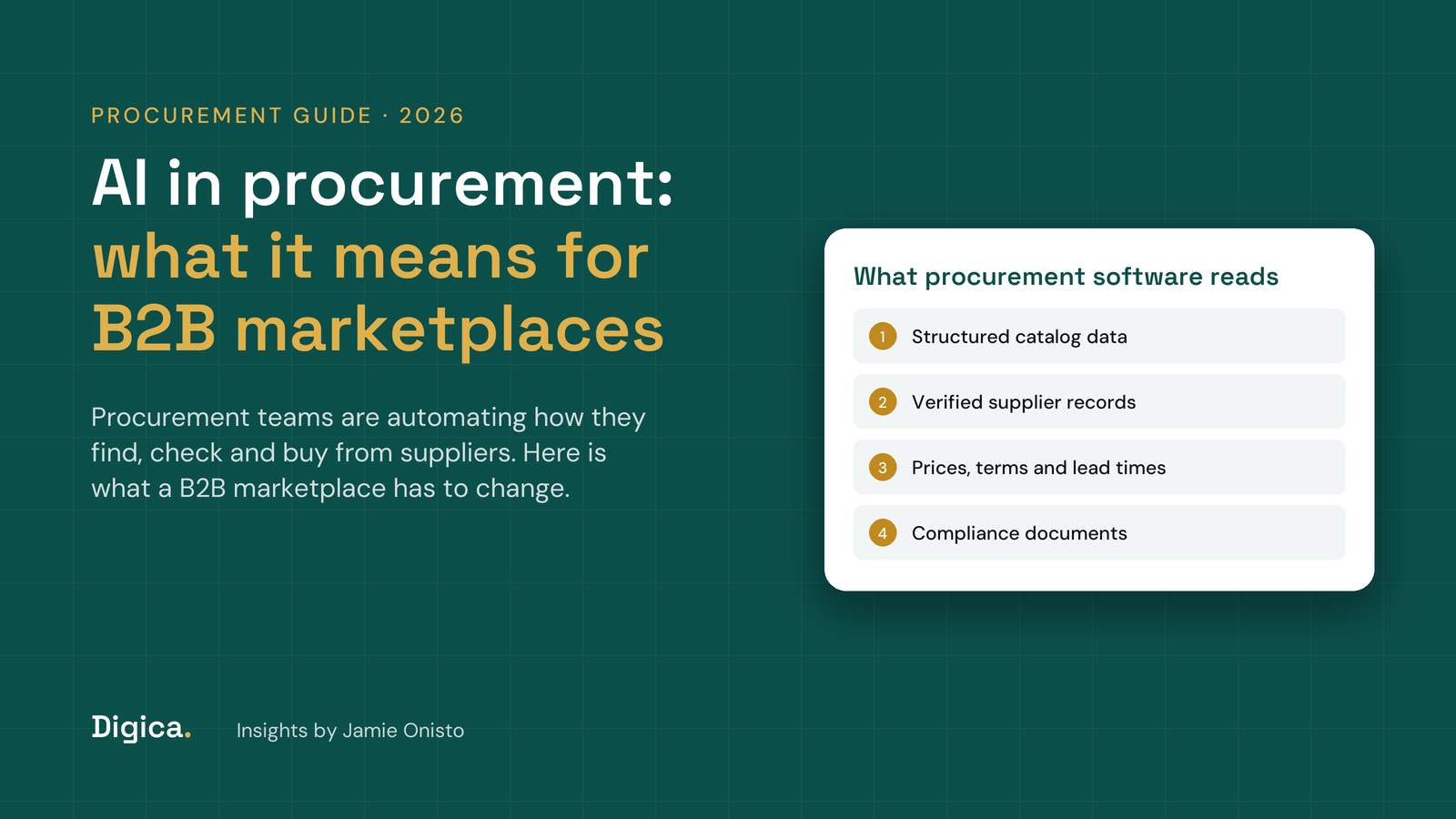
AI in procurement has moved from slideware to budgets. In the Hackett Group's 2026 study, 43% of procurement organizations were actively pursuing AI deployment, nearly double the year before, although only 12% had reached large-scale implementation (The Hackett Group, March 2026). The same study found that 69% get their AI through features built into the procurement platforms they already use.
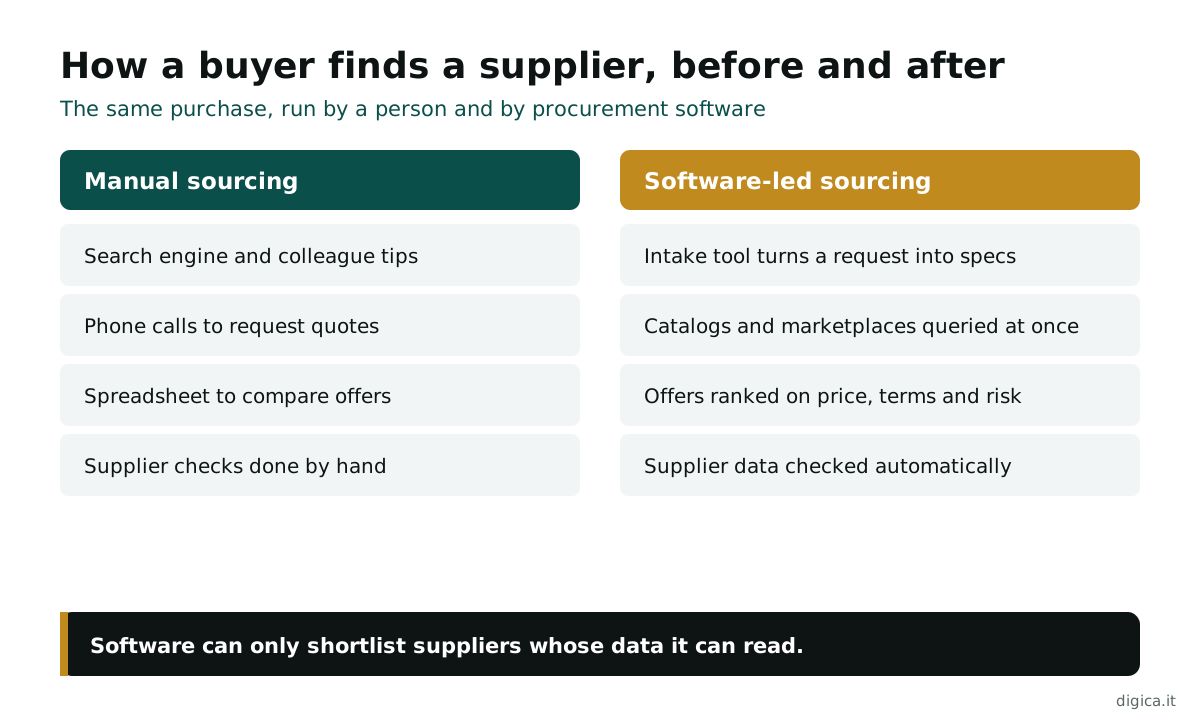
That last number is the one a B2B marketplace should worry about. When the buyer's own software turns a request into a specification, searches catalogs, shortlists suppliers and drafts the purchase order, the first reader of your listing is no longer a person. It is a system that can only rank what it can read, check and compare. A supplier with a beautiful profile and no structured data simply does not make the list.
This guide explains what AI in procurement and digital procurement actually do in 2026, how far procurement teams have got, and what changes for the B2B marketplaces that sell into them. It is the same question we work through when we help procurement B2B marketplaces grow their supplier base and their buying organizations together.
Quick Navigation
- What AI in procurement means in 2026
- How far procurement teams have actually got
- Where AI touches the buying journey
- Why supplier data decides who gets shortlisted
- Supplier discovery is moving inside procurement software
- What B2B marketplaces need to change
- Three failure scenarios
- Where to start: a decision framework
- What being readable is worth
- FAQ
- Related Articles
What AI in procurement means in 2026
The short answer: AI in procurement is software that reads requests, supplier data and past purchases, then shortlists, compares, negotiates or flags on the buyer's behalf, usually inside the procurement platform the company already runs.
Digital procurement is the older, broader idea. SAP defines e-procurement, or digital procurement, as "the process of requisitioning, ordering, and purchasing goods and services online". That was the first wave: catalogs, purchase orders and invoices moved from paper and email into software. AI is the second wave, and it changes who does the reading. The first wave digitized the paperwork. The second wave automates the judgment calls that used to sit with a buyer: which suppliers to ask, which offer is best, which purchase looks wrong.
Look at what the leading tools say they do today, in their own words:
- SAP Ariba with Joule. SAP describes a Sourcing Event Agent that "analyzes data and past sourcing events, shortlists suppliers, and suggests questions", and a Bid Analysis Agent that evaluates complex bid scenarios, including total cost.
- Zip. Zip runs five "superagents" covering intake, procurement, contracts, accounts payable and configuration, which it describes as AI users that plan, take action and collaborate across the business.
- Fairmarkit. Its Supplier Discovery Agent matches suppliers and supports renewals, and an Intake Agent builds compliant requests from what an employee types.
- Globality. Its assistant, Glo, messages suppliers, counters their offers and negotiates price and terms, with the level of autonomy set per sourcing event.
- Amazon Business. Guided Buying steers employees to preferred products, Savings Insights analyzes spend and Spend Anomaly Monitoring alerts teams when purchases look unusual.
Notice the pattern. Every one of these tools shortlists, compares or filters suppliers. None of them can shortlist a supplier it cannot see, and none of them can compare a supplier whose prices, lead times or certifications are locked in a PDF.
How far procurement teams have actually got
The short answer: most procurement teams are experimenting and a minority have scaled, so the window to get your B2B marketplace ready is open but closing.
The figures line up across sources. Deloitte's 2025 Global CPO Survey, which covered more than 250 chief procurement officers in 40 countries, found about 40% of procurement organizations at least piloting AI. The Hackett Group's figure of 43% actively pursuing deployment lands in the same place. Both say the same thing about scale: piloting is common, and running AI across the function is rare.
What procurement teams use AI for matters more to a B2B marketplace than how many use it. In Deloitte's survey, spend analytics was the top generative AI use case, cited by 53%, followed by RFx generation at 42%. Intake and guided buying, the part that steers an employee towards a product or a supplier, sat at 17%. That is the part that will touch your listings most directly, and it is the least mature. The teams that adopt it next will be choosing which catalogs and B2B marketplaces to connect, and they will choose the ones that are easy for their software to read.
Buyers outside the procurement team are moving faster. Gartner's 2026 survey of 645 B2B buyers found that 45% had used generative AI, mainly to gather information on vendors and products, and that 69% then checked those AI-generated insights with a sales rep. In other words, the shortlist is increasingly built by an assistant and confirmed by a person.
Selling into procurement teams through your B2B marketplace?
In 30 minutes we look at how procurement buyers and their software find suppliers in your category, and where your B2B marketplace drops out of the shortlist.
The practical reading for an operator is simple. You do not need to build AI. You need your B2B marketplace to be the cleanest, most complete source of supplier data in your category, so that when a procurement team or a buyer's assistant goes looking, your suppliers are the ones it can rank with confidence. That is a supply and data job, and it is the same job that wins in classic search.
Where AI touches the buying journey
The short answer: AI now touches five stages of a business purchase, and each stage reads something different from the suppliers and B2B marketplaces it considers.
A business purchase moves through intake, sourcing, comparison, buying and paying. The table below maps what procurement software does at each stage, what it needs from a supplier or B2B marketplace to include them, the cost of being missing, and the risk to the operator.
| Stage | What the software does | What it reads from you | Cost of being missing | Main risk for a B2B marketplace | Best for a B2B marketplace that |
|---|---|---|---|---|---|
| Intake | Turns a request into a specification | Clear product and service categories | You are not matched to the need | Vague categories that map to nothing | Has a clean category tree |
| Sourcing | Shortlists suppliers to invite | Verified supplier records and coverage | You never receive the request | Thin or unverified profiles | Verifies every supplier |
| Comparison | Ranks offers on price, terms and risk | Prices, lead times, certifications | You lose on missing fields, not price | Quote-only listings | Publishes prices and terms |
| Buying | Routes the order through approvals | Punchout or catalog connection | Staff buy elsewhere, outside policy | No connection to the buyer's system | Offers punchout or an API |
| Paying | Matches invoices and flags anomalies | Consistent order and invoice data | Payments delayed, supplier churns | Messy invoicing across sellers | Consolidates invoicing |
Two stages matter most for growth. Sourcing decides whether your suppliers are invited at all, and comparison decides whether they win once they are. Both depend on data your B2B marketplace controls today, not on technology you would need to build.
The comparison stage also changes how price competes. A human buyer might phone the supplier with the missing lead time. Software tends to rank what it can see. In our experience, a supplier with a complete, verified profile and a slightly higher price often beats a cheaper supplier with gaps, because the cheaper offer cannot be scored with confidence. A $51,000 offer with a stated lead time can outrank a $48,000 offer without one. Procurement teams that buy through a guided catalog rarely go hunting for a missing field.
Why supplier data decides who gets shortlisted
The short answer: procurement leaders themselves name poor data as the main thing holding AI back, so the B2B marketplaces with the best supplier data will be the ones procurement software trusts.
The barrier is not appetite. In GEP's 2026 European CPO Report, 77% of the 100 chief procurement officers surveyed cited poor data infrastructure and quality as a barrier to adopting AI, and poor data quality was the single biggest obstacle to autonomous AI, named by 31% (GEP, 2026). Deloitte's survey points the same way: data quality was the top internal risk CPOs saw in generative AI, ranked in their top three by about 44%.
Read that from the supplier's side. A procurement team that does not trust its data will connect fewer, better sources. A B2B marketplace that hands it verified supplier records, standard categories, current prices and certificates that have not expired solves the buyer's biggest problem. A B2B marketplace that hands it free-text profiles adds to it.
Supplier data quality has four parts that procurement software actually uses:
- Identity. Legal name, registration, location and ownership, checked rather than typed in by the supplier.
- Capability. What the supplier makes or does, in standard categories, with capacity and coverage.
- Commercials. Prices or price bands, minimum orders, lead times and payment terms.
- Compliance. Certifications, insurance, sustainability and diversity data, with expiry dates.
Most B2B marketplaces we see collect the first two at signup and leave the last two to the quote. That made sense when a person read every profile. It is a handicap when the first reader is software.
Can procurement software read your supplier profiles?
A growth audit checks how your B2B marketplace's supplier data, category structure and listing pages hold up when a procurement tool or an AI assistant goes looking for suppliers.
This is also where AI search and procurement software meet. The structured, verified data that lets a procurement tool score your suppliers is the same data that lets an AI assistant cite your B2B marketplace when a buyer asks who supplies a category. We covered the citation side in our guide to being the source AI answer engines cite. The procurement side rewards exactly the same discipline.
Supplier discovery is moving inside procurement software
The short answer: discovery used to happen on the open web and in B2B marketplaces, and it is moving into the procurement platform itself, which changes how a B2B marketplace wins new buying organizations.
Procurement teams want more suppliers, not fewer. In Amazon Business's 2025 State of Procurement Data research, 62% of 3,500 decision makers said developing a broader supplier base was a high priority. Deloitte found that 74% of CPOs see maintaining active alternative sources as their most effective way to manage supply risk. That is demand for exactly what a B2B marketplace offers: many verified suppliers in one place.
What has changed is where the search starts. SAP describes its sourcing agent shortlisting suppliers from data and past events. Fairmarkit sells a supplier discovery agent. Amazon Business sits inside many companies' procurement systems as a connected catalog. When discovery happens inside the buyer's platform, a B2B marketplace has three ways in:
- Be a connected source. Offer punchout or an API so the buyer's platform can search your catalog and send the cart back as a requisition.
- Be a trusted data source. Supply verified supplier records that the procurement platform or its data partners can ingest.
- Be the cited source. Be the B2B marketplace that AI assistants and search results name for your category, so the buyer adds you as a source in the first place.
Spend under management makes the stakes clear. Ardent Partners reports that procurement teams now manage about 71% of enterprise spend, the first time the figure has passed 70% in two decades, which leaves roughly 29% unmanaged. As AI pulls more of that tail into managed channels, the purchases that used to happen on a company card, often on an open B2B marketplace, move into systems that only buy from connected, approved sources. If your B2B marketplace is not one of those sources, that spend is not lost to a competitor. It is lost to a channel you are not in.
We ranked the platforms most procurement teams connect today in our guide to the best procurement marketplaces for B2B buyers, and the supplier-finding side in our review of supplier databases and directories.
What B2B marketplaces need to change
The short answer: make every supplier profile complete, verified and structured, connect to the buyer's systems, and earn the visibility that gets you added as a source.
None of this requires an AI product. It requires the operating discipline most B2B marketplaces postpone. In order of impact:
Turn profiles into records. Replace free-text supplier profiles with structured fields that map to standard categories, with required fields for capability, capacity, coverage and lead time. Make completeness visible to suppliers and tie it to how often they appear in results. Our guide to marketplace vendor onboarding covers why a listed supplier is not a live one.
Verify what matters to procurement. Check identity and certificates, store expiry dates and chase renewals before they lapse. A badge that says "verified" means nothing to procurement software unless it can see what was verified and when.
Publish commercials where you can. Price bands, minimum order quantities and lead times turn a quote-only listing into one software can score. Where exact prices are impossible, a range still beats a blank.
Connect to the buyer's system. Punchout through cXML or OCI, or a catalog feed, lets employees buy from your B2B marketplace inside their company's rules. Without it, a procurement team that wants to use you has to work around its own controls.
Make category pages machine-readable. Clear headings, consistent attributes and structured data help both search engines and AI assistants understand which suppliers you cover. Our guide to category page SEO for marketplaces explains why these are the money pages.
Be named where buyers ask. Earn mentions on trusted industry sites and in the sources AI assistants read. This is the same visibility work that delivered 10x+ organic impressions within six months for a water and wastewater marketplace, and procurement teams use the same sources when they look for new suppliers.
Three failure scenarios
The short answer: B2B marketplaces fail procurement buyers in predictable ways, and each one is visible long before revenue drops.
The beautiful profile nobody can score. A B2B marketplace invests in rich supplier pages with photos, videos and long descriptions, but leaves prices, lead times and certifications to the quote. Human visitors like it. Procurement software cannot rank it, so the suppliers on it are skipped at the comparison stage, and the operator reads the drop in requests as weak demand.
Verified once, wrong forever. Suppliers are checked at signup and never again. Within a year a share of certificates have expired and some companies have changed ownership. A procurement team that connects the B2B marketplace finds the errors in its first supplier audit and disconnects it, and that buyer does not come back for a second try.
Visible on the web, invisible in the workflow. The B2B marketplace ranks well and gets traffic, but has no punchout and no catalog feed. Employees at large customers find it, like it and are told to buy through the approved system instead. The operator sees strong traffic from big companies and weak orders, and never connects the two.
Where to start: a decision framework
The short answer: fix supplier data before anything else, then connections, then commercials, then visibility, because each step only pays off once the one before it is done.
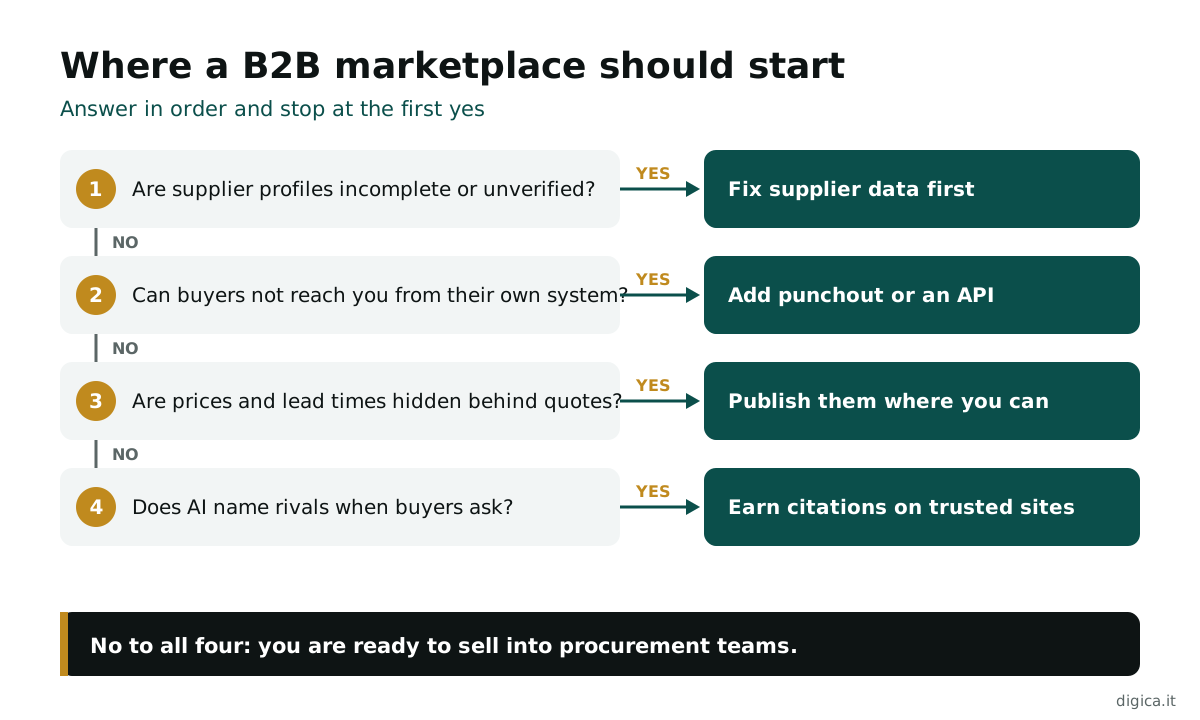
Answer the questions in order and stop at the first yes:
- If supplier profiles are incomplete or unverified, start there. Every later step depends on data that software can trust.
- If buyers cannot reach you from their own procurement system, add punchout or a catalog feed before spending more on traffic.
- If prices and lead times are hidden behind quotes, publish ranges where your suppliers will allow it, starting with your highest-volume categories.
- If AI assistants name your rivals when buyers ask about your category, invest in the citations and mentions that get you named.
- If the answer to all four is no, you are ready to approach procurement teams directly with a connection offer, starting with the buying organizations already active on your B2B marketplace.
What being readable is worth
The short answer: procurement buying through connected B2B marketplaces is already a market worth tens of billions of dollars, and it goes to the platforms that software can read.
Amazon Business alone reached $60 billion in annualized gross sales in the second quarter of 2026, serving more than 11 million organizations, including 97 of the Fortune 100, and adding more than 1.8 million new organizations in the first half of the year (Amazon, July 2026). That spend flows through guided buying, punchout and approved catalogs, the channels AI in procurement is expanding.
Put it in your own numbers. For illustration, take a B2B marketplace doing $20 million a year in gross sales, where a quarter comes from large companies with procurement teams. That is $5 million of revenue that depends on being a source their systems can read. If AI-led guided buying moves even a fifth of that spend into connected channels over the next two years, $1 million a year is at stake for a platform that has not connected. Set that against the cost of a data cleanup and a punchout integration, typically a one-off project rather than a running cost, and the payback is short. The cost of doing nothing is not a slow decline. It is a buying organization that switches you off in a single supplier audit and does not tell you why.
Growing a procurement or supplier B2B marketplace?
We help procurement B2B marketplaces build the verified supplier base and the buyer visibility that procurement teams and their software look for.
The good news is that the work compounds. The same verified records, published lead times and structured category pages that get your suppliers shortlisted by procurement software also help them rank in search and get named by AI assistants. You fix the data once and every channel that reads it gets better, which is why we treat supplier data as a growth asset rather than an admin task.
FAQ
What is AI in procurement? AI in procurement is software that reads purchase requests, supplier data and past spend, then shortlists suppliers, compares offers, negotiates or flags unusual purchases on the buyer's behalf. It usually runs inside the procurement platform a company already uses, such as SAP Ariba, Zip or Amazon Business.
What is digital procurement? Digital procurement, or e-procurement, is requisitioning, ordering and purchasing goods and services online, through catalogs, purchase orders and electronic invoices. AI in procurement builds on it by automating decisions, such as which suppliers to invite and which offer to accept.
How many procurement teams use AI? About two in five. Deloitte's 2025 Global CPO Survey found roughly 40% of procurement organizations at least piloting AI, and the Hackett Group's 2026 study found 43% actively pursuing deployment, with only 12% at large scale.
How does AI in procurement affect suppliers on a B2B marketplace? Procurement software can only shortlist and compare suppliers whose data it can read. Suppliers with complete, verified profiles, published price ranges and lead times get ranked; suppliers whose details sit behind a quote are often skipped at the comparison stage.
What should a B2B marketplace do first to prepare for AI in procurement? Fix supplier data first: structured categories, verified identity and certificates with expiry dates, and commercial fields such as lead times and minimum orders. Then add punchout or a catalog feed so buyers can reach you from their own procurement system.
What is punchout and why does it matter? Punchout lets an employee open a supplier's or B2B marketplace's catalog from inside their company's procurement system, fill a cart and return it as a requisition for approval. Without it, procurement teams that want to buy from you have to work around their own controls.
Related Articles
- Procurement B2B marketplace growth
- B2B marketplace growth strategy: what works in 2026
- Best procurement marketplaces for B2B buyers in 2026
- Best supplier databases and directories for B2B in 2026
- Being the source AI answer engines cite
Where this connects
This article is part of our B2B marketplace growth series. Browse more on the Digica blog.