B2B marketplace growth strategy: what works in 2026, and why market growth is not your growth
Grand View Research values the global B2B e-commerce market at $24.1 trillion in 2025 and forecasts $105.9 trillion by 2033, a compound annual growth rate of 20.9% (Grand View Research, 2026). Numbers like that are why every B2B marketplace pitch deck opens with a market slide. They are also why so many marketplace strategy documents stop there.
Market growth is not your growth. A market can double while a B2B marketplace inside it stalls at a few hundred active buyers, because buyers do not arrive just because the category is growing. They arrive when your B2B marketplace has the suppliers they need, shows up where they search, and turns a visit into a completed order. The operators who grow with the market are the ones who turn each buyer shift into a specific move on their own platform.
This guide sets out the five buyer shifts behind B2B marketplace growth in 2026, grades the statistics you will see quoted about them, and turns each into the move an operator should make. It is the framework behind our B2B marketplace growth consulting, and the same engine behind a B2B agency marketplace that grew from five people to 40,000+ listed agencies and 1M+ monthly users.
Quick Navigation
- Why market growth does not become your growth
- The five buyer shifts behind B2B marketplace growth
- Supply first: the constraint most B2B marketplaces hit
- Liquidity tells you whether it is working
- Organic growth compounds, paid growth rents
- Vertical depth before horizontal reach
- Be the answer when buyers ask AI
- Growth levers side by side
- Three failure scenarios
- Where to start: a decision framework
- What compounding growth is worth
- FAQ
- Related Articles
Why market growth does not become your growth
The short answer: buyers do not join a B2B marketplace because its category is growing, they join because it solves today's purchase better than the alternatives, and most platforms are not yet good enough at that to ride the market.
Look at how big the opportunity really is for marketplaces specifically. Digital Commerce 360 estimated that B2B marketplace sales nearly doubled in 2023, to $224.0 billion from $113 billion in 2022. That sounds enormous until you set it against the whole market: it was about 1.3% of all B2B sales. Most business buying still happens through distributors, sales reps, EDI connections and supplier websites. The growth is real, but it is a share shift you have to win, not a tide that lifts everyone.
That share shift goes to specific platforms for specific reasons. In the B2B marketplaces we have worked on, growth usually stalls for one of four reasons: not enough suppliers in the categories buyers searched, too few buyer requests ending in a match, too much dependence on paid traffic, or being spread across too many verticals to be the best answer in any of them. None of those is fixed by a bigger market. Each is fixed by a decision the operator controls.
So the useful question is not "how fast is B2B e-commerce growing?" It is "which buyer shifts favor my B2B marketplace, and what do I have to change to capture them?"
The five buyer shifts behind B2B marketplace growth
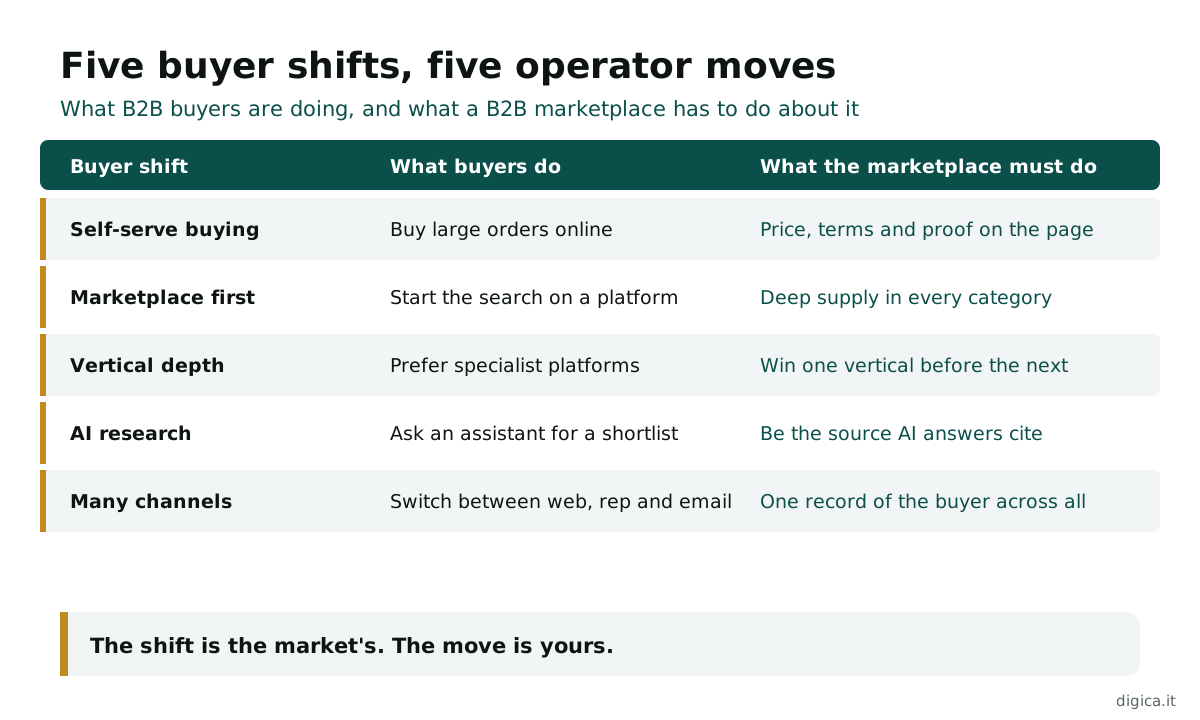
The short answer: buyers are buying more online without a rep, starting on marketplaces, preferring specialist platforms, researching with AI and moving between many channels, and the statistics behind each shift are stronger for some than others.
You will see these shifts in Google's AI Overview, in analyst decks and in every vendor report. The trouble is that the numbers get repeated until nobody checks where they came from. Here is each shift with the best source we could find, and an honest grade.
1. Self-serve buying. Gartner's 2026 sales survey of 646 B2B buyers found that 67% prefer a rep-free buying experience, and 45% had used AI in a recent purchase. McKinsey's B2B Pulse research found 73% of B2B buyers willing to spend more than $50,000 on a single order through digital channels, up from 59% two years earlier. Strong sources, consistent direction. Grade: solid.
2. Marketplace first. The most quoted figure, that 59% of B2B buyers make more than a quarter of their purchases on online marketplaces, comes from a 2023 Forrester and Digital Commerce 360 survey of 103 buyers. The direction is right, but it is a small sample and three years old. Mirakl's often-cited claim that B2B marketplace sales grow 7.3 times faster than total B2B e-commerce dates from 2022. Grade: directionally right, dated.
3. Vertical depth. The argument that specialist platforms beat generalists is widely made, including in a 2025 Forbes column on vertical marketplaces. It is mostly argued from examples rather than measured. Grade: plausible, thinly evidenced.
4. AI research. Gartner's figure that 45% of B2B buyers used AI in a recent purchase is the cleanest data point, and McKinsey's 2026 research on B2B sales growth links higher AI investment to faster-growing sellers. Grade: early, moving fast.
5. Many channels. McKinsey's 2026 B2B Pulse research puts the average at ten channels across the purchasing journey, from websites and marketplaces to reps, email and events. Grade: solid.
One correction worth knowing. At the time of writing, Google's AI Overview for "b2b marketplace growth" presents the $24 trillion figure as a 2033 projection. In Grand View Research's report it is the 2025 starting point. If you put it in a board deck, quote it correctly.
Is your B2B marketplace growing with the market, or just inside it?
In 30 minutes we look at which of these buyer shifts favor your B2B marketplace and where growth is stalling: supply, matching, acquisition or focus.
What matters for strategy is not the exact number but the direction. Every one of these shifts moves buying power towards platforms that are easy to buy from without help, deep in a category, visible where buyers research and consistent across channels. That is a description of a well-run B2B marketplace. The rest of this guide is about becoming one.
Supply first: the constraint most B2B marketplaces hit
The short answer: in a B2B marketplace's early years, growth tracks the number and quality of suppliers more closely than anything else, so supply acquisition comes before demand generation.
Founders usually want to start with buyers, because buyers bring revenue. But buyers who search and find nothing do not come back, and they tell their peers. In our experience the first job is always to make sure a buyer who arrives in your core category finds enough relevant, verified suppliers to make a choice.
The data backs this up. BCG's analysis of B2B marketplaces, citing Mirakl, found that 96% of the variation in gross merchandise value in a marketplace's first five years can be explained by the increase in the number of sellers, and that the top 10% of sellers often generate more than 80% of third-party sales (BCG, 2024). Read together, those two findings say: add sellers, and work hardest to find and keep the few who will carry most of the volume.
The pattern behind a B2B agency marketplace that grew from five people to 40,000+ listed agencies was exactly this. It did not try to be everything at once. It seeded the categories buyers searched most, made the value of being listed obvious to suppliers, and gave every new supplier a reason to complete their profile. Supply growth then fed demand, because a deep category ranks, converts and gets recommended.
The practical moves are well understood, even if they are rarely done well: pick the categories where buyers already search, sign up the first suppliers by hand, make the listing worth more than the effort of creating it, and measure how many listed suppliers are actually active. Our guides to attracting vendors to a B2B marketplace and vendor onboarding cover both halves.
Liquidity tells you whether it is working
The short answer: liquidity, the share of buyer requests or listings that end in a transaction, is the metric that tells you whether supply and demand have actually met, and it is the one to report every month.
Traffic, signups and listings can all rise while a B2B marketplace fails, because none of them measures whether buyers and suppliers are completing business. Liquidity does. When a buyer posts a request, how often do they get a relevant response? When a supplier lists, how often do they win work within a set period? Those two numbers tell you more about a B2B marketplace's health than any top-line growth chart.
a16z's widely used marketplace metrics framework makes a related point: marketplaces with more fragmented supply and demand sides tend to be more valuable and defensible, because no single buyer or supplier can take their business elsewhere and leave the platform empty. Fragmentation is only an advantage when the platform reliably matches the fragments, which is what liquidity measures.
We argue in our post on why liquidity is the only marketplace metric that compounds that every other growth lever should be judged by whether it moves this number. Supply acquisition should raise it. Demand generation should raise it without diluting it. A new vertical should only be opened once liquidity in the first one is strong.
Organic growth compounds, paid growth rents
The short answer: paid acquisition buys buyers for as long as you keep paying, while organic growth builds an asset that keeps sending buyers after the work is done, so a growing B2B marketplace needs both from one engine.
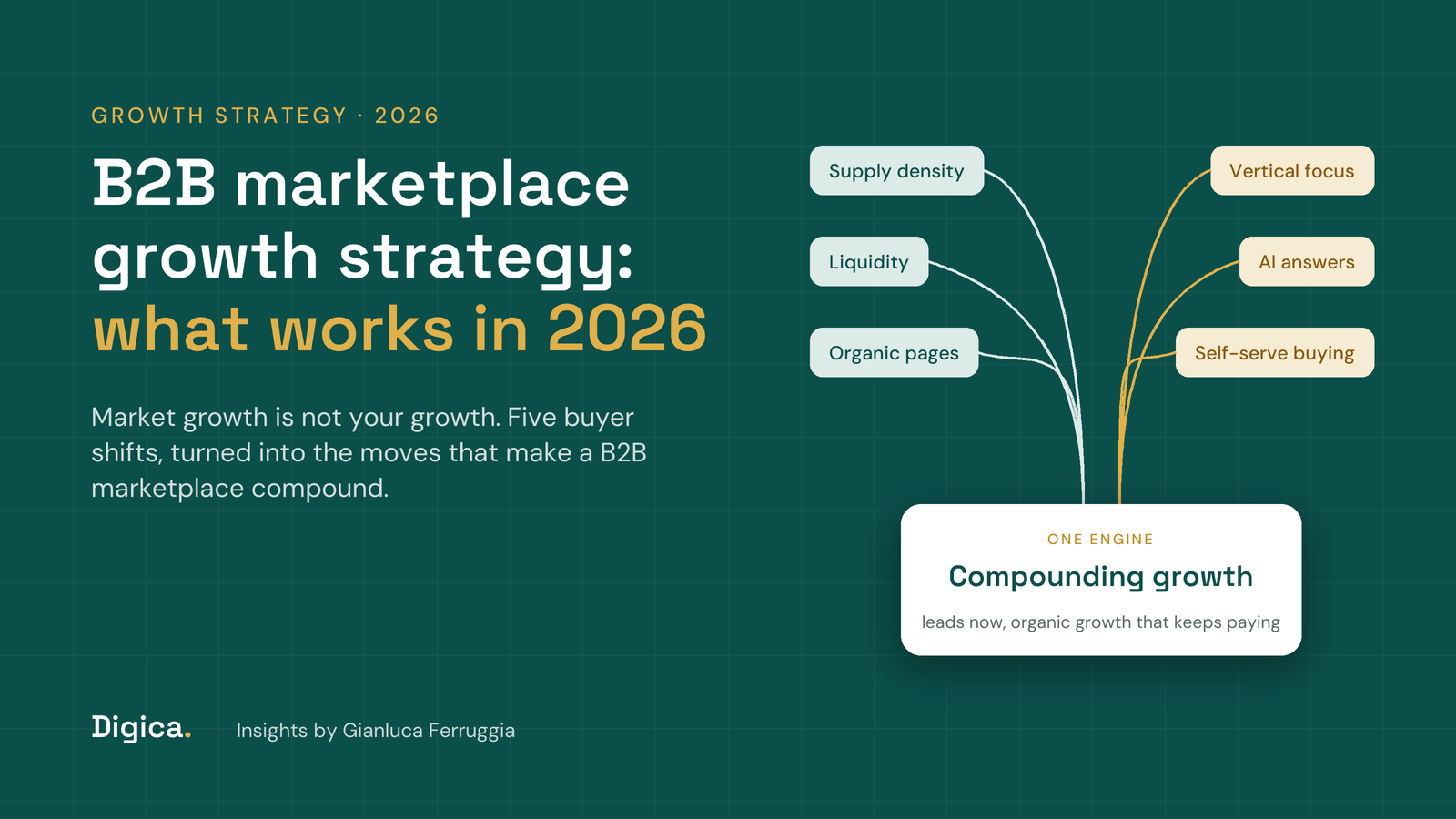
Our promise line is the clearest way to put it: leads and organic growth from the same engine. One engine, two outputs: qualified leads this quarter, organic growth that keeps paying after. In practice that means category and location pages that win commercial searches, proof pages that convert, and editorial placements on real company domains that build the authority those pages need to rank.
Where do your B2B marketplace's buyers really come from?
A growth audit maps your traffic, supply density and liquidity by category, and shows which growth lever will move your B2B marketplace fastest.
The reason this matters more for B2B marketplaces than for most businesses is the long tail. A B2B marketplace serves thousands of category and location combinations, and every one is a search someone makes. Paid search can cover a handful profitably. Organic pages can cover all of them, and each one strengthens the others. That is how a B2B marketplace reaches a million monthly users without a million-dollar ad budget. We saw the same effect when a water and wastewater marketplace reached 10x+ organic impressions within six months.
We are deliberate about how authority is earned. We earn editorial placements on real company domains and point them at the pages that convert. No paid directories, no bought links. The same approach produced 275+ editorial collaborations in one live program for a design marketplace. Our paid versus organic growth post sets out where each channel belongs, and our guide to category page SEO covers the pages that do most of the work.
Vertical depth before horizontal reach
The short answer: win one vertical properly before opening the next, because depth is what makes a B2B marketplace the obvious answer, and being the obvious answer is what compounds.
Generalist B2B marketplaces exist and some are enormous, but they are rare and they started with huge capital. For almost every other operator, the winning pattern is the same: own one category so completely that buyers in it start their search with you. That is the pattern we see across the platforms in our industry rankings, from load boards to data marketplaces.
Research on network effects explains why. Andrei Hagiu and Julian Wright's 2024 Harvard Business Review article on marketplace success argues that network effects are stronger when sellers are differentiated in the eyes of buyers. A specialist platform can show the differences that matter in its vertical, such as certifications, capacity, lead times and specialties, in a way a generalist cannot. That makes each additional supplier more valuable to buyers, which is the network effect working.
Vertical depth also helps every other lever in this guide. It concentrates supply where buyers search, raises liquidity, makes category pages more authoritative and makes it more likely that AI assistants name you for that category. Spreading across many verticals dilutes all of it.
Be the answer when buyers ask AI
The short answer: a growing share of B2B buyers now start research with an AI assistant, so a B2B marketplace has to be the source those assistants cite for its category, not just a site that ranks.
When nearly half of B2B buyers use AI in a purchase, the shortlist is increasingly written by an assistant before anyone visits a website. Have you checked what AI says about your category? If it names your competitors, or names the suppliers on your B2B marketplace without naming you, buyers are being routed around you.
Visibility in AI answers is one of the four jobs we do for every B2B marketplace, alongside traffic and authority, audience and supply, and paid subscribers and high-intent leads. The mechanics are not mysterious: AI assistants draw on the sources that are consistently clear, structured and mentioned by others. We cover them in our guides to being the source AI answer engines cite and GEO for marketplaces.
The same discipline also helps when the buyer is not a person at all. Procurement teams are adopting software that shortlists suppliers from structured data, which we cover in AI in procurement and what it means for B2B marketplaces. The B2B marketplaces with clean, verified, structured supplier data will be read by both.
Growth levers side by side
The short answer: each growth lever moves a different part of the engine, at a different cost and speed, and the right order depends on where your B2B marketplace is stalling.
| Lever | What it moves | Cost to start | Time to show results | Main risk | Best for |
|---|---|---|---|---|---|
| Supply acquisition | Depth in core categories | Team time and supplier incentives | Weeks to months | Signing up suppliers who never activate | B2B marketplaces where requests go unmatched |
| Liquidity work | Share of requests that end in a deal | Mostly operational effort | Weeks | Optimizing matching before supply is deep enough | Platforms with traffic but few completed deals |
| Organic pages and authority | Compounding buyer traffic | Content and placements up front | Months, then compounding | Thin pages that never rank | B2B marketplaces paying too much for buyers |
| Vertical focus | Being the default in one category | Opportunity cost of saying no | Months | Picking a vertical without enough demand | Platforms spread across several verticals |
| AI visibility | Being named in AI answers | Content, structure and citations | Months | Chasing mentions without a strong site | Categories where buyers research with AI |
| Paid acquisition | Buyers this quarter | Ongoing media spend | Days | Growth stops when spend stops | Testing demand or filling a new category fast |
Two patterns stand out. The cheapest levers to start, liquidity work and vertical focus, are the ones operators most often skip, because they feel like operations rather than growth. And the lever with the fastest results, paid acquisition, is the only one that stops the moment you stop paying.
Three failure scenarios
The short answer: B2B marketplace growth strategies fail in three recognizable ways, and each one looks like success for a while.
Demand before supply. A B2B marketplace raises money and spends it on buyer acquisition. Traffic climbs, signups climb, and buyers find thin categories with few relevant suppliers. Repeat visits fall, paid acquisition costs rise to replace lost buyers, and the board sees growth right up to the point where it sees churn.
The listing count trap. A B2B marketplace celebrates passing 10,000 listed suppliers, but only a fraction have complete profiles and fewer still respond to requests. Liquidity is low, buyers lose patience, and the platform keeps adding suppliers who will never be active because nobody measures activation.
Everything for everyone. A B2B marketplace opens five verticals in its first two years to show a bigger market. None reaches the depth to rank, convert or be named by AI, and a specialist competitor wins each vertical in turn. The operator ends up with five small marketplaces instead of one strong one.
Where to start: a decision framework
The short answer: start with whatever is stopping buyers and suppliers from completing business today, in this order: supply, acquisition, visibility, focus.
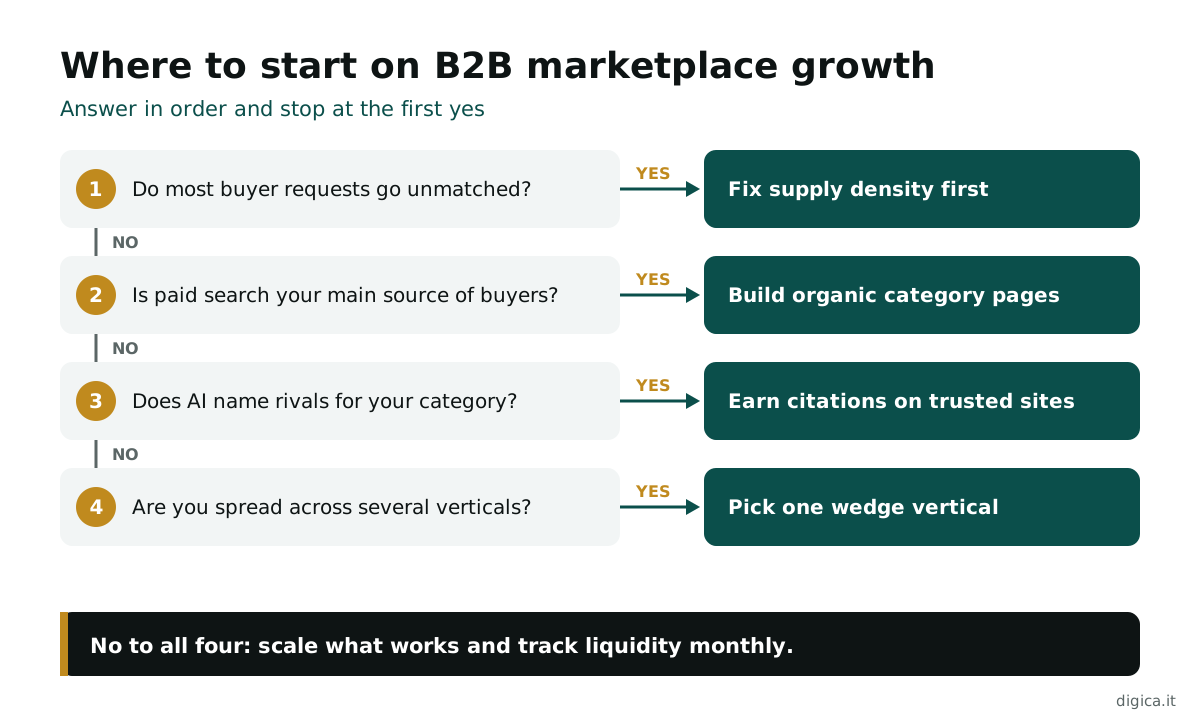
Answer the questions in order and stop at the first yes:
- If most buyer requests go unmatched, fix supply density in your core categories before spending another dollar on buyers.
- If paid search is your main source of buyers, build the organic category pages and authority that will keep buyers coming when spend stops.
- If AI assistants name your rivals when buyers ask about your category, earn the citations and structured content that get you named.
- If you are spread across several verticals, pick the one with the strongest liquidity and make it your wedge.
- If the answer to all four is no, scale what is working and track liquidity every month so you see the next constraint before it bites.
Most B2B marketplaces we review answer yes to more than one question. Work on the first yes only, and come back to the list each quarter. Fixing the earliest constraint usually makes the later ones cheaper to solve.
What compounding growth is worth
The short answer: the gap between B2B suppliers and platforms that execute well on digital commerce and those that do not is already large, and it widens every year the engine runs.
Deloitte Digital's 2026 B2B commerce research found that high-maturity suppliers beat their annual sales goals by a 110% greater margin than low-maturity suppliers (Deloitte Digital, 2026). Whatever the exact definition of maturity, the direction matches what we see in B2B marketplaces: the platforms that invest early in easy buying, supply depth and visibility pull away, and the gap widens each year.
Put it in your own numbers. For illustration, take a B2B marketplace with $10 million in annual gross sales that spends $1.5 million a year acquiring buyers through paid channels. If organic category pages and earned authority replace even a third of that paid demand over two years, the platform keeps $500,000 a year it would otherwise spend renting buyers, and the pages keep working after the investment. Over three years that is $1.5 million saved, before counting the higher liquidity that deeper supply brings. Because the pages keep working after they are built, the payback period shortens every year the program runs.
Ready to build a growth engine for your B2B marketplace?
We work as an embedded team with B2B marketplace operators on supply, demand, liquidity and organic growth: leads this quarter, compounding growth after.
The cost of doing nothing is not standing still. It is renting the same buyers every quarter at rising prices while a competitor with deeper supply and stronger organic pages becomes the default answer in your category, in search results and in AI assistants. Market growth will keep coming. Whether it becomes your growth depends on the moves above, made in the right order and measured by whether buyers and suppliers complete more business on your platform each month.
FAQ
What is a B2B marketplace growth strategy? A B2B marketplace growth strategy is the plan for how a platform adds suppliers, attracts buyers and increases the share of requests that end in completed business. A good one sets the order: supply depth first, then liquidity, organic acquisition, vertical focus and visibility in AI answers.
How fast is B2B e-commerce growing? Grand View Research values the global B2B e-commerce market at $24.1 trillion in 2025 and forecasts $105.9 trillion by 2033, a 20.9% compound annual growth rate. Estimates vary widely between research firms, so quote the source and the year.
How big are B2B marketplaces? Digital Commerce 360 estimated B2B marketplace sales at $224.0 billion in 2023, nearly double 2022, but still about 1.3% of all B2B sales. Amazon Business alone reported $60 billion in annualized gross sales in mid 2026.
Should a B2B marketplace focus on supply or demand first? Supply first, in most cases. BCG, citing Mirakl, found that 96% of the variation in a marketplace's gross merchandise value in its first five years is explained by growth in the number of sellers. Buyers who find thin categories rarely return.
What is the most important metric for B2B marketplace growth? Liquidity: the share of buyer requests or listings that end in a transaction. Traffic, signups and listing counts can all rise while a B2B marketplace fails; liquidity shows whether supply and demand are actually meeting.
How do B2B marketplaces show up in AI answers? AI assistants draw on sources that are clear, structured and mentioned by others. B2B marketplaces earn that visibility with well-structured category pages, verified supplier data and editorial mentions on trusted sites.
Related Articles
- B2B marketplace growth consulting
- AI in procurement: what it means for B2B marketplaces
- Liquidity is the only marketplace metric that compounds
- How to attract vendors to a B2B marketplace
- Marketplace business models: how B2B platforms make money
Where this connects
This article is part of our B2B marketplace growth series. Browse more on the Digica blog.