Hiring a B2B SEO Consultant for a Marketplace: What to Look For, What to Pay, Who to Shortlist
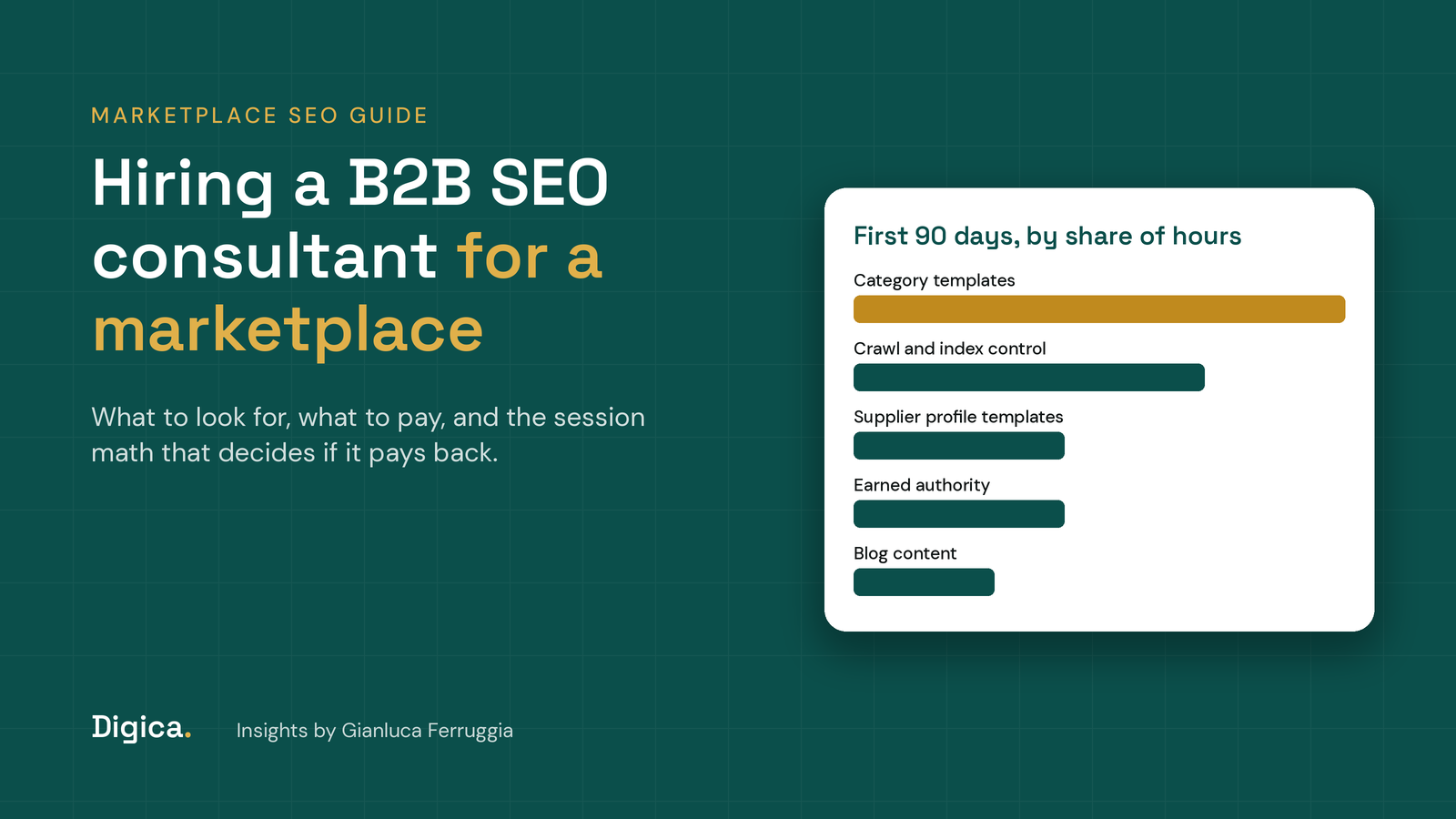
Most B2B SEO consultants are hired to grow a blog, and most B2B marketplaces do not need one. In the marketplaces we audit, 60% to 80% of organic revenue typically lands on category, location and supplier pages, not articles. A consultant who arrives with a SaaS content playbook will spend a $3,000 to $12,000 monthly budget on the 20% of the site that pays the least.
That is the trap in the search for a B2B SEO consultant. The label covers two very different jobs. One is content-led SEO for a single-product B2B company. The other is template-led SEO for a two-sided platform with thousands of URLs generated from a database. They need different skills, different access to engineering and different reporting.
This guide covers what marketplace SEO actually involves, what to pay, how the hiring options compare, and the session math that tells you whether a consultant will pay back. It builds on our guide to category pages as a marketplace's money pages and is written for the founder or growth lead who signs the contract and has to justify it a quarter later.
Quick Navigation
- Why marketplace SEO is not B2B SaaS SEO
- What a B2B SEO consultant should own on a marketplace
- What a B2B SEO consultant costs
- Marketplace SEO help, ranked
- How to vet a B2B SEO consultant
- Three failure scenarios
- Where to start: a decision framework
- A worked example: what one category session is worth
- What a consultant is worth on the same traffic
- FAQ
- Related Articles
Why marketplace SEO is not B2B SaaS SEO
Marketplace SEO is different because the pages that earn traffic are generated by templates from your database, not written one by one. That shifts the work from content production to architecture: which URLs exist, which get indexed, and what every category and profile page says by default.
Three features make a marketplace harder than a SaaS site:
- Faceted navigation. Filters for location, price, certification and category can generate millions of URL combinations. Google warns that faceted navigation often creates an "infinite URL space" that wastes crawling and slows the discovery of useful pages, and recommends returning a 404 for filter combinations with no results.
- Supply-dependent quality. A category page with three thin supplier listings is a weak page, however good the copy. SEO quality depends on liquidity in each category.
- Two audiences. Buyers search for "best X suppliers near Y". Suppliers search for "how to find buyers for X". Both are acquisition, and both need landing pages.
A B2B SaaS consultant is usually strong on topic clusters, thought leadership and conversion copy. Those skills help a marketplace's blog, but the blog is rarely where the revenue is. In the marketplaces we work with, the highest-return SEO projects are almost always template changes that touch hundreds of pages at once.
The question to ask is simple: does this consultant think in pages or in templates? A marketplace needs someone who thinks in templates.
What a B2B SEO consultant should own on a marketplace
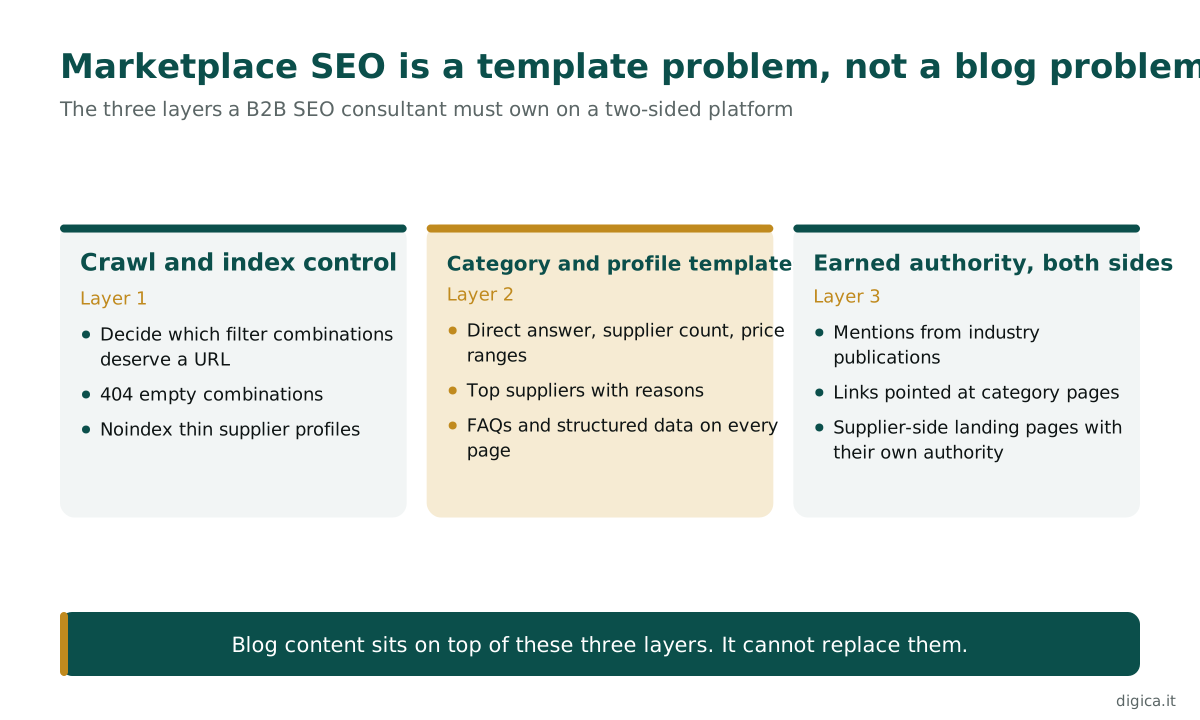
A marketplace SEO consultant should own three layers: crawl and index control, the templates for category and supplier pages, and an earned authority plan that covers both sides of the market. Content strategy sits on top of those, and only after they work.
Crawl and index control. Decide which filter combinations deserve an indexable URL, block or canonicalize the rest, and clean out empty and duplicate pages. On a large catalog, this alone can change which pages Google bothers to crawl.
Category and supplier templates. Define what every category page carries by default: a direct answer, supplier count, price ranges, top suppliers with reasons, FAQs and structured data. Then do the same for supplier profiles, so each one has enough unique facts to deserve indexing. These are also the facts AI engines quote, which is why template work now feeds GEO for marketplaces as much as classic search.
Earned authority on both sides. Links and mentions from industry publications, associations and partner sites, pointed at category pages, not just the homepage. Supplier-side pages need their own authority if you want suppliers to find you through search.
Reporting tied to requests. Organic sessions by template type, indexed pages by template, and requests per 1,000 organic sessions. Rankings are an input, not the result.
What the consultant should not own: writing every page, managing your developers or running paid search. A good consultant writes the specification, reviews what ships, and measures the effect. If the proposal is mostly content volume, you are buying a content agency with an SEO label.
What a B2B SEO consultant costs
Expect $100 to $250 an hour for an experienced independent consultant, $3,000 to $12,000 a month for a retainer, and $5,000 to $20,000 for a one-off technical audit on a large catalog. These are ranges from the engagements we see, not a published benchmark, and they vary with catalog size and how much the consultant ships versus advises.
Five ways to buy B2B SEO help for a marketplace, compared by cost, main risk and best fit.
| Model | Typical cost | What you get | Main risk | Best for |
|---|---|---|---|---|
| Hourly consultant | $100 to $250 an hour | Answers to specific problems, code and template reviews | Nobody owns the roadmap | Teams with an SEO lead who needs a second brain |
| One-off technical audit | $5,000 to $20,000 | Crawl, index and template findings with priorities | The report sits in the backlog | Large catalogs before a replatform or redesign |
| Monthly retainer | $3,000 to $12,000 a month | Roadmap, template specs, QA, reporting | Activity without request growth | Marketplaces with 1,000+ indexable pages and dev time |
| Fractional growth lead | $6,000 to $20,000 a month | SEO inside a full top-of-funnel plan, both sides | Depends on one senior person's time | Founders who need SEO, GEO and acquisition owned together |
| Senior in-house hire | Roughly $10,000 to $15,000 a month fully loaded (US, from our experience) | Full-time ownership | Six-month ramp, hard to hire well | Marketplaces past Series B with a steady roadmap |
What moves price: catalog size, number of templates, international markets, and whether the consultant writes tickets your developers can ship. A consultant who hands over a 90-slide deck and leaves is cheaper per month and usually more expensive per result.
Our breakdown of growth consultant pricing models covers retainers, hourly and outcome-based fees in more depth, including exit clauses.
Is your SEO budget going to the right pages?
We review where your organic revenue lands, by template, in a 30-minute call.
One more cost is rarely in the proposal: engineering time. In our experience, a marketplace SEO roadmap needs 10% to 20% of one developer's time to ship. Without it, even an excellent consultant becomes an expensive advisor. Price that time into the decision. If a developer costs you $12,000 a month fully loaded, 15% of their time is $1,800 a month, and it belongs in the same budget line as the retainer. Founders who leave it out compare a $6,000 consultant with an $8,000 one and miss that neither will deliver without the developer.
Marketplace SEO help, ranked
For a B2B marketplace, the strongest option is a specialist that has grown two-sided platforms and treats SEO as one part of a top-of-funnel engine. We are Digica, so we rank ourselves first; the criteria are below so you can judge the ranking.
We ranked five options on four equally weighted criteria: two-sided marketplace experience, template-level execution, earned authority on real domains, and reporting tied to requests and revenue.
Marketplace SEO options at a glance, ranked for B2B marketplaces.
| Rank | Option | Model | Published cost | Main risk | Best for |
|---|---|---|---|---|---|
| 1 | Digica | B2B marketplace growth specialist | Not published, scoped after a call | Small senior team, limited capacity | Marketplaces that want traffic, authority and AI citations owned together |
| 2 | Independent marketplace SEO consultant | Hourly or retainer | Rarely published | Single point of failure | Teams with an in-house lead and dev time |
| 3 | Technical SEO consultant | Audit or hourly | Varies | Strong on crawl, light on growth | Very large catalogs and migrations |
| 4 | B2B SaaS SEO consultant | Retainer | Varies | Applies a blog playbook to templates | Rarely right for a two-sided platform |
| 5 | Senior in-house hire | Salary | Not applicable | Slow to hire and ramp | Later-stage marketplaces with a steady roadmap |
1. Digica
We build the top-of-funnel growth engine for B2B marketplaces: traffic, earned authority and audience. SEO sits next to GEO and earned editorial placements on real company domains, and we track traffic through to requests and revenue. The playbook is proven across marketplaces and tailored to yours, and we will tell you honestly if your marketplace is not ready for it yet.
Best for: B2B marketplaces with a working product that need more of the right buyers and suppliers to find them.
Watch: we work with a small number of marketplaces at a time.
2. Independent marketplace SEO consultant
A senior independent with marketplace or directory experience can be excellent value, especially as a second brain for an in-house SEO lead.
Best for: teams that can execute and need specialist judgment.
Watch: holidays, illness and other clients all land on your roadmap.
3. Technical SEO consultant
Technical specialists are strongest on crawl budget, rendering, migrations and log analysis. They are the right call when the problem is indexation at scale.
Best for: catalogs past 100,000 URLs or a platform migration.
Watch: they rarely own growth targets or authority building.
4. B2B SaaS SEO consultant
Strong on content strategy and conversion, weaker on templates and facets. Useful for a marketplace blog, risky as the main SEO owner.
Best for: a content program once the templates work.
Watch: case studies that are all single-product SaaS companies.
5. Senior in-house hire
A full-time owner is the right end state for a large marketplace. Getting there through a consultant first usually means a better hiring brief and a faster ramp.
Best for: marketplaces with a stable roadmap and two or more SEO workstreams.
Watch: the hire will need six months to reach full speed.
How to vet a B2B SEO consultant
Vet a B2B SEO consultant on marketplace evidence, not on general SEO credentials. Five questions do most of the filtering:
- "Show me a template change you shipped on a marketplace or directory, and what it did." You want a before and after on a template, not a single page.
- "How would you handle our faceted URLs?" Listen for a rule ("index category plus location, block price filters, 404 empty combinations"), not a tool name.
- "Which pages would you look at first?" The right answer is category and supplier templates, not the blog.
- "How will you report progress?" Organic sessions and requests by template, not keyword positions alone.
- "What do you need from engineering?" A consultant who does not ask is planning to write documents, not ship changes.
Google's own advice on hiring search help adds two filters worth keeping. Be wary of anyone who guarantees a #1 ranking or claims a special relationship with Google, and grant read-only Search Console access for audits, not write access. A consultant who pushes back on either is telling you how they will work.
Want a template-level view of your SEO?
Our growth audit scores your category and supplier templates before you hire anyone.
Ask for one reference from a two-sided business, and call it. Ask what shipped, not whether the consultant was nice to work with. The answer will tell you more than the proposal. Then ask the reference one harder question: what would they do differently if they hired the same consultant again? People who are happy with the work answer quickly and specifically. Hesitation, or praise that stays vague, usually means the engagement produced documents rather than changes on the site.
Three failure scenarios
These patterns come up repeatedly in marketplaces that come to us after a first SEO engagement. Numbers are representative ranges, not a specific account.
Scenario 1: the content program on a broken catalog. A B2B equipment marketplace hires a SaaS-focused consultant at $7,000 a month. The consultant builds 40 blog articles in six months. Meanwhile, 30,000 faceted URLs with no results sit in the index, and Google keeps crawling them instead of new category pages. Six months and $42,000 later, blog traffic is up and category traffic is flat.
The right call: fix crawl and index control first, and make the first 90 days at least 50% template work.
Scenario 2: the index bloat nobody owned. A services marketplace launches 12,000 supplier profiles, most with a name, a logo and two sentences. Search Console shows most of them crawled but not indexed. The team reads it as a Google problem and buys more content.
The right call: set a minimum fact set for indexable profiles (services, locations, price range, reviews), noindex the rest, and improve them as suppliers complete their listings.
Scenario 3: the consultant with no developer. A marketplace signs an $8,000 a month retainer but gives the consultant no engineering time. Six months later, 45 tickets sit in the backlog and $48,000 has bought a well-documented plan.
The right call: reserve 10% to 20% of one developer's time before signing, or buy a one-off audit instead of a retainer.
All three failures share a root cause: the engagement was scoped around what the consultant sells, not what the marketplace needs.
Where to start: a decision framework
Use your catalog size, traffic and engineering capacity to decide what to buy. These thresholds come from our own engagements; adjust them to your margins.
- If you have fewer than 1,000 indexable URLs and under 10,000 organic sessions a month, buy a one-off audit ($3,000 to $8,000) and fix category templates in house. A retainer will outrun your ability to ship.
- If you have 1,000 to 10,000 indexable URLs and at least 10% of a developer's time, hire a marketplace SEO consultant on a six-month retainer with a 90-day review.
- If you have more than 10,000 pages changing daily, or more than a million pages changing weekly, add technical depth. Those are roughly the sizes at which Google's own crawl budget guidance starts to apply.
- If more than 30% of submitted URLs are "crawled, currently not indexed", prioritize index control and profile quality before any new content.
- If you cannot commit engineering time, do not sign a retainer. Buy the audit and revisit in a quarter.
- If the consultant fails two of the five vetting questions, keep looking.
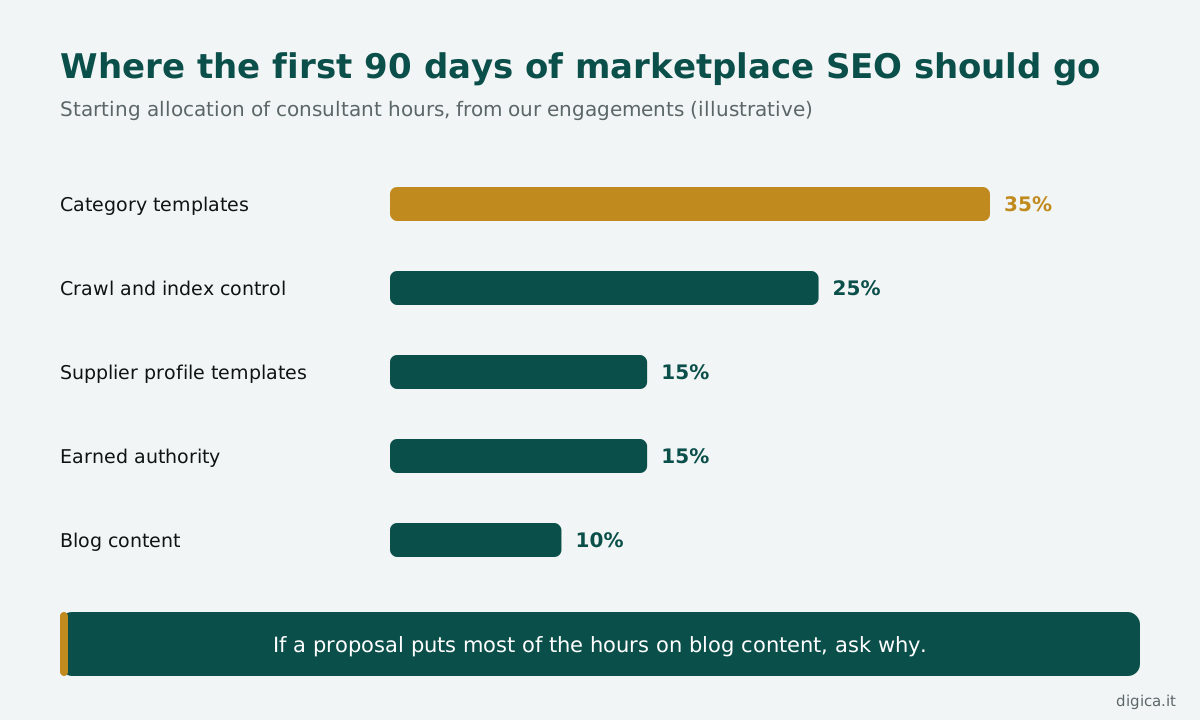
The allocation above is the shape we expect to see in a good 90-day plan. If a proposal reverses it, with most of the hours on blog content, ask why. Some marketplaces have a real reason, such as a brand-new category with no supply yet, but most do not. Ask the consultant to show the split in hours, not just in deliverables, so you can compare proposals on the same basis.
A worked example: what one category session is worth
Put a value on one organic session to a category page before comparing retainers. It turns the hiring decision into a payback calculation.
Take a B2B services marketplace (illustrative numbers, replace with yours):
- Category pages: 120, averaging 400 organic sessions a month, so 48,000 sessions
- Request rate from category pages: 2.5%, so 1,200 requests
- Requests that become a transaction: 40%, so 480 transactions
- Average transaction: $2,000 at a 10% take rate, so $200 of net revenue each
Monthly net revenue from category-page traffic: 480 × $200 = $96,000.
Value per category session: 2.5% × 40% × $200 = $2.00.
An $8,000 a month retainer needs $8,000 ÷ $2.00 = 4,000 extra category sessions a month to break even. On a 48,000-session base, that is an 8.3% lift. A consultant who ships template fixes across 120 category pages should clear that within two to three quarters; one who writes blog posts probably will not.
The supplier side adds a second line to the model. Suppose supplier landing pages bring 3,000 organic sessions a month, 3% of those visitors list their business, and each new active supplier generates $1,200 of net revenue in its first year. That is 90 new suppliers a month and roughly $108,000 of first-year net revenue from each monthly cohort. Most SEO proposals ignore this side completely, which is one more reason to hire someone who has worked on a two-sided business.
Run the sensitivity before you sign. If the real request rate is 1.5% rather than 2.5%, each category session is worth $1.20 and the same retainer needs about 6,700 extra sessions to break even. If it is 4%, the bar drops to 2,500. The rate you measure today decides how ambitious the consultant's targets must be.
Run the session math on your own marketplace
We build the per-session value model with your real numbers in one call.
The model also shows where to aim. A 20% lift on the same 120 pages adds 9,600 sessions and $19,200 of net revenue a month. That is the case to bring to the board: not "more traffic", but more requests from pages you already own. It also tells you which consultant to hire. Ask each finalist which three templates they would change first and how many of your 48,000 sessions those templates touch. The one whose first changes cover the most revenue-bearing sessions has understood your marketplace.
What a consultant is worth on the same traffic
On the same traffic, a marketplace SEO consultant is worth the lift on your category and supplier templates multiplied by the value of each session. In the example above, a 20% lift on category traffic adds $19,200 of net revenue a month, or $230,400 a year, against a retainer of $96,000. The engagement pays back in about five months once the lift lands, and the templates keep earning after the contract ends.
The cost of doing nothing compounds the other way. Every quarter a marketplace leaves faceted URLs uncontrolled and profiles thin, competitors with cleaner templates take the category rankings, and the AI citations that now follow them.
The number to take into your next leadership meeting: at $2.00 per category session, an $8,000 retainer must add 4,000 category sessions a month to pay for itself, and a 20% lift on a 48,000-session base is worth $230,400 a year.
FAQ
What does a B2B SEO consultant do for a marketplace? A B2B SEO consultant for a marketplace controls which URLs get crawled and indexed, specifies the category and supplier page templates that carry most organic revenue, plans earned authority on both the buyer and supplier side, and reports organic requests by template. Blog content comes after those foundations work.
How much does a B2B SEO consultant cost? From the engagements we see, experienced independents charge $100 to $250 an hour, retainers run $3,000 to $12,000 a month, and a technical audit on a large catalog costs $5,000 to $20,000. Price moves with catalog size, number of templates and how much the consultant ships.
What is the difference between a B2B SEO consultant and a marketplace SEO consultant? A typical B2B SEO consultant grows a content-led site for one product. A marketplace SEO consultant works on database-generated templates, faceted navigation and supplier profiles for a two-sided platform. The second job needs template thinking and engineering access more than content volume.
When should a marketplace hire an SEO consultant instead of an agency? A consultant fits when you have an internal team that can ship and need senior judgment. An agency or specialist fits when you need execution and strategy together. Below 1,000 indexable URLs, a one-off audit is usually enough.
How long does marketplace SEO take to work? Crawl and index fixes can show effects within weeks. Category template changes usually take two to four months to show in traffic, and earned authority takes three to six months to compound. Judge progress at 90 days on indexed pages and sessions by template.
When does crawl budget matter for a marketplace? It matters once the catalog is large or changes fast. Google's crawl budget guide is written for sites with roughly 1 million or more pages changing weekly, or 10,000 or more pages changing daily, and for sites with many URLs stuck as discovered but not indexed. Below that, fix index quality first.
Should a B2B SEO consultant also handle AI search? Increasingly, yes. The facts that make a category page rank, such as prices, counts and clear answers, are the same facts AI engines quote. Ask any consultant how their template work supports citations in ChatGPT, Perplexity and Google AI Overviews.
Related Articles
- Category page SEO for marketplaces: the money page guide
- How B2B marketplaces reach 1M monthly organic visitors
- How to choose a GEO agency for a B2B marketplace
- Growth consultant cost: pricing models and what to expect
Where this connects
This article is part of our B2B marketplace growth series.