How B2B marketplaces reach 1M monthly organic visitors: the marketplace organic growth playbook
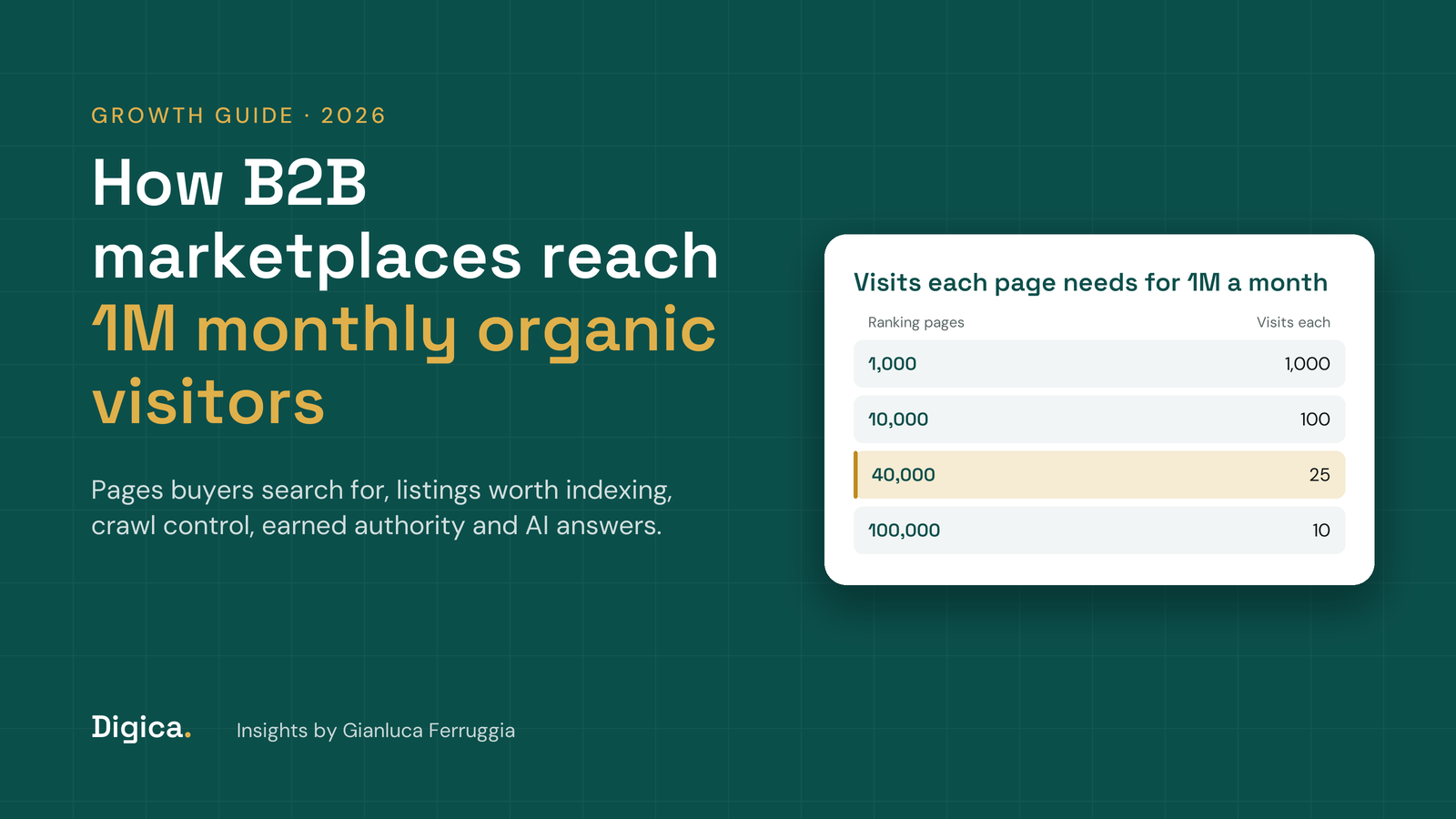
A million monthly organic visitors sounds like a brand problem. It is mostly an arithmetic problem. Spread 1,000,000 visits across 40,000 listing pages and each page needs only 25 visits a month. Spread it across 400 pages and each one needs 2,500. Marketplace organic growth at that scale comes from many pages each earning a little, not from a few pages earning a lot.
We have done it from the inside. Our founder was general manager of a B2B agency marketplace during the years it grew 3,200% to 1M+ monthly organic visits, and that business went from five people to 40,000+ listed agencies. The engine behind it was not a secret trick or a link budget. It was pages buyers search for, supply that filled them, authority earned on real domains, and a site search engines could crawl without getting lost.
This guide is for founders and marketing leads at B2B marketplaces and directories who want organic search to carry growth rather than decorate it. It covers the page architecture, the listing quality, the crawl control, the authority and the AI answers that compound into a seven-figure audience, and it ends with a decision framework. For the service side of the same work, see our marketplace SEO page; for the wider plan it fits into, our B2B marketplace growth strategy.
Quick Navigation
- The arithmetic of 1M monthly organic visitors
- Why most B2B marketplaces stall long before it
- Page architecture: the marketplace organic growth engine
- Listings worth indexing: supply is your content
- Crawl control: keeping search engines on the right pages
- Authority you earn, not links you buy
- Organic growth levers, side by side
- Marketplace SEO meets AI answers
- Three failure scenarios
- Where to start: a decision framework
- What 1M organic visitors is worth
- FAQ
- Related Articles
The arithmetic of 1M monthly organic visitors
The short answer: 1M monthly organic visitors is the sum of thousands of pages that each rank for a specific buyer search. The more pages that genuinely deserve to rank, the less traffic each one has to win, and the less any single ranking can sink you.
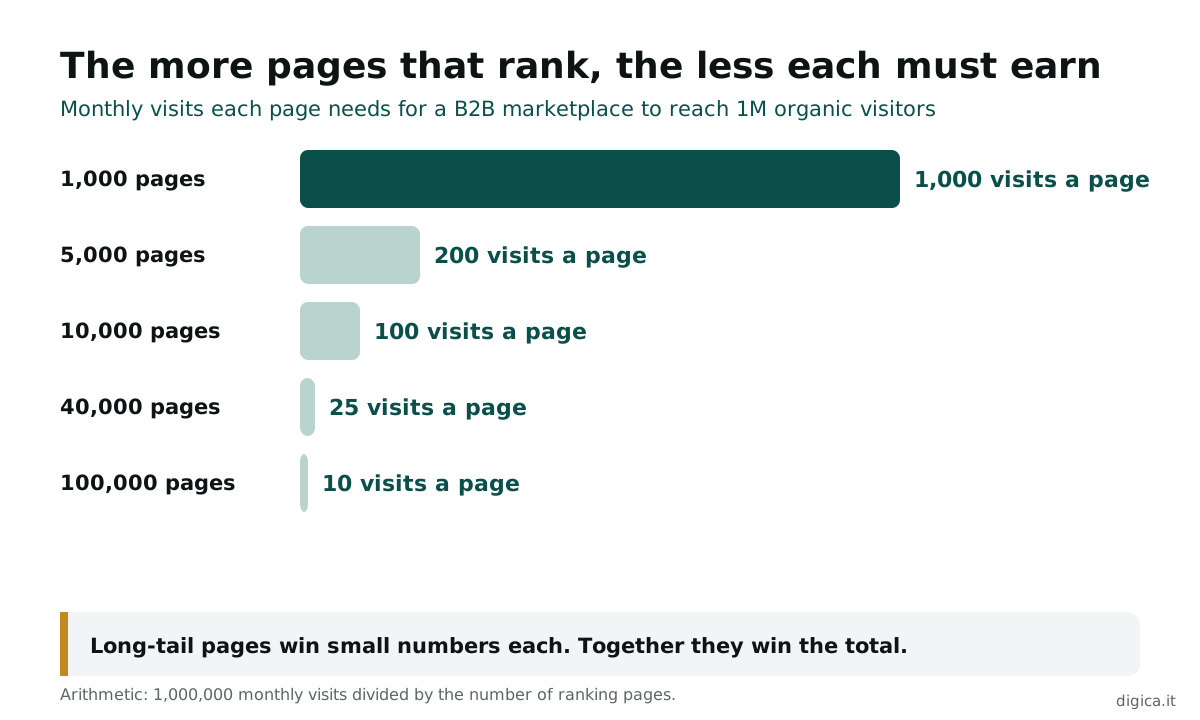
Run the numbers backwards. At 1,000 ranking pages, each needs 1,000 visits a month, which means a top-three position on searches with real volume. At 10,000 pages, each needs 100. At 40,000, each needs 25, which a specific page can earn from a handful of long-tail searches nobody else bothered to answer. A B2B marketplace is one of the few business models that can produce pages at that count, because every vendor, category and location combination is a page a buyer might look for.
That is also why B2B marketplaces are judged differently from software companies or publishers. A SaaS business wins organic traffic with a few hundred articles and comparison pages. A publisher wins it with volume of content it pays to write. A B2B marketplace wins it with pages its supply side fills: listings, reviews, prices, availability, locations. The content cost per page falls as the marketplace grows, which is the compounding part.
Our view: set the target as pages that rank, not as traffic. Traffic follows pages, and pages follow supply. A team that counts ranking pages every month knows whether it is on the path to 1M visits long before the traffic chart shows it.
Why most B2B marketplaces stall long before it
The short answer: most B2B marketplaces stall because they publish pages faster than they fill them. Thin category pages, empty location pages and near-duplicate listings teach search engines that most of the site is not worth showing.
The pattern recurs across verticals. A founder launches with a category tree copied from the industry's standard taxonomy, 300 categories deep, multiplies it by 200 cities and gets 60,000 pages on day one. Most hold one vendor or none. Search engines crawl them, find little to rank, and start to treat the whole domain with caution. Two years later the team is still trying to get the good pages indexed.
The opposite mistake is just as common: a beautiful B2B marketplace with 40 pages and every listing hidden behind a login or a search box. Buyers who arrive from Google land on the homepage, if they arrive at all. The supply is there. Search engines cannot see it.
Is your B2B marketplace stuck below the traffic it should have?
In 30 minutes we look at your categories, your listings and how search engines and AI assistants see them, and tell you what we would fix first, and whether we are the right people to do it.
Both mistakes have the same cause. The team treats organic growth as a marketing channel bolted onto the product, rather than as a product decision about which pages exist, what they show and who fills them. Have you checked how many of your published pages actually hold enough supply to deserve a ranking? Count them by hand on a sample of 50 category pages, and the answer usually explains the traffic chart better than any dashboard.
Page architecture: the marketplace organic growth engine
The short answer: a B2B marketplace that reaches 1M organic visitors is built on four page types, each answering a different buyer search: category pages, category and location pages, listing pages and comparison or guide pages. The architecture decides which of them exist, and in what order.
- Category pages answer "best X" and "X providers" searches. They are the money pages, and our guide to category page SEO for marketplaces covers what they must show.
- Category and location pages answer "X in Chicago" or "X suppliers in Germany". They multiply reach, and they are where thin pages multiply too.
- Listing pages answer brand and long-tail searches, and they carry the proof buyers want: services, prices, reviews, certifications, past work.
- Comparison and guide pages answer research searches before a buyer knows which category they need, and they feed authority to the pages below them.
Scale is where architecture meets crawling. Google's own guide to crawl budget says it is written for large sites with more than 1 million unique pages whose content changes about once a week, and for sites with more than 10,000 unique pages whose content changes daily (Google Search Central). A B2B marketplace on the path to 1M visits crosses the second line early. From that point, which pages exist is a crawling decision as much as a content one.
The rule we apply is to publish a page when its supply can fill it, not when the taxonomy allows it. A category and location page goes live when it holds enough vendors to be a useful answer, and stays out of the index until then. That rule alone separates the B2B marketplaces whose traffic compounds from the ones whose page count compounds while traffic stays flat. Our work on category and location page content starts from exactly that threshold.
Listings worth indexing: supply is your content
The short answer: on a B2B marketplace, the vendors write most of the content, so listing quality is an onboarding problem, not an editorial one. The marketplaces that reach 1M visits make complete, specific listings the easiest thing for a vendor to submit.
A listing that ranks has something no other page on the web has: this vendor's services, prices, locations, certifications, clients and reviews, in structured fields. A listing that does not rank has a logo, a two-line description copied from the vendor's homepage and an empty reviews tab. Search engines can tell the difference, and so can buyers.
Three things move listing quality across thousands of vendors at once. First, required structured fields at signup, so every listing exposes the facts buyers compare on. Second, profile completeness that pays: better placement in category pages for complete listings, which gives vendors a reason to finish. Third, reviews and proof collected as part of the product, not as an afterthought. Each of these is a supply decision, which is why attracting vendors to a B2B marketplace and organic growth are the same project.
Structured data is the last step, not the first. Marking up listings with the right schema helps search engines and AI assistants read the facts, but markup on an empty listing is still an empty listing. Fill the fields, then expose them.
The trade-off is friction. Every required field costs some vendors at signup. In our experience the right answer is a short first step, a live listing quickly, and completeness prompts that follow, so supply grows without the pages staying thin. A B2B marketplace that loses 10% of signups to a longer form but doubles the share of listings worth indexing usually comes out ahead on organic traffic within a year.
Crawl control: keeping search engines on the right pages
The short answer: crawl control means deciding which URLs search engines should see, and making the rest invisible to them. On a B2B marketplace the biggest risk is filters, sorting and pagination that turn one category into millions of near-identical URLs.
Every B2B marketplace has filters: location, price band, certification, company size, rating. Each combination can produce a URL. Left alone, a few hundred categories become millions of crawlable pages, almost all of them duplicates of each other. Search engines spend their time there, and the category pages buyers actually search for get crawled late or not at all.
The fix is a short list of decisions made once, in the platform rather than page by page. Which filter combinations deserve their own indexable page because buyers search for them? Which get a canonical tag pointing back to the category? Which are blocked from crawling entirely? How does pagination link through a long category so every listing is reachable in a few clicks? Rendering belongs on the same list: category and listing pages should arrive as finished HTML, not as a shell that fills in after JavaScript runs.
None of this is visible to buyers, which is why it gets skipped. It is also why a B2B marketplace can double its listings and see organic traffic stay flat. Our crawlability and render engineering work exists because the fix almost always sits with the development team, and it is cheaper to brief before launch than to repair after.
A practical test: compare the number of pages you want indexed with the number search engines report as indexed, and with the number of URLs they report crawling. If crawled URLs run at ten times your intended pages, filters are eating the crawl. If indexed pages sit well below intended ones, the pages are too thin or too hard to reach.
Authority you earn, not links you buy
The short answer: authority comes from other real websites citing yours, and on a B2B marketplace it is earned with data and stories only the marketplace has. Buying links is both against search engine rules and a waste of the asset you are building.
Google's spam policies are plain about it. They define link spam as creating links primarily to manipulate search rankings, and list buying or selling links for ranking purposes as an example (Google Search Central). Paid directories and link packages are the version most B2B marketplaces are offered. They look cheap and they compound in the wrong direction.
Our policy is the same for every client: we earn editorial placements on real company domains and point them at the pages that convert. No paid directories, no bought links. In one live programme for a design marketplace that has meant 275+ editorial collaborations, each one a page on a real business's site that mentions the marketplace because it was useful to their readers.
A B2B marketplace has three things publishers want and few other businesses can offer. Its own data: what buyers search for, what vendors charge, which categories are growing. Its vendors: thousands of businesses, each with a reason to mention the marketplace that lists and ranks them. And its rankings and awards, which vendors share on their own sites. Built properly, those three produce links every month without a link budget, and our editorial placements and digital PR service starts from them.
The trade-off is time. Earned authority shows in rankings over months, not weeks, and the first placements are the slowest. That is exactly why it compounds: a competitor with a bigger budget cannot buy what you earned, and you keep it when the programme ends.
Organic growth levers, side by side
The short answer: page architecture and crawl control decide how much traffic the site can hold, listings and authority decide how much it wins, and AI answers decide whether it is named when buyers skip the search results.
Five organic growth levers for a B2B marketplace compared on what each builds, cost, time to show, main risk and best fit
| Lever | What it builds | Main cost | Time to show | Main risk | Best for |
|---|---|---|---|---|---|
| Page architecture | Pages that match buyer searches | Product and developer time | 3 to 6 months | Publishing pages supply cannot fill | Every B2B marketplace, first |
| Listing quality | Unique content on every listing | Onboarding design, vendor effort | 3 to 9 months | Signup friction | Marketplaces with 500+ vendors |
| Crawl control | Crawl spent on pages that matter | Developer time, once | Weeks after the fix | Blocking pages that should rank | Sites past 10,000 URLs |
| Earned authority | Links and mentions you own | Data, editorial and outreach time | 6 to 12 months | Slow first results | Competitive categories |
| AI answers | Being named in assistants' answers | Content and data work | 3 to 9 months | Hard to measure | Categories buyers research in AI tools |
Which of the five levers is holding your traffic back?
A growth audit crawls your B2B marketplace the way search engines and AI crawlers do, and shows which category, location and listing pages they can read, which they never reach, and where your authority goes.
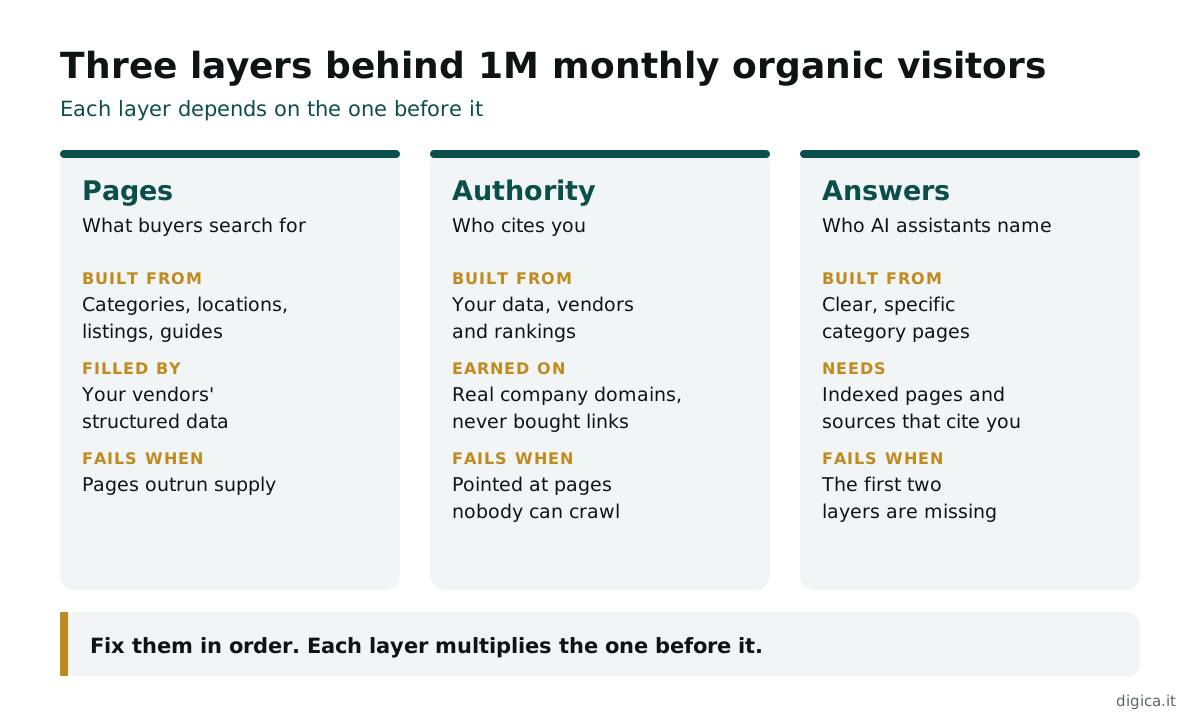
The time ranges are what we see in practice, not guarantees, and they overlap. The order matters more than the durations: authority pointed at a site that cannot be crawled is wasted, and AI assistants rarely quote a B2B marketplace that search engines have not indexed. Most teams we meet are working on the fourth or fifth lever while the first or second is still broken, which is why effort and traffic stop moving together.
Marketplace SEO meets AI answers
The short answer: buyers now get answers before they click, so a B2B marketplace has to be the source those answers name. The same structured pages and earned authority that win rankings are what AI assistants quote.
The click is shrinking. When Google shows an AI summary above the results, fewer searchers click through to any page, and the figures are in the last section of this guide. For a B2B marketplace, that means some of the traffic a ranking used to deliver now arrives as a mention instead: a buyer reads that your marketplace lists the vendors they need, then searches for you by name.
That changes what a page has to do. It has to state its answer plainly near the top, carry specific facts an assistant can lift, and be the source other sites cite on the topic. Category pages that open with the count, the criteria and the top vendors work for both readers. Our guide to GEO for marketplaces covers how category and listing pages are rebuilt for this, and our generative engine optimization service does the work.
Marketplace SEO and AI visibility are not two programmes. They are one engine with two outputs: rankings that send buyers this quarter, and citations that make the B2B marketplace the name buyers already know when they arrive. Have you checked what AI assistants say when a buyer asks who to use in your category?
Three failure scenarios
These are the patterns that recur when B2B marketplaces chase organic growth with the wrong lever first.
- The taxonomy that published itself. A B2B marketplace for industrial services launches every category in every city at once: 48,000 pages, most with no vendors. Search engines index a fraction and rank almost none, and the few strong category pages get crawled less often because the site is mostly empty. Publishing only the combinations its supply could fill, perhaps 2,000 pages, and adding more as vendors joined, would have put the same crawl behind pages that deserved it.
- The link budget that rented a ranking. A software marketplace buys a package of guest posts and directory links to push its top category pages. Rankings rise for a quarter, then fall after a search engine update, and the budget has bought nothing that lasts. The same spend on a yearly report built from its own buyer search data would have earned mentions it could keep.
- The listings nobody finished. A professional services marketplace grows to 5,000 vendors with a signup form that asks for a name, a logo and a website. Listing pages are near-identical and almost none rank. Required fields for services, locations and past clients, with better category placement for complete profiles, would have turned the same 5,000 vendors into 5,000 pages worth finding.
Each team worked hard on organic growth. None of them matched the lever to the constraint the site actually had.
Where to start: a decision framework
The short answer: fix the constraint in this order and stop at the first one that applies, because each later lever depends on the one before it.
- If search engines report crawling more than 5 times the number of pages you want indexed, start with crawl control: filters, sorting and pagination.
- If more than half of your published category and location pages hold fewer than 3 vendors, stop publishing new pages and remove or no-index the empty ones until supply catches up.
- If fewer than half of your listings have the fields buyers compare on, fix onboarding and profile completeness before you write another guide.
- If your best category pages sit on page two for their main searches, invest in earned authority, starting with data only your B2B marketplace has.
- If you already rank but buyers say they found you through an AI assistant, or never mention one, add AI answers to the plan and measure mentions alongside rankings.
- If none of these apply and traffic still grows slower than supply, the architecture is missing page types buyers search for. Map the searches before you build.
Want this run as one engine, not five projects?
We run marketplace SEO for B2B platforms: page architecture, listings, crawl control and earned authority, with your developers building from our brief or our in-house team doing it for you.
The thresholds above are starting points we use, not industry standards. Adjust them to your category's size, but keep the order. Most B2B marketplaces that stall have skipped a step, usually the unglamorous one, and are spending on the lever that cannot work until it is fixed. Revisit the list every quarter, because fixing one constraint usually exposes the next, and the right lever this quarter is rarely the right lever a year from now.
What 1M organic visitors is worth
The short answer: 1M monthly organic visitors is worth what the same traffic would cost to rent, every month, and it keeps arriving after the spend that built it stops. That is the gap between organic growth and paid growth.
AI summaries change that arithmetic, and it is worth being honest about how much. Pew Research Center tracked the browsing of 900 US adults and found that users who saw an AI summary on Google clicked a traditional search result in 8% of visits, against 15% for users who did not see one (Pew Research Center). Rankings still carry the traffic. A growing share of their value now also arrives as being named.
Work out your own number. If a paid click in your category costs $4, a million visits a month would cost $4 million a month to buy, and the traffic would stop the day the budget did. Organic traffic has costs too: product time, content, data and editorial work. But those costs build pages, listings and links the marketplace owns. Our comparison of paid and organic growth for marketplaces walks through the trade-off in more detail.
The pace can surprise people once the engine is in place. We have seen a water and wastewater marketplace reach 10x+ organic impressions within six months. That did not come from a single campaign. It came from pages, supply and authority finally pointing the same way.
The number to take into your next board meeting is the paid-equivalent value of your organic traffic, not the traffic itself. If your B2B marketplace earns 100,000 organic visits a month in a category where clicks cost $4, organic search is already doing $400,000 a month of work, and each month of delay on the right lever leaves that figure flat. The biggest cost of doing nothing is a competitor whose pages, listings and links compound while yours do not.
FAQ
How long does marketplace organic growth take? Expect early movement in 3 to 6 months once page architecture and crawl control are fixed, and compounding growth from 12 months on, as listings fill and earned authority builds. A B2B marketplace that starts from thin pages takes longer, because it has to repair before it can grow.
What is the difference between marketplace SEO and regular SEO? Marketplace SEO works on pages the supply side fills: thousands of category, location and listing pages generated from vendor data. Regular SEO for a software or services company mostly works on pages the team writes. The marketplace version is more about architecture, listing quality and crawl control than about articles.
How many pages does a B2B marketplace need to reach 1M monthly visitors? There is no fixed number, but the arithmetic helps: at 10,000 ranking pages each needs about 100 visits a month, and at 40,000 each needs about 25. What matters is how many pages genuinely deserve to rank, not how many exist.
Should a B2B marketplace buy backlinks? No. Google's spam policies treat buying links for ranking purposes as a link scheme, and bought links rarely last. Earn editorial placements with data, vendor stories and rankings only your B2B marketplace can offer, and point them at the pages that convert.
Do AI Overviews reduce organic traffic for marketplaces? They reduce clicks on some searches. Pew Research Center found users clicked a traditional result in 8% of visits when an AI summary appeared, against 15% when one did not. The answer is to be the source those summaries name, with clear, specific category and listing pages.
Can organic growth work for a new B2B marketplace? Yes, if it starts narrow. Pick the categories and locations your first vendors can fill, publish only those pages, and widen as supply grows. A new B2B marketplace with 500 complete pages will usually outgrow one with 50,000 empty ones.
Related Articles
- Marketplace SEO for B2B platforms
- B2B marketplace growth strategy: what works in 2026
- Category page SEO for marketplaces: the money page guide
- GEO for marketplaces: category and listing page playbook
- How to grow a B2B marketplace: a stage-by-stage guide
- Paid vs organic marketplace growth: a founder lesson
- B2B marketplace software: build, buy or white-label?
- Being the source AI answer engines cite
Where this connects
This article is part of our B2B marketplace growth series. Browse more on the Digica blog.