The best auto parts marketplaces for repair shops, ranked on catalog and speed
A car on a lift with no part is a bay that earns nothing. Repair shops know the cost by the hour, which is why the auto parts marketplace they order from matters as much as the price of the part. PartsTech connects 34,000+ repair shops to 300+ suppliers at 30,000+ locations. Car-Part.com lists 190 million recycled parts from 4,400 suppliers. Both promise the right part, and they measure it in different units.
Demand is not slowing. The average age of light vehicles in the US reached a record 12.8 years in 2025, with 289 million in operation (S&P Global Mobility). Older cars need more repairs and more parts, often for models dealers no longer stock. The ordering platform a shop uses decides how many suppliers it can see at once, and how long a car waits for its part.
This guide ranks six auto parts marketplaces and ordering platforms for repair shops on catalog and delivery speed: catalog in each platform's own unit, such as suppliers, parts, shops or orders, and what each states about speed. It is written for owners of independent, collision and fleet repair shops choosing where to order, and for founders growing an auto parts B2B marketplace. Figures come from each platform's own pages and 2025 to 2026 trade reports, checked on November 15, 2026.
Quick Navigation
- How we ranked catalog and speed
- Six parts platforms side by side
- 1. PartsTech: the widest aftermarket search
- 2. OEC RepairLink and CollisionLink: the dealer parts network
- 3. Nexpart: the distributor ordering network
- 4. Worldpac speedDIAL: import parts, same day or next day
- 5. Car-Part.com: the recycled parts market
- 6. PartsTrader: collision parts with delivery data
- Three failure scenarios
- Choosing a parts platform by the work your shop does
- What delivery speed is worth
- FAQ
- Related Articles
How we ranked catalog and speed
We ranked on how much of the parts market a typical independent shop can reach through each platform, and how fast it says a part arrives. Catalog came first, because a platform that cannot find the part cannot deliver it. Speed came second, because a found part that takes a week still idles a bay.
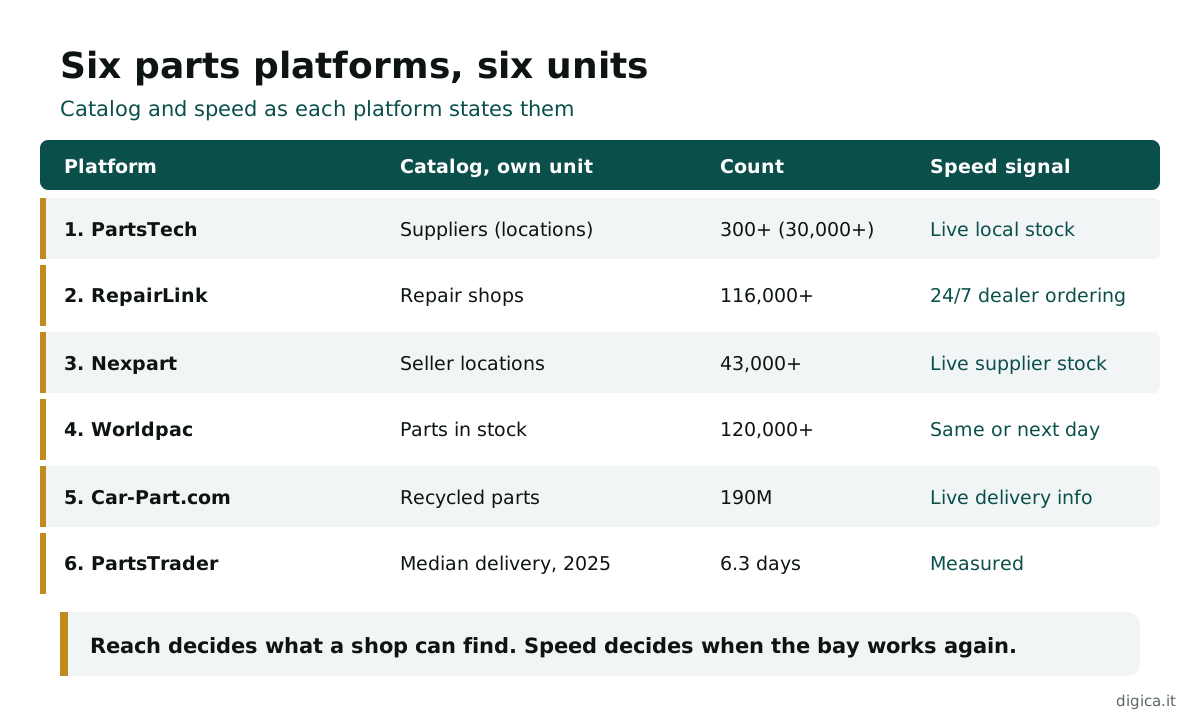
Each platform counts its catalog in its own unit: suppliers, supplier locations, parts, shops connected or orders a year. We recorded each one as stated. On speed, most platforms show live local stock rather than a delivery promise, so we noted where a platform states a delivery time or publishes measured delivery data.
Ownership has also changed fast. OEC bought PartsTech in January 2025, and Francisco Partners agreed to take a majority stake in OEC in November 2025. Carlyle bought Worldpac in November 2024. Enlyte, the parent of Mitchell, agreed to buy PartsTrader in December 2025. Shops should know who runs the platforms they depend on.
Our view: for most shops, the best parts platform is the one that shows the most local suppliers in one search. Price follows reach, because a shop that sees five suppliers can choose; a shop that sees one cannot.
Six parts platforms side by side
The table sets each platform's catalog against its speed signal, its fit and its main risk. Use it to shortlist before reading the ranking.
| Rank | Platform | Catalog, in its own unit | Speed signal | Who it serves | Main risk | Best for |
|---|---|---|---|---|---|---|
| 1 | PartsTech | 300+ suppliers at 30,000+ locations; 15M+ parts | Live local stock across suppliers | 34,000+ repair shops | Delivery set by each supplier | One search across aftermarket, tires and OE |
| 2 | OEC RepairLink and CollisionLink | 116,000+ repair shops; 19,000+ collision shops | 24/7 online ordering from dealers | Mechanical and collision shops | Dealer parts only | Genuine OE parts from dealers |
| 3 | Nexpart | 43,000+ seller locations; 370,000+ buyers | Live stock from a shop's own suppliers | Shops and parts stores | Depends on suppliers a shop links | Ordering from existing distributors |
| 4 | Worldpac speedDIAL | 120,000+ parts in stock; 11M+ vehicle fits | Most orders same day or next day | Import specialists | One distributor's stock | European and Asian vehicles |
| 5 | Car-Part.com | 190M recycled parts; 4,400 suppliers | Live delivery info across 15,000 supply links | Collision and mechanical shops | Used parts vary in grade | Recycled OEM parts |
| 6 | PartsTrader | Collision quotes from competing suppliers | Median 6.3 delivery days in 2025 | Collision repairers and insurers | Narrower network data published | Collision parts procurement |
Two patterns stand out. The platforms with the widest catalog leave delivery to the supplier, and the one that publishes measured delivery data serves only collision work. That is why reach leads the ranking, and why speed decides the order among platforms with similar reach.
1. PartsTech: the widest aftermarket search
PartsTech is a free ordering platform that lets a shop search many parts suppliers at once. It says it is trusted by 34,000+ repair shops and connects them to 300+ aftermarket and tire suppliers at 30,000+ locations, with 15 million+ parts from 7,000+ brands. Since OEC bought it, it also shows OE dealer parts from 8,800+ dealers in the same search.
That combination is the reason it ranks first. A shop types a vehicle and a job once, and sees aftermarket parts, tires and dealer parts side by side with live local stock and price. Delivery depends on the supplier a shop picks, so the speed is as good as the stores near the shop.
The verdict: PartsTech for independent shops that buy from several suppliers and want one search across all of them.
2. OEC RepairLink and CollisionLink: the dealer parts network
RepairLink is OEC's platform for ordering genuine OE parts from dealers. It counts 116,000+ repair shops, with 20+ manufacturers offering parts availability, and says it supports 97% of vehicles on the road. CollisionLink, its collision counterpart, has 19,000+ enrolled shops and processes 4 million+ collision parts orders a year across 29+ parts programs in the US and Canada.
Running an auto parts B2B marketplace?
In 30 minutes we look at how repair shops and suppliers find platforms like yours, on Google and in AI answers, and how to turn your catalog into more orders.
Dealer parts matter more as cars age and repairs get more complex. Some jobs, and many insurer and warranty repairs, require genuine parts, and RepairLink puts dealer stock and dealer pricing programs in one place. Ordering is online around the clock, and delivery comes from the dealer's own parts operation.
The verdict: RepairLink for mechanical shops that buy OE parts regularly, and CollisionLink for collision shops working with dealer parts programs.
3. Nexpart: the distributor ordering network
Nexpart, from WHI Solutions, is the ordering network many parts distributors and stores use to sell to shops. Integration partner Karmak puts it at over 43,000 seller locations and more than 370,000 active professional buyers, with over $5.1 billion in annual online parts sales. A 2025 integration with shop software Tekmetric gave shops access to a network of more than 53,000 vendors and 20 million products.
Its strength is the relationship a shop already has. Nexpart shows live stock from the distributors a shop links, at the shop's own pricing, so it fits a shop that wants to keep its suppliers and order faster. Its limit is the same: reach depends on which suppliers the shop connects.
The verdict: Nexpart for shops with established distributor accounts that want those accounts online.
4. Worldpac speedDIAL: import parts, same day or next day
Worldpac, owned by Carlyle since November 2024, is a distributor of original equipment and import parts, and speedDIAL is its ordering platform. It states 120,000+ parts in stock across its network, 11 million+ vehicle fit combinations and 41+ carlines. It says most orders are delivered the same day or the next day, depending on location and availability.
That is the clearest delivery promise in this guide. The trade-off is that speedDIAL shows one distributor's stock, not a marketplace of many. For European and Asian vehicles, where the right part is often hard to find locally, that one distributor's depth is the point.
The verdict: Worldpac for import specialists who need the correct original part by tomorrow.
5. Car-Part.com: the recycled parts market
Car-Part.com runs the largest database of recycled parts in North America: 190 million parts from 4,400 suppliers, mainly professional auto recyclers. Delivery information is updated in real time across 15,000 supply chain relationships, so a shop can see which recycler can get a part to it and when.
Recycled OEM parts fill a gap the other platforms do not: genuine parts for older cars at a lower price than new, and parts no longer made. Labor shortages make that gap matter. Automotive service technicians and mechanics held about 825,800 jobs in 2025, with a median pay of $50,620 (BLS). A shop that cannot hire more technicians earns more by keeping the ones it has working, not waiting.
The verdict: Car-Part.com for collision and mechanical shops that use recycled OEM parts, and for any shop working on older vehicles.
Grade and fit are the questions to settle before ordering. Recyclers grade used parts by condition, and a shop should know what each grade means at the recyclers it uses, and what warranty comes with the part. A recycled door that needs an hour of prep may still beat a new one that takes a week to arrive.
Are repair shops finding your parts platform?
A growth audit shows how shops search for parts platforms like yours, what AI answers say about your catalog and delivery, and which pages would win more shops and suppliers.
The first five platforms serve shops of every kind. The last one in this ranking is narrower by design, built for collision repair, where the parts list is long, the insurer is watching cycle time and several suppliers can quote on the same job. That focus is why it publishes delivery numbers the broader platforms do not. For a collision shop, those numbers are the most useful benchmark in this guide.
6. PartsTrader: collision parts with delivery data
PartsTrader is a collision parts procurement platform where suppliers compete to fill a repairer's parts list. It ranks sixth because it serves one kind of work, but it publishes the best delivery data in this guide. In 2025 its median delivery time for all part types fell from 9.2 days in January to 6.3 days, with OEM parts falling from 11.2 to 7.8 days and recycled parts from 3.7 to 3.5 days.
Its AI procurement tool, Orderly, was rolled out across Crash Champions' 650+ locations in December 2025. Enlyte, the parent of Mitchell, agreed to buy PartsTrader the same month, linking it to one of the estimating systems collision shops already use.
The verdict: PartsTrader for collision repairers and their insurer partners who want competitive quotes and measured delivery times. It publishes less about the size of its network, so ask for supplier counts in your area.
Three failure scenarios
These are illustrative patterns, not accounts of named companies. The costs are typical, not audited. Each comes from ordering through a platform built for different work, the pattern we see most often when shops grow faster than their parts process.
- One supplier, one search. A shop orders everything from one distributor's portal out of habit. A common brake job waits two days for stock that a store two miles away had on the shelf. Across a year, slow parts cost the shop about 150 lost bay hours, roughly $22,000 at $150 an hour. A multi-supplier search would have shown the nearer stock.
- Aftermarket where OE was required. A shop fits an aftermarket part on an insurer job that called for OE, and the repair is sent back. The redo costs the parts twice and a day of the bay. Checking OE requirements and ordering through a dealer network would have avoided it.
- The cheapest part, the slowest delivery. A collision shop always takes the lowest quote. Its cycle time grows by two days a car, and its insurer partner moves work elsewhere. Weighing delivery days alongside price would have kept the referrals.
In each case the platform did its job. The failure was using it for work it was not built for, or judging it on price alone. Before choosing, track for one month how long parts take to arrive by type, and which jobs wait longest. That one list usually points at the platform the shop is missing, and it is the evidence a service manager needs to change a long-standing ordering habit.
Choosing a parts platform by the work your shop does
Start with the work your shop does most, then match the platform. These thresholds are a starting point.
- If more than half your work is collision, use CollisionLink for dealer parts and PartsTrader for competitive quotes.
- If insurer or warranty jobs require OE parts, order through RepairLink, or PartsTech's OE dealer search.
- If more than a third of your cars are European or Asian imports, add Worldpac speedDIAL.
- If your average vehicle is over 12 years old, add Car-Part.com for recycled OEM parts.
- If you buy from three or more suppliers today, run every search through PartsTech.
- If you want to keep your current distributor accounts and pricing, put them on Nexpart.
- If parts waits cost more than 10 bay hours a month, change platforms before changing suppliers.
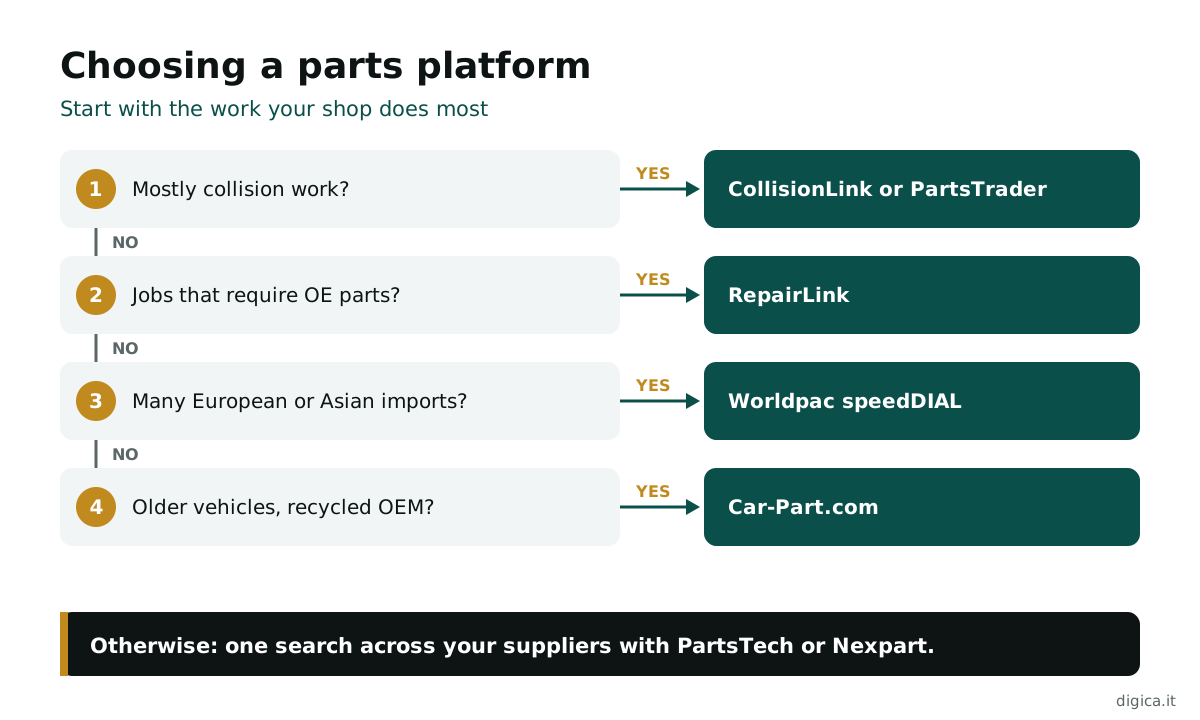
Most shops end up with two: one multi-supplier search for everyday jobs and one specialist channel for OE, imports or recycled parts.
What delivery speed is worth
Run an illustrative case. A six-bay shop billing $150 an hour loses about 12 bay hours a month to parts that arrive late. That is about $21,600 a year. Cutting late parts by half through a wider search or a faster channel is worth about $10,800 a year, more than most shops pay for any ordering software. The saving comes from bay hours, not from cheaper parts.
The market is growing, so the stakes rise each year. The US light-duty aftermarket is forecast to grow 5.2% in 2026 and pass $500 billion by 2029 (Auto Care Association). More repairs mean more parts orders, and more cost from every slow one. Older vehicles add to the strain: a 12-year-old car is more likely to need a part the local store does not stock, which is exactly when a wider search or a recycled part saves the most time.
Speed also shows up in reviews and repeat customers. A driver told the car will be ready Thursday, then Monday, rarely blames the parts supplier. They blame the shop. For a shop that wins work on trust and word of mouth, the parts process is part of the customer experience, even though the customer never sees it.
Measure it the simple way. For one month, log every job that waited for a part, the part type, the supplier and the hours the bay sat empty. Most shops find that a small number of part types and suppliers cause most of the waiting, and that one change of platform or channel fixes the largest share. The log also gives a shop the facts to negotiate with suppliers, because a supplier shown its own late deliveries tends to improve them.
For founders, the lesson is about proof. An auto parts B2B marketplace that publishes its suppliers by region, its parts coverage and its measured delivery times gives shops the answers they need, on its own pages and in the answers AI assistants give when a shop asks where to order.
Growing an auto parts B2B marketplace?
We help auto parts marketplaces win shops and suppliers through search, AI answers and the proof that makes a shop switch where it orders.
The number to take into your next shop meeting is 6.3: PartsTrader's median delivery days for collision parts in 2025, down from 9.2. Know your own number by part type. The biggest cost of doing nothing is bays waiting for parts, about $21,600 a year in a six-bay shop. Payback on a wider parts search is usually the first month.
FAQ
What is an auto parts marketplace for repair shops? It is an ordering platform where repair shops search and buy parts from many suppliers, distributors, dealers or recyclers at once, with live stock and their own pricing, instead of calling each one.
What is the best parts ordering platform for independent shops? PartsTech suits most independent shops, with 300+ suppliers at 30,000+ locations and dealer parts in one search. Nexpart suits shops that want to keep existing distributor accounts.
Where do repair shops buy OEM parts online? Through dealer networks such as OEC RepairLink, used by 116,000+ repair shops, and CollisionLink for collision work. Worldpac supplies original parts for import vehicles.
Where can shops buy recycled auto parts? Car-Part.com lists 190 million recycled parts from 4,400 suppliers, mainly professional auto recyclers, with live delivery information.
How fast do auto parts platforms deliver? Most show live local stock and leave delivery to the supplier. Worldpac says most orders arrive the same day or next day, and PartsTrader's median for collision parts was 6.3 days in 2025.
Are auto parts ordering platforms free for shops? Many are free for shops and earn from suppliers, but terms vary. Check the platform's pricing page and whether your own supplier pricing carries over.
Related Articles
- Auto parts marketplace growth
- The best aviation parts marketplaces
- The best industrial marketplaces
- The best B2B logistics marketplaces, compared
- The best surplus equipment marketplaces
Where this connects
This article is part of our B2B marketplace growth series. Browse more on the Digica blog.