The best B2B lead generation marketplaces, one award each for lead quality
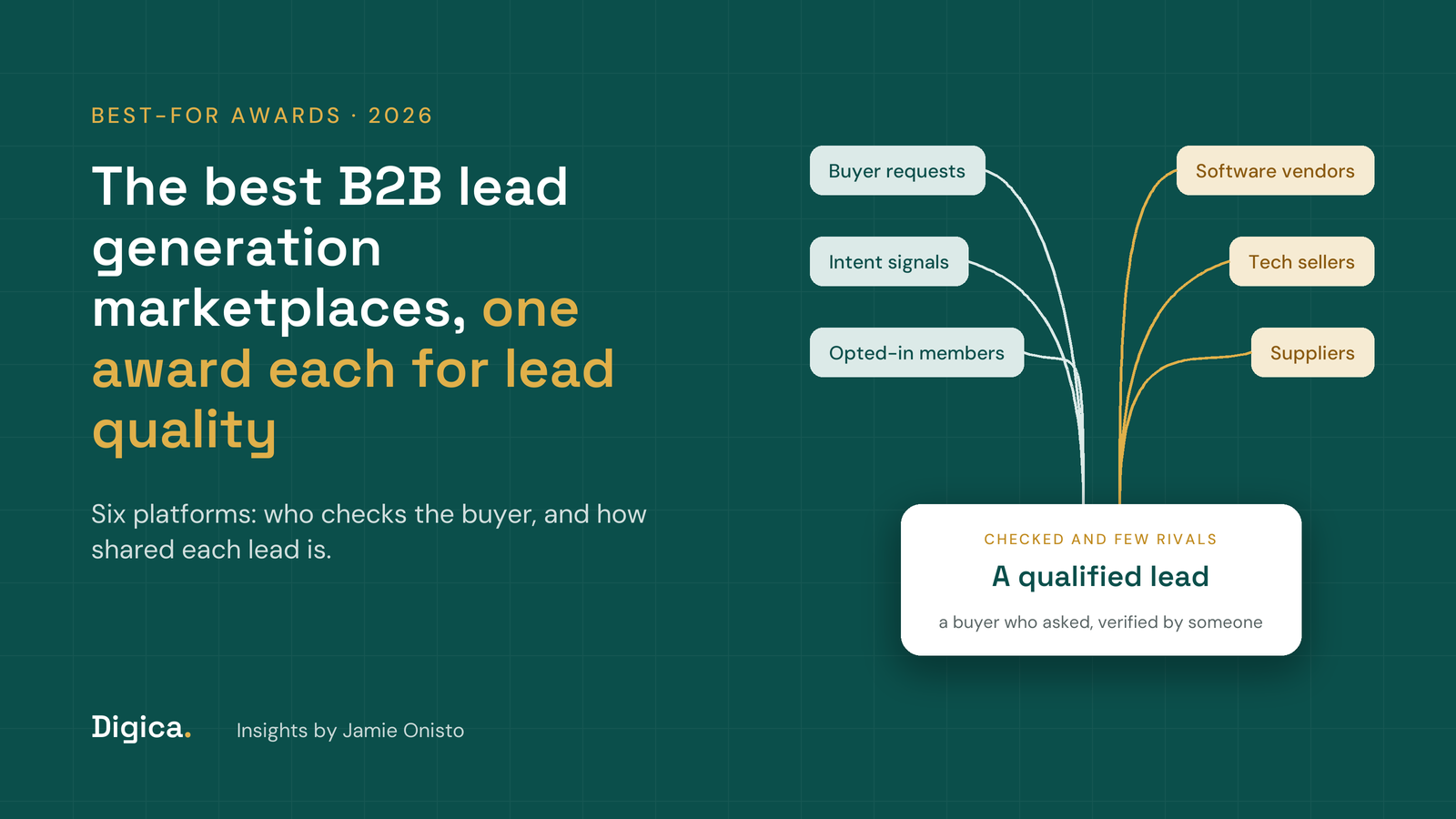
Every B2B lead generation marketplace sells "qualified leads". The word covers very different things. On 360Connect, a person calls each buyer within five minutes to check the request, then passes it to up to five suppliers. On G2, a "lead" can be a company that viewed your pricing page and compared you with a rival, with no person attached. Both are sold as leads, and the gap between them is where most lead budgets are won or lost.
Buyers have made that gap harder to close. The typical business purchase now involves 13 internal stakeholders and nine external influencers (Forrester). A single form fill rarely speaks for that group, so what a lead marketplace actually hands over, and how it checked it, matters more than the volume it promises.
This guide gives six B2B lead generation marketplaces one award each for lead quality: who verifies the buyer, how shared each lead is, and what a seller receives for its money. It is written for sales and marketing leaders deciding where to buy demand, and for founders growing a B2B marketplace or directory that sells leads to its own vendors. Figures come from each platform's own pages, checked on November 14, 2026.
Quick Navigation
- How we judged lead quality
- The six awards at a glance
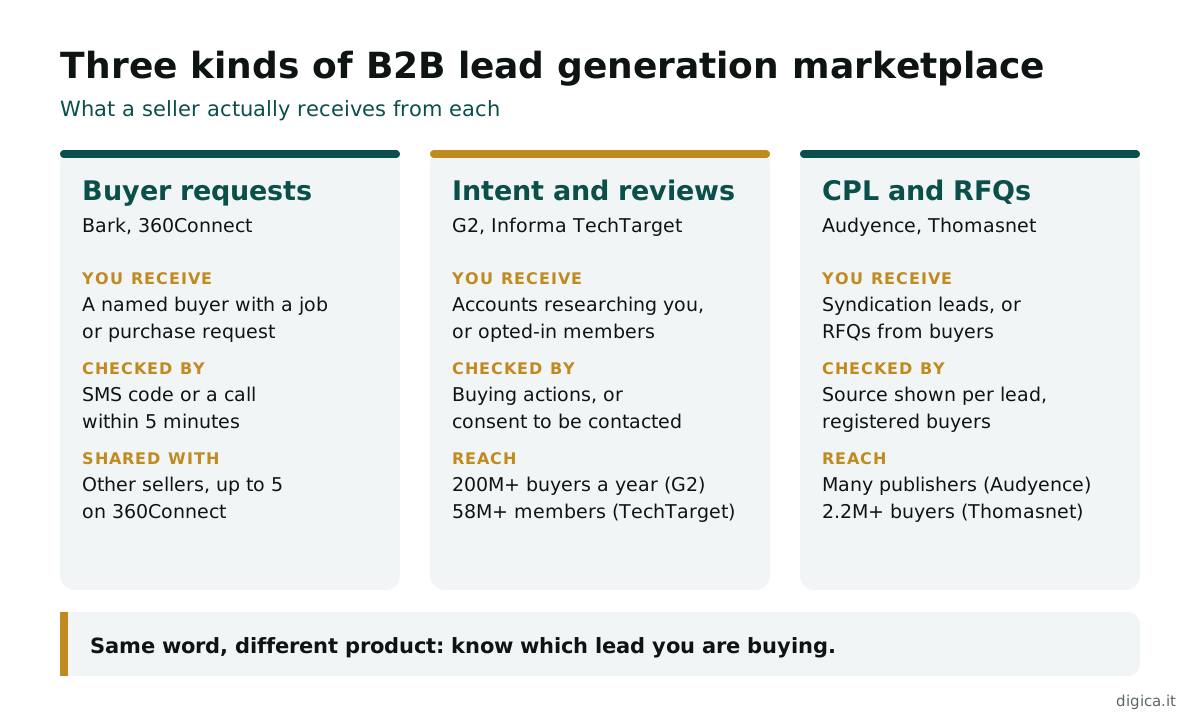
- Buyer-request marketplaces: Bark and 360Connect
- Intent and review marketplaces: G2 and Informa TechTarget
- Cost-per-lead and RFQ platforms: Audyence and Thomasnet
- What "qualified" means on each platform
- Three failure scenarios
- Choosing a B2B lead generation marketplace by what you sell
- What lead quality is worth
- FAQ
- Related Articles
How we judged lead quality
We asked three questions of each platform. Who checks the buyer, and how? How many other sellers receive the same lead? And what exactly arrives: a named person with a need, a company showing interest, or a contact who downloaded something? Those three answers decide whether a lead is worth calling.
We then gave each platform the award it earns on those answers, rather than ranking them against each other. A buyer request for a copier and an intent signal from a software comparison are different products, and a single ranking would hide that. We left out B2B contact databases and data providers, which sell records rather than buyers and are covered in our guide to B2B data providers.
Our view: the best lead is not the cheapest or the most numerous. It is the one where the buyer asked, someone checked, and few rivals got the same name. Most platforms deliver two of those three at best, so the job is knowing which two you are paying for.
The six awards at a glance
The table sets each award against what a seller receives, how the platform checks it, how shared it is and how it is sold. Use it to shortlist before reading the awards.
| Award | Platform | What you receive | How it is checked | How shared | How you pay | Main risk |
|---|---|---|---|---|---|---|
| Best for software vendors | G2, with Capterra, GetApp and Software Advice | Account-level buying signals, with pay-per-lead coming | Actions such as pricing page views and competitor comparisons | Signals can reach several vendors in a category | Subscription, with new pay-per-lead offers | A signal is not a conversation |
| Best for enterprise tech sellers | Informa TechTarget | Named, opted-in prospects with intent context | 58M+ permissioned members; consent to be contacted | Content syndication is sold to many sponsors | Programs and data subscriptions | Content downloads are early-stage |
| Best for local and professional B2B services | Bark | A buyer request with details of the job | Buyer confirms phone number by SMS | Shared with other professionals | Credits per response, valid 3 months | Competing on every lead |
| Best for phone-verified SMB purchase requests | 360Connect | A business purchase request | A call within 5 minutes to verify | Up to 5 suppliers | $10 to $600 per lead, monthly minimum | Shared with four rivals |
| Best for transparent cost-per-lead buying | Audyence | Content-syndication leads from many publishers | Fraud detection, source and path shown per lead | Depends on publisher | Cost per lead | Quality varies by publisher |
| Best for industrial manufacturers and suppliers | Thomasnet | RFQs and identified buyer companies | 2.2M+ registered industrial buyers | RFQs can go to several suppliers | Free profile, Verified subscription, sponsored listings | Results depend on listing spend |
Two patterns stand out. The platforms that verify a person charge per lead and share it. The platforms that sell signals reach far more buyers but hand over accounts, not conversations.
Buyer-request marketplaces: Bark and 360Connect
Buyer-request marketplaces start with a buyer who asked for something. That makes them the closest thing to an inbound enquiry you can buy. The trade-off is that you are rarely the only seller who sees it.
Best for local and professional B2B services: Bark
Bark matches customers with professionals in more than 1,500 categories, from accountants and web designers to cleaners and consultants. A buyer describes the job in detail and confirms a phone number by SMS before the request goes out. Professionals receive every lead that matches their service and area, as soon as it is placed.
Sellers pay only to respond. They buy a pack of credits and spend them on the requests they want, with the price set by the service, the value of the job and local supply and demand. Credits are valid for three months, and Bark returns the credits from a first pack if it wins no business. The catch is competition: several professionals can respond to the same request, so speed and the quality of the first reply decide who wins.
Best for phone-verified SMB purchase requests: 360Connect
360Connect handles business purchases such as copiers, payroll, managed IT and HR outsourcing in the US. Its check is the strictest of the request marketplaces here: a member of its Buyer Connect Team calls each buyer within five minutes to verify the request, alongside predictive lead scoring.
Running a B2B marketplace that sells leads to its vendors?
In 30 minutes we look at how buyers find platforms like yours, on Google and in AI answers, and how to turn more of those visits into requests your vendors will pay for.
Each verified buyer is shared with up to five suppliers. Leads cost $10 to $600 each against a monthly minimum, and suppliers can ask for a review of a bad lead within 10 days and get a refund if it is confirmed. 360Connect says clients who follow its best practices average about a 10% close rate, a vendor figure rather than an audited one. The award goes to it for being clear on all three quality questions: who checks, how many rivals, and what happens when a lead is bad.
Intent and review marketplaces: G2 and Informa TechTarget
Intent marketplaces sell evidence that a company or person is researching your category. The volume is far larger than any request marketplace, because most buyers research long before they ask anyone for a quote. What you receive is earlier and less certain.
Best for software vendors: G2
G2 agreed in January 2026 to buy Capterra, Software Advice and GetApp from Gartner, joining the largest software review sites under one owner. G2 says more than 200 million software buyers research across the four sites each year, and that the combined network will hold nearly 6 million verified customer reviews.
Its buyer intent signals come from actions close to a purchase: product and category page views, competitor comparisons, pricing page visits and review reading. G2 says the combined network will deliver up to three times more of these signals and power new pay-per-lead offers. For a software vendor this is the widest view of who is evaluating the category. The limit is that most signals name an account, not a person, so a sales team still has to find the buyer inside it. Our guide to software review sites covers the review side in detail.
Best for enterprise tech sellers: Informa TechTarget
Informa TechTarget runs a network of 220 editorial sites for technology buyers and counts a permissioned member base of more than 58 million enterprise technology and business professionals. Its difference is the person: it surfaces demand at the level of a named, permissioned individual rather than only an account.
Its content syndication delivers opted-in buyers who have consented to be contacted, drawing on intent signals from an audience of 32 million+ technology professionals. That consent is the quality signal. The caution is stage: a person who downloaded a guide is researching, not buying, so these leads belong in a nurture program before they reach a sales call.
Cost-per-lead and RFQ platforms: Audyence and Thomasnet
The last two awards go to platforms that solve a specific quality problem. Audyence makes the source of each bought lead visible. Thomasnet puts a seller in front of industrial buyers who search with a part or a process in mind.
Best for transparent cost-per-lead buying: Audyence
Audyence calls itself the first programmatic marketplace for cost-per-lead inventory in B2B. Instead of buying content-syndication leads from one network at a time, a marketer buys from many publishers in one place and sees each lead's true source and path. Quality controls include targeting, built-in fraud detection and real-time optimization, drawing on what it describes as 17.5 billion data points.
Audyence argues that up to 47% of a typical cost per lead goes to manual work, commissions and markups, its own estimate. Whether or not that figure holds for your program, the point stands: when you can see which publisher produced which lead, you can stop paying for the ones that never convert.
Best for industrial manufacturers and suppliers: Thomasnet
Thomasnet, part of Xometry, is the North American sourcing platform where engineers and procurement teams search for suppliers. It reports 2.2 million+ registered industrial buyers and says 66% of buyers visit with a specific purchasing need. Suppliers receive requests for quotation through their profiles, and its analytics show identified buyer companies with their industry, latest search and recent activity.
It is not sold per lead. A free profile can receive RFQs, and a Verified subscription and sponsored listings increase visibility. That makes Thomasnet a long-term channel: results grow with the profile and the spend, and our guide to supplier databases covers the wider sourcing field.
What "qualified" means on each platform
The six platforms use the same words for four different checks. Knowing which check you are paying for decides what your sales team still has to do.
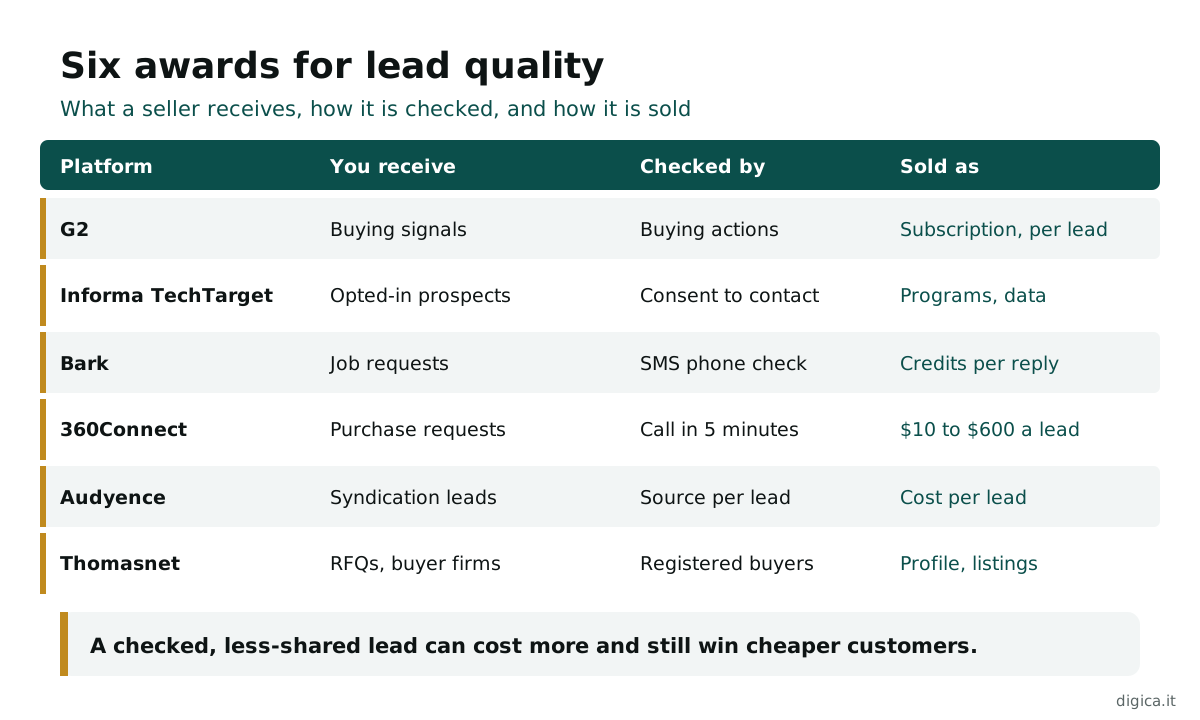
A verified contact, from Bark's SMS check or 360Connect's call, proves a real person asked for something. A verified need, from Thomasnet's RFQs and 360Connect's request details, proves what they want. A consented contact, from Informa TechTarget, proves the person agreed to hear from sponsors. A verified signal, from G2, proves a company did something that predicts buying. None of these proves budget or timing. That part is still the seller's job.
Timing is the hardest part. Buyers make first contact with a seller when they are already 61% of the way through their buying process, and they fill four of the five places on their shortlist on day one (CustomerThink, reporting 6sense research). A request lead arrives late in that process, with a shortlist already forming. A signal arrives early, before the shortlist. The two need different follow-up, and treating them the same is the most common reason lead marketplaces disappoint.
Three failure scenarios
These are illustrative patterns, not accounts of named companies. The costs are typical, not audited.
- The signal treated as a request. A software company buys intent data and hands every flagged account to sales as a hot lead. Reps call people who have never heard of the product, connect rates collapse, and the team stops trusting the data within a quarter. Routing signals to targeted ads and nurture first, and to sales only after a reply, would have kept the program alive.
- The shared lead answered slowly. An IT services firm buys requests shared with four other suppliers and replies the next morning. By then two rivals have called and booked visits. At $200 a lead and no wins, a month of spend is lost. Replying within minutes, which the platform's own model rewards, is the cheapest fix available.
- Paying for the unknown source. A marketing team buys content-syndication leads from a broker at a fixed price per lead and never asks where they came from. A third of the leads turn out to be outside the target market, and the cost per real opportunity is three times the plan. Asking for source transparency, or buying where it is shown, would have exposed the problem in the first week.
Are your leads reaching the right buyers?
A growth audit shows how buyers search for platforms in your category, what AI answers say about you, and which pages would turn visits into qualified requests.
In each case the marketplace did what it promised. The failure was buying one kind of lead and treating it as another. Before any spend, write down which of the four checks the platform performs, how many rivals see each lead, and how fast you can reply. Those three lines predict results better than any sales deck. Keep them next to each invoice, and review them with sales every month.
Choosing a B2B lead generation marketplace by what you sell
Start with what you sell and how buyers look for it, then match the platform. These thresholds are a starting point.
- If you sell software and buyers compare vendors on review sites, use G2's intent data, and test its pay-per-lead offers as they arrive.
- If you sell enterprise technology with a long cycle, use Informa TechTarget, and plan for at least one nurture step before sales.
- If you sell a professional or local service and can reply within an hour, Bark's per-response model lets you pick the jobs worth paying for.
- If you sell an SMB purchase such as copiers, payroll or managed IT in the US, use 360Connect, and track close rate against its stated average of about 10%.
- If you already buy content-syndication leads, move some budget to a marketplace that shows each lead's source, such as Audyence, and compare cost per opportunity.
- If you make or supply industrial parts and services, build a Thomasnet profile first, then add paid visibility once RFQs arrive.
- If a platform will not say how many sellers receive each lead, assume the answer is many.
Buyers increasingly prefer to do the research alone: 67% of B2B buyers favor a buying experience without a sales rep, according to a Gartner survey of 646 buyers (Digital Commerce 360). That favors platforms where buyers research and ask on their own terms, and it makes the speed and quality of your first reply the deciding factor.
What lead quality is worth
Run an illustrative case on a pay-per-lead model. If a lead costs $200 and 10% of leads close, each customer costs $2,000 in lead spend. If a lower-quality source costs $100 a lead but only 3% close, each customer costs about $3,300. The cheaper lead is the more expensive customer, and the gap widens with every month the program runs.
The same arithmetic applies to time. A sales rep who spends an hour on each of 100 poor leads a month gives up 100 hours that could have gone to the 10 leads that were real. Lead quality is a sales capacity question before it is a marketing budget question.
For marketplace founders, the lesson is the mirror image. A B2B marketplace that tells its vendors exactly how each lead was checked, and how many rivals saw it, earns more per lead and keeps vendors longer. That proof belongs on your pricing and vendor pages, in your demand generation and in the answers AI assistants give when a vendor asks where to find buyers.
Growing a B2B marketplace that sells leads?
We help B2B marketplaces fill both sides: buyers who ask, vendors who pay, and the proof that makes each lead worth buying.
The number to take into your next budget meeting is cost per customer, not cost per lead. If you buy leads that close at 10% instead of 3%, you can pay twice as much per lead and still spend about a third less on each customer won. The biggest cost of doing nothing is a lead budget judged on volume, quietly paying for names nobody can sell to. Payback on moving spend to better-checked sources usually shows within one quarter, as soon as cost per customer is tracked by source.
FAQ
What is a B2B lead generation marketplace? A B2B lead generation marketplace is a platform that connects sellers with business buyers, either by passing on buyer requests, selling buying signals, or delivering contacts who opted in to hear from sponsors. Sellers pay per lead, per response or by subscription.
Where can I buy qualified B2B leads? It depends on what you sell. Software vendors use G2, enterprise tech sellers use Informa TechTarget, service firms use Bark, US SMB suppliers use 360Connect, industrial suppliers use Thomasnet, and content-syndication buyers can use Audyence to see each lead's source.
Are pay-per-lead leads exclusive? Usually not. 360Connect shares each verified request with up to five suppliers, and Bark lets several professionals respond to the same request. Ask any platform how many sellers receive each lead before you buy.
What is the difference between a lead and an intent signal? A lead names a person who asked for something or agreed to be contacted. An intent signal shows that a company is researching your category, for example by comparing vendors or viewing pricing, without a request attached.
Does G2 own Capterra? Yes. G2 agreed in January 2026 to buy Capterra, Software Advice and GetApp from Gartner, bringing the four software review sites under one owner.
How do I measure lead quality? Track cost per opportunity and cost per customer by source, not cost per lead. Record how each lead was checked and how many rivals received it, then compare close rates across platforms over at least a quarter.
Related Articles
- Lead generation for B2B marketplaces
- The best software review sites: G2, Capterra and the alternatives
- The best B2B data providers, compared
- The best supplier databases for sourcing
- The best advertising marketplaces for B2B
Where this connects
This article is part of our B2B marketplace growth series. Browse more on the Digica blog.