The best energy marketplaces for businesses, grouped by type and compared on volume and participants
An energy marketplace can mean a power exchange that clears more than a thousand terawatt hours a year, or a website where 20 suppliers bid for one office building's electricity contract. Both are real B2B marketplaces. They answer different questions, and a business that confuses them either overpays for power or spends months trying to join a market it was never meant to trade on directly.
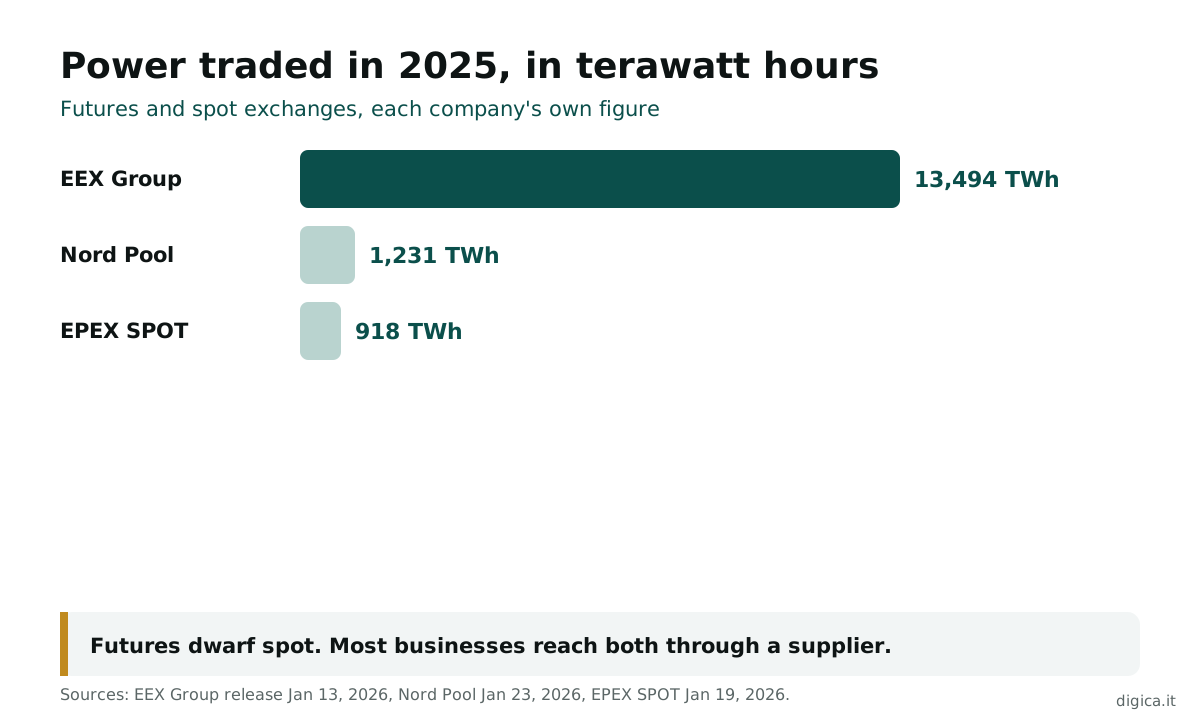
The volumes are large and still growing. EPEX SPOT says it traded a record 917.5 terawatt hours (TWh) of power in 2025, and Nord Pool says 1,231 TWh changed hands on its markets. Corporate buyers are active too: companies signed 55.9 gigawatts (GW) of clean power purchase agreements (PPAs) in 2025, according to BloombergNEF, with a record 29.5 GW in the United States (BloombergNEF).
This guide groups six energy marketplaces for businesses into three types: wholesale power exchanges, procurement auctions for business energy contracts, and marketplaces for renewable PPAs and certificates. It compares them on trading volume and participants: how much each one trades and who, and how many, trade on it. It is written for energy and procurement leads choosing where to buy, and for founders growing an energy B2B marketplace. Figures are each company's own, checked on November 2, 2026. For solar equipment and installers, see our guide to solar marketplaces and directories.
Quick Navigation
- What counts as an energy marketplace for a business
- Six energy marketplaces, compared on volume and participants
- Type 1: wholesale power exchanges
- Type 2: procurement auctions for business energy contracts
- Type 3: renewable PPA and certificate marketplaces
- Where an energy directory fits
- Volume against participants: what each energy marketplace number measures
- Three failure scenarios
- Choosing an energy marketplace: a decision framework
- What the right route is worth
- FAQ
- Related Articles
What counts as an energy marketplace for a business
The short answer: an energy marketplace is a platform where many sellers and many buyers of power, gas, renewable contracts or energy certificates meet, and where price is set by competition rather than by one supplier's tariff. A single utility's online quote form does not count.
For a business, the category splits three ways. Wholesale power exchanges, such as Nord Pool, EPEX SPOT and EEX, are where generators, suppliers, traders and very large consumers trade power for delivery tomorrow, later today or years ahead. Procurement auctions, such as Transparent Energy, run a live tender for a company's own supply contract, with retail suppliers bidding against each other. Renewable marketplaces, such as Zeigo and Xpansiv CBL, match corporate buyers with renewable developers or trade the certificates that prove where power came from.
All three are B2B marketplaces in the full sense. Sellers are on one side, buyers on the other, and the platform earns its fee or its membership when both keep coming back. The tests we apply to every B2B marketplace apply here: how much trades, who trades it and how well the two sides are matched.
What differs is access. A finance team cannot open an account on a power exchange the way it opens one on a procurement platform. Exchanges need members, clearing and collateral, so most businesses reach them through a supplier, a broker or an aggregator. That is why trading volume alone is a poor guide to which energy marketplace a business should use.
Our view: start from who is allowed to trade, then look at how much trades. The biggest number in this guide belongs to a market that almost no company in its first energy tender should try to join.
Six energy marketplaces, compared on volume and participants
The short answer: Nord Pool and EPEX SPOT carry the most spot power in this guide, EEX the most in total once futures are counted, Transparent Energy the most published spend among procurement auctions, Zeigo the largest published network of corporate PPA buyers, and Xpansiv CBL describes itself as the largest spot exchange for energy certificates.
Six energy marketplaces compared on type, volume claimed, participants, how a business takes part, main risk and best fit
| Marketplace | Type | Volume claimed | Participants | How a business takes part | Main risk | Best for |
|---|---|---|---|---|---|---|
| Nord Pool | Spot power exchange | 1,231 TWh in 2025 | Around 400 businesses, 20 countries | Membership, or through a supplier | Not a direct channel for most companies | Nordic and Baltic generators, suppliers, large users |
| EPEX SPOT | Spot power exchange | 917.5 TWh in 2025 | 455 trading members | Membership and clearing, or a member | Collateral and trading desk costs | European utilities, traders, aggregators |
| EEX Group | Power and gas derivatives | 13,494 TWh of power in 2025 | Exchange members and brokers | Usually through a broker or supplier | Hedging needs expertise | Businesses fixing prices years ahead |
| Transparent Energy | Procurement reverse auction | $5.35B+ of energy spend | 3,500+ customers | Hand over usage data, watch the auction | Deregulated US and Canadian markets only | US companies buying electricity and gas |
| Zeigo | PPA tender network | Not published | 600+ corporate buyers, nearly 40 developers | Run a PPA tender | Long contracts need stable demand | Mid-size and large firms on a first PPA |
| Xpansiv CBL | Certificate exchange | 3.15M MWh of RECs in 2024 | Members and brokers | Membership, or through a broker | No full-year 2025 total published | Companies buying certificates in volume |
Every figure is the company's own, and the units differ. The column that matters most for a business is "How a business takes part", because it decides whether the platform is a place to buy or a market your supplier buys on for you.
Type 1: wholesale power exchanges
The short answer: power exchanges carry the most volume of any energy marketplace, but they are built for members who trade every day. For most businesses they are the price reference behind a supply contract, not the place to sign it.
Nord Pool
Nord Pool runs day-ahead and intraday power markets from Oslo. It says 1,231 TWh was traded on its markets in 2025, with 1,037 TWh in the day-ahead market and 194 TWh intraday, where volume rose by more than 60% on 2024. It also says around 400 businesses from 20 countries trade on it, and it has announced plans to move into power futures.
That participant number is the useful one. Around 400 businesses clear more than a thousand terawatt hours, which tells you the exchange is a wholesale venue: utilities, generators, retailers, traders and a small number of very large industrial users. A food manufacturer in Finland benefits from Nord Pool prices every day without ever logging in.
Running an energy marketplace or procurement platform?
In 30 minutes we look at how businesses, suppliers and developers find platforms like yours, on Google and in AI answers, and where they drop off before they trade.
EPEX SPOT
EPEX SPOT, part of EEX Group and based in Paris, is the other large spot power exchange in Europe. It reported a record 917.5 TWh traded in 2025, up from 868.2 TWh in 2024, with 676.3 TWh in the day-ahead market and 241.2 TWh intraday. It had a record 455 registered trading members at the end of 2025, after admitting 46 new members during the year.
EPEX SPOT is also widening what it trades. Its Guarantees of Origin auction cleared 4,324 gigawatt hours (GWh) in 2025, and more than 200,000 assets are connected to its Localflex market in the UK, which buys local flexibility for a distribution network. On October 1, 2025 it switched day-ahead trading to 15-minute products. Each of those changes brings new kinds of participant, such as battery operators and aggregators, closer to the exchange.
EEX
EEX, the European Energy Exchange in Leipzig, is where prices are fixed months and years ahead. EEX Group says it traded 13,493.7 TWh of power across its markets in 2025, up 9%, including 9,330.3 TWh of European power derivatives. German power futures passed 6,000 TWh for the first time, and natural gas reached a record 8,823.2 TWh. The group calls itself the world's largest power trading platform.
A business uses EEX when it wants price certainty, usually by agreeing a fixed or partly fixed price with its supplier, who hedges on the exchange, or through a broker. The verdict. Nord Pool and EPEX SPOT show what power costs today and tomorrow. EEX shows what it is expected to cost in future years. Few businesses should join any of them directly.
Type 2: procurement auctions for business energy contracts
The short answer: a procurement auction runs a timed, competitive tender for one company's supply contract, with pre-screened retail suppliers bidding against each other. It is the energy marketplace a finance or facilities team can actually use this quarter.
Transparent Energy
Transparent Energy, based in Fairfield, New Jersey, runs live reverse auctions for business electricity and natural gas contracts. On its website it says it has executed more than 5,400 energy supply contracts, put more than $5.35 billion of energy supply spend through its platform, served more than 3,500 customers and procured more than 33 TWh of power, plus more than 8.5 million renewable energy certificates (RECs).
The model is simple to describe. A business hands over its usage data, suppliers that have been screened in advance submit prices in a timed auction and the buyer watches the bids fall in real time. The volume figure is the sum of many separate contracts, not a single pool of liquidity, so the meaningful measure is how many suppliers bid on each auction rather than the platform total.
The limit is geography. Reverse auctions only work where a business can choose its retail supplier, which in North America means deregulated US states and Canadian provinces. A company with sites in regulated states still buys from its utility there, whatever the platform can show elsewhere.
The verdict. For a US business in a deregulated state, a procurement auction is the most direct way to put suppliers in competition. It complements, rather than replaces, an energy advisor who understands your load profile.
Type 3: renewable PPA and certificate marketplaces
The short answer: PPA marketplaces match corporate buyers with renewable projects for contracts of ten years or more, and certificate exchanges trade the RECs and Guarantees of Origin that prove a megawatt hour came from a clean source. One builds new supply, the other trades proof.
Zeigo
Zeigo, now part of Schneider Electric, is a network where companies run tenders for renewable PPAs. Its website says more than 600 corporate sustainability leaders are active in the Zeigo Network, alongside nearly 40 of the largest renewable energy developers. It publishes quarterly PPA price reports drawn from offers submitted into its tenders.
That is a participant figure, not a volume figure, and Zeigo does not publish the gigawatts contracted through its network. For a buyer the participant number still matters, because a PPA tender succeeds when enough developers with suitable projects respond. The trade-off is commitment: a PPA ties a business to a price and a volume for a decade or more, which suits stable, large consumption far better than a fast-changing footprint.
Xpansiv CBL
Xpansiv CBL, run by Xpansiv in New York, is a spot exchange for environmental commodities. Xpansiv says 3.15 million megawatt hours (MWh) of RECs traded on CBL in 2024, up 18%, with a notional value of $158 million. In January 2025 alone, 251,758 MWh of RECs traded, with a record monthly notional value of more than $27 million.
It is also adding products. Xpansiv says 675,000 MWh of nuclear-based clean energy certificates traded in the first week after their launch on December 2, 2025, with buyers and sellers including Mercuria, Constellation and SmartestEnergy US. Xpansiv describes CBL as the largest spot exchange for energy attribute certificates and carbon credits. It has not published a full-year 2025 REC total.
The verdict. A company that wants new renewable capacity built in its name should run a PPA tender through a network like Zeigo. A company that needs certificates to match this year's consumption should buy them on an exchange like Xpansiv CBL, directly or through a broker.
Where an energy directory fits
The short answer: an energy directory lists suppliers, brokers, developers or installers so a buyer can find them, and leaves the price and the contract to the two parties. It is the start of a search, not a market.
Directories are useful when the question is "who could supply this" rather than "what is the price". A facilities team looking for battery storage installers, a developer looking for an offtaker or a supplier mapping competitors will start in a directory, then move to a tender. For solar, our guide to solar marketplaces and directories covers the largest ones.
We found no general energy directory that publishes a credible 2025 count of listed companies or active buyers, so none is ranked here. That is itself a finding. In a category where exchanges publish volume to the decimal place, a directory that cannot say how many buyers use it is asking suppliers to pay for visibility they cannot measure.
The gap is an opportunity for whoever fills it. An energy directory that verifies its listings, shows how many buyer enquiries each category receives and publishes those numbers would stand out quickly, because buyers comparing suppliers increasingly start with a search engine or an AI assistant, and both favor sources that can be checked.
Volume against participants: what each energy marketplace number measures
The short answer: energy marketplaces report two kinds of number. Volume, in TWh, MWh or dollars, says how much trades. Participants, in members, customers or companies, says who can trade. A business needs both, and almost no platform publishes both in the same unit.
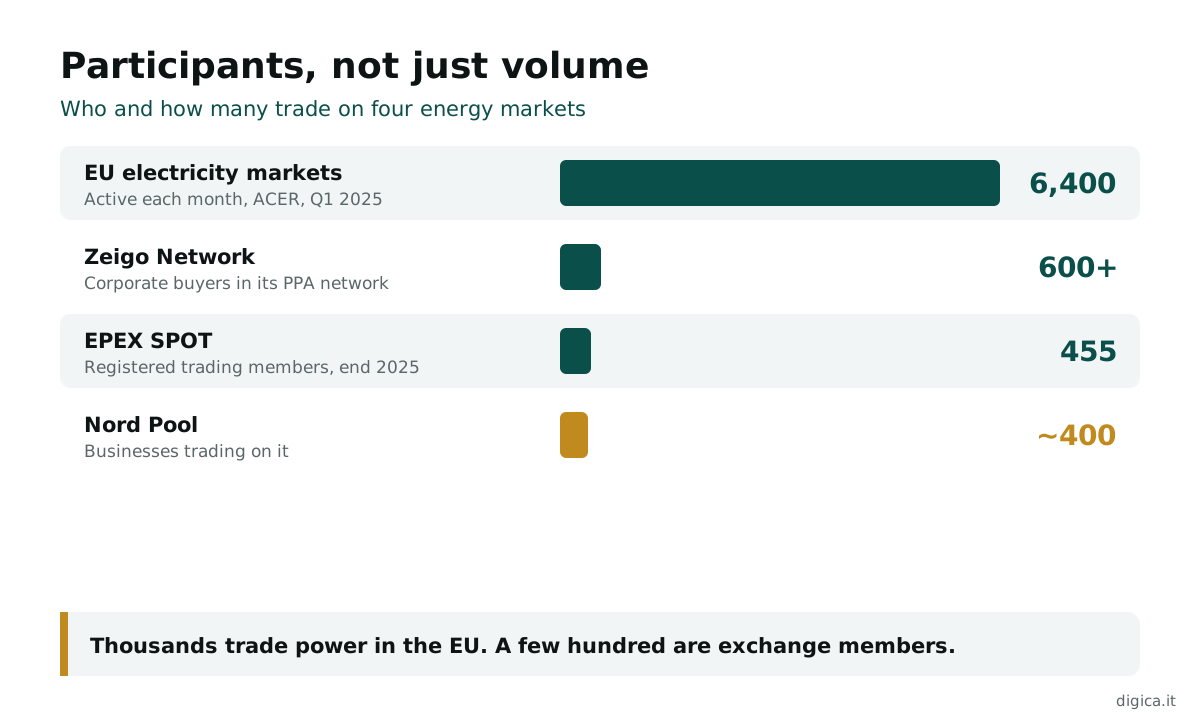
Look at the spread. Nord Pool's 1,231 TWh comes from around 400 businesses. EPEX SPOT's 917.5 TWh comes from 455 members. Transparent Energy's 33 TWh comes from more than 3,500 customers, each running its own contract. Zeigo publishes 600+ buyers and no volume at all. Divide volume by participants and the exchanges average more than 2 TWh per participant, while the procurement auction averages under 0.01 TWh per customer. Both are healthy. They are simply different markets.
Do businesses find your energy marketplace before a rival's?
A growth audit maps how buyers search for energy marketplaces like yours, on Google and in AI answers, and which of your market, product and supplier pages they never reach.
The wider market is crowded with participants. The EU Agency for the Cooperation of Energy Regulators (ACER) says that in the first quarter of 2025, on average 6,400 market participants were active each month in EU electricity markets, against 2,500 in gas, with almost 100 million trades reported (ACER). Many of them reach the market through brokers, suppliers or bilateral deals rather than as exchange members, which is how a few hundred members can account for such large exchange volumes.
For an operator, the lesson is to publish the number buyers actually use. A procurement platform should show suppliers per auction and contracts renewed. A PPA network should show megawatts contracted, not only members. A certificate exchange should publish annual volume every year, not only record months.
Three failure scenarios
These are the patterns that recur when businesses choose an energy marketplace on headline volume.
- The exchange application nobody needed. A mid-size manufacturer reads that power exchanges set the price and decides to buy wholesale directly. Six months later it is still working through membership, clearing and collateral rules, and its supply contract has rolled onto a standard variable rate. Running a tender for an index-linked supply contract, priced off the exchange, would have given it wholesale prices without the membership.
- The PPA that outlived the plan. A retailer signs a 12-year PPA through a tender to meet a sustainability target, sized to its current store estate. Three years later it has closed a fifth of its sites and is paying for power it no longer uses. A shorter certificate purchase for part of the demand, with a smaller PPA for the stable core, would have met the target with far less risk.
- The auction in a regulated state. A US company with sites in eight states runs a reverse auction and assumes it covers the whole portfolio. Three states are regulated, so those sites stay with their utilities and the projected saving shrinks by a third. Mapping which sites can choose a supplier before the tender would have set the right expectation with the finance team.
Each business picked a real energy marketplace. None matched the platform's participants and access rules to what it actually needed.
Choosing an energy marketplace: a decision framework
The short answer: start from what you are buying, how long you can commit and whether you are allowed to trade directly, then pick the type of energy marketplace that matches.
- If you are a business buying electricity or gas for your own sites in a deregulated US state or Canadian province, run a procurement auction such as Transparent Energy, and check how many suppliers bid on each auction.
- If you are in Europe and want wholesale prices without membership, ask suppliers for a contract indexed to Nord Pool or EPEX SPOT day-ahead prices.
- If you consume more than about 50 GWh a year and want price certainty for several years, fix part of your price through your supplier or a broker who hedges on EEX.
- If you want new renewable capacity built in your name and your consumption is stable for 10 years or more, run a PPA tender through a network such as Zeigo.
- If you need certificates to match this year's consumption, buy RECs or Guarantees of Origin on an exchange such as Xpansiv CBL or EPEX SPOT's auctions, directly or through a broker.
- If you are a generator, supplier, trader or large aggregator trading every day, apply for exchange membership.
Price data matters on every route. Corporate PPA volumes fell about 10% in 2025 after nearly a decade of growth, according to the BloombergNEF figures above, so buyers now have more room to compare offers than they had at the peak.
Growing an energy B2B marketplace?
We help energy marketplaces recruit the suppliers and developers that make a tender worth running, and reach the businesses comparing them, on Google and in AI answers.
Revisit the choice at every contract renewal. A company that starts with procurement auctions often adds a certificate purchase, then a PPA, as its sustainability targets harden and its demand becomes predictable. The routes are not exclusive: a large buyer can run a supply tender, hedge part of its price and sign a PPA for its stable base load, all in the same year, as long as each contract is sized to the demand it covers.
What the right route is worth
The short answer: the right energy marketplace is worth the difference between a competitive price and the incumbent's renewal offer, and it avoids the cost of commitments a business cannot carry.
Run the numbers on a typical case. A business spending $500,000 a year on electricity that renews without a tender takes whatever its supplier offers. If a competitive auction among several suppliers lowers the rate by 5%, that is $25,000 a year, or $75,000 over a three-year contract. The arithmetic is illustrative, and real savings depend on market timing and load profile, but the direction is consistent: more bidders on the same contract rarely produce a higher price.
The opportunity is growing in the United States. The US Energy Information Administration says US electricity generation reached a record 4.43 thousand TWh in 2025, and retail sales to commercial customers rose 2.9% (US EIA). More commercial demand means more contracts coming up for renewal, and every renewal is a chance to run a competitive tender instead of signing the incumbent's offer.
The number to take into your next budget conversation is the share of your energy spend that was last priced competitively. If the answer is none, one tender at the next renewal is the cheapest test you can run. The biggest cost of doing nothing is a rolling contract on a standard rate, renewed by default, year after year.
FAQ
What is an energy marketplace? An energy marketplace is a platform where many sellers and buyers of power, gas, renewable contracts or energy certificates trade, with price set by competition. For businesses the main types are wholesale power exchanges, procurement auctions for supply contracts and marketplaces for renewable PPAs and certificates.
Which energy marketplace trades the most power? In this guide, EEX Group reports the most, 13,493.7 TWh of power in 2025, mainly futures and other derivatives. Among spot exchanges, Nord Pool reported 1,231 TWh and EPEX SPOT 917.5 TWh in 2025.
Can a business buy electricity directly on a power exchange? Only by becoming an exchange member, with clearing and collateral, which suits utilities, traders and very large consumers. Most businesses get exchange prices through a supply contract indexed to the exchange, or through a broker.
How do energy procurement auctions work? A business shares its usage data, pre-screened suppliers bid for its contract in a timed reverse auction and the business picks the best offer. They work only where the business can choose its supplier, such as deregulated US states.
What is the difference between a PPA marketplace and a REC exchange? A PPA marketplace matches a company with a renewable project for a long contract, usually 10 years or more, which helps new capacity get built. A REC exchange trades certificates that prove a megawatt hour came from a renewable source, usually for the current year.
What is an energy directory? An energy directory lists energy suppliers, brokers, developers or installers so buyers can find them. It does not set prices or handle contracts, so it is the start of a search rather than a marketplace.
Related Articles
- Energy marketplace growth
- Best solar marketplaces and directories for installers
- Best procurement marketplaces for B2B buyers in 2026
- Best B2B marketplaces in 2026: 7 examples by industry
- Liquidity is the only marketplace metric that compounds
Where this connects
This article is part of our B2B marketplace growth series. Browse more on the Digica blog.