The best manufacturing and industrial communities, grouped by how members take part
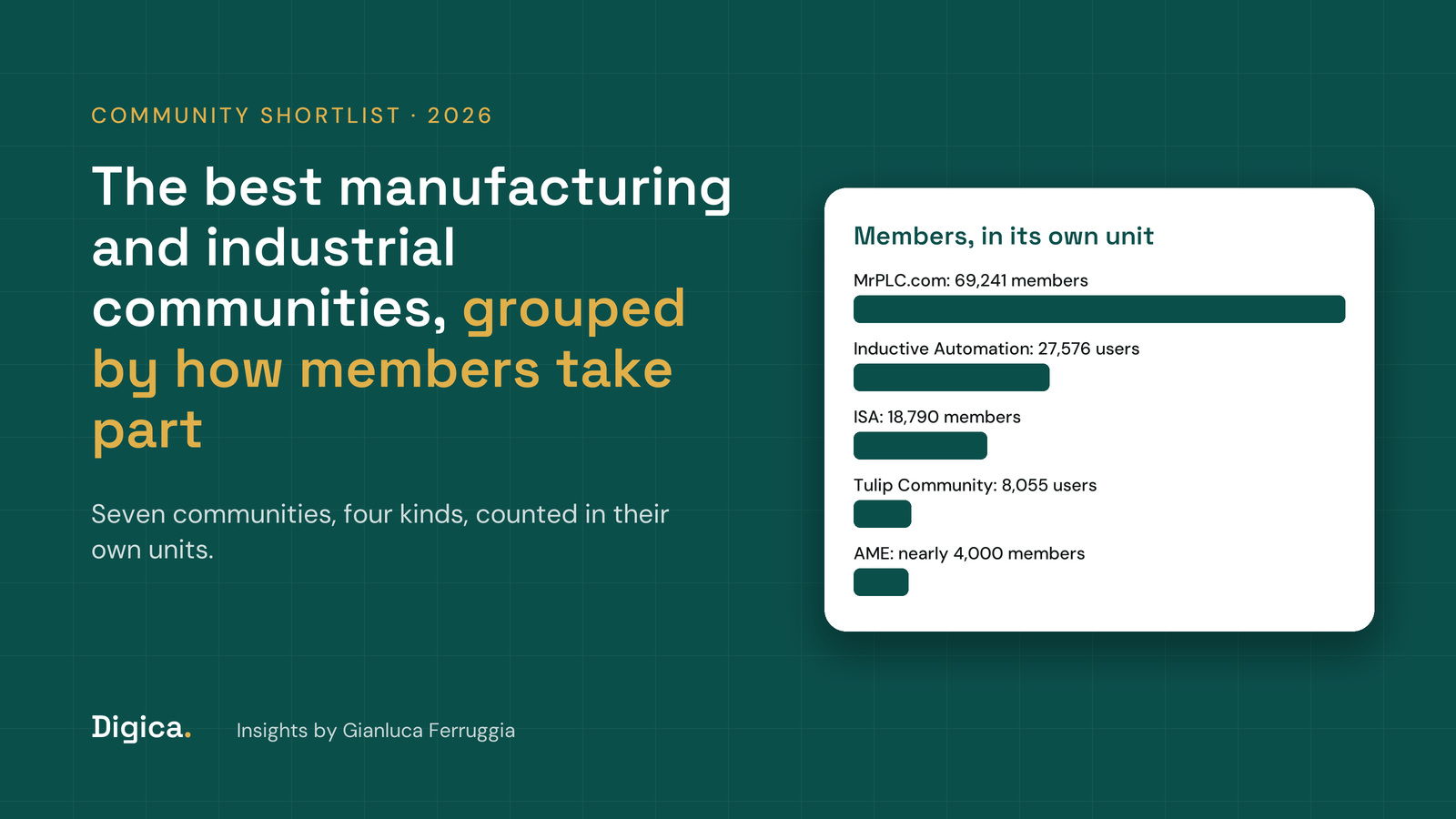
A controls engineer with a stuck PLC at 2 a.m. does not open a search engine first. They open a forum where someone has seen the same fault before. MrPLC.com has 69,241 members and 193,900 posts for exactly that moment. The Inductive Automation forum has 27,576 users, and 2,175 of them were active in the last 30 days. Both answer a search for an "industrial community", and they reward very different kinds of member.
The audience is large and short of time. The US had over 12.6 million manufacturing workers in September 2026, and 522,000 open manufacturing jobs in August (NAM). Fewer people are doing more specialized work, so the places where they swap fixes, benchmarks and job leads matter more each year. Which manufacturing community you join decides whose answers you get, and whether anyone answers at all.
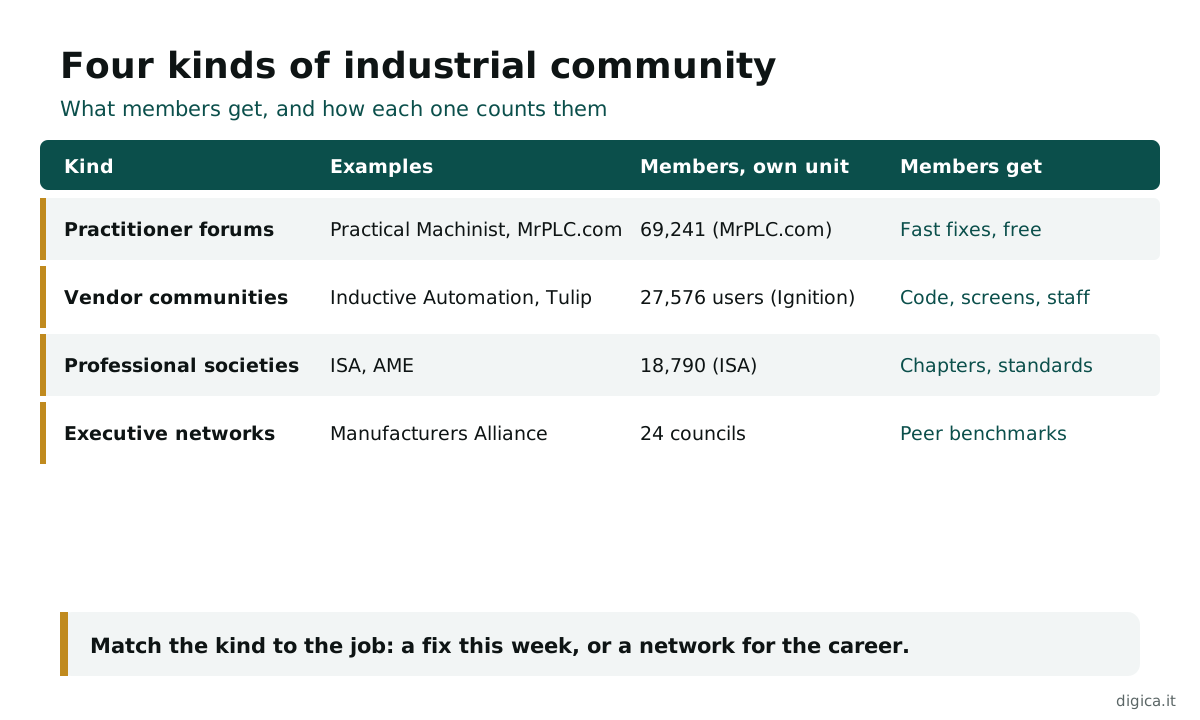
This guide groups seven manufacturing and industrial communities by how members take part: practitioner forums, vendor user communities, professional societies and executive peer networks. It compares them on members in each community's own unit, on activity, and on who joins. It is written for engineers and plant leaders choosing where to spend their hours, and for founders building an industrial B2B marketplace or community. Figures come from each community's own pages, checked on November 15, 2026.
Quick Navigation
- How we grouped and compared them
- Seven industrial communities side by side
- Practitioner forums: Practical Machinist and MrPLC.com
- Vendor user communities: Inductive Automation and Tulip
- Professional societies: ISA and AME
- Executive peer network: Manufacturers Alliance
- Members versus active members
- Three failure scenarios
- Choosing a manufacturing community by role and goal
- What an active community is worth
- FAQ
- Related Articles
How we grouped and compared them
We grouped communities by how members take part, because that decides what you get back. A forum rewards the person with a specific problem. A vendor community rewards people who run that vendor's software. A professional society rewards people who show up to chapters, standards work and conferences. An executive network rewards senior leaders who will share numbers with peers.
For each community we recorded members in its own unit, since they count differently: forum members, registered users, professional members, regions or councils. Where a community publishes activity, such as posts or active users, we recorded that too. A member count says how many people signed up once. Activity says how many will read your question this week.
We left out general business networks and closed buyer groups, which are covered in our guide to business communities, and supplier directories, which are covered in our guide to manufacturing directories.
Our view: in manufacturing, the useful community is the one where your exact problem has already been discussed. Size helps only when it raises the odds of that.
Seven industrial communities side by side
The table sets each community's type and size against its activity signal, its audience and its main risk. Use it to shortlist before reading the groups.
| Community | Type | Members, in its own unit | Activity signal | Who joins | Main risk | Best for |
|---|---|---|---|---|---|---|
| Practical Machinist | Practitioner forum | Not published | 1.2M posts in its General forum alone | Machinists, CNC programmers, job shop owners | No member count to judge reach | Machining and tooling problems |
| MrPLC.com | Practitioner forum | 69,241 members | 193,900 posts, 39,700 topics | Controls engineers, PLC programmers | Small team behind it | PLC and automation fixes |
| Inductive Automation forum | Vendor user community | 27,576 users | 2,175 active users in 30 days | Ignition developers and integrators | Only useful if you run Ignition | SCADA and MES builds on Ignition |
| Tulip Community | Vendor user community | 8,055 users | 211 active users in 30 days | Process engineers building Tulip apps | Smaller, single platform | Frontline operations apps |
| ISA | Professional society | 18,790 professional members | 101 sections in 33 countries | Automation and controls professionals | Membership fee, slower pace | Standards, training, local chapters |
| AME | Professional society | Nearly 4,000 members | 11 regions, annual conference | Lean and continuous improvement leaders | Smaller and US-centered | Plant tours and lean peers |
| Manufacturers Alliance | Executive peer network | 24 councils and 3 circles | Council meetings by function | Executives at $750M+ revenue companies | Closed to smaller firms | Benchmarking with peers |
Two patterns stand out. The communities with the most posts publish the least about who their members are, and the ones that know their members best are the hardest to join. Neither is better. They answer different questions.
Practitioner forums: Practical Machinist and MrPLC.com
Practitioner forums are where hands-on problems get solved in public. They are free to read, usually free to join and searchable, which is why their threads rank well and why engineers trust them.
Practical Machinist
Practical Machinist is the best-known forum for machinists and job shops. Its General forum, for manufacturing techniques, machines and tooling, holds 81,400 threads and 1.2 million posts. Its CNC Machining forum adds 49,300 threads and 608,100 posts, and its Antique Machinery and History forum holds another 333,600 posts. It does not publish a total member count on its forum index.
The verdict: Practical Machinist for anyone who cuts metal for a living. The depth of its archive means most machining questions already have an answer, often from someone who ran the same machine for twenty years.
MrPLC.com
MrPLC.com, run by Elston Systems, is a forum for programmable logic controllers and industrial automation. It counts 69,241 members, 39,700 topics and 193,900 posts, with a record of 13,996 people online at once. Its boards are split by controller brand, so an engineer can go straight to the platform on their line.
The verdict: MrPLC.com for controls engineers who need a second opinion on a specific controller, fast. The catch is that a small team runs it, so treat it as a place to ask, not a place to file a support ticket.
Building an industrial community or B2B marketplace?
In 30 minutes we look at how engineers and plant leaders find platforms like yours, on Google and in AI answers, and how to turn members into active ones.
Both forums share a weakness worth knowing before you rely on them. Neither checks who is answering, so a confident reply can come from a hobbyist or a vendor's salesperson as easily as from an expert. Read the poster's history before acting on a fix, and test any change on one machine before rolling it out across a line. The archive is the asset; judgment is still yours.
Vendor user communities: Inductive Automation and Tulip
Vendor user communities form around one software platform. Their members share code, screens and workarounds for that product, and the vendor's own staff often answer. They are the most active per member of any group here, because everyone in them is using the same tool this week.
Inductive Automation forum
The forum for Ignition, Inductive Automation's industrial software platform, counts 27,576 users, 63,020 topics and 435,898 posts. In the last 30 days it had 2,175 active users and 1,075 new posts. Around it sits an integrator program of more than 5,500 integration companies, and the company says its software is used by 69% of the Fortune 100.
The verdict: the Inductive Automation forum for anyone building SCADA, MES or dashboards on Ignition. Its activity rate is the highest we could measure in this guide.
Tulip Community
Tulip's community serves people building frontline operations apps on its no-code platform. It counts 8,055 users, 4,980 topics and 34,188 posts, with 211 active users in the last 30 days. It is smaller than the Ignition forum, and younger, but focused on the process engineers who build apps for operators.
The verdict: Tulip Community for teams already running Tulip on the shop floor. Outside that platform, its threads will be of limited use.
Professional societies: ISA and AME
Professional societies combine an online community with chapters, standards and certification. Membership costs money, and the return comes from people you meet in person as much as from threads you read.
ISA
ISA, the International Society of Automation, reported 18,790 professional members in 2025, up 6.76% on 2024, plus 3,252 student members. It runs 101 sections in 33 countries, and 87% of those sections offered three or more member activities in the year. Its standards work draws 4,900 volunteers from 40 countries. ISA has also taken over the content of MESA International, the manufacturing operations association.
The verdict: ISA for automation and controls professionals who want standards, training and a local section in one membership. It moves slower than a forum, and that is the point: its value builds over a career.
AME
AME, the Association for Manufacturing Excellence, says it has nearly 4,000 members across a wide range of industries, organized in 11 regions: eight in the US plus Australia, Canada and Mexico. It describes itself as practitioner to practitioner, and its plant tours and workshops are run by people who have led lean programs. Its next international conference is in Charlotte in November 2027, and individual membership starts at $150 a year.
The verdict: AME for continuous improvement leaders who learn best by walking someone else's shop floor.
Executive peer network: Manufacturers Alliance
Executive peer networks are closed by design. Manufacturers Alliance, which has supported manufacturing leaders since 1933, runs 24 councils and 3 circles organized by function: plant management, manufacturing operations, supply chain, finance, engineering and more. Its councils serve companies with $750 million or more in revenue and a large US presence.
It does not publish a member count, and that fits the model. The value is a room of peers who run the same function at a similar scale, and who will compare numbers they would never post on a forum. Investment pressure makes that comparison more useful. A 2025 survey of 600 manufacturing executives found that 80% plan to invest 20% or more of their improvement budgets in smart manufacturing (Deloitte). When most of your peers are spending on the same tools, knowing what worked for them is worth a seat at the table.
The verdict: Manufacturers Alliance for functional leaders at large manufacturers who want benchmarks, not answers to a single fault.
Members versus active members
A member count is the number in the headline. Active members are the number that answers your question. The Inductive Automation forum is the clearest example we found, because it publishes both.
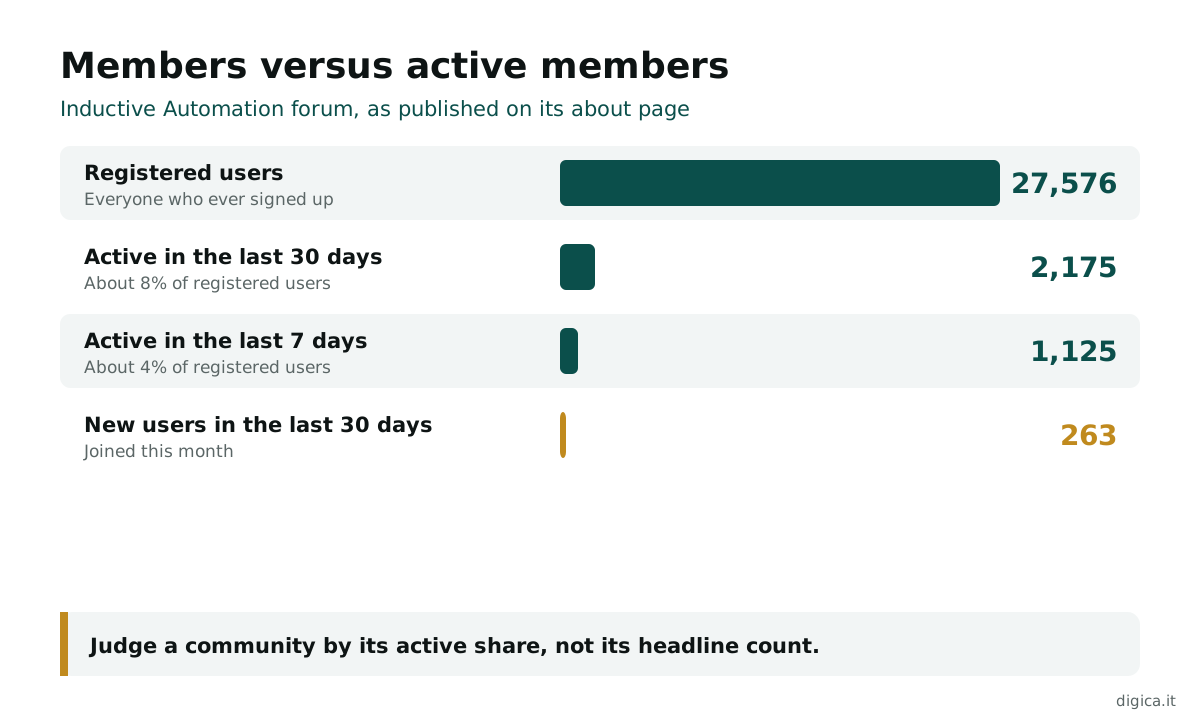
About 8% of its registered users were active in the last 30 days, and about 4% in the last week. That is a healthy rate for a technical forum, where most people sign up to ask one question and come back only when the next problem arrives. It still means a question reaches about 1,100 people in a typical week, not 27,000.
Read every community's numbers the same way. Ask how many people posted or logged in last month, not how many have ever joined. A society with 4,000 members who meet in person every quarter can be more useful than a forum with ten times the sign-ups and a few hundred readers. For founders, the lesson cuts the other way: publishing your active numbers, not just your total, is the proof that makes a busy engineer join.
Three failure scenarios
These are illustrative patterns, not accounts of named companies. The costs are typical, not audited. Each one comes from treating a community as if it were a different kind of community, which is the most common mistake we see among engineers who join several groups at once and among founders who launch one. The fix in each case is cheap if it is caught early and expensive if it is not.
- The wrong group for the problem. A plant engineer joins a professional society to fix a recurring controller fault, then waits a month for the next chapter meeting. The line loses two hours a week in the meantime. The same question posted to a practitioner forum would likely have had an answer within a day.
- The vendor community without the vendor. A team picks a community around a platform it is only evaluating, then finds the threads assume a working install. Months of reading give them little. Asking for a vendor's reference customers, and joining the community after the decision, would have used the time better.
- The headline count. A founder launches an industrial community and reports total sign-ups to investors. Eighteen months later, under 3% of members are active and sponsors stop renewing. Tracking and publishing active members from the start would have shown the problem when it was cheap to fix.
Is your industrial community visible to the right members?
A growth audit shows how engineers and plant leaders search for communities like yours, what AI answers say about you, and which pages would turn visitors into active members.
In each case the community did what it was built to do. The failure was choosing it for a job it was not built for, or judging it by the wrong number. Before joining, read the last month of posts in the boards you care about. Before launching, decide which activity number you will publish, and publish it every month even when it falls. Members forgive a dip. They do not forgive a number they later find was inflated, and in a field as small as industrial automation, word travels fast between plants, integrators and vendors.
Choosing a manufacturing community by role and goal
Start with what you need this quarter, then match the group. These thresholds are a starting point.
- If you need an answer to a specific machining problem within a day, post on Practical Machinist.
- If your problem is a PLC or controller fault, search MrPLC.com first, then post with the controller model in the title.
- If your plant runs Ignition at one or more sites, join the Inductive Automation forum before your next build.
- If your operators use Tulip apps, join Tulip Community and follow its app-building boards.
- If you work in automation and want standards, training and a local network, join ISA, and check that a section meets within an hour of you.
- If you lead a lean or continuous improvement program, join AME and book one plant tour a year.
- If your company has $750 million or more in revenue and you run a function, ask Manufacturers Alliance about its council for that function.
- If a community cannot tell you how many members were active last month, treat its total as a ceiling, not a reach number.
Most people need two: one forum or vendor community for this week's problem, and one society or network for the career.
What an active community is worth
Run an illustrative case. A plant with 15 engineers each spends two hours a week searching for answers to problems someone else has solved. At a loaded cost of $75 an hour, that is about $117,000 a year. If an active community cuts that search time by a quarter, it is worth about $29,000 a year to the plant, more than most memberships and conferences combined.
Training raises the stakes. Manufacturers spend about $31.9 billion a year on training, up from $26.2 billion in 2019, and 44.7% cited attracting and retaining workers as a top concern (NAM). A community where new engineers learn from experienced ones is part of that training budget, whether it is counted or not.
For founders, the same logic sets the goal. A manufacturing community grows when it publishes its active numbers, its experts and its best threads in a form that search engines and AI assistants can quote. That is what puts it in the answer when an engineer asks where to go.
Growing an industrial B2B marketplace or community?
We help industrial marketplaces and communities win members, buyers and suppliers through search, AI answers and the proof that makes engineers join.
The number to take into your next planning meeting is 8%: the share of the Inductive Automation forum's 27,576 users active in the last 30 days. Judge every community you join, or build, by its active share, not its headline count. The biggest cost of doing nothing is engineers who spend hours each week solving problems a peer solved years ago, about $29,000 a year in the illustrative plant above. A membership that cuts that search time pays back in its first quarter, often in its first month.
FAQ
What is an industrial community? An industrial community is an online or member group where engineers, machinists, plant managers and manufacturing leaders share fixes, benchmarks and job leads. It can be a forum, a vendor user community, a professional society or an executive peer network.
What is the best manufacturing community for machinists? Practical Machinist is the best-known forum for machinists and job shops. Its General forum alone holds 1.2 million posts on manufacturing techniques, machines and tooling.
Where do controls and automation engineers ask questions? MrPLC.com has 69,241 members for PLC and automation questions. Engineers who run Ignition use the Inductive Automation forum, which had 2,175 active users in the last 30 days.
Is joining a manufacturing association worth it? For a career in automation or lean manufacturing, usually yes. ISA adds standards, training and 101 local sections, and AME adds plant tours and lean peers. Use a forum alongside it for day to day problems.
How do I judge whether an online manufacturing community is active? Look for active users or posts in the last 30 days, not total members. Read the last month of threads in the boards you care about, and check how quickly questions get answered.
How do you grow a manufacturing community? Publish active member numbers and expert answers in pages that search engines and AI assistants can read, give members a reason to return each week, and track active share from the first month.
Related Articles
- Industrial marketplace growth
- The best business communities, compared
- The best community platforms for B2B brands
- How to grow an online community
- The best manufacturing marketplaces
Where this connects
This article is part of our B2B marketplace growth series. Browse more on the Digica blog.