The best lending marketplaces for business loans, with an award for each
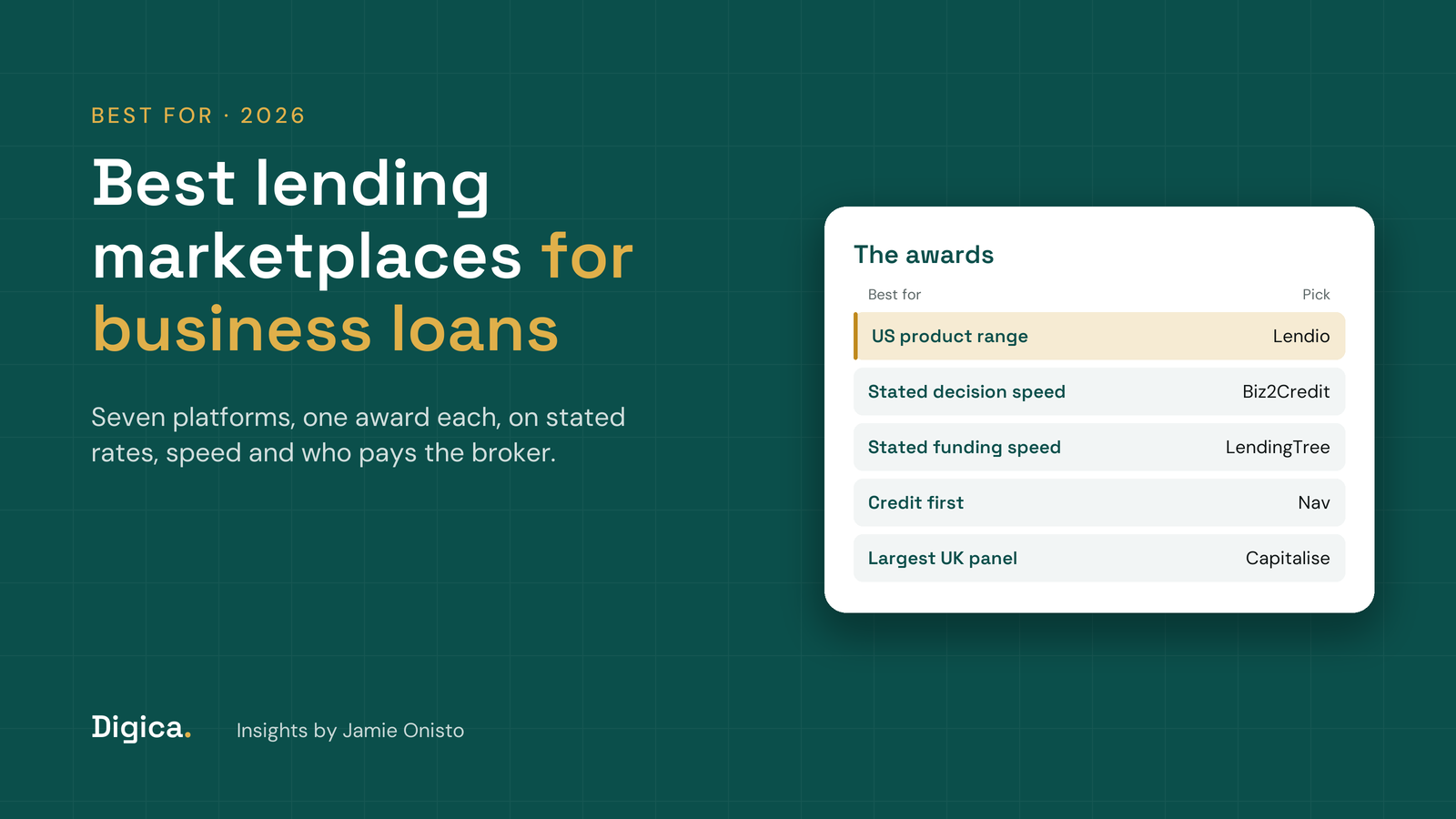
A lending marketplace matches one business with several lenders, and its value rests on two numbers: what the money costs and how quickly it arrives. Those are also the two numbers most platforms are vaguest about. Biz2Credit advertises a decision in as little as 24 hours. LendingTree advertises financing in as little as 24 hours. Almost none of the seven marketplaces in this guide will show you a rate until you have applied.
The stakes are real. In the Federal Reserve Banks' 2026 report on small employer firms, 60% of firms had applied for financing in the prior 12 months, and only 42% of applicants got the full amount they sought. The share going to online lenders rose from 17% in 2020 to 29% in 2025, and 60% of those online borrowers said their costs turned out higher than expected, against 37% at small banks (Federal Reserve Banks). Cost is where this decision goes wrong most often.
This guide gives seven lending marketplaces one award each, based on what they publish about rates, speed, minimums and how they get paid. These are stated claims, checked on November 4, 2026. We have not applied for a loan through any of them, and this is not financial advice. It is written for owners comparing a business loan marketplace, and for operators building one. For the wider category, see our page on fintech and lending B2B marketplace growth.
Quick Navigation
- What a lending marketplace is, and who pays for it
- Seven lending marketplaces at a glance
- Best US product range: Lendio
- Best stated decision speed: Biz2Credit
- Best stated funding speed: LendingTree
- Best for a guided process: Fundera by NerdWallet
- Best for checking your credit first: Nav
- Largest stated UK panel: Capitalise
- Clearest commission disclosure: Swoop
- Why rates stay hidden until you apply
- Three failure scenarios
- Choosing a lending marketplace: a decision framework
- What comparing lenders is worth
- FAQ
- Related Articles
What a lending marketplace is, and who pays for it
A lending marketplace takes one application and shows it to several lenders, so a business can compare offers without applying to each. Most make their money from the lender, which is the most important fact on the page.
That model has a clear benefit. It saves time, and it can reach lenders an owner has never heard of, including ones that will take a weaker file than a bank. It also has a built-in tension: the platform is usually paid when you take a loan, and some lenders may pay more than others. Swoop says so plainly, and we come back to that below. LendingTree says it is compensated by the companies whose listings appear, which may affect their order.
We chose platforms that match businesses with more than one funding source and left out direct lenders. SmartBiz, once a common name on these lists, acquired a bank in 2025 and now operates as SmartBiz Bank. Funding Circle sold its US business in 2024. Biz2Credit is included with a flag: its term loans come from Itria Ventures or Cross River Bank, so it works more like a hybrid than a pure marketplace.
Our view: before you compare rates, find out how the platform is paid. It tells you whose interest the ranking serves.
Seven lending marketplaces at a glance
Five of the seven are in the US and two are in the UK. None publishes a simple rate range for all its loans, so the columns below compare what each one does state.
Seven lending marketplaces compared on lenders, stated rates, stated speed, minimums, who pays, main risk and best fit
| Marketplace | Lenders or partners | Cost and rates shown | Stated speed | Stated minimums | Main risk | Best for |
|---|---|---|---|---|---|---|
| Lendio (US) | 75+ | Varies; credit lines 8% to 60% | Approval as soon as 24 hours | 6+ months, $8,000+ monthly revenue, 520+ credit (Finder) | Rate unknown until full application | Comparing many loan types |
| Biz2Credit (US) | Itria Ventures, Cross River Bank | Not published | Decision as fast as 24 hours | 650 FICO, $100,000 revenue | Hybrid, past FTC settlement | Established firms needing a fast answer |
| LendingTree (US) | Hundreds across all categories | Not on the business page | Financing in as little as 24 hours | Varies by lender | Paid placement may affect order | A broad first look |
| Fundera (US) | Not disclosed | Not disclosed | Not stated | $60,000 revenue, 600+ credit, 6+ months | Least transparent | Owners who want a guide |
| Nav (US) | 70+ options from 25+ partners | After engaging a lender | Not stated | Varies by partner | Follow-up contact, paid tiers | Fixing credit before applying |
| Capitalise (UK) | 130+ | Not published | Funded in as little as 48 hours | UK limited companies | UK only, guarantees possible | UK firms and their advisers |
| Swoop (UK) | Not counted | Not published | Not stated | 18+, no formal thresholds | Commission can affect the rate | Debt, equity and grants together |
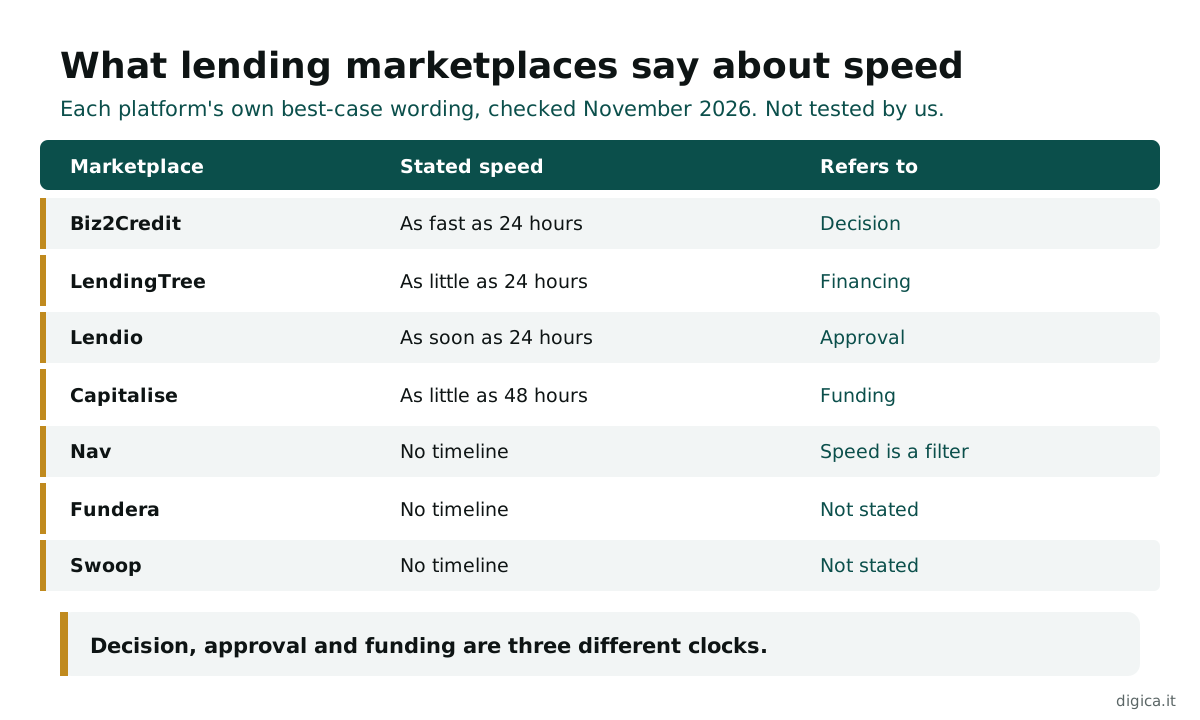
The "Stated speed" column carries the phrases "as soon as" and "as little as" for a reason. They describe the fastest cases, not the average. Read "Main risk" before "Best for".
Best US product range: Lendio
Lendio wins on breadth, with more than 75 lenders and 11 financing options in one application, and it is the name most US comparisons start with.
Finder's October 2026 review puts its panel at more than 75 lenders and says it has facilitated over $15 billion. It covers term loans, lines of credit, SBA loans, equipment financing, advances, receivables financing, commercial real estate, startup and acquisition loans. Applying is free, and reviews say lenders pay referral fees. The minimums Finder lists are six months in business, $8,000 in monthly revenue and a 520 credit score, though its review page also quotes higher figures, so treat those as the floor.
Speed depends heavily on the product. Finder reports approval as soon as 24 hours, and term loans, equipment finance and advances within a day or two. SBA, real estate and acquisition loans take weeks or months. On cost, Lendio publishes no single range, because rates vary by lender and product. Finder cites lines of credit at 8% to 60%, which shows how wide the spread can be.
Lendio is also moving beyond its own site. In June 2026 it announced that Lili would use it for embedded lending inside its small business platform. That points to where these marketplaces are going: into the software owners already use.
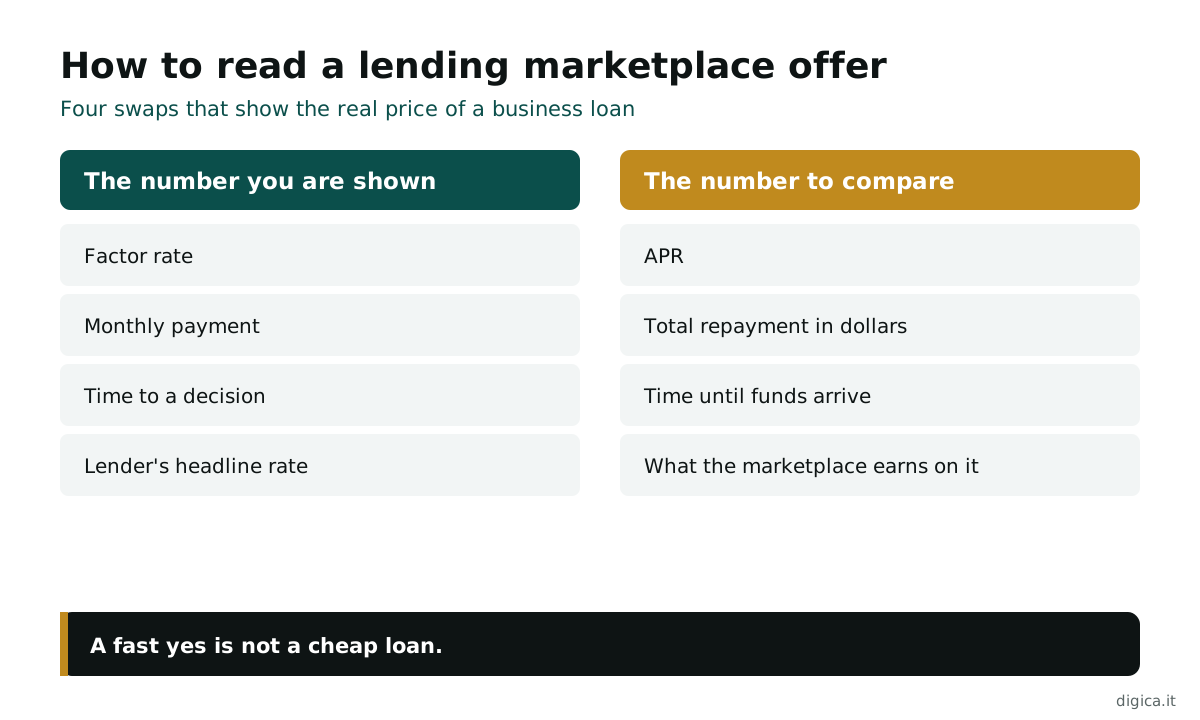
The risk is that you see no firm rate until a formal application, which can involve a hard credit pull, and that sales contact can follow. Ask for the APR on every offer, not just the factor or the monthly payment.
Best stated decision speed: Biz2Credit
Biz2Credit states one of the clearest speed claims in this group, a decision as fast as 24 hours, and it sets its bar higher than most.
It says term loans require a 650 FICO score and $100,000 in revenue, with amounts from $25,000 to more than $2 million and lines of credit up to $500,000. Its about page says more than $12 billion in one place and more than $8 billion in business financing in another, so we would not quote either figure with confidence. It also claims more than 200,000 small businesses funded.
Running a lending or fintech B2B marketplace?
In 30 minutes we look at how business owners and lenders find platforms like yours, on Google and in AI answers, and what we would do first to win both sides.
Biz2Credit is not a neutral panel in the way Lendio is. Its site says term loans are made by Itria Ventures LLC or Cross River Bank, so a borrower should not expect the same range of competing offers. Rates are not published, and Finder notes that revenue-based financing uses factor rates, which look lower than an APR and often are not.
There is one history point to check too. In March 2024 the Federal Trade Commission announced a $33 million settlement with Biz2Credit over Paycheck Protection Program loans, and Biz2Credit said it admitted no wrongdoing. It is outside our usual date window, but comparison sites still flag it, and a careful borrower would want to know. For an established business with solid revenue that needs a fast yes or no, it remains a reasonable place to look.
Best stated funding speed: LendingTree
LendingTree's business loans page says financing can arrive in as little as 24 hours, and it also publishes a useful volume figure for its own concierge service.
The company says its concierge connected more than 5,000 businesses with over $300 million of loans in 2025, an average of about $60,000 per business by our arithmetic. Its loan types include SBA, term, working capital, invoice factoring and merchant cash advances. It works with hundreds of financial partners across all its categories, though that figure includes far more than business lenders.
LendingTree is the most candid here about its model in one respect: it says it is compensated by companies whose listings appear, which may influence where they appear, and that not all lenders are shown. That is normal for a comparison site, but it means the top result is not necessarily the cheapest.
There is no published rate range and no minimum on the business page, since both vary by lender. Use it as a wide first look, and take the shortlist elsewhere to compare. An owner who has never applied for business credit gets a quick sense of what is available, without needing to know the difference between products first.
Best for a guided process: Fundera by NerdWallet
Fundera, now run by NerdWallet, suits owners who would rather be guided through a choice than compare a long list themselves. It is also the least transparent marketplace here.
It is free to use and serves only US-based small businesses. Finder lists loans from $5,000 to $5 million, with minimums of $60,000 in annual revenue, a 600 credit score and six months in business. The number of lenders, the APRs and the loan amounts for specific products are not disclosed without an application, and we found no stated timeline. NerdWallet says its partners compensate it for advertising.
So why does it earn a place? Because the alternative for many owners is not a careful spreadsheet. It is taking the first offer. A guided process with a recognized publisher behind it can stop an owner taking a costly advance when a term loan was available. If you already know what product you need, one of the wider panels will serve you better.
Best for checking your credit first: Nav
Nav starts with the business's credit profile and shows financing options from there, which suits owners who are not sure they would qualify.
It says more than 2.7 million small business owners have used it and more than 97,000 applications have been approved for funding. Finder lists more than 70 funding options from more than 25 partners, across term loans, credit lines, SBA loans, business credit cards, factoring and revenue-based financing, with amounts from $500 to $5 million. Nav does not lend directly. Its marketplace is free, and paid Nav Prime tiers start at $39.99 a month.
The benefit is sequence. An owner who sees that a thin credit file is holding them back can fix that before a hard inquiry. Nav shows rates only after you engage with a lender, and speed is a filter rather than a promise, so it wins on preparation, not on price or pace. Expect follow-up calls and emails, which reviewers mention often.
Largest stated UK panel: Capitalise
Capitalise claims more than 130 lenders for UK businesses, the largest panel we could verify among UK platforms in this guide, and it is unusually clear about commission.
Elsewhere on its site it says "over 100", so treat 130 as its latest figure. Capitalise reports more than £2 billion, about $2.7 billion, in approved funding and more than 200,000 UK businesses using it. It says businesses can be funded in as little as 48 hours. Its transparency page says any commission comes directly from the lender, that it never charges businesses a commission or broker fee, and that its subscriptions run from about $27 to $80 a month.
Its context is a changing UK market. The British Business Bank's Small Business Finance Markets 2025/26 report says challenger and specialist banks made up 60% of gross SME bank lending excluding overdrafts, up from 39% in 2012 (British Business Bank). More of the money now sits with lenders an owner may not know. That is the case for a broker panel.
Do business owners find your lending marketplace first?
A growth audit maps how owners search for business finance, on Google and in AI answers, which comparison sites sit between you and them, and which pages would win that demand directly.
Capitalise does not publish rates, and its homepage says it serves UK limited companies only, though other text mentions wider eligibility, so check if you are a sole trader. Personal guarantees can apply. It suits UK companies that have outgrown their bank's offer and want a broad look, particularly through an accountant. Owners who only need a small, simple loan may find that a direct application to one lender they already know is quicker, and they should compare that route before paying for a subscription or sharing their file more widely.
Clearest commission disclosure: Swoop
Swoop wins this award for saying the quiet part out loud: different providers pay different commission rates, and that may influence the interest rate you are offered.
Swoop describes itself as a credit broker, not a lender, with a panel of lenders, equity funds and grant agencies. It publishes no count of that panel, but it does publish a live funding total of about £1.51 billion, roughly $2.03 billion, along with 317,520 global customers. There are no published rates or timelines, and no formal thresholds beyond being over 18, though guarantees may be required.
The disclosure is the point. Its site says it typically receives a commission from the finance provider, and that for some lenders this may affect the rate. Every commission-based marketplace has this tension, and few spell it out. Reading that sentence should change how you read every offer: ask what the broker earns on the deal, and ask whether a lower rate is available if the commission falls.
Swoop also stands out for range. Having debt, equity and grants in one place suits a UK company that has not decided what kind of funding it wants. A company that only wants the cheapest term loan may do better on a wider lender panel.
Why rates stay hidden until you apply
Business loan pricing depends on the borrower, so marketplaces say they cannot quote a rate before they see a file. That is partly true. It also means owners compare offers late, after a lot of effort has gone in.
Three things make the comparison harder. Products are priced differently: an APR on a term loan, a factor rate on an advance, and a draw fee on a line of credit do not compare directly. Rates vary widely, as Lendio's 8% to 60% range for credit lines shows. And the platform may earn more on some products than on others.
The Fed's finding is the warning here. When 60% of online borrowers say costs were higher than expected, the gap is not usually fraud. It is that the price was hard to read. Government-backed lending offers a useful comparison: the Small Business Administration reported 84,400 7(a) and 504 loans for $44.8 billion in fiscal 2025, with a maximum of $5 million on 7(a) loans (SBA). Those loans come with caps on rates, and they are much slower.
For operators, this is an opening. A lending marketplace that shows typical rate ranges by product, real time to funding and how it gets paid would answer what owners are searching for and what the comparison sites leave vague. In our experience, that kind of plain page is also what search engines and AI answers quote. Our guide to marketplace category page SEO explains the structure, and our list of the best fintech directories shows where else these platforms get found.
Three failure scenarios
These are the patterns that recur when owners use a lending marketplace under time pressure. The figures are illustrative.
- The fast yes that cost twice as much. A retailer needs $80,000 for stock before a busy season and takes the first offer, an advance with a factor rate of 1.35. It looks like 35%, but it is repaid over nine months, so the effective annual cost is far higher. A term loan through the same platform, which took four more days, would have cost about half as much.
- The application that went to too many places. An owner applies through three marketplaces in a week. Several lenders run hard credit checks, and the score falls before any offer is signed. Starting on one platform, with a soft check first, would have kept the better offers open.
- The broker's favorite. A company is steered to one lender without seeing alternatives, and pays 14% when its profile could get 12%. On a $200,000 three-year loan with monthly repayments, that is roughly $7,000 extra in interest. Asking how the broker is paid and asking for two other quotes would have shown the gap.
Each owner used a real marketplace. None of them compared the total cost of the loan before saying yes.
Choosing a lending marketplace: a decision framework
Start with how much time you have, then your revenue and credit, and let those rule platforms out.
- If you need funds within a week and have $100,000 or more in revenue with 650+ credit, try Biz2Credit and Lendio, and compare APR on each offer.
- If your credit score is below 600, start with Nav, see what is holding you back and apply later if you can wait 60 days.
- If you have under six months of trading, most of these minimums rule you out. Look at startup products on Lendio, or personal and grant routes.
- If you can wait 60 days or more and want the lowest cost, price an SBA loan first, then use a marketplace as your comparison.
- If you are a UK limited company, compare Capitalise and Swoop, and ask both what they earn on the deal.
- If you do not know which product you need, use Fundera or LendingTree for a guided first look, then get a second quote.
- If an offer is quoted as a factor rate, convert it to an APR before you compare it with anything else.
Growing a lending or fintech B2B marketplace?
We help fintech and lending platforms win both sides, from the search pages that bring in business owners to the programs that bring in more lenders.
These are starting points, not financial advice, and an accountant or broker who has seen your numbers should have the last word. Thresholds move with lender appetite, so recheck them when you apply. The order of the steps matters more than the exact numbers: know your timeline, know your file, then ask every platform how it gets paid before you share your full file.
What comparing lenders is worth
Comparing lenders is worth the difference in total repayment between your first offer and your best one, and on a business loan that difference is usually larger than owners expect.
Run an illustrative case. A company borrows $150,000 over three years. At 12% with monthly repayments, total interest is about $29,400. At 20%, it is about $50,700. That is a difference of about $21,300 for a few days of extra comparison, on a monthly payment gap of about $590. Those rates fall inside the ranges marketplaces describe, though your own rate depends on your file. The arithmetic is why the first offer is rarely worth taking without a second.
The number to take into your next finance meeting is total repayment, in dollars, on every offer. If you are only comparing monthly payments, you cannot see the real price. The biggest cost of doing nothing is signing the fastest offer because it arrived first, then paying for that speed for the next three years.
FAQ
What is a lending marketplace? A lending marketplace is a platform that takes one application from a business and matches it with several lenders, so the owner can compare offers. Most are free for borrowers and are paid by lenders, usually through a commission or referral fee.
What is the best lending marketplace for small business loans? Lendio has the broadest US range, with more than 75 lenders and 11 financing options. Biz2Credit and LendingTree make the fastest stated claims, and Capitalise has the largest stated panel among the UK platforms we checked.
How do business loan marketplaces make money? Most earn a commission or referral fee from the lender when a loan closes, and some also sell subscriptions or advertising. Swoop says commission rates differ by provider and may affect the rate you are offered, so it is worth asking.
Does using a lending marketplace affect my credit score? An initial check is often soft, but a formal application to a lender can involve a hard credit inquiry. Ask each platform which check it runs at each stage, and avoid applying through several at once.
How fast can a lending marketplace fund a business loan? Stated claims range from 24 hours at Lendio, Biz2Credit and LendingTree to 48 hours at Capitalise, and those are best cases. SBA, real estate and acquisition loans usually take weeks or months.
Are online lenders more expensive than banks? Often, yes. In the Federal Reserve Banks' 2026 report, 60% of borrowers from online lenders said costs were higher than expected, against 37% at small banks and 32% at large banks. Compare APR and total repayment rather than the headline rate.
Related Articles
- Fintech and lending B2B marketplace growth
- Best fintech directories
- The best B2B marketplaces in 2026
- Marketplace business models
- Marketplace metrics: GMV, take rate and core KPIs
Where this connects
This article is part of our B2B marketplace growth series. Browse more on the Digica blog.