The best medical supply marketplaces for clinics, ranked on catalog and compliance
A clinic that buys a prescription device from the wrong seller can lose more than the order. It can fail an audit, void a warranty or put a recalled product in front of a patient. That is why a medical supplies marketplace has to be judged on two things at once: how much it carries, and what it checks before a product, a seller or a buyer gets in. US medical products sales through distribution reached $61 billion in 2025, and a growing share of that buying now starts online.
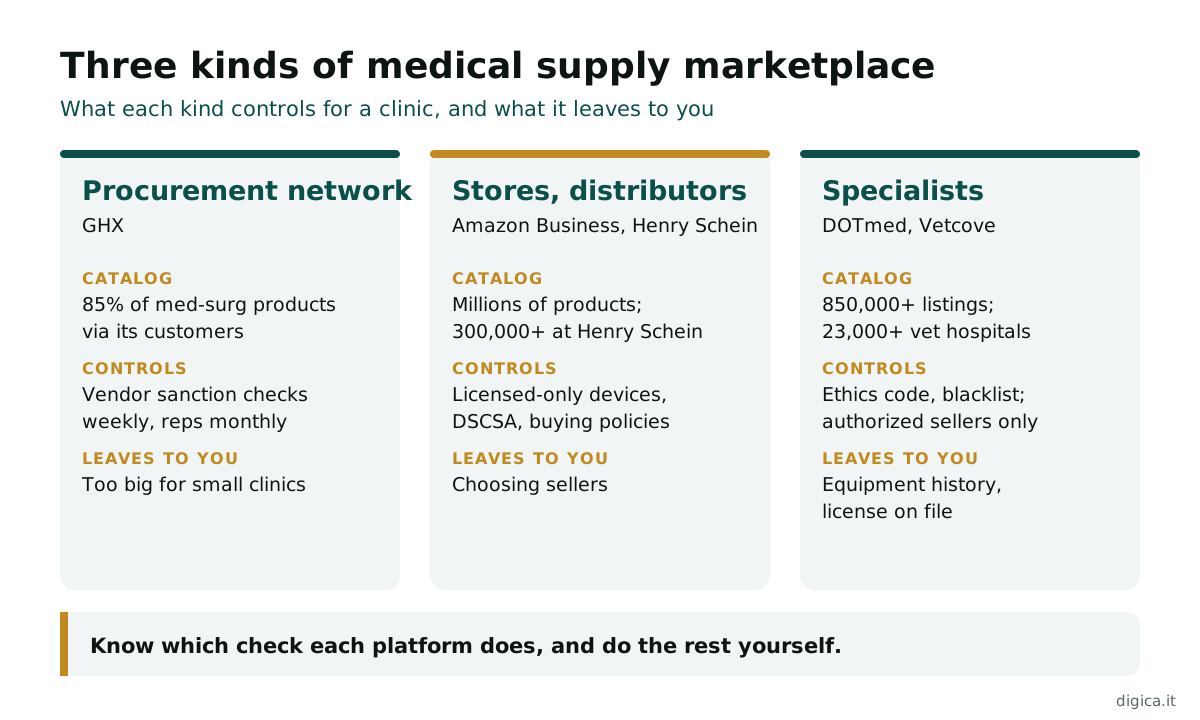
The two tests pull in opposite directions. The biggest catalogs come from open platforms that let many sellers list, and the strongest compliance comes from closed networks and distributors that control who sells. A clinic that wants both has to know which platform sits where.
This guide ranks six medical supply marketplaces and platforms for clinics, hospitals, dental and veterinary practices on catalog and compliance. For each we give the catalog in its own unit, who may buy, who may sell and what paperwork it keeps. It is written for practice managers, procurement leads and clinic owners, and for founders growing a healthcare B2B marketplace. It covers business buyers only. Figures come from each platform's own pages and filings, checked on November 13, 2026.
Quick Navigation
- How we ranked catalog and compliance
- Six medical supply marketplaces side by side
- 1. GHX: the hospital procurement network
- 2. Amazon Business: the widest catalog with controls
- 3. Henry Schein: the distributor benchmark
- 4 to 6. DOTmed, Vetcove and Medikabazaar
- Compliance rules every clinic should know
- Three failure scenarios
- Choosing a medical supplies marketplace by practice
- What catalog and compliance are worth
- FAQ
- Related Articles
How we ranked catalog and compliance
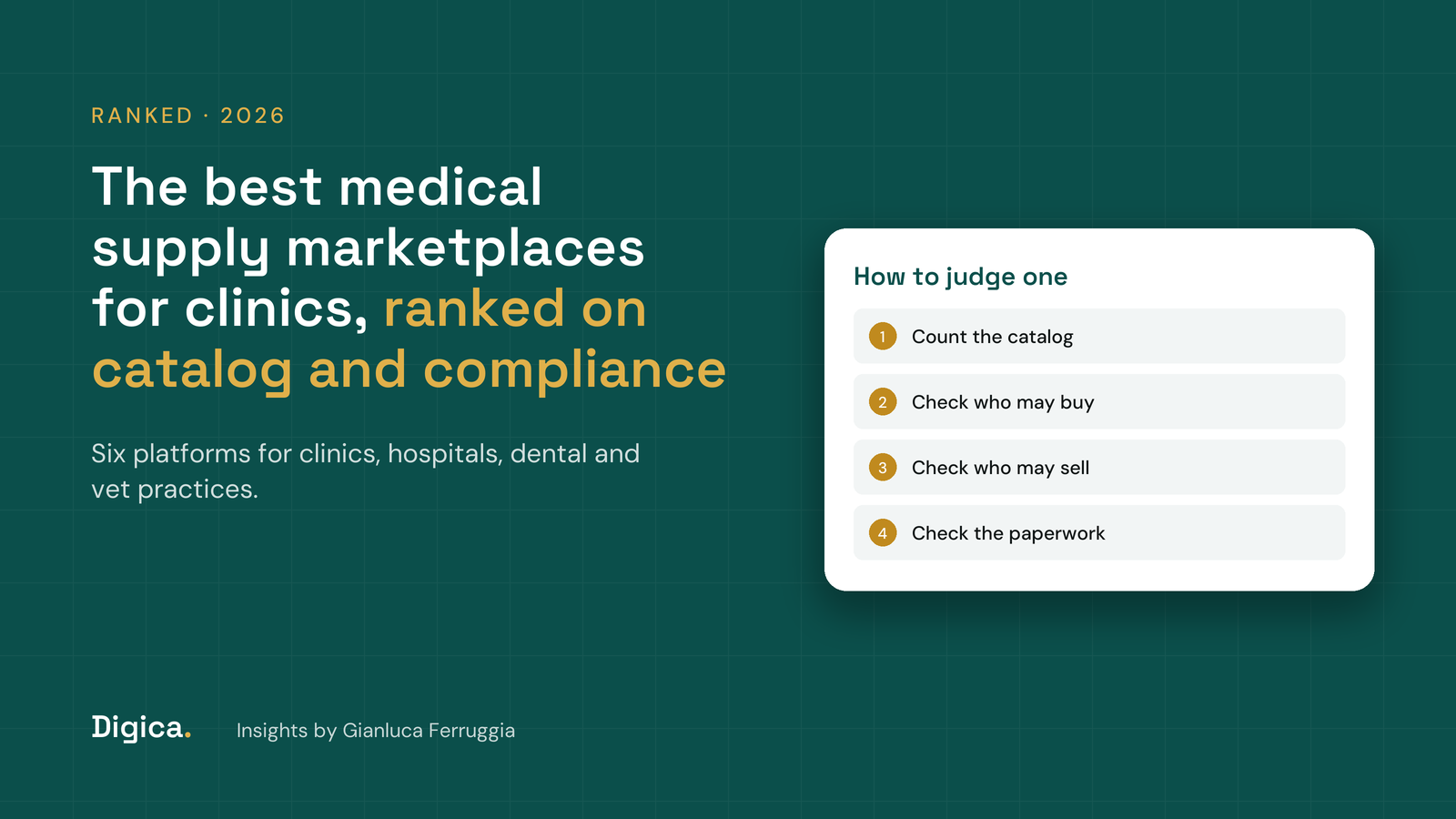
We scored each platform on two questions. How big is the catalog, in the platform's own unit: products, listings or the share of a category its network covers? And what does it check: who may sell, who may buy, and what records it keeps for an audit? A platform ranked higher when it did well on both, and lower when one side was thin or unpublished.
We kept to business buyers: hospitals, clinics, dental and veterinary practices. We left out consumer pharmacies and the lab and pharmaceutical ingredient platforms covered in our guide to pharma and lab supply marketplaces. We also included one distributor, Henry Schein, as a benchmark, because many clinics compare every online option against their distributor's catalog and terms.
The market is large and shifting toward smaller sites of care. The Health Industry Distributors Association reports that US medical products sales through distribution reached $61 billion in 2025, up 4.6%, with physician practices growing 2.3% and treatment centers such as dialysis, rehab and urgent care growing 12.6% (HIDA). Those smaller sites are exactly the buyers most likely to shop on a medical supplies marketplace.
Our view: in medical supplies, the compliance is part of the product. A catalog of a million items is worth little to a clinic if it cannot tell which sellers are authorized and which products need a license to buy.
Six medical supply marketplaces side by side
The table sets each platform's catalog against its checks. Use it to shortlist before reading the ranking.
| Rank | Platform | Catalog, in its own unit | Who may buy | Who may sell, and checks | Cost to the clinic | Main risk | Best for |
|---|---|---|---|---|---|---|---|
| 1 | GHX | 85% of med-surg products represented by its customers; 1.3M+ trading partner connections | Hospitals, health systems, government facilities | Manufacturers and distributors; vendor sanction checks weekly, rep checks monthly | Subscription | Built for hospitals, not small practices | Health systems automating purchasing |
| 2 | Amazon Business | Millions of products | Businesses; Rx and professional devices only to licensed practitioners | Amazon and third-party sellers; Professional Healthcare program for restricted devices | Free account, business pricing | Many sellers per product | Clinics wanting breadth with spend controls |
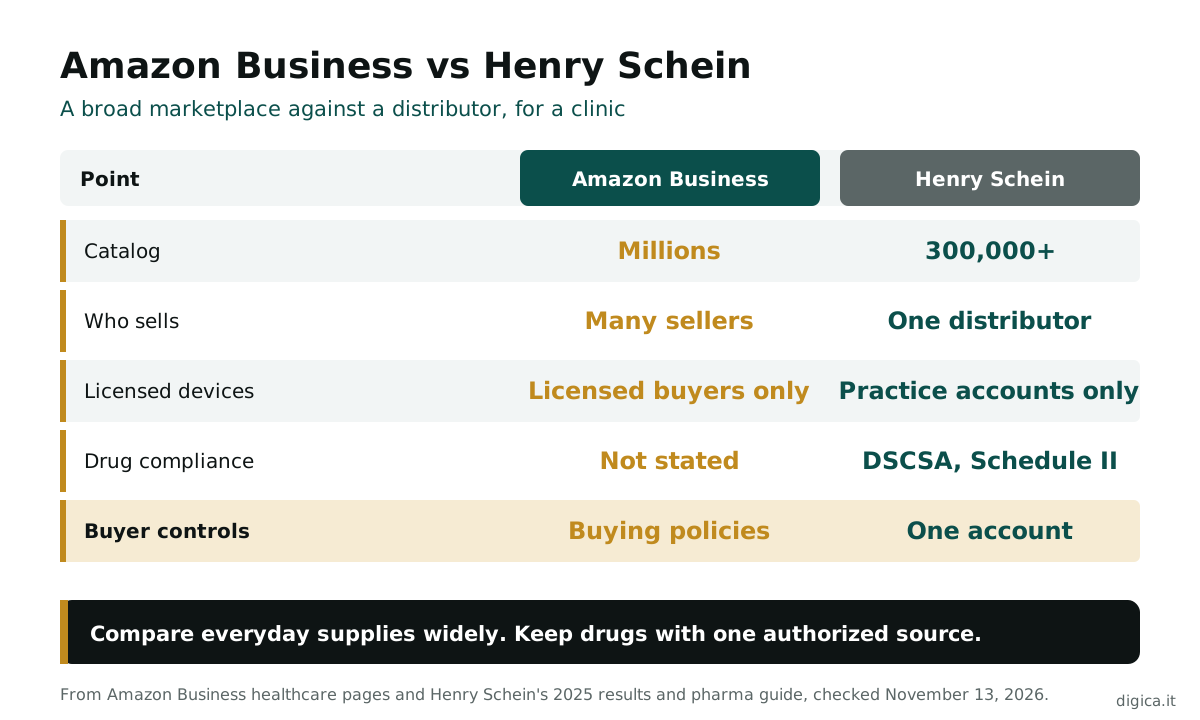
| 3 | Henry Schein | 300,000+ products | Office-based medical and dental practices | One distributor; DSCSA compliant, electronic Schedule II ordering | Product price | Single source, one price list | Practices wanting one compliant supplier |
| 4 | DOTmed | 850,000+ listings in 500+ categories | Hospitals, clinics, imaging and biomed teams | Registered users; signed ethics code for certified sellers, blacklist | Free to browse, fees for sellers | Used equipment, check each seller | Buying used and refurbished equipment |
| 5 | Vetcove | Used by 23,000+ veterinary hospitals | Veterinary clinics and nonprofits | Manufacturers and authorized distributors only; GMP standards | Free to clinics | Seller, not Vetcove, checks the license | Veterinary practices comparing suppliers |
| 6 | Medikabazaar | 60,000+ products from 13,000+ verified vendors | Registered healthcare entities in India | Verified vendors | Product price | India only; figures vary across its pages | Indian hospitals and clinics |
Two patterns stand out. The closed networks and distributors publish the clearest compliance. The open platforms publish the biggest catalogs and leave more of the checking to the buyer.
1. GHX: the hospital procurement network
GHX is not a storefront. It is the trading network that connects hospitals and health systems with medical-surgical manufacturers and distributors, automating orders, invoices and payments and keeping item data clean. It ranks first because no other platform here covers as much of the category: GHX says 85% of med-surg products are represented by its customers, across more than 1.3 million trading partner connections.
Its compliance is the deepest on the vendor side. Through Vendormate, GHX reviews vendor documents and runs sanction checks monthly on sales representatives and weekly on vendor organizations, with badging and audit reporting for hospitals. It also serves the US Defense Health Agency and many military hospitals.
GHX says it saved the healthcare industry $2.2 billion in the past year. In July 2025 it released new data and AI tools for North American customers to flag supply disruptions earlier. The catch is fit: GHX is built for hospitals and health systems with procurement teams, and a five-doctor clinic will find it more than it needs.
2. Amazon Business: the widest catalog with controls
Amazon Business offers clinics the broadest catalog here, with millions of products and a healthcare storefront offering business-only pricing on everyday supplies. Customers on its healthcare page range from a large academic health system to pediatric urgent care and veterinary groups.
Its compliance works in two layers. Prescription and professional-use medical devices are sold through a Professional Healthcare program, which lets approved sellers reach licensed healthcare practitioners only. On the buyer side, clinics can set buying policies that mark categories or sellers as preferred, restricted or blocked, add spend limits and use three-way matching. Amazon Business integrates with more than 300 purchasing and finance systems.
Running a healthcare or medical supply B2B marketplace?
In 30 minutes we look at how clinics and hospitals find platforms like yours, on Google and in AI answers, and how to turn your compliance into the reason they buy.
The risk is the open seller base. Many sellers can list the same product, so a clinic should set preferred sellers for anything clinical and keep restricted categories locked to approved accounts. Used that way, it ranks second: the widest catalog, with controls a practice manager can actually set. The same controls give finance a clean record of who bought what, from whom, which matters as much at audit time as the price did at checkout.
3. Henry Schein: the distributor benchmark
Henry Schein is a distributor, not an open marketplace, and it is here as the benchmark most clinics measure online options against. It carries more than 300,000 branded and own-brand products in its main distribution centers, reported $13.2 billion in sales in 2025, and operates in 34 countries and territories.
Its compliance is the most complete for a practice buying drugs as well as supplies. Henry Schein states it is fully compliant with the Drug Supply Chain Security Act, and it offers electronic ordering for Schedule II controlled substances through the Drug Enforcement Administration's secure ordering system. One supplier, one set of records and one account make audits simpler.
The trade-off is choice. A single distributor sets one price list, so clinics that buy only from it can pay more on commodity supplies than they would by comparing sellers. Many practices keep the distributor for drugs and clinical items and compare everyday supplies elsewhere.
4 to 6. DOTmed, Vetcove and Medikabazaar
The next three serve narrower needs: used equipment, veterinary practices and Indian healthcare buyers. Each is the strongest option in its niche.
4. DOTmed: used and refurbished equipment
DOTmed, founded in 1999, is an open marketplace for new and used medical equipment, parts and service. It lists more than 850,000 items on any given day across more than 500 categories, with more than 375,000 registered users and over 25,000 visitors a day. Hospitals, imaging centers and biomedical teams use it to source used scanners, monitors and parts, and to sell their own surplus.
Its checks are ethical rather than regulatory. Certified users sign a code of ethics, buyers rate sellers, and DOTmed keeps a blacklist of users banned for dishonest dealing. It does not own the equipment listed, so a clinic still needs to check the seller, the service history and any recertification before buying.
5. Vetcove: veterinary supply comparison
Vetcove is a free procurement platform used by more than 23,000 veterinary hospitals. Clinics connect their existing supplier accounts, compare price and stock across vendors and check out in one place, with their group purchasing pricing applied. American Veterinary Medical Association members can use its Direct Connect program through Vetcove.
Its seller rules are strict on paper. Sellers must be the manufacturer or an authorized distributor, and products must be made, stored and shipped to good manufacturing practice standards. Sellers, not Vetcove, must check that a buyer holds a valid veterinary license before completing a sale, which keeps the license check with the party shipping the product.
6. Medikabazaar: India's medical supplies marketplace
Mumbai-based Medikabazaar, founded in 2015, is a B2B medical supplies marketplace for Indian hospitals, clinics, labs and pharmacies. Its about page lists more than 60,000 medical products from 13,000+ verified vendors, and it says it has served more than 20,000 medical establishments. Buyers must be registered healthcare entities or professionals.
It ranks sixth because its published figures vary between its own pages and it does not explain how vendor or buyer licenses are checked. For an Indian clinic it remains the broadest single marketplace, and its vendor verification is a useful first filter.
Compliance rules every clinic should know
Most compliance on a medical supplies marketplace comes down to three questions: is the seller authorized, is the buyer allowed to buy, and can you show the trail later? The rules behind them differ by product.
For prescription drugs, the Drug Supply Chain Security Act requires tracing records as products move between trading partners. The Food and Drug Administration has exempted small dispensers, those with 25 or fewer full-time pharmacists or pharmacy technicians, from some of its requirements until November 27, 2027 (FDA). An exemption delays the rules. It does not remove the need to buy from authorized trading partners.
For devices, the check is mostly on the buyer: prescription and professional-use devices should only be sold to licensed practitioners. For used equipment, the check is on the product: service records, recertification and whether the manufacturer will support it. For veterinary products, the license check usually sits with the seller.
A clinic does not need to master all of this. It needs to know which check each platform does for it, and which it must do itself. Write that down for each supplier and keep it with your purchasing policy.
Three failure scenarios
These are illustrative patterns, not accounts of named companies. The costs are typical, not audited.
- The cheapest seller on an open platform. A clinic buys a box of professional-use devices from the lowest-priced seller on a large open platform without setting preferred sellers. The product turns out to be grey-market stock without a valid warranty. Replacing it and documenting the issue costs several thousand dollars and staff time. A buying policy limiting clinical items to approved sellers would have prevented it.
- The used scanner with no history. An imaging center buys a used scanner from an open equipment listing to save on a new unit. It arrives without full service records, and the manufacturer will not support it until it is recertified, which takes weeks and a five-figure bill. Asking for service history and recertification before paying would have caught it.
- The audit with no trail. A practice buys drugs from several online sources over a year. At audit, it cannot produce the tracing records for some purchases. The finding costs weeks of work and a remediation plan. Buying drugs only from one authorized distributor, with records kept in one place, would have avoided it.
Is your compliance visible to clinics?
A growth audit shows how clinics and hospitals search for platforms in your category, what AI answers say about your checks, and which pages would win more trust.
In each case the platform did what it said. The clinic assumed it did more. Know which check you are getting from each platform, and do the rest yourself before the order, not after the audit. The cost of that habit is a short checklist kept with your purchasing policy. The cost of skipping it is measured in recalls, write-offs and audit findings, and it usually lands on the practice manager who placed the order.
Choosing a medical supplies marketplace by practice
Start with the type of practice and what it buys, then match the platform. These thresholds are a starting point, not rules.
- If you run a hospital or health system with a procurement team, connect to GHX and run purchasing and vendor credentialing through it.
- If you are a clinic spending more than $50,000 a year on everyday supplies, add Amazon Business, with preferred sellers and restricted categories set before the first order.
- If you buy prescription drugs or controlled substances, keep them with one authorized distributor such as Henry Schein and keep the records together.
- If you need used or refurbished equipment, source on DOTmed, and pay only after you see service history and recertification.
- If you run a veterinary practice, compare suppliers on Vetcove and confirm your license is on file with each seller.
- If you buy for a hospital or clinic in India, start with Medikabazaar and confirm each vendor's documents.
- If a platform does not say who may sell or buy, use it for non-clinical items only.
For founders, the list doubles as a brief. A medical supply B2B marketplace that publishes who may sell, who may buy and what records it keeps, on every product page, answers a clinic's first question before the clinic has to ask it.
What catalog and compliance are worth
Run an illustrative case. A multi-site clinic spends $500,000 a year on supplies. Assume half of that is everyday, non-clinical supplies. If comparing those items across sellers on a broad marketplace, while keeping drugs and clinical items with an authorized distributor, saves 5% on that half, the clinic keeps $12,500 a year. The compliance value is avoided loss: one grey-market recall or failed audit avoided every few years is worth as much again.
The pressure on cost is not going away. US health care spending grew 7.2% in 2024 to $5.3 trillion, 18.0% of gross domestic product (CMS National Health Expenditure data). Every practice is being asked to buy more carefully, and a medical supplies marketplace that shows its checks clearly is easier to approve.
For founders, catalog and compliance belong on the page together: product counts by category, seller authorization on every listing, and license rules in plain words, in the structured data and in the answers AI assistants give.
Growing a healthcare B2B marketplace?
We help healthcare and medical supply marketplaces win clinics, hospitals and suppliers through search, AI answers and the proof that makes a purchase easy to approve.
The number to take into your next purchasing review is $61 billion: what US medical products sales through distribution reached in 2025, growing fastest at smaller sites of care. If your clinic buys online without a written rule for who may sell you clinical items, the biggest cost of doing nothing is the one recall or audit finding that arrives through a seller nobody checked. Writing that rule takes an afternoon, so it pays back with the first order it stops, and it gives every new buyer on your team the same standard from day one.
FAQ
What is a medical supplies marketplace? A medical supplies marketplace is an online platform where clinics, hospitals and practices buy supplies and equipment from many sellers. The best ones control who may sell, check who may buy licensed products and keep records for audits.
What is the best online marketplace for medical supplies for clinics? For breadth with controls, Amazon Business offers millions of products with buying policies and restricted categories. Hospitals and health systems use GHX for procurement, and many clinics keep a distributor such as Henry Schein for drugs.
Can clinics buy prescription medical devices on Amazon Business? Yes, through Amazon's Professional Healthcare program, which lets approved sellers offer prescription and professional-use devices to licensed healthcare practitioners only.
What is the difference between a medical supply distributor and a marketplace? A distributor sells its own stock from one price list and takes responsibility for its supply chain. A marketplace lets many sellers list, which widens choice and prices but leaves more checking to the buyer.
Where can clinics buy used medical equipment safely? DOTmed lists more than 850,000 new and used items, with certified sellers, ratings and a blacklist. Ask any seller for service history and recertification before paying.
Is there a dental supplies or veterinary marketplace? Yes. Henry Schein serves dental and medical practices, and Vetcove lets more than 23,000 veterinary hospitals compare suppliers and check out in one place for free.
Does DSCSA apply to clinics buying drugs online? Clinics that dispense prescription drugs are covered. Small dispensers with 25 or fewer full-time pharmacists or pharmacy technicians are exempt from some requirements until November 27, 2027.
Related Articles
- Healthcare B2B marketplace growth
- The best pharma and lab supply marketplaces, head to head
- The best procurement marketplaces for B2B buyers
- The best industrial marketplaces for MRO buying
- The best wholesale marketplaces for retailers
Where this connects
This article is part of our B2B marketplace growth series. Browse more on the Digica blog.