The best pharma and lab supply marketplaces, head to head on supplier verification
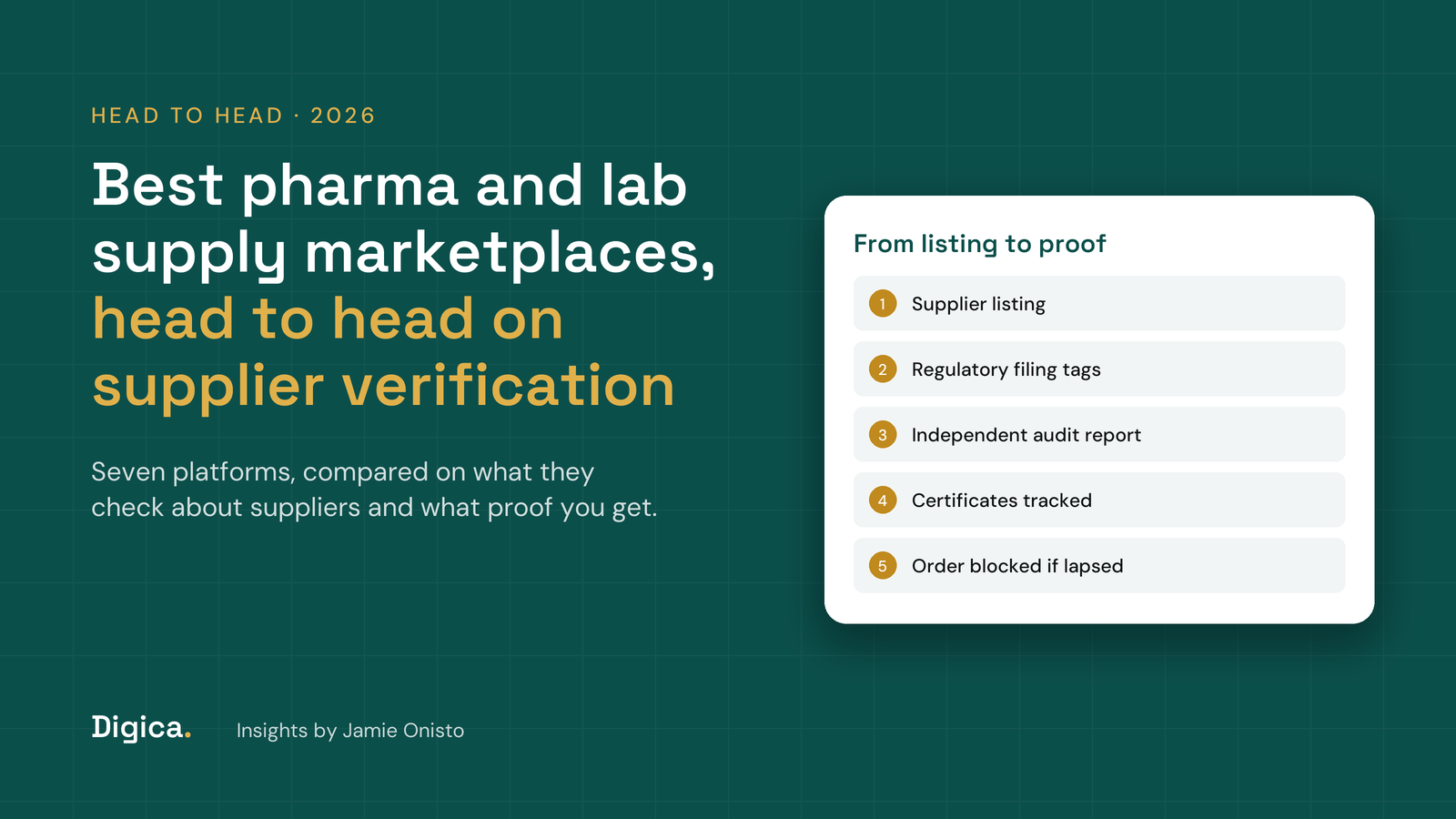
A pharma marketplace is only as useful as the proof it gives you about a supplier. Finding a manufacturer of an active pharmaceutical ingredient takes minutes, and one sourcing platform alone says more than 35,000 registered pharma buyers use it to do so. Knowing whether its plant passed its last inspection, which regulatory filings it holds and whether its certificates are still valid takes weeks, and that is where most of the risk sits. The platforms in this guide answer that question very differently, from a directory that tags each supplier's filings to a platform that blocks a purchase until the paperwork is in place.
Regulators are looking harder at the same thing. In its report on the state of pharmaceutical quality for fiscal year 2024, the US Food and Drug Administration said more than 62% of its drug quality inspections took place at foreign sites, an all-time high, and it issued 105 quality-related warning letters to human drug sites, the most in five years (FDA). A buyer who treats a listing as a qualification inherits that risk.
This guide compares seven pharma and lab supply marketplaces head to head, on one lens: what each platform checks about its suppliers, and what proof it hands the buyer. It covers active ingredient sourcing, lab supply procurement and outsourced research services, and is written for procurement, quality and research operations leads, and for founders growing a life sciences B2B marketplace. Figures are each company's own, checked on November 3, 2026. For the chemicals upstream of pharma, see our guide to the best chemical marketplaces.
Quick Navigation
- How we judged supplier verification
- The scorecard: seven platforms side by side
- API sourcing head to head: CPHI Online vs Pharmaoffer vs PharmaCompass
- Lab supply head to head: ZAGENO vs Quartzy vs Labviva
- Research services: Scientist.com and the audit trail
- Where lab equipment marketplaces and life sciences directories fit
- What verified means on a pharma marketplace
- Three failure scenarios
- Choosing a pharma marketplace: a decision framework
- What verified supply is worth
- FAQ
- Related Articles
How we judged supplier verification
The short answer: we asked three questions of each platform. What does it say it checks about suppliers? What proof can a buyer download or see? And who carries the paperwork when something goes wrong?
Pharma and lab supply sit under very different rules. An active pharmaceutical ingredient, or API, must come from a site that follows Good Manufacturing Practice, or GMP, and usually holds a regulatory filing such as a US Drug Master File (DMF) or a European Certificate of Suitability (CEP). Lab consumables and reagents carry lighter rules, but large buyers still need approved supplier lists, contract pricing and an audit trail. Outsourced research needs proof that the lab or contract organization is qualified before any sample leaves the building.
We picked seven of the most important B2B platforms across those three jobs, all live and reporting their scale in 2025 or 2026. Then we read what each says about checking suppliers, in its own words. Where a platform says it does not check, we say so. Where it hands the buyer an audit report or a tracked certificate, we say that too.
Our view: in regulated supply, the platform that gives you the most suppliers is rarely the one that saves you the most time. The one that gives you the most proof usually is.
The scorecard: seven platforms side by side
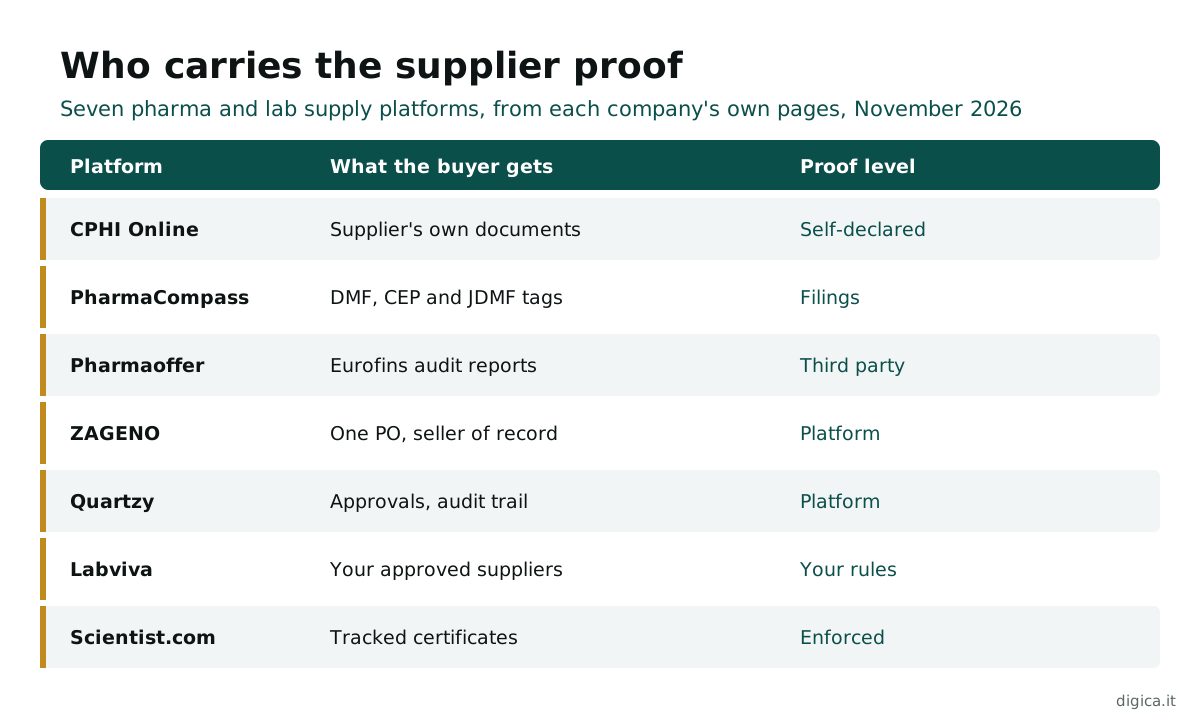
The short answer: CPHI Online and PharmaCompass are directories that leave checking to the buyer, Pharmaoffer adds independent audit reports, the lab supply platforms take on the paperwork as seller of record or inside your own procurement system, and Scientist.com tracks supplier qualifications continuously.
Seven pharma and lab supply marketplaces compared on what they sell, scale claimed, supplier checks, proof for the buyer, main risk and best fit
| Platform | What it covers | Scale claimed | Supplier checks | Proof for the buyer | Main risk | Best for |
|---|---|---|---|---|---|---|
| CPHI Online | API, excipient, CDMO suppliers | 125K+ visits a month | Exhibitor-linked listings | Supplier's own documents | No platform check stated | Finding event-vetted suppliers |
| Pharmaoffer | APIs, excipients, CDMOs | 35,000+ registered buyers | Filters by GMP, CEP, DMF | Independent Eurofins audit reports | Data not guaranteed current | API shortlists with audits |
| PharmaCompass | API, FDF, excipient suppliers | Not stated | Filing tags per supplier | DMF, CEP, JDMF tags | Informational only | Checking who holds filings |
| ZAGENO | Lab products | 50M+ products, 5,000+ suppliers | Supplier governance | One PO, one invoice | Vetting criteria not published | Consolidating lab vendors |
| Quartzy | Lab products | 20M+ products, 10,000+ labs | Distributor of record | Approvals, audit trail | Lighter for regulated buys | Startups and academic labs |
| Labviva | Lab products | 15M+ products, 18,000 makers | Buyer controls suppliers | Contracts in your system | Needs enterprise setup | Enterprise procurement |
| Scientist.com | CRO and CDMO services | 6,000+ pre-vetted suppliers | Continuous qualification checks | Tracked certificates, audit trail | Services, not materials | Regulated outsourced research |
Every figure is the company's own claim, and the units differ. Read the "Proof for the buyer" column first, because it tells you how much qualification work is left on your desk after you find a supplier.
API sourcing head to head: CPHI Online vs Pharmaoffer vs PharmaCompass
The short answer: CPHI Online is the widest supplier directory tied to the industry's biggest event, Pharmaoffer gives the most proof per supplier through independent audit reports, and PharmaCompass is the fastest way to see who holds which regulatory filing.
CPHI Online against Pharmaoffer
CPHI Online, run by Informa Markets, lists companies that exhibit or have exhibited at CPHI events, the largest trade shows in pharma ingredients and contract manufacturing. Informa says it draws more than 125,000 unique visits a month. Buyers search for an API, excipient or contract manufacturer, contact the supplier and request a meeting, often to continue at the next event. Supplier pages carry the documents suppliers choose to show, such as GMP certificates and filings. We found no statement that CPHI checks those documents itself.
Pharmaoffer, based in Amsterdam, says it is trusted by more than 35,000 registered pharma buyers. Buyers filter API suppliers by GMP, CEP, FDA status and US DMF, and request quotes from each supplier. Its clearest difference is audits. Through a partnership with Eurofins Healthcare Assurance, buyers can request an existing GxP audit report on a supplier, carried out independently by Eurofins. Pharmaoffer also says plainly that it does not guarantee the accuracy or current validity of supplier data.
Running a pharma or life sciences B2B marketplace?
In 30 minutes we look at how procurement and quality teams find platforms like yours, on Google and in AI answers, and where they drop off before they request a quote.
Head to head, the choice depends on where you are in qualification. CPHI Online is better for discovering suppliers and meeting them in person. Pharmaoffer is better once you have a shortlist and want an audit report before you spend on your own audit. Neither replaces your own supplier qualification, and both say so. What they change is how much of that qualification you can do before you travel or spend on testing, and in pharma that early filtering is where most of the time is saved.
PharmaCompass against both
PharmaCompass, run from India, is a directory of API, finished dose and excipient suppliers. Its strength is the filing tags on every supplier row: US DMF, CEP, Japanese DMF, EU written confirmation, NDC, Korean DMF and Veterinary DMF. In one search, a buyer sees which manufacturers of a molecule hold which filings. It states that listings are for information only, that it does not supply or sell any product, and that buyers should confirm details with the supplier.
Against the other two, PharmaCompass is the quickest regulatory screen. Use it to cut a list of 40 manufacturers to the eight with the filing your market needs, then go to Pharmaoffer for audits or to CPHI to meet them. That order saves the most time.
Lab supply head to head: ZAGENO vs Quartzy vs Labviva
The short answer: ZAGENO is the largest lab supply marketplace by products listed, Quartzy is the simplest single account for smaller labs, and Labviva fits enterprises that want their own contracts and approved suppliers enforced.
ZAGENO against Quartzy
ZAGENO, based in Cambridge, Massachusetts, says it offers more than 50 million laboratory products from more than 5,000 suppliers, and in September 2026 it was named Frost and Sullivan's North American life sciences ecommerce company of the year. Its model is consolidation: purchases from many suppliers go on one purchase order and one invoice, with ZAGENO as the single supplier of record. It speaks of supplier governance and compliance, but does not publish its supplier vetting criteria.
Quartzy, based in Hayward, California, lists more than 20 million products, says more than 10,000 labs use it and tracks more than $1 billion of lab spend a year. It raised $23 million in April 2026. Like ZAGENO, it acts as distributor of record, so the paperwork stops with Quartzy rather than with dozens of vendors, and it adds approvals, an audit trail and contract compliance for larger customers.
Head to head, ZAGENO wins on range and Quartzy on simplicity. For a research lab buying reagents and consumables, both remove the work of opening and checking a new vendor for every order. For regulated material that goes into a product, neither replaces your quality team's own supplier approval.
Labviva against both
Labviva, based in Boston, takes the opposite approach. It plugs into the buyer's own procurement system, gives the buyer control over which suppliers are approved, and says it covers more than 15 million products from 18,000 manufacturers. It raised a $25 million Series B in January 2025, and its inventory tools can track compliance with environmental, health and safety requirements.
The difference is who sets the rules. On ZAGENO and Quartzy, the platform is the supplier of record. On Labviva, your contracts and approved suppliers apply. Large pharma procurement teams usually want the second, because their supplier list has already been through quality review.
Research services: Scientist.com and the audit trail
The short answer: Scientist.com goes furthest of the seven on supplier verification, with continuous qualification checks, tracked certificates and a request flow that stops until the documents are in place.
Scientist.com, based in Solana Beach, California, connects pharma and biotech researchers with more than 6,000 pre-vetted contract research and manufacturing organizations, and says researchers at more than 130 biopharma companies use it. GHO Capital's acquisition of the company closed in November 2025. Its compliance module tracks ISO, GMP and GxP certifications with expiration monitoring, runs continuous in-house checks of supplier qualifications, and monitors suppliers against sanctions lists, watchlists and adverse media around the clock.
Two details matter most to a quality lead. Requests are blocked until the required documents are in place, so a project cannot start with a lapsed certificate. And every step leaves an immutable audit trail, which is what an inspector asks to see. Its on-site inspection service checks facilities, people and processes before a buyer commits to a full audit of its own.
The trade-off is scope. Scientist.com is for services, such as studies, assays and manufacturing runs, not for buying an API or a box of pipette tips. For outsourced research under regulatory scrutiny, it is the platform where the proof comes built in. For everything else, it shows what good verification looks like.
Where lab equipment marketplaces and life sciences directories fit
The short answer: lab equipment marketplaces and life sciences directories help buyers find equipment and partners, but they verify far less than the seven platforms above, so treat them as discovery tools.
A lab equipment marketplace usually sells new, used and refurbished instruments, often through listings and auctions. The checks that matter there are about the instrument rather than the supplier: service history, calibration records, whether the seller tested it and what warranty comes with it. Ask for all four in writing before you bid. A used instrument with no service record can cost more to qualify than a new one.
A life sciences directory, by contrast, is mainly a lookup tool. Regional cluster directories and business development databases list companies, products and licensing opportunities, which is useful for finding a partner or a contract manufacturer to approach. Few of them check anything about the companies listed, and most do not claim to.
The rule is simple. The further a platform is from the transaction, the less it checks. That is not a flaw. It just means the verification work moves to you. Our guide to supplier databases covers the wider set of discovery tools that work the same way.
What verified means on a pharma marketplace
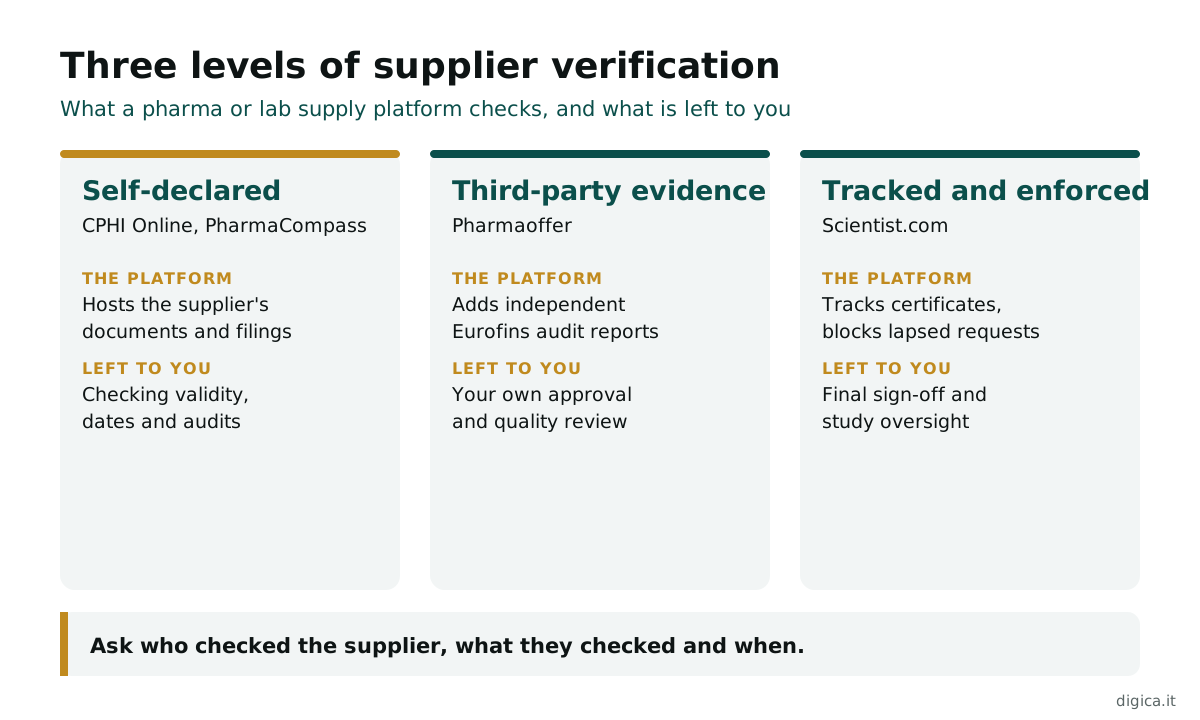
The short answer: "verified" can mean anything from a supplier uploading its own certificate to an independent auditor's report. Always ask who checked, what they checked and when.
Across these seven platforms, there are three levels. At the first, the platform hosts documents the supplier provides, and the buyer checks them. At the second, the platform adds evidence from a third party, such as an independent audit report or a filing tag drawn from regulators' public lists. At the third, the platform tracks certificates over time, monitors for sanctions and blocks a purchase when something lapses.
Europe is also raising the stakes for critical supply. The European Medicines Agency's Union list of critical medicines, updated in its 2025 review, covers medicines that account for about 75% of all authorized medicinal products in the EU, and listed medicines are prioritized for EU-wide action to strengthen their supply chains (EMA). For a buyer of the ingredients behind those medicines, a supplier's compliance record is a supply risk as well as a quality one.
Do quality and procurement teams find your platform first?
A growth audit maps how pharma and lab buyers search for suppliers and platforms like yours, on Google and in AI answers, and which molecule, category and supplier pages they never reach.
The practical test is to open one supplier page on any platform and ask three questions. Who produced this document? When does it expire? Who will tell me if it changes? A platform that can answer all three is doing verification. A platform that can answer only the first is a directory. Directories are useful, but the checking then sits with your quality team, and the budget and timeline should say so from the start.
Three failure scenarios
These are the patterns that recur when buyers treat a listing as a qualification.
- The certificate that had expired. A generic drug company shortlists an API maker from a directory listing that shows a GMP certificate. The certificate expired four months earlier, after an inspection with findings. The company finds out during its own audit, after samples, stability testing and a quarter of work. Checking the certificate date and the regulator's public records on day one would have taken an hour.
- The lab vendor nobody approved. A fast-growing biotech lets scientists buy from any supplier they find. An auditor later asks for evidence that the suppliers of a critical reagent were qualified, and there is none. Months go into rebuilding the record. A procurement platform with approvals and an audit trail, set up before the growth, would have produced it in a day.
- The research partner with a lapsed qualification. A sponsor sends a study to a contract lab chosen by price. Halfway through, the lab's accreditation lapses and the data cannot be used in the filing. The study is repeated. A platform that tracks qualifications and blocks work when one lapses would have stopped the project before it started.
Each team used a real platform. None of them asked who had checked the supplier, and when.
Choosing a pharma marketplace: a decision framework
The short answer: match the platform to the regulatory weight of what you are buying, then to how much qualification work your team can carry.
- If you are sourcing an API for a regulated product, screen manufacturers on PharmaCompass for the filing your market needs, then request audit reports on Pharmaoffer before your own audit.
- If you want to meet API and contract manufacturing suppliers in person, use CPHI Online to shortlist exhibitors before the next CPHI event.
- If your lab buys from more than 20 vendors a year, consolidate on ZAGENO or Quartzy, one supplier of record with one invoice.
- If you are a startup or academic lab, start with Quartzy for a single account and approvals.
- If your company already has approved suppliers and negotiated contracts, use Labviva inside your procurement system.
- If you outsource research that will support a regulatory filing, use Scientist.com, where qualifications are tracked and requests stop when documents lapse.
- If you are buying used lab equipment, require service history, calibration records, test results and a warranty in writing.
Growing a healthcare or life sciences B2B marketplace?
We help healthcare and life sciences B2B marketplaces win the suppliers that make them credible, and reach the procurement and quality teams searching for verified supply.
Most organizations end up using two or three of these, one for each job. Write down which platform covers which category, and which level of verification each gives you, so the quality team knows where its own checks still apply. Our guide to procurement marketplaces for B2B buyers covers the purchasing controls that sit around these choices. Review the split once a year, or after any failed audit.
What verified supply is worth
The short answer: verified supply is worth the delays and repeated work it prevents. One failed supplier qualification costs more than years of platform fees.
Europe is moving to reward suppliers with stronger records. The European Commission's proposed Critical Medicines Act would let public buyers favor suppliers that make a significant share of critical medicines in the EU where a vulnerability analysis justifies it, and would support strategic projects to build EU capacity for medicines and their ingredients (European Parliament). Suppliers and platforms that can prove compliance will have an advantage when those rules apply.
Run a typical case. Suppose a qualification that fails at the audit stage costs a generic company three months of work and $150,000 in testing, travel and staff time, and it happens twice a year. That is $300,000. If an audit report or a filing check up front catches half of those failures before the spend, the saving is $150,000 a year, against platform and report fees of a few thousand dollars. The figures are illustrative, but the logic holds for most regulated buyers: the cost of finding out late is far larger than the cost of checking early.
The number to take into your next supplier review is how many qualifications failed after money was spent. If your team cannot answer it, start logging it this quarter. The biggest cost of doing nothing is a supplier who looked qualified on a listing and failed in front of an auditor.
FAQ
What is a pharma marketplace? A pharma marketplace is an online B2B platform where buyers find suppliers of active ingredients, excipients, finished doses or contract manufacturing. Some, like CPHI Online and PharmaCompass, are directories. Others, like Pharmaoffer, add quote requests and independent audit reports.
How do I verify an API supplier? Check which regulatory filings the supplier holds, such as a US DMF or a CEP, confirm its GMP certificate is current with the issuing regulator, and review an audit report, your own or an independent one such as those Pharmaoffer offers through Eurofins.
What is the best lab equipment marketplace? For consumables and reagents, ZAGENO lists more than 50 million products and Quartzy more than 20 million, both on one account. For used instruments, choose a marketplace that provides service history, calibration records and a warranty.
What is a life sciences directory? A life sciences directory lists companies, products or partners in pharma and biotech so buyers and business development teams can find them. Most directories do not check the companies they list, so they are best used for discovery.
What does "verified supplier" mean on a pharma marketplace? It varies. It can mean the supplier uploaded its own certificates, that a third party such as Eurofins audited it, or that the platform tracks certificates and blocks orders when one lapses, as Scientist.com does for research services.
Which platform is best for outsourced pharma research? Scientist.com connects buyers with more than 6,000 pre-vetted contract research and manufacturing organizations, tracks their certifications with expiration monitoring and keeps an audit trail of every request.
Related Articles
- Healthcare B2B marketplace growth
- Best chemical marketplaces in 2026, ranked on trust
- Best procurement marketplaces for B2B buyers in 2026
- Best supplier databases and directories for B2B in 2026
- Best industrial marketplaces for MRO buying in 2026
Where this connects
This article is part of our B2B marketplace growth series. Browse more on the Digica blog.