The best metals marketplaces in 2026, grouped by what trades on them
The 70 countries that report to the World Steel Association made 1,803.8 million tonnes of crude steel in 2025, and almost every tonne of it was sold through a relationship, a contract or a phone call before it reached a platform. Search for a "metals marketplace" today and you will still find pages describing Reibus, a US platform that closed its online metals marketplace in June 2025. The category moves fast, and the platforms that last are the ones with real volume behind them.
That volume is the right test. A metals marketplace earns its place when steel, alloys or scrap actually change hands on it, between counterparties it has checked. A directory of mills with a contact form is not the same thing, and neither is a price feed. For a buyer, a seller or a trader, the question is not which platform looks biggest but what trades on it, how much, and with whom.
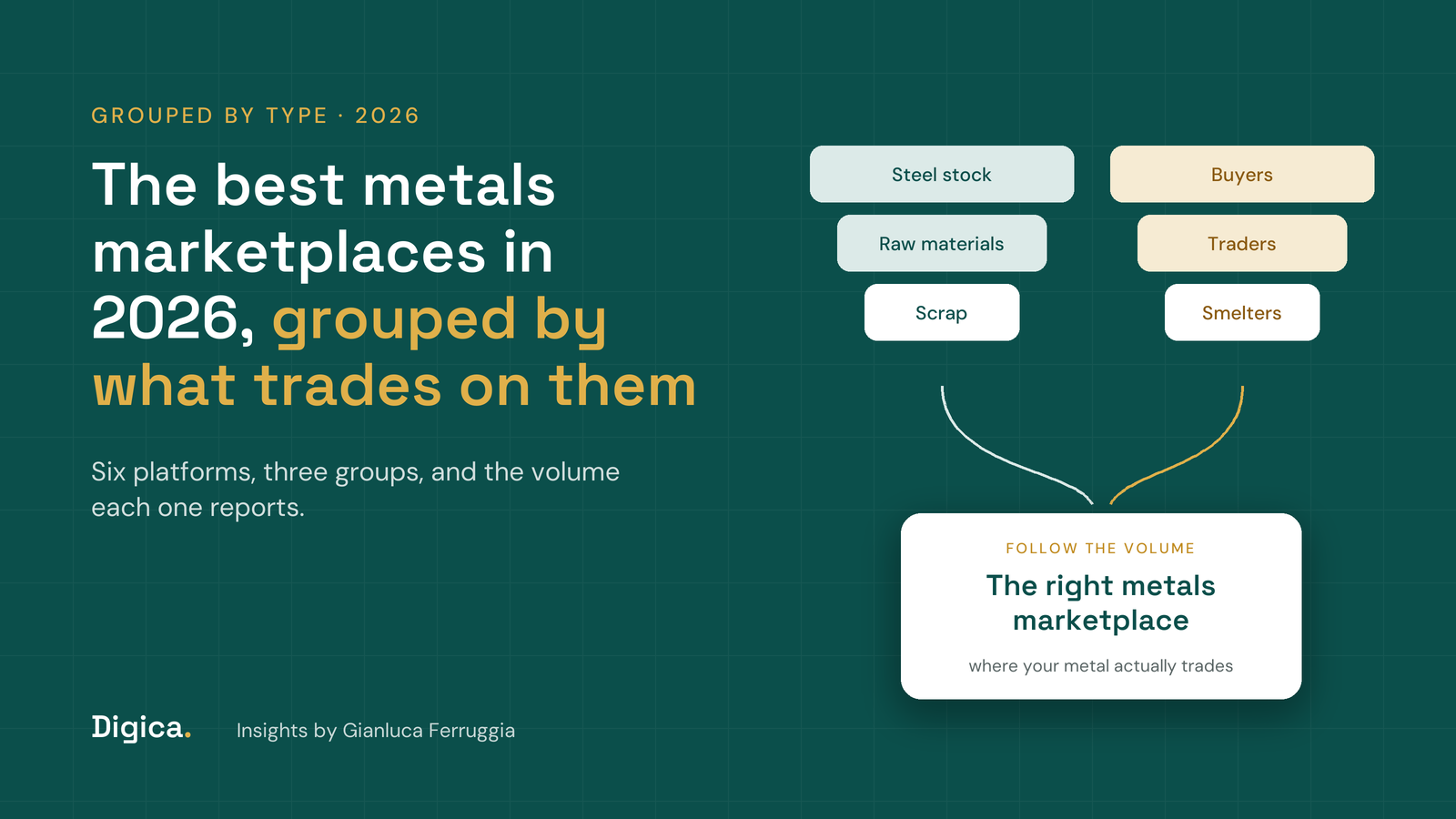
This guide groups six metals marketplaces by what trades on them: digital steel and metals stores, trading platforms for raw materials, and scrap marketplaces. For each one we give the volume it reports in its own unit and how it checks the other side. It is written for procurement and sales leads at manufacturers, service centers and traders, and for founders growing an industrial B2B marketplace. Figures come from company reports, filings and live pages, checked on November 13, 2026.
Quick Navigation
- How we grouped the metals marketplaces
- Six metals marketplaces side by side
- Digital steel and metals stores
- Trading platforms for raw materials
- Scrap metal marketplaces
- Why scrap is the fastest-moving group
- Three failure scenarios
- Choosing a metals marketplace by what you trade
- What volume is worth to a buyer and a seller
- FAQ
- Related Articles
How we grouped the metals marketplaces
We grouped each platform by what trades on it, because that decides who you meet there. A digital store sells finished steel and metal products from stock. A trading platform matches producers, consumers and traders of raw materials such as ferroalloys and battery metals. A scrap marketplace moves secondary metal from yards and manufacturers to smelters and foundries.
Within each group we asked two questions. How much trades, in the platform's own unit: tonnes shipped, gross merchandise value, companies or transactions. And how does it check the other side: credit checks, verified profiles, compliance rules or batch-level evidence. We left out price reporters and exchanges, which publish prices rather than match trades, and the industrial supply sites covered in our guide to industrial marketplaces.
Two platforms that once led this category are missing on purpose. Reibus closed its metals marketplace in June 2025 and kept only its logistics business (Steel Market Update). Felux now sells quoting software to service centers rather than running a marketplace. In metals, a platform that cannot hold volume does not survive, which is why we led with volume.
Our view: in metals, trade volume is the only number that proves a marketplace works. Profiles, listings and users are easy to grow. Tonnes that ship are not.
Six metals marketplaces side by side
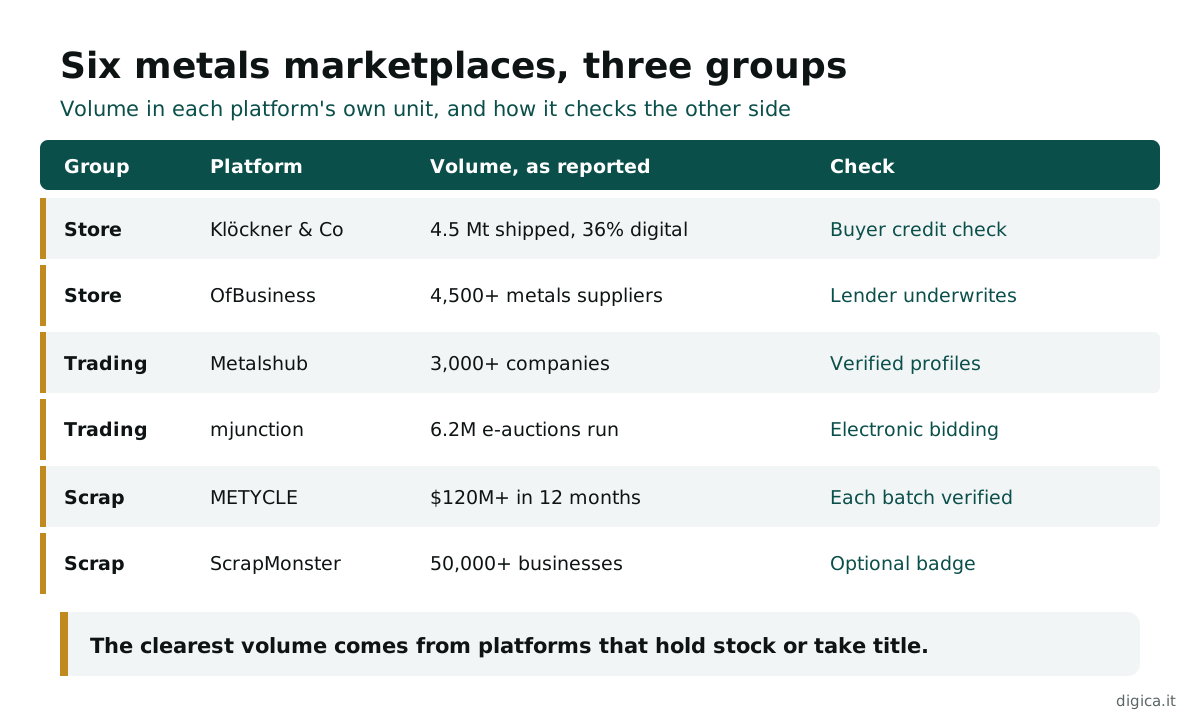
The table sets each platform's volume against what trades and how it checks counterparties. Use it to shortlist by group.
| Group | Platform | Volume, in its own unit | What trades | How it checks the other side | Cost to the user | Main risk | Best for |
|---|---|---|---|---|---|---|---|
| Digital store | Klöckner & Co | 4.5 million tonnes shipped in 2025; 36.2% of orders digital | Flat, long, tubes, stainless, aluminium | Credit check before order acceptance | Product price | One seller, not an open marketplace | Steel buyers in Europe and North America |
| Digital store | OfBusiness | Metals sales of about $1.2 billion in FY26; 4,500+ metals suppliers | Long and flat steel, stainless, aluminium, copper, zinc | Lending arm underwrites buyers | Product price, credit available | Metals sales fell 20% in FY26 | Indian SMEs buying with credit |
| Trading platform | Metalshub | 3,000+ companies, 400+ raw materials | Ferroalloys, battery and critical raw materials, steel inputs | Every profile verified, counterparty ratings | Subscription for trading tools | No tonnage published | Producers and consumers of raw materials |
| Trading platform | mjunction | More than ₹150,000 crore GMV a year across commodities; 6.2 million e-auctions | Steel, pig iron, scrap, plus coal and iron ore | Electronic bidding, GST-compliant scrap suppliers | Fees on auctions and procurement | Metals share of GMV not split out | Large Indian producers selling by auction |
| Scrap marketplace | METYCLE | More than $120 million traded in 12 months, up 150% | Aluminium, copper, brass, mixed non-ferrous scrap | Verifies each batch's quality and records | Margin on traded metal | Acts as trader, not neutral venue | Smelters and refiners buying non-ferrous scrap |
| Scrap marketplace | ScrapMonster | 50,000+ businesses | Ferrous and non-ferrous scrap, plus other recyclables | Optional verified badge | Free and paid tiers | Unverified members can post | Finding buyers or sellers fast |
Two patterns stand out. The platforms with the clearest volume either hold stock or take title to the metal. The pure listing boards have the widest reach and the least proof that trades complete.
Digital steel and metals stores
Digital stores sell finished products from stock, online or through digital quoting. They are the easiest way for a manufacturer to buy steel without phoning a service center, and the checks run mostly one way: the seller checks the buyer's credit.
Klöckner & Co
Klöckner & Co, based in Düsseldorf, is a steel and metals distributor that has pushed more of its own business online than almost any peer. In 2025 it shipped 4.5 million tonnes and reported sales of €6.38 billion, about $6.9 billion. Digital channels carried 36.2% of orders, against a target of 37.0%, and 30.1% of quotes, beating a target of 26.6%. Its AI-driven Kloeckner Assistant handles the main types of customer request.
It sells to more than 60,000 mostly small and mid-size steel and metal users from over 110 locations, with roughly 154,000 products. Prospective customers are credit-checked against an in-house risk board before an order is accepted. The catch is that Klöckner is one seller. It is a digital store, not an open metals marketplace, so compare its price with other suppliers.
OfBusiness
OfBusiness, based in Gurugram, sells raw materials to small and mid-size Indian businesses and finances many of those purchases through its lending arm, Oxyzo. Metals are its largest category: metals sales were ₹10,434 crore in FY26, roughly $1.2 billion, down 20% on the year. Its site lists 4,500+ metals suppliers and 50+ brands across long and flat steel, stainless, aluminium, copper and zinc, with live ex-works prices.
Running a metals or industrial B2B marketplace?
In 30 minutes we look at how buyers and sellers find platforms like yours, on Google and in AI answers, and how to turn your trade volume into proof that wins more of both.
Its check runs through credit. Oxyzo underwrites buyers using financial and external data, and on some purchase-finance loans pays suppliers directly; its gross non-performing loans were 0.74% at the end of FY26. The fall in metals sales is worth noting: volume on a store moves with steel prices and demand, not only with the platform. For a buyer, the credit line is often the real product, because it lets a small manufacturer buy a full truckload instead of a partial one, at a better price per tonne.
Trading platforms for raw materials
Trading platforms match producers, consumers and traders of raw materials through quotes, tenders and auctions. They suit buyers who source many materials from many counterparties, and the check runs both ways.
Metalshub
Metalshub, also based in Düsseldorf, says 3,000+ companies trade 400+ raw materials on its platform, from ferroalloys and battery raw materials to industrial minerals, aluminium and copper. Steelmakers and foundries use it to run requests for quotes, tenders and spot or contract trades, and producers use it to reach new buyers.
Every profile is verified, and buyers can trade only with pre-vetted partners, with counterparty ratings and compliance workflows. It does not publish tonnage. It does publish average outcomes: procurement users save 2.3% in costs and find nine new suppliers, by its own account. For a raw materials buyer, the verified network matters more than any single price.
mjunction
mjunction, a Kolkata-based joint venture of Tata Steel and SAIL, runs e-auctions, e-sales and e-procurement for steel, scrap, coal, iron ore and more. It says its platforms transact more than ₹150,000 crore of gross merchandise value a year across all commodities, coal included, and have run about 6.2 million e-auctions. More than 300,000 buyers and sellers use them.
For metals, the steel business has a buyer base of more than 15,000 across product categories, and the scrap business supplied 1.2 million tonnes to integrated steel plants across 15 states over three years, from 250+ GST-compliant suppliers. Sales run through electronic bidding. The model suits large producers who want a transparent, auditable way to sell seconds, by-products and scrap.
Scrap metal marketplaces
Scrap marketplaces move secondary metal between yards, manufacturers, traders and smelters. Here the hardest check is not the counterparty but the material: is the load what the seller says it is?
METYCLE
Cologne-based METYCLE, founded in 2022, started as an online scrap marketplace and now calls itself a vertically integrated secondary metals company. It buys, upgrades and supplies non-ferrous scrap such as aluminium, copper and brass. It traded more than $120 million of secondary metals in the past 12 months, up 150%, with a team in 15 countries.
It raised a €14.4 million Series A, about $15 million, in February 2025, and later a $150 million credit facility from Rivonia Road Capital to finance larger trades. Its check is on the metal: it verifies quality against agreed specifications, and its TrustTrack system links origin, weight, composition and delivery records to each batch. Buyers should know it trades as principal rather than acting as a neutral venue.
ScrapMonster
ScrapMonster combines scrap prices, news and a directory with a buy and sell board. It says 50,000+ businesses worldwide trust it, and its board carries current offers for ferrous and non-ferrous scrap. It is the widest reach in this guide and the lightest check.
A "Verified by ScrapMonster" badge marks companies that its team has confirmed are legally registered with no complaints filed, but basic members can post without one. That makes it useful for finding buyers or sellers quickly, and a starting point rather than a finished check. Ask for the badge before you ship.
Why scrap is the fastest-moving group
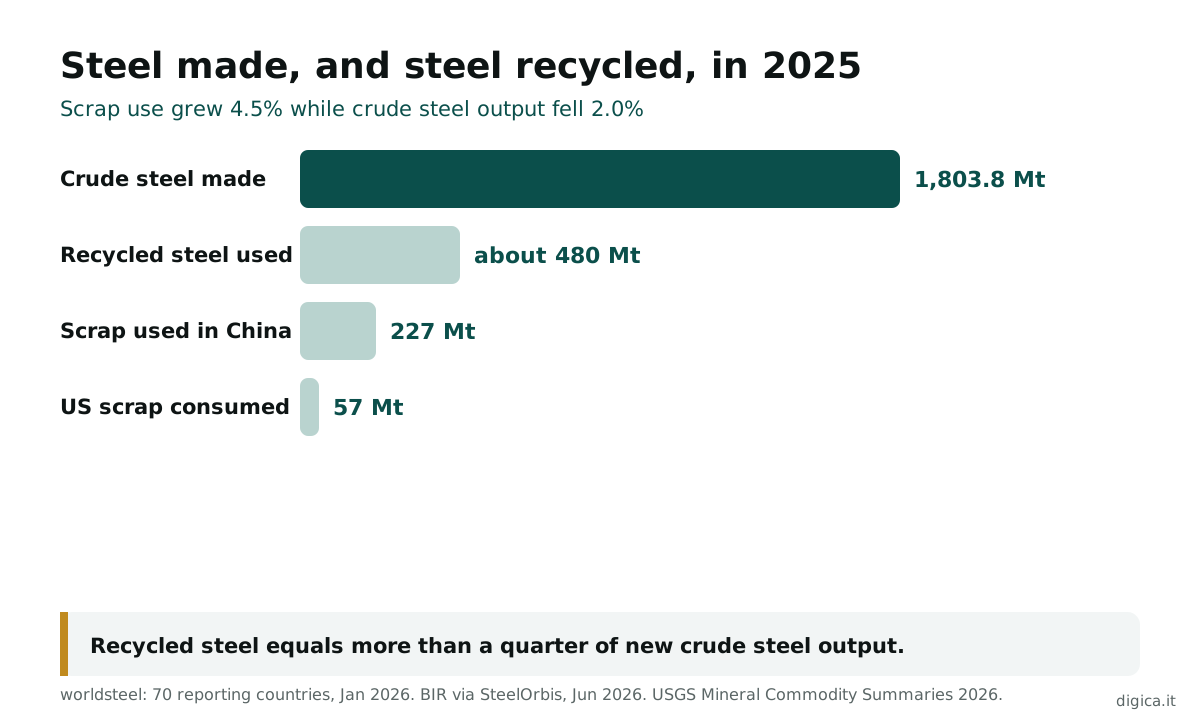
Scrap is where metals trade is growing while steelmaking stalls. Global crude steel output fell 2.0% in 2025 to 1,803.8 million tonnes across the 70 countries that report to the World Steel Association (worldsteel). Recycled steel use rose 4.5% in the same year to about 480 million tonnes, according to the Bureau of International Recycling.
That shift favors platforms that can verify material, finance trades and move metal across borders. The scrap trade is fragmented, with many small yards selling to fewer, larger mills and smelters, which is the classic setting for a B2B marketplace. It is also the setting where quality disputes are most expensive, so the platforms that win are the ones that prove what is in the load.
Three things decide which scrap platforms grow from here. The first is proof of material: a buyer paying for copper wants evidence of grade and weight before the truck leaves, not after the melt. The second is finance, because scrap trades are paid fast and settled slowly, and the platform that can pay a yard on collection wins its loads. The third is reach across borders, since scrap flows from countries that collect more than they melt to countries that melt more than they collect. METYCLE's batch records and credit line answer the first two. Open boards such as ScrapMonster answer the third, with the least proof.
Three failure scenarios
These are illustrative patterns, not accounts of named companies. The costs are typical, not audited.
- The listing taken as a buyer. A scrap yard sells a container of copper scrap to a buyer it met on an open board, with no verification and payment due on arrival. The buyer disputes the grade and pays half. The yard loses tens of thousands of dollars and months chasing the rest. A verified counterparty, or advance payment through the platform, would have prevented it.
- The platform that closed. A service center moves most of its spot buying onto one young metals marketplace for better prices. The platform shuts its marketplace and the center rebuilds its supplier list in a hurry, paying spot premiums for weeks. Checking the platform's trade volume and funding, not only its prices, would have flagged the risk.
- The grade nobody checked. A foundry buys aluminium scrap online at an attractive price. The load arrives with more contamination than the specification allowed, and melt losses wipe out the saving. A platform that verifies each batch against an agreed specification would have cost a little more per tonne and saved the margin.
Is your trade volume visible to buyers?
A growth audit shows how metals buyers and sellers search for platforms in your category, what AI answers say about you, and which pages would win more trades.
The pattern behind all three is the same. The buyer or seller judged the platform on reach and price, and ignored the two things that protect the trade: who is on the other side, and what is in the load. Write both down before you trade, and favor platforms that publish how they check them. A platform that will not say how it checks counterparties or material is asking you to carry that risk yourself, and the price it quotes should be lower to match.
Choosing a metals marketplace by what you trade
Start with what you trade, then match the group. These thresholds are a starting point, not rules.
- If you buy finished steel and metal products from stock in Europe or North America, compare Klöckner's digital channels with your local service centers.
- If you are an Indian SME that needs credit to buy steel or non-ferrous metals, use OfBusiness and compare its prices with at least two other suppliers.
- If you source ferroalloys, battery or critical raw materials from many producers, run tenders on Metalshub, where every profile is verified.
- If you are a large producer selling seconds, by-products or scrap in India, use mjunction's electronic auctions for a transparent price.
- If you buy or sell non-ferrous scrap above roughly $100,000 a trade, use a platform that verifies each batch, such as METYCLE.
- If you need a buyer or seller fast and the trade is small, post on ScrapMonster, and trade only with verified members.
- If a platform does not publish any volume figure, treat it as a directory and run your own checks.
For founders, the same thresholds show what buyers look for. A metals B2B marketplace that publishes tonnes or trade value, names the metals that trade, and explains its checks on every listing gives buyers the proof they need to move a purchase onto it.
What volume is worth to a buyer and a seller
The prize for getting that proof right is large. The US alone consumed an estimated 57 million tons of iron and steel scrap in 2025, worth $19.7 billion (US Geological Survey). Even a small share of that moving through B2B marketplaces is a large business, for buyers, sellers and the platform in the middle.
Run an illustrative case. A manufacturer buys $5 million of steel and raw materials a year. If running part of that through a verified trading platform saves 2%, in line with the averages one platform reports for its own users, that is $100,000 a year. The larger value is risk: one disputed load of $50,000 avoided every two years is worth another $25,000 a year.
For sellers, volume is the proof that wins buyers. A metals marketplace that shows tonnes shipped, the share of orders that are digital, and how it checks counterparties earns trust before the first call. That proof belongs on the page, in the structured data and in the answers AI assistants give when a buyer asks where to source.
Growing an industrial or metals B2B marketplace?
We help industrial marketplaces win buyers and suppliers through search, AI answers and the proof that makes a trade feel safe.
The number to take into your next sourcing review is 2%: the average saving one verified trading platform reports for its procurement users. On $5 million of annual spend, that is $100,000 a year, and the biggest cost of doing nothing is the disputed load or the vanished platform that a volume and verification check would have caught. Moving one category to a verified platform costs little, so payback usually comes within the first year, and the volume and verification check takes an afternoon.
FAQ
What is a metals marketplace? A metals marketplace is an online platform where businesses buy and sell steel, non-ferrous metals, raw materials or scrap. Some sell from their own stock, some match producers with buyers, and some move scrap between yards and smelters.
What is the best online marketplace for buying steel? It depends on where you buy. Klöckner & Co reported 36.2% of its 2025 orders through digital channels in Europe and North America, while OfBusiness serves Indian SMEs with credit. Compare at least two sources on price and delivery.
Where can I sell scrap metal online to businesses? METYCLE buys and supplies non-ferrous scrap with batch-level verification, ScrapMonster runs a buy and sell board used by 50,000+ businesses, and mjunction sells manufacturers' scrap to steel plants in India through auctions.
How do metals marketplaces verify buyers and sellers? Methods vary. Metalshub verifies every profile, Klöckner credit-checks buyers, METYCLE verifies each batch of material, and ScrapMonster offers an optional verified badge. Ask which check applies before you trade.
Is Reibus still operating? Reibus closed its online metals marketplace in June 2025 and kept its logistics business. Pages that still list it as a live metals marketplace are out of date.
How big is the scrap metal market? Recycled steel use reached about 480 million tonnes worldwide in 2025, up 4.5%. In the US, iron and steel scrap consumption was about 57 million tons, worth $19.7 billion.
Related Articles
- Industrial marketplace growth
- The best industrial marketplaces for MRO buying
- The best surplus and used industrial equipment marketplaces
- The best manufacturing marketplaces for custom parts
- The best chemical marketplaces in 2026
Where this connects
This article is part of our B2B marketplace growth series. Browse more on the Digica blog.