The best mining marketplaces and equipment exchanges, head to head on listings
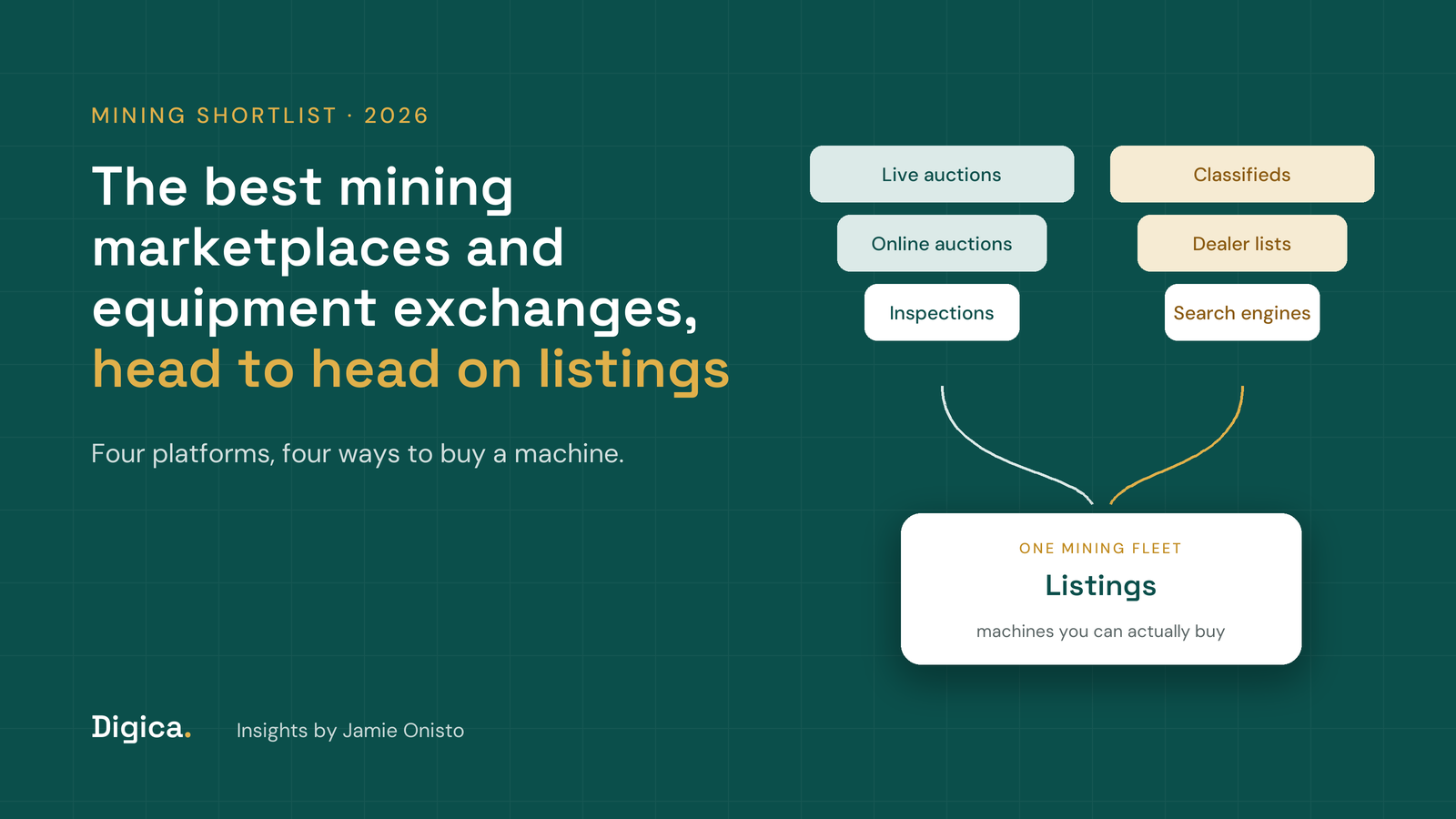
A mine manager who needs a second underground haul truck before the next shift change has a short list of places to look. Surplus Record shows 3,753 construction and mining listings, including 79 scooptrams and 18 underground haul trucks. RB Global, which runs Ritchie Bros. and IronPlanet, sold $16.2 billion of equipment and other assets in 2025. Both are a "mining equipment marketplace", and they put very different machines, and very different risks, in front of a buyer.
The pressure on mining budgets makes the choice matter. Investment in critical mineral development fell by 9% in 2025, ending several consecutive years of growth (IEA). When capital for new fleets is tight, more mines buy used, sell idle machines and rent the gap, and the mining marketplace they use decides how much they pay and how much risk they carry on the machine.
This guide compares four mining marketplaces and equipment exchanges head to head on listings: how much mining equipment each holds, in its own unit, how you buy, and who checks the machine before you pay. It covers heavy mining equipment, not crypto mining hardware, which shares the search term. It is written for mine operators, contractors and equipment dealers, and for founders growing an industrial B2B marketplace. Figures come from each platform's own pages, checked on November 15, 2026.
Quick Navigation
- How we compared equipment listings
- The scorecard: four mining equipment marketplaces
- Ritchie Bros. and IronPlanet vs Mascus: auction or classified
- Machinio vs Surplus Record: search engine or dealer list
- What the mining listings actually hold
- Auctions against listings: who carries the risk
- Three failure scenarios
- Choosing a mining marketplace by machine and deadline
- What a listing count is worth
- FAQ
- Related Articles
How we compared equipment listings
We compared listings, because a mining marketplace is only as useful as the machines on it that fit your site. For each platform we recorded what it holds in its own unit: lots sold, listings in a category, sellers, users or visitors. Those units are not interchangeable, so we set them side by side rather than ranking one number against another.
We then recorded how a buyer buys: at auction, from a classified ad, by contacting a seller found through a search engine, or through a dealer listed in a directory. Finally we recorded who checks the machine. On some platforms an inspector has photographed the unit and stands behind the report. On others the buyer arranges every check.
We left out crypto mining hardware, rental platforms, which are covered in our guide to equipment rental marketplaces, and general surplus sites, covered in our guide to surplus equipment marketplaces.
Our view: in mining, a listing count tells you where to start looking. The buying model tells you how much risk you are taking on, and that matters more on a machine that costs as much as a house.
The scorecard: four mining equipment marketplaces
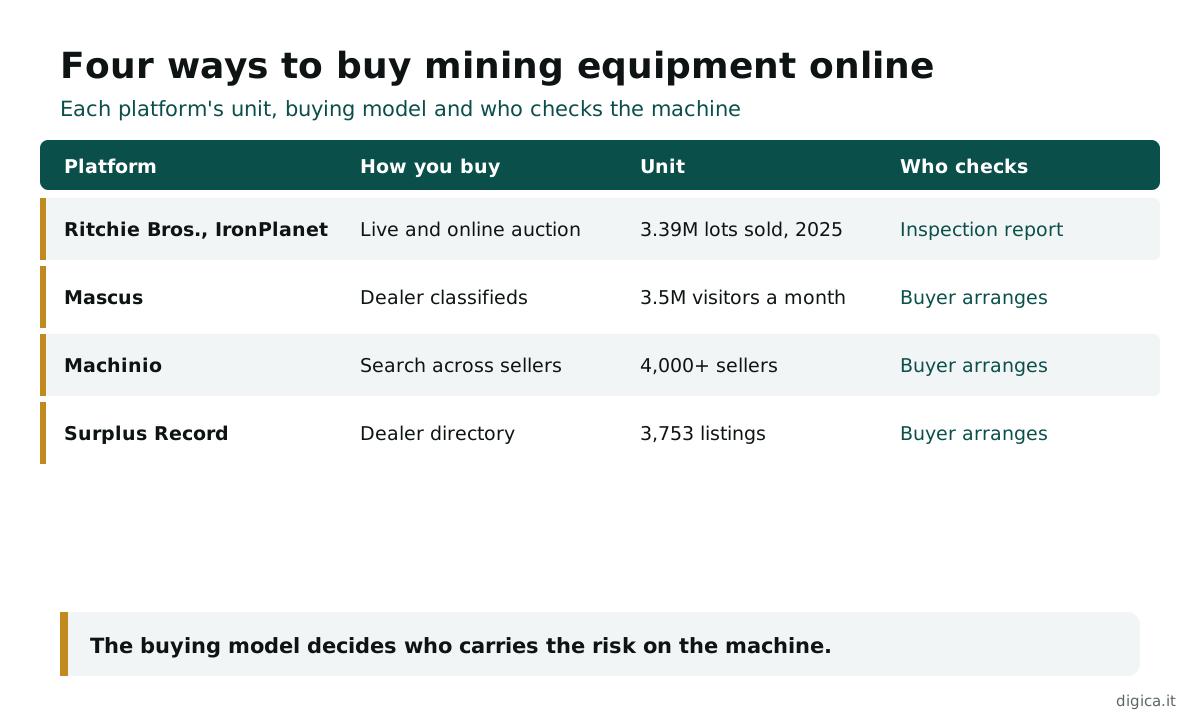
The table sets each platform's listings against its buying model, its checks and its main risk. Use it to shortlist before reading the head-to-heads.
| Platform | Owner | How you buy | Listings, in its own unit | Reach | Who checks the machine | Main risk | Best for |
|---|---|---|---|---|---|---|---|
| Ritchie Bros. and IronPlanet | RB Global | Live and online auctions | 3.39M lots sold in 2025; 101 items in IronPlanet's mining category when checked | 19,500+ bidders from 80+ countries at one Orlando auction | IronPlanet inspection reports on its online listings | Price set on the day; machine sold as is | Selling or buying whole fleets fast |
| Mascus | RB Global | Classified ads from dealers | Mining listings not published | 3.5M visitors a month, 37 languages | The seller; buyer arranges inspection | No platform check on the machine | Finding dealer stock across Europe and beyond |
| Machinio | Liquidity Services | Search engine; buyer contacts seller | Not published per category | 12.5M+ annual users, 4,000+ sellers, 190+ countries | The seller; buyer arranges inspection | Listings vary in depth and freshness | Searching many sellers at once |
| Surplus Record | Independent | Dealer listings; buyer contacts dealer | 3,753 construction and mining listings | 12 dealers listed as mining specialists | The dealer; buyer arranges inspection | Smaller pool, US-weighted | Underground and processing equipment |
Two patterns stand out. The platforms that publish the most about reach publish the least about mining stock, and the one that counts mining machines most precisely is the smallest. Ritchie Bros. and Mascus share an owner but sell in opposite ways, which is why they are the first head to head.
Ritchie Bros. and IronPlanet vs Mascus: auction or classified
Both sit inside RB Global, which reported $16.2 billion in gross transaction value and 3.39 million lots sold in 2025. The difference is how a mining machine changes hands.
Ritchie Bros. and IronPlanet
Ritchie Bros. runs live onsite and online auctions, and IronPlanet runs weekly online auctions. The scale is hard to match. Its Orlando auction in February 2026 sold more than $265 million of equipment across 14,500+ items, to over 19,500 participants from more than 80 countries. When we checked, IronPlanet's mining category showed 101 items, against 43,787 in construction, so most mining-grade machines appear under construction categories such as excavators, dozers and haul trucks.
IronPlanet listings carry IronClad Assurance inspection reports, with photographs and checks of the main systems. That is the clearest check in this guide. The trade-off is price: an auction sets the price on the day, and the machine sells as is beyond what the report covers.
Running a mining or industrial equipment B2B marketplace?
In 30 minutes we look at how mine operators and dealers find platforms like yours, on Google and in AI answers, and how to turn your listings into more buyers and sellers.
Mascus
Mascus is a classified listings site, founded in Europe in 2001, that joined Ritchie Bros. in 2016. Dealers list stock, and buyers contact them directly. It says that stock is seen by 3.5 million visitors a month and published in 37 languages. It does not publish a mining listing count on the pages we could read.
The verdict on this pair: Ritchie Bros. and IronPlanet when speed and an inspection report matter more than the last dollar of price, Mascus when you want to compare dealer stock across countries and negotiate. Because they share an owner, a seller can reach both audiences, but a buyer should not assume the same protections apply on each.
Machinio vs Surplus Record: search engine or dealer list
Neither of these platforms holds the machine or runs a sale. Both put the buyer in touch with the seller. The difference is breadth against focus.
Machinio
Machinio, owned by Liquidity Services, is a search engine for used machinery that pulls listings from many sellers into one search. It counts 12.5 million+ annual users, more than 1 million monthly visits and 4,000+ sellers, with reach in more than 190 countries. Buyers contact the seller directly, and the seller completes the sale.
The strength is coverage: one search returns crushers, drills and loaders from dealers on several continents. The weakness is depth. Each listing is only as detailed as the seller made it, and the platform does not inspect.
Surplus Record
Surplus Record has listed used machinery since its first printed edition in 1924. Its construction and mining section shows 3,753 listings, with subcategories that match how mines buy: 191 mining crushers, 131 ball, pebble and SAG mills, 79 scooptrams, 28 underground mining loaders, 22 jumbo drills, 18 underground haul trucks and 12 mine shaft hoists. It lists 12 dealers that specialize in mining equipment.
The verdict on this pair: Machinio for a wide first search across sellers, Surplus Record when you need underground or processing equipment and want to see exactly how many of each are listed. Both leave inspection, payment and shipping to the buyer and the dealer.
What the mining listings actually hold
Surplus Record is the one platform here that counts mining machines by type, so it is the clearest view of what a mining equipment marketplace holds. The mix is weighted toward processing and underground equipment, not the large surface trucks most people picture.
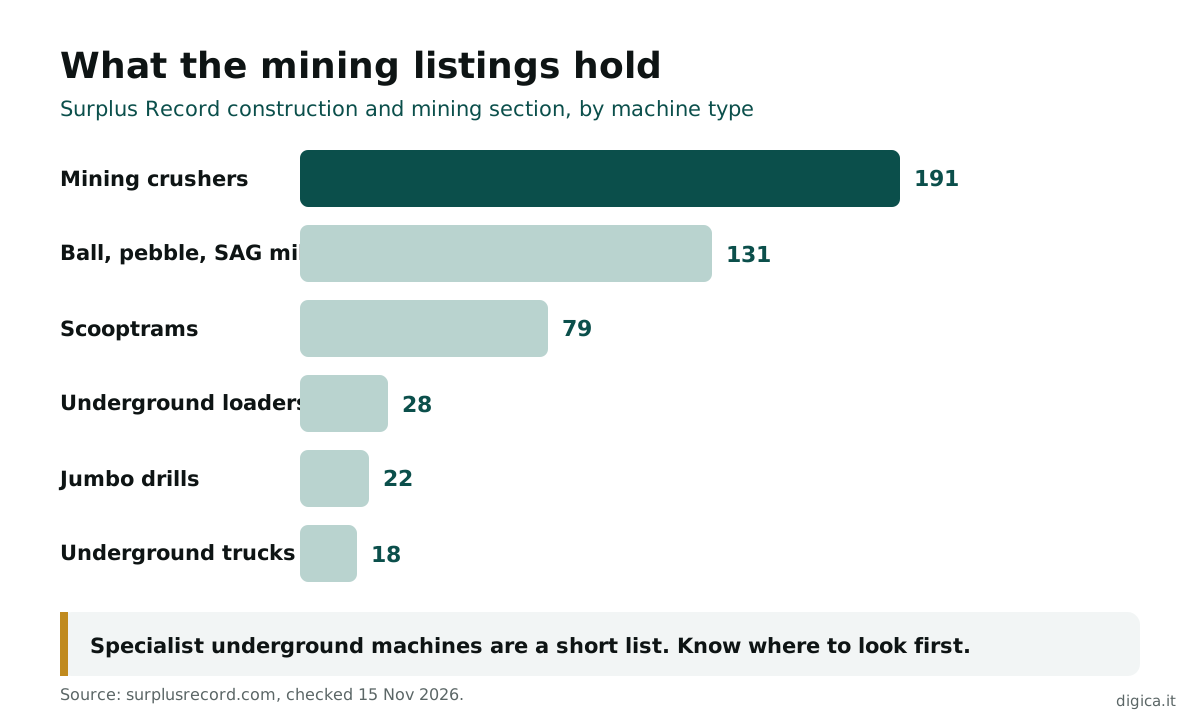
That matters for buyers of specialist machines. When a site needs one more underground haul truck, 18 listings on one platform is a short list, and an auction calendar may not have one for months. The labor market adds pressure: US mining, outside oil and gas, employed 189,600 people in October 2026, including 20,900 excavating and loading machine operators in 2025 (BLS). A machine that sits idle waiting for a part or a replacement also idles the crew trained to run it.
For sellers, the same scarcity is an opportunity. A specialist underground machine listed with full hours, service history and photographs stands out among a few dozen rivals, and is more likely to be found by a search engine or an AI assistant when a mine asks where to buy one.
Auctions against listings: who carries the risk
The buying model decides who carries the risk on the machine. At an auction with inspection, the platform has documented the condition and the buyer competes on price. On a listing site, the buyer negotiates the price and carries the job of checking the machine.
Neither is safer by default. An inspection report covers what an inspector can see and run, not hidden wear inside an engine or a gearbox. A dealer listing can come with the dealer's own warranty and a site visit. The question is which checks you can arrange in the time you have.
Ask three things before you bid or call. Who inspected the machine, and when? What does the report or the dealer guarantee, in writing? And who pays to move a machine that weighs as much as a building across a border? The answers usually decide the platform before the price does.
Payment is the fourth question, and the one buyers skip most often. At an auction, the terms are set by the platform and the same for every bidder. On a listing site, terms are whatever the buyer and seller agree, so a deposit, an escrow arrangement or a staged payment against delivery has to be negotiated. For a first purchase from a dealer you have not used, ask for references from other mines and confirm the dealer owns the machine it is selling. A machine listed by a broker who does not hold it can be sold twice, and the second buyer finds out when the truck does not arrive.
Three failure scenarios
These are illustrative patterns, not accounts of named companies. The costs are typical, not audited. Each one comes from buying through the right platform in the wrong way, which is more common than buying through the wrong platform.
- The listing taken as a guarantee. A contractor buys a used underground loader from a classified ad without an independent inspection, to meet a start date. The transmission fails in the first month. The rebuild and two weeks of downtime cost $180,000, far more than an inspection and a week's delay would have.
- The auction without a plan for transport. A mine wins a large crusher at auction at a good price, then finds that dismantling, permits and shipping to site cost almost as much as the machine. Pricing transport before bidding would have changed the bid, or the platform.
- The fleet sold one machine at a time. A mine closing a pit lists 30 machines one by one on classified sites. Eighteen months later, a third are still unsold and losing value. Selling the fleet in one auction would have released the capital in a day, at a lower but certain price.
Are mine operators finding your equipment listings?
A growth audit shows how mining buyers search for equipment platforms like yours, what AI answers say about your stock and checks, and which pages would win more buyers and sellers.
In each case the platform worked as described. The failure was skipping a check, a cost or a decision about speed. Before using any mining marketplace, write down the inspection you need, the date the machine must run and the full cost to get it on site. Those three lines choose the platform for you, and they are the same three lines a finance team will ask about after the purchase.
Choosing a mining marketplace by machine and deadline
Start with the machine and the date it must work, then match the platform. These thresholds are a starting point.
- If you are selling a fleet of more than 10 machines from one site, start with Ritchie Bros. and its auction calendar.
- If you are buying a surface machine and want an inspection report before you bid, search IronPlanet's online auctions first.
- If you want to compare dealer stock across Europe and negotiate, search Mascus.
- If you need a specialist underground or processing machine, check Surplus Record's subcategory counts, then call the mining dealers it lists.
- If you need a wide first search across thousands of sellers, use Machinio, then shortlist by seller.
- If the machine must run within 30 days, favor a dealer listing with stock on hand over an auction calendar.
- If transport will cost more than 20% of the price, price it before you bid or call.
Most buyers use two: one wide search to see what exists, and one platform whose buying model fits the deadline.
What a listing count is worth
Run an illustrative case. A mid-size mine runs 40 major machines. If a breakdown idles a loader and its crew for three weeks while the team searches for a replacement, the lost output can exceed $250,000 on a single unit. Finding the right machine in one week instead of three cuts that by about two thirds, around $165,000 on one incident.
Market shifts make that search harder to plan. US coal exports fell to 93 million short tons in 2025, from 108 million in 2024 (EIA). When output shifts, fleets move between sites and owners, and the platforms that list them clearly are the ones mines turn to first.
Sellers face the mirror image. A mine that idles a machine for a year pays to store, insure and maintain it while its value falls. Listing it on the platform whose buyers want that machine type, with hours, service records and photographs, turns a cost into cash, and the earlier the decision, the more of the value survives.
For founders, the lesson is about proof. A mining equipment marketplace that publishes its stock by machine type, its inspection standard and its transport options gives buyers the answers they need, on its own pages and in the answers AI assistants give when a mine asks where to buy.
Growing a mining or industrial equipment B2B marketplace?
We help industrial marketplaces win buyers and sellers through search, AI answers and the proof that makes a mine trust a listing.
The number to take into your next fleet review is 18: the underground haul trucks listed on Surplus Record when we checked. For specialist machines, the market is thin, so know your platforms before a breakdown forces the search. The biggest cost of doing nothing is weeks of idle crew and output while the team looks for a machine, often more than $250,000 on one unit. Payback on knowing where to look is the first breakdown it shortens.
FAQ
What is a mining marketplace? A mining marketplace is a platform where mines, contractors and dealers buy and sell mining equipment, parts and fleets, through auctions, classified listings or dealer directories. In search, the term is also used for crypto mining hardware, which this guide does not cover.
Where can I buy used mining equipment? Ritchie Bros. and IronPlanet run auctions with inspection reports, Mascus and Machinio list dealer stock, and Surplus Record lists 3,753 construction and mining machines from dealers, including underground equipment.
What is the largest mining equipment marketplace? By value, RB Global, which runs Ritchie Bros. and IronPlanet and owns Mascus, reported $16.2 billion in gross transaction value in 2025 across all equipment and assets, not only mining.
Is it safer to buy mining equipment at auction? An auction with an inspection report gives you a documented condition, but the machine still sells as is beyond the report. A dealer listing can offer a warranty and a site visit. Choose the checks you need first.
How do I sell a mining fleet? For many machines from one site, an auction usually releases the capital fastest at a certain price. For single specialist machines, a dealer listing with full service history often reaches the right buyer at a better price.
Do mining equipment marketplaces inspect machines? Some do. IronPlanet publishes inspection reports on its online listings. Classified and search platforms such as Mascus, Machinio and Surplus Record leave inspection to the buyer and the seller.
Related Articles
- Industrial marketplace growth
- The best surplus equipment marketplaces
- The best equipment rental marketplaces for contractors
- The best metals marketplaces, by what trades
- The best industrial marketplaces
Where this connects
This article is part of our B2B marketplace growth series. Browse more on the Digica blog.