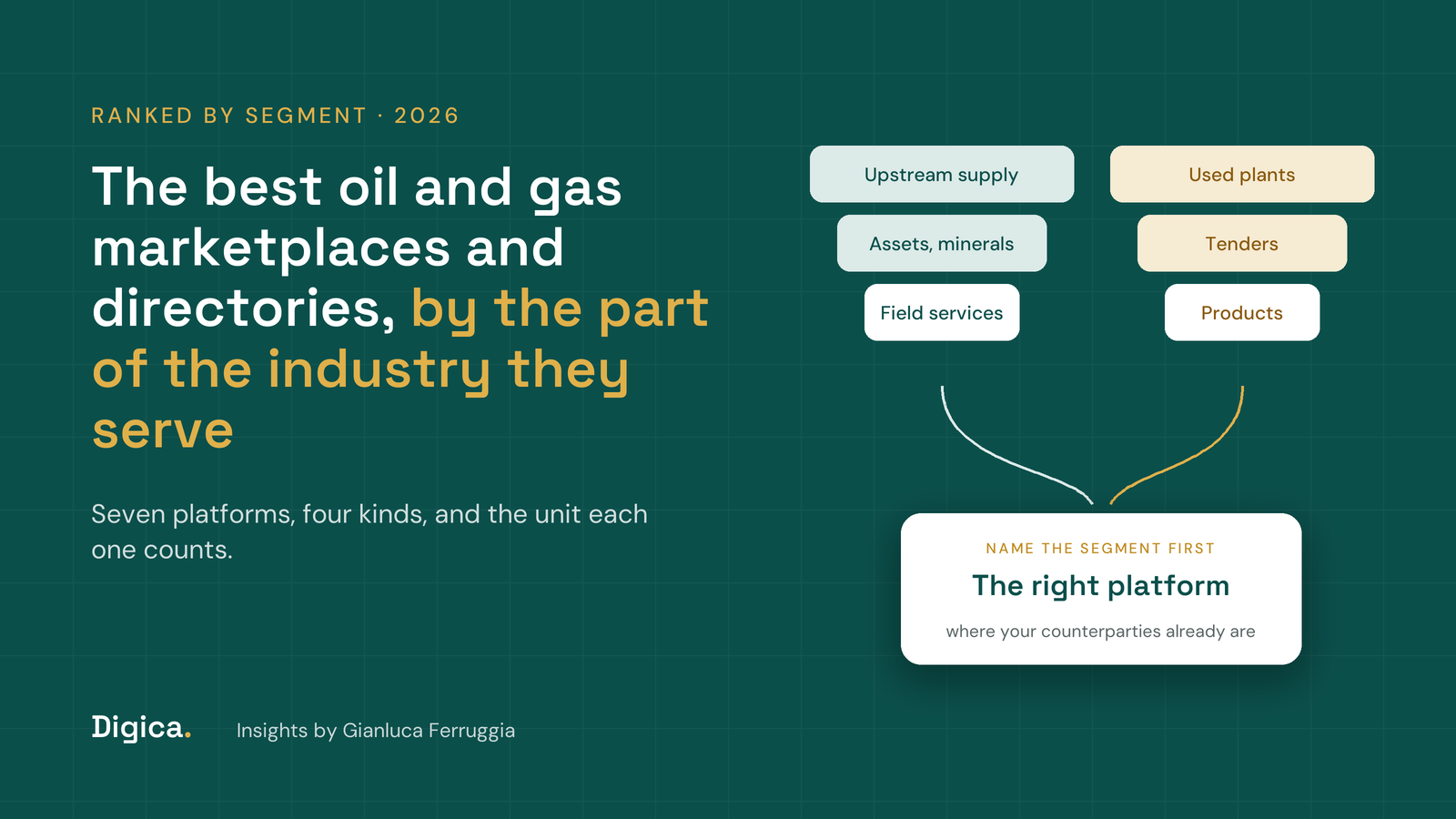
The best oil and gas marketplaces and directories, by the part of the industry they serve
Upstream oil and gas investment was expected to fall to just under $570 billion in 2025, down around 4 percent, with 40 percent of it spent on slowing declines at existing fields (IEA). When capital is that tight, the platform you use to find and pay suppliers matters. Yet an oil and gas directory sounds like one thing, and it is at least four. A drilling contractor looking for a valve supplier, a mineral owner selling a royalty, a refinery buying a used gas plant and a Nigerian operator running a tender all search for an "oil and gas marketplace", and none of them should end up on the same platform. Pick the wrong one and you spend weeks on a site whose suppliers, buyers or listings belong to a different part of the industry.
Search results do not help much. For "oil and gas directory", Google returns contact databases, regional chamber lists and archived government pages, and several domains that once ran popular oilfield directories are now parked or for sale. For "oil and gas marketplace", it mixes sponsored articles with commodity market reports. Nobody explains which platform serves which segment.
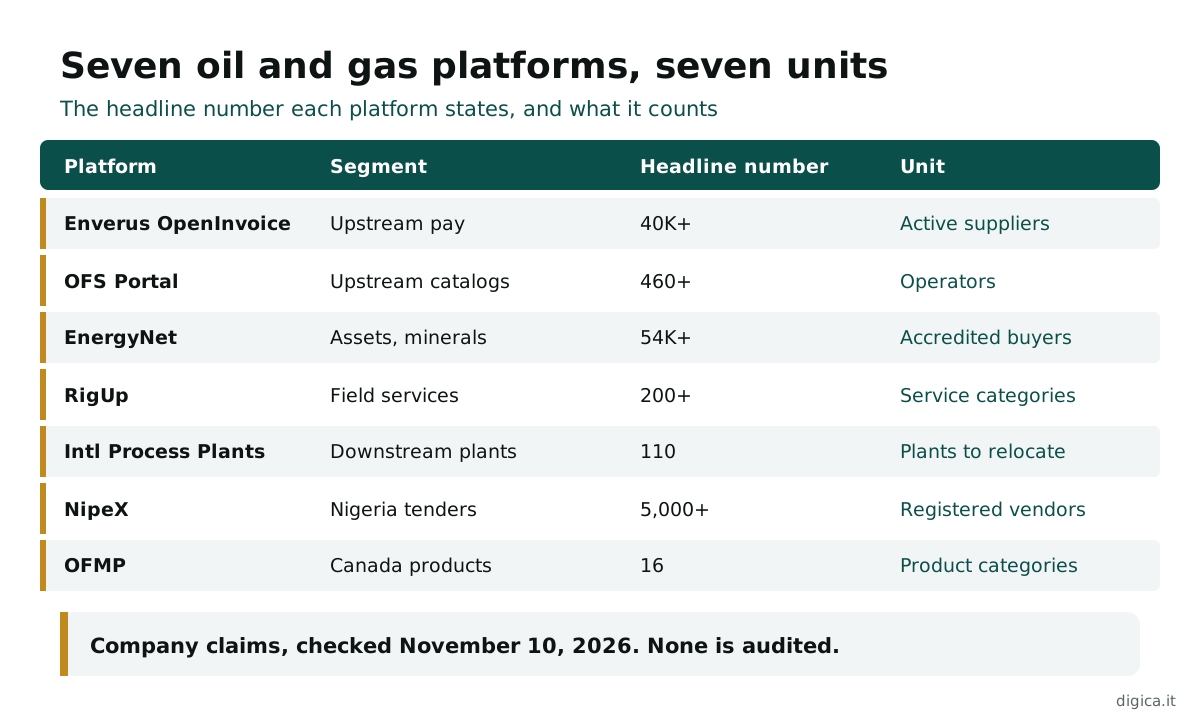
This guide ranks seven oil and gas marketplaces and directories by specialization: the part of the industry each serves, what a buyer actually does there and how large its network is in its own unit. It is written for procurement leads, operators and suppliers in the industry, and for founders growing an energy B2B marketplace. Every figure is the company's own, checked on November 10, 2026.
Quick Navigation
- How we ranked oil and gas platforms
- The seven oil and gas marketplaces at a glance
- 1. Enverus OpenInvoice: upstream procure-to-pay
- 2. OFS Portal: supplier catalogs for operators
- 3. EnergyNet: upstream asset and mineral sales
- 4. RigUp: oilfield service vendors and labor
- 5. International Process Plants: used downstream plants
- 6. NipeX: national upstream e-procurement
- 7. OFMP: a Canadian oilfield products marketplace
- Where oil and gas sourcing goes wrong
- Choosing an oil and gas directory by segment
- FAQ
- Related Articles
How we ranked oil and gas platforms
We ranked by how much of the industry's day-to-day buying and selling each platform carries, within the segment it serves. A network that thousands of upstream suppliers invoice through ranks above a storefront with 16 categories, even if the storefront is easier to use. Specialization decides which platform you should use. Reach decides the order.
Reach matters more in oil and gas than in most B2B categories, because counterparties are concentrated. The two largest upstream networks in this guide each count their operators in the hundreds, not the thousands, and suppliers set up on whichever network those operators use. A platform with the right operators attracts the suppliers, and the suppliers keep the operators there.
We read every number on the company's own pages, and none is audited. Each platform counts something different, so we name the unit every time: operators, suppliers, buyers, vendors, plants or categories. We left out several familiar names. Some former oilfield directories now point to parked domains, and broad equipment auction sites are covered in our guide to surplus equipment marketplaces.
Our view: in oil and gas, the best platform is the one your counterparties already use. A better interface rarely beats a network where 80 percent of the suppliers you need are already set up to invoice.
The seven oil and gas marketplaces at a glance
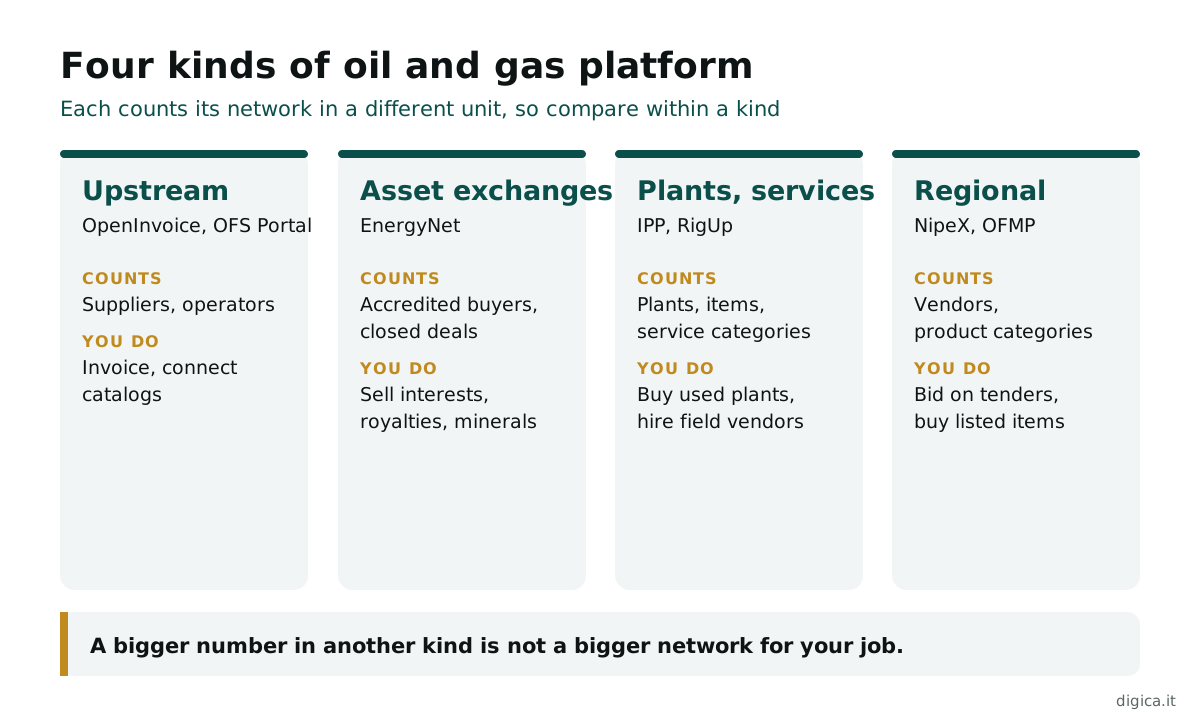
Three of the seven serve upstream operators and their suppliers, one serves people buying and selling oil and gas assets, one serves downstream and midstream plant buyers, and two serve a single country. Read the "Segment" column first, because a platform that leads one segment is often useless in the next.
Seven oil and gas marketplaces and directories compared on segment, what you do there, scale claimed, main risk and best fit
| Rank | Platform | Segment | What you do there | Scale claimed | Main risk | Best for |
|---|---|---|---|---|---|---|
| 1 | Enverus OpenInvoice | Upstream procure-to-pay | Invoices, purchase orders, field tickets | 40K+ active suppliers, $200B annual spend | Figures vary by Enverus page | Operators paying many field suppliers |
| 2 | OFS Portal | Upstream supplier catalogs | Connect supplier catalogs to your procurement platform | 460+ operators, 47+ procurement platforms | Not a place to find new suppliers | Big suppliers and operators linking systems |
| 3 | EnergyNet | Upstream assets and minerals | Buy or sell working interests and royalties by auction or bid | 54K+ accredited buyers, $17B+ closed | Asset sales, not supplies | Selling non-core acreage |
| 4 | RigUp | Upstream and midstream services | Find, contract and pay field service vendors and crews | 200+ service categories | Savings figures are its own | Operators managing field vendors |
| 5 | International Process Plants | Downstream and midstream plants | Buy relocatable plants and used process equipment | 110 plants, 15,000 items | One seller, not open listings | Refinery and gas processing buyers |
| 6 | NipeX | Nigerian upstream tenders | Register, prequalify and bid on tenders | 5,000+ vendors, $12B+ contracts | One country's rules | Vendors selling into Nigeria |
| 7 | OFMP | Canadian oilfield products | Buy listed products online with card, ACH or PO | 16 categories | Smallest network here | Quick buys in Western Canada |
A higher rank means more reach inside its segment, not a better choice for you. A pipe trader would get nothing from EnergyNet, and a mineral owner would get nothing from OFS Portal.
1. Enverus OpenInvoice: upstream procure-to-pay
Enverus OpenInvoice is the network most upstream operators and their field suppliers already use to exchange invoices, purchase orders and field tickets. It ranks first because of reach: Enverus says its source-to-pay network connects more than 40,000 active suppliers transacting $200 billion in annual spend.
It is a procure-to-pay network rather than a directory you browse. An operator joins, and its suppliers invoice it through the network, with prices checked against agreed contracts. Enverus says operators typically find around 80 percent of their suppliers are already on the platform, which is the real value: onboarding a supplier base is the slow part of any procurement system.
Read the scale numbers carefully. Enverus's own pages describe the network in more than one way, from about 40,000 to more than 50,000 active suppliers and from $190 billion to $260 billion in spend, depending on which product and period the page covers. Treat 40,000 suppliers and $200 billion as a working size, not an audited figure. Blackstone agreed to acquire Enverus in August 2025.
Pick it if you operate wells and pay hundreds of field suppliers. It is less useful for finding a new supplier, because its strength is transacting with suppliers you already have.
2. OFS Portal: supplier catalogs for operators
OFS Portal is a Houston-based group of large upstream suppliers that sets standard e-commerce terms and connects their catalogs to operators' procurement systems. It lists more than 460 operators as buyers, including international and national oil companies, and more than 47 procurement platforms in its community.
That makes it infrastructure rather than a storefront. When an operator buys from a major oilfield services company through its own e-procurement system, OFS Portal often supplies the legal framework and the catalog connection underneath. Its members include some of the largest oilfield suppliers, and it was formed by suppliers in 2000.
Running an energy or oil and gas B2B marketplace?
In 30 minutes we look at how operators and suppliers find platforms like yours, on Google and in AI answers, and where they drop off before they sign up.
For a buyer, the practical point is simple: if your large suppliers are OFS Portal members, ask whether your procurement platform is one of the 47 connected to it before you build catalog links yourself. For a smaller supplier, it is not a route to new customers, because membership is built around established upstream suppliers. Use it to connect what you already buy, then look to a directory or a network such as RigUp to find someone new.
3. EnergyNet: upstream asset and mineral sales
EnergyNet is the largest oil and gas marketplace in this guide for buying and selling the assets themselves: working interests, royalties, mineral rights and government lease sales. Now part of Efficient Markets, it states more than 54,000 registered, financially accredited buyers and more than $17 billion in cumulative closed transactions.
Its scale shows in the deal count. It reports more than 135,000 successful transactions and an 82 percent sales success rate, run as online auctions, sealed bids and negotiated sales with data rooms. For a seller, that means a large pool of buyers already checked for funding, which shortens the hunt for a counterparty.
It is the specialist for the asset side of the industry, not for supplies. If you are trying to source equipment or services, it has nothing for you. If you hold non-core acreage, small royalty interests or a package too small for a banker, it is usually the first place to look. Our guide to energy marketplaces covers the power, gas and certificate exchanges that trade the energy rather than the asset.
4. RigUp: oilfield service vendors and labor
RigUp connects upstream and midstream operators with the vendors and crews that do field work. It describes a network of trusted vendors across more than 200 service categories, with tools for bids, contracts, compliance and payment.
The company was founded as RigUp in 2014, called itself Workrise from 2021 and went back to the RigUp name in September 2025. Its homepage says it has saved operators between 18 and 29 percent in quantifiable costs. That is its own claim, with no stated method, so use it as a reason to ask for references rather than as a forecast. Independent research points the same way: Boston Consulting Group estimates that operators with strong procurement and supply chain capabilities typically achieve a cost advantage of 4 to 8 percent over their peers (BCG).
Its specialization is services, not products. A completions manager who needs a vetted crew next week, with insurance and safety records checked, is the user it serves best. It is less useful for buying pipe, valves or chemicals, where a supplier catalog or a product marketplace fits better.
5. International Process Plants: used downstream plants
International Process Plants (IPP) serves the downstream and midstream end of the industry: refineries, petrochemical units and gas processing plants. From its headquarters in Princeton Junction, New Jersey, it lists 20 complete plant sites, 110 plants for relocation and 15,000 process systems and major pieces of equipment.
It is a specialist seller rather than an open marketplace. IPP buys idle plants and equipment, holds or markets them, and sells them on, with engineering support for relocation. It states 47 years of experience, more than 160,000 customers worldwide and 11 offices.
The reason to use it is time. Moving a used gas processing unit can be faster than ordering new equipment with long fabrication lead times, and a large inventory makes it more likely that something close to your specification exists. The risk is that you are buying from one company, so compare its price and condition reports against an independent inspection.
6. NipeX: national upstream e-procurement
NipeX, the Nigerian Petroleum Exchange, is the e-procurement and vendor management platform for Nigeria's upstream sector. It states more than 5,000 registered vendors, more than $12 billion in contracts processed and more than 45 industry operators, and it was established in 2005.
It is the clearest case of geographic specialization in this guide. Vendors register and prequalify through its joint qualification system, then see and bid on tenders from operators in Nigeria. For a supplier that wants to sell into Nigerian upstream projects, it is close to a requirement rather than an option.
Operators and suppliers elsewhere should note the model rather than the platform. Several producing countries run national systems like this, often tied to local content rules, and the right first step in a new country is usually to ask which system its operators require before you search any global directory.
7. OFMP: a Canadian oilfield products marketplace
OFMP, the Oilfield Marketplace, is the closest thing here to a conventional online store for oilfield products. Based in Calgary, it lists products in 16 categories, from artificial lift and drill bits to valves, wireline and personal protective equipment, with prices shown and checkout by card, ACH or purchase order.
It is the smallest network in this ranking. Its listings show Canadian dollar prices, from a set of bit nozzles at C$651 to a multiphase meter at C$160,000, and rentals are still marked as coming soon. A sponsored article from April 2025 said it reached more than 5,600 buyers a month, but that is the company's own figure in paid content, so we give it little weight.
Pick it for quick, priced purchases in Western Canada, especially for standard items where comparing a few listings is faster than a quote round. For specialized or high-value equipment, treat it as a starting price and still ask for a formal quote.
Where oil and gas sourcing goes wrong
These patterns recur when buyers and suppliers choose a platform by name rather than by segment. The examples are illustrative, and the dollar figures are estimates of the kind we see, not audited costs.
- The directory that was never updated. A procurement team builds a shortlist of fabricators from a free oil and gas directory and finds a third of the listings are closed or merged. Two weeks go on chasing dead contacts. Starting with the platform where active suppliers already transact, and treating a directory as a lead list only, would have saved perhaps $15,000 of staff time on one sourcing round.
- The tender nobody registered for. A supplier targets a West African project and prepares a strong bid, then learns it needed to prequalify on the national system months earlier. The bid never counts. Checking which system operators in that country require, before writing a word, would have cost one email.
- The used plant without an inspection. A buyer agrees to a relocatable gas unit on the seller's condition report and finds corrosion during dismantling. Repairs add months and a large share of the savings disappears. An independent inspection before signing, a small fraction of the price, is cheap insurance on any used plant.
Do operators find your oil and gas platform before a competitor's?
A growth audit maps how operators, engineers and suppliers search for your segment, on Google and in AI answers, and which category and location pages you are missing.
The common thread is that each team picked a platform before naming its segment. In oil and gas, the counterparties you need cluster in one place per segment, and they rarely move. Much of a procurement team's advantage is simply knowing where suppliers already are, before a deadline makes the search urgent. Name the segment first, then the country, then the platform, and most of these failures never start.
Choosing an oil and gas directory by segment
Start from what you are buying or selling, then the country, then whether you need new counterparties or a better way to pay existing ones.
- If you operate wells and pay more than 100 field suppliers a year, start with Enverus OpenInvoice, and ask how many of your current suppliers are already on it.
- If you buy from large oilfield services companies through your own e-procurement system, ask whether your platform is one of the 47 connected to OFS Portal.
- If you are selling acreage, royalties or minerals worth less than about $50 million, list with EnergyNet before you hire a banker.
- If you need vetted field crews or service vendors within a month, use RigUp, and ask for references behind its savings figure.
- If you need a refinery, petrochemical or gas processing unit faster than a new build, check International Process Plants, and budget for an independent inspection.
- If you sell into Nigerian upstream projects, register and prequalify on NipeX before you look anywhere else.
- If you need a standard oilfield product in Western Canada this week, compare listed prices on OFMP.
Demand is not going away, which is why these networks keep their value. The US Energy Information Administration forecasts US crude oil production will average 13.8 million barrels per day in 2026, a new record above the 13.7 million set in 2025 (EIA). Record output on flat or falling investment means more work per dollar, and more pressure on how suppliers are found and paid. Most teams will keep two of these platforms in use: one network to pay the suppliers they have, and one specialist to find what they lack. Reviewing that pair once a year, against the segments you actually buy in, takes an afternoon and keeps the list honest.
Growing an energy or oil and gas B2B marketplace?
We help energy B2B marketplaces win the suppliers that make them credible, and reach the operators and engineers searching for them.
The number to take into your next procurement review is the share of your active suppliers you can reach through one network. If it is below half, you are paying for that gap in staff time on every invoice and every sourcing round. Count your active suppliers, check how many already transact on the network your peers use, and the case for moving usually makes itself. Our guides to procurement marketplaces and supplier databases cover the cross-industry tools around these choices.
FAQ
What is the best oil and gas directory? It depends on the segment. For upstream suppliers you already pay, Enverus OpenInvoice has the widest reach. For asset sales, EnergyNet leads. For new field service vendors, RigUp is stronger. Free directories are best treated as lead lists.
What is an oil and gas marketplace? An oil and gas marketplace is an online platform where operators, suppliers or investors buy and sell products, services or assets. Some are procurement networks, some sell assets by auction and some list priced products, so check which one fits your job.
Where can I sell oil and gas mineral rights online? EnergyNet, now part of Efficient Markets, runs online auctions, sealed bids and negotiated sales for working interests, royalties and minerals. It states more than 54,000 registered, financially accredited buyers.
How do suppliers register with oil and gas operators? Usually through the operator's procurement network or a national system. Many upstream operators invoice through Enverus OpenInvoice, and in Nigeria vendors register and prequalify on NipeX before they can bid.
Can you buy a used refinery or gas processing plant? Yes. International Process Plants lists 110 plants for relocation and 15,000 process systems and pieces of equipment. Budget for an independent inspection and relocation engineering before you agree a price.
Are free oil and gas directories reliable? Use them with care. Several former oilfield directory domains are now parked or for sale, and listings age quickly. Confirm that a supplier is active before you add it to a shortlist.
Related Articles
- Energy marketplace growth
- Best energy marketplaces for businesses
- Best surplus equipment marketplaces
- Best procurement marketplaces for B2B buyers in 2026
- Best supplier databases and directories for B2B in 2026
Where this connects
This article is part of our B2B marketplace growth series. Browse more on the Digica blog.