The best printing marketplaces for businesses, grouped by how fast they print
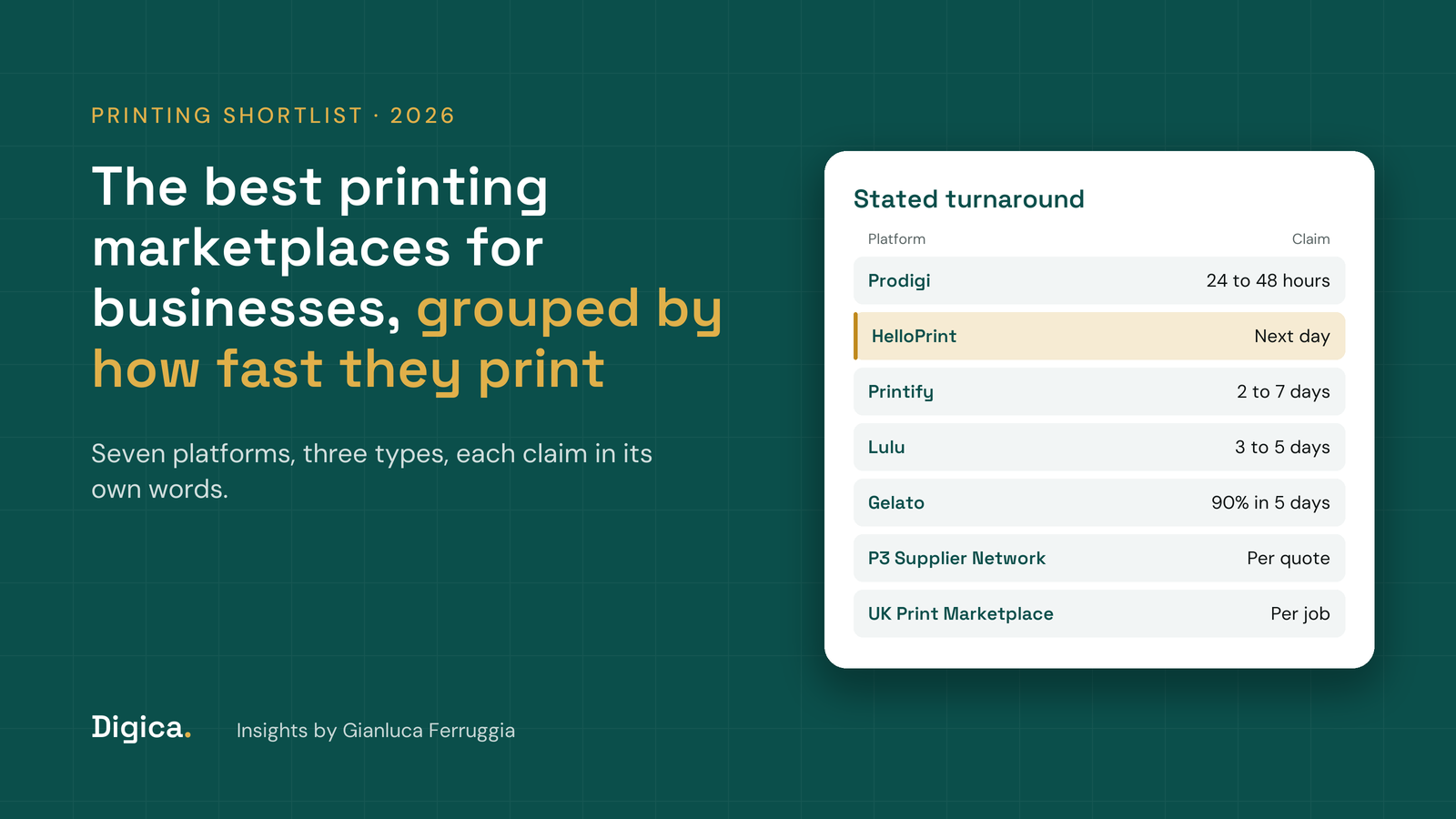
A trade show banner that arrives the day after the show is worth nothing. That is why the first question to ask a printing marketplace is not the unit price but how fast it turns a file into a delivered job. Prodigi says the vast majority of its products are produced within 24 to 48 hours. Gelato says 90% of its orders arrive within five days. HelloPrint offers order today, get it tomorrow on express jobs. All three call themselves a printing marketplace, and all three are measuring something different.
Speed is also where buyers feel the pain. In the Spring 2026 Print Buyer Report from PRINTING United Alliance, 26% of the 207 communication buyers surveyed said speed to market or turnaround time limits how much print they use, and 57% spend at least $250,000 a year on print (PRINTING United Alliance, Print Buyer Report, Spring 2026). A slow route to press costs campaigns, not just days. For anyone building one of these platforms, it is a professional services marketplace problem as much as a print one.
This guide groups seven printing marketplaces into three types: production networks, an aggregator that routes jobs to local printers, and procurement platforms for corporate and public buyers. It compares them on stated turnaround, the printer network behind that number and what businesses can order. It is written for marketing operations, procurement leads and founders growing a print B2B marketplace. Figures come from each platform's own pages, checked on November 16, 2026.
Quick Navigation
- How we grouped the printing marketplaces
- Seven printing marketplaces side by side
- Production networks: print near the recipient
- Aggregators: one order, a local printer
- Procurement platforms: quote, then print
- Production time is not delivery time
- Three failure scenarios
- Choosing a printing marketplace by deadline
- What a faster route to press is worth
- FAQ
- Related Articles
How we grouped the printing marketplaces
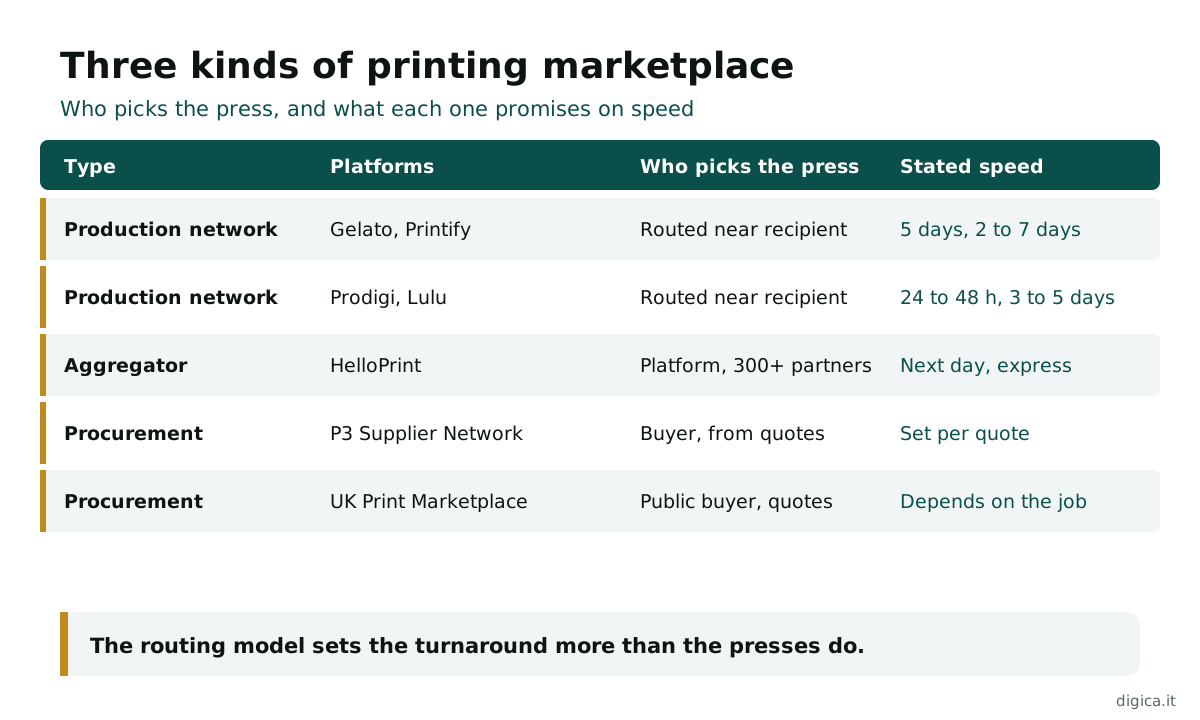
We grouped each printing marketplace by how it decides which press prints your job, because that choice sets the turnaround more than anything else. Production networks route each order to a partner plant near the person receiving it. Aggregators take the order themselves and place it with one of their local print partners. Procurement platforms let a buyer request quotes from many suppliers and choose.
Within each group, we recorded the platform's own turnaround claim in its own words, whether that claim covers production, dispatch or delivery, how many print partners or facilities sit behind it, and what a business can order. We kept every claim in its original unit. An hour-level production promise and a five-day delivery figure are both useful, and neither can be ranked against the other without saying what it measures.
We left out single-company online printers that print everything in their own plants, such as the large business card and flyer brands, because they are printers rather than printing marketplaces. We also left out custom packaging platforms, covered in our guide to packaging marketplaces.
Our view: in print, the network is the promise. A platform that can only print in one country cannot deliver a poster in another tomorrow, however fast its presses run. The best printing marketplace for a business is the one whose network sits closest to the people who need the job.
Seven printing marketplaces side by side
The table puts each printing marketplace's turnaround claim next to the network behind it. Read the "what it measures" column before you compare speeds.
| Printing marketplace | Type | Stated turnaround | What it measures | Network behind it | Cost to the buyer | Main risk | Best for |
|---|---|---|---|---|---|---|---|
| Gelato | Production network | 90% of orders arrive within 5 days | Order to delivery | 250+ print partners in 32 countries | Product price plus shipping per order | Plant varies by destination | Global merch and wall art, delivered locally |
| Printify | Production network | Most orders ship within 2 to 7 business days | Order to dispatch | 141 facilities, 209 countries and territories | Provider's price, chosen by you | Speed depends on the provider you pick | Merch with the widest choice of providers |
| Prodigi | Production network | Vast majority produced within 24 to 48 hours | Production, by lab | 70+ print partners in 10+ countries | Product price plus shipping | Catalog leans to wall art and photo products | Art and photo prints with hour-level service levels |
| Lulu | Production network | Books ship within 3 to 5 business days | Order to dispatch | Global printer network, 200+ countries and territories | Per-book price | Books only, slower than merch | Manuals, workbooks and books on demand |
| HelloPrint | Aggregator | Express: order today, get it tomorrow | Order to delivery | 300+ local print partners | Listed product price | You do not choose the printer | Marketing print in Europe on short deadlines |
| P3 Supplier Network | Procurement platform | Set per quote | Agreed job by job | 500+ global print providers | Quoted per job | No platform-level turnaround | Complex corporate print programs |
| UK Print Marketplace | Procurement platform | Depends on complexity | Agreed job by job | Registered suppliers, number not stated | Instant quotes with pricing built in | Public sector only | UK public bodies buying routine print |
Two patterns stand out. The production networks publish the fastest and most specific numbers, because routing to a nearby plant is their whole model. The procurement platforms publish none, because turnaround is part of each quote.
Production networks: print near the recipient
Four printing marketplaces in this guide are production networks. Each routes an order to a partner plant close to the recipient, so turnaround depends on how many plants it has and where.
Gelato
Oslo-based Gelato says it has 250+ print partners across 32 countries and more than 60 logistics partners. Its own pages state that 90% of all orders are produced locally and 90% of orders arrive within five days of ordering. Its delivery estimates include production, so the five days run from order to doorstep, not from dispatch.
Running a printing or print-on-demand B2B marketplace?
In 30 minutes we look at how business buyers find print platforms like yours, on Google and in AI answers, and how to turn your turnaround and network numbers into more orders.
Businesses use it for apparel, wall art, posters, cards, mugs, calendars and stationery, often printed in the country where the customer lives. The trade-off is consistency. The plant that prints an order in Germany is not the plant that prints it in the US, so a brand that cares about exact color across markets should order samples from each region before a launch.
Printify
Printify, which merged with Printful, says its network covers 141 facilities and ships to 209 countries and territories, with more than 60 million orders completed. Its help center says most orders are shipped within two to seven business days after submission, and that production cannot be expedited. Each provider's average fulfillment time over the last 30 days is shown on the product.
Speed depends on the provider you choose. Printify scores every provider from 0 to 10 on quality, production speed and shipping, updated weekly, and its Printify Choice option routes each order to a high-scoring provider. Its public network status page also shows when a provider's production time slips, which is more honesty than most networks offer. The trade-off is that the choice, and the risk, sit with the buyer.
Prodigi
Prodigi, which runs its own labs in the UK, the US and the Netherlands alongside 70+ print partners in more than ten countries, publishes the most precise numbers in this group. It says the vast majority of its products are produced within 24 to 48 hours, and it publishes a service level table by product and region: fine art prints in 24 to 72 hours across the UK, EU and US, canvas in 48 to 72 hours in the UK and EU and 72 to 120 hours in the US and Australia.
Each product carries its own service level agreement with the facility that makes it. For a business ordering framed prints for offices or hotel rooms, that is a rare level of certainty. The trade-off is range: the catalog leans heavily toward wall art and photo products, not the flyers and brochures most marketing teams order.
Lulu
Lulu, based in North Carolina's Research Triangle, prints books on demand from a global network of printers and delivers to more than 200 countries and territories. It says books ship within three to five business days, and that it can usually print and ship a book to most places worldwide in five to seven business days, printing as close to the destination as it can.
Businesses use it for manuals, workbooks, training guides and catalogs printed one copy at a time. It does not publish how many printers sit in its network. Three to five business days is slower than the merch networks, but a bound book is a slower job, and single-copy printing means no stock to store or throw away.
Aggregators: one order, a local printer
An aggregator takes the order, the payment and the customer service itself, and places the job with one of its print partners. The buyer gets one storefront and one invoice. The aggregator chooses the press.
HelloPrint
Rotterdam-based HelloPrint, which started in the Benelux in 2013, says it owns no printing presses. It works with more than 300 local print partners, so an order is printed close to where it needs to go whenever possible. It lists 10,000+ products and says it has served more than one million customers.
Its express service is the clearest turnaround promise in this guide for marketing print: order today, get it tomorrow, with each product showing the latest time to upload the file. Flyers, brochures, posters, stickers, signage and promotional items are all covered, which suits a marketing team with a deadline more than an art buyer.
The trade-off is control. You do not choose, and may not know, which printer runs the job. For a one-off event that rarely matters. For a brand reprinting the same brochure every quarter, specify color standards and keep proofs, so a different plant next quarter produces the same result.
Procurement platforms: quote, then print
Procurement platforms do not promise a turnaround at all. They let a buyer send a job to many suppliers, compare quotes, and choose on price, speed and fit. They suit complex or regulated buying, where the right supplier matters more than the fastest default.
P3 Supplier Network
The P3 Supplier Network connects users of P3Source, P3Software's print procurement system, with more than 500 global print providers, according to the company's March 2025 announcement. P3Source covers sourcing, ordering and billing for print buyers, brokers and in-house print teams.
There is no platform-level turnaround because each job is quoted. That is a strength for a corporate program with many job types, from direct mail to point-of-sale displays, where one fixed speed would be meaningless. It is a weakness for a buyer who needs something tomorrow and does not have time to run a quote round.
UK Print Marketplace
The UK government's Print Marketplace, run by the Government Commercial Agency (formerly Crown Commercial Service), is a self-service platform where public sector buyers see a list of instant quotes, with supplier pricing built in, and filter and sort them. It covers business cards, flyers, brochures, forms, posters, exhibition graphics, large print and braille.
Its own page says time to supply depends on the complexity of the job. Only recognized public sector bodies on the authorized customer list can buy through it, so private businesses cannot. We include it because it ranks for the term "printing marketplace" and is the compliant route for its buyers. Local printers can register as suppliers.
Production time is not delivery time
Every turnaround figure in this guide is true, and almost none can be compared directly. Some measure production, some measure dispatch, and some measure delivery to the door.
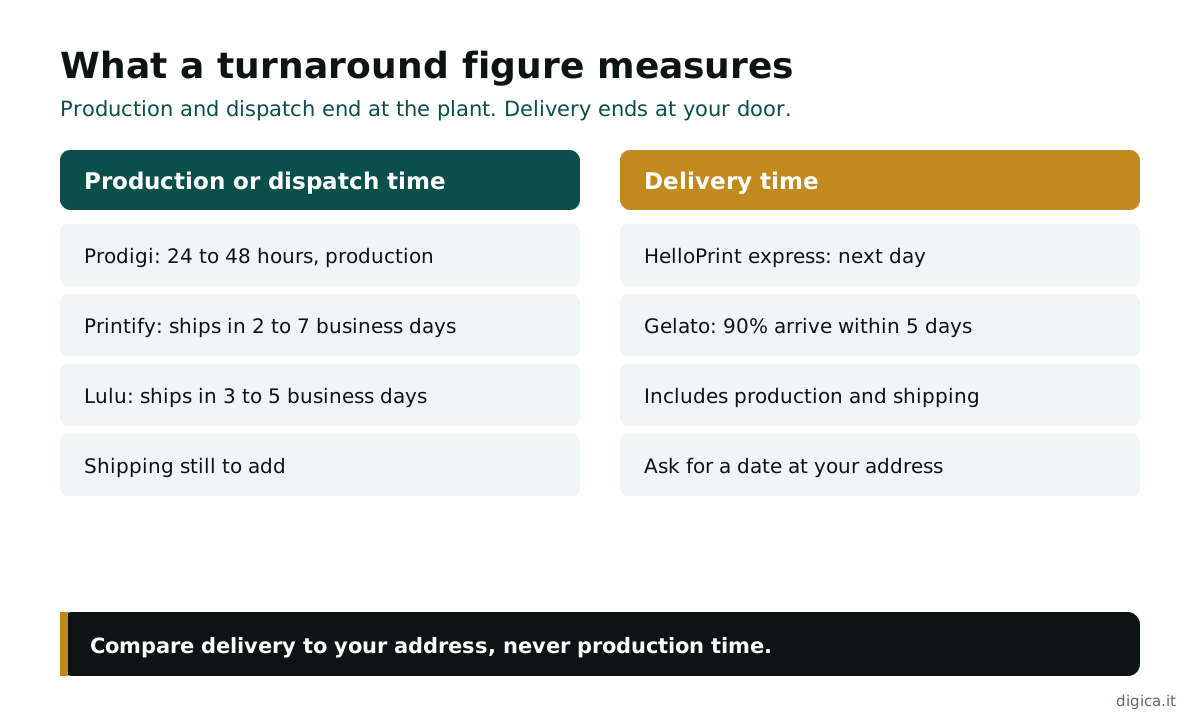
Prodigi's 24 to 48 hours is production time at the lab, before shipping. Printify's two to seven business days and Lulu's three to five business days run until the order ships. Gelato's five days and HelloPrint's next day run until the order arrives. A 48-hour production promise can still mean a five-day delivery if the plant is far away. A five-day delivery promise can beat it if the plant is local.
The industry these platforms route work into is large and steady. US printing and related support activities produced sectoral output of $90.2 billion in 2025, up from $88.9 billion in 2024, according to Bureau of Labor Statistics data published by the Federal Reserve Bank of St. Louis (BLS via FRED, sectoral output for NAICS 323). Most of that capacity sits in independent plants, which is why a marketplace that routes to the right one can be faster than any single printer.
The number to ask any printing marketplace for is the one that matches your deadline. If the event is on Friday, ask for delivery by Thursday to this address, not for production time. A platform that cannot answer that question for your destination is giving you a marketing number.
Three failure scenarios
These are illustrative patterns, not accounts of named companies. The costs are typical, not audited.
- The production promise mistaken for delivery. A marketing team orders event prints from a platform that promises production in 48 hours, assuming they will arrive in two days. The lab is in another country, shipping adds four, and the prints arrive after the event. Asking for a delivery date to the venue, rather than a production time, would have pointed to a network with a plant in the same country.
- The cheapest provider, the slowest queue. A brand picks the lowest-priced provider on a print-on-demand network for a seasonal merch drop. That provider's average production time slips from three business days to five in peak season, and a week of orders ships late, with refund requests to match. Checking each provider's recent fulfillment time and choosing on speed for the peak weeks would have cost a little more per unit and saved the launch.
- The quote round that ran out of time. A procurement team sends an urgent direct mail job through a multi-supplier quote process because it is the approved route. Quotes take three days to come back, the best price wins, and the mailing misses its drop date. Holding one pre-approved fast-track supplier, or a fixed-turnaround platform for urgent jobs, would have kept the process and met the date.
Are business buyers finding your print network?
A growth audit shows how buyers search for printing platforms in your category, what AI answers say about your turnaround, and which pages would win more orders.
The pattern behind all three is the same. The buyer took a number at face value without asking what it measured or who it depended on. Every turnaround claim has a unit and a dependency: the plant, the provider or the quote. Ask for both before you place the order, and write the answer into the brief, so the next person who books the same job checks the same things.
Choosing a printing marketplace by deadline
Start with the date the job must arrive, then work back to the type of printing marketplace. These thresholds are a starting point, not rules.
- If the job must arrive tomorrow and it is standard marketing print in Europe, use an aggregator's express service such as HelloPrint and upload before the stated cutoff.
- If you are shipping merch or wall art to customers in many countries, use a production network such as Gelato that prints locally, and order samples from each region before launch.
- If you want the widest choice of providers and prices for merch, use Printify, and pick on each provider's recent fulfillment time in peak weeks, not on price alone.
- If you need hour-level certainty for art or photo prints, use Prodigi and check its service level table for your product and region.
- If you need manuals, workbooks or catalogs one copy at a time, use Lulu and plan for three to five business days plus shipping.
- If the job has many components, needs a compliant quote record, or runs more than $25,000, use a procurement platform such as the P3 Supplier Network, and keep one fast-track supplier for urgent work.
- If you buy for a UK public body, check the UK Print Marketplace first, since it is built for that route.
Europe's printing base explains why local routing works there. Intergraf, the European printing federation, says the European graphical sector is made up of some 100,000 printing companies, 95% of them small and medium-sized, employing 600,000 people (Intergraf, Economic Report 2026 press release). That density is what lets a network print close to almost any address, and what lets a new printing marketplace sign supply quickly.
What a faster route to press is worth
Run an illustrative case. A marketing team spends $250,000 a year on print, the threshold the Print Buyer Report uses for its larger buyers, across 100 jobs averaging $2,500. If one job in ten misses its date and has to be reprinted or rushed, at an extra 30% of the job's cost, the team loses about $7,500 a year in rework and rush fees, before counting the cost of an event or campaign that runs without its print.
Routing those jobs to platforms whose turnaround claims match the deadline, and checking delivery rather than production time, can cut most of that loss. The saving is modest on paper. The bigger gain is the 26% problem: buyers who use less print because they do not trust it to arrive on time. A reliable route to press brings that budget back.
For founders, the lesson runs the other way. A printing B2B marketplace wins business buyers by publishing turnaround the way buyers plan: delivery dates by destination, cutoff times, and how many plants sit within a day of a city. That belongs on the category pages that rank for "same day flyer printing" and in the answers AI assistants give when a buyer asks who can print by Friday.
Growing a printing or professional services B2B marketplace?
We help print and service marketplaces win buyers and supply partners through search, AI answers and the proof that makes an order feel safe.
The number to take into your next print review is 26%: the share of print buyers who say turnaround limits how much they print. If your printing marketplace only publishes production time, the biggest cost of doing nothing is missed dates you cannot see coming, and the budget that quietly moves to other channels after each one. Switching where you route urgent work costs nothing up front, so the payback starts with the first job that arrives on time.
FAQ
What is a printing marketplace? A printing marketplace is a platform that takes print orders from businesses and routes them to a network of print partners, or lets buyers compare quotes from many printers. Production networks, aggregators and procurement platforms are the three main types.
Which printing marketplace is fastest? It depends on what you measure. Prodigi says most products are produced within 24 to 48 hours, HelloPrint offers next-day delivery on express jobs, and Gelato says 90% of orders arrive within five days. Compare delivery to your address, not production time.
How does print on demand turnaround work for businesses? A production network sends each order to a partner plant near the recipient, prints it, then ships it. Printify says most orders ship within two to seven business days, and turnaround varies by provider and season.
Is there a printing marketplace for large corporate print programs? Yes. Procurement platforms such as the P3 Supplier Network let buyers request quotes from 500+ print providers and manage ordering and billing in one system. Turnaround is agreed job by job.
Can private businesses use the UK government Print Marketplace? No. The UK Print Marketplace, run by the Government Commercial Agency, is open only to recognized public sector bodies on its authorized customer list. Private businesses use commercial platforms instead.
How do I avoid color differences when a printing marketplace uses many printers? Order samples from each region or plant before a launch, specify color standards on repeat jobs, and keep approved proofs. Networks that route by destination may print the same file in different plants.
Related Articles
- Professional services marketplace growth
- The best packaging marketplaces for brands
- The best procurement marketplaces
- The best manufacturing directories
- Marketplace liquidity: the metric that compounds
Where this connects
This article is part of our B2B marketplace growth series. Browse more on the Digica blog.