The best recycling marketplaces for businesses, one award each by material and buyer
A bale of plastic film is only worth something if the right buyer is on the other side of the trade. That is why the first question to ask a recycling marketplace is not how many users it has but which materials it moves and who buys them. Scrapo says more than 90,000 businesses in over 150 countries are registered to negotiate plastic scrap on its platform. Reverse Resources traces textile cutting waste from 1,211 garment manufacturers to 239 recyclers. Both are recycling marketplaces, built for completely different loads.
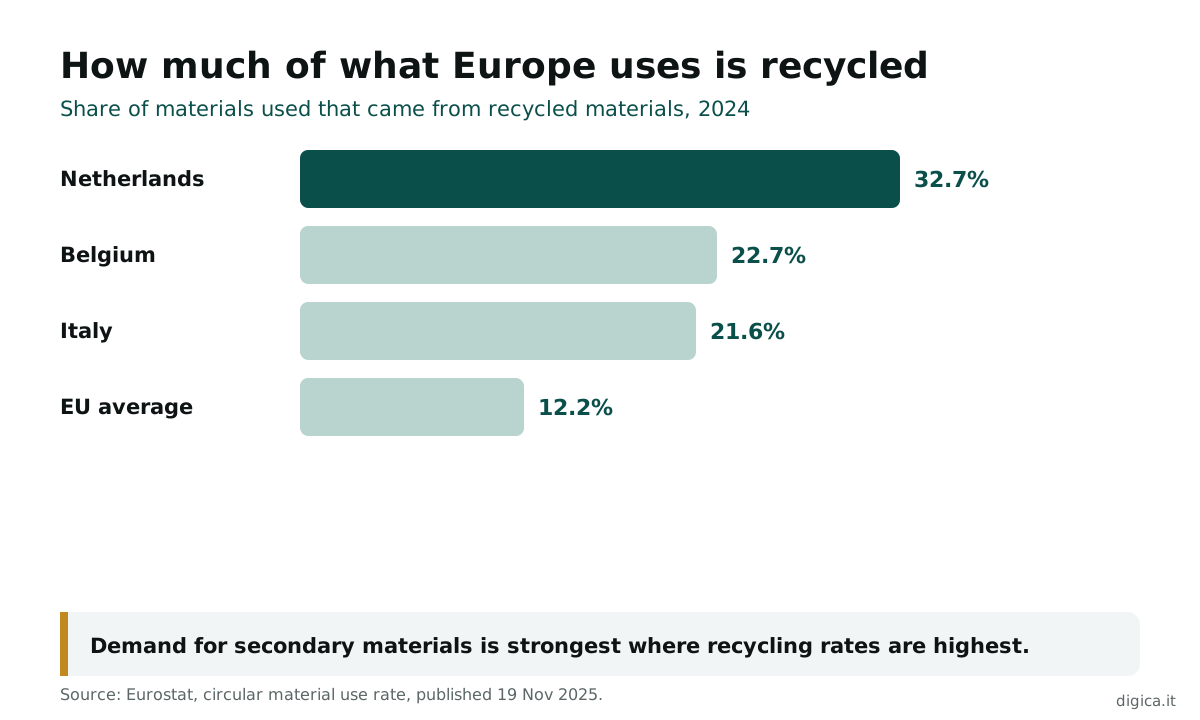
The stakes are rising. In 2024, 12.2% of the materials used in the EU came from recycled materials, the highest rate Eurostat has recorded (Eurostat). Recycled content targets are pushing manufacturers to buy more secondary material, and the marketplace that matches the right stream to the right buyer decides whether a load earns money or costs a disposal fee. For anyone building one of these platforms, it is a recycling marketplace growth problem as much as a materials one.
This guide gives seven recycling marketplaces one award each, by material category and buyer: plastics and paper across borders, plastic scrap traded directly, surplus assets reused inside a company, reclaimed construction components, textile waste, enterprise e-waste and tested recycled polymer. It is written for sustainability, operations and procurement leads selling or buying secondary materials, and for founders growing a recycling B2B marketplace. Figures come from each platform's own pages, reports or trade press, checked on November 16, 2026.
Quick Navigation
- How we gave the awards
- The seven awards at a glance
- Plastics, paper and metals: three recycling marketplaces
- Reuse, components and textiles
- E-waste: certified buyers only
- Recycling directory or recycling marketplace?
- Three failure scenarios
- Choosing a recycling marketplace by material
- What the right buyer is worth
- FAQ
- Related Articles
How we gave the awards
We asked each recycling marketplace two questions: which material streams does it actually move, and who buys them? A platform that trades plastic regrind between compounders serves a different business from one that redeploys office furniture inside a company, even if both call themselves recycling marketplaces.
We then recorded each platform's scale in its own unit (registered businesses, users, exchanges, tonnes traced or service providers) and how it checks counterparties or material quality. Each platform won the one award its materials, buyers and checks support best. We left out recyclers that process material in their own plants, pricing indexes, and platforms that have closed. The plastics recyclate marketplace Cirplus, for example, stopped operating on April 1, 2026. We also left out the scrap metal platforms covered in our guide to metals marketplaces.
Our view: in recycling, the buyer is the product. A seller with a clean, consistent stream can always find a price somewhere. The best recycling marketplace for a business is the one that puts its specific material in front of the buyers who will pay most for it, and checks enough that the trade actually closes.
The seven awards at a glance
The table pairs each award with the material, the buyer and the check behind it. Use it to shortlist before reading the detail.
| Award | Recycling marketplace | Material streams | Who buys | Scale, in its own unit | Cost to use | Main risk | Best for |
|---|---|---|---|---|---|---|---|
| Cross-border plastics, paper and metals | WasteTrade | Plastics, paper, metals, tyres; 465+ material types | Accredited reprocessors | 4,450+ users | Fees not published, platform handles payment | Fees and margins not public | Exporters who need compliance handled |
| Direct negotiation on plastic scrap | Scrapo | Plastic scrap, regrind, filler masterbatch | Recyclers, compounders, manufacturers | 90,000+ businesses, 150+ countries | Free to join, paid premium and inspection | Checks are optional | Traders who want to negotiate themselves |
| Internal reuse of surplus assets | Rheaply | Furniture, equipment, lab gear, building materials | Teams inside the same company, then nonprofits | 5,636 exchanges, $28.7M value in 2025 | Enterprise subscription | Works best at enterprise scale | Universities, health systems, large offices |
| Reclaimed construction components | Excess Materials Exchange | Cable trays, grating, fixtures, ceilings, doors | Developers, contractors, airports | Pilot data, no platform tonnage | From about $5,900 per package | No published volumes | Asset owners stripping out buildings |
| Pre-consumer textile waste | Reverse Resources | Cutting waste and leftover fabric | Textile-to-textile recyclers, brands | 1,211 manufacturers, 239 recyclers, 100,000+ tonnes traced | Subscription | Post-consumer textiles not covered | Brands and factories tracing waste |
| Enterprise e-waste | RGX | Retired IT, data center and telecom equipment | Certified ITAD and recycling providers | 330+ service providers | Competitive bids per job | US focus | Enterprises decommissioning IT |
| Tested recycled polymer | Ambio | rHDPE, rLDPE, rPP, rPVC and other grades | Plastic converters in Europe | Volumes not published | Spot or contract price | Young company, founded 2023 | Converters who need spec-matched recyclate |
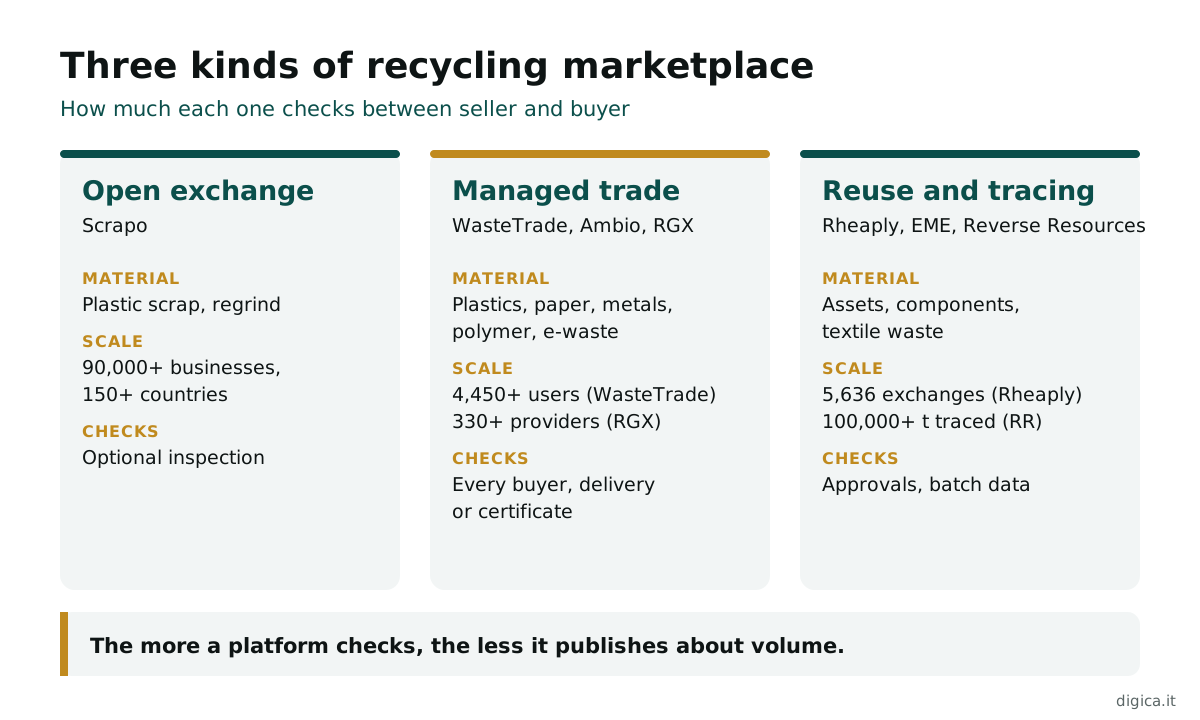
Two patterns stand out. The managed platforms check more and publish less about volume. The open exchange publishes the biggest numbers and leaves most checks to the buyer.
Plastics, paper and metals: three recycling marketplaces
Three awards go to platforms that trade recyclable commodities between companies. They differ most in how much they stand between buyer and seller.
Best for cross-border plastics, paper and metals: WasteTrade
WasteTrade, based in Stafford, England, lets companies buy and sell recyclable plastics, paper and metals, with more than 465 material types listed. Its founder said in January 2026 that it has more than 4,450 users worldwide. Every seller, buyer and haulier is checked before they trade, and the platform maps Basel Convention and customs classification to each trade.
Running a recycling or secondary materials B2B marketplace?
In 30 minutes we look at how buyers and sellers of recycled materials find platforms like yours, on Google and in AI answers, and how to turn your material and buyer numbers into more trades.
Loads are verified on arrival and funds are secured before material is released, which is the part that matters most to an exporter who has been burned by a buyer who never paid. Its digital product passport records origin, quality and traceability. The award goes for compliance: cross-border waste shipments fail on paperwork as often as on price.
Best for direct negotiation on plastic scrap: Scrapo
Scrapo, a Sunnyvale, California, company, runs an open exchange for recyclable and recycled plastics, from PET and HDPE to nylon, regrind and filler masterbatch. Its site says more than 90,000 businesses from over 150 countries are registered, with 20 million tons of material listed and more than 200,000 negotiations held. Those figures are Scrapo's own.
Buyers and sellers negotiate directly, which suits traders who want control of price and terms. Checks are optional: its ScrapoSure service sends a team to visit the seller's site, verify identity, inspect material and supervise loading. The award goes for reach and directness, with a clear rule attached: on a first trade with a new counterparty, pay for the inspection.
Best for tested recycled polymer: Ambio
Helsinki-based Ambio, founded in 2023 with teams in Berlin and Stockholm, sells recycled polymers such as rHDPE, rLDPE, rPP and rPVC to plastic converters across Europe. It raised a seed round of about $5.5 million (€5.1 million) in October 2026. It qualifies every grade, tests each delivery against the buyer's production requirements, and keeps a batch history per grade.
Ambio acts as the principal in each trade, buying and reselling the material, so the converter deals with one counterparty responsible for sourcing, quality and delivery. It publishes no volumes. The award goes for specification: a converter whose extrusion line stops on a bad batch needs tested recyclate more than it needs the lowest price.
Reuse, components and textiles
Three awards go to platforms that keep materials in use before they become a recycling problem: surplus assets, building components and textile cutting waste.
Best for internal reuse of surplus assets: Rheaply
Chicago-based Rheaply runs private reuse marketplaces where teams inside a company redeploy furniture, fixtures, lab equipment and building materials before buying new. It also runs the public Materials Marketplace it acquired from the US Business Council for Sustainable Development in 2022. Its 2025 Reuse Recap counts 5,636 exchanges, 159,600 items exchanged and $28.7 million in value exchanged during the year, with 12.7 million items available for reuse.
Buyers are mostly internal: workplace teams, universities and health systems, then nonprofits that receive donations. Approval workflows and audit trails keep exchanges inside controlled portals. The award goes for internal reuse, the cheapest buyer of all being the department down the hall.
Best for reclaimed construction components: Excess Materials Exchange
Amsterdam-based Excess Materials Exchange, founded in 2017, matches surplus building components, from cable trays and steel grating to light fixtures, ceiling elements and doors, with reuse projects. A pilot at Schiphol airport with contractor Heijmans avoided 9.4 tonnes of CO2 and 3.7 tonnes of waste, according to Royal Schiphol Group's sustainability team in August 2026.
It publishes its prices: a starter pack from €5,500 (about $5,900) and an activation package at €14,000 (about $15,100). It does not publish platform-wide tonnage. The award goes for components: a cable tray reused in another building is worth far more than the same tray sold as scrap.
Best for pre-consumer textile waste: Reverse Resources
Tallinn-based Reverse Resources traces cutting waste and leftover fabric from garment factories to recyclers. A European Commission case study from December 2025 lists 1,211 manufacturers, 239 recyclers, 166 waste handlers and 18 brands on the platform, and more than 100,000 tonnes of textile waste traced. Its co-founder told Fashion for Good that around half of that went to textile-to-textile recycling.
Factories record composition, quality and origin for each batch, which is what a fiber-to-fiber recycler needs to accept it. The award goes for traceability: for textile waste, the data about the material is what makes the material sellable.
E-waste: certified buyers only
E-waste is the stream where the buyer's certification matters more than the price, because a retired server can still hold data and hazardous materials.
Best for enterprise e-waste: RGX
RGX, based in Castle Rock, Colorado, runs a managed marketplace where enterprises post IT decommissioning jobs, from data centers and telecom equipment to end-user devices, and certified providers bid for them. Trade press reported in August 2026 that it works with more than 330 service providers across the US.
In May 2026 RGX joined the e-Stewards Enterprise Program run by the Basel Action Network, and it tracks its providers' certifications. Every decommission carries certified data sanitization and chain of custody records. The award goes for certified buyers: on e-waste, the cheapest bidder without the right certificate is the most expensive choice an enterprise can make.
The pressure on recyclers makes buyer choice harder. Plastics Recyclers Europe expects the region to have lost almost one million tonnes of plastics recycling capacity since 2023 by the end of 2025, with zero net growth forecast for the year (Plastics Recyclers Europe). Fewer recyclers means fewer buyers for each stream, and a marketplace with a wide, checked buyer base becomes more valuable to sellers as plants close.
Recycling directory or recycling marketplace?
A recycling directory tells you who accepts a material near you. A recycling marketplace lets you sell it, and often checks the buyer. Most searches for a recycling directory come from businesses asking where to send a specific material.
Many US states run free directories of recycling end markets. North Carolina's Recycling Markets Directory, run by its Department of Environmental Quality, lets a business search for buyers and processors by material. Directories like these are the right starting point for a small, local, regular stream: one call, one hauler, done.
A recycling marketplace earns its place when the stream is large, irregular or crosses borders. That is when price discovery, counterparty checks and payment security start to pay for the platform's fees. Countries that recycle more show where demand for secondary materials is strongest: in the Netherlands, almost a third of the materials used come from recycling, nearly three times the EU average.
The practical rule: use a directory to find a local outlet, and a marketplace to find the best buyer. Many businesses need both, for different streams, and the mix changes as volumes grow: a stream that starts as a few bins a month can become a full truckload worth putting out to competing buyers.
Three failure scenarios
These are illustrative patterns, not accounts of named companies. The costs are typical, not audited.
- The export load with the wrong code. A plant sells 20 tonnes of mixed plastic film to an overseas buyer it found through an open listing. The shipment is classified under the wrong waste code, held at port and returned, and the seller pays freight both ways plus storage. A platform that maps waste classification to the trade and checks the buyer would have caught it before the load left.
- The bad batch on the extrusion line. A converter buys recycled polypropylene at a good price from a new supplier without testing. The batch carries contamination, the line stops for a shift and a run of product is scrapped. Buying tested recyclate, or paying for an inspection on the first trade, would have cost a few percent more per tonne.
- The office clearance sold for scrap. A company relocating a headquarters sells several floors of furniture and equipment for scrap value, then buys new for another office in the same year. An internal reuse marketplace would have moved the best of it to the second site and donated the rest.
Are buyers finding your recycling platform?
A growth audit shows how buyers and sellers of secondary materials search for platforms in your category, what AI answers say about your materials and checks, and which pages would win more trades.
The pattern behind all three is the same. The seller or buyer chose on price and ignored the two things that decide whether a recycling trade works: whether the buyer is right for the material, and whether someone checked the load. Write both down before you list a stream, and choose a recycling marketplace that answers both questions on the listing, not after the load has already left the yard.
Choosing a recycling marketplace by material
Start with the material, then the buyer, then the platform. These thresholds are a starting point, not rules.
- If you ship plastics, paper or metals across borders, use a managed platform such as WasteTrade that checks counterparties and handles classification and payment.
- If you trade plastic scrap and want to negotiate yourself, use Scrapo, and pay for an inspection on any first trade above 20 tonnes.
- If you run extrusion, injection or blow molding lines in Europe, buy tested recyclate from a principal such as Ambio rather than untested spot lots.
- If your organization replaces furniture, equipment or lab gear across more than one site, run internal reuse on Rheaply before selling anything for scrap.
- If you are stripping out a building with reusable components, list them through Excess Materials Exchange before demolition starts.
- If you make garments or source from garment factories, trace cutting waste through Reverse Resources so recyclers can accept it.
- If you decommission IT equipment, use RGX and only accept bids from certified providers.
- If the stream is small, local and regular, start with your state's recycling directory instead of a marketplace.
The US market behind these decisions is large. The Recycled Materials Association, ReMA, says the US recycled materials industry generates $184 billion in annual economic activity and supports more than 603,000 jobs (Recycled Materials Association). A market that size has buyers for almost every stream. The work is reaching the right one.
What the right buyer is worth
Run an illustrative case. A manufacturer generates 500 tonnes of a clean plastic stream a year. Selling it to a local broker at a low price earns little, while a checked buyer that needs that exact grade may pay noticeably more per tonne. A difference of $50 a tonne on 500 tonnes is $25,000 a year, before counting the cost of a single rejected or returned load.
For founders, the lesson runs the other way. A recycling B2B marketplace wins sellers by showing buyers, not just users: which buyer types are active for each material, in which countries, and what is checked before a trade. That belongs on the category pages that rank for "sell PP regrind" and "e-waste recycling for business", and in the answers AI assistants give when an operations lead asks who will buy a stream.
Growing a recycling or waste B2B marketplace?
We help recycling and secondary materials marketplaces win buyers and sellers through search, AI answers and the proof that makes a trade feel safe.
The number to take into your next waste review is $25,000: what an extra $50 a tonne is worth on a 500-tonne stream. If you sell to whoever collects it, the biggest cost of doing nothing is that margin, every year, plus the occasional rejected load that wipes out a quarter's gains. Listing a stream on the right recycling marketplace costs little up front, so the payback starts with the first trade.
FAQ
What is a recycling marketplace? A recycling marketplace is a platform where businesses buy and sell recyclable materials, surplus assets or reusable components. Some let buyers and sellers negotiate directly, some check every counterparty and handle payment, and some trade the material themselves.
Which recycling marketplace has the most users? Among the platforms in this guide, Scrapo reports the largest network, with more than 90,000 registered businesses in over 150 countries trading plastic scrap. Those figures are self-reported.
What is the difference between a recycling directory and a recycling marketplace? A recycling directory lists who accepts a material, often by location, such as state end-market directories. A recycling marketplace lets you sell the material and often checks the buyer and secures payment.
Where can a business sell plastic scrap? Open exchanges such as Scrapo let businesses negotiate directly with recyclers and compounders, and managed platforms such as WasteTrade check every buyer and handle compliance and payment for cross-border trades.
How do businesses recycle IT equipment safely? Use certified providers with data sanitization and chain of custody records. RGX runs a marketplace where enterprises post decommissioning jobs and certified providers bid, and it is part of the e-Stewards Enterprise Program.
Is there a marketplace for reusing building materials? Yes. Excess Materials Exchange matches surplus building components with reuse projects in the Netherlands, and Rheaply's Materials Marketplace lists building materials for reuse in the US.
Related Articles
- Recycling marketplace growth
- The best metals marketplaces
- The best surplus equipment marketplaces
- The best fabric marketplaces
- The best chemical marketplaces
Where this connects
This article is part of our B2B marketplace growth series. Browse more on the Digica blog.