How to sell data to AI companies: a data licensing guide for 2026
Data licensing has become one of the fastest ways for a company with proprietary records to earn from AI. Reddit's IPO filing disclosed data licensing contracts worth $203 million in aggregate over two to three years. Wiley reported $49 million of AI revenue in its 2026 fiscal year, up 23%. Neither company sold its data outright. Both licensed access to it, on terms they could defend.
Most data owners never get that far. They hear that AI labs pay for data, ask a broker what theirs is worth, and stall when the buyer asks who owns each record, who consented and whether personal details have been removed. The deal is lost at the rights stage, not the price stage.
This guide is for data owners who want to sell data to AI companies, and for the brokers and AI data marketplaces that sit between them and the labs. It covers the three routes to a buyer, what labs check before they sign, how AI data licensing deals are priced and how to value your data first. It builds on our map of the AI training data market, which covers who buys and who sells.
Quick Navigation
- What data licensing means when the buyer is an AI lab
- Three routes to sell data to AI companies
- The three routes side by side
- What labs check before they sign
- How AI data licensing deals are priced
- How to value data before you sell it
- Three failure scenarios
- Where to start: a decision framework
- What clean rights are worth
- FAQ
- Related Articles
What data licensing means when the buyer is an AI lab
The short answer: data licensing is a contract that lets a buyer use your data for stated purposes, for a stated time, while you keep ownership. When the buyer is an AI lab, the purposes are usually training, fine-tuning, evaluation or live answers, and each one is priced and limited separately.
That distinction matters more than most sellers expect. Training uses your data once to shape a model. Retrieval, often called RAG, uses it again every time the model answers a question. A license that allows training may say nothing about retrieval, and the reverse. Newer arrangements, such as Microsoft's pay-per-use Publisher Content Marketplace, price that answer layer separately.
Ownership stays with you, which is the point. Research for the Organisation for Economic Co-operation and Development (OECD) found that the value of data depends heavily on the rules that govern how it can be used (OECD), so the license terms are part of what you sell. A license can be exclusive or non-exclusive, perpetual or time-limited, and limited to one model family or open to any. Informa's Taylor & Francis described its 2024 deals as non-exclusive access to archive content, which left it free to sell the same archive again. That one word decides whether your data earns once or many times.
Our view: treat AI content licensing like a product line, not an asset sale. The data owners earning the most are the ones who package it, document it and renew it, the way a software company sells subscriptions.
Three routes to sell data to AI companies
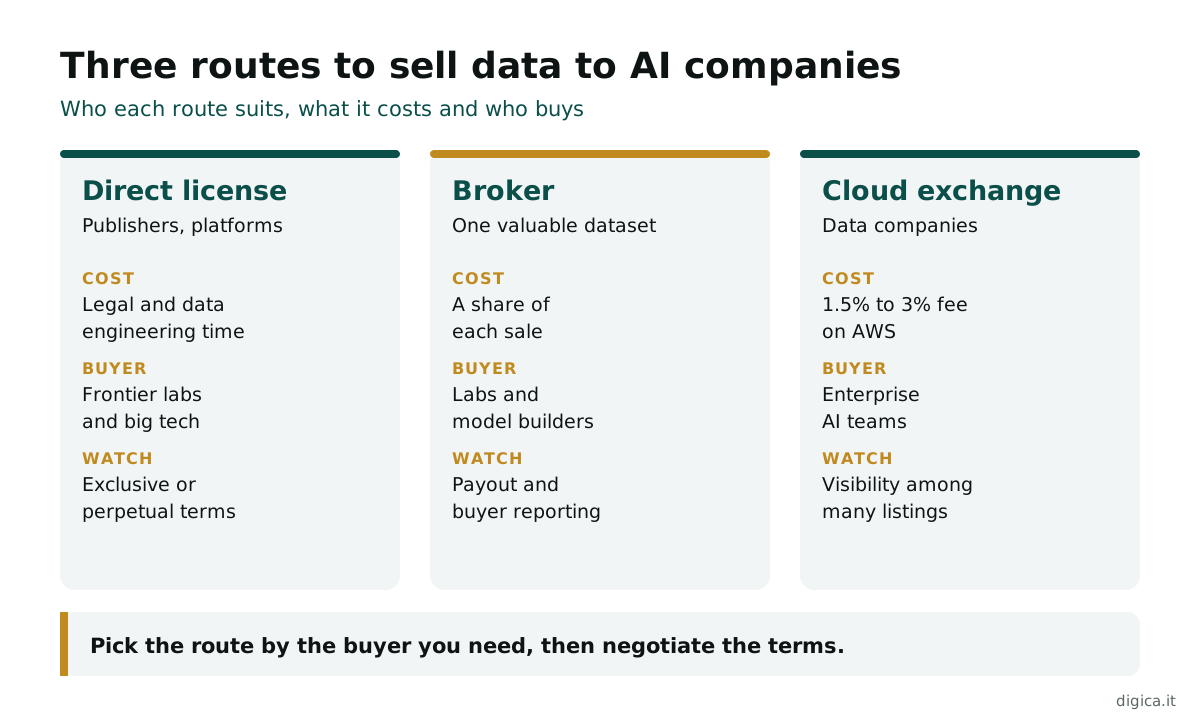
The short answer: you can license directly to a lab, go through a broker or AI data marketplace, or list on a cloud data exchange. Direct deals pay the most but only reach the largest owners. Brokers handle the work for a share. Cloud exchanges are self-serve but mostly reach enterprise AI teams, not frontier labs.
Route 1: a direct licensing deal
Direct deals are the ones that make headlines. News Corp's agreement with OpenAI was reported by the Wall Street Journal as potentially worth more than $250 million over five years, including credits for OpenAI's technology. Amazon agreed to pay The New York Times a reported $20 million to $25 million a year for news, NYT Cooking and The Athletic content. Reddit delivers its licensed data through continuous access to its data API plus quarterly transfers, according to its filing.
Running a data B2B marketplace or brokering AI training data?
In 30 minutes we look at how data owners and AI teams find platforms like yours, on Google and in AI answers, and which side of your market is too thin to close deals.
These deals share three traits. The licensor has a large, continuously updated body of content. It has a legal team that can negotiate warranties and use limits. And it has enough leverage that the lab comes to it. If your data does not meet all three, a direct approach usually ends in a pilot that never converts. The lab gains a sample and you gain nothing to show for it.
Route 2: a broker or AI data marketplace
Brokers and AI data marketplaces exist for everyone else. They find the buyer, clean and package the data, write the license and take a share. Troveo said in April 2026 that it had paid more than $20 million to content owners and holds over 8 million hours of licensed video. Protege, which works with more than 100 data partners across healthcare and media, raised $30 million in January 2026. Created by Humans licenses book rights for training and retrieval, with authors opting in. Defined.ai lists more than 700 datasets. Opendatabay and Pewter work with companies that hold business datasets.
The trade-off is margin for reach. A broker knows which labs are buying which data types this quarter, and that knowledge is worth more to a first-time seller than a few points of share. We cover the choice in detail in our ranking of the best places to sell data.
Route 3: a cloud data exchange
Cloud data exchanges let you list data where enterprise buyers already work. AWS Data Exchange charges a 3% listing fee on public offers, and on private offers 3% under $1 million in contract value, 2% from $1 million to under $10 million and 1.5% above that. In June 2025 Snowflake Marketplace added Cortex Knowledge Extensions, which let publishers such as The Associated Press and the USA TODAY Network license content to enterprise AI apps for retrieval.
The catch is the buyer. Cloud exchanges reach companies building their own AI applications, not usually the frontier labs training the largest models. That can be a better fit for business data, and a worse fit for a large text or video archive.
The three routes side by side
The short answer: choose a direct deal if you have scale and leverage, a broker if you need the buyer found and the data prepared, and a cloud exchange if your buyers are enterprise AI teams that already use that cloud.
Three routes to sell data to AI companies compared on who it suits, typical cost, the main risk and best fit
| Route | Who it suits | Typical cost to the seller | Typical buyer | Main risk | Best for |
|---|---|---|---|---|---|
| Direct licensing deal | Large publishers and platforms with continuous content | Legal and data engineering time | Frontier labs and big tech | Signing exclusive or perpetual terms too early | Archives plus fresh daily content |
| Broker or AI data marketplace | Companies with one valuable dataset and no AI sales team | A share of each sale, varies by broker | Labs and model builders | Weak buyer reporting, unclear payout terms | Video, audio, books, company records |
| Cloud data exchange | Data companies already selling feeds | 1.5% to 3% listing fee on AWS Data Exchange | Enterprise AI teams | Low visibility among thousands of listings | Structured, regularly updated business data |
| Pay per crawl or usage | Websites with content AI agents already visit | Setup only, price set by you | AI crawlers and answer engines | Bots that do not pay, then go elsewhere | Publishers who want terms, not a block |
Most sellers use more than one route over time. A common path is a broker for the first deal, which sets a price benchmark, then a direct conversation once a lab has seen the data.
What labs check before they sign
The short answer: labs check four things before price: that you own or control the rights, that the data's origin is documented, that personal data is removed or consented, and what exclusivity and warranties you offer.
Rights. You must show you can license the data for AI use. User-generated content, contributor uploads and customer records often carry terms that never mentioned AI. HarperCollins handled this by asking authors to opt in before including their titles in its Microsoft deal.
Provenance. Buyers increasingly need to explain where their training data came from. Under the EU AI Act, providers of general-purpose AI models must publish a summary of their training content and keep a copyright policy that respects opt-outs, obligations that have applied since August 2, 2025. The Data and Trust Alliance's Data Provenance Standards set out 22 metadata fields across source, provenance and use, built by 19 companies including IBM, Mastercard, Pfizer and Walmart. Selling data with those fields filled in saves the buyer weeks of work.
De-identification. Any dataset touching people needs a defensible method. For US health data, HIPAA allows two routes: Expert Determination, where a qualified expert documents that the risk of re-identification is very small, or Safe Harbor, which removes 18 named identifiers (HHS). The same discipline applies to support tickets, emails and chat logs, where names and account numbers hide in free text.
Exclusivity and warranties. Labs ask the seller to confirm it had the right to sell and to cover them if it did not. That warranty is where your risk sits. Cap it, and keep the license non-exclusive unless the price clearly pays for giving up future buyers.
Our experience from building a B2B agency marketplace to 40,000+ listed agencies and 1M+ monthly users is that trust is earned on the supply side first. Buyers came back because the listings were verified and complete. Data buyers behave the same way: documentation is what turns a one-off purchase into a renewal.
How AI data licensing deals are priced
The short answer: published deals use five pricing models: a flat annual fee, an archive fee plus a recurring fee, a per-work or per-title price, a fixed fee plus a variable share, and pay per use or per crawl.
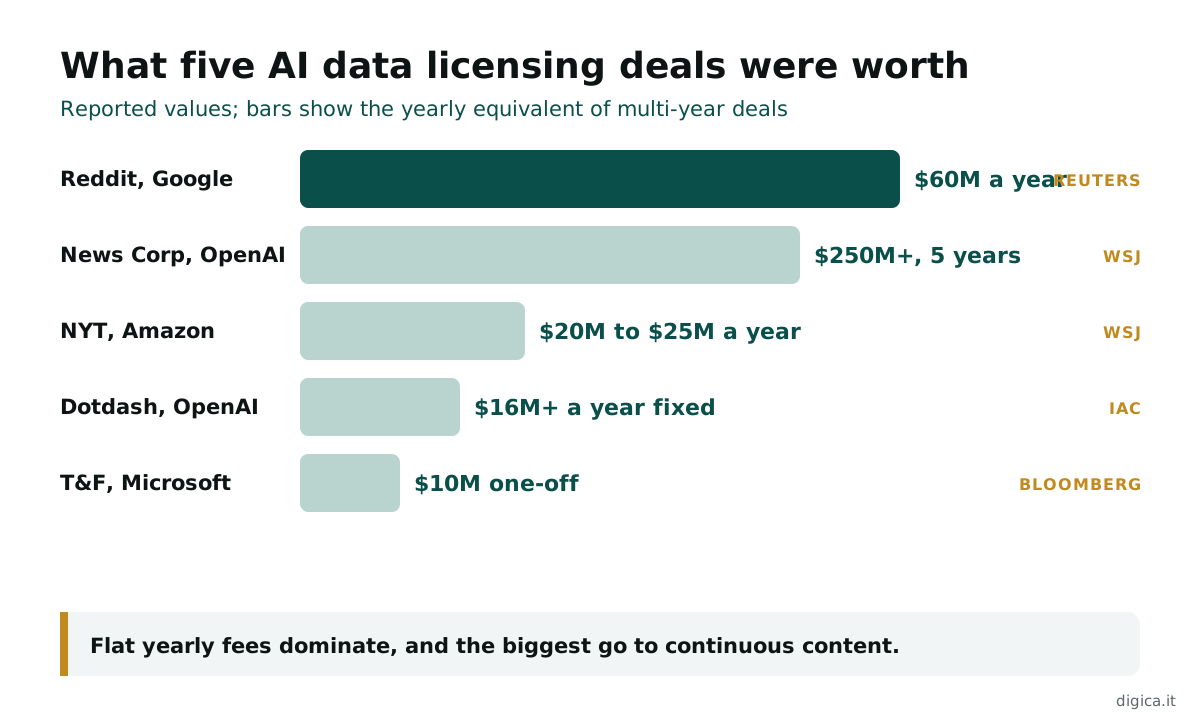
Flat annual fees dominate large deals. Reuters reported Reddit's deal with Google at about $60 million a year, and the Amazon and New York Times deal sits at a reported $20 million to $25 million a year. A flat fee is predictable, but it can underprice data whose value rises as models improve.
Fixed plus variable splits the difference. IAC said Dotdash Meredith, now People Inc, receives at least about $16 million a year from OpenAI as a fixed fee, plus a variable part. In November 2025 People Inc also joined Microsoft's Publisher Content Marketplace, which its CEO described as pay per use.
Per work or per title suits books and long-form content. HarperCollins' three-year deal with Microsoft for select nonfiction titles was reported by trade press at $5,000 per title, split between author and publisher. Informa reported $75 million or more of AI-related revenue at Taylor & Francis in 2024, with its Microsoft deal reported at $10 million.
Usage and revenue share is growing in the answer layer. Perplexity launched a $42.5 million publisher pool in August 2025 and said 80% of its Comet Plus subscription revenue would go to publishers. Cloudflare launched pay per crawl in July 2025, letting a website set a flat per-request price for AI crawlers. The RSL standard, backed by Reddit, Quora and Yahoo, adds machine-readable licensing terms to a site.
Our view: for a first deal, prefer a time-limited, non-exclusive license with a fixed floor and a usage component. The floor protects you, and the usage share lets you benefit if the buyer relies on your data more than expected.
How to value data before you sell it
The short answer: value your data three ways, cost, market and use, then negotiate from the highest figure you can defend. Most first offers are anchored on cost, which is almost always the lowest number.
The UK government's October 2025 estimate of the value of public sector data groups valuation methods into exactly those three families: cost-based, market-based and use-based. As the OECD research above shows, governance drives value, so for a seller documentation and clean rights are part of the price, not a cost on top.
Do data owners find your platform when they look for a buyer?
A growth audit maps how data owners and AI teams search for data marketplaces and brokers, on Google and in AI answers, and which of your pages they never reach.
- Cost value. What it cost to collect, clean and store the data. A floor, never a price.
- Market value. What comparable data has sold for. Use the published deals above, broker quotes and cloud exchange listings for similar datasets.
- Use value. What the buyer gains. Data that fills a gap in a model, such as a rare language, a regulated domain or expert reasoning, is worth far more than its size suggests.
- Scarcity. If three other companies hold the same data, your price falls to theirs. If you are the only source, it does not.
- Freshness. Continuous data supports a recurring fee. A closed archive usually earns one payment.
Researchers have also built ways to value single data points by how much they improve a model, such as Data Shapley. They are useful inside a lab. For a seller, the practical test is simpler: ask the broker or buyer what the data would replace, and price against that.
Three failure scenarios
These are the patterns that recur when a company first tries to sell data to AI companies.
- The license that forgot retrieval. A trade publisher licenses its archive for training at a flat fee. A year later the same buyer uses the archive to answer live questions in a paid product, and the contract does not cover or price that use. Naming training and retrieval as separate, separately priced uses would have kept the second revenue stream.
- The dataset with hidden people in it. A B2B platform offers ten years of support tickets to a broker. The broker's review finds customer names, phone numbers and contract values throughout the free text, and the clean-up quote is larger than the expected payment. Running a de-identification scope before marketing the data would have set a realistic price, or stopped the project early.
- The marketplace with nothing to sell. An AI data marketplace signs letters of interest from model builders but recruits only a handful of data owners, none with documented rights. Buyers leave after one visit. Recruiting a smaller number of owners with complete provenance first would have given buyers a reason to return.
Each team treated the sale as the hard part. In every case the hard part was the paperwork that came before it.
Where to start: a decision framework
The short answer: start with rights, then provenance, then route, then price. Stop at the first step you cannot answer.
- If you cannot show you own or control the rights for AI use, fix your terms or seek opt-in before anything else. No serious buyer will pay for data it cannot defend.
- If the data includes personal information, budget a de-identification review first, and expect it to take weeks for free-text data.
- If you hold more than a few million documents or hours with continuous new content, a direct license is realistic. Get legal advice on warranties and use limits, and ask for training and retrieval to be priced separately.
- If you hold one valuable dataset and no AI sales team, use a broker or AI data marketplace for the first sale and treat it as a price benchmark.
- If your buyers are enterprise AI teams already on AWS, Snowflake or Databricks, list there and accept a 1.5% to 3% fee for the reach.
- If AI crawlers already visit your site, add machine-readable terms and consider pay per crawl before you consider a block.
Growing a data or AI training data B2B marketplace?
We help data B2B marketplaces recruit the data owners that make a catalog worth buying from, and reach the AI teams searching for it.
A rule of thumb from the supply side of B2B marketplaces holds here too: the first ten sellers with complete documentation are worth more than a hundred without it. Brokers and AI data marketplaces that publish how each dataset was collected and consented close deals faster, because the buyer's legal team has less to ask. If you run one, see how we approach data marketplace growth.
What clean rights are worth
The number to take into your next board meeting is about $3,000 per work. That is roughly what Anthropic agreed to pay for each of about 482,000 books in the $1.5 billion settlement of Bartz v. Anthropic (US District Court filing). It is the cost of training on data without a license, and it explains why labs now pay for documented rights.
If you can prove ownership, provenance and consent for your data, you can charge for the risk you remove, and keep selling it on non-exclusive terms. The biggest cost of doing nothing is watching competitors with cleaner paperwork set the price for your category while your archive stays unsold.
FAQ
What is data licensing? Data licensing is a contract that lets a buyer use your data for defined purposes, for a defined time, while you keep ownership. For AI buyers, licenses usually specify training, fine-tuning, evaluation or retrieval, and whether the deal is exclusive.
How do I sell data to AI companies? Confirm you hold the rights, document where the data came from, remove or consent personal data, then choose a route: a direct license if you have scale, a broker or AI data marketplace for a first sale, or a cloud data exchange for enterprise AI buyers.
How much do AI companies pay for data? Published deals range widely. Reddit's deal with Google was reported at about $60 million a year, Amazon pays The New York Times a reported $20 million to $25 million a year, and book deals have been reported at $5,000 per title.
How do you value data for AI licensing? Use three methods: what the data cost to collect, what comparable data has sold for, and what the buyer gains from it. Scarcity and freshness raise the price, and clean rights and documentation are part of the value.
What is AI content licensing? AI content licensing is data licensing for text, images, audio or video, where publishers, platforms and creators license their content to AI companies for training or for use in live answers, usually for a fee or a revenue share.
Is LLM training data licensing exclusive? Usually not. Most published LLM training data deals are non-exclusive, so the seller can license the same data to other buyers. Exclusive terms should come with a much higher price and a fixed end date.
Do I need a broker to sell data to AI labs? Not always. Large publishers and platforms license directly. Companies with one valuable dataset and no AI sales team usually do better through a broker or AI data marketplace, which finds the buyer and prepares the data for a share of the sale.
Related Articles
- AI training data market: who buys, who sells, who wins
- Best data marketplaces in 2026: 10 platforms compared
- Best places to sell data in 2026: brokers and platforms
- Best places to buy datasets for AI training in 2026
- B2B marketplace growth strategy: what works in 2026
Where this connects
This article is part of our B2B marketplace growth series. Browse more on the Digica blog.