Entity SEO for B2B Marketplaces: How Search and AI Engines Decide Who You Are
Most B2B marketplaces assume Google and ChatGPT know who they are. Ask an AI engine to describe yours and check the answer. In the audits we run, roughly one marketplace in three gets at least one material fact wrong in a five-prompt test: an old positioning, a category it left two years ago, or a company with a similar name. Each wrong answer reaches buyers before your homepage does.
That is what entity SEO fixes. Search engines and AI answer engines no longer just match keywords to pages. They build a model of things, called entities, and the relationships between them: your marketplace, the categories it serves, the suppliers it lists, the people who run it. When the sources that describe you disagree, engines pick a version, and it is not always yours.
This guide explains entity SEO for B2B marketplaces: how engines assemble your entity, which signals matter most, when Wikipedia and Wikidata are worth pursuing and when they are a trap, and what to fix first. It extends our playbook on getting cited by AI answer engines, because an engine has to know who you are before it will quote you.
Quick Navigation
- What entity SEO means for a marketplace
- The four sources engines use to define your marketplace
- Start on your own site: Organization schema and an About page
- Knowledge panels: what you can and cannot control
- Wikipedia and Wikidata: when they help and when they backfire
- Three failure scenarios
- Where to start: a decision framework
- A worked example: what entity confusion costs
- What a clear entity is worth on the same branded traffic
- FAQ
- Related Articles
What entity SEO means for a marketplace
Entity SEO is the work of making search and AI engines understand exactly what your marketplace is, which categories it serves, and how it relates to other entities, so they describe and recommend it accurately. For a marketplace, there are three layers of entity to manage, not one.
- The marketplace itself. Name, what it does, who it serves, where it operates, who founded it. This is the entity buyers and suppliers search for by name.
- The categories. "Industrial pump suppliers", "fractional CFOs", "freight forwarding in Europe". Engines need to associate your marketplace with the categories you want to be recommended for.
- The suppliers. Every listed company is an entity too. Supplier profiles that link to the supplier's own site and use consistent names help engines connect the dots, and make your marketplace a useful source about them.
The second layer is where most of the growth sits. When a buyer asks an AI engine for "the best marketplaces for industrial equipment", the engine leans on what it already associates with that category. If independent sources consistently describe your marketplace as "a B2B marketplace for industrial equipment", you are a candidate. If they describe you as "a procurement software startup", you are not, however good your category pages are.
Entity SEO is not a separate discipline from GEO for marketplaces; it is the foundation under it. Citations follow recognition.
The four sources engines use to define your marketplace
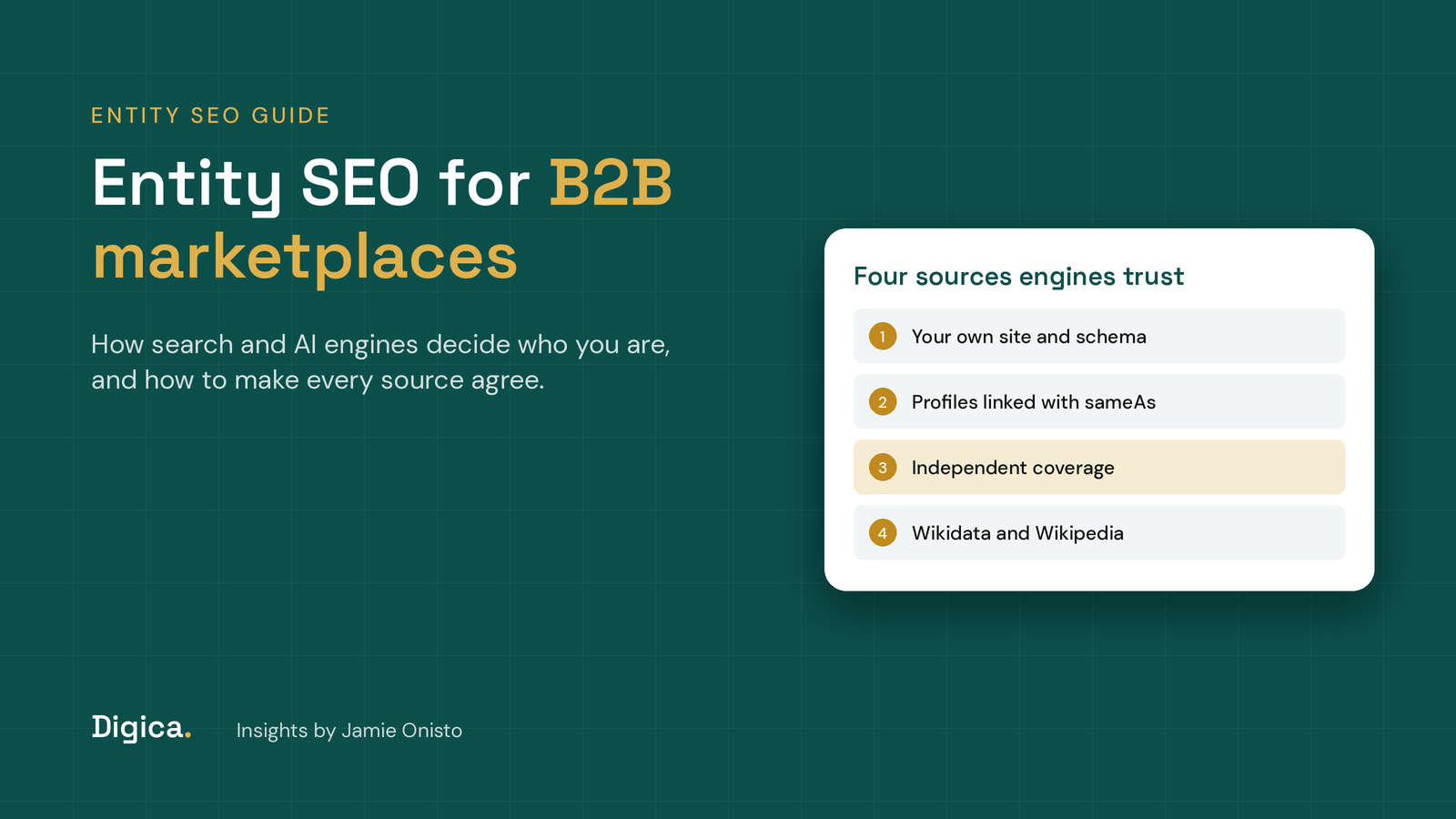
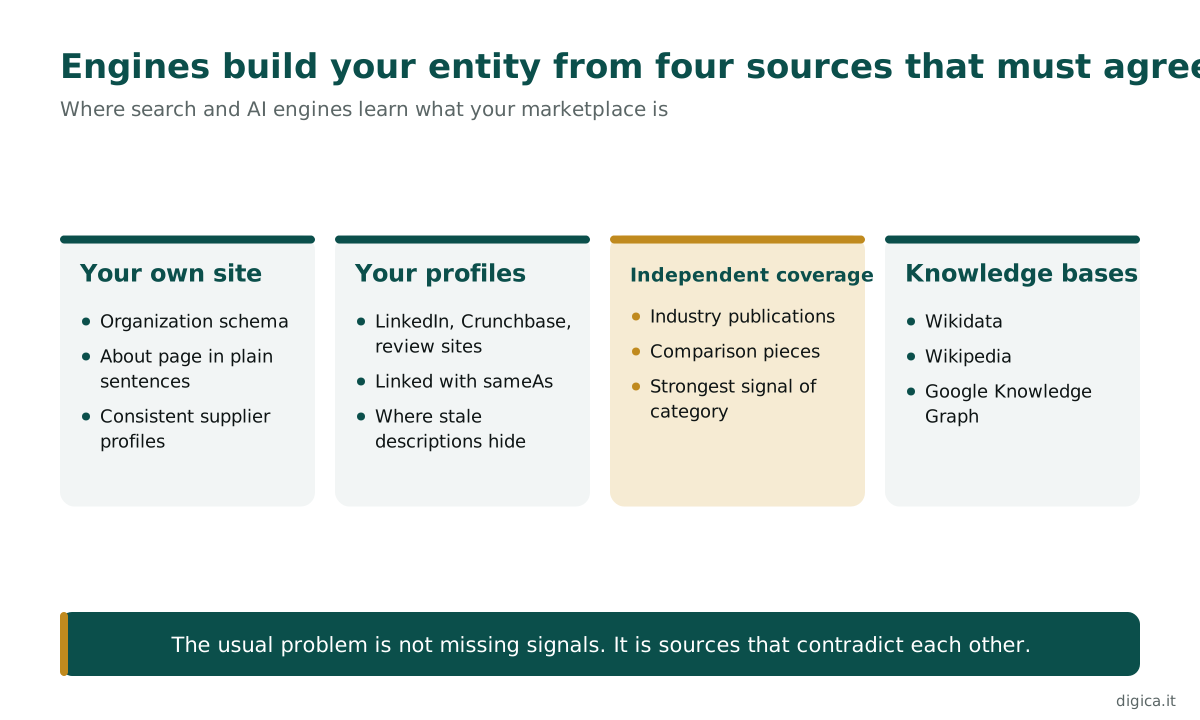
Engines build your entity from four kinds of source: your own site, your profiles on other platforms, independent coverage, and structured knowledge bases. Each one carries a different weight, and the goal is not to maximize any single source but to make all four say the same thing.
1. Your own site. The homepage, About page and Organization structured data. It tells engines how you describe yourself, which is useful but not independent.
2. Your profiles elsewhere. LinkedIn, Crunchbase, review sites, app directories and industry associations. These are semi-independent: you usually control the text, but engines see them as separate sources. They are also where stale descriptions hide.
3. Independent coverage. Articles in industry publications, mentions in comparison pieces, interviews and podcasts. This is the strongest signal of what you are, because someone else wrote it. It is also the hardest to fake.
4. Knowledge bases. Wikidata, Wikipedia and Google's Knowledge Graph. These are structured summaries that many systems reuse. They usually reflect sources 1 to 3 rather than create anything new.
The most common entity problem we find is not missing signals. It is conflicting ones: a homepage that says "marketplace", a Crunchbase profile that says "agency", and a press release from three years ago that says "software". Engines reconcile the conflict, and the result is a blurred entity that matches no category well.
What does AI say your marketplace is?
We run a five-prompt entity check across ChatGPT, Perplexity and Google with you in a 30-minute call.
Run the check yourself first. Ask three AI engines "what is [your marketplace]?", "who founded it?", "what categories does it serve?", "who are its competitors?" and "is it a good place to find [your top category]?". Note every wrong fact and the source the engine cites. Those sources are your fix list, in order of how often they appear, and the list is usually shorter than teams expect.
Start on your own site: Organization schema and an About page
Start where you have full control: an About page that states the facts plainly, and Organization structured data that repeats them in machine-readable form. It is a few hours of work and it gives every other source something consistent to agree with.
Google's documentation says Organization markup helps it understand administrative details and distinguish your organization from others, and that it can influence the visual elements of your knowledge panel, including which logo appears. There are no required properties, so add the ones that apply. For a marketplace, the useful set is:
- name, alternateName and legalName, so engines can match the brand to the company behind it.
- description, one sentence that names the category: "Acme is a B2B marketplace for industrial pump suppliers in North America."
- url and logo, with a logo of at least 112 by 112 pixels.
- sameAs, linking to every official profile: LinkedIn, Crunchbase, review sites, association listings.
- foundingDate, address and contactPoint, where they are public.
The About page should say the same things in plain sentences, because AI engines quote prose, not markup. One paragraph should answer: what the marketplace is, who it serves on each side, which categories, where, since when, and who runs it.
Then apply the same discipline to supplier profiles. A profile that names the supplier consistently, links to its website and lists its locations and services helps engines connect your marketplace to every company it lists. That is also what makes a profile worth indexing. Our guide to category page SEO for marketplaces covers the page templates in more depth.
Knowledge panels: what you can and cannot control
You cannot create or buy a Google knowledge panel. Google states that knowledge panels are generated automatically when an entity is in its Knowledge Graph, drawing on sources across the web. What you can do is make the facts consistent across those sources and, once a panel exists, claim it and suggest corrections.
What drives a panel to appear is, in practice, the same work as the rest of this guide: consistent facts on your site and profiles, and enough independent coverage that the entity is clearly recognized. In our experience, marketplaces with a few hundred branded searches a month and several independent articles about them usually get a panel; very young ones usually do not, and no markup changes that.
Once a panel appears:
- Claim it through Google's verification process, using an official account tied to the brand.
- Suggest corrections to wrong facts, with a source that supports the change.
- Keep the sources current. A panel that shows an old description is usually reflecting an old profile somewhere else. Fix the source, not just the panel.
Do not confuse a knowledge panel with a Business Profile. Business Profiles are for businesses that serve customers at a location or within a service area. Most online marketplaces need the knowledge panel, not a local listing.
Ready to make your marketplace the entity engines recognize?
Entity and citation work sit at the core of our GEO service for B2B marketplaces.
If you already have a panel, look at it with a buyer's eyes. Does the description name your category? Is the logo current? Are the founders and founding year right? Each wrong element points to a source somewhere on the web that still carries the old fact. Fixing that source is slower than clicking "suggest an edit", and it is the only change that also corrects what AI engines say, because they read the same sources.
Wikipedia and Wikidata: when they help and when they backfire
Wikipedia helps entity SEO only when your marketplace already meets Wikipedia's notability bar, and it backfires when it does not. Wikidata has a lower bar and is often the more practical step. Neither can be bought legitimately, and both reward independent coverage you have already earned.
Wikipedia. Wikipedia's notability guideline for companies expects significant coverage in multiple independent, reliable sources. Press releases, funding announcements and paid placements do not count. An article created without that coverage is likely to be deleted, and the deletion discussion stays visible. Wikipedia's terms also require anyone paid to edit to disclose it. If someone offers to "get you on Wikipedia" for a fee without asking about your independent coverage first, walk away.
Wikidata. Wikidata stores structured facts about entities and is reused widely. Its criteria are lower: an item needs to describe a clearly identifiable entity, supported by serious, public references. For a marketplace with some independent coverage, a well-referenced Wikidata item with its official website, founding date, founders and industry can be a reasonable step. Keep it factual and referenced; unreferenced promotional items get removed.
Entity signals compared by cost, time to effect, main risk and best fit for a B2B marketplace (cost ranges from our engagements).
| Signal | Typical cost | Time to effect | Main risk | Best for |
|---|---|---|---|---|
| Organization schema and About page | 2 to 6 hours of work | Weeks | Facts that conflict with other sources | Every marketplace, first |
| Consistent profiles linked with sameAs | $500 to $2,000 or about a week of cleanup | Weeks to months | Stale profiles you forgot about | Marketplaces that repositioned |
| Earned coverage in industry publications | $2,000 to $10,000 a month for an editorial program | Three to six months | Paid placements that do not count | Building category association |
| Wikidata item with references | A few hours | Months | Removal if unreferenced | Marketplaces with some independent coverage |
| Wikipedia article | Cannot be bought legitimately | Months, if notable | Deletion and a public record | Clearly notable marketplaces only |
| Claiming a knowledge panel | Free, once a panel exists | Days to weeks | Correcting the panel, not the source | Marketplaces that already have one |
The order in the table is the order to work in. Each step makes the next one more likely to succeed.
Three failure scenarios
These patterns come from marketplaces we have audited. Figures are representative, not a specific account.
Scenario 1: the name collision. A logistics marketplace shares its name with an unrelated software company. The software company has a knowledge panel and a Wikipedia article; the marketplace has neither. AI engines answer "what is [name]?" with the software company's description, and some buyers assume the marketplace is the same business.
The right call: use alternateName and a descriptive tagline consistently ("[Name] freight marketplace"), build sameAs links, and earn coverage that pairs the name with the category every time.
Scenario 2: the old positioning that will not die. A B2B services marketplace started as a staffing agency and repositioned two years ago. Its Crunchbase, LinkedIn and two directory profiles still say "staffing agency". AI engines describe it as an agency, and suppliers who would join a marketplace ignore it.
The right call: audit every profile, update the descriptions to one sentence that names the category, and link them all from Organization sameAs.
Scenario 3: the paid Wikipedia shortcut. A marketplace pays $3,000 for a Wikipedia article. It has two funding announcements and no independent coverage. Editors delete the article within weeks, and the deletion discussion becomes the top result for "[name] Wikipedia".
The right call: earn significant independent coverage first. If notability follows, let an independent editor write the article, and disclose any paid involvement.
Every scenario has the same fix underneath: consistent facts, then independent coverage, then knowledge bases. Teams that try to skip to the last step usually end up worse off than when they started, because the shortcut leaves a public record that engines keep reading.
Where to start: a decision framework
Decide by branded search volume, the accuracy of AI answers about you, and the independent coverage you already have. These thresholds come from our own audits; adjust them to your category.
- If AI engines get a material fact wrong in one or more of five test prompts, fix the cited sources before anything else.
- If you get fewer than 100 branded searches a month, do the basics only: Organization schema, an About page, and consistent profiles with sameAs.
- If you have at least three independent articles with significant coverage in reliable publications, create a referenced Wikidata item.
- If a knowledge panel exists for your marketplace, claim it this month and correct its sources.
- If you get 1,000 or more branded searches a month and third-party pages outrank you for "[brand] reviews", add trust and pricing pages to the entity work.
- If someone offers a Wikipedia article for a fee before asking about your coverage, decline.
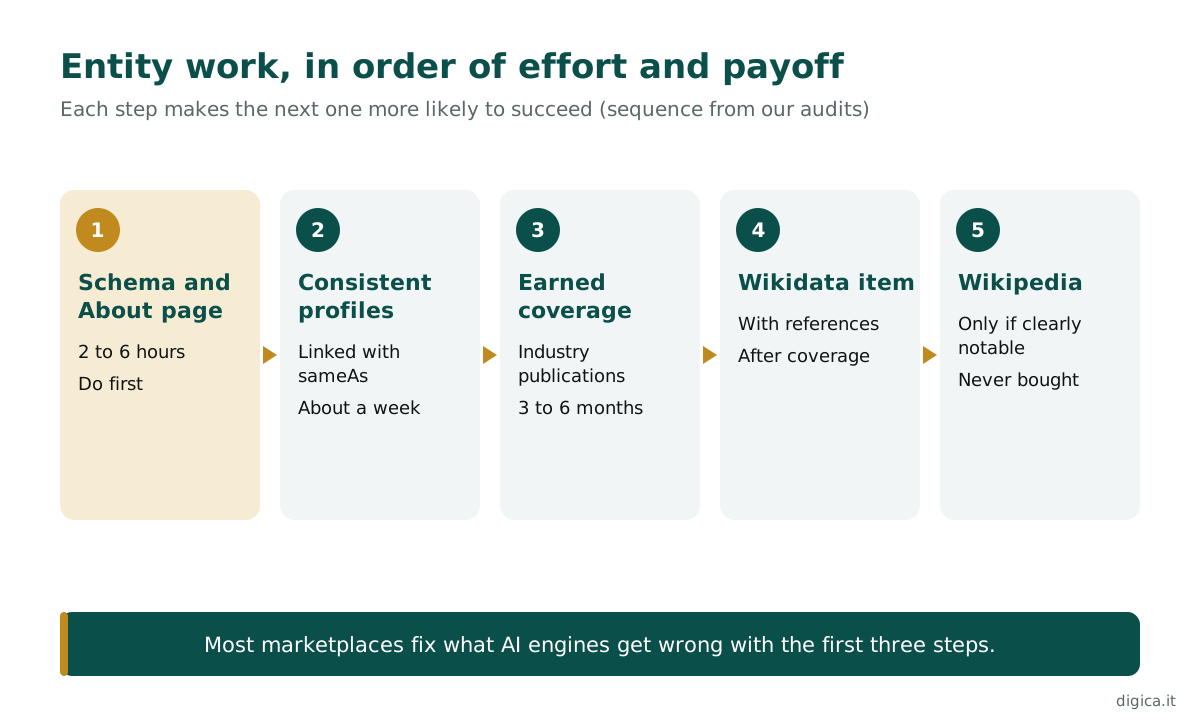
Most marketplaces we audit stop at step two or three of this sequence for a year or more, and that is fine. The first three steps fix most of what AI engines get wrong, and they cost far less than the last two. The sequence also protects you from the most expensive mistake in entity SEO: spending on a knowledge base entry before the sources it would summarize say the right thing. Wikidata and Wikipedia reflect the web; they cannot overrule it.
A worked example: what entity confusion costs
Put a number on entity confusion before deciding how much to invest. Branded search is the cleanest place to start, because those searchers already chose you and every one you lose is a request you had already earned. Take a B2B marketplace (illustrative numbers):
- Branded searches: 2,000 a month
- Share that reach the marketplace's own site today: 60%, so 1,200 sessions
- Share lost to a similarly named company, stale profiles or third-party pages because of entity confusion: 20 percentage points, so 400 sessions
- Request rate from branded sessions: 5%, so 20 requests a month lost
- Request to transaction rate: 40%, at $200 of net revenue per transaction
Lost net revenue: 20 × 40% × $200 = $1,600 a month, or $19,200 a year.
Where do the 400 sessions go? In the marketplaces we audit, three leaks recur. Some branded searchers click a similarly named company that ranks above you. Some click a review or "alternatives" page written by a third party, which may recommend a competitor. And some ask an AI engine instead of searching, get a stale description, and decide you are not what they need. Each leak has a different fix, which is why the five-prompt check and a look at your branded results come before any spend.
The cost side is small by comparison. Schema and an About page take a few hours. A profile cleanup takes about a week. A focused effort to earn three or four independent articles that describe the marketplace correctly takes a quarter. Together, in our engagements, that is typically $5,000 to $10,000 of one-off work, before any ongoing editorial program.
How much branded demand is your marketplace losing?
We will run this model on your branded search and AI answers in one call.
The model ignores the larger effect, which is harder to count: being left out of AI answers for category questions because engines do not associate your marketplace with the category. If entity work helps you appear in even a handful of category answers that send 200 extra sessions a month at the same request and transaction rates, that is another $800 a month on top. The brand number is the floor of the business case, not the ceiling, and it is the one a finance team can check against analytics.
What a clear entity is worth on the same branded traffic
On the same branded traffic, a clear entity is worth the sessions and requests that confusion currently sends elsewhere. In the example, recovering 400 branded sessions a month is worth about $19,200 a year in net revenue. Entity cleanup, schema and profile work typically costs $5,000 to $10,000 one-off in our engagements, so the work pays back in three to six months.
It also holds up as AI search grows. Google's guidance on its AI features is that no special schema, AI-specific text files or new machine-readable files are required; standard SEO practices apply. Clean, consistent facts about who you are is that standard practice, applied to the entity rather than the page. The cost of doing nothing is an engine describing your marketplace from someone else's outdated summary.
The number to take into your next leadership meeting: on 2,000 branded searches a month, entity confusion that diverts 20% of visits costs about $19,200 a year, and fixing it costs $5,000 to $10,000 once.
FAQ
What is entity SEO? Entity SEO is the practice of helping search and AI engines understand what a company, product or concept is and how it relates to other entities. For a marketplace, it means consistent facts about the marketplace, clear association with its categories, and well-linked supplier profiles.
How do I get a knowledge panel for my company? You cannot request or buy one. Google generates knowledge panels automatically when an entity is in its Knowledge Graph. Consistent facts on your site and profiles, Organization structured data and independent coverage make it more likely; once a panel exists, you can claim it and suggest corrections.
Does Wikidata help SEO? Indirectly. Wikidata stores structured facts that many systems reuse, so a well-referenced item can reinforce what engines know about your marketplace. It needs serious public references, and it reflects your independent coverage rather than replacing it.
Should a marketplace create a Wikipedia page? Only if it clearly meets Wikipedia's notability guideline, which expects significant coverage in multiple independent, reliable sources. Without that, the article is likely to be deleted. Anyone paid to edit Wikipedia must disclose it.
Does Organization schema help with AI search? It helps engines identify your organization and can influence your knowledge panel. Google says no special schema is required to appear in its AI features, so treat Organization markup as part of standard, consistent facts rather than an AI-specific tactic.
How long does entity SEO take? Schema and profile fixes can show up in weeks. Changes in how AI engines describe you often take one to three months, as sources are recrawled. Earned coverage that builds category association takes three to six months to compound.
Related Articles
- Being the source AI answer engines cite: a GEO playbook
- GEO for marketplaces: turn category and listing pages into AI citations
- Best AEO tools, priced per prompt
- How to choose a GEO agency for a B2B marketplace
Where this connects
This article is part of our B2B marketplace growth series.