B2B ecommerce trends in 2026: what a B2B marketplace should act on this quarter
Most lists of B2B ecommerce trends are written for suppliers with a web store. If you run a B2B marketplace, half of them do not apply and the other half apply differently. The headline number explains why it matters anyway: Digital Commerce 360 put US B2B ecommerce at $2.93 trillion in 2025, up 13%, while total US manufacturing and distribution B2B sales grew just 0.4%.
So digital is taking share from a market that is barely growing. That is good news for a B2B marketplace only if buyers choose it over the supplier's own site, a procurement portal, a distributor or an AI assistant that answers the question before anyone clicks. The trends that matter are the ones that decide that choice.
This guide takes the trends that top-ranking lists repeat, keeps the seven backed by 2025 and 2026 research, and gives each one the action a B2B marketplace operator should take this quarter and the metric that shows whether it worked. It sits alongside our B2B marketplace growth strategy and our work with B2B marketplaces and directories.
Quick Navigation
- The future of B2B ecommerce, filtered for marketplaces
- Trend 1: digital takes share while total demand stays flat
- Trend 2: buyers want rep-free buying with an expert on call
- Trend 3: AI search and agents become the front door
- Trend 4: bigger, younger buying groups ask for proof
- Trend 5: payment terms decide the checkout
- Trend 6: the largest B2B marketplaces are pulling away
- Trend 7: digital leaders and laggards drift further apart
- B2B marketplace trends side by side
- Three failure scenarios
- What to act on this quarter: a decision framework
- FAQ
- Related Articles
The future of B2B ecommerce, filtered for marketplaces
The short answer: the future of B2B ecommerce is self-serve, researched through AI and paid on terms, and a B2B marketplace wins it only where it gives buyers a faster, safer purchase than the supplier's own channels.
Read ten trend lists and you see the same headings: personalization, mobile, headless commerce, omnichannel, AI. Most are written by platform vendors for suppliers deciding what to build. A B2B marketplace operator has a different problem. You do not need a better store. You need buyers to start their search with you, find enough suppliers to compare, and complete the purchase on your platform rather than taking the contact offline.
That is the filter we used. A trend made this list only if it changes one of three things: whether buyers find you, whether they trust what they find, or whether they finish the transaction with you. Headless architecture and mobile-first design are real, but they are build decisions, not growth decisions, and most marketplaces made them years ago.
Our view: a trend is only useful to an operator if it comes with an action and a number. Everything below has both. Where the evidence is thin, we say so, because a trend list that cannot tell strong data from a vendor survey is how teams end up spending a quarter on the wrong thing.
Trend 1: digital takes share while total demand stays flat
The short answer: B2B buying is moving online faster than the market is growing, so a B2B marketplace grows by taking share from offline and supplier channels, not by riding a rising tide.
Digital Commerce 360 estimated US manufacturing and distribution B2B sales at $15.12 trillion in 2025, up 0.4%, after 1.0% in 2024 and 0.4% in 2023. Inside that flat total, it reported digital channels, B2B marketplaces and e-procurement growing at a double-digit pace. McKinsey's 2026 B2B Pulse, a survey of nearly 4,000 decision-makers in 13 countries, found that 71% of B2B companies now offer e-commerce, and that for those companies about a third of revenue comes through digital channels.
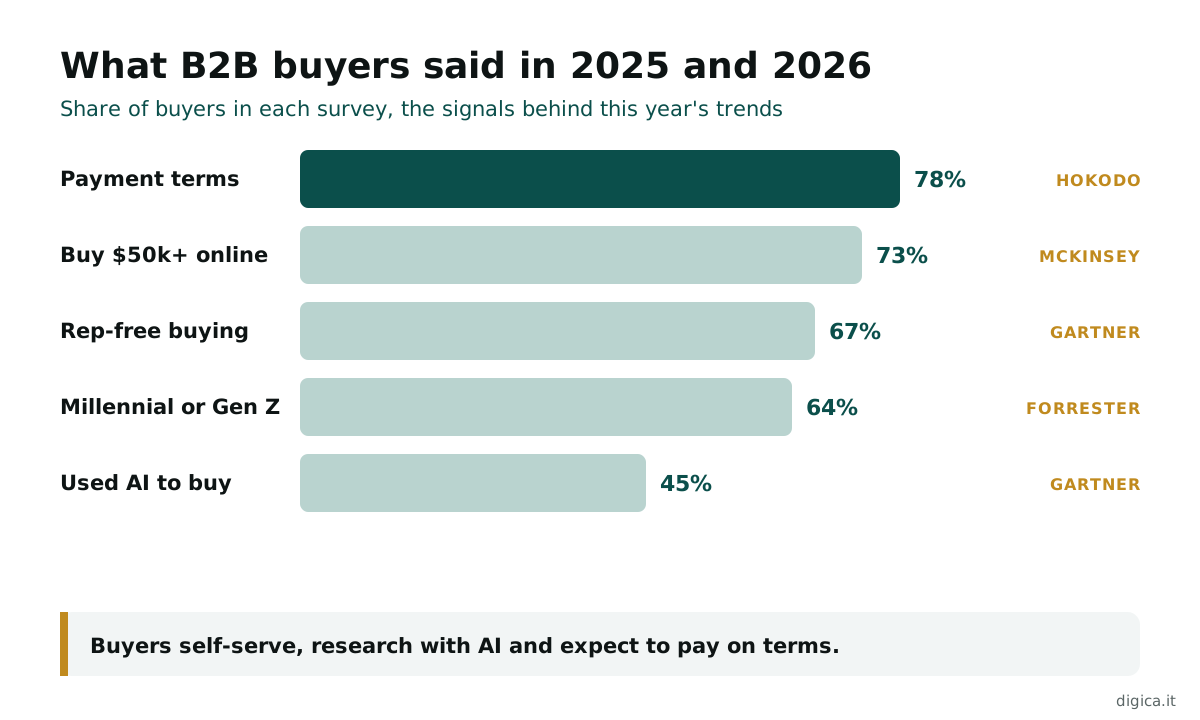
Buyers are also comfortable with bigger orders online. In the same survey, the share of buyers comfortable ordering more than $50,000 online rose from 59% in 2022 to 73% in 2026. Large orders are where B2B marketplaces earn the most, and they are no longer the exception.
The trap is reading this as market growth. A B2B marketplace in a vertical growing 0.4% a year does not grow because B2B ecommerce is growing. It grows because it wins orders that would otherwise go to a sales rep, a distributor or a supplier's own portal. We have seen this in our own work: a B2B agency marketplace we grew from five people to 40,000+ listed agencies and 1M+ monthly users did it by being the best answer in its categories, not by waiting for the category to grow.
Act on it this quarter. Pick the five categories where buyers place the largest orders and check that each has enough suppliers to compare.
Measure. Share of buyer requests in those categories that end in a match or an order.
Trend 2: buyers want rep-free buying with an expert on call
The short answer: most B2B buyers now prefer to buy without a sales rep, but they still want expert help at the moment of doubt, and a B2B marketplace that offers both beats one that offers either.
Gartner's March 2026 survey of 646 B2B buyers found that 67% prefer a rep-free buying experience, up from 61% in its 2025 survey (Gartner). The same 2026 survey found that 45% had used AI during a recent purchase. In its 2025 survey, Gartner reported that 73% of buyers avoid suppliers who send irrelevant outreach, and 69% saw inconsistencies between what a supplier's website said and what its reps said.
Is your B2B marketplace built for buyers who self-serve?
In 30 minutes we look at where buyers drop out of your search, compare and request journey, and which fixes would move the most orders.
That last number is the opening for a B2B marketplace. When a supplier's own channels contradict each other, a platform that shows consistent specs, prices, lead times and reviews in one place becomes the more reliable source. McKinsey's 2026 Pulse found buyers now use an average of ten channels, and that inconsistent information and a lack of knowledgeable support now lead the reasons buyers switch suppliers.
Rep-free does not mean help-free. The buyers who prefer to self-serve still hit a question the listing cannot answer: a compliance detail, a custom size, a delivery window. A marketplace that routes that question to the right supplier, fast, keeps the transaction. One that shows a contact form and a three-day wait sends the buyer to the phone.
Act on it this quarter. Audit your top 20 listings for missing fields buyers ask about, and set a response-time target for supplier replies.
Measure. Median supplier response time, and the share of requests answered inside one business day.
Trend 3: AI search and agents become the front door
The short answer: buyers increasingly start supplier research in AI assistants rather than search engines, and the B2B marketplaces that AI answers name will collect demand that never reaches a results page.
Gartner predicted in October 2025 that by 2028, 90% of B2B buying will be intermediated by AI agents, putting more than $15 trillion of B2B spend through agent exchanges. Treat that as a forecast, not a measurement. The present-day evidence is smaller but clearer. McKinsey's 2026 Pulse found AI tools are now among the top five channels buyers use to find and evaluate suppliers, and 58% of buyers trust AI tools to learn about products.
Software buying is furthest ahead. G2, itself a software marketplace, surveyed 1,076 software buyers in March 2026 and found that 51% now start research with an AI chatbot more often than with Google, up from 29% a year earlier, and that 69% had chosen a different vendor than planned because a chatbot recommended one. It is vendor research covering one category, but the direction matches every other source.
For a B2B marketplace this cuts both ways. An AI assistant can recommend your platform, or it can answer the buyer's question with a supplier name and skip you entirely. Which one happens depends on whether your category pages, supplier profiles and comparison content are structured so AI systems can read, trust and cite them. We cover the mechanics in our guide to generative engine optimization for marketplaces, and the procurement side in AI in procurement for B2B marketplaces.
Act on it this quarter. Ask the main AI assistants the ten questions your buyers ask most, and record whether they name your B2B marketplace, a competitor or a supplier directly.
Measure. Share of those answers that cite or name your platform, tracked monthly.
Trend 4: bigger, younger buying groups ask for proof
The short answer: purchases are now decided by large groups that include procurement and a younger generation of buyers, and they want evidence they can share internally, not a sales pitch.
Forrester's State of Business Buying 2026, based on its survey of about 18,000 buyers, found that a typical purchase now involves 13 internal stakeholders and 9 external influencers. Procurement is a decision-maker in 53% of buying cycles. More than 60% of buyers use a trial before buying, rising to 78% for purchases of $10 million or more.
The people in those groups are also changing. Forrester reported in April 2026 that 64% of business buyers at manager level and above are Millennials or Gen Z. They grew up comparing products online and expect the same in their working lives: reviews, side-by-side comparisons and prices they can see without booking a call.
A buying group of 13 does not all visit your B2B marketplace. One person does, then shares what they found. That changes what a listing has to carry. It needs the proof the absent twelve will ask for: certifications, case studies, delivery records, references and terms, in a form someone can forward. A profile that only works for the person who found it loses the deal in the meeting after.
Act on it this quarter. Add a shareable comparison or shortlist feature, or at minimum make supplier profiles carry certifications and verified reviews above the fold.
Measure. Shares or exports of supplier profiles and shortlists per buyer session.
Trend 5: payment terms decide the checkout
The short answer: B2B buyers expect to pay on invoice terms, and a B2B marketplace that only takes cards at checkout loses orders it has already won.
A study of 300 B2B buyers by Hokodo, the B2B Ecommerce Association and Greenwood Consulting, reported by Digital Commerce 360 in October 2025, found that 78% call payment terms essential when choosing suppliers, and two-thirds had abandoned a purchase when terms were not offered. The same study found 80% prefer to pay by bank transfer. Hokodo sells trade credit, so read the numbers as a strong signal rather than a neutral census, but they match what operators see.
This is where B2B marketplaces differ most from consumer ones. A procurement team cannot put a $40,000 order on a card. It needs net 30 or net 60 terms, a purchase order and an invoice that fits its accounting system. If your checkout does not offer that, buyers find the supplier on your platform and then place the order directly, which costs you the take rate and the data.
Embedded B2B payments and trade credit providers have made this far easier to offer than it was five years ago. The decision is usually not whether to offer terms but who carries the credit risk: the marketplace, the supplier or a third-party provider. Our guide to marketplace business models covers how that choice affects your revenue.
Act on it this quarter. Check how many orders above your average value are abandoned at checkout, and whether terms are offered on them.
Measure. Checkout completion rate for orders above your average order value.
Trend 6: the largest B2B marketplaces are pulling away
The short answer: the biggest horizontal B2B marketplaces are growing fast and adding procurement and AI features, which raises the bar for every vertical platform.
How does your B2B marketplace compare with the platforms buyers already use?
A growth audit maps where buyers in your categories search, on Google and in AI answers, and which of your category pages they never reach.
Amazon Business reported $60 billion in annualized gross sales in July 2026, serving more than 11 million organizations in 11 countries, including 97 of the Fortune 100. It said business-specific discounts saved customers more than $1 billion in 2025, and it added AI features for spend insights and anomaly monitoring. Faire, with nearly $3 billion in annual wholesale volume, opened its platform in June 2026 to business-use buyers that do not resell.
The software layer is consolidating too. Mirakl, which powers more than 450 marketplaces, reported about $14.6 billion in marketplace and dropship GMV for 2025, up 31%, and launched an agentic commerce platform. More operators are building on shared infrastructure, which makes features cheap to copy and differentiation harder to hold.
A vertical B2B marketplace cannot outspend Amazon Business on catalog breadth or price. It can win where depth matters more than breadth: specialist suppliers, technical specifications, compliance, and categories where a wrong purchase is expensive. Our ranking of the best B2B marketplaces by industry shows how each leader won its vertical, and our procurement marketplaces ranking shows what large buyers compare.
Act on it this quarter. List the categories where buyers could buy the same item on Amazon Business, and decide which to defend with depth and which to stop competing in.
Measure. Organic share of search for your top category terms against the horizontal platforms.
Trend 7: digital leaders and laggards drift further apart
The short answer: the B2B companies gaining share use AI and personalization at roughly twice the rate of everyone else, and the gap is widening.
McKinsey's 2026 Pulse found that companies growing market share by more than 10% use generative AI at twice the rate of other companies, 44% against 22%, and offer one-to-one personalization at four times the rate, 20% against 5% (McKinsey). Among leaders, 71% raised AI investment by double digits, against 25% of their peers. Only 22% of companies said they had fully implemented generative AI.
For a B2B marketplace, the personalization that matters is not a product carousel. It is showing each buyer the suppliers, terms and prices that fit their company: approved suppliers first, the right currency and delivery region, reorder shortcuts and pricing that reflects their volume. That is where AI earns its place in a marketplace, matching buyers with suppliers faster, not writing product descriptions.
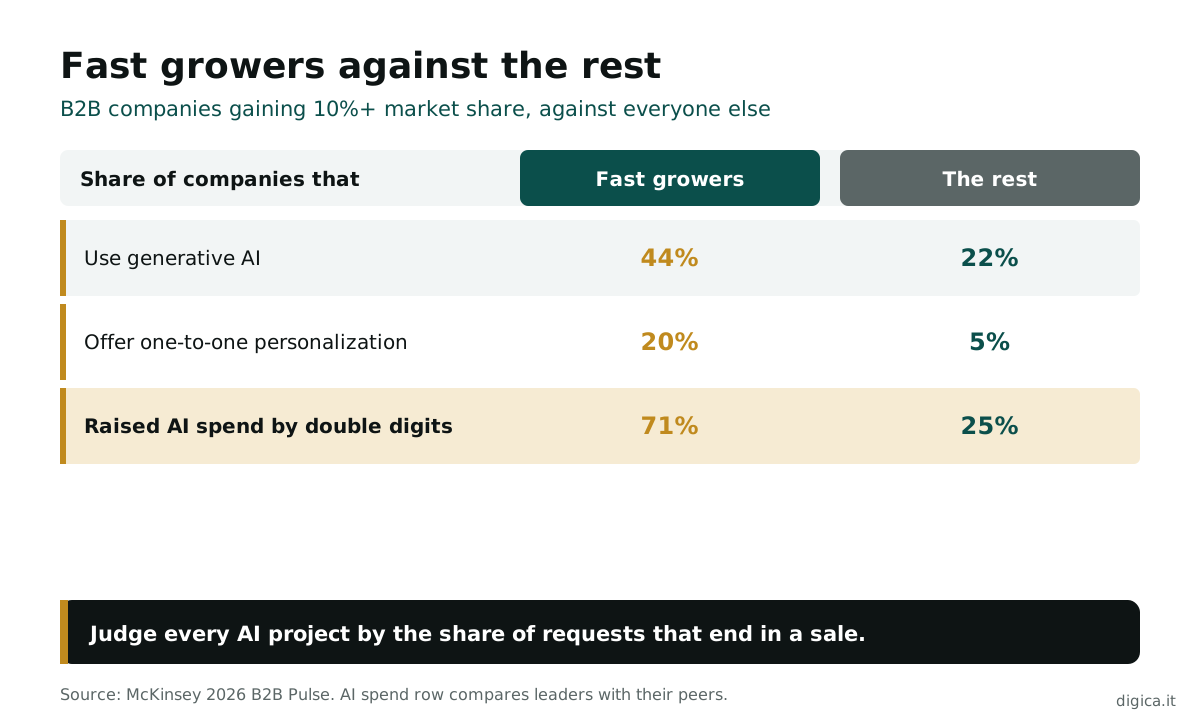
The risk is spending on AI features that do not touch liquidity. A chatbot on the homepage is visible. Better matching between buyer requests and supplier capacity is not, but it is what moves the numbers. Our view: judge every AI project by whether it raises the share of requests that end in a transaction, which is the liquidity metric that compounds.
Act on it this quarter. Pick one matching or recommendation step in the buyer journey and test a personalized version against the current one.
Measure. Request-to-match rate for the test group against the control.
B2B marketplace trends side by side
The short answer: rep-free buying, AI search and payment terms carry the strongest evidence and the most direct revenue impact, so most B2B marketplaces should start there.
Seven B2B ecommerce trends compared on strength of evidence, the operator action, the metric, the risk of ignoring it and which B2B marketplaces it matters most to
| Trend | Evidence strength | Operator action this quarter | Metric to watch | Risk of ignoring it | Best for |
|---|---|---|---|---|---|
| Digital takes share | Strong (McKinsey, Digital Commerce 360) | Fill supplier gaps in top five categories | Request-to-match rate | Growth stalls in a flat market | Every B2B marketplace |
| Rep-free buying | Strong (Gartner, two surveys) | Fix missing listing fields, set reply targets | Median supplier response time | Buyers return to reps and phone | Considered, repeat purchases |
| AI search and agents | Medium (forecasts plus surveys) | Test top buyer questions in AI assistants | Share of AI answers naming you | Demand bypasses your platform | Software, services, data |
| Bigger, younger buying groups | Strong (Forrester) | Make proof shareable on profiles | Profile shares per session | Deals lost in the internal meeting | High-value, technical purchases |
| Payment terms | Medium (vendor-led study) | Offer invoice terms on large orders | Checkout completion above average order | Orders leak off-platform | Wholesale, MRO, industrial |
| Large marketplaces pull away | Strong (company disclosures) | Defend categories with depth | Organic share of category searches | Squeezed on price and breadth | Vertical B2B marketplaces |
| Leaders and laggards split | Strong (McKinsey) | Test personalized matching | Request-to-match rate in test | Spend on AI that does not move liquidity | Platforms with enough request data |
The table is the short version of this guide. If you only act on one row this quarter, choose the one where your current metric is weakest, not the one with the most attention in the trade press.
Three failure scenarios
These patterns recur when B2B marketplaces act on trend lists without an operator filter.
- The AI feature nobody asked for. A marketplace spends a quarter building a buyer chatbot because every trend list says AI. Usage is low, and the request-to-match rate does not move. Meanwhile AI assistants outside the platform answer buyer questions by naming suppliers directly. The same quarter spent making category pages readable and citable by AI systems would have protected the demand that was already leaking.
- The checkout that only takes cards. A wholesale B2B marketplace grows sign-ups but sees large orders stall at checkout. Buyers contact suppliers through the platform, then order directly on invoice terms. The platform loses the take rate on its most valuable orders. Offering net terms through a credit partner would have kept them.
- The breadth race. A vertical marketplace adds adjacent categories to look bigger, competing with horizontal platforms on range. Supplier depth in its core category thins, buyers find fewer options to compare, and match rates fall. Doubling down on the core category, where its specialist suppliers had no equal, would have kept its lead.
Each team followed a real trend. None checked it against the metric that pays.
What to act on this quarter: a decision framework
The short answer: start with the trend attached to your weakest metric, run one test, and measure it for a full quarter before adding the next.
- If fewer than 60% of buyer requests in your top categories end in a match or order, start with Trend 1: fill supplier gaps before anything else. No other trend works on an empty shelf.
- If median supplier response time is more than one business day, start with Trend 2. Rep-free buyers will not wait.
- If AI assistants name a competitor or a supplier for more than half of your top ten buyer questions, start with Trend 3 and fix the pages AI systems read.
- If your average order is above $10,000 and you do not offer invoice terms, start with Trend 5. Forrester's finding that 78% of buyers trial purchases above $10 million is a reminder that larger deals need more support, not less (Forrester).
- If you compete with Amazon Business in more than a third of your categories, apply Trend 6 and decide where to go deeper.
- If you have more than 1,000 buyer requests a month, you have enough data to test Trend 7 personalization properly.
Want this framework applied to your B2B marketplace?
Our B2B marketplace growth consulting team works inside your roadmap to fix supply, demand and organic visibility, from the same engine.
What does acting early look like in practice? In our work with a water and wastewater B2B marketplace, structuring category and supplier pages for search delivered 10x+ organic impressions within six months. That is the compounding side of these trends: the work done for AI answers and self-serve buyers keeps paying after the quarter ends.
The number to take into your next planning meeting is the gap between market growth and channel growth. US B2B ecommerce grew 13% in 2025 while total B2B sales grew 0.4%. If your B2B marketplace grew less than 13% last year, you lost share in the channel that is winning, and the biggest cost of doing nothing is that buyers who now start in AI assistants and self-serve journeys will settle on someone else.
FAQ
What are the biggest B2B ecommerce trends in 2026? The biggest B2B ecommerce trends in 2026 are rep-free buying, AI search and AI agents in supplier research, larger and younger buying groups, payment terms at checkout, and the growth of large B2B marketplaces such as Amazon Business.
What is the future of B2B ecommerce? The future of B2B ecommerce is self-serve, researched through AI assistants and paid on invoice terms. Gartner predicts that by 2028, 90% of B2B buying will be intermediated by AI agents, though that is a forecast rather than a measured figure.
What are the main B2B marketplace trends? The main B2B marketplace trends are specialist vertical platforms competing on depth, procurement features such as invoice terms and approvals, AI matching between buyers and suppliers, and visibility in AI answers as a new source of demand.
How fast is B2B ecommerce growing? Digital Commerce 360 estimated US B2B ecommerce at $2.93 trillion in 2025, up 13%, while total US manufacturing and distribution B2B sales grew 0.4% to $15.12 trillion.
Do B2B buyers still want sales reps? Fewer do. Gartner's 2026 survey found 67% of B2B buyers prefer a rep-free buying experience, but buyers still want expert help for complex questions, so the best platforms make that help fast to reach.
Which B2B ecommerce trend should a marketplace act on first? Start with the trend tied to your weakest metric. For most B2B marketplaces that is supplier depth in the top categories, because rep-free buying, AI visibility and personalization all fail when buyers find too few suppliers to compare.
Related Articles
- B2B marketplaces and directories
- B2B marketplace growth strategy: what works in 2026
- AI in procurement: what it means for B2B marketplaces
- Best B2B marketplaces in 2026: 7 examples by industry
- Liquidity is the only marketplace metric that compounds
Where this connects
This article is part of our B2B marketplace growth series. Browse more on the Digica blog.