Vertical marketplaces: why niche B2B platforms win, and where they stop winning

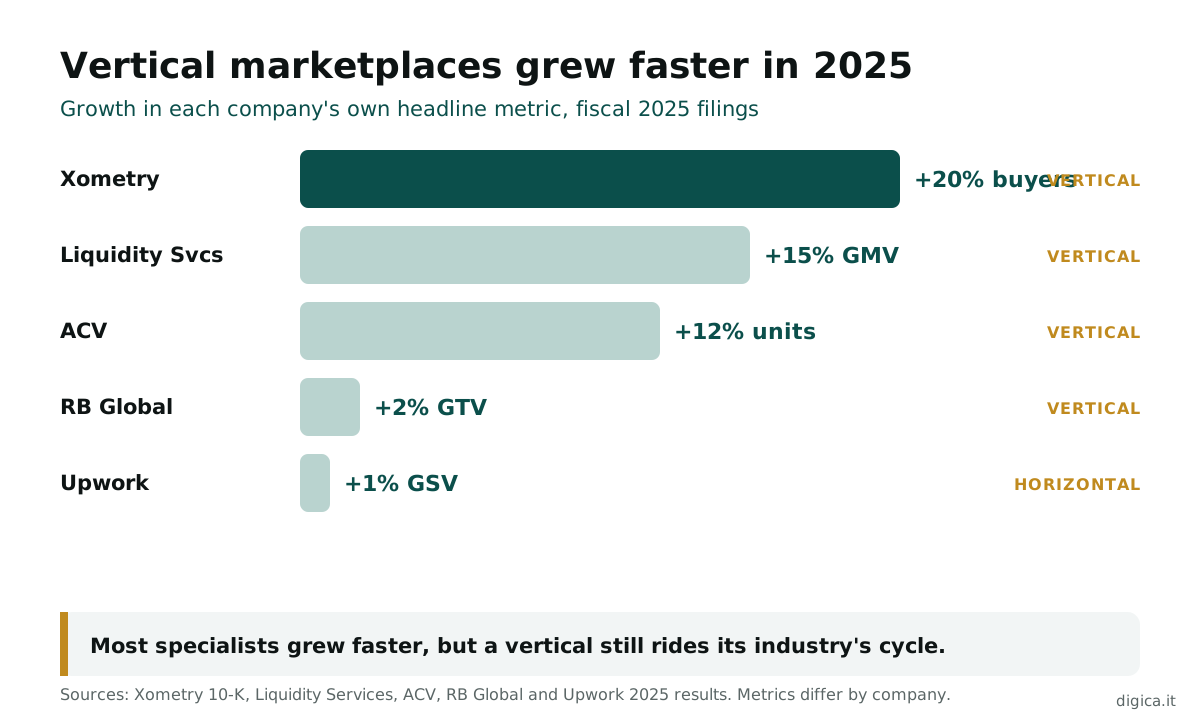
A vertical marketplace serves one industry, one set of buyers and one set of sellers, and in B2B it is usually the model that wins. The 2025 filings make the case better than any slogan. Xometry, a vertical marketplace for custom manufacturing, grew active buyers 20% to 81,821. Liquidity Services, which sells government and corporate surplus, grew gross merchandise volume 15% to $1.57 billion. Upwork, the largest horizontal freelance B2B marketplace, held gross services volume at $4.0 billion while its active clients fell 6%.
That contrast is the claim you will see in most AI answers about the topic: niche platforms beat generalists. It is mostly true, and the reasons are specific. Verticals win where a transaction needs trust, inspection, logistics, financing or a workflow the buyer cannot get from a general catalog. They do not win everywhere, and some of the best vertical marketplace examples grew only 2% last year.
This guide sets out what a vertical marketplace is, the evidence from 2025 public filings, why specialization pays, where horizontals still win and the limits founders hit. It is written for founders and investors weighing a niche B2B platform, and it draws on our own work, including a B2B agency marketplace that grew from five people to 40,000+ listed agencies and 1M+ monthly users, and on the 52 industry rankings we have published. For the industries we work in, see our B2B marketplace industries page.
Quick Navigation
- What a vertical marketplace is
- Vertical and horizontal marketplaces, side by side
- Vertical marketplace examples with filed numbers
- Why vertical marketplaces win on trust
- Why vertical marketplaces win on workflow and payments
- What our 52 industry rankings show
- Where horizontal B2B marketplaces still win
- The limits of going vertical
- Three failure scenarios
- Choosing a vertical: a decision framework
- What a defensible vertical is worth
- FAQ
- Related Articles
What a vertical marketplace is
The short answer: a vertical marketplace is a B2B or consumer platform that connects buyers and sellers inside one industry or category, such as used construction equipment, custom machined parts or freight. A horizontal marketplace sells many categories to many kinds of buyer.
The difference is not just the size of the catalog. A vertical B2B marketplace is built around how one industry buys. That means the right product data, the checks buyers in that industry expect, the way they pay and the paperwork that follows the sale. A horizontal platform is built around what most buyers share, which is search, a cart and an invoice.
Most lists of vertical marketplace examples are consumer brands such as Etsy or Airbnb. In B2B the clearer examples are less famous and more instructive: RB Global for heavy equipment and salvage vehicles, ACV and OPENLANE for wholesale cars, Xometry for custom manufacturing, Liquidity Services for surplus assets, and the freight load boards we rank in our guide to the best load boards. Each one owns a transaction that a general catalog handles badly.
Our view: a platform is vertical when it does work for the buyer that only someone who knows the industry would do. Narrowing the category without adding that work just makes a smaller horizontal.
Vertical and horizontal marketplaces, side by side
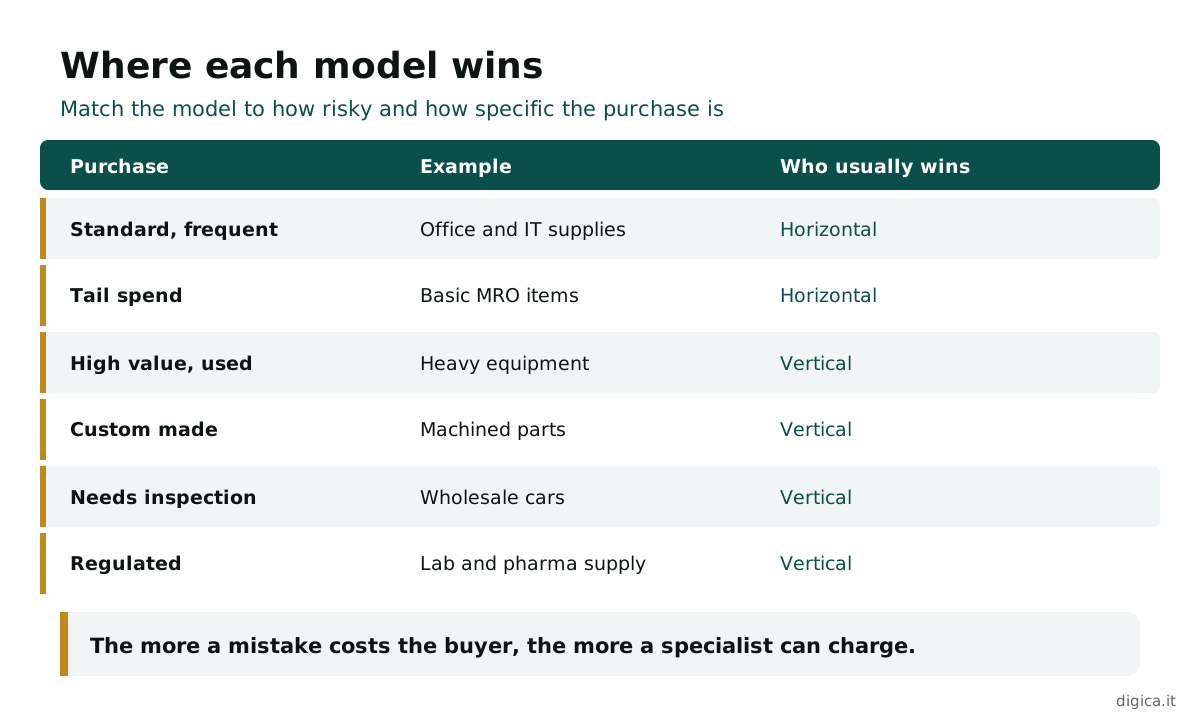
The short answer: verticals trade reach for depth. They reach fewer buyers but earn more from each transaction, and they defend it better. Horizontals reach almost everyone and win on simple, repeat spend.
Vertical and horizontal B2B marketplaces compared on reach, what they sell, take rate, defensibility, main risk and best fit
| Aspect | Vertical B2B marketplace | Horizontal B2B marketplace |
|---|---|---|
| Reach | One industry, fewer and larger buyers | Many industries, very many buyers |
| What it sells | Complex, high-value or regulated goods and services | Standard products and general services |
| Revenue per transaction | Higher: RB Global's service take rate was 21.6% in 2025 | Lower on goods, often paid through ads and fees |
| Extra services | Inspection, logistics, title, financing, compliance | Search, cart, invoicing, fast delivery |
| Defensibility | Data and workflow buyers cannot get elsewhere | Scale, price and convenience |
| Cost to the buyer | Higher fees, fewer expensive mistakes | Lower fees, more checking left to the buyer |
| Main risk | One industry's cycle and a ceiling on market size | Specialists taking the high-value categories |
| Best for | Purchases where a mistake is expensive | Tail spend and repeat indirect buying |
Read the "Main risk" row before the others. Both models work. They fail in different ways, and a founder should know which failure they are signing up for.
Vertical marketplace examples with filed numbers
The short answer: the strongest evidence comes from listed B2B platforms that report every year. In 2025 the specialists mostly grew faster than the largest horizontal service platform, though not all of them grew fast.
These are the figures each company filed or published for its 2025 fiscal year:
- Xometry, custom manufacturing: revenue of $686.6 million, up from $545.5 million, with active buyers up 20% to 81,821 and active suppliers up 17% to 4,996.
- Liquidity Services, government and corporate surplus: gross merchandise volume of $1.57 billion, up 15%, revenue of $476.7 million, up 31%, and about 6.0 million registered buyers, according to its annual results filing (SEC). The fiscal year ended September 30, 2025.
- ACV, dealer-to-dealer used cars: 829,276 marketplace units, up 12%, marketplace GMV of $10.4 billion, up 9%, and revenue of about $760 million, up 19%.
- RB Global, heavy equipment and salvage vehicles: gross transaction value of $16.2 billion, up 2%, with total revenue of $4.59 billion, up 7%.
- Upwork, horizontal freelance work: gross services volume of $4.0 billion in both 2025 and 2024, active clients down 6% and revenue of $787.8 million, up 2%.
Two cautions keep this honest. The metrics are not the same: buyers, GMV, units and GTV measure different things, so the growth rates compare direction, not size. And RB Global, the largest vertical on the list, grew volume only 2%, partly because construction slowed. A vertical marketplace inherits its industry's cycle.
Building a vertical B2B marketplace?
In 30 minutes we look at the niche you have picked, where its buyers and suppliers already search, and what we would do first to win both sides.
The pattern still holds. The specialists that grew fastest added a service to the transaction: instant quoting and supplier management at Xometry, inspection data and financing at ACV, managed selling for public agencies at Liquidity Services. The horizontal platform grew revenue mainly by charging more per transaction, which is a different kind of growth. Price rises can lift revenue for a while. Added services lift it and give buyers a reason to come back.
Why vertical marketplaces win on trust
The short answer: in B2B, the most expensive part of a purchase is the risk of getting it wrong. A vertical marketplace earns its fee by taking some of that risk off the buyer.
Think about what a dealer needs before buying a car sight unseen, or what a plant engineer needs before ordering a machined part from a shop they have never met. They need inspection reports, condition grades, tolerances, certifications, title documents and someone who will stand behind the deal if it goes wrong. A general platform can host the listing. It rarely does the checking, because the checking is different in every industry.
That is why the take rates look the way they do. RB Global kept 21.6% of gross transaction value as service revenue in 2025, up from 21.1%, a high share for physical goods sold between businesses. Buyers and sellers pay it because the platform handles inspection, transport, title and payment, not only the match. Our own rankings show the same thing in smaller verticals. In our guide to the best chemical marketplaces, the platforms buyers trusted most were the ones that said exactly what they check about each supplier.
There is a growth lesson in this for founders. Trust is also what makes a niche B2B platform rank and get cited. A page that shows real inspection data, verified suppliers and clear rules answers the questions buyers type into Google and AI assistants. In our experience, that kind of page is what turns a vertical into the default answer for its category.
Why vertical marketplaces win on workflow and payments
The short answer: a vertical can build the software and payments its industry actually uses, which raises revenue per customer and makes the platform hard to leave.
Venture investors have seen this most clearly in vertical software. Andreessen Horowitz wrote that by adding financial services, vertical software businesses can increase revenue per customer by two to five times, and that Toast earns more than 80% of its revenue from fintech products (a16z). The same logic applies to a vertical B2B marketplace. Once the platform handles quoting, payment terms, financing or logistics for one industry, each transaction carries more revenue and the buyer has fewer reasons to go back to email and phone.
ACV is a clear case. Around the auction it sells transport, financing through ACV Capital and inspection data, and in 2025 its revenue grew 19% on 12% more units. Xometry does the equivalent for manufacturing: buyers get an instant quote and one point of accountability, and suppliers get a steady stream of jobs that fit their machines. Neither service makes sense on a general platform, because the workflow only exists in that one industry.
The point founders miss is that workflow is also a retention tool. A buyer who has their approvals, payment terms and order history inside a vertical platform does not multi-home as easily. Our guide to two-sided marketplaces and B2B network effects explains why that matters so much when participants are few and large.
What our 52 industry rankings show
The short answer: across the 52 industry rankings we published between October 7 and November 2, 2026, the big horizontal platforms made the list in only 7. In the other 45, every platform we named was a specialist.
We counted this from our own ranking data. Across those 52 articles we named 340 platforms, an average of six or seven per ranking, chosen as the biggest or most important in each industry. We then checked which rankings included any of seven large horizontal B2B platforms: Alibaba.com, Amazon Business, Upwork, Fiverr, IndiaMART, Made-in-China.com and Global Sources. They appeared in 7 rankings. Most of those were general topics by design, such as wholesale, freelance work, procurement and our list of the best B2B marketplaces.
In the rest, from freight and energy to consulting and electronic components, the leaders were vertical. Load boards lead freight. Specialist exchanges lead energy trading, as our guide to the best energy marketplaces shows. Vetted networks lead consulting. When we went looking for the most important platform in a specific industry, it was almost never a generalist.
This is not a scientific sample. We chose the topics and the companies, and our selection leans toward the niches where B2B marketplaces exist at all. But it is a useful check on the claim. A buyer in a specialist industry usually starts on a specialist platform, which is exactly the kind of buyer a founder of a niche B2B platform wants.
Where horizontal B2B marketplaces still win
The short answer: horizontals win wherever the purchase is standard, frequent and low risk, and they win it at a scale no vertical can match.
Amazon Business said in July 2026 that it had passed $60 billion in annualized gross sales and serves more than 11 million organizations. That is far larger than any single vertical in this article, and it is built on exactly the purchases verticals do not want: office supplies, basic maintenance items, IT accessories and the long tail of indirect spend. For those, a buyer values one catalog, one invoice and fast delivery more than industry expertise.
Horizontals also learn from verticals. Research on Amazon by Feng Zhu and Qihong Liu published in the Strategic Management Journal, found that the platform was more likely to enter product spaces that were already succeeding, and less likely to enter spaces that needed more seller effort to grow. That is a warning and a comfort at once. A niche that is easy to serve will attract the generalist. A niche that needs specialist work is much harder for a generalist to take.
The horizontal service platforms are moving in the same direction from the other side. Upwork's 2025 report credits the expansion of Lifted, its enterprise business, with growth in gross services volume, and its take rate rose to 18.7% from 18.0% as it sold more advertising and monetization products. In practice, the largest horizontals are adding vertical and enterprise layers on top of their reach. For a founder, that changes the question. The risk is rarely that a generalist launches a rival site for your niche. It is that a generalist adds a premium tier for your best customers, the ones with the largest and most complex projects, and that your platform has nothing those customers cannot get there. Defending a vertical means owning the work that tier cannot copy.
The limits of going vertical
The short answer: a vertical marketplace trades the risk of competition for the risk of concentration. Its market can be too small, too cyclical or too slow to buy online.
The first limit is the ceiling. A niche narrow enough to own may be too small to fund the business, especially once the platform has to pay for inspection, logistics and support. Founders often pick the niche for the first year and then discover it cannot support the third. The fix is usually adjacency: winning one segment and then moving to the next one that shares buyers or suppliers.
The second is the cycle. RB Global's 2% volume growth in 2025, after construction slowed, shows how one industry's downturn reaches the platform. Convoy, the digital freight B2B marketplace, shut down in October 2023 after a freight recession and a tighter funding market. A horizontal spreads that risk across many industries. A vertical carries it whole.
Is your niche big enough to own?
A growth audit maps how buyers and suppliers in your niche search, on Google and in AI answers, how much of that demand you capture today and which adjacent segments could come next.
The third is that services add risk as well as revenue. ACV recorded losses of $18.7 million in 2025 linked to the bankruptcy of Tricolor, a customer of its financing arm. Embedded finance and managed services raise revenue per transaction, and they also put the platform's own balance sheet behind the deal. That is a choice to make deliberately, not a feature to add because a competitor has it.
Three failure scenarios
These are the patterns that recur when founders choose a vertical without testing what makes it defensible.
- The niche that was only a filter. A founder launches a B2B marketplace for one category of industrial supplies, with the same listings, search and checkout a general platform offers. Buyers compare prices and buy the standard items from the generalist they already use. After 18 months the platform has listings but little repeat demand. Adding the one service the category lacked, such as verified specifications or managed delivery, would have given buyers a reason to stay.
- The vertical too small to fund its own service. A team builds an excellent inspection and escrow flow for a narrow equipment niche. Each transaction works, but there are too few of them to cover the cost of the service team. The company runs out of money with happy customers. Sizing the niche on transactions a year, and planning the adjacent segment before launch, would have shown the gap in month one.
- The vertical that bet on one cycle. A marketplace grows quickly in one segment during a boom and hires for that pace. When the industry turns, volume drops 30%, and the costs stay. A second segment with a different cycle, or a cost base built for the downturn, would have kept it alive.
Each team picked a real niche. None of them tested whether the niche needed specialist work, and whether it could pay for it.
Choosing a vertical: a decision framework
The short answer: pick a vertical where a buying mistake is expensive, where the workflow is specific to the industry and where the transaction count can fund the service you add.
- If the average order is under $500 and the product is standard, do not build a vertical. Sell through a horizontal platform or win the category with content.
- If a wrong purchase costs the buyer more than the item itself, in downtime, rework or compliance, a vertical with verification or inspection can charge for removing that risk.
- If buyers in the niche make fewer than 1,000 platform-sized transactions a year in total, plan the adjacent segment before launch, because one niche will not carry the cost of service.
- If more than half of the industry's buying still happens by email and phone, start with one workflow, such as quoting or payment terms, and win it before adding categories.
- If the industry is strongly cyclical, plan a second segment with a different cycle within two years.
- If a horizontal leader already sells the category with no extra service, compete on the work it cannot do, never on price.
Growing a vertical B2B marketplace?
Our B2B marketplace growth consulting finds the segment where your supply and demand already meet, wins it on search and in AI answers, then plans the next segment with your own team.
The thresholds are starting points rather than laws, and they move with the industry. The useful habit is to write down which one applies before you build, then check it again after the first year of data. Our guide on how to build a B2B marketplace covers the order of work once the vertical is chosen, from signing the first suppliers by hand to the first category pages.
What a defensible vertical is worth
The short answer: a defensible vertical is worth the revenue it earns on each transaction and the buyers it keeps. In the filed numbers, that shows up as take rate and repeat growth, not only as volume.
Run an illustrative case. A vertical B2B marketplace with $100 million of annual transaction value and a 5% take rate earns $5 million. If it adds a service that buyers value, inspection or managed logistics for example, and lifts its take rate to 10% on the same volume, revenue doubles to $10 million without one new buyer. That is the same lever RB Global uses at a 21.6% service take rate, at a much larger scale (RB Global). If building that service costs $3 million, the extra $5 million a year pays it back in about seven months. The figures here are illustrative, but the arithmetic is the reason investors pay attention to verticals with real services.
The second part of the value is the network. Vertical marketplaces live or die on liquidity, and a niche that is small enough to fill is also small enough to win. We saw this with a water and wastewater B2B marketplace that reached 10x+ organic impressions within six months once its category pages answered what buyers in that industry actually search for. Our guide to marketplace metrics shows how to track take rate and repeat rate together.
The number to take to your next board or investor meeting is revenue per transaction against a horizontal alternative. If you cannot show that buyers pay more, or stay longer, because of the work your platform does, you have a smaller horizontal, not a vertical. The biggest cost of doing nothing is a niche platform that a generalist can copy in a quarter.
FAQ
What is a vertical marketplace? A vertical marketplace is a platform that connects buyers and sellers in one industry or category, such as heavy equipment, freight or custom manufacturing. It builds its product data, checks and services around how that one industry buys.
What is the difference between a vertical and a horizontal marketplace? A vertical marketplace goes deep in one industry. A horizontal marketplace goes wide, selling many categories to many kinds of buyer. Verticals win on trust and workflow for complex purchases. Horizontals win on reach and convenience for standard ones.
What are some vertical marketplace examples in B2B? RB Global for heavy equipment and salvage vehicles, ACV and OPENLANE for wholesale used cars, Xometry for custom manufacturing, Liquidity Services for surplus assets and DAT for freight are all vertical B2B marketplaces.
Are vertical marketplaces better than horizontal ones? They are better for complex, high-value or regulated purchases, where buyers pay for inspection, logistics, financing or compliance. Horizontal platforms such as Amazon Business, with more than $60 billion in annualized gross sales, are better for standard, frequent purchases.
Is Amazon a vertical or horizontal marketplace? Amazon, including Amazon Business, is a horizontal marketplace. It sells many categories to many kinds of buyer and wins on breadth, price and delivery rather than industry-specific services.
How do vertical marketplaces make money? Most charge a commission or take rate on each transaction, plus fees for services such as inspection, logistics, financing or listings. Services are why some verticals earn a high share of volume, such as RB Global's 21.6% service take rate in 2025.
Related Articles
- B2B marketplace industries we work in
- B2B marketplace growth strategy: what works in 2026
- The best B2B marketplaces in 2026
- Best surplus and used industrial equipment marketplaces
- Best consulting marketplaces in 2026, ranked on vetting
- Best industrial marketplaces for MRO buying in 2026
- Liquidity is the only marketplace metric that compounds
Where this connects
This article is part of our B2B marketplace growth series. Browse more on the Digica blog.