The best cybersecurity marketplaces and directories, head to head on vendor vetting
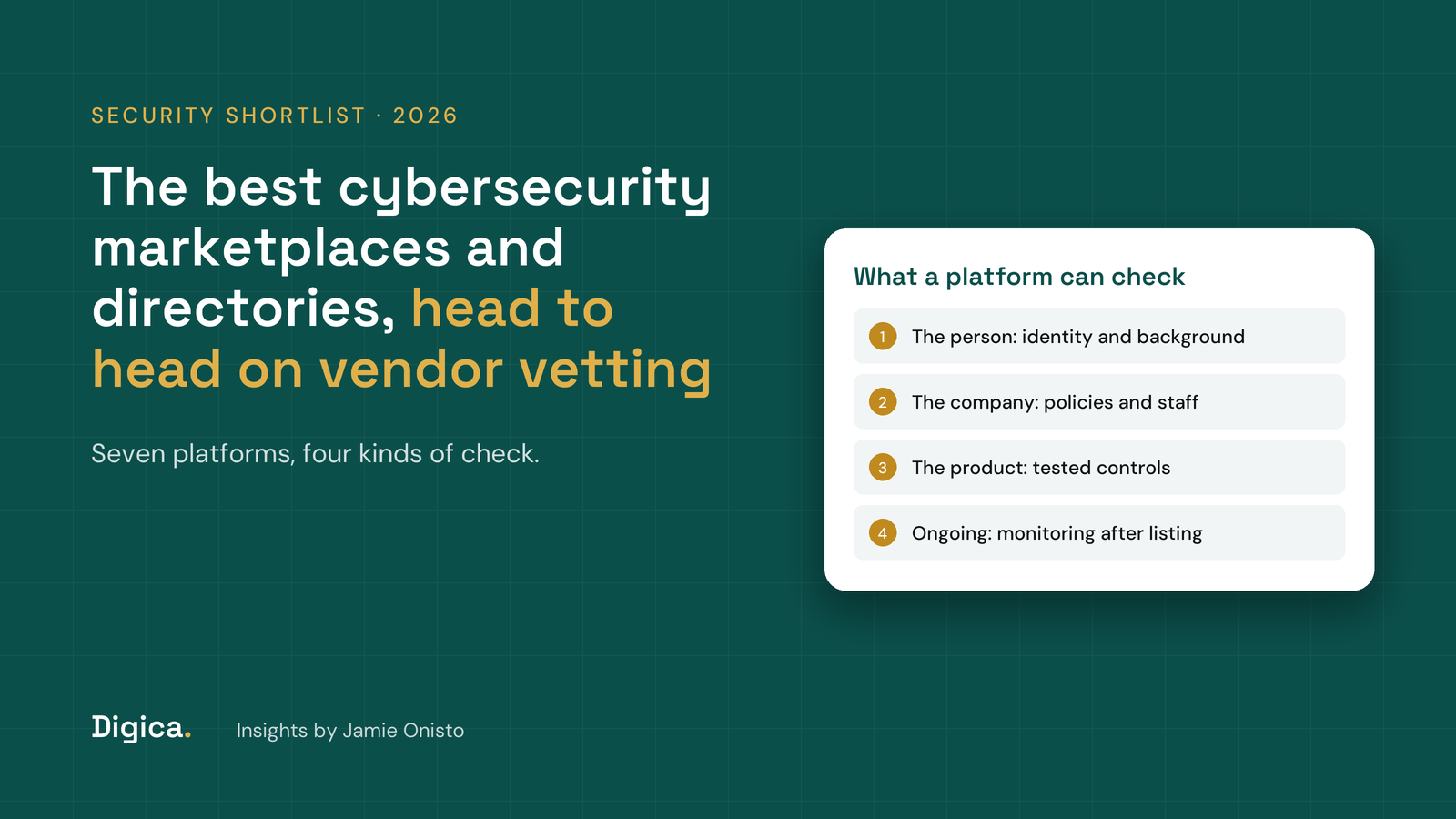
Every security vendor says it is trusted. Only some cybersecurity marketplaces check before they list one. The FedRAMP Marketplace lists 517 authorized cloud services, each assessed by an accredited third party, while an open software directory will list a security tool after a form and a logo. Both rank when a buyer searches for a "cybersecurity marketplace", and the difference between them is the whole point of buying through one.
That difference is growing in value. A security vendor is now part of your attack surface: a weak supplier can become the way in. Yet most companies still do little to check theirs, which means the vetting a cybersecurity directory does on your behalf may be the only check a vendor ever gets.
This guide compares seven cybersecurity marketplaces and directories head to head on vendor vetting: what each one checks, how many vendors, products or researchers pass, and who buys from it. It is written for security, procurement and IT leaders choosing where to source, and for founders growing a software or security B2B marketplace. Figures come from each platform or its official data, checked on November 11, 2026.
Quick Navigation
- How we judged vendor vetting
- The scorecard: seven platforms side by side
- FedRAMP Marketplace vs GovRAMP: two lists for government cloud
- CREST vs NCSC assured services: two badges for service firms
- HackerOne vs Bugcrowd: the two largest crowds
- Synack against both crowds: a closed team
- What "vetted" means on each platform
- Three failure scenarios
- Choosing a cybersecurity directory by what you buy
- What vetting is worth
- FAQ
- Related Articles
How we judged vendor vetting
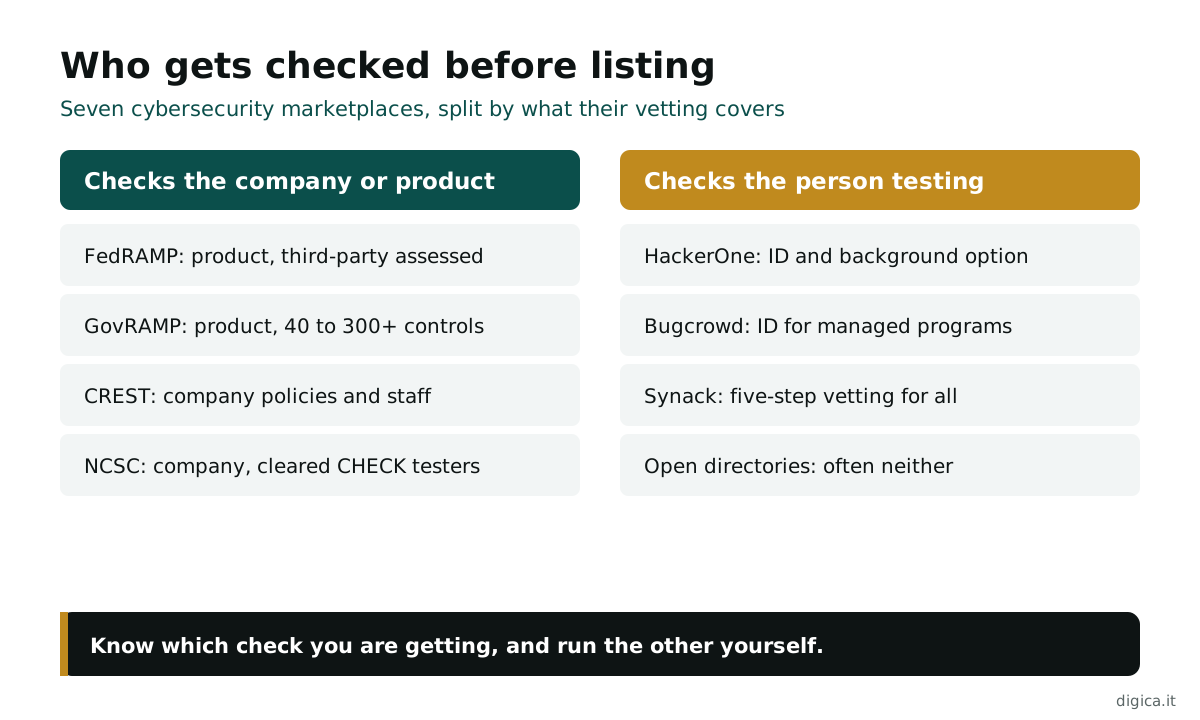
We asked one question of each platform: what has to be true before a vendor, product or person appears? The answers fall into two kinds. Some platforms check the company or the product, its controls, policies and accreditation. Others check the person who will touch your systems, their identity, skills and background. Both matter, and a platform that does neither is a list, not a cybersecurity marketplace.
We then recorded how many vendors, products or researchers each platform lists, in its own unit, and who buys from it. We left out the general cloud marketplaces and software review sites covered in our guides to software marketplaces and software review sites, because their checks are not specific to security.
The gap these platforms fill is wide. Only 15% of UK businesses reviewed the cyber risks posed by their immediate suppliers in the past year, and just 6% looked at their wider supply chain, while 43% had a breach or attack (UK Cyber Security Breaches Survey 2026). If most buyers do not vet their suppliers, the platform's vetting is doing that job for them.
Our view: in security, the listing criteria are the product. A directory with ten times the vendors and no stated check is worth less to a buyer than a short list where every name passed an assessment.
The scorecard: seven platforms side by side
The table sets each platform's check against its listing count and buyers. Use it to shortlist before reading the head-to-heads.
| Platform | What it checks | Listed, in its own unit | Who buys | Cost to the buyer | Main risk | Best for |
|---|---|---|---|---|---|---|
| FedRAMP Marketplace | Cloud product, assessed by an accredited third party, then authorized and monitored | 517 authorized cloud services | US federal agencies | Free to search | Authorization covers the product, not your setup | Federal cloud buying |
| GovRAMP | Cloud product, in tiers from 40 to 300+ controls | 330+ products in the program | State and local government | Free to search | Lower tiers check far fewer controls | State and local cloud buying |
| CREST | Service company's policies and procedures, plus qualified staff | 552 companies on its marketplace | Enterprises, regulators, governments | Free to search | Accreditation is of the company, not each tester | Pentest and incident response firms worldwide |
| NCSC assured services | Service company, with cleared and certified testers for CHECK | About 500 companies with badged services | UK public sector and critical infrastructure | Free to search | UK only | UK government and regulated work |
| HackerOne | Researcher identity; ID-verified and background-checked option | 1,300+ customer companies | Enterprises and governments | Platform fee plus bounties | Open programs reach unvetted researchers | Large bug bounty programs |
| Bugcrowd | Researcher identity for managed programs; background checks for a trusted cohort | No current official count | Enterprises and public sector | Platform fee plus bounties | Background checks only on request | Managed bounties and pentest as a service |
| Synack | Five-step vetting of every researcher | 1,500+ vetted researchers | Federal agencies, large enterprises | Subscription | Smaller pool than open crowds | Testing where every tester must be vetted |
Two patterns stand out. The government lists check the most and cost nothing to search, and the crowdsourced platforms trade vetting depth for reach.
FedRAMP Marketplace vs GovRAMP: two lists for government cloud
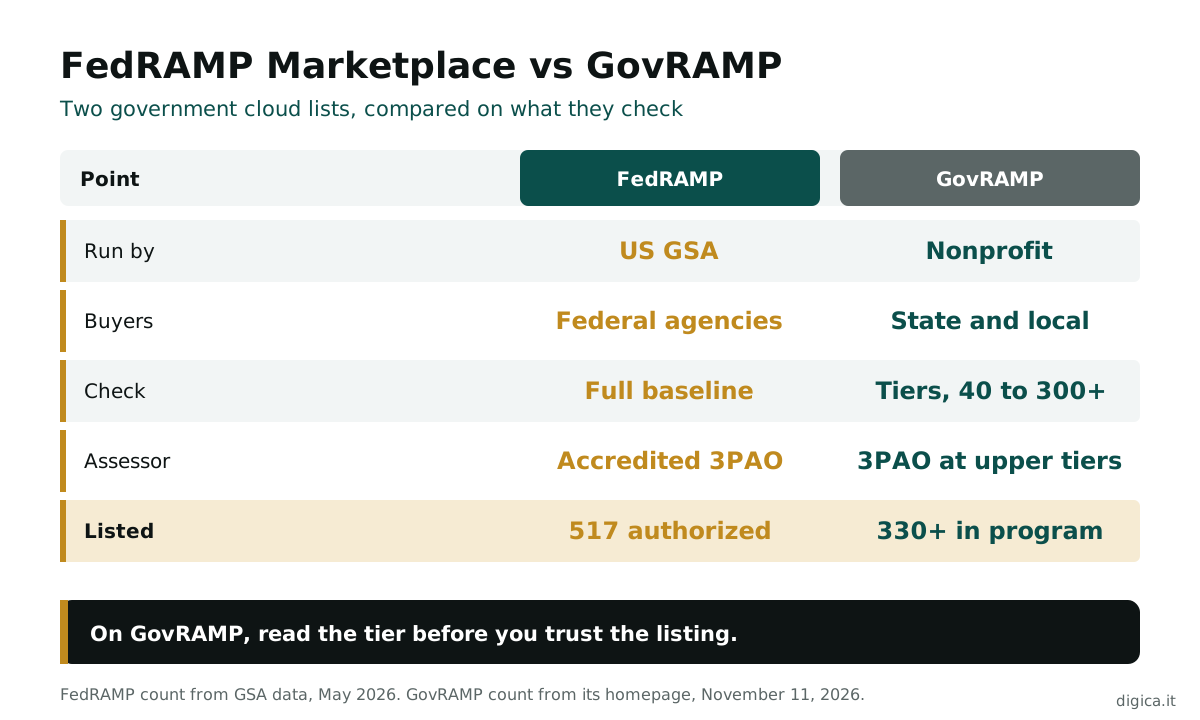
The FedRAMP Marketplace is the US federal government's list of cloud services that have passed, or are working through, a FedRAMP assessment. GovRAMP, renamed from StateRAMP in February 2025, runs a similar list for state and local government. Both check the product, not the vendor's sales team.
FedRAMP's check is the deepest in this guide. An accredited third-party assessor tests the service against controls based on the National Institute of Standards and Technology framework, an agency or the FedRAMP program authorizes it, and the provider then faces continuous monitoring and an annual assessment. The General Services Administration's data, last updated in May 2026, lists 517 authorized cloud services, 66 rated FedRAMP Ready and 67 more in process, assessed by 50 accredited assessors. In fiscal 2025, FedRAMP reported 131 authorizations under its main process plus 13 under its faster 20x pilot, and cut final review time to under 30 days.
GovRAMP checks in tiers. A Security Snapshot covers 40 controls, Core 60, Ready 80 and full Authorized status 300+, with third-party assessment at the upper tiers. Its homepage counts 330+ products in the program, 1,200+ member organizations and 70+ government organizations. That tiering is both its strength and its catch: a buyer must read the tier, not just the listing.
The verdict: FedRAMP for federal work and as the strongest single signal any cloud security product can carry. GovRAMP for state and local buyers, with the tier checked every time.
CREST vs NCSC assured services: two badges for service firms
When the purchase is a service, such as a penetration test or incident response, the check moves from product to company. CREST is an international not-for-profit accreditation body, and its marketplace lists 552 member companies. The UK's National Cyber Security Centre (NCSC) runs its own assured schemes, which about 500 companies hold between them.
CREST assesses each member's policies, processes and procedures before membership is approved, and members sign a code of conduct. It says it works with more than 40 governments and regulators across six regions. In July 2026 it added an optional AI-enabled penetration testing accreditation, and the first ten companies passed in September.
NCSC goes further on people. For its CHECK penetration testing scheme, every team member must be eligible for security clearance, and from March 2026 team members also need a professional title from the UK Cyber Security Council. Its 2025 annual review counted 54 CHECK companies, 46 assured incident response providers, 17 resilience audit providers and 402 Cyber Essentials certification bodies employing 934 assessors. CHECK providers ran more than 2,684 penetration tests in a year.
Running a security or software B2B marketplace?
In 30 minutes we look at how buyers find platforms like yours, on Google and in AI answers, and how to make your vetting the reason they choose you.
The verdict: CREST for buyers anywhere who want an accredited testing or response firm. NCSC assured services for UK public sector and regulated work, where clearance and a government badge are often part of the contract. The two can work together: many UK firms hold both, so a buyer outside government can start with CREST and add the NCSC badge as a requirement only when the data, the client or the regulator demands it. Either way, ask who will actually do the work.
HackerOne vs Bugcrowd: the two largest crowds
HackerOne and Bugcrowd run crowdsourced security: bug bounties, vulnerability disclosure programs and pentest as a service. Here the vetting is of people, and it is optional by program. That is the trade-off of a crowd. You reach far more testers, and you choose how many of them you need to trust.
HackerOne is the larger by visible activity. It says 1,300+ companies use it and 600,000+ bugs have been found, and it paid a record $89 million to researchers in the year to June 2026, up 18%. Its Clear option limits a program to ID-verified and background-checked researchers. Its 2026 report also found that the backlog of validated but unresolved vulnerabilities grew 131% in two years, a reminder that finding bugs is the easy half.
Bugcrowd requires identity verification, a selfie and a government ID, before any researcher submits to a managed bug bounty program, and offers background checks for a trusted cohort. It does not publish a current community total. Its 2026 survey of more than 2,000 hackers on the platform found 82% use AI in their work, and in November 2025 it bought the AI offensive security company Mayhem Security.
The verdict: HackerOne for the widest reach and the clearest public numbers. Bugcrowd for managed programs where identity checks come as standard. In both, ask which programs require which check, because the default is not the strictest setting.
Synack against both crowds: a closed team
Synack takes the opposite approach to an open crowd. Every member of the Synack Red Team passes a five-step vetting process designed to test skill and trust, and Synack has said it accepts fewer than 10% of applicants. Researchers test only through its own controlled gateway, and the platform holds FedRAMP Moderate authorization.
The pool is smaller by design: 1,500+ vetted researchers. In October 2026 Synack completed its merger with NetSPI, adding 350+ in-house penetration testers to the same business. Synack's FedRAMP status applies to the Synack platform only.
The verdict against the crowds: Synack for federal agencies and enterprises where every tester must be vetted before the first packet. HackerOne or Bugcrowd where the number of eyes matters more than the vetting of each one.
What "vetted" means on each platform
The word "vetted" covers four different checks, and most platforms do one or two of them. The distinction decides what you still have to do yourself.
Product checks, from FedRAMP and GovRAMP, tell you the cloud service meets a control baseline. They do not tell you how the vendor will configure it for you. Company checks, from CREST and NCSC, tell you a service firm runs sound processes and employs qualified staff. They do not certify the individual on your job. Person checks, from HackerOne, Bugcrowd and Synack, tell you who is testing your systems. They do not tell you the platform has checked the company that hired them.
The fourth check, ongoing monitoring, is the rarest. FedRAMP's annual assessment and continuous monitoring are the clearest example. Most directories check once, at listing, and never again.
Third parties are now a major route in. Verizon's 2025 Data Breach Investigations Report found third-party involvement in breaches doubled to 30%, across 12,195 confirmed breaches (Verizon). Every vendor you add through a marketplace is a third party, which is why the depth of the platform's check matters as much as the product.
Three failure scenarios
These are illustrative patterns, not accounts of named companies. The costs are typical, not audited.
- The listing taken as a check. A mid-size company picks a security tool from an open software directory because it ranked well and had good reviews. Nobody checked how the vendor stored customer data. A breach at the vendor exposes the company's records, and the response, legal and notification costs run into the millions. A product with a third-party assessment, or a security review before purchase, would have flagged the gap.
- The tier misread. A state agency sees a cloud product on a government cloud list and assumes full authorization. It holds only an early-tier snapshot. An audit finds the product never passed the controls the agency's data required, and the project stalls for months. Reading the tier on the listing would have taken a minute.
- The open program. A company launches a public bug bounty to keep costs down, with no identity checks. A researcher tests further than the scope allows, and the company spends weeks on legal advice and a disclosure it did not plan. A private program limited to ID-verified researchers would have cost a little more and avoided the incident.
Is your vetting visible to buyers?
A growth audit shows how security buyers search for platforms in your category, what AI answers say about your checks, and which pages would win more trust.
In each case the platform did what it promised. The failure was assuming it promised more. Read the listing criteria before you rely on the listing, and write down which of the four checks you are getting. That note takes five minutes, and it is the document an auditor, an insurer or your own board will ask for first when something goes wrong with a supplier you bought through a platform.
Choosing a cybersecurity directory by what you buy
Start with what you are buying, then match the check. These thresholds are a starting point.
- If you are a US federal agency buying a cloud service, start and finish with the FedRAMP Marketplace.
- If you are a US state, local or education body, use GovRAMP and require at least the Ready tier, 80 controls, for anything holding sensitive data.
- If you are buying a penetration test or incident response anywhere, shortlist from CREST members, and ask for the tester's own qualifications too.
- If the work is UK government or critical infrastructure, require an NCSC assured provider, and CHECK for penetration tests.
- If you want continuous testing at scale and can manage scope, run a HackerOne or Bugcrowd program, private first, with identity checks on.
- If every tester must be vetted before touching your systems, use Synack.
- If a directory does not publish its listing criteria, treat it as a starting list and run your own vendor review.
The cost of a weak choice keeps rising. IBM's 2026 report put the global average cost of a data breach at a record $4.99 million, 12% more than the year before (IBM). Against that number, the extra weeks a stricter check adds to procurement are cheap.
What vetting is worth
Run an illustrative case. A company buying ten security products and services a year spends two weeks of staff time vetting each one, about $8,000 a review at typical loaded salaries, or $80,000 a year. Buying through platforms that do a recognized check can halve that work for some purchases. The larger value is the risk: if better vetting avoids one serious supplier breach in ten years, against an average cost near $5 million, it is worth about $500,000 a year in expected loss.
For founders, the lesson runs the other way. A cybersecurity B2B marketplace that publishes exactly what it checks, and shows it on every listing, gives buyers the reason to choose it over a bigger open directory. Vetting is the product, so it belongs on the page, in the structured data and in the answers AI assistants give.
Growing a security or software B2B marketplace?
We help software and security marketplaces win buyers and vendors through search, AI answers and the proof that makes buyers trust a listing.
The number to take into your next vendor review is 15%: the share of UK businesses that review their immediate suppliers' cyber risk. If your company is in the other 85%, the platform's check may be the only one your vendors face, and the biggest cost of doing nothing is a breach that arrives through a supplier nobody looked at. Payback on a stricter sourcing policy is usually the first vendor it screens out.
FAQ
What is a cybersecurity marketplace? A cybersecurity marketplace is a platform where organizations find or buy security products, services or testers from many vendors. The best ones check vendors before listing them, through assessment, accreditation or identity checks.
What is the FedRAMP Marketplace? It is the US government's list of cloud services that are FedRAMP authorized, ready or in process. Authorized services are assessed by an accredited third party and monitored after authorization. It listed 517 authorized services in its May 2026 data.
What is the difference between FedRAMP and GovRAMP? FedRAMP serves US federal agencies. GovRAMP, formerly StateRAMP, serves state and local government and checks products in tiers, from 40 controls for a snapshot to 300+ for full authorization.
How do I find a CREST-accredited penetration testing company? Search the CREST marketplace, which listed 552 member companies in November 2026. Filter by service and region, then ask for the individual testers' qualifications.
Are bug bounty hackers background-checked? Not by default. HackerOne offers programs limited to ID-verified and background-checked researchers, Bugcrowd requires identity checks for managed programs and offers background checks for a trusted cohort, and Synack vets every researcher.
How do I vet a cybersecurity vendor before buying? Check what the listing platform verified, ask for third-party assessments or accreditation, review how the vendor handles your data, and confirm who will access your systems. Write down which checks you relied on.
Related Articles
- Software and SaaS marketplace growth
- The best software marketplaces for SaaS vendors
- The best software review sites: G2, Capterra and the alternatives
- The best SaaS directories to list your product
- The best expert networks, by pool and compliance
Where this connects
This article is part of our B2B marketplace growth series. Browse more on the Digica blog.