The best electronic components marketplaces in 2026, with one award each for stock availability
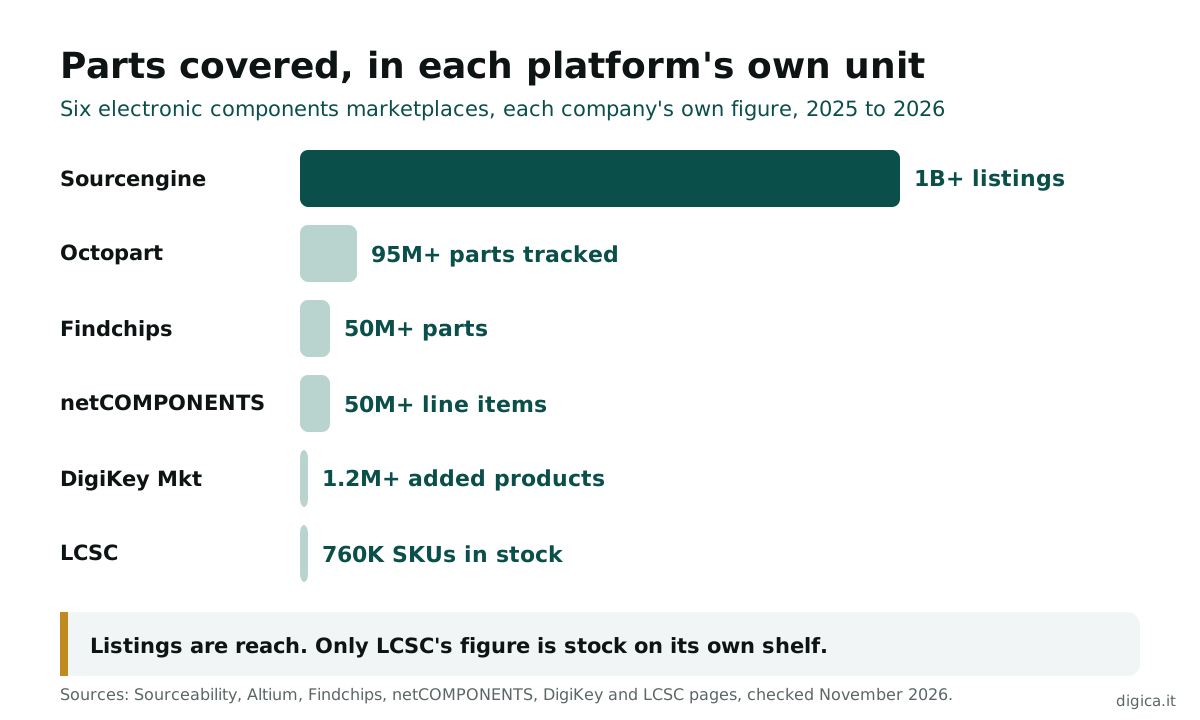
An electronic components marketplace is only as good as its answer to one question: is the part in stock, and can I trust where it came from? Engineers and buyers ask it thousands of times a year, and the platforms answer in very different units. Sourcengine says it has access to more than 1 billion part listings. Octopart tracks stock for more than 95 million parts. LCSC holds 760,000 SKUs in its own warehouses. Each number is real, and each one measures something different.
The stakes have risen with the market. Global semiconductor sales reached $791.7 billion in 2025, up 25.6% on 2024, according to the Semiconductor Industry Association (SIA). When demand climbs that fast, lead times stretch, authorized stock runs short and buyers turn to search engines and broker networks to find what is left. A buyer who reads a listing count as a stock count can lose weeks on a part that was never on a shelf.
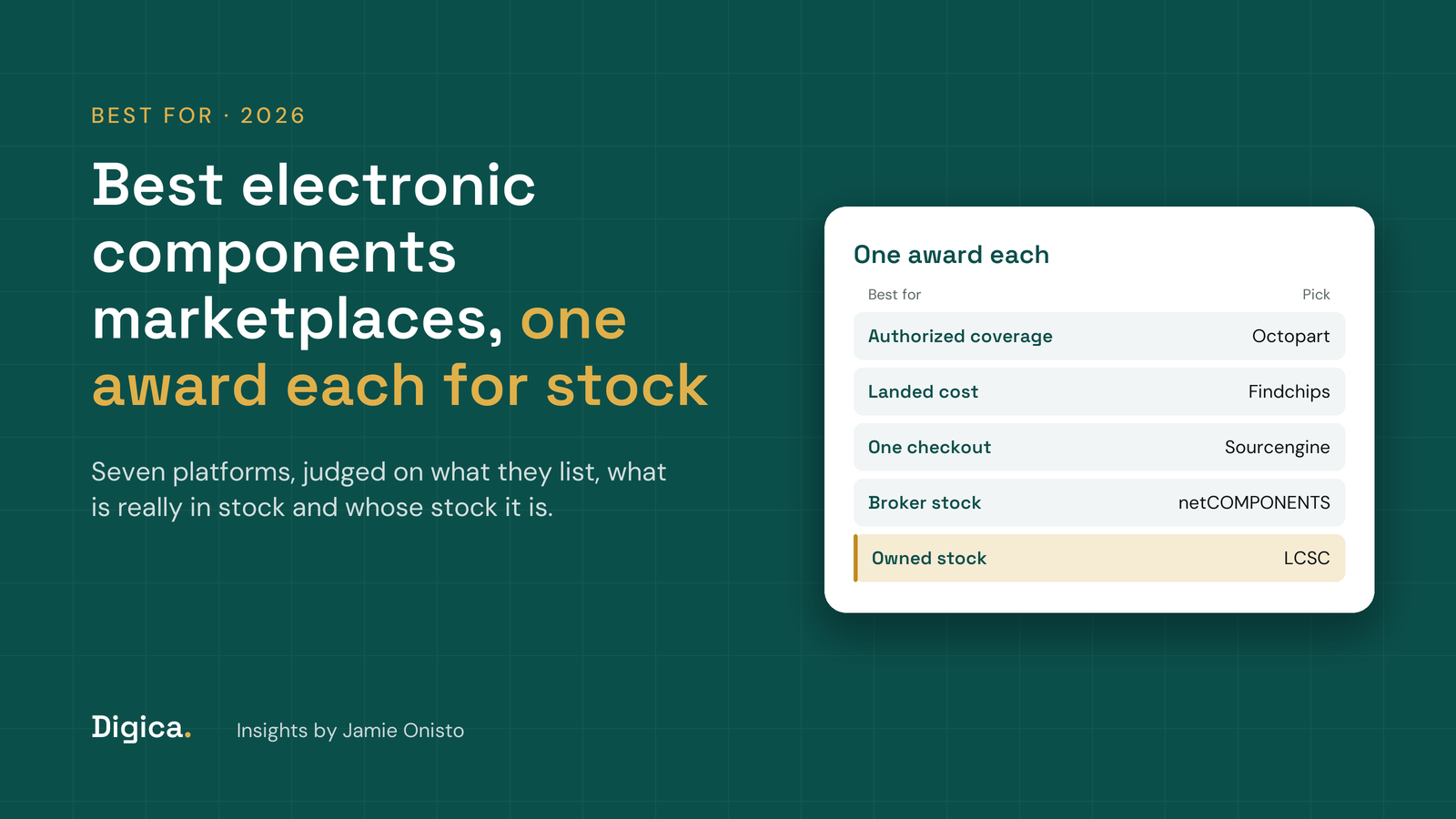
This guide picks seven electronic components marketplaces, search engines and directories and gives each one award, based on stock availability: what it lists, what it can confirm is in stock, whose stock it is and how fast it ships. It is written for engineers, component buyers and supply chain leads, and for founders growing an electronics B2B marketplace. Figures are each company's own, checked on November 2, 2026. For wider industrial supplies, see our guide to the best industrial marketplaces for MRO buying.
Quick Navigation
- How we picked the best electronic components marketplaces
- Seven picks at a glance
- Best for authorized distributor coverage: Octopart
- Best for landed cost checks: Findchips
- Best for one checkout across many sellers: Sourcengine
- Best for independent and broker stock: netCOMPONENTS
- Best for a wider range in one trusted cart: DigiKey Marketplace
- Best for franchised against independent filtering: oemsecrets
- Best for owned in-stock inventory: LCSC
- Three failure scenarios
- Choosing an electronic components marketplace: a decision framework
- What reliable stock data is worth
- FAQ
- Related Articles
How we picked the best electronic components marketplaces
The short answer: we looked for platforms that help a buyer find parts in stock across many sources, then judged each on how clearly it separates listed parts from stocked parts, and authorized stock from independent stock.
Electronic components are sold through two channels. Authorized, or franchised, distributors buy directly from the manufacturer and can trace every part back to it. Independent distributors and brokers buy surplus and excess stock from anywhere, which makes them essential during shortages and for obsolete parts, and riskier when the paperwork is thin. A good electronic components marketplace or directory makes that difference visible on every result.
Six of our seven picks are search engines, directories or multi-seller marketplaces. The seventh, LCSC, is a single distributor, included because it shows the opposite model: fewer parts, all of them on its own shelves. All seven are B2B platforms buyers use to answer the same question, and the tests we apply to every B2B marketplace hold here too: how much supply, how reliable it is and how well buyers are matched to it.
Our view: count confirmed stock before listings, and trust traceable stock over cheap stock. A listing is a lead. A traceable part on a shelf is an order.
Seven picks at a glance
The short answer: Octopart covers the most authorized distributors, Sourcengine the most listings in one checkout, netCOMPONENTS the deepest broker network, DigiKey Marketplace the safest extended range, and LCSC the largest owned stock of the seven.
Seven electronic components marketplaces compared on parts covered, whose stock it is, how buyers order, main risk, cost to the buyer and best fit
| Platform | Parts covered | Whose stock | How buyers order | Main risk | Cost to search | Best for |
|---|---|---|---|---|---|---|
| Octopart | 95M+ parts, 679 distributors | Authorized distributors | Click through to distributor | Not a seller itself | Free | Authorized coverage |
| Findchips | 50M+ parts | Distributors and manufacturers | Click through to distributor | Not a seller itself | Free | Landed cost checks |
| Sourcengine | 1B+ listings, 3,500+ suppliers | Vetted or traceable suppliers | One checkout | Listings are not all stocked | Free to search | Multi-seller buying |
| netCOMPONENTS | 50M+ line items, 3,000+ suppliers | Independent and authorized | Contact sellers directly | Buyer vets each seller | Membership | Broker and shortage stock |
| DigiKey Marketplace | 1.2M+ extra products | Vetted, authorized partners | DigiKey cart, ships from supplier | Ships in 1 to 3 days, not same day | Free | Extended range, one account |
| oemsecrets | 209 distributors | Franchised and independent | Click through to distributor | Coverage varies by part | Free | Filtering by source type |
| LCSC | 760K SKUs in stock | LCSC's own warehouses | Direct checkout | One source, Asia based | Free | Owned in-stock parts |
Every figure is the company's own claim, and the units differ. The column to read first is "Whose stock", because it tells you who you are trusting when the part arrives.
Best for authorized distributor coverage: Octopart
The short answer: Octopart is the widest search across authorized distributors. Altium, which owns it, says it aggregates data from 679 distributors and more than 11,000 manufacturers, and updates stock, pricing, lifecycle status and lead times daily for more than 95 million parts.
Octopart is a search engine rather than a seller. A buyer searches for a part number and sees offers from distributors such as DigiKey, Mouser, Arrow and Avnet side by side, with stock and price breaks. Its BOM Tool, relaunched in April 2025, matches a whole bill of materials to live offers and marks verified offers from authorized suppliers. For a design engineer checking whether a part can actually be bought before committing to it, that daily stock refresh is the point.
Running an electronic components B2B marketplace?
In 30 minutes we look at how engineers and buyers find platforms like yours, on Google and in AI answers, and where they drop off before they request a quote.
The limit is the flip side of its strength. Octopart shows authorized stock, so in a shortage it can confirm that nobody authorized has the part, and then the search moves elsewhere. It is the right first stop, and often the right last one, but not the only one a buyer needs when a line is down. Use it to confirm authorized stock and lifecycle status first, then widen the search only when it comes back empty.
Best for landed cost checks: Findchips
The short answer: Findchips, part of Supplyframe, a Siemens company, compares availability and pricing for more than 50 million parts, and added a tariff estimator in February 2026 that shows what a part will really cost to import.
Findchips covers the same core job as Octopart: one search, many distributors, real-time pricing and inventory. Its 2026 addition is what sets it apart. The tariff estimator on each part page takes the harmonized tariff code, country of origin and price, and returns estimated duty and charges, with rates checked daily against US International Trade Commission data. For a buyer comparing two in-stock offers from different countries, the cheaper listing is not always the cheaper part.
Supplyframe also says its CAD model and technical content ecosystem passed 1.2 million registered engineers in January 2026. That matters for stock availability in a quiet way: engineers who pick parts with live stock data in view design fewer shortages into their products.
Best for one checkout across many sellers: Sourcengine
The short answer: Sourcengine, run by Sourceability, gives buyers access to more than 1 billion part listings from more than 3,500 suppliers, and sells them through one checkout with a three-year warranty on every part.
Sourcengine works like a true multi-seller B2B marketplace. A buyer compares price, availability and delivery time from several sellers for the same part, then buys in one transaction instead of opening accounts with each one. Sourceability says every part comes from vetted or traceable suppliers, and backs every purchase with a three-year warranty, which is unusual on a platform that mixes many sources.
The caveat is in the unit. One billion listings includes many offers for the same part, and listings with pricing, date codes and availability that change constantly. Read the number as reach, not as stock. The useful test is narrower: for the parts you buy, how many sellers show stock today, and how fast can each ship?
Best for independent and broker stock: netCOMPONENTS
The short answer: netCOMPONENTS is the long-running directory where independent distributors and brokers list inventory. It says it lists more than 50 million line items from more than 3,000 suppliers, and its results show which suppliers are authorized and which stock is in hand.
When authorized stock runs out, most buyers end up in the independent channel, and netCOMPONENTS is one of its main meeting points. It is vendor neutral: buyers contact sellers directly rather than buying through a platform checkout. The site adds a supplier quality rating system and escrow, and it reports more than 3.5 million page views a month.
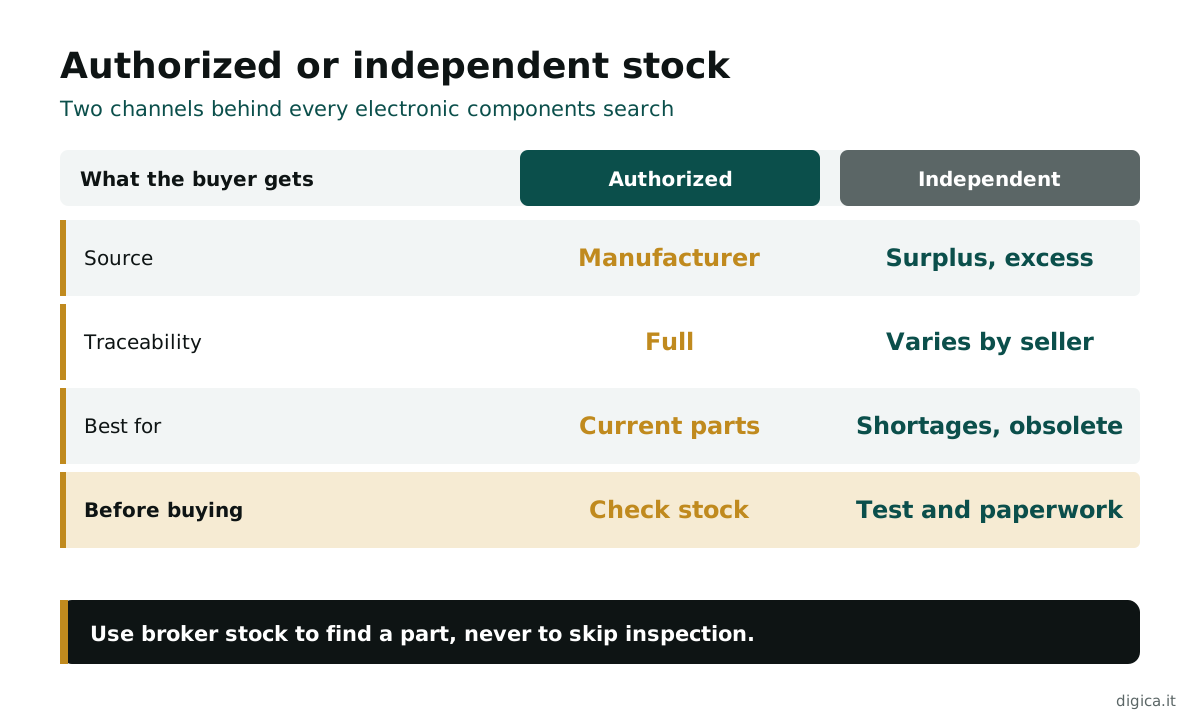
That reach brings risk the buyer has to manage. ERAI, which tracks suspect counterfeit and nonconforming parts, says 748 parts were reported to it in 2025, down 29.1% on 2024, and 68.84% of them were classed as suspect counterfeit (ERAI). A broker directory is the right place to find a scarce part. It is not a substitute for inspection, test reports and a seller history check before the part goes on a board.
Best for a wider range in one trusted cart: DigiKey Marketplace
The short answer: DigiKey Marketplace adds more than 1.2 million products from vetted, authorized partners to DigiKey's own range, bought through the same DigiKey account and cart, with an average time to ship of one to three days.
The model suits buyers who already trust DigiKey and do not want another supplier record. Marketplace items ship from the partner rather than from DigiKey's warehouse, and DigiKey says all sellers are vetted and approved, 99% of orders ship within the stated lead time and the incident rate is below 1%. Buyers can also filter Marketplace items out of search when they need DigiKey's own stock.
DigiKey keeps widening its range. It says it added more than 108,000 new stocking parts and 364 new suppliers in 2025, and more than 1.6 million new products across its core business, Marketplace and its fulfillment program. For a buyer, the practical value is one account that covers both the common part in stock today and the less common part a partner ships in three days.
Best for franchised against independent filtering: oemsecrets
The short answer: oemsecrets, based in York in the UK, compares offers from 209 distributors and lets buyers filter by franchised or independent source, which makes the trade-off between traceability and availability visible in one search.
That filter is the reason for the award. Many search engines lean on authorized distributors, and many broker sites lean on independent ones. oemsecrets puts both in front of the buyer and lets them decide how much risk a given part can carry. Its part search API serves pricing, inventory, datasheets and compliance data from more than 140 distributors on more than 40 million parts, which is how procurement teams build the same comparison into their own tools.
Do engineers find your components platform before a rival's?
A growth audit maps how engineers and component buyers search for platforms like yours, on Google and in AI answers, and which part, category and brand pages they never reach.
For a buyer, the practical use is simple. Run the same part number with the franchised filter on, then off. If the part only appears once the filter is off, you know before you buy that you are in the independent channel, and that inspection and paperwork checks belong in the budget and the schedule. That one comparison often decides whether a redesign is cheaper than a risky buy.
Best for owned in-stock inventory: LCSC
The short answer: LCSC, based in Shenzhen, is the opposite of an aggregator. It holds 760,000 SKUs from 4,400 manufacturers in more than 130,000 square meters of its own warehouses, handles more than 24,000 orders a day and can process an order in as little as four hours.
LCSC earns its place because it answers the stock question without a caveat: if it is listed as in stock, it is on LCSC's shelf. It reports more than 9.5 million registered users, many of them engineers and small manufacturers buying for prototypes and short runs, and it is strong on Asian manufacturers' parts that some Western distributors do not carry.
The limit is that it is one source. For a part LCSC does not hold, a buyer is back on a search engine. For a design built around parts it does hold, it is often the fastest route from a confirmed stock figure to a parcel. Owned stock is most valuable when lead times elsewhere are stretching.
Three failure scenarios
These are the patterns that recur when buyers read listing counts as stock.
- The listing that was a quote request. A hardware startup finds a microcontroller on a platform with hundreds of listings for it and plans a pilot run around the first price. Most listings turn out to be offers to quote, with stock to be confirmed. The run slips five weeks. Filtering for confirmed stock and asking two sellers for a firm quote before committing the schedule would have caught it in a day.
- The broker part with no paperwork. A contract manufacturer buys an obsolete regulator from the cheapest broker listing on a directory to finish a batch. The parts fail incoming tests, and the batch waits while a second source is found. Paying more for a seller with a strong rating, test reports and a return policy would have cost less than the delay.
- The design built on a part nobody stocked. An engineering team picks a sensor because its datasheet suits the design, without checking stock. At production, no authorized distributor has it, and the lead time is months. Checking stock on an aggregator at the design stage, and picking a part with several stocking sources, would have avoided a redesign.
Each team used a real electronic components marketplace or directory. None checked whose stock it was, and whether it was really there.
Choosing an electronic components marketplace: a decision framework
The short answer: start with what the part is for, how fast you need it and how much counterfeit risk the product can carry, then pick the platform that matches.
- If you are choosing parts at the design stage, check stock and lifecycle on Octopart or Findchips, and prefer parts with at least three authorized stocking sources.
- If you are importing parts into the United States, compare landed cost on Findchips before choosing between two in-stock offers.
- If you want to buy from several sellers without opening several accounts, use Sourcengine and its single checkout.
- If authorized stock has run out or the part is obsolete, search netCOMPONENTS, and require test reports and a seller history check before buying.
- If your company already buys from DigiKey, use DigiKey Marketplace for the extended range and filter it out when you need same-day stock.
- If you need to weigh traceability against availability for one part, use oemsecrets and its franchised or independent filter.
- If you are prototyping or running short batches with parts LCSC holds, buy directly from LCSC's own stock.
Growing an electronics or industrial B2B marketplace?
We help industrial and component B2B marketplaces win the suppliers that fill their range, and reach the engineers and buyers searching for parts in stock.
Most buyers end up with two or three of these, one for design checks, one for routine orders and one for shortages. That split is sensible. Write down which platform covers which job, and review it after every shortage, because the platform that found your last scarce part is a good sign of where to look first next time. Our guide to procurement marketplaces for B2B buyers covers the purchasing controls that sit around these choices.
What reliable stock data is worth
The short answer: reliable stock data is worth the production time it protects. A confirmed, traceable part in stock turns a stalled build into a shipment.
Lead times are moving the wrong way. In a July 2026 survey by the Electronic Components Industry Association, 82% of respondents reported longer lead times, and 100% did for semiconductors (ECIA). When lead times stretch, the platform that shows real stock is worth more than the one that shows the lowest price.
Run the numbers on a typical case. Suppose a contract manufacturer's line earns a contribution of $3,000 an hour, and a missing component stops it for two shifts of eight hours, three times a year. That is $144,000 of lost contribution. If confirmed stock data and a second trusted source halve those stoppages, the saving is $72,000 a year, more than most buyers will ever save on unit prices. The figures are illustrative, but the logic holds for most electronics production: the cost of waiting is far larger than the cost of the part.
The number to take into your next supply review is hours lost waiting for components, not average price paid. If your team cannot answer it, start logging it this quarter, and pay back the effort with the first shortage it helps you avoid. The biggest cost of doing nothing is a build stopped for a part that was listed everywhere and stocked nowhere you could trust.
FAQ
What is an electronic components marketplace? An electronic components marketplace is an online platform where buyers find and buy chips, passives, connectors and other parts from many distributors or sellers. Some, like Sourcengine and DigiKey Marketplace, sell through one checkout. Others, like Octopart and Findchips, are search engines that send buyers to distributors.
What is the best electronic components search engine? Octopart covers the widest set of authorized distributors, with stock for more than 95 million parts from 679 distributors. Findchips covers more than 50 million parts and adds a tariff estimator for landed cost.
What is an electronic components directory? An electronic components directory lists suppliers or their inventory so buyers can contact them directly. netCOMPONENTS is a leading example for independent and broker stock, with more than 50 million line items from more than 3,000 suppliers.
What is the difference between authorized and independent distributors? Authorized, or franchised, distributors buy directly from the manufacturer and can trace every part back to it. Independent distributors and brokers source surplus and excess stock from many places, which helps in shortages but needs more inspection to rule out counterfeit parts.
How do I avoid counterfeit electronic components? Buy from authorized distributors where possible. When you must use the independent channel, choose sellers with strong ratings and history, ask for test reports and traceability documents, and inspect parts on arrival. ERAI's 2025 data classed 68.84% of reported problem parts as suspect counterfeit.
Where can I buy electronic components in stock? Start with an aggregator such as Octopart or Findchips to see which distributors hold stock, then buy from the distributor or through a single-checkout platform such as Sourcengine or DigiKey Marketplace. LCSC sells from its own stock of 760,000 SKUs.
Related Articles
- Industrial marketplace growth
- Best industrial marketplaces for MRO buying in 2026
- Best procurement marketplaces for B2B buyers in 2026
- Best surplus and used industrial equipment marketplaces
- Best manufacturing directories: Thomasnet alternatives
Where this connects
This article is part of our B2B marketplace growth series. Browse more on the Digica blog.