The best engineering marketplaces for hiring and projects, one award each for how they vet engineers
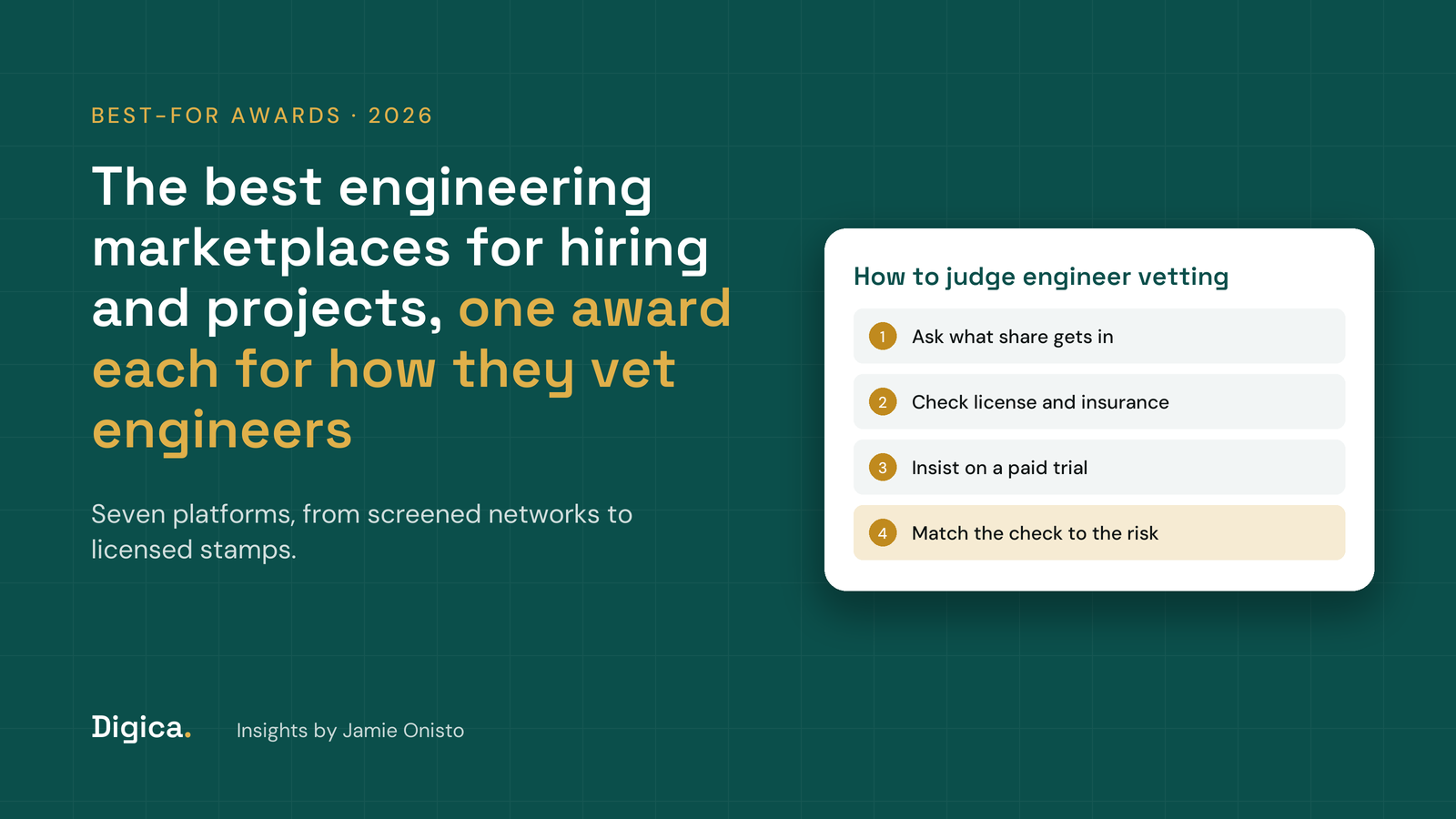
Every engineering marketplace says its engineers are vetted. The word covers very different checks. Toptal says fewer than 3% of applicants get through a five-step screening that ends in a paid test project. Field Engineer runs criminal and motor vehicle background checks and requires business auto insurance. GreenLancer works with engineers licensed and insured in all 50 states. Each check answers a different question, and the right engineering marketplace is the one whose check matches the work you are hiring for.
The pressure to hire well is high. The US Bureau of Labor Statistics projects about 174,800 openings a year in architecture and engineering occupations, with a median annual wage of $99,520 in May 2025 (US Bureau of Labor Statistics). At that wage, a wrong hire who lasts three months costs about $25,000 in pay before counting the rework. For anyone building one of these platforms, vetting is also the core of the pitch: it is a professional services marketplace growth problem as much as a hiring one.
This guide gives seven engineering marketplaces one award each, by how they vet engineers: vetted software engineers, the widest pool, on-demand CAD and product design, research and development, on-site field engineers, licensed stamps and design contests. It is written for engineering, operations and procurement leads hiring engineers for projects, and for founders growing an engineering B2B marketplace. Figures come from each platform's own pages, filings or help centers, checked on November 18, 2026.
Quick Navigation
- How we gave the awards
- Seven awards, seven kinds of vetting
- Screened networks: Toptal and Kolabtree
- Open engineering marketplaces with vetted tiers
- Managed engineering work: Cad Crowd, Field Engineer and GreenLancer
- What vetted actually means on an engineering marketplace
- Three failure scenarios
- Choosing an engineering marketplace by the check you need
- What a vetted hire is worth
- FAQ
- Related Articles
How we gave the awards
We asked each engineering marketplace one question: what does it check before a business can hire an engineer? We recorded the answer in its own terms, from acceptance rates and live interviews to identity checks, license verification, background checks and insurance, and what a business gets if the work goes wrong.
We then recorded each pool in its own unit: network members, experts, engineers, freelancers or users. Each platform won the one award its vetting supports best. We left out manufacturing marketplaces that sell machined parts rather than engineering time, and general recruitment agencies. Platforms built mainly for software teams appear in our guides to talent marketplaces and Upwork alternatives, so here we look at them only for engineering work.
Our view: vetting is not one thing, and a platform that checks everything checks nothing well. A structural review needs a license. A site visit needs a background check and insurance. A software build needs a skills test and a trial. Match the check to the risk, and the shortlist writes itself.
Seven awards, seven kinds of vetting
The table pairs each award with the check behind it, the pool it draws from and what a business gets if the work goes wrong. Use it to shortlist before reading the detail.
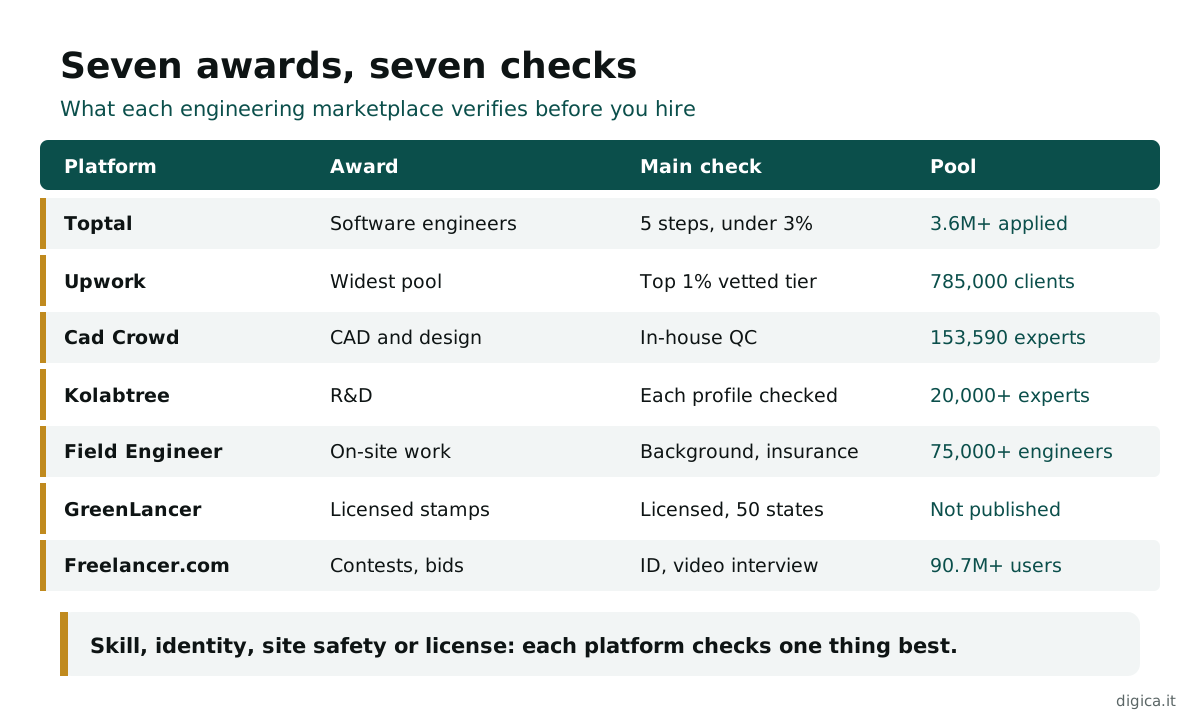
| Award | Engineering marketplace | What it checks | Pool, in its own unit | Buyer protection | Main risk | Best for |
|---|---|---|---|---|---|---|
| Vetted software engineers | Toptal | Five steps, fewer than 3% accepted | 3.6M+ applications received | Trial, pay only if satisfied | Premium rates | Senior software and DevOps hires |
| The widest pool | Upwork | Job Success Score, reviews, top 1% Expert-Vetted tier | 785,000 active clients | Contracts, escrow | Most profiles not hand-vetted | Any engineering task, any budget |
| On-demand CAD and product design | Cad Crowd | Pre-screened, in-house engineering QC | 153,590 experts | 30-day full refund on design accuracy | No acceptance rate published | Mechanical and product design |
| Research and development | Kolabtree | Each profile verified personally, ORCID sync | 20,000+ experts, 175+ countries | Refund if not satisfied, NDAs | Science-heavy, not site work | Prototyping, modeling, R&D |
| On-site field engineers | Field Engineer | Background checks, certifications, insurance | 75,000+ engineers, 200+ countries | Insured providers, no client fees | Telecom and IT focus | Network and IT site work |
| Licensed stamps | GreenLancer | Licensed and insured in all 50 states | No engineer count published | 1 to 3 day residential turnaround | Solar focus | Permit plan sets and PE stamps |
| Design contests and budget bids | Freelancer.com | Identity, KYC, video interview, entry exam for top tier | 90.7M+ registered users | Milestone payments | Quality varies widely | Early concepts, small tasks |
The pattern is clear. The platforms that publish acceptance rates screen for skill. The platforms that serve physical or regulated work check licenses, backgrounds and insurance instead. Few do both, and none publishes every check.
Screened networks: Toptal and Kolabtree
Two awards go to platforms that screen engineers before they can take a project at all. The screening is the product.
Best for vetted software engineers: Toptal
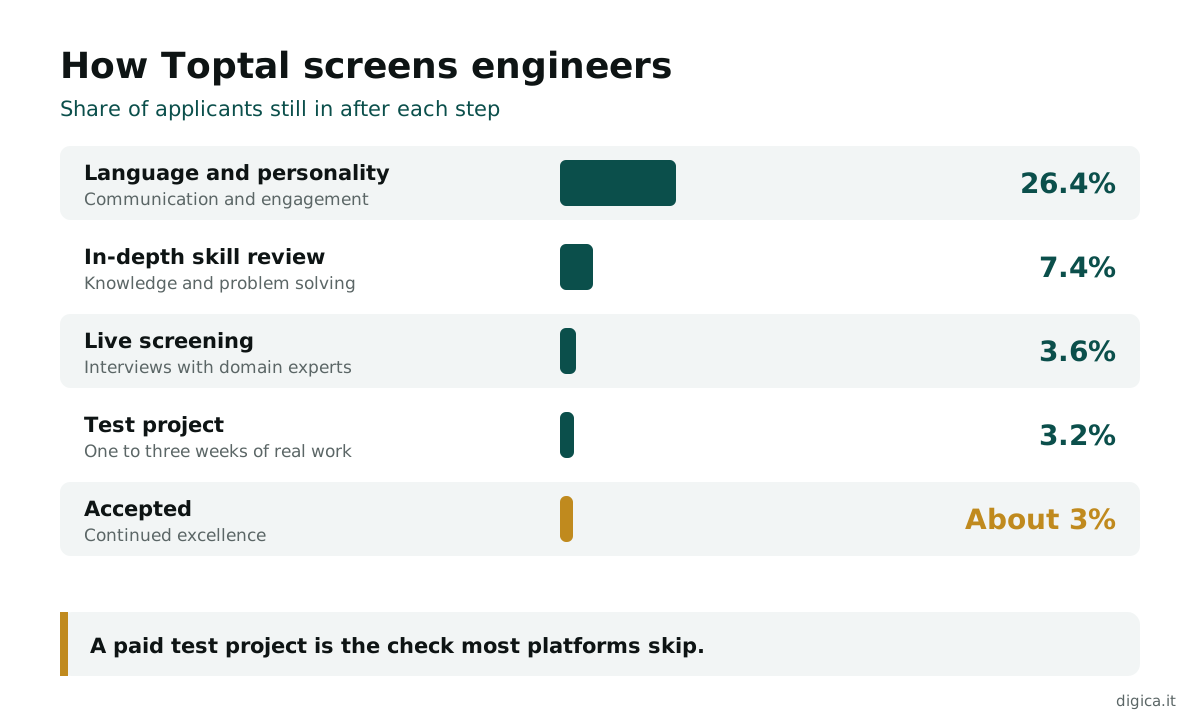
Toptal, a remote-first company, places software, DevOps, data, mobile and embedded engineers with businesses. Its screening has five steps over three to eight weeks. According to Toptal, 26.4% of applicants pass the language and personality step, 7.4% the in-depth skill review, 3.6% the live screening with domain experts and 3.2% a test project lasting one to three weeks, with about 3% accepted.
Running an engineering or professional services B2B marketplace?
In 30 minutes we look at how businesses hiring engineers find platforms like yours, on Google and in AI answers, and how to turn your vetting into more clients and more projects.
Its about page counts more than 3.6 million talent applications received and 91,000 talent engagements. A business works with a new engineer on a trial basis and pays only if satisfied, and Toptal states a 98% trial-to-hire success rate. The award goes for the depth of the skill screen: a test project of one to three weeks tells a hiring manager more than any CV.
Best for research and development: Kolabtree
Kolabtree, operated from London by Cactus Communications, connects businesses with more than 20,000 scientists and experts in over 175 countries, including engineers for modeling, simulation, prototyping and product research. It says 2,500 businesses trust it, and its team verifies each profile personally, with ORCID iD sync and online identity checks.
It publishes no acceptance rate. What it adds is a refund if a business is not satisfied, nondisclosure agreements with experts and no minimum fee. The award goes for research depth: a materials question or a finite element model needs a specialist with publications, not a generalist with good reviews.
Open engineering marketplaces with vetted tiers
Two awards go to open marketplaces where anyone can join, and a smaller, checked tier sits on top.
Best for the widest pool: Upwork
Upwork, based in Palo Alto, California, runs the largest general work marketplace, with an engineering and architecture category covering mechanical, electrical, civil, structural and CAD work. It reported 785,000 active clients at the end of 2025. Most freelancers are checked through reviews and a Job Success Score built from client outcomes.
Its Expert-Vetted tier, described as the top 1% of talent, is invitation only, with screening by talent managers and an interview, and those profiles are visible to Business Plus and Enterprise clients. The award goes for breadth: for a small, well-defined task, a large pool with transparent reviews is often enough, and the vetted tier is there when it is not.
Best for design contests and budget bids: Freelancer.com
Freelancer.com, based in Sydney, says more than 90.7 million employers and freelancers from over 247 countries have registered. That counts all users, not engineers. Its Verified badge requires email, phone, payment and identity checks plus a video interview with an agent.
Its Preferred Freelancer tier adds an extensive interview, vetting and an entrance exam. Businesses can also run design contests, paying only for the winning entry. The award goes for early-stage exploration: a contest brings many concept sketches for a low price, as long as a qualified engineer checks the winner before anything is built.
Managed engineering work: Cad Crowd, Field Engineer and GreenLancer
Three awards go to platforms that manage the work as well as the match, each for a different kind of engineering risk.
Best for on-demand CAD and product design: Cad Crowd
Cad Crowd, based in Glendale, California, describes a community of 153,590 experts across mechanical, product, civil, structural, electrical and drafting work. It says all its freelance designers and contract manufacturers are pre-screened, and an in-house quality control team of engineers assigns projects to the best contractors.
It guarantees design accuracy or a full refund within 30 days, and its terms assign intellectual property in paid designs to the buyer. It publishes no acceptance rate, so the vetting is its own description. The award goes for managed design work: a product team that needs CAD files this week gets a matched designer and a quality check in one step.
Best for on-site field engineers: Field Engineer
Field Engineer, based in New York, says it has more than 75,000 vetted engineers in over 200 countries for telecom, network and IT work on site. Engineers who opt in are background checked for criminal and motor vehicle records, with checks re-run periodically, and the platform checks certifications.
Providers must carry workers' compensation and at least $1,000,000 in business auto liability insurance, and fees come out of engineer earnings rather than client invoices. The award goes for site risk: an engineer who walks into a data center or a cell site needs a background check and insurance more than a coding test.
Best for licensed stamps: GreenLancer
GreenLancer, based in Detroit, connects solar installers and contractors with structural, electrical and civil engineers who are licensed and insured in all 50 states. Each review and stamp is matched to the right state license, with wet and digital stamps available.
It states turnaround of one to three business days for residential projects and two to five for small commercial ones. It publishes no engineer count. The award goes for licensing: where a permit office needs a professional engineer's stamp, the license check is the whole point, and a platform that verifies it state by state saves a contractor from a rejected permit.
What vetted actually means on an engineering marketplace
Vetted means whatever the platform checks, and nothing more. Read the check, not the badge.
The checks fall into four groups. Skill screens test what an engineer can do, through interviews, tests and paid trial projects. Identity checks confirm who the engineer is. Background checks and insurance protect a business when an engineer works on its site. License checks confirm the engineer may legally sign the work. Each one costs the platform time and money, which is why so few platforms do all four.
The shortage makes the checks matter more. ManpowerGroup reports that nearly 73% of employers worldwide have difficulty finding skilled engineering talent (ManpowerGroup). When engineers are scarce, platforms are tempted to loosen entry rules to keep supply up. A business should ask any engineering marketplace what share of applicants it turned away last year, and treat a vague answer as an answer.
Three failure scenarios
These are illustrative patterns, not accounts of named companies. The costs are typical, not audited.
- The unstamped structural drawing. A contractor hires the lowest bidder on an open marketplace to design a roof-mounted equipment frame. The permit office rejects the drawings because they need a licensed engineer's stamp in that state, and the project waits weeks while a second engineer redoes the calculations. A platform that verifies state licenses would have matched the right engineer first.
- The site visit without insurance. A company sends a freelance network technician to a branch office. A vehicle accident on the way leaves the company exposed, because the freelancer carried no business auto cover. Background checks and minimum insurance, required up front, would have moved that risk off the company.
- The software hire on a CV. A startup hires a backend engineer from a profile with strong reviews on small tasks. Three months in, the system cannot scale, and the startup rebuilds it. A paid trial on real work, or a screened network with a test project, would have shown the gap in two weeks.
Are businesses finding your engineering marketplace?
A growth audit shows how businesses hiring engineers search for platforms in your category, what AI answers say about your vetting, and which pages would win more clients and engineers.
The pattern behind all three is the same. The business bought on price or reviews and skipped the one check that mattered for that kind of work: a license, insurance or a skills trial. Name the risk before you post the project, and choose the engineering marketplace that checks for it. Then ask the platform to show the check in writing, whether that is a license number, a certificate of insurance or the result of a test project, and keep it with the contract so the next person who hires through the platform starts from the same standard.
Choosing an engineering marketplace by the check you need
Start with the risk in the work, then the check that covers it, then the platform. These thresholds are a starting point, not rules.
- If the work needs a professional engineer's stamp, use a platform that verifies state licenses, such as GreenLancer for solar permit sets, and never an unverified freelancer.
- If the engineer will work on your site, require background checks and insurance of at least $1,000,000 business auto liability, as Field Engineer does.
- If you are hiring a software engineer for more than three months, use a screened network such as Toptal and insist on a paid trial.
- If the problem is research, modeling or materials, look for verified specialists with publications on Kolabtree.
- If you need CAD or product design files within two weeks, use a managed service such as Cad Crowd with in-house quality control and a refund guarantee.
- If the task is small and well defined, under about $2,000, an open marketplace such as Upwork, checked through reviews and job success, is usually enough.
- If you want many early concepts cheaply, run a design contest on Freelancer.com and have a qualified engineer review the winner.
The long-term picture explains why vetting is worth paying for. Research from the ACEC Research Institute finds the US engineering workforce faces a net shortage of approximately 18,000 engineers a year (ACEC). A shortage that persists year after year means more businesses hiring engineers they have never met, and more weight on whoever checks them first.
What a vetted hire is worth
Run an illustrative case. A business hires an engineer at the BLS median wage of $99,520 a year. If the hire fails after three months, the business has paid about $25,000 in wages, plus the cost of redoing the work and restarting the search. A two-week paid trial, or a platform that screens before matching, costs far less than that and catches most failures before they become expensive.
For founders, the lesson runs the other way. An engineering B2B marketplace wins clients by showing its checks, not just its pool size: what it tests, which licenses it verifies, what insurance it requires and what share of applicants it accepts. That belongs on the case studies and proof pages and category pages that rank for "hire a structural engineer" and "freelance mechanical engineer", and in the answers AI assistants give when an engineering lead asks where to hire.
Growing an engineering or professional services B2B marketplace?
We help professional services marketplaces win clients and experts through search, AI answers and the proof that makes a hiring manager trust a match.
The number to take into your next hiring review is $25,000: the wages paid on a three-month mis-hire at the median engineering salary. If you keep hiring engineers on reviews alone, the biggest cost of doing nothing is that loss on every failed hire, plus the rework, the delay and the search that starts again. A vetted platform or a paid trial costs a fraction of it, so the payback comes with the first hire it saves.
FAQ
What is an engineering marketplace? An engineering marketplace is a platform where businesses hire engineers for projects or roles, from software and CAD design to structural reviews, research and on-site field work. Most charge a fee on each engagement and check engineers before they can take work, though the checks vary widely.
Which engineering marketplace has the strictest vetting? Among the platforms in this guide, Toptal publishes the most detailed screening: five steps, including a live screening and a test project, with fewer than 3% of applicants accepted.
How do I hire a licensed professional engineer online? Use a platform that verifies state licenses before matching, such as GreenLancer for solar permit plan sets, and confirm the engineer is licensed in the state where the project will be permitted.
Are freelance engineers on these platforms insured? It depends on the platform. Field Engineer requires providers to carry workers' compensation and at least $1,000,000 in business auto liability. GreenLancer says its engineers are licensed and insured. On open marketplaces, ask each freelancer for proof.
Where can I hire a freelance mechanical engineer? Cad Crowd offers pre-screened mechanical and product designers with in-house quality control, and Upwork's engineering and architecture category offers the widest pool, checked through reviews and job success scores.
What does vetted mean on an engineering marketplace? It means whatever the platform checks: skill tests and trials, identity checks, background checks and insurance, or license verification. Ask which of these the platform runs, and what share of applicants it turns away.
Related Articles
- Professional services marketplace growth
- The best talent marketplaces
- The best freelance marketplaces
- The best staffing marketplaces
- The best consulting marketplaces
Where this connects
This article is part of our B2B marketplace growth series. Browse more on the Digica blog.