The best freelance communities in 2026, ranked on members and real support
A freelance community can get you a law passed, an insurance plan or an answer by tomorrow morning. Most lists treat these as the same thing, then rank them by how many people signed up. Freelancers Union claims more than 500,000 members and lobbied for payment laws in several US jurisdictions. A German association of 15,889 community members publishes how often its members get an answer, and 56% of questions are answered within 24 hours. The bigger number is not always the more useful community.
The audience is large enough for this to matter. MBO Partners counts a record 74.9 million Americans earning income independently, in its 2026 State of Independence research (MBO Partners). Nobody in that group has an HR department, a legal team or a colleague at the next desk. A community is often the only place those gaps get filled, which makes it a real business decision, not a social one.
This guide ranks six freelance communities on two things: the members each one claims, in its own unit, and the practical support a member actually gets. Figures are each community's own unless we say otherwise, checked on November 4, 2026. If you are looking for work rather than support, our guide to the best freelance marketplaces covers the platforms that sell it.
Quick Navigation
- How we ranked the best freelance communities
- Six freelance communities at a glance
- 1. Freelancers Union: the deepest support in the US
- 2. r/freelance: the largest open freelance community
- 3. Freelancing Females: the paid network for women
- 4. IPSE: the fullest cover in the UK
- 5. VGSD: lobbying and answers in Germany
- 6. Being Freelance: the small room that works together
- What a member count hides
- Three failure scenarios
- Choosing a freelance community: a decision framework
- What the right community is worth
- FAQ
- Related Articles
How we ranked the best freelance communities
We looked for groups where freelancers actually help each other or get help, then ranked them on members claimed and on the depth of practical support. Support weighed more than size. A plain job board did not qualify, and neither did a marketplace that only takes a cut of the work.
Support here means something you could use this month: insurance, a legal or tax helpline, a contract template, lobbying that changes the rules, a peer who answers a question, or a person to work next to. We gave more credit to support that a freelancer would otherwise have to buy or could not get at all.
We also checked how each group proves its size. Some publish a precise number with a date. Some publish none, and we say so rather than estimate. One publishes two different figures on the same page. The order below is our judgment, not a measured score, and geography changes it: the best choice for a freelancer in Manchester is not the best choice for one in Chicago.
Our view: choose the community that covers your biggest risk first. Add the one you enjoy second.
Six freelance communities at a glance
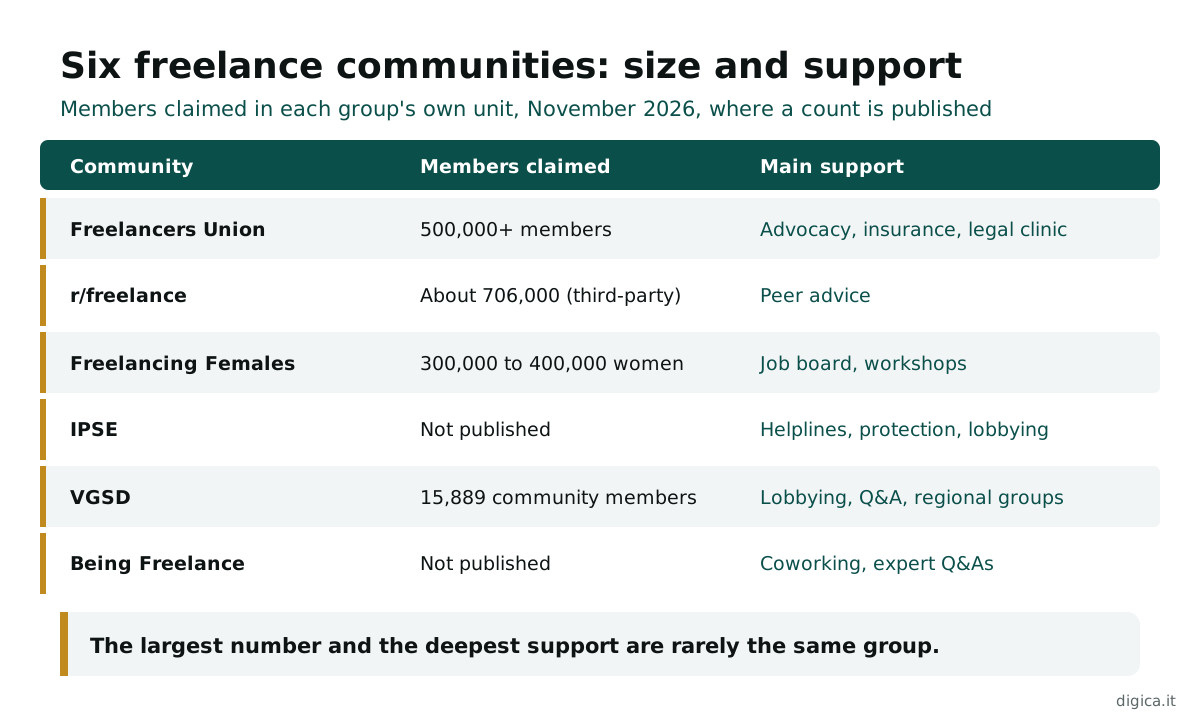
Freelancers Union leads on US support, r/freelance on open reach, Freelancing Females on a network for women, IPSE on UK cover, VGSD on German lobbying and Being Freelance on day-to-day company.
Six freelance communities compared on members claimed, who they suit, cost, main support, main risk and best fit
| Community | Members claimed | Who it suits | Cost to join | Main support | Main risk | Best for |
|---|---|---|---|---|---|---|
| Freelancers Union | 500,000+ members | US independent workers | Free; benefits priced separately | Advocacy, insurance marketplace, legal clinic | Benefits are built for the US | US freelancers who need cover |
| r/freelance | About 706,000 (third-party count) | Any freelancer | Free | Peer advice | Anonymous, unvetted answers | Quick second opinions |
| Freelancing Females | 300,000 to 400,000 women (both on its site) | Women freelancers | $99 a quarter or $315 a year | Job board, workshops, discounts | Size claim is unclear | Women seeking referrals |
| IPSE | Not published | UK self-employed | About $40 to $1,070 a year | Helplines, protection, lobbying | UK only, highest cost here | UK contractors with contract risk |
| VGSD | 15,889 community members | German founders and self-employed | Free | Lobbying, Q&A, 21 regional groups | Runs in German | Self-employed people in Germany |
| Being Freelance | Not published | Freelancers in any trade | Paid monthly plans | Coworking, expert Q&As, directory | No legal or insurance help | Beating isolation |
Read the "Main risk" column first. Each group is strong at one kind of support and thin at the rest, which is why most working freelancers need more than one. IPSE prices are converted from pounds and rounded.
1. Freelancers Union: the deepest support in the US
Freelancers Union ranks first because it combines scale, free entry and support you can use: lobbying, an insurance marketplace and legal help.
The organization says it has more than 500,000 members and has worked for over 25 years on what it calls new rules for the new workforce. Membership is free. Its insurance marketplace covers health, dental, liability, disability, life, vision and pet plans, priced separately. It also runs a Legal Clinic, a Tax Center and Spark meetups, and its staff are based at the Freelancers Hub in New York City, which opened in 2022.
Its advocacy is what sets it apart. The group lists Freelance Isn't Free wins in New York State, Illinois, Los Angeles and Minneapolis, measures that give freelancers a route to challenge late or missing payment. In May 2026 its blog covered a bill for a city-run freelancers payment fund in New York City. Few communities can point to a change in the law.
Growing a freelance community or talent B2B marketplace?
In 30 minutes we look at how freelancers and clients find platforms like yours, on Google and in AI answers, and what we would do first to win members who stay.
The limit is geography. A freelancer outside the US gets little from the benefits, and health plan choice inside the US depends on where you live. It also suits people who want services more than conversation. If what you want is a tight group that knows your name, add a smaller community alongside it. Join for the cover and the advocacy, and look elsewhere for the conversation.
2. r/freelance: the largest open freelance community
r/freelance is the biggest group here by raw count, and the quickest place to get a second opinion, but it offers only what other members choose to post.
Reddit does not sell it as a product, so its size comes from outside sources. GummySearch put it at about 706,000 members on November 3, 2026, up by about 78,000 in a year, and The Hive Index shows about 687,000. Joining is free and open. Most of the activity is people asking for advice about clients, pricing and getting started.
That makes it useful for a narrow job: testing whether a client's request is normal, or whether a rate sounds right. You will usually get several answers fast. You will not know who wrote them, and nobody checks them. There is no insurance, contract library or lobbying behind it.
Use it for opinions and never for legal or tax decisions. It is the only group on this list with no barrier to entry, and that is both its value and its weakness. For a freelancer in their first year, reading a few months of old threads is a free education in how client problems tend to go.
3. Freelancing Females: the paid network for women
Freelancing Females calls itself the largest community of freelance women, and it charges for access to its job board, events and member offers.
Its site gives two figures, inviting visitors to join 400,000 Freelancing Females in one place and 300,000 women in another. It does not say how those numbers break down, and they may include people who only follow it on social media. The paid membership costs $99 a quarter or $315 a year, with the option to pause or cancel.
Members get community access, a private job board, networking, workshops, member discounts and offers. Its founder is Tia Meyers. The real attraction is the network: a referral from someone who has seen your work tends to be worth more than a cold listing.
The trade-off is simple. There is no advocacy or insurance, so it does not cover your downside. It is for growing your pipeline and your confidence. It is worth paying for if you will actually use the job board and go to the sessions, and worth skipping if you only want to read along.
4. IPSE: the fullest cover in the UK
IPSE, the UK's association for the self-employed, offers the most complete protection on this list, and it is also the most expensive.
The UK has a large audience for it. IPSE's own research says 4.2 million people work as solo self-employed in the UK, and that they contributed £366 billion, about $491 billion, to the economy in 2024 (IPSE). IPSE does not publish its own member count on its membership pages, so we do not give one.
Its tiers were announced on August 31, 2026. Advocate costs about $40 a year and supports its campaigning. Empower costs about $51 a month or $540 a year and includes unlimited tax and legal helplines, templates, legal and business protection, late payment recovery support and peer networking. Accelerate costs about $101 a month or $1,070 a year and adds a mentor match, dedicated account management and business promotion. Full terms and exclusions apply to the protection, so read them before relying on them.
Do freelancers find your community when they search?
A growth audit maps where freelancers and clients ask for advice, which communities and AI answers name your rivals, and which pages would put you in the conversation.
IPSE also lobbies. It responded to the UK Budget on October 28, 2026 and has commented on the Making Tax Digital deadline this year. For a UK contractor with real contract and tax risk, one helpline call can justify the fee. For a part-time freelancer earning a few thousand a year, it is more cover than the income needs. We see the same pattern in our work with B2B communities: members pay when the community removes a risk they can name.
5. VGSD: lobbying and answers in Germany
VGSD, the German association of founders and self-employed people, is the most transparent group on this list about whether its community actually works.
On October 28, 2026 its site showed 5,268 association members, 15,889 community members and 21 regional groups. Joining is free. It represents founders, the self-employed and businesses with fewer than ten employees, and its campaigning has real results to point to: it lists preventing a mandatory pension scheme in 2012 and helping to cut minimum health insurance contributions by more than half in 2019.
Its current work is on the rules that decide whether a freelancer counts as truly self-employed, a live issue for anyone in Germany working mainly for one client. On November 4, 2026 it was publishing an analysis of a joint paper from two federal ministries on reforming that assessment.
The number that interests us most is in its Q&A forum, Frag den VGSD. Out of 3,368 questions, 94% have at least one answer and 56% were answered within 24 hours. Very few communities show this. It tells you more than any member count. The limit is obvious: it runs in German and its lobbying is about German law, so it suits only those who work there.
6. Being Freelance: the small room that works together
Being Freelance is the smallest group here and the most personal, built for the day-to-day isolation of working alone rather than for legal cover.
UK freelancer Steve Folland runs it, and it grew out of the Being Freelance podcast he started in 2015. The community publishes no member count and we could not read a current price, though it uses monthly plans that are easy to cancel and offers no free trial. Part-timers and new freelancers are welcome, and taking its starter course includes six months of access.
Members work together in virtual coworking sessions, in 25-minute bursts with chat in between. There is a library of expert Q&As, a book club, and both a public and a private freelancer directory. None of that will save you in a contract dispute. It might save your week.
Do not underrate that. Most freelancers do not quit because of a legal problem. They quit because the work gets lonely and the pipeline goes quiet at the same time. A small group that notices when you stop showing up does something a 500,000-member organization cannot. Pair it with a larger group that handles your risk.
What a member count hides
A member count shows how many people joined at some point. It does not show who is still there, whether anyone answers, or what happens when you have a problem.
Look at the units in this ranking. r/freelance's figure is a third-party count of subscribers to a free forum. Freelancers Union's is members of a free organization, many of whom may join for benefits and never post. Freelancing Females gives two numbers. VGSD separates association members from its wider community, 5,268 against 15,889, a distinction almost nobody else on this list makes. IPSE and Being Freelance give none.
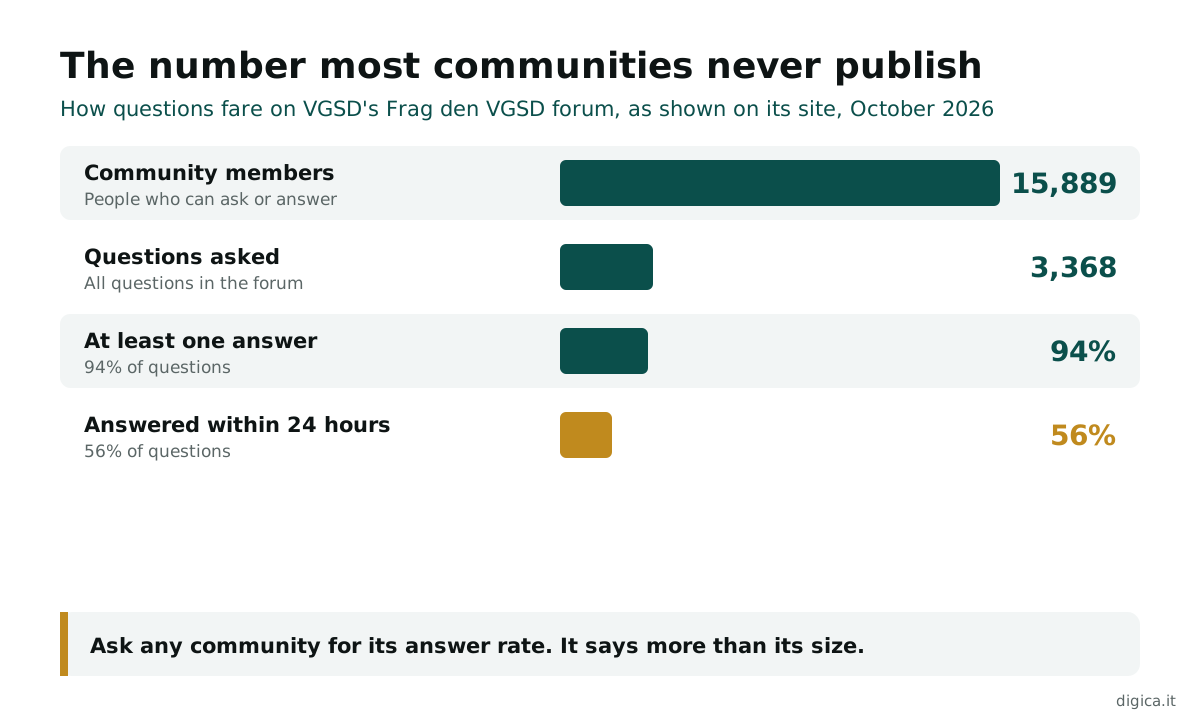
So test activity before you trust size. Post a real question, or read how recent questions went. If most get a useful reply within a day, the community is working. If the latest threads are a pile of self-promotion with no replies, the number on the home page is history.
The test also applies if you run one. Communities that publish answer rates give a reason to join that no rival's bigger number can beat. Our guide to community SEO explains how those threads can also bring in search traffic when they are structured properly, and our list of the best community platforms covers what they run on.
Three failure scenarios
These are the patterns that recur when freelancers pick a community for the wrong reason.
- The free group that could not help with the real problem. A designer relies on an open forum for every business question. A client refuses to pay a $6,000 invoice, and the forum offers sympathy and conflicting legal opinions. The designer hires a lawyer late and writes off part of the debt. A membership with a legal helpline, chosen before the dispute, would have cost far less than the loss. The figures here are illustrative.
- The annual fee nobody used. A new freelancer pays for a year of a professional association because the cover sounds sensible. They never call the helpline, skip every event and do not renew. A free community for the first year, then paid cover once income justified it, would have kept the money in the business.
- The community that was all sellers. A consultant joins a large group hoping for clients and posts their services weekly. Every other member is a freelancer doing the same thing. Nobody in the room is buying. A peer community is for advice and referrals. Clients come from marketplaces, networks and search, and our list of the best Upwork alternatives is a better place to start for that.
Each of them joined a real community. None of them started by asking what risk or gap the community had to cover.
Choosing a freelance community: a decision framework
Start from where you work, then your biggest risk and your income, and let those three choose.
- If you work in the US and need health or liability cover, start with Freelancers Union. It is free to join, and you only pay for the plans you take.
- If you work in the UK and contract or tax risk could cost you more than about $500 a year, IPSE's Empower tier is the one to price first.
- If you work in Germany, join VGSD. It is free, and its forum is the fastest way to check how German rules apply to you.
- If you are a woman who wins most work by referral, test Freelancing Females for one quarter at $99 and count the leads.
- If you earn under $20,000 a year from freelancing, stay on free communities until the income justifies paid cover.
- If you feel isolated more than you feel exposed, join a small paid group like Being Freelance and go to two coworking sessions a week.
- If you just need a quick second opinion, use r/freelance, and treat every answer as a starting point.
Running a freelance B2B marketplace or talent network?
We help freelance and talent platforms grow both sides, from the search pages that bring in clients to the programs that bring in and keep the right freelancers.
Most freelancers end up with one group for risk and one for company. Review the pair once a year as your income changes, and leave any community you have not used in six months. These thresholds are our rule of thumb, not a published standard, so adjust them to your own costs, your clients and the size of the risk you are carrying.
What the right community is worth
A good freelance community pays for itself by preventing one bad outcome or adding one good client. Protections written into law help too, but only if you know about them.
New York shows why that matters. Since August 28, 2024, the state's Freelance Isn't Free Act has set contract requirements and a formal enforcement process for freelance workers, with a model contract available from the state Department of Labor and complaints going to the Attorney General (New York State Department of Labor). A freelancer who does not know this exists may simply write off an unpaid invoice. Communities are often how people find out.
Run an illustrative case. A UK freelancer billing $90,000 a year pays about $540 for an association tier with a legal helpline. One late-paying client is chased with the right letter and pays a $6,000 invoice that would otherwise have been written off. That single result returns the fee about 11 times over. In a free community, one referral worth $3,000 does similar work at no cost at all.
The number to take to your next review of your business is what your communities delivered last year: invoices recovered, clients referred, decisions made faster. If the answer is nothing, change them. The biggest cost of doing nothing is carrying every risk alone, and only finding out what help existed after the invoice has gone unpaid.
FAQ
What is a freelance community? A freelance community is a group where independent workers share advice, referrals and support. It can be an open forum, a paid network, a professional association or a union-style organization with insurance and advocacy.
What is the best freelance community? For US freelancers who want real support, Freelancers Union is the strongest, with more than 500,000 members claimed, free membership and an insurance marketplace. The best choice depends on your country and on whether you need cover or company.
Are there free freelance communities? Yes. Freelancers Union, r/freelance and VGSD are all free to join. Freelancers Union charges for the insurance plans you choose, while Freelancing Females and IPSE charge for membership.
How do I find a freelance community to join? Start with your country's main association, then look for one group in your trade. Read recent threads or ask a real question before paying, because activity tells you more than the member count.
Do freelance communities help you find clients? Sometimes, mostly through referrals and job boards such as the private board at Freelancing Females. Most peer communities are full of other freelancers, so use them for advice and referrals, and use marketplaces for direct client work.
Is IPSE membership worth it for UK freelancers? It is worth pricing if you have real contract or tax risk, since its Empower tier includes unlimited tax and legal helplines and protection cover. For low or part-time freelance income, the cost may be more than the cover is worth.
Related Articles
- B2B marketplace growth for freelance platforms
- The best freelance marketplaces in 2026
- Best Upwork alternatives
- Best talent marketplaces
- Best community platforms for B2B communities in 2026
- Best B2B and business communities to join in 2026
Where this connects
This article is part of our B2B marketplace growth series. Browse more on the Digica blog.