The best translation marketplaces for businesses, head to head on languages and speed
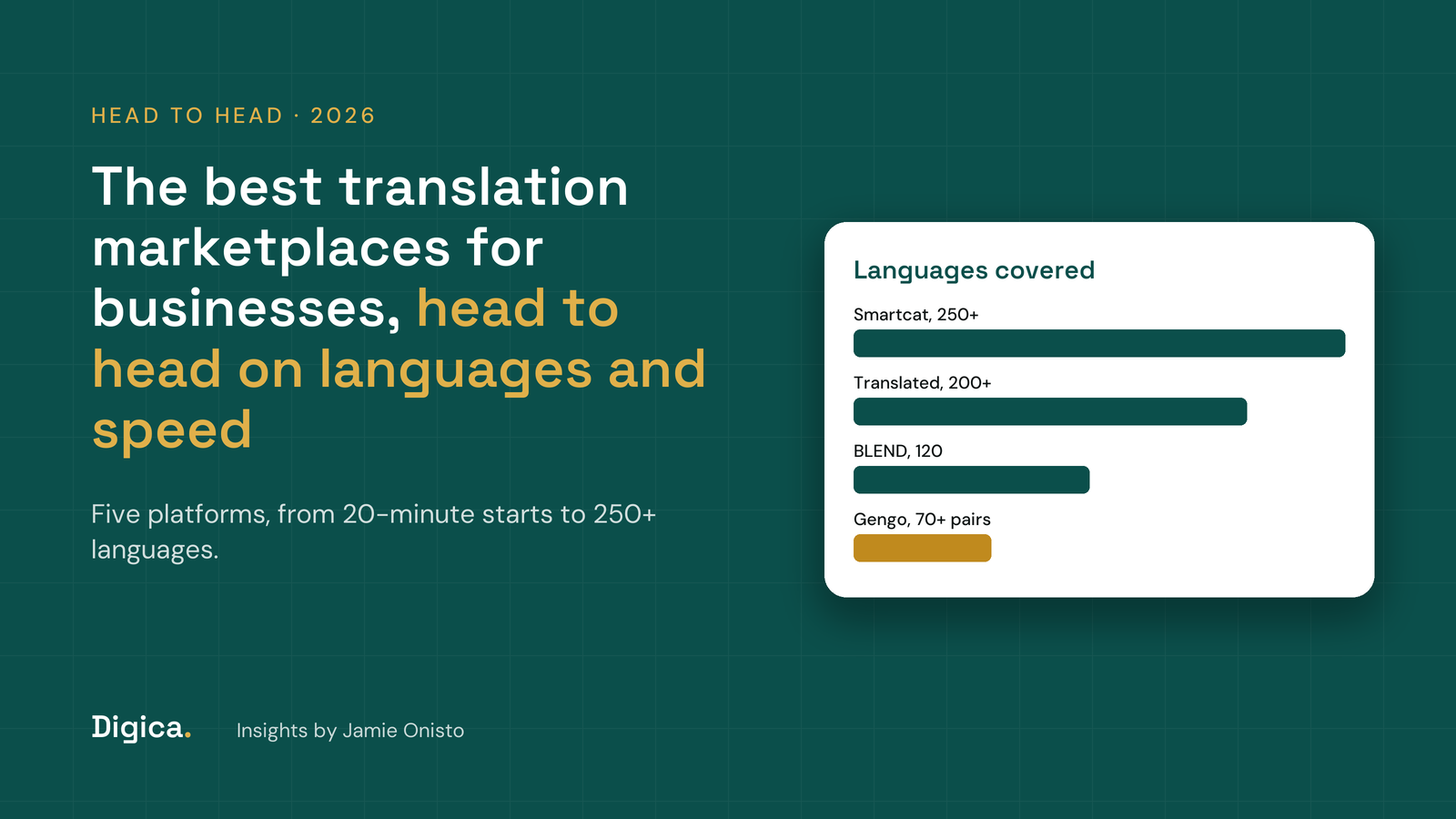
A contract that must be in Japanese by Friday and a product catalog that must be in 40 languages by next quarter are two different jobs, and translation marketplaces are built for one or the other. Gengo says its translators start most orders within 20 minutes, across 70+ language pairs. Smartcat says it covers 250+ languages with a pool of 500,000+ vetted translators. Both rank when a business searches for a "translation marketplace", and picking the wrong one costs either days or languages.
Machine translation has not made the human side disappear. Interpreters and translators held about 73,900 jobs in the US in 2025, 28% of them self-employed, and employment is projected to grow 2% from 2025 to 2035 (US Bureau of Labor Statistics). That self-employed share is the reason translation marketplaces exist: much of the skilled supply is freelance, and someone has to find it, check it and book it.
This guide compares five translation marketplaces head to head on language coverage and turnaround: ProZ.com, Smartcat, Gengo, BLEND and Translated. It is written for localization, marketing and operations leaders buying translation, and for founders growing a professional services B2B marketplace. Figures come from each platform's own pages, checked on November 14, 2026.
Quick Navigation
- How we compared coverage and speed
- Five translation marketplaces side by side
- ProZ.com vs Smartcat: the two biggest translator pools
- Gengo vs BLEND: fast online ordering
- Translated against all four: matching by algorithm
- Languages, language pairs and depth
- How each translation marketplace vets linguists
- Three failure scenarios
- Choosing a translation platform by deadline and language
- What speed and coverage are worth
- FAQ
- Related Articles
How we compared coverage and speed
We asked two questions of each translation marketplace. How many languages, or language pairs, does it say it covers? And how fast does it say work starts or finishes? Then we recorded how many linguists it can draw on, in its own unit, and how it checks them.
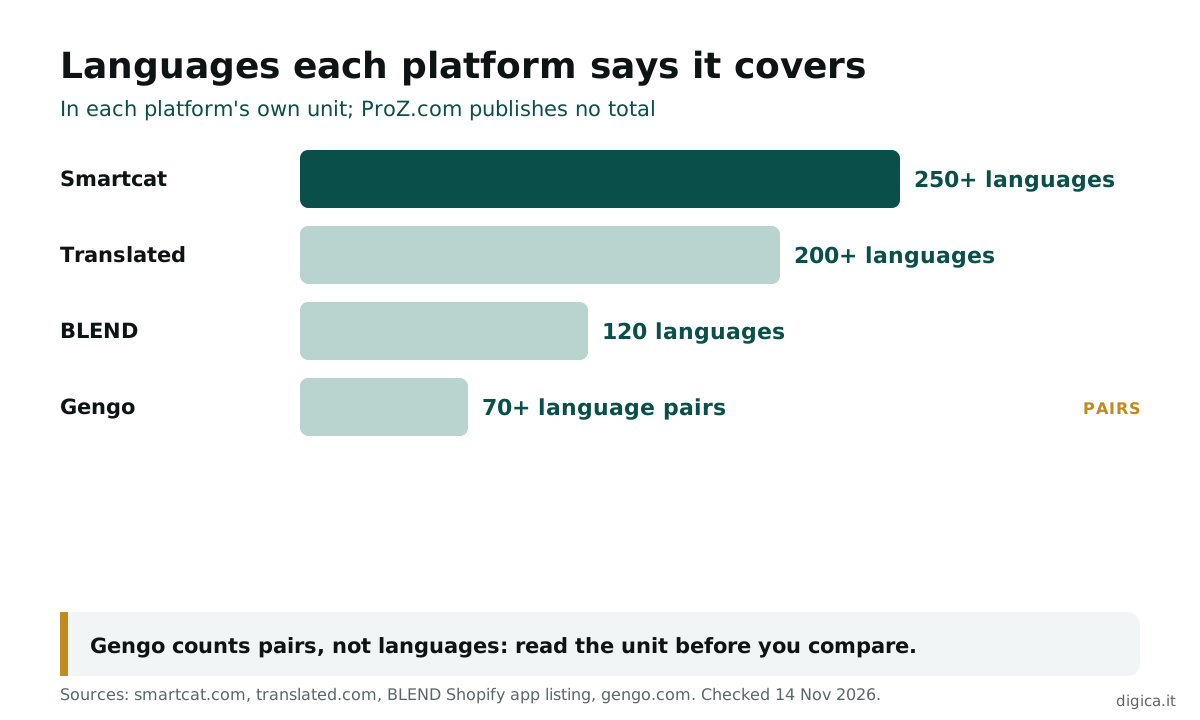
The units matter more than the totals. A platform that counts "languages" and one that counts "language pairs" are not measuring the same thing: 70 pairs can mean far fewer than 70 languages. A pool of registered users is not a pool of vetted translators. We kept each figure in the unit the platform uses, and say where a platform does not publish one.
We left out general freelance platforms such as Upwork and Fiverr, which carry translators among thousands of other skills and are covered in our guide to Upwork alternatives. We also left out enterprise localization software sold without a translator network, because a business searching for a translation marketplace wants people, not only a tool.
Our view: for a business buyer, turnaround is the number that decides most orders, and coverage is the number that decides the platform. Choose the platform on coverage, then judge each order on speed.
Five translation marketplaces side by side
The table puts each platform's coverage and speed next to its pool, its check and its main risk. Use it to shortlist before the head-to-heads.
| Platform | Languages, in its own unit | Linguists, in its own unit | Stated speed | How it checks linguists | How you order | Main risk | Best for |
|---|---|---|---|---|---|---|---|
| ProZ.com | No total published | 1,324,930 registered users | Set by each freelancer | Open membership; credentials can be verified, plus a screened Certified PRO Network | Post a job or search the directory | Most members are not screened | Finding a rare specialist yourself |
| Smartcat | 250+ languages | 500,000+ vetted translators | Claims a 30% cut in turnaround | Vetted pool, matched to your content by AI | Inside its translation platform | Speed claim has no stated method | High volume across many languages |
| Gengo | 70+ language pairs | 21,000+ certified translators | Most orders started within 20 minutes | Two-part test, plus a Pro test for higher-tier work | Web or API order | Narrowest coverage here | Fast, short, frequent orders |
| BLEND | 120 languages | 25,000 experts | No standard turnaround on pages we could read | Professional network | Online order or Shopify app | Fewer public numbers | Ecommerce store translation |
| Translated | 200+ languages | 10,000+ experts from a network of 500,000+ | Not published as a standard | Every linguist through its selection process; T-Rank matching | Online quote and order | Less control over who is picked | Managed quality across 40+ subject areas |
Two patterns stand out. The largest pools come with the lightest default checks, and the fastest service covers the fewest languages. No platform here leads on both coverage and stated speed.
ProZ.com vs Smartcat: the two biggest translator pools
ProZ.com and Smartcat give a business access to the largest numbers of translators. They do it in opposite ways. ProZ.com is a community and directory where you choose the person. Smartcat is a platform where the software chooses for you.
ProZ.com has run for 24 years and counts 1,324,930 registered users, run by a team of 35 staff. Membership is open, so the directory is broad rather than screened. Members can submit credentials for verification, and ProZ.com runs a smaller Certified PRO Network for translators who pass its checks. Turnaround depends entirely on the freelancer you hire, which is a strength for a rare legal or medical pair and a weakness for a deadline you cannot negotiate.
Smartcat lists a pool of 500,000+ vetted translators and covers 250+ languages, the widest stated coverage in this guide. Its software reads your content and matches it with subject-matter translators, weighing category knowledge, past performance and quality. Smartcat claims a 30% reduction in turnaround time, but does not state how it measured that, so treat it as a direction rather than a promise.
Running a translation or language services B2B marketplace?
In 30 minutes we look at how business buyers find platforms like yours, on Google and in AI answers, and how to turn your language coverage into more orders.
The verdict: ProZ.com when you need to find and vet a specific specialist yourself, and have the time to do it. Smartcat when you need volume across many languages and would rather the platform pick the linguist. Many teams use both: Smartcat for the routine flow of product and marketing content, and ProZ.com for the handful of jobs where the translator's own credentials are the deliverable, such as a certified legal translation.
Gengo vs BLEND: fast online ordering
Gengo and BLEND sell translation the way an ecommerce site sells a product: upload, pay, receive. Both run networks of tens of thousands of linguists and take orders online. The difference is the trade between speed and coverage.
Gengo, owned by Lionbridge, is the speed leader in this guide. It says its 21,000+ certified translators work across all major time zones and start most orders within 20 minutes, and that it translates 5 million+ words a week for 65,000+ customers. The catch is coverage: it counts 70+ language pairs, the narrowest list here. Every Gengo translator passes a two-part test, and a separate Pro qualification unlocks higher-tier work.
BLEND, formerly OneHourTranslation, describes a global network of 25,000 experts and commerce localization in 120 languages, and sells a translation app for Shopify stores. The pages we could read did not state a standard turnaround, so a buyer should ask for one in writing before relying on it for a launch date.
The two models suit different buyers inside the same company. A support team that translates a few hundred words of help content every day cares about start time above all, because a customer is waiting. A marketing team launching a seasonal campaign in a dozen countries cares more about having every market covered on the same date. Asking which team the order is for usually settles which of the two to try first.
The verdict: Gengo for short, frequent orders in major language pairs where hours matter, such as support content and product updates. BLEND for ecommerce teams that want more languages and a store integration, with turnaround agreed per project.
Translated against all four: matching by algorithm
Translated, based in Rome, takes a third approach. It is a managed service with a marketplace underneath. Its T-Rank system matches each piece of content with the most qualified translator for that job, drawn from 10,000+ expert translators and copywriters within a network of 500,000+ professionals.
Its coverage is the second widest here, at 200+ languages, and it has served 380,341 customers. It says every linguist passes its selection process, and it runs industry teams across 40+ subject areas. It does not publish a standard turnaround, because speed depends on the job.
That model suits content where the subject matters as much as the language: a clinical document, a financial report or technical documentation for an industrial product. The platform's job is to know which of its linguists has translated that kind of text before, and its matching system is built to answer exactly that question.
Against ProZ.com, Translated removes the work of choosing. Against Smartcat, it is closer to a service than a tool. Against Gengo and BLEND, it trades instant ordering for matching depth. The verdict: Translated for businesses that want specialist quality in many languages without managing linguists, and are willing to let the platform choose who does the work.
Languages, language pairs and depth
Coverage claims are where buyers are most often misled, usually by accident. A "language" count tells you how many languages a platform can work in. A "language pair" count tells you how many source and target combinations it can deliver, which is the number that matters for your order.
Most platforms are deepest from and into English. A platform that covers 200 languages may have dozens of translators for English into Spanish and two for Finnish into Korean. The headline total says nothing about the second case. Ask any platform how many active linguists it has for your exact pair, and how many jobs in that pair it delivered last quarter.
Scale puts these totals in context. The European Commission's translation service works across the EU's 24 official languages and is one of the largest public translation services in the world (European Commission). A business that needs more than 24 languages is already asking for wider coverage than one of the world's biggest translation departments provides as standard, which is why the long tail is where marketplaces earn their fee.
Our view: a coverage number without a depth number is marketing. The platforms that will win business buyers over the next few years are the ones that publish linguist counts per pair, not just the grand total.
How each translation marketplace vets linguists
Vetting decides whether speed is worth having. A translation delivered in an hour by someone who has never been tested is a risk, not a saving.
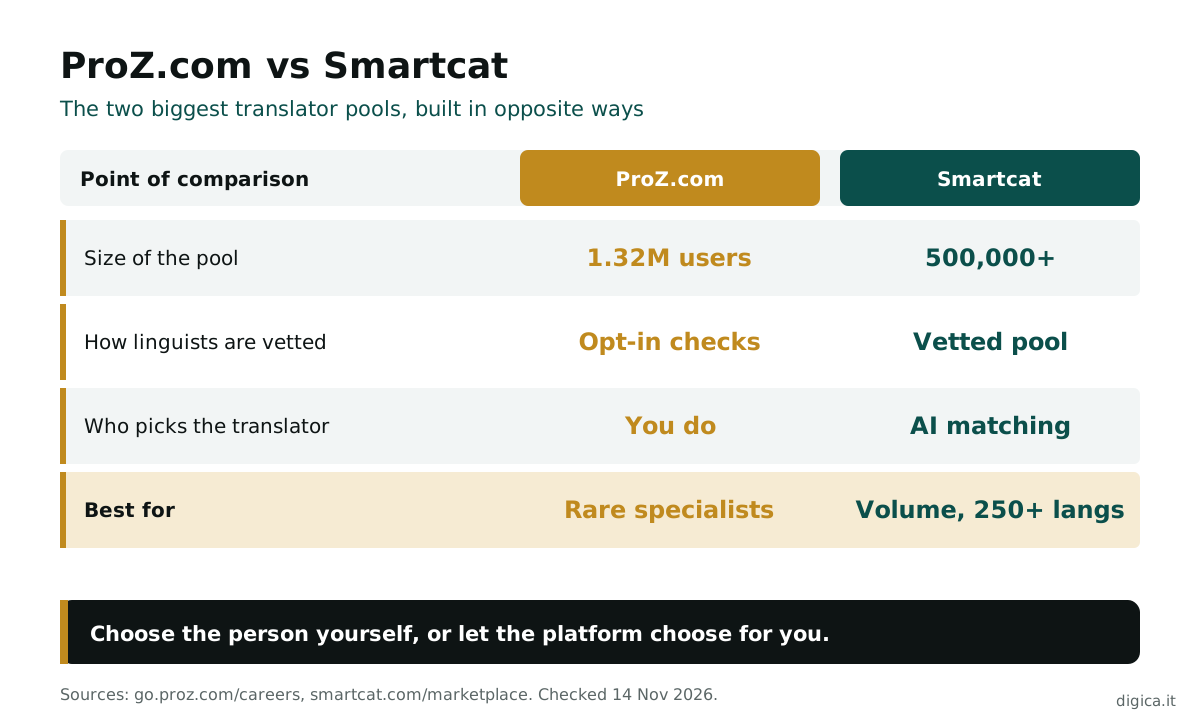
The five platforms check in different ways. Gengo tests every translator, with a harder test for its Pro tier. Translated puts every linguist through its selection process and then matches by subject. Smartcat describes its pool as vetted and matches on past performance and quality. BLEND describes a professional network. ProZ.com is open to all, with verification and its Certified PRO Network as opt-in layers on top.
The strictest external reference point is ISO 17100, the international standard for translation services. It requires translators to hold a recognized degree in translation, or a degree in another field plus two years of full-time professional experience, or five years of full-time professional experience, and it requires every translation to be revised by a second linguist Ask whether a platform's process meets that bar, and whether revision is included or extra. A platform that tests its translators but skips revision has done half the job. One that revises but never tests has done the other half, and only the buyer can see which half is missing.
Three failure scenarios
These are illustrative patterns, not accounts of named companies. The costs are typical, not audited.
- The pair that was not there. A software company picks a platform for its 200+ language total and schedules a launch in Thai, Vietnamese and Indonesian. Two of the three pairs have only a handful of active linguists, and the launch slips by two weeks while the platform recruits. Asking for linguist counts per pair before signing would have taken an email.
- Speed without revision. A retailer orders product descriptions on the fastest service it can find and publishes the same day. Nobody revised the work, and a sizing error in one language triggers a wave of returns that costs more than a year of translation. A second-linguist revision, as ISO 17100 requires, would have added a day and caught it.
- The open directory treated as vetted. A legal team hires a translator from an open directory because the profile looked strong. The credentials were never verified, and the translated contract has to be redone by a certified translator before filing. Filtering to verified members, or using a platform that tests everyone, would have avoided the rework.
Is your coverage visible to business buyers?
A growth audit shows how buyers search for translation platforms in your category, what AI answers say about your languages and speed, and which pages would win more orders.
In each case the platform delivered what it advertised. The failure was reading a headline number as a promise about the specific job. Write down the pair, the deadline and the check you need before you choose where to order, and send those three lines to any platform you shortlist. A good translation marketplace will answer all three in a day.
Choosing a translation platform by deadline and language
Start with the deadline and the language pair, then match the platform. These thresholds are a starting point.
- If you need a short job back in hours in a major pair, start with Gengo.
- If you need more than 100 languages across a steady flow of content, shortlist Smartcat and Translated.
- If you need specialist subject quality and do not want to manage linguists, use Translated.
- If you run an ecommerce store and want translation inside it, look at BLEND.
- If the pair is rare or the translator's own credentials matter, search ProZ.com, filter to verified or Certified PRO members, and interview two candidates.
- If any order will be published or filed without a second check, require revision by a second linguist, the rule set by ISO 17100, whichever platform you use.
- If a platform cannot tell you how many linguists it has in your pair, treat its coverage total as unproven.
Most businesses end up with two platforms: one for speed in major pairs, and one for depth across the long tail. That split is normal, and it costs less than forcing one platform to do both.
What speed and coverage are worth
Run an illustrative case. The median US pay for interpreters and translators was $60,170 a year in May 2025, according to the same BLS data. Covering ten languages with one in-house translator each would cost about $600,000 a year in salary alone, before benefits, tools and revision. A translation marketplace turns that fixed cost into spending per word, and gives access to languages a business would never hire for.
Revision has a cost that is easy to estimate from the same figure. At $60,170 a year, a translator costs roughly $29 an hour in salary. A second linguist spending a day revising a 5,000-word launch costs about $230 in salary, against a launch budget that is usually many times larger. That is why skipping revision to save a day is almost never the cheaper choice.
Speed has a value too. If a product update ships in ten languages and each extra day of waiting delays revenue in those markets, a platform that starts work in minutes rather than days is worth more than its rate card suggests. The right comparison is not price per word, but the total cost of a late or wrong launch.
For founders, the lesson runs the other way. A translation B2B marketplace that publishes its linguist counts per pair, its real turnaround and its checks gives buyers the proof they look for, on its own pages, in its structured data and in the answers AI assistants give when someone asks where to get a document translated.
Growing a translation or professional services B2B marketplace?
We help professional services marketplaces win buyers and supply through search, AI answers and the proof that makes an order feel safe.
The number to take into your next budget meeting is $60,170: the median US pay for one translator. If you cover ten languages through a marketplace instead of ten hires, you avoid a fixed cost of about $600,000 a year. The biggest cost of doing nothing is a launch that waits on a language pair nobody checked, or a translation published without a second pair of eyes. Both are cheap to prevent and expensive to fix. Payback on a second platform for the long tail is usually the first launch it keeps on schedule.
FAQ
What is a translation marketplace? A translation marketplace is a platform where businesses find, order from or are matched with professional translators from many independent linguists or agencies. Some let you choose the translator, others match one to your content for you.
Which translation marketplace covers the most languages? Among the platforms in this guide, Smartcat states the widest coverage, at 250+ languages, followed by Translated at 200+. Always ask how many active linguists each platform has for your exact language pair.
Which translation service is fastest? Gengo says its translators start most orders within 20 minutes, the fastest stated start in this guide. It covers 70+ language pairs, so check that yours is one of them.
How do I find a vetted freelance translator? Use a platform that tests every translator, such as Gengo or Translated, or search ProZ.com and filter to members with verified credentials or its Certified PRO Network. Ask for a short paid test on your own content.
What is the difference between a language and a language pair? A language is one language a platform works in. A language pair is a source and target combination, such as English into German. Pairs are what you order, so a pair count is the more useful number.
What is ISO 17100? ISO 17100 is the international standard for translation services. It sets minimum qualifications for translators and requires every translation to be revised by a second linguist.
Related Articles
- Professional services marketplace growth
- The best freelance marketplaces for businesses
- The best Upwork alternatives for hiring vetted talent
- The best talent marketplaces, compared
- The best consulting marketplaces, ranked on vetting
Where this connects
This article is part of our B2B marketplace growth series. Browse more on the Digica blog.