Two-sided marketplaces: how B2B network effects work, and why they build slower
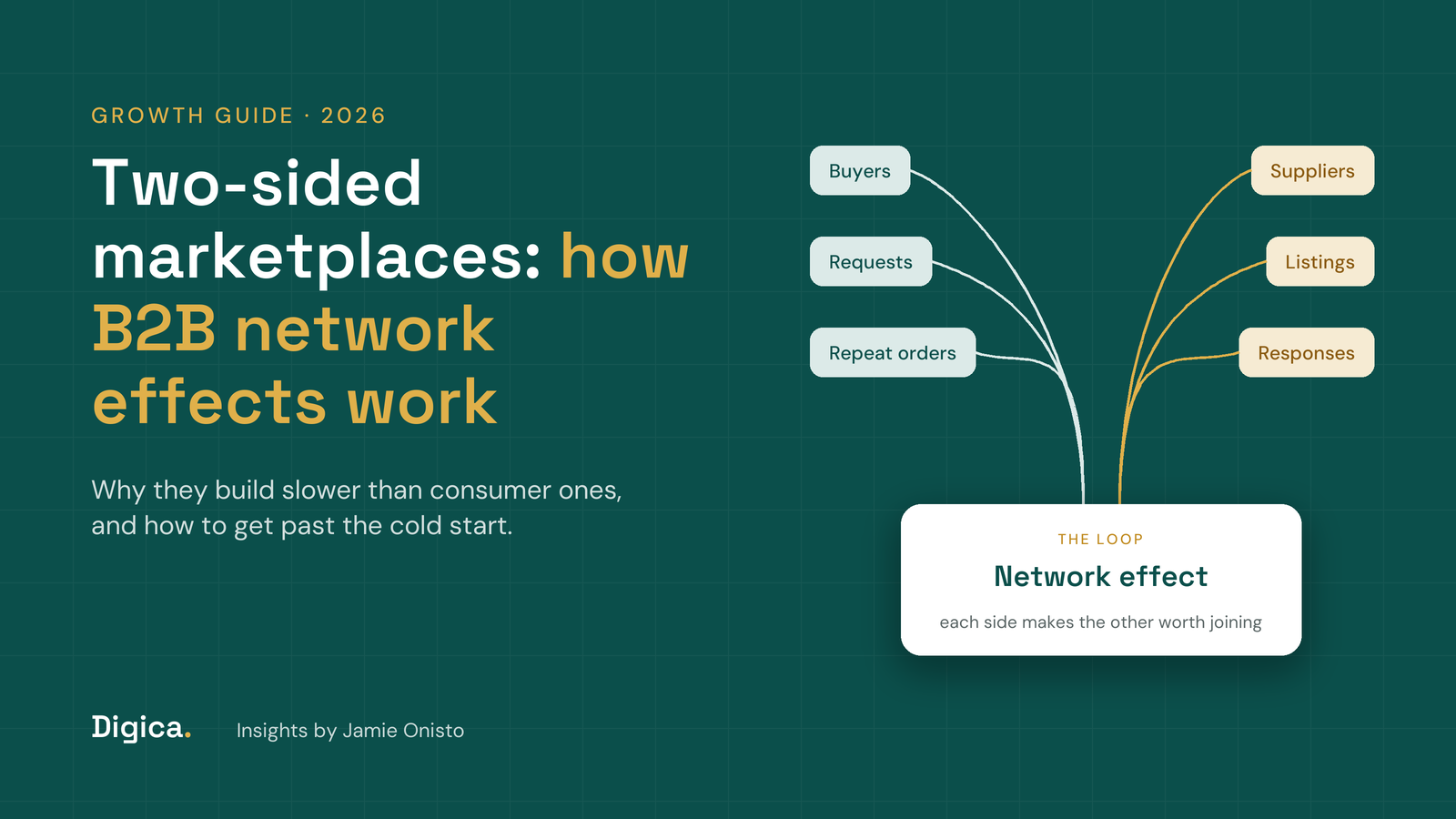
A two sided marketplace earns its keep when each new buyer makes the platform more valuable to sellers, and each new seller makes it more valuable to buyers. That loop is the network effect, and it is why investors pay a premium for marketplaces that have one. It is also why so many B2B marketplace founders are disappointed in year two. Liquidity Services, which runs surplus and government asset marketplaces, ended its 2025 fiscal year with 6.0 million registered buyers, up 9.5% in a year, and describes its model as a cycle in which buyers and sellers attract one another. Getting that cycle started is the hard part.
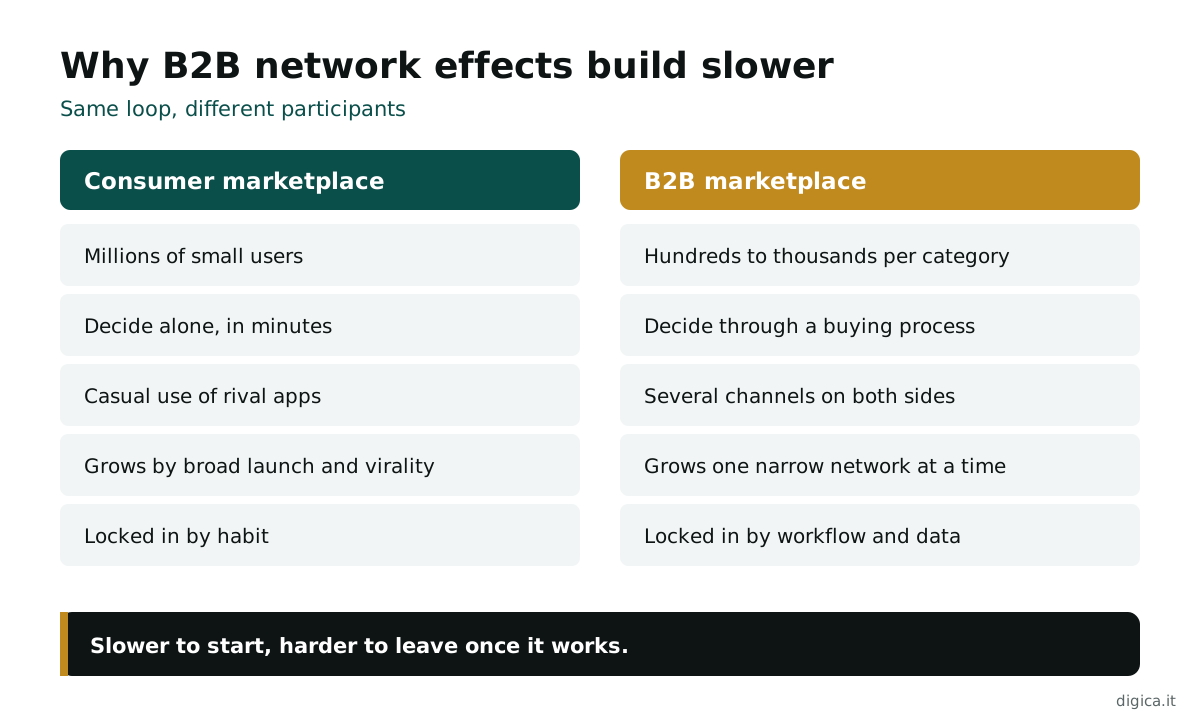
Consumer marketplaces taught a generation of founders to expect network effects to arrive quickly. In B2B they arrive slowly, because the participants are fewer and larger, each one decides through a buying process rather than on impulse, and most of them already use two or three other channels. None of that stops a B2B network effect from forming. It changes what you have to do to start it, and how long you should expect to wait.
This guide explains how network effects work in a two-sided B2B marketplace, why they build more slowly than consumer ones, how to get through the cold start problem, and which levers speed the loop up. It is written for founders and operators of B2B marketplaces, and draws on public filings and our own work, including a B2B agency marketplace that grew from five people to 40,000+ listed agencies and 1M+ monthly users. For the go-to-market side of the same question, read our guide to taking a B2B marketplace to market on both sides.
Quick Navigation
- What a two sided marketplace is
- How marketplace network effects work
- Why B2B network effects build more slowly
- The cold start problem in a B2B marketplace
- Five ways to speed up B2B network effects
- When network effects work against you
- Consumer and B2B network effects side by side
- Three failure scenarios
- Where to start: a decision framework
- What a working network effect is worth
- FAQ
- Related Articles
What a two sided marketplace is
The short answer: a two sided marketplace is a platform that serves two distinct groups, usually buyers and sellers, and makes money by helping them find and transact with each other. Its product is the match, not the inventory.
Harvard Business Review's classic article on the subject, by Thomas Eisenmann, Geoffrey Parker and Marshall Van Alstyne, describes two-sided networks as platforms that bring together two groups of users and can earn greater returns at scale than traditional value chains (Harvard Business Review). Their examples were credit cards and operating systems. The same logic now runs B2B marketplaces for wholesale vehicles, industrial surplus, freight, agency services and data.
What separates a two-sided platform from an online store is who holds the risk. A store buys stock and resells it. A two-sided B2B marketplace connects a buyer with a seller who owns the stock or delivers the service, and earns a fee, a subscription or both for making the connection work. That is why its growth depends on both groups at once. A store with no customers still has inventory. A B2B marketplace with no buyers has nothing to offer its sellers, and the sellers leave.
Our view: if you cannot name the two groups and the one thing each comes for, you do not yet have a two-sided marketplace. You have a directory waiting for a reason to be used.
How marketplace network effects work
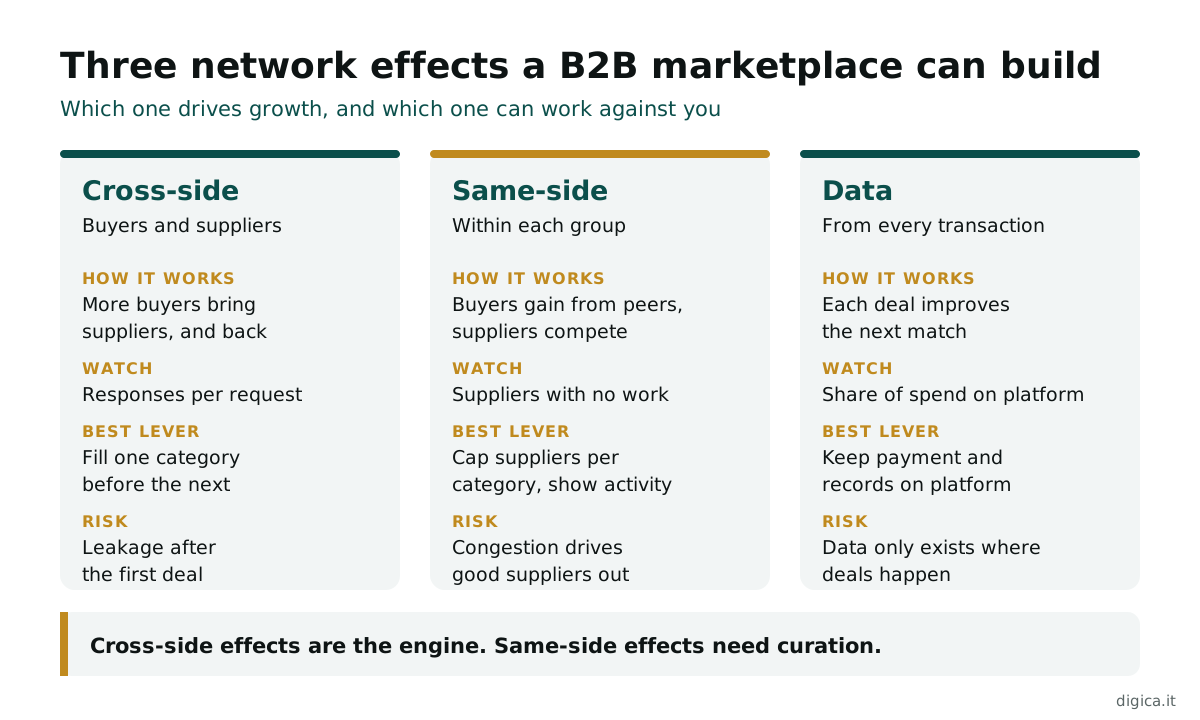
The short answer: marketplace network effects come in two kinds. Cross-side effects make the platform more valuable to one group as the other grows. Same-side effects change the value to a group as more of that same group joins, and in a B2B marketplace they are often negative.
Cross-side effects are the engine. More buyers posting requests means more reasons for suppliers to list and respond. More suppliers responding means buyers get answers faster and come back. Liquidity Services' 2025 annual report describes exactly this loop: buyers and sellers attract one another in greater numbers, which it calls a positive network effect. Its numbers show the asymmetry that is typical of B2B. Millions of registered buyers sit opposite thousands of sellers, and those 6.0 million buyers produced 4.1 million auction participants in the year.
Same-side effects need more care. A buyer can benefit from other buyers, for example when peers rate suppliers, or when a common standard makes a supplier easier to compare. Sellers, though, mostly compete with each other. Add twenty suppliers to a category with three large buyers and every supplier's chance of winning work falls. That is a negative same-side effect, and it is the reason supply growth without demand growth can make a B2B marketplace worse.
There is a third effect that matters more in B2B than in consumer markets: data. Every completed transaction tells the platform something about price, lead time, quality or fit. Used well, that data makes the next match better, which is a network effect of its own. It is also the hardest for a competitor to copy, because it only exists where the transactions happened.
Why B2B network effects build more slowly
The short answer: B2B network effects build slowly because there are fewer participants, each one is worth more and decides more carefully, and almost every one of them can use several channels at once. Each new member adds more value than a consumer user does, but each one takes longer to win.
Four forces slow the loop down.
- Fewer, larger participants. A consumer platform can add thousands of users a day. A B2B marketplace may have a few hundred buyers who matter in a category. Each one brings real volume, but a network of a few hundred has far less room for the random, overlapping connections that make consumer networks feel alive.
- A buying process, not a click. A business buyer often needs a supplier approved, a contract checked or a budget confirmed before the first order. The marketplace has to fit that process, or the buyer browses and then orders elsewhere.
- Multi-homing. Sellers list on several platforms and keep their own sales team. Buyers keep their existing suppliers. Andreessen Horowitz argues that this kind of overlap and low switching cost weakens network effects, using employers that recruit across several hiring platforms as an example.
- Leakage. Once a buyer and a seller have met and worked together, both have a reason to transact directly next time. RB Global's 2025 annual report names this risk plainly: some customers, including large fleet owners, may seek private sales instead of third-party transaction solutions.
None of this is a reason to give up on network effects in B2B. It is a reason to measure them differently. A consumer founder watches daily signups. A B2B founder should watch what share of buyers return, and what share of each buyer's spend moves onto the platform. ACV, a digital wholesale vehicle marketplace for dealers, grew units 12% in 2025 partly by increasing its share of wholesale transactions from existing customers, alongside new dealer partners. That is what a B2B network effect looks like when it works: depth before breadth.
The cold start problem in a B2B marketplace
The short answer: the cold start problem is the period before a two-sided marketplace has enough participants on both sides for either side to find it useful. In B2B it is usually solved by winning one small, complete network first, not by launching wide.
Andrew Chen, who wrote a book on the subject, calls that first unit the atomic network: the smallest network that can stand on its own. He also separates every network into an easy side and a hard side, where the hard side is a minority of users who create disproportionate value and are harder to win and keep. In most B2B marketplaces the hard side is the buyers with budget, or, in services, the best suppliers.
The atomic network in B2B is usually defined by category and region together. Not "industrial parts", but hydraulic components for food plants in one country. Not "agencies", but B2B software agencies for companies of a certain size. The test is simple: when a buyer in that slice posts a request, do enough relevant suppliers respond, fast enough, that the buyer would come back? If yes, you have a network. If not, you have a list.
Stuck in the cold start of a B2B marketplace?
In 30 minutes we look at which side of your marketplace is the hard side, where your first complete network could be, and what we would do first to fill it.
Cold start in B2B also has an advantage that consumer founders do not get. Because each participant is valuable, it is worth winning them one at a time. A founder can call the twenty suppliers that matter in a niche, sign them by hand and bring the first buyers to them directly. That is slow, and it does not scale, but it does not need to. It only needs to last until the atomic network fills.
Five ways to speed up B2B network effects
The short answer: you cannot skip the slow part, but you can shorten it. Five levers work repeatedly in B2B: a useful tool for one side, supply recruited by hand, a narrow first network, subsidy for the hard side and services that keep transactions on the platform.
- Give one side a reason to come before the network exists. A B2B marketplace that offers suppliers a useful tool, such as a storefront, quoting software or inventory management, can sign them up before buyers arrive. OPENLANE's 2025 annual report shows how far this goes at scale: alongside about 1.5 million vehicle transactions, it earned $257.1 million from software and other services.
- Recruit supply by hand. The first suppliers in a B2B marketplace rarely arrive from ads. They arrive because someone explained why the platform will send them work. Our guide on how to attract vendors to a B2B marketplace covers the order to approach them in.
- Fill one network before opening the next. Launch in the narrowest category where you can reach liquidity, then expand to adjacent categories that share buyers or suppliers. Each full network makes the next one easier to start.
- Subsidize the hard side. HBR's two-sided market research describes pricing one side low, the subsidy side, so the other side, the money side, has a reason to pay. In B2B that often means free listings for suppliers until demand arrives, or free requests for buyers with fees charged on completion.
- Bundle services that only work on the platform. Inspection, logistics, payment protection and financing remove friction from the deal and give both sides a reason not to take it offline. OPENLANE's annual report says that liquidity, and the breadth and selection of inventory, are essential to its sellers and buyers, and it adds floorplan financing for dealers on top.
Organic search is the lever that runs underneath all five. Every category and supplier page that ranks brings buyers who did not cost anything to acquire, and those buyers make the platform more valuable to suppliers. NFX, which has studied network effects across hundreds of companies, catalogs the different kinds and how each one compounds (NFX). Search does not create a network effect on its own, but it feeds the cross-side loop at a cost that falls over time. A water and wastewater marketplace we worked with reached 10x+ organic impressions within six months, which is the kind of demand that gives hand-recruited suppliers their first reason to stay.
When network effects work against you
The short answer: network effects can stall or reverse. In B2B the three usual causes are supply growing faster than demand, deals moving off the platform once trust is built, and participants splitting their activity across rival platforms.
Congestion is the first. If a category fills with suppliers who receive no requests, the good ones stop logging in and buyers see slower, weaker responses. The fix is curation: fewer, better suppliers per category until demand catches up, and clear signals of which suppliers are active.
Leakage is the second, and it is a trust problem in disguise. Research by Grace Gu and Feng Zhu in Management Science, based on a randomized experiment on a freelance platform, found that stronger trust helped clients find better freelancers but, past a point, increased transactions made off the platform. In other words, the platform that does the best job of introducing two businesses can lose the second deal between them. The answer is to keep earning the second transaction, through payment protection, records, repeat ordering tools or financing, rather than to hide contact details.
Multi-homing is the third. A supplier listed on three B2B marketplaces gives each one a third of its attention. A buyer with an approved supplier list uses the marketplace only for what the list does not cover. Neither habit will change because a platform asks. It changes when one platform is clearly the best place to win or fill a particular kind of request, which takes us back to depth in a narrow category.
Is your B2B marketplace leaking its second transaction?
A growth audit maps where your buyers and suppliers come from, where repeat demand goes after the first match, and which pages and channels could bring more of it back to the platform.
Watch for all three in the same report. Responses per request, repeat transactions between the same pairs, and the share of each supplier's work that comes through you tell you whether the loop is getting stronger or quietly running in reverse. Report them by category every month, next to supplier and buyer counts, so a rising headcount never hides a weakening loop.
Consumer and B2B network effects side by side
The short answer: consumer and B2B network effects follow the same logic but differ in nearly every number. B2B networks are smaller, slower to start, harder to leave once they work, and more exposed to leakage.
Consumer and B2B two-sided marketplaces compared on participants, cost to win each one, time to liquidity, main risk and what to build first
| Dimension | Consumer marketplace | B2B marketplace |
|---|---|---|
| Participants who matter | Thousands to millions | Hundreds to thousands per category |
| Cost to win each participant | Low, mostly paid and viral | High, often sales led and hand recruited |
| How a buyer decides | Individually, in minutes | Through a buying process, in weeks |
| Time to liquidity in a category | Weeks to months | Months to years |
| Multi-homing | Common but casual | Standard practice on both sides |
| Main risk | A rival with more users | Leakage after the first deal |
| Best for growth | Broad launch, viral loops | One narrow network, then adjacent ones |
| What locks the network in | Habit and convenience | Workflow, data, payment and records |
The last row is the reason B2B network effects are worth the wait. Once a buyer's approvals, records and repeat orders run through a platform, switching costs are real. A consumer can delete an app in a second. A procurement team rarely rebuilds its supplier workflow on a whim.
Three failure scenarios
These are the patterns we see most often when founders expect consumer-speed network effects from a B2B marketplace.
- The national launch with no complete network. A construction materials B2B marketplace launches in every region at once with 2,000 suppliers and a paid campaign for buyers. Requests arrive in 40 categories and regions, and most get one response or none. Buyers do not come back, and suppliers who received nothing stop answering. Launching in one region and five categories, with suppliers recruited by hand, would have produced a network buyers returned to, at a fraction of the spend.
- The supply count that hid congestion. A services B2B marketplace celebrates passing 5,000 listed providers. Response rates fall, because most providers receive no work and stop logging in, and the best ones are the first to leave. Capping suppliers per category and featuring active ones would have kept response quality high while demand caught up.
- The introduction business. A B2B marketplace for industrial services matches buyers with contractors and charges a fee on the first job. Repeat work moves to direct invoices, and gross transaction value stalls after the first year. Adding payment protection, job records and repeat ordering that only work on the platform would have given both sides a reason to keep the second job there.
Each team had a real two sided marketplace. None of them measured the loop in the place where B2B networks break.
Where to start: a decision framework
The short answer: start from the side that is hardest to win, the slice of the market where you can fill a network fastest, and the metric that shows the loop is working.
- If fewer than half of buyer requests in a category get a useful response within two working days, stop adding categories and recruit suppliers into that one.
- If suppliers outnumber active buyers by more than ten to one in a category, stop recruiting suppliers there and point demand generation at it.
- If more than 30% of repeat business between the same pairs leaves the platform, add services that only work on the platform, such as payment protection, records or financing, before raising fees.
- If your hard side is suppliers, give them a tool or free listing that is useful before buyers arrive, and sign the first twenty by hand.
- If your hard side is buyers, put organic search and content behind one category until it fills, then expand to the adjacent one.
- If a category fills reliably for two quarters, open the next category that shares the same buyers or suppliers.
The thresholds are starting points from our own work, not industry standards. Set your own once you have six months of data, and review them every quarter. Our guide to liquidity, the only marketplace metric that compounds explains how to measure response and fill rates by category.
Want the loop running in your B2B marketplace?
Our marketplace liquidity work finds the categories where supply and demand already meet, and fills them first, with your own team and inside your roadmap.
A narrow start also gives you cleaner numbers. One category, one region and a few hundred participants are easy to measure. You can see which requests went unanswered, which suppliers never responded and which buyers came back. That is the evidence the next category, and the next funding round, will be built on. Our B2B marketplace growth strategy shows how this first network fits the wider plan.
What a working network effect is worth
The short answer: a working network effect is worth the acquisition spend you no longer need. Once each side attracts the other, every buyer you win makes the next supplier cheaper to win, and the other way around.
Chen notes that Slack's atomic network was under ten people in a single company (Lenny's Newsletter). B2B marketplace networks are bigger than that, but the principle holds: the first complete network is small, and everything after it is cheaper. Public B2B marketplaces show where that leads. OPENLANE handled $28.8 billion of gross merchandise value in 2025, ACV $10.4 billion and Liquidity Services $1.6 billion. None of them reached that scale by launching wide.
Run the numbers on a typical case. Suppose a B2B marketplace spends $400 to win each new supplier through sales effort. If buyer demand in a category reaches the point where half of new suppliers arrive on their own, the blended cost falls to $200. At 500 new suppliers a year, that is $100,000 saved annually, and the sales effort behind the first 250 pays back faster, before counting the buyers who return because responses improved. The figures are illustrative, but the logic holds: the saving comes from the loop, not from a cheaper channel.
That is what we mean by leads and organic growth from the same engine. One engine, two outputs: qualified leads this quarter, organic growth that keeps paying after. The number to take into your next board meeting is the share of new suppliers, and new buyers, who arrived without paid acquisition. If it is rising, your network effect is real. The biggest cost of doing nothing is paying full price for both sides indefinitely, on a platform that never fills one network completely.
FAQ
What is a two sided marketplace? A two sided marketplace is a platform that serves two distinct groups, usually buyers and sellers, and earns money by helping them find and transact with each other. Examples in B2B include wholesale vehicle marketplaces such as OPENLANE and ACV, and surplus asset marketplaces such as those run by Liquidity Services.
What are marketplace network effects? Marketplace network effects are the ways a platform becomes more valuable as more people use it. Cross-side effects make it more valuable to buyers as sellers join and to sellers as buyers join. Same-side effects change the value to a group as more of that group joins, and data effects improve matching with every transaction.
Why are network effects slower in B2B marketplaces? B2B marketplaces have fewer, larger participants who decide through a buying process, use several channels at once and can move repeat deals off the platform. Each participant adds more value, but each one takes longer to win and keep.
What is the cold start problem? The cold start problem is the early stage when a marketplace or network does not yet have enough participants on both sides for either side to find it useful. Most B2B marketplaces solve it by filling one small, complete network, a single category and region, before expanding.
How do you solve the cold start problem in a B2B marketplace? Pick the narrowest category and region where you can reach liquidity, recruit the first suppliers by hand, give the hard side a reason to join before the network exists, and bring buyers to that one category until requests are reliably filled.
What is the difference between direct and indirect network effects? Direct, or same-side, network effects occur when users benefit from more users like themselves. Indirect, or cross-side, network effects occur when one group benefits from growth in another group, such as buyers benefiting from more suppliers. Two-sided marketplaces depend mainly on cross-side effects.
Can a B2B marketplace lose its network effect? Yes. Network effects can stall or reverse when supply grows faster than demand, when buyers and sellers move repeat deals off the platform, or when participants split their activity across rival platforms. Tracking response rates, repeat transactions and share of spend shows it early.
Related Articles
- B2B marketplace growth consulting
- B2B marketplace growth strategy: what works in 2026
- Marketplace go-to-market when both sides are customers
- Liquidity is the only marketplace metric that compounds
- How to attract vendors to a B2B marketplace
- How to build a B2B marketplace: the order that works
- Marketplace metrics: GMV, take rate and core KPIs
Where this connects
This article is part of our B2B marketplace growth series. Browse more on the Digica blog.