How to build a B2B marketplace: the order of work that gets it to liquidity
Most founders who ask how to build a B2B marketplace are really asking what to build first. The honest answer is less software than they expect. A B2B marketplace with 40 suppliers who answer every buyer request inside a day is worth more than one with 4,000 imported listings and a feature roadmap. We have watched the same pattern play out from the inside: a B2B agency marketplace that grew from five people to 40,000+ listed agencies and 1M+ monthly users did it in a particular order, and the order mattered more than the code.
The pattern is not ours alone. Lenny Rachitsky interviewed founders and early employees of 17 consumer and B2B marketplaces and found that, with one exception, every one of them constrained its initial market before it grew (Lenny's Newsletter). Going small first is not caution. It is how the big ones got big.
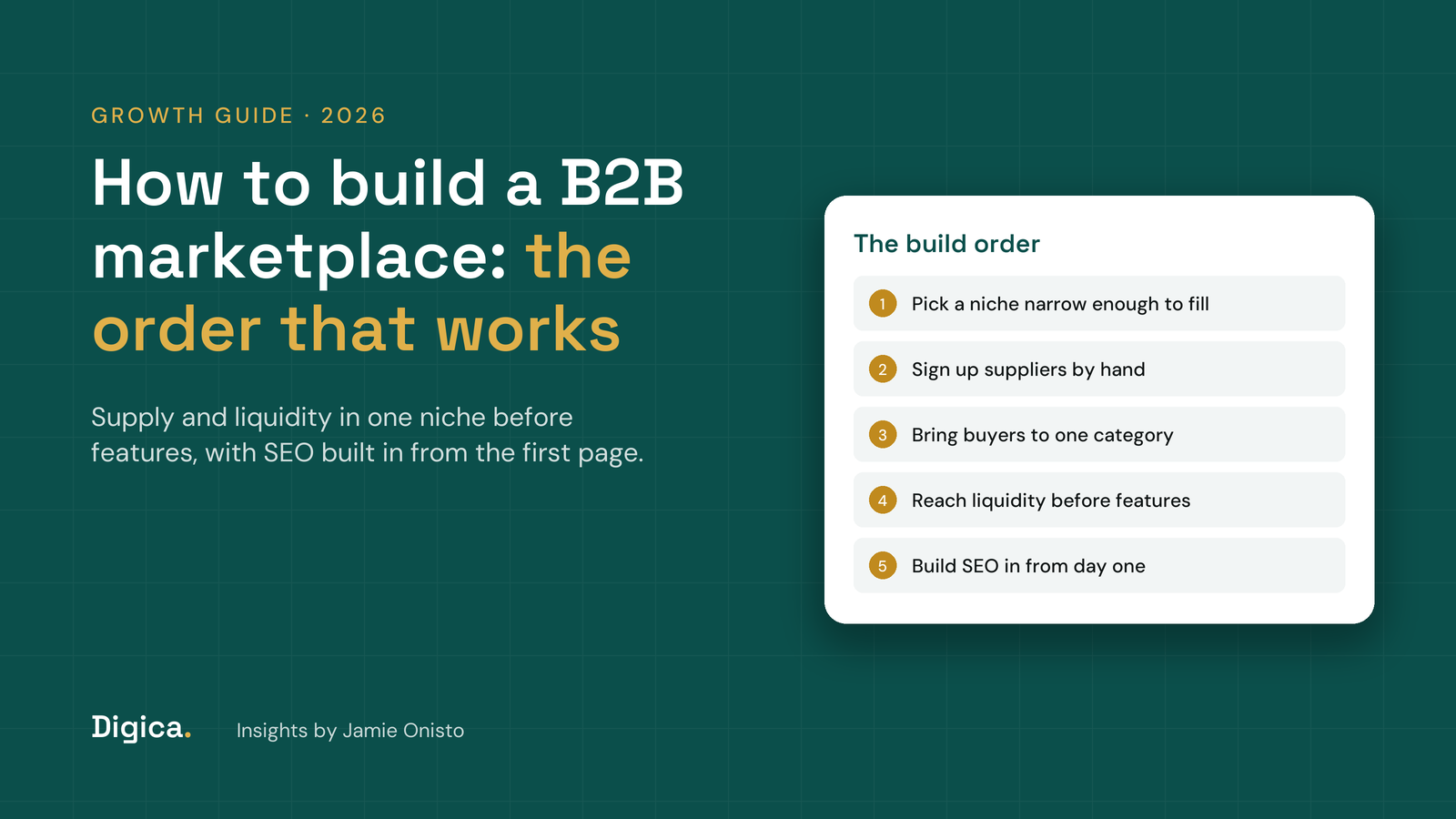
This guide sets out the order of work that gets a new B2B marketplace to liquidity: a niche narrow enough to fill, suppliers signed by hand, demand pointed at one category, enough matches before more features, and SEO built in from the first page. It is written for founders and operators starting a B2B marketplace, and for teams relaunching one that never took off. For what comes after launch, see our stage-by-stage guide to growing a B2B marketplace.
Quick Navigation
- Why the order decides more than the build
- Step 1: pick a niche narrow enough to fill
- Step 2: sign up your first suppliers by hand
- Step 3: bring buyers to one category, not the whole site
- Step 4: reach liquidity before you add features
- Step 5: build SEO in from the first page
- How to create a B2B marketplace without overbuilding
- The build order, side by side
- Three failure scenarios
- How to start a B2B marketplace: a decision framework
- What getting the order right is worth
- FAQ
- Related Articles
Why the order decides more than the build
The short answer: a B2B marketplace is only useful once buyers reliably find what they came for, and every step before that point either moves you toward it or delays it. Building features first delays it. Building supply in one niche first moves you toward it.
Founders usually start where their skills are. A technical founder builds the platform: profiles, search, messaging, payments, reviews. A commercial founder builds a brand and a launch. Both are real work, and both come before the thing that makes a B2B marketplace worth visiting, which is supply a buyer can act on. Six months later the site is finished, the category list is long, and every category is thin.
The pattern is common because the build is visible and supply is not. A finished platform can be demoed to investors. Sixty signed suppliers in one category cannot be screenshotted. But buyers do not judge the platform. They judge whether their first search returns a supplier who replies.
Our view is blunt: the platform is the cheapest part to get right and the most expensive part to get wrong early. Software can be bought, configured or rebuilt. A reputation with your first 200 buyers, who arrived and found nothing, cannot. Our guide to B2B marketplace software covers the build, buy or white-label choice once you know what the first transactions need.
Step 1: pick a niche narrow enough to fill
The short answer: pick the smallest category where buyers have a frequent, painful search problem and suppliers want more customers, then make your B2B marketplace the best place for that one category before adding a second.
Narrow is a supply decision, not a branding one. A category is narrow enough when you can list most of the suppliers worth listing in it within a few months, by name. "Industrial services" is not a niche. "Calibration labs for medical device makers in the Midwest" might be. The narrow version lets a small team cover the category properly, and coverage is what buyers judge you on.
Three tests help. Is there a buyer search with real volume that today's results answer badly? Are there enough suppliers to give buyers a choice, but few enough to recruit one by one? And do those suppliers already pay for leads somewhere else, through trade shows, directories or sales staff? A yes to all three is a niche worth starting with.
Starting a B2B marketplace and unsure which niche to open with?
In 30 minutes we look at your category, the searches buyers already make and the suppliers you could sign first, and tell you what we would do first, and whether we are the right people to do it.
The trade-off is the size of the opening story. Investors and co-founders like a big total addressable market. The answer is to show the sequence: the first niche, the adjacent ones it unlocks and the order you will take them in. Every large B2B marketplace we know of started narrower than its current name suggests, and our B2B marketplace growth strategy explains why vertical depth comes before horizontal reach.
Step 2: sign up your first suppliers by hand
The short answer: recruit the first 30 to 100 suppliers yourself, one conversation at a time, and make each listing complete before you go looking for buyers. Bulk imports fill a database. Hand-signed suppliers fill a B2B marketplace.
Imported listings look like progress. A scraped list of 5,000 companies makes every category look full on launch day. But imported suppliers have not agreed to anything. They do not answer requests, their details go stale, and buyers who contact them hear nothing back. The first buyers learn that your B2B marketplace does not work, and they rarely come back to check again.
Hand-signed suppliers are different. They have a login, a complete profile, a reason to reply and a person at your company who will call if they do not. In our experience of growing a B2B agency marketplace from five people to 40,000+ listed agencies, the listings that carried the business were the ones whose owners had a reason to keep them current. Volume came later, on top of that base.
What do suppliers actually sign up for? Leads they could not get elsewhere, visibility in searches they cannot rank for on their own, and proof they can show their own clients. Our guide on how to attract vendors to a B2B marketplace goes step by step through the offer, the first 50 vendors and the first 30 days, and vendor onboarding covers turning a signup into a live listing.
The cost is founder time. Signing 100 suppliers by hand can take a quarter of focused work. It is still the cheapest supply you will ever acquire, because it teaches you what suppliers want, which becomes the self-serve signup flow you build later.
Step 3: bring buyers to one category, not the whole site
The short answer: point every early buyer at the one category you have filled. Demand spread across a full site lands mostly on empty pages, and demand concentrated on one category produces the matches that prove the model.
The instinct at launch is to announce everything: a homepage that covers the whole industry, paid campaigns for every category, a press release about the big vision. Each visitor then lands somewhere random. If 80% of categories are thin, roughly 80% of first impressions are bad ones, and you paid for each of them.
Concentrated demand works the other way. Every channel in the first months points at the category you can serve: the searches buyers already make there, the trade associations and communities where those buyers gather, direct outreach to the companies you know need it. A few hundred buyers who find good suppliers tell you more than 10,000 visitors who bounce.
This matters more in B2B than anywhere else. The a16z marketplace glossary notes that B2B marketplaces are typically constrained by sales, and that most marketplaces fail because they never reach or maintain liquidity (a16z). Concentrated demand is how a small team gets enough sales conversations into one category to reach it.
The trade-off is slower top-line traffic. A narrow launch looks small on a dashboard. It is meant to. Traffic you cannot convert is a cost, not an asset, and the demand generation work that scales later is built on the conversion data the narrow launch gives you.
Step 4: reach liquidity before you add features
The short answer: liquidity is the share of buyer requests or listings that end in a match or a transaction, and it is the test of whether a B2B marketplace works. Until your first category is liquid, new features mostly decorate a problem they cannot fix.
Liquidity is two numbers, not a feeling. On the buyer side, how many requests get a useful reply, and how fast. On the supplier side, how many listings get enquiries worth answering. Set a threshold for each in your first category, measure it weekly and treat it as the gate for everything else. Our guide to why liquidity is the only marketplace metric that compounds covers how to measure it and the volumes where a B2B marketplace starts to behave like one.
Features earn their place when they remove a specific reason a match did not happen. If buyers do not reply because they cannot compare suppliers, structured profiles and comparison help. If suppliers miss requests, notifications and response tracking help. If deals fall through at payment, payments help. A feature with no named failure behind it is roadmap filler, however good it looks in a demo.
This is also where many teams start to charge too early. A take rate or subscription added before liquidity makes suppliers leave the B2B marketplace at exactly the moment you need them to stay. Our guide to marketplace business models covers when and how to charge without stalling growth.
Step 5: build SEO in from the first page
The short answer: decide your page architecture, URLs and what search engines can see before you launch, because these are hard to change once thousands of pages exist. SEO built in from day one costs little. SEO repaired in year two costs a rebuild.
A B2B marketplace grows organically through pages its suppliers fill: categories, categories by location, supplier profiles and comparisons. The decisions that matter are made at build time. Does every category and profile have its own clean URL? Do pages arrive as finished HTML that a crawler can read, or as an empty shell that fills in later with JavaScript? Do filters create millions of duplicate URLs? Do empty categories go live, or wait until they hold enough suppliers?
Filters are the classic trap. Ten filters on every category can turn a few hundred pages into millions of near-identical URLs, and a B2B marketplace can create that problem before its first buyer arrives. Deciding which filter combinations deserve their own page, and which stay out of the index, is a one-time decision at build time.
The rule we use is to publish a page when supply can fill it. Launch with the categories your hand-signed suppliers cover, keep the rest out of the index until they are ready and add them as supply grows. Our guide to how B2B marketplaces reach 1M monthly organic visitors shows what that discipline compounds into, and category page SEO covers the pages that carry the most weight.
Have you checked whether your staging site is readable by a crawler with JavaScript turned off? It takes ten minutes, and it is the cheapest SEO audit you will ever run.
How to create a B2B marketplace without overbuilding
The short answer: build the minimum that lets a buyer find a supplier, contact them and come back, and do the rest by hand until volume makes it painful. Manual work in the first months is a feature, because it shows you what to automate.
The first version of most successful B2B marketplaces is mostly profiles, search within one category, a request or contact form and an email to the supplier. Matching can be done by a person. Payments can run through invoices. Reviews can be collected by asking. Each manual step is a chance to learn what buyers and suppliers actually need before you spend on building it.
What should not be manual, even on day one, is anything that determines how search engines and buyers see the site: URLs, page templates, structured supplier data and the rules for which pages get published. Those are cheap to set up early and expensive to change later. The work we brief for marketplace platform builds starts there, with the client's own developers usually building from it.
Building or relaunching a B2B marketplace?
A growth audit checks your build before it hardens: which pages search engines and AI crawlers can read, which categories your supply can fill, and what to fix before launch rather than after.
The trade-off is that manual work does not scale, and it should not have to. The point at which a manual step becomes a bottleneck is the signal to automate it, and by then you know exactly what the automation must do. Founders who automate first spend months building for buyers and suppliers they have not met. Founders who wait build the right thing once, with real usage data behind every decision, and usually spend less doing it.
The build order, side by side
The short answer: each step has a signal that tells you it is done, and moving on before that signal appears is the most common reason a new B2B marketplace stalls.
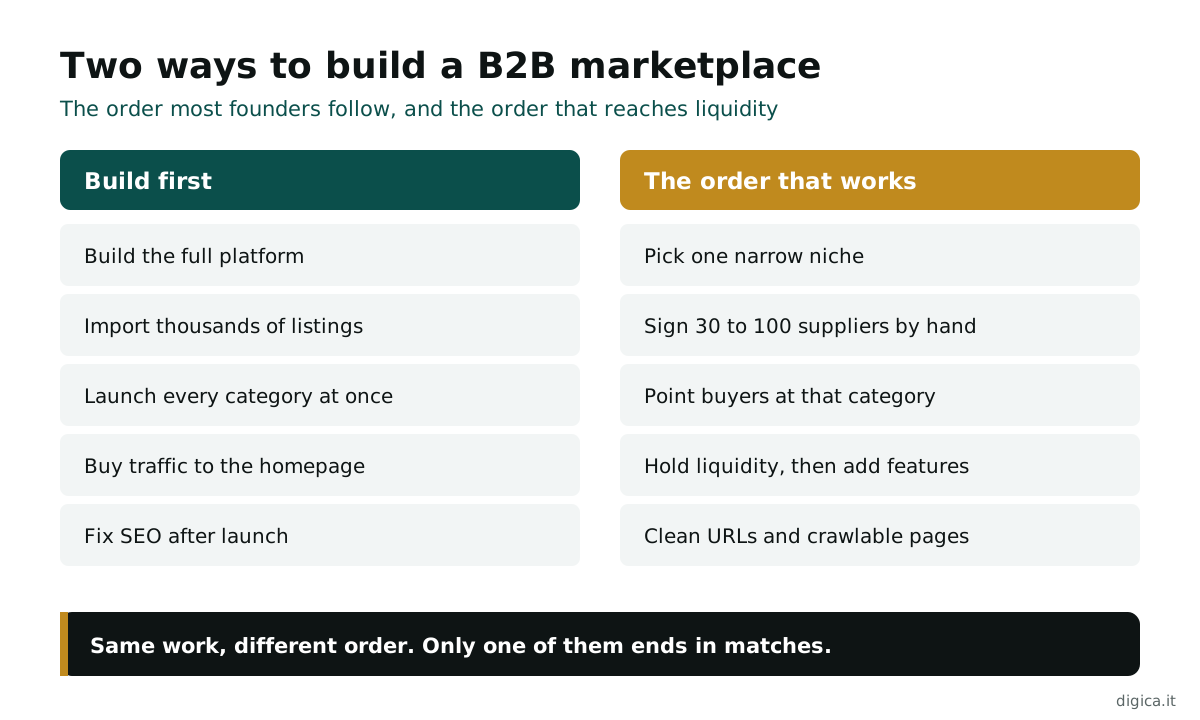
Five steps to build a B2B marketplace compared on what you do, main cost, signal to move on, main risk and when it matters most
| Step | What you do | Main cost | Signal to move on | Main risk | Best for |
|---|---|---|---|---|---|
| Narrow niche | Pick one category with a real buyer search | Founder research time | You can name most suppliers worth listing | Choosing a niche too small to grow from | Every new B2B marketplace, first |
| Hand-signed supply | Recruit 30 to 100 suppliers one by one | A quarter of founder or team time | Complete, responsive profiles in one category | Imported listings that never reply | Categories where trust decides the deal |
| Concentrated demand | Point every channel at the filled category | Content, outreach and some paid tests | Buyers who find a supplier and return | Spreading traffic across empty pages | Launch and the first two quarters |
| Liquidity first | Measure matches weekly, fix what blocks them | Operations time, light tooling | Your match threshold holds for 8 to 12 weeks | Features and fees added before it holds | Any B2B marketplace before a second category |
| SEO from day one | Clean URLs, crawlable pages, publish rules | Developer time, once | Pages indexed as supply fills them | Thousands of thin or uncrawlable pages | B2B marketplaces that will rely on search |
The thresholds are the ones we use as starting points, not industry standards. The order is the part to keep. SEO sits last in the table because its payoff shows last, but the decisions behind it belong in the first build, which is why the fifth step overlaps all the others.
Three failure scenarios
These are the patterns that recur when founders build a B2B marketplace in the wrong order.
- The platform that launched empty. A founding team spends nine months and most of a seed round building profiles, messaging, payments and reviews for an equipment rental B2B marketplace across 60 categories. On launch day 12 suppliers are live, spread thin, and buyers find nothing in the categories they search. The same team spending three of those months signing 80 suppliers in one category, on a simple site, would have had matches in the first quarter and a clear brief for the real build.
- The import that taught buyers to leave. A sourcing B2B marketplace scrapes 20,000 supplier records to look full at launch. Buyers send requests that nobody answers, and reply rates fall below one in ten. The team then has to win back buyers who have already decided the site does not work. Starting with 200 claimed, complete profiles would have looked smaller and performed far better.
- The rebuild nobody planned. A services B2B marketplace grows to 3,000 suppliers on a single-page app where search engines see almost no content and filters generate endless duplicate URLs. Organic traffic stays flat for two years, and the fix is a rebuild of the front end. Deciding URLs, rendering and publish rules at the start would have cost a few weeks of developer time.
The third scenario is the most avoidable. Google's own guidance warns that faceted navigation can generate infinite URL spaces, and that when crawling is spent on useless URLs, crawlers have less time for new, useful ones (Google Search Central).
Each team worked hard. None of them chose a bad idea. They chose a bad order.
How to start a B2B marketplace: a decision framework
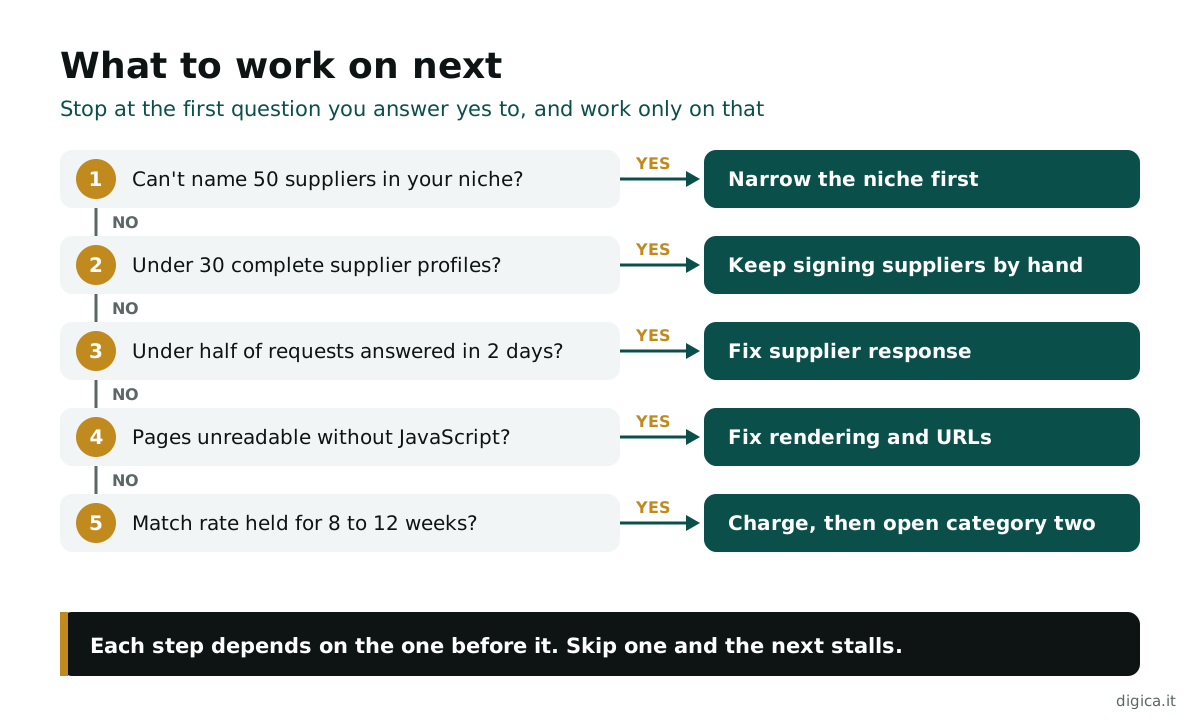
The short answer: find the first step on this list that is not yet done, and work only on that. Each later step depends on the one before it.
- If you cannot name 50 suppliers in your first category, your niche is too wide or too thin. Narrow it or pick another before building anything.
- If fewer than 30 suppliers have complete, claimed profiles, keep signing suppliers by hand. Do not launch publicly yet.
- If buyers arrive but fewer than half of their requests get a useful reply within two working days, fix supplier response before adding buyers or features.
- If your match threshold has held for 8 to 12 weeks in the first category, start charging, automate the manual steps that hurt most and plan the adjacent category.
- If search engines cannot read your category and supplier pages as finished HTML, fix it now, whatever stage you are at. It only gets more expensive.
- If all of the above hold, open the next category, and repeat the order there.
Want help with the first steps, not just the build?
Our B2B marketplace growth consulting covers the order that works: the niche, the first suppliers, the first buyers and the pages search engines and AI assistants read, with your own team building from our brief.
Revisit the list every month in the first year. Founders tend to treat it as a one-time plan, but the right next step changes as supply, demand and the site grow. The most common mistake we see is a team working on step five while step three is still broken, because step five is more interesting to build. The framework is deliberately boring. Its value is that it stops a small team from spreading itself across five problems at once.
What getting the order right is worth
The short answer: the right order is worth the months and money you do not spend building for a B2B marketplace nobody uses yet. It also decides whether the supply you sign stays long enough to compound.
Run the numbers on a typical start. Suppose a founding team of four costs $50,000 a month in salaries and contractors. Nine months spent building features before suppliers are signed costs $450,000 before the first real match. Three months of hand-signing suppliers in one category, on a simple site, costs $150,000 and produces the evidence, the supplier relationships and the brief for the platform that follows. The difference, $300,000, is runway a seed-stage company rarely gets back.
The upside compounds the other way. Hand-signed suppliers in a liquid category become the base that the next category, the SEO architecture and later the paid programmes are built on. That is what we mean by leads and organic growth from the same engine. One engine, two outputs: qualified leads this quarter, organic growth that keeps paying after.
The number to take into your next board or investor conversation is months to liquidity in the first category, not features shipped. If you can cut that from nine months to four, you save roughly five months of burn, $250,000 at $50,000 a month, and you raise the next round on evidence instead of a roadmap. Three months of hand-signing pays back inside the first two quarters if it moves liquidity forward by even that much. The biggest cost of doing nothing is a finished platform with empty categories, and buyers who have already decided it does not work.
FAQ
How do you build a B2B marketplace from scratch? Start with one narrow category, sign up the first 30 to 100 suppliers by hand, point every early buyer at that category and measure how many requests end in a match. Build features only when they remove a specific reason matches fail, and set up clean URLs and crawlable pages from the first release.
How do you start a B2B marketplace with no suppliers? Recruit them directly before you launch to buyers. Pick suppliers who already pay for leads elsewhere, offer them visibility and qualified requests they cannot get on their own, and complete their profiles with them. Do not import scraped listings to look full.
Should a B2B marketplace start with supply or demand? Supply, in most cases. Buyers judge a B2B marketplace on whether they find a useful supplier on their first visit, so the first category needs complete, responsive supply before demand is pushed toward it.
How long does it take to build a B2B marketplace? A simple first version can launch in weeks if it focuses on profiles, search in one category and a request form. Reaching liquidity in that first category usually takes months of supplier recruitment and buyer acquisition, and that, not the software, decides the timeline.
What features does a B2B marketplace need at launch? Supplier profiles with structured data, search or browse within one category, a way for buyers to contact or request quotes, and notifications that get suppliers to reply. Payments, reviews, advanced matching and dashboards can follow once volume shows which ones matter.
When should a new B2B marketplace start SEO? On day one. URLs, page templates, rendering and the rules for which pages get published are cheap to decide before launch and expensive to change after thousands of pages exist. Content and authority work can scale later.
How do B2B marketplaces make money at the start? Most wait until the first category is liquid, then charge suppliers through subscriptions, lead fees or a commission on transactions. Charging before matches are reliable tends to drive away the suppliers a new B2B marketplace needs most.
Related Articles
- B2B marketplace growth consulting
- B2B marketplace growth strategy: what works in 2026
- How to grow a B2B marketplace: a stage-by-stage guide
- How to attract vendors to a B2B marketplace
- Liquidity is the only marketplace metric that compounds
- B2B marketplace software: build, buy or white-label?
- How B2B marketplaces reach 1M monthly organic visitors
- Marketplace business models: how B2B platforms make money
Where this connects
This article is part of our B2B marketplace growth series. Browse more on the Digica blog.